Publication: J. Linn. Soc., Bot. 22: 503 (1887)
Description
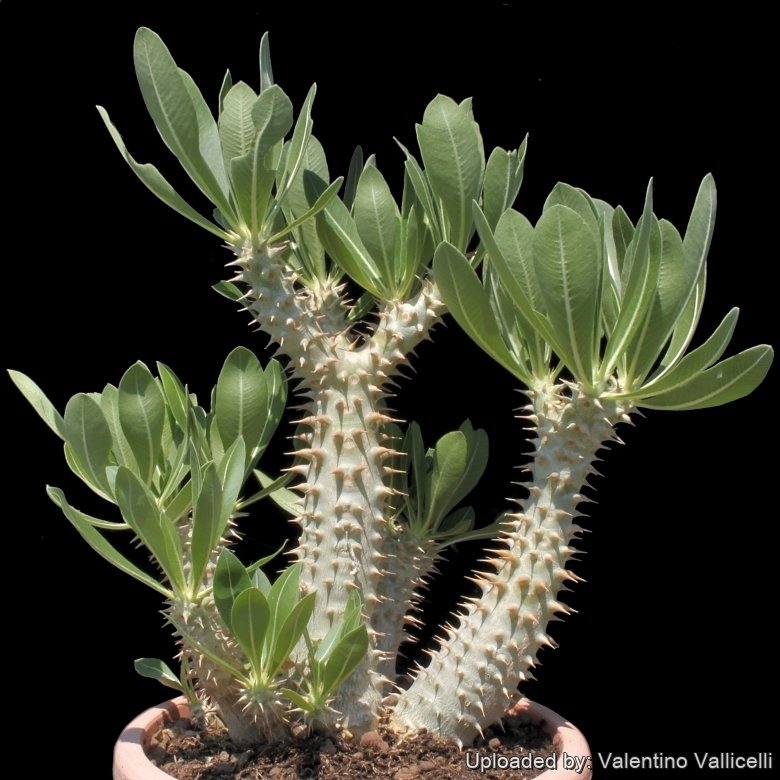
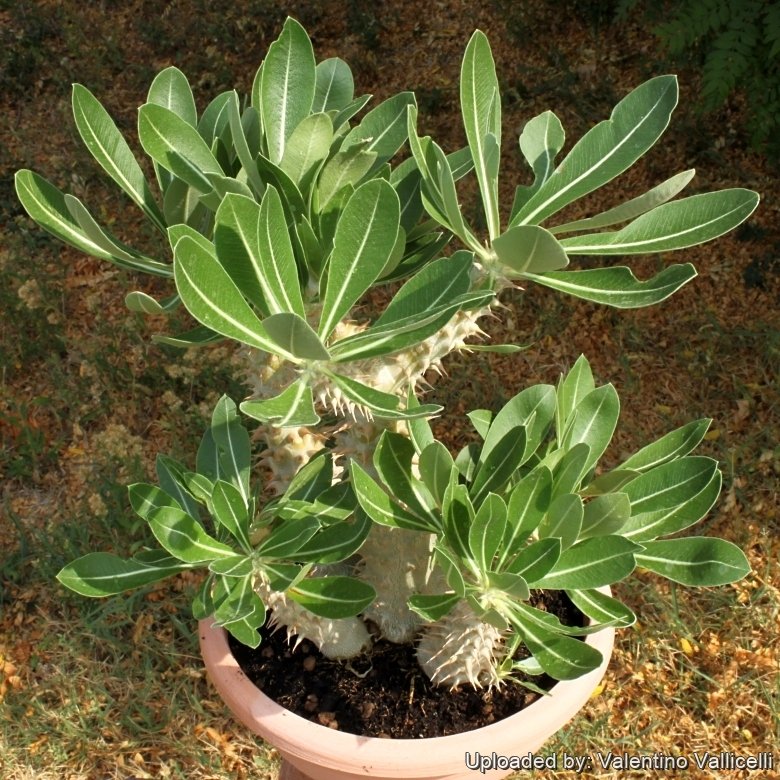
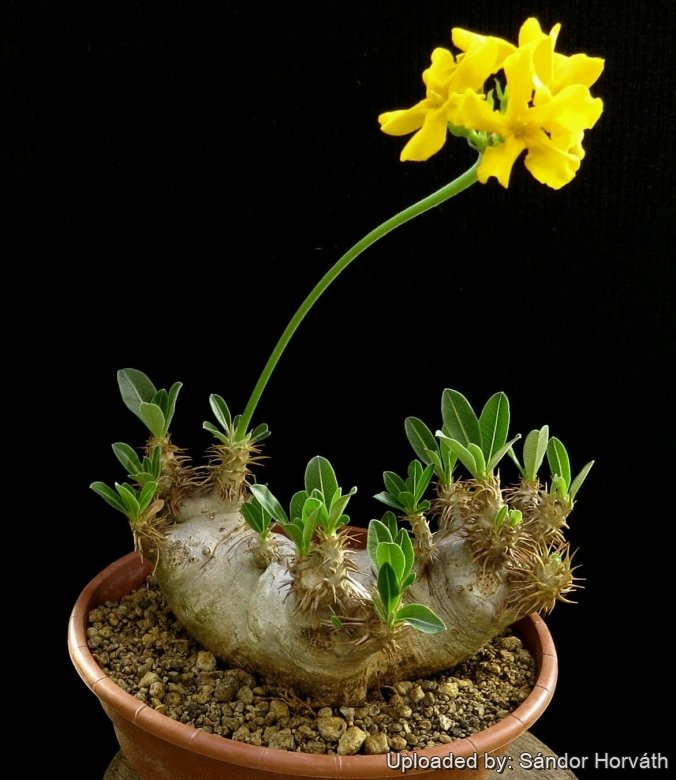
Pachypodium densiflorum is a caudiciform multi-branched shrublet with a massively swollen trunk that can attain a diameter of up to 2 m and a height of about 70 cm. Its name means literally “dense flowered” which is an apt description of its abundant floral display.
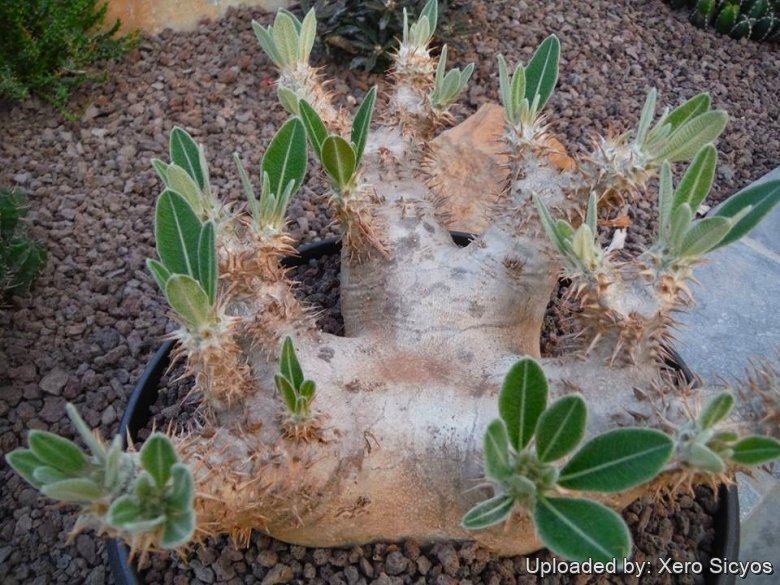
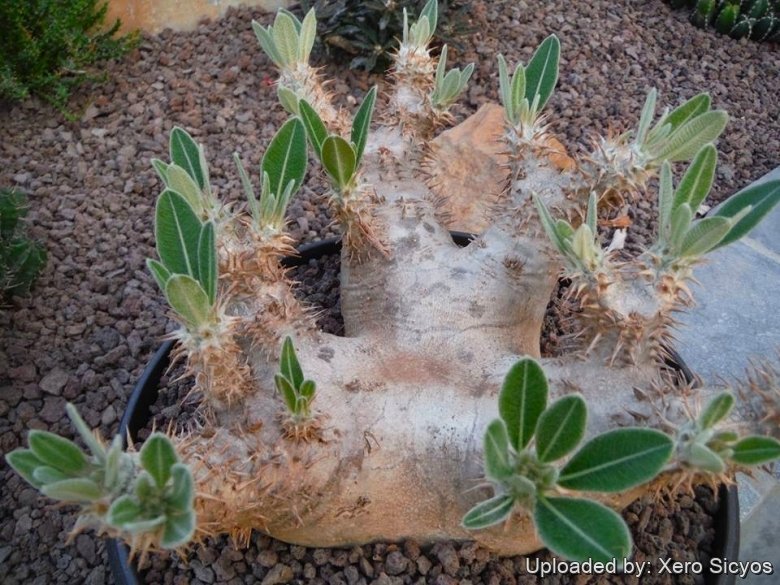
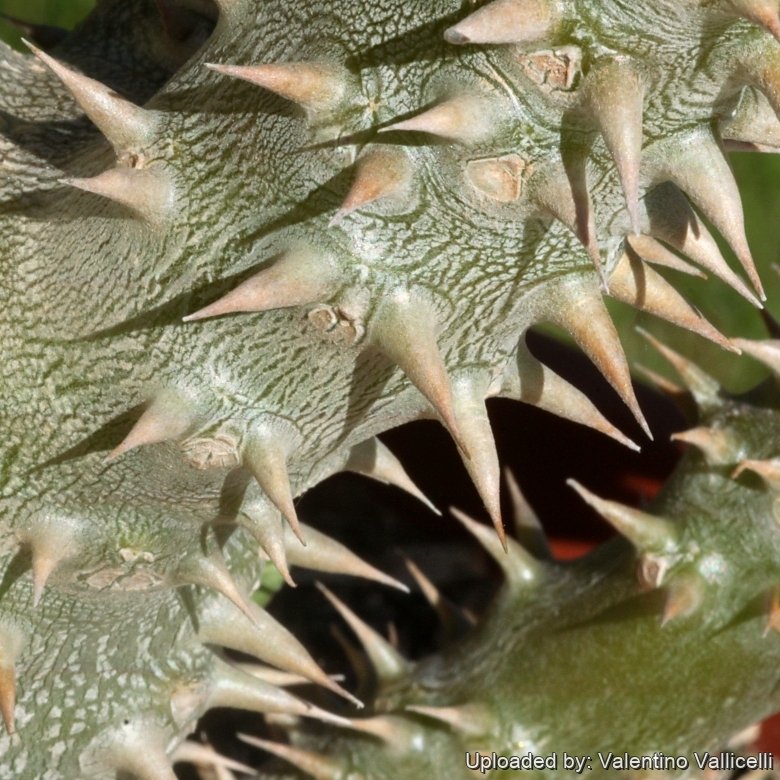
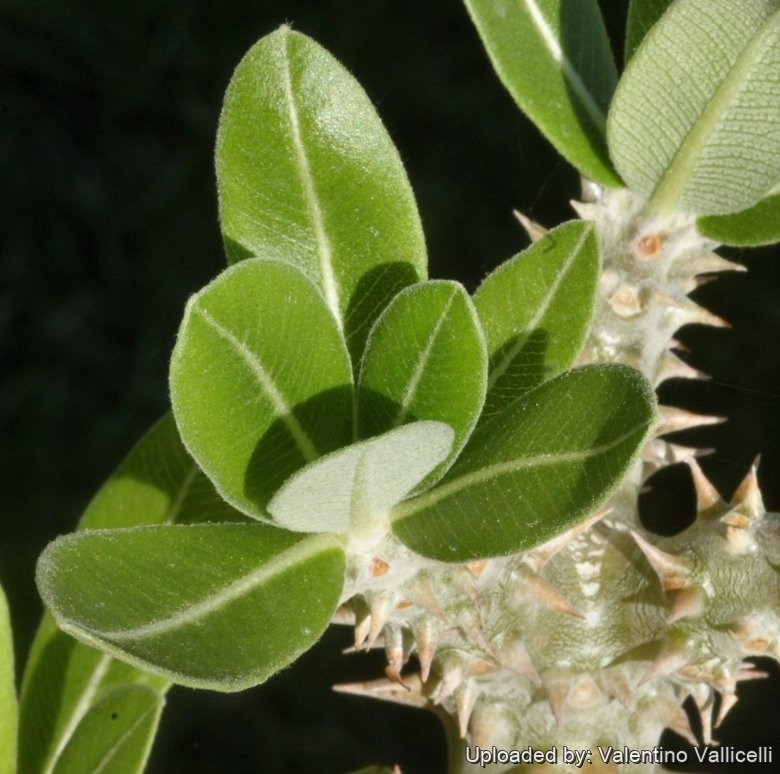
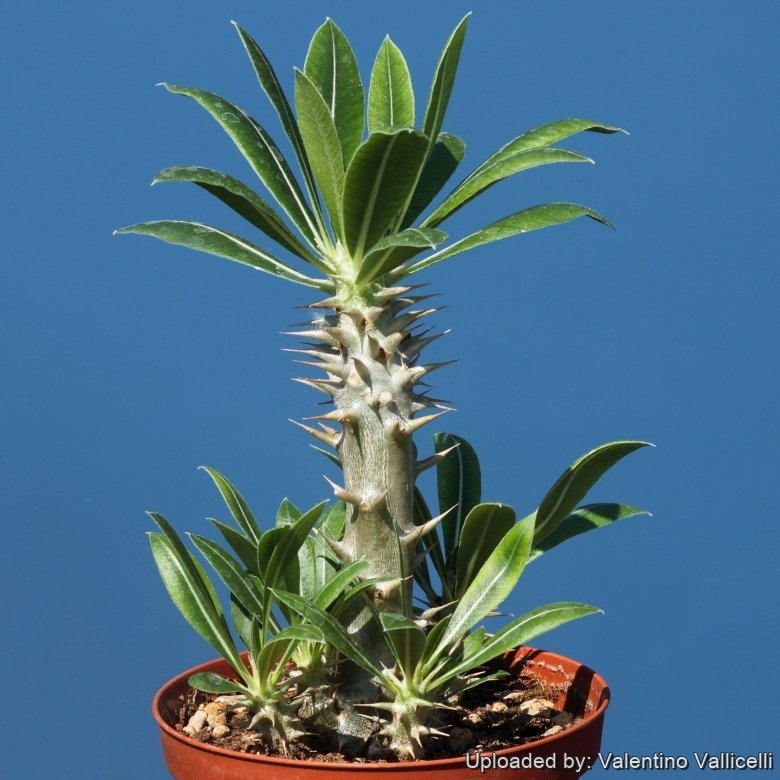
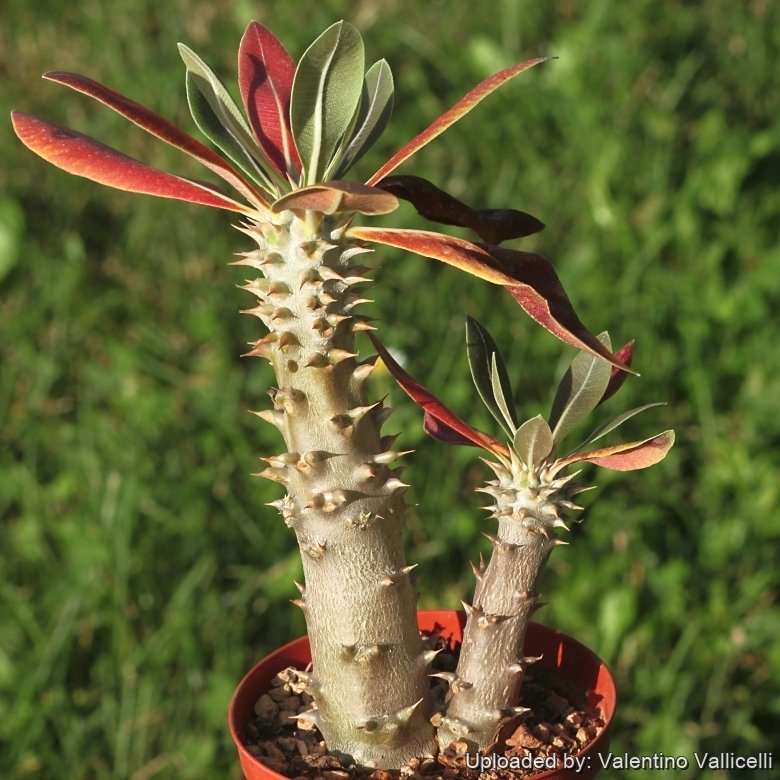
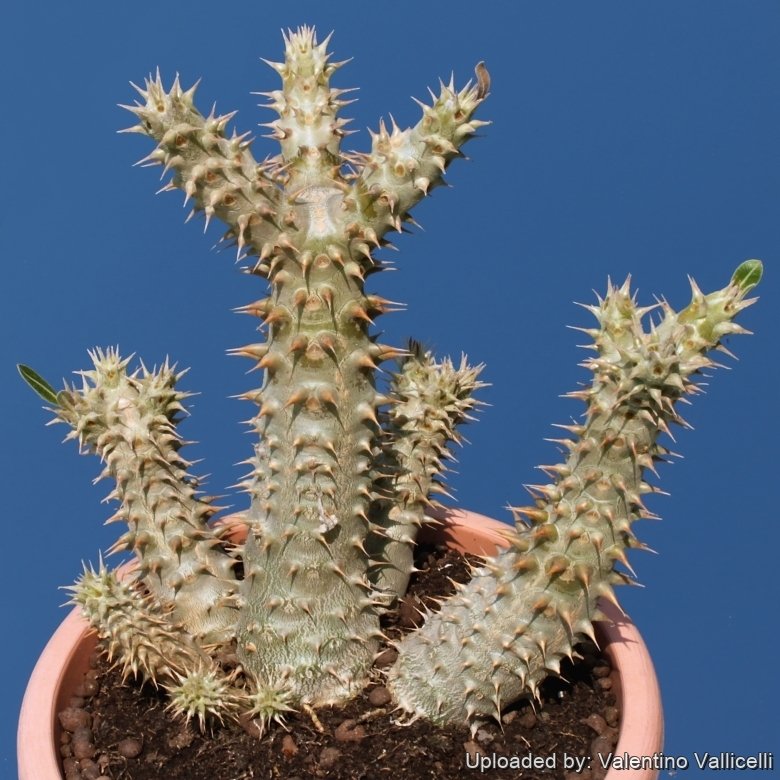
Stem/caudex: It has many short spiny branches from a fat caudiciform trunk. The trunk is smooth, silver with a light green tint and can attain with great age the height of 70 cm and the diameter of 1 m (or more) at the base. The branches are upright, short, tapered and covered with paired conical spines, the epidermis appears shining silver coloured due to the presence of fine greyish-white felt.
Leaves: Deciduous almost sessile, elliptic to obovate, 5 x 10 cm wide, shining dark olive green above and paler/pubescent below with a lighter middle vein and symmetrical venation.
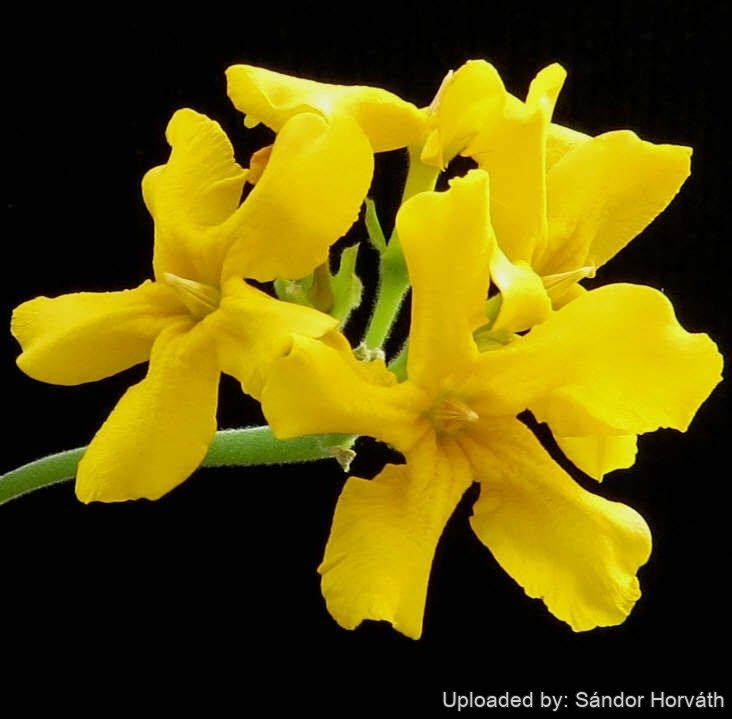
Flowers: Several (up to 10) clustered on 25-40 cm long erected, scapes growing far above the plant, flowers yellow or sometimes tinted deep. Pedicels usually about 5-7 mm long (but variable from 0 to 24 mm long). Sepals (the green outer whorl of flower parts) usually 5-7 mm long ((but variable from 3 to 9.5 mm). Corolla five-lobed, 1,5-3 cm in diameter, yellow and orange almost flat, with a saucer-like depression in the centre containing the central androecial cone with 5 anthers.
Blooming season: Flowers appear in springtime. This specie can flower at a very young age even if it usually takes 2 years.
Fruits: in pairs, horn shaped, 11-15 cm long.
Seeds: 4-6 mm in diameter.
Remarks: The thick spiny pachycaul trunks is a water storage organ similar to a cactus that allows it to survive in dry, hostile environments. The trunk (caudex) and branches can also photosynthesize, making the leaves, unnecessary in times of drought. Spines help condense moisture from fog or dew into drops which fall at the base of the plant.
Origin and Habitat
Southern, central and northern Madagascar.
Altitude: about 1500 m ASL.
Habitat: in grows on granite outcrops.
Cultivation and Propagation
It is one of the most attractive species in the entire genus that can be grown both indoors, as well as outdoors in warm climates. It’s a moderate grower and an impressive caudex can be steadily developed. In the winters it is deciduous, except in very tropical areas.
Frost resistance: It is tender and should not be exposed to frost (USDA Hardiness zones: 10 – 11).
Soil: Needs a draining cactus potting mix
Water: It requires regular water when the plant has leaves, contrary to popular belief, it likes a lot of water in the warm summers, as long as it’s planted in a very well draining soil and considerably less water in the cool months. Indoors it is best to keep it on the dry side, or it is prone to rot. Do not let this specimen sit damp in cool weather.
exposition: It like full sun to light shade.
Maintenance: This Pachypodium will not require any pruning to look like a very interesting and unusual bonsai, but after several years it can outgrow its indoor location, requiring a ‘pruning’. It has amazing regenerative properties.
Repot: Repot the plant every 3 years; this is quite tricky given all the spines. The best way is to wrap several layers of newspaper around the trunk where it is to be handled.
Warning: This plant has spines use caution when handling.
Propagation: Seeds or (rarely) cuttings. Fresh seeds results in a remarkable yield of new plants, perhaps 90% and seedlings grow fairly easily. Soak seeds in warm water for 24 hours before sowing in a 5 mm deep, sterile, moist sandy medium (4 parts fine and 4 parts coarse river sand 1 part sieved, well-rotten compost; 1 part perlite; 1 part vermiculite. Keep the mix moist and at a temperature of 27–35°C to ensure rapid germination. Seed start sprouting in just 3-4 days ( but continue to germinate erratically for about 6 month) they are also propagated by removal of branches from old plant (if they need to be pruned). They should be allowed to dry for 5 to 8 days before potting up, however the cuttings often fail to root.
Bibliography
Major references and further lectures
-
S. H. J. V. Rapanarivo “Pachypodium (Apocynaceae)” CRC Press, 01/Jun/1999
-
Werner Rauh “The Wonderful World of Succulents: Cultivation and Description of Selected Succulent Plants Other Than Cacti” Smithsonian Institution Press, 1984
-
G. D. Rowley: Pachipodium. In: Urs Eggli: “Illustrated Handbook of Succulent Plants: Dicotyledons.” Springer Verlag, 2002
-
Perrier de la Bathie, H.. “Les Pachypodium de Madagascar.” in: Bull. Soc. Bot. France 81: 297–318. 1934
-
Rapanarivo, S. H. J. V. & A. J. M. Leeuwenberg. “Taxonomic revision of Pachypodium. Series of revisions of Apocynaceae XLVIII.” in: Rapanarivo, S. H. J. V. et al., “Pachypodium (Apocynaceae): taxonomy, habitats and cultivation.” 1999.
-
Rowley, G. “Pachypodium & Adenium.” in: Cactus File 5: 1-79. 1999
-
Rowley, G.D. “The Pachypodium rosulatum aggregate (Apocynaceae) - one species or several?” Bradleya: The British Cactus and Succulent Society Yearbook. (16/1998)
-
Lüthy, Jonas M. “Another look at the pachypodiums of Madagascar.” Bradleya: The British Cactus and Succulent Society Yearbook. (22/2004)
-
Eggli U., Newton L.E. & Rowley G.D., “CITES Aloe and Pachypodium Checklist” Board of Trustees of the Royal Botanic Gardens, Kew, 2001
From llifle page Pachypodium brevicalyx
Description
Pachypodium densiflorum var. brevicalyx is a local or morphological form of Pachypodium densiflorum distinguished by having the leaf blade tapered below into a short petiole, a shortly pubescent inflorescence, shorter half-size sepals (the green outer whorl of flower parts) only (1-)3(-7) mm long, slightly smaller flowers borne on longer pedicels (7-)15-24(-25) mm long, and hairs inside the somewhat deeper corolla tube. However the length of sepals in the standard Pachypodium densiflorum is quite variable (from 3 to 9.5 mm), showing a continous variation in sepal length. Therefore the sepal characters of the var. brevicalyx appear to fall within the natural variation Pachypodium densiflorum and it should be synonymized with the latter.
Taxonomic history: Pachypodium densiflorum var. brevicalyx was described as a variety of Pachypodium densiflorum by Perrier in 1934, but raised to specific status by Pichon in 1949. Rauh (1963) discussed its position in an article on P. densiflorum and came to the conclusion that it was merely a local variety of P. densiflorum. Markgraf (1976) treated it as a variety.
Derivation of varietal name: The varietal epithet ‘brevicalyx’ comes frorm Latin ‘brevis’ (= short); and Latin ‘calyx’ (= calyx) and means “with a short calyx”.
Origin and Habitat
Pachypodium densiflorum var. brevicalyx comes from a separate area, slightly north west of the south-central locus of var. densiflorum on sandstone at an altitude of about 200 metres.
Cultivation and Propagation
Pachypodium densiflorum var. brevicalyx is one of the most attractive species in the entire genus that can be grown both indoors, as well as outdoors in warm climates. It’s a moderate grower and an impressive caudex can be steadily developed. In the winters it is deciduous, except in very tropical areas.
Frost resistance: It is tender and should not be exposed to frost (USDA Hardiness zones: 10 – 11).
Soil: Needs a draining cactus potting mix
Water: It requires regular water when the plant has leaves, contrary to popular belief, it likes a lot of water in the warm summers, as long as it’s planted in a very well draining soil and considerably less water in the cool months. Indoors it is best to keep it on the dry side, or it is prone to rot. Do not let this specimen sit damp in cool weather.
exposition: It like full sun to light shade.
Maintenance: This Pachypodium will not require any pruning to look like a very interesting and unusual bonsai, but after several years it can outgrow its indoor location, requiring a ‘pruning’. It has amazing regenerative properties.
Repot: Repot the plant every 3 years; this is quite tricky given all the spines. The best way is to wrap several layers of newspaper around the trunk where it is to be handled.
Warning: This plant has spines use caution when handling.
Propagation: Seeds or (rarely) cuttings. Fresh seeds results in a remarkable yield of new plants, perhaps 90% and seedlings grow fairly easily. Soak seeds in warm water for 24 hours before sowing in a 5 mm deep, sterile, moist sandy medium (4 parts fine and 4 parts coarse river sand 1 part sieved, well-rotten compost; 1 part perlite; 1 part vermiculite. Keep the mix moist and at a temperature of 27–35°C to ensure rapid germination. Seed start sprouting in just 3-4 days ( but continue to germinate erratically for about 6 month) they are also propagated by removal of branches from old plant (if they need to be pruned). They should be allowed to dry for 5 to 8 days before potting up, however the cuttings often fail to root.
Bibliography
Major references and further lectures
-
Urs Eggli “Illustrated Handbook of Succulent Plants: Monocotyledons” Springer Science & Business Media, 06 December 2012
-
Urs Eggli, Leonard E. Newton “Etymological Dictionary of Succulent Plant Names” Springer Science & Business Media, 29 June 2013
-
Gordon D. Rowley “Pachypodium and Adenium” Cactus File, Cirio Pub. Services, 1999
-
Werner Rauh “Succulent and xerophytic plants of Madagascar”, Volume 1 Strawberry Press, 1995
-
S. H. J. V. Rapanarivo “Pachypodium (Apocynaceae)” CRC Press, 01 June 1999
-
“The Flowering Plants of Africa”, Volumes 50-51 Botanical Research Institute, Department of Agricultural Technical Services, Republic of South Africa., 1988
-
Friedrich Markgraf in “Fl. Madag.” fam. 169: 299 (1976).
Source: Pachypodium brevicalyx, LLIFLE - Encyclopedia of living forms, CC-BY-SA, retrieved 2026-10-26.
Cultivars and forms (2)
Varieties (1)
Forms (1)
Gallery