Publication: Bradleya 5: 93 (1987)
Description
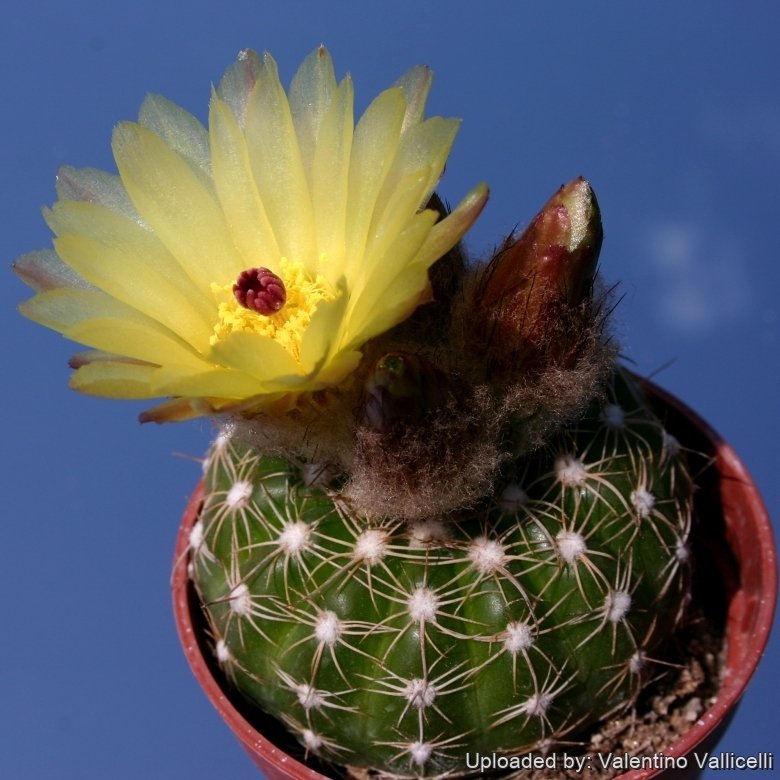
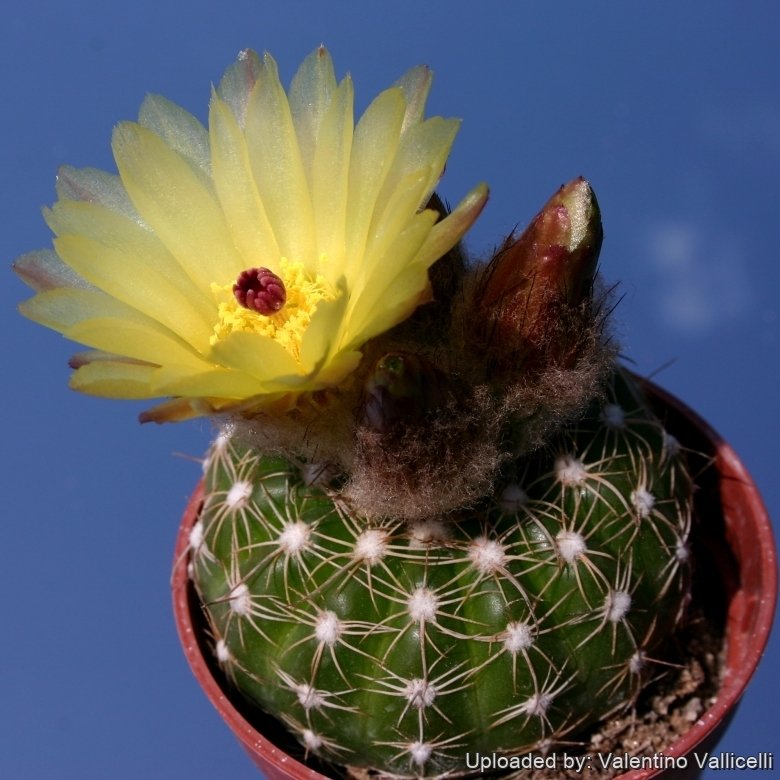
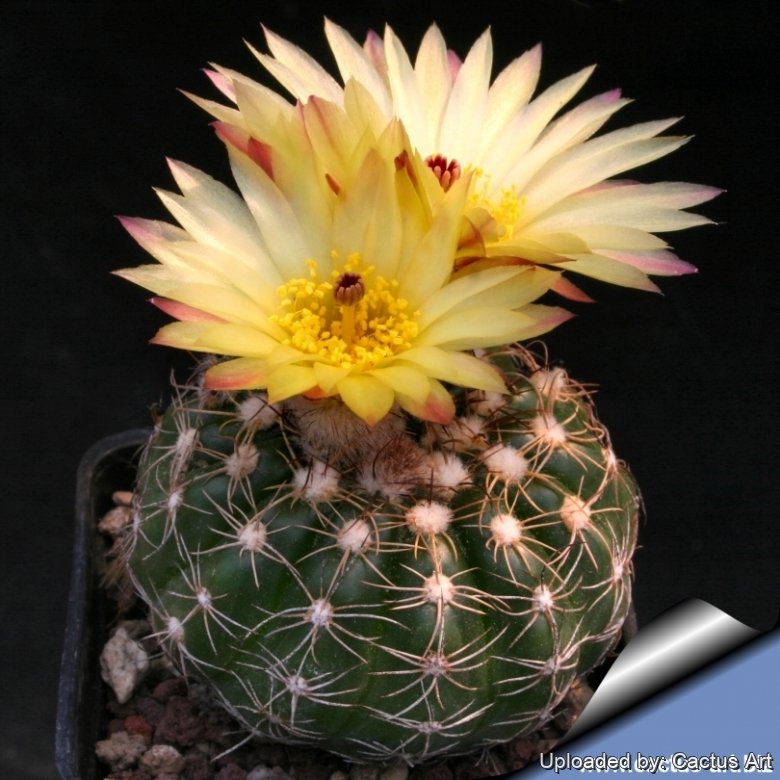
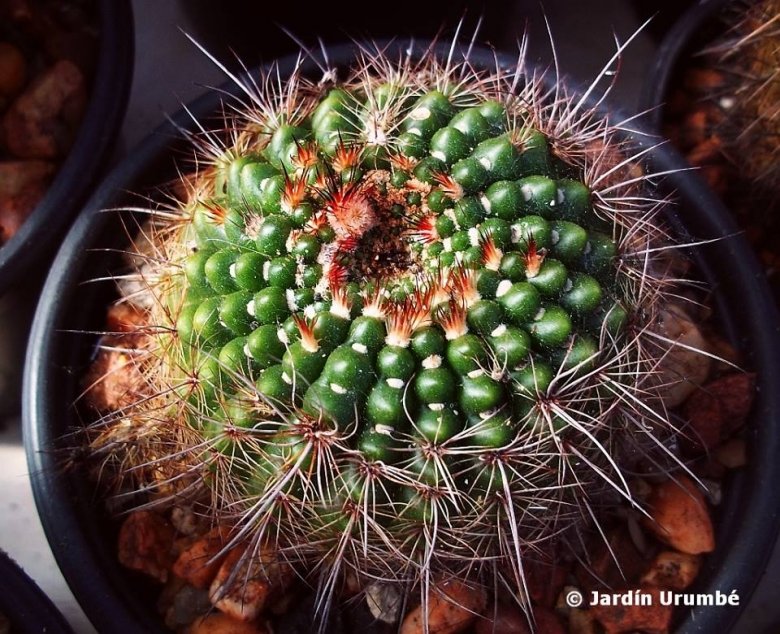
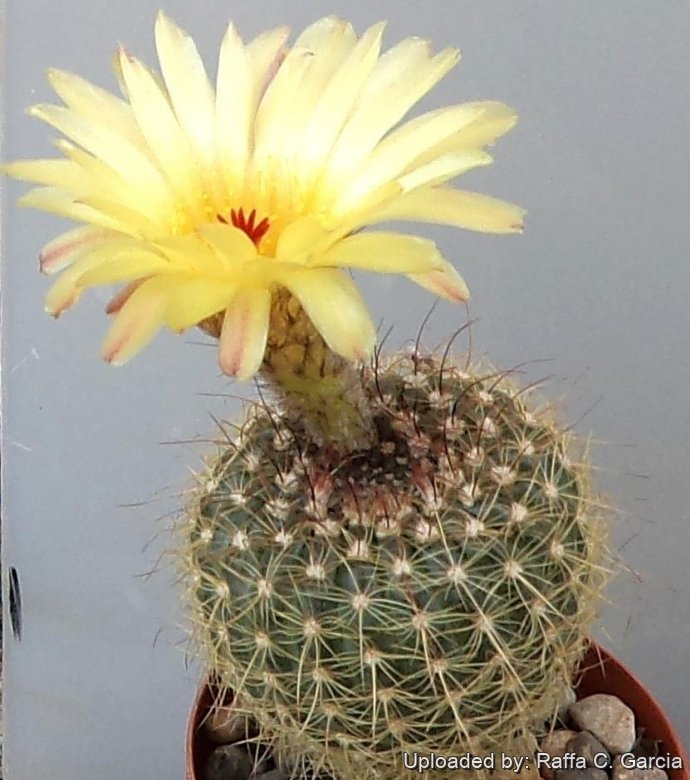
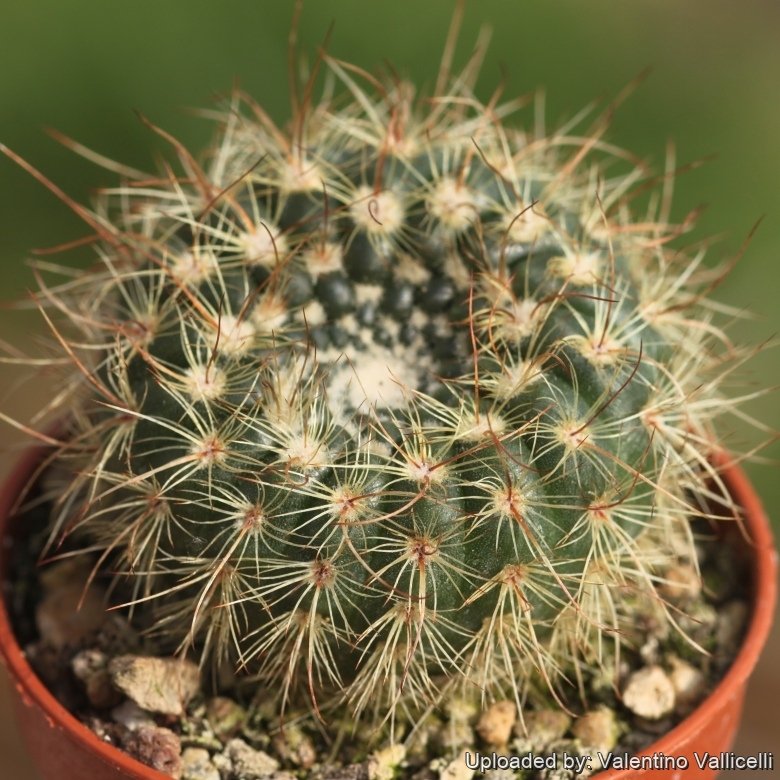
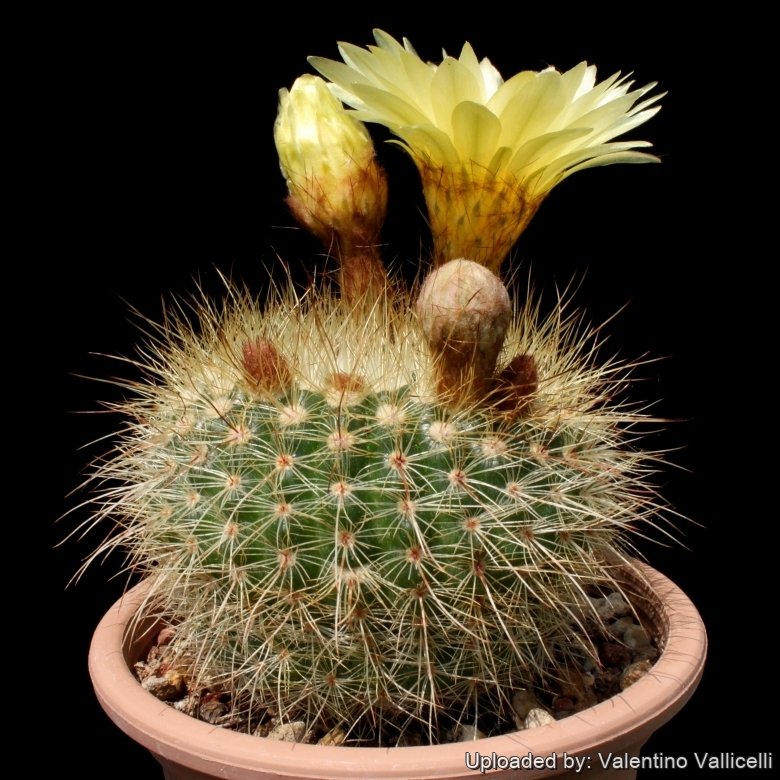
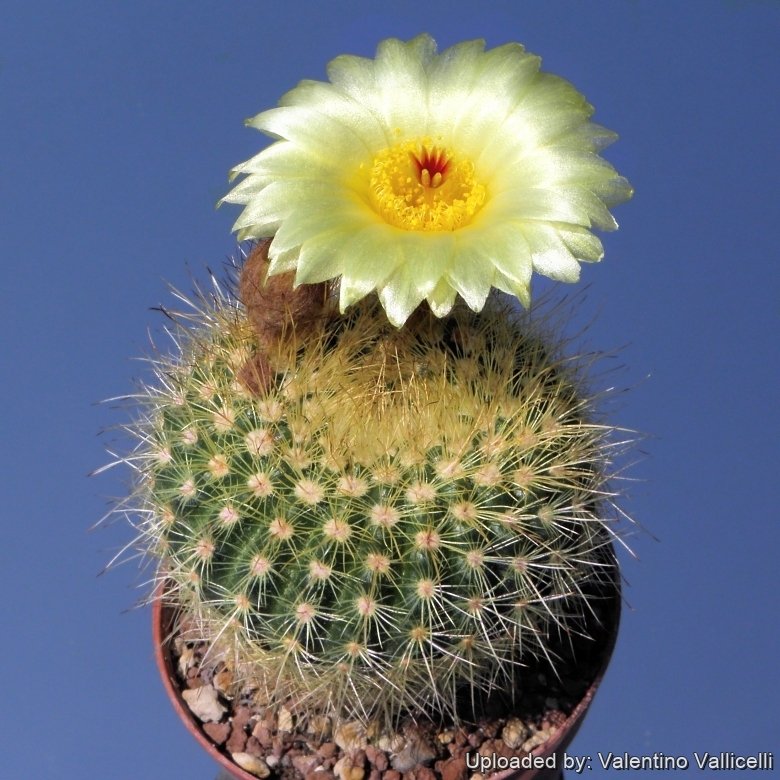
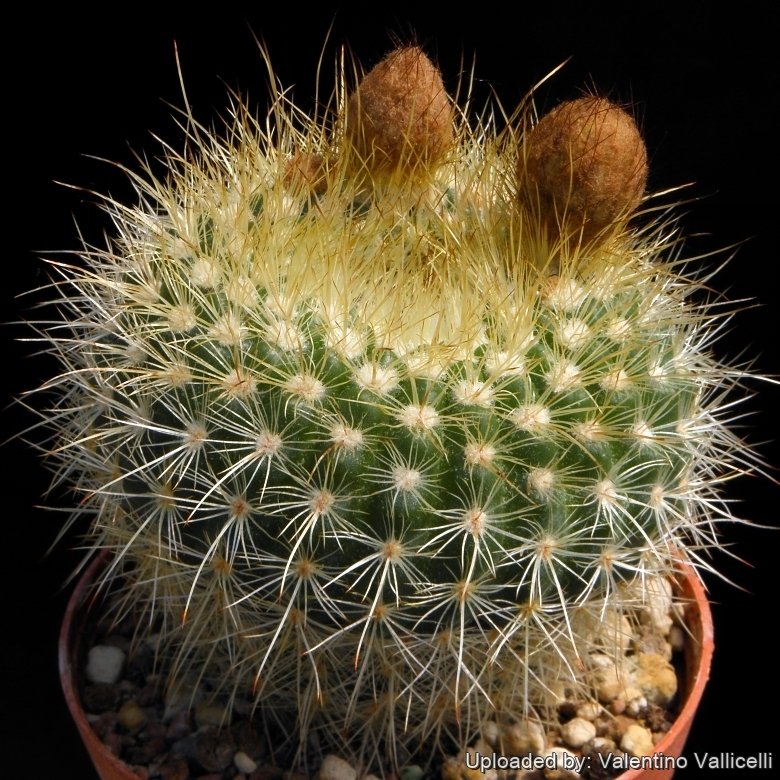
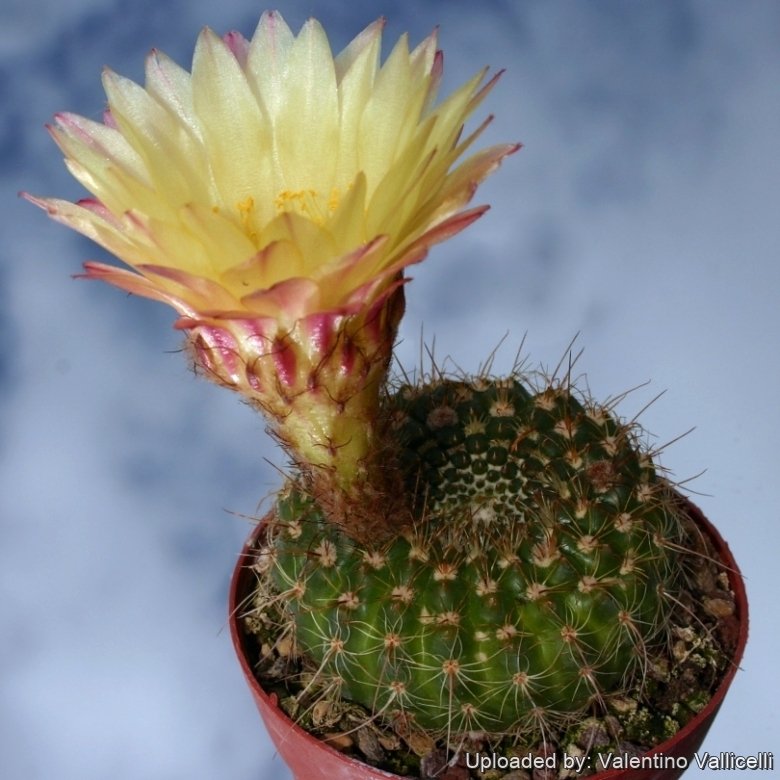
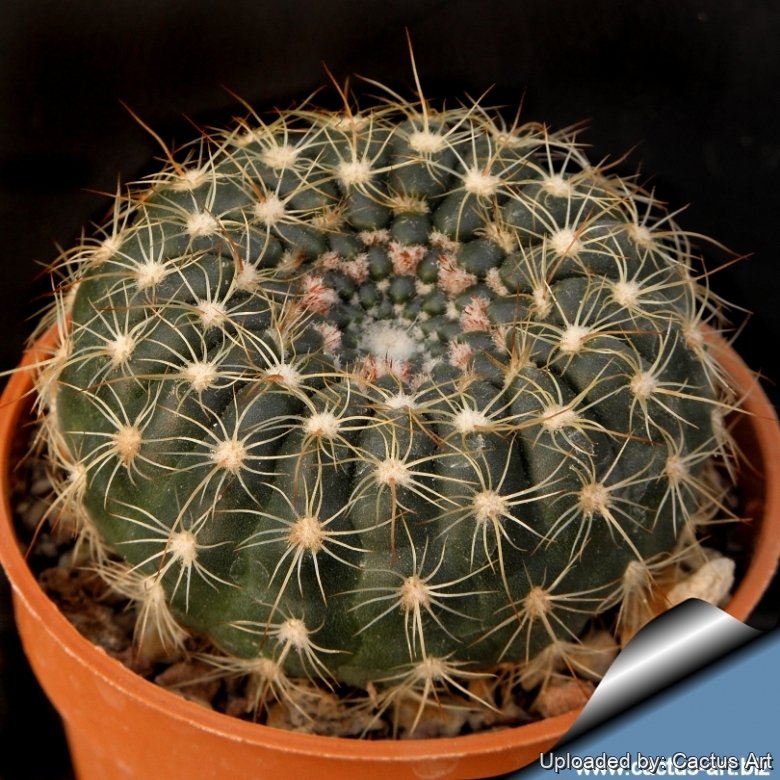
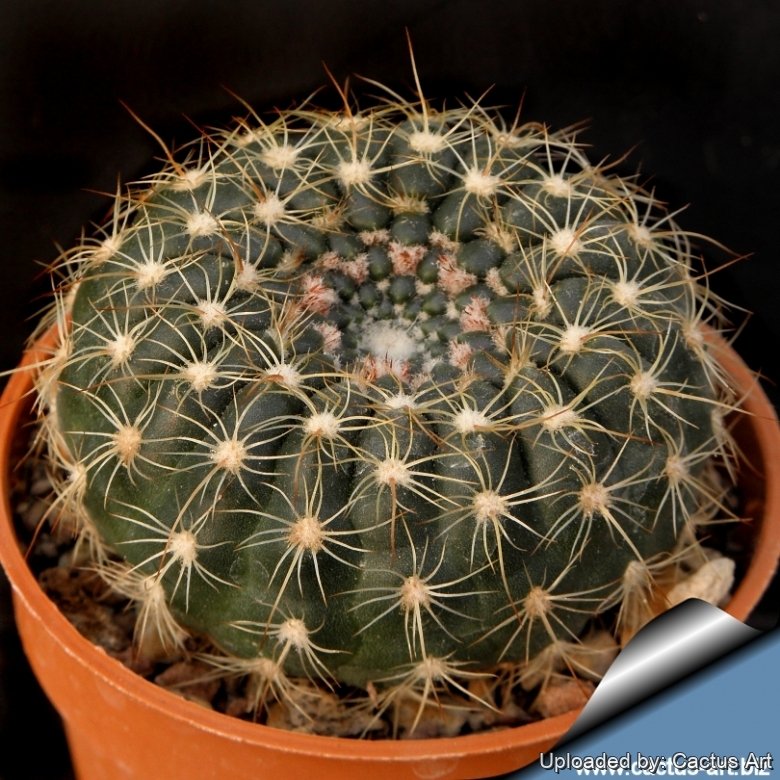
Parodia concinna is small cactus species forming a flattened and much-ribbed sphere.
Stem: Simple, broadly globular or somewhat depressed at apex, eventually longer in age, about 3-10 cm tall, and 4-10 cm across, light or dark glossy green, ribbed and warty at the top.
Ribs: About 16 to 20, with somewhat conspicuous chin-like tubercles between the areoles
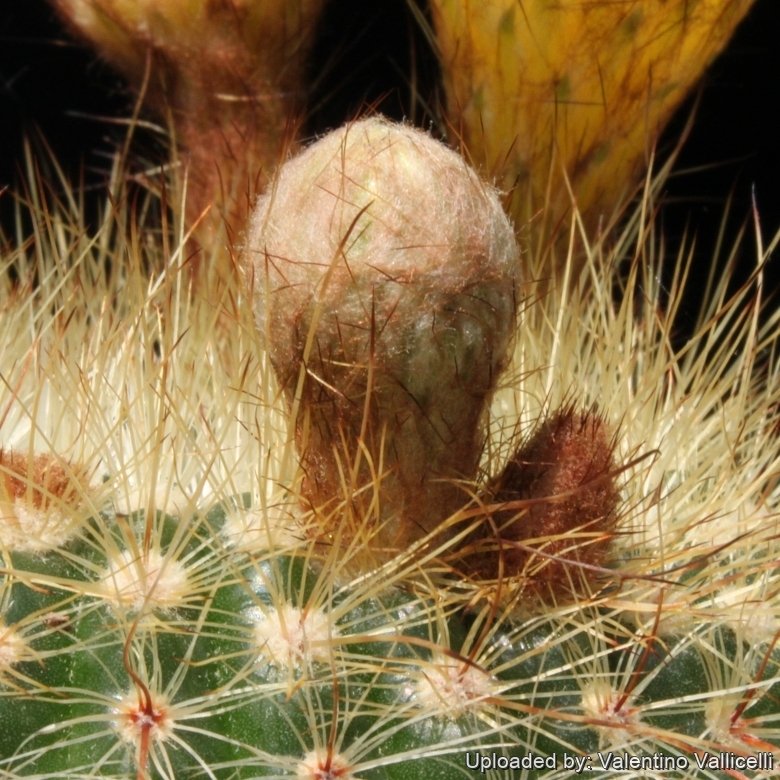
Areoles: Young areoles white-felted.
Spines: Spreading, setaceous, hair-like to bristle-like, some more or less curved to twisted, brown, reddish or partly whitish to yellowish often poorly differentiated as centrals and radials.
Radial spines:9 to 25, about 5 to 7 mm long adpressed and interlaced.
Central spines: 1-4(-6), one much longer (1-2,5cm ), spreading or turned downward.
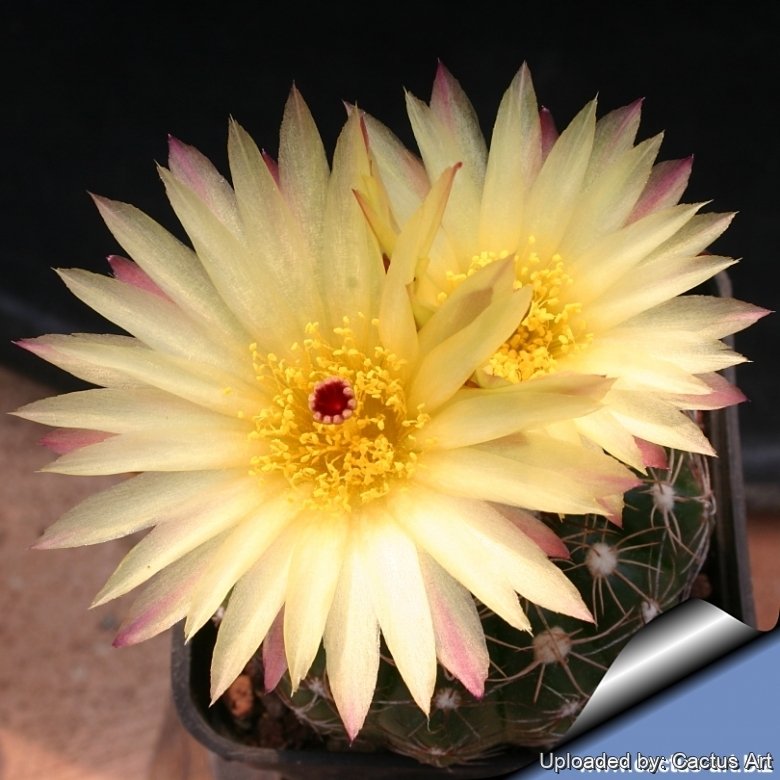
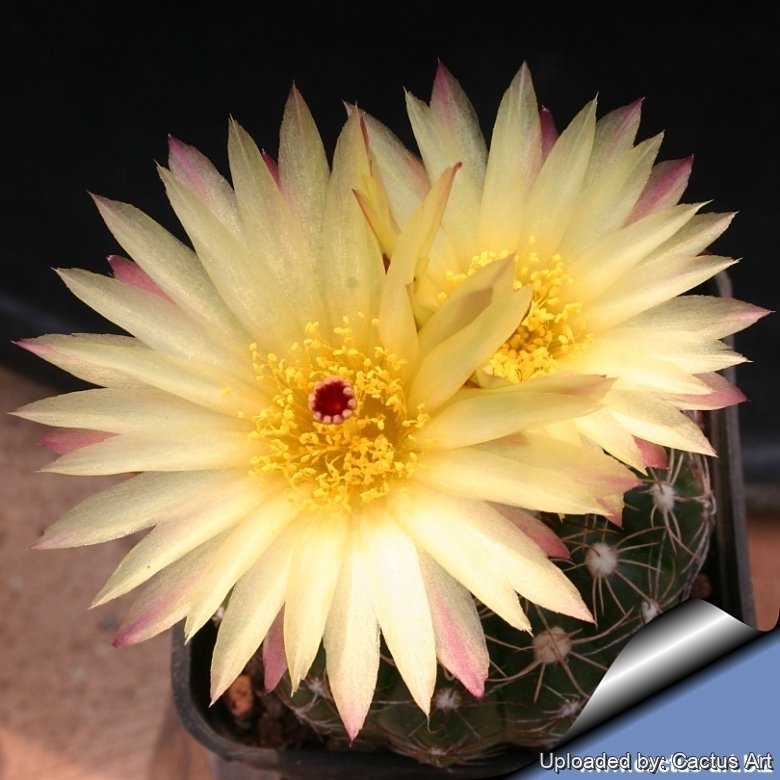
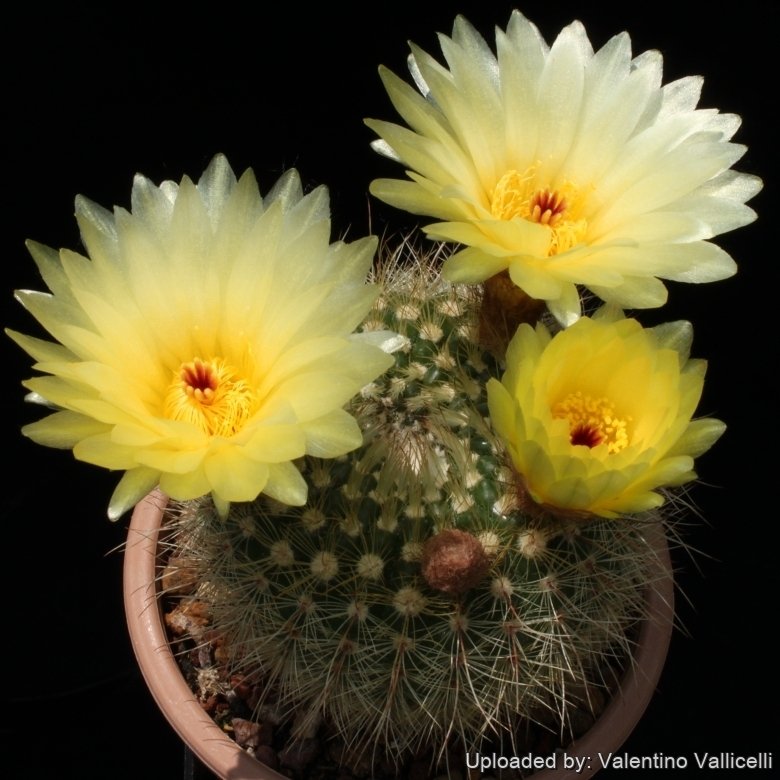
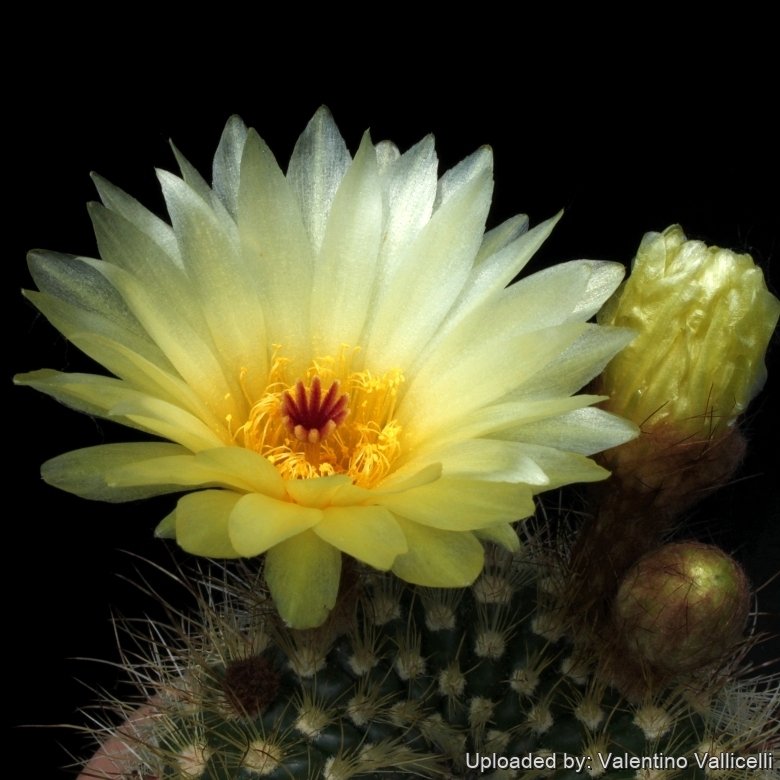
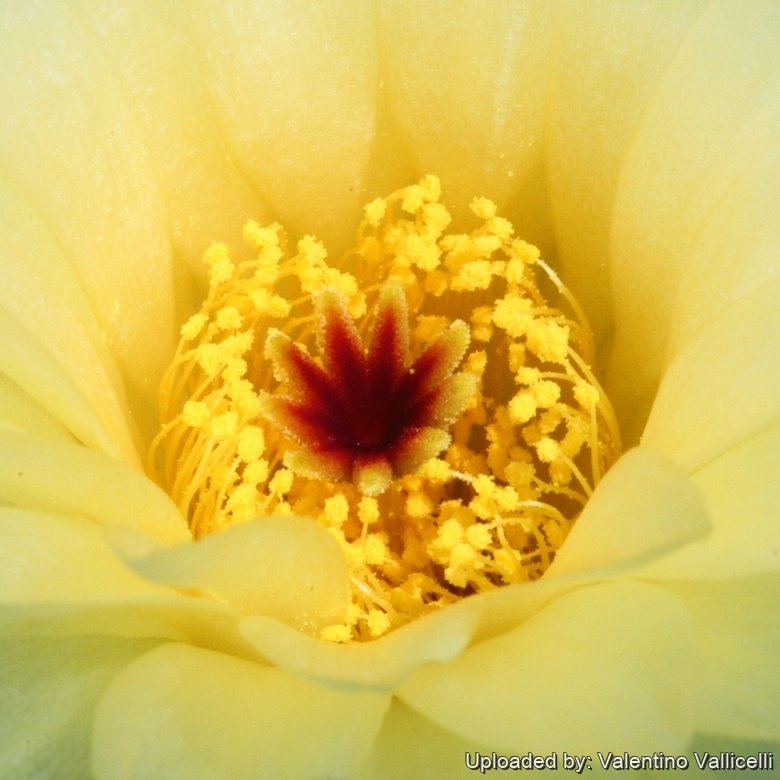
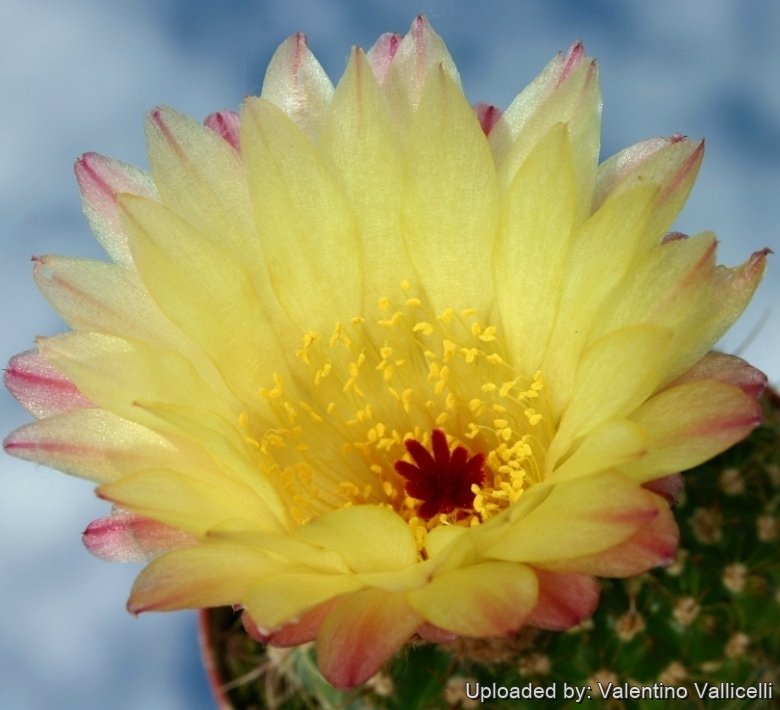
Flowers: 1-5 produced together at the apex, bright yellow, funnel-shaped, large, about 5 to 8 cm across. Outer perianth-segments narrow, acute, reddish, inner perianth-segments oblong, yellow almost transparent, except the reddish tips, acute. Stigma-lobes scarlet. Scales on the ovary hairy in their axils. Perianth-tube slender.
Blooming season: Summer.
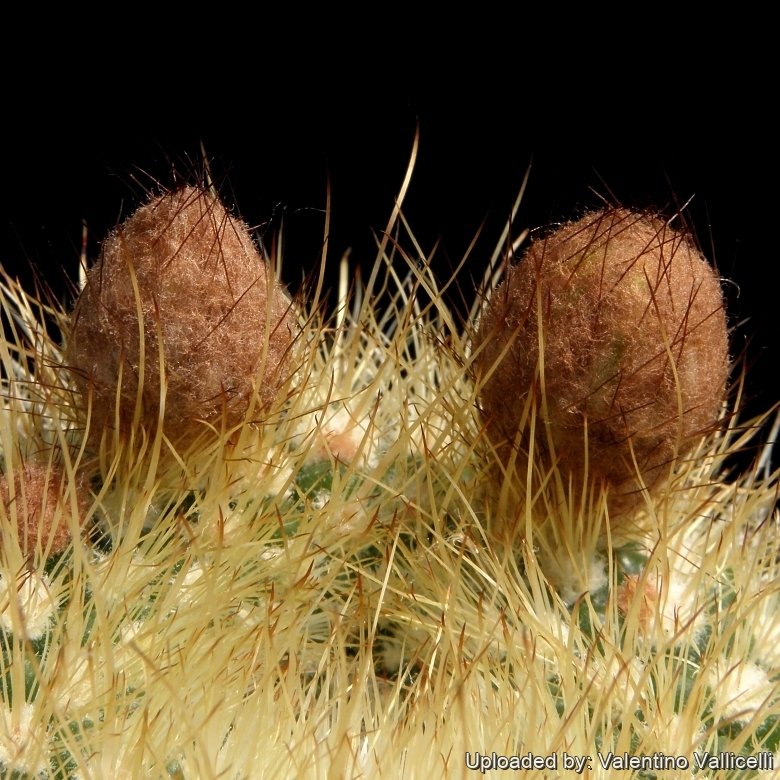
Fruit: Green ovoid to globular approx. 1,5 cm cm long, thin-walled, splitting or disintegrating at maturity with more than 100 seeds per fruit.
Seed: 0,8-1 mm, bell-shaped broadest at the hilum, somewhat, tuberculate, shiny and black.
Origin and Habitat
Parodia concinna is distributed in Southern Brazil (Rio Grande do Sul) and in practically all of Uruguay.
Altitude range: elevations from 20 to 300 metres above sea level.
Habitat and Ecology: The species grows on rocky outcrops in grasslands or pampas. A generation length of 10 years has been inferred based on field observations.
The species is relatively common but not abundant. The populations are decreasing, and a 50% decline over 30 years (including past and future) is estimated for Brazil based on direct observation, and if considering the whole range the decline is probably around 30%. The major threats are cattle grazing, illegal collection and forestry of Eucalyptus.
Cultivation and Propagation
It is relatively easy to grow on its own roots.
Soil: Grow it in an open sandy-gritty cactus compost.
Pots: It needs a relatively shallow pot to accommodate its fibrous roots and provide a very good drainage. It may stay in the same pot for many years.
Watering: Water in moderation, it prefer a completely dry place during winter. Mature individuals easily rot and die especially after planting so be extremely cautious with watering. Keep dry in winter or when night temperatures remain below 10° C. Water it less than average if in bigger pots.
Special need: Provide very good ventilation. Nearly all problems occur as a result of overwatering and poor ventilation, especially when weather conditions are dull and cool or very humid.
Fertilization: Feed them once during the growing season with a fertilizer specifically formulated for cactus and succulents (high potash fertilizer with a dilute low nitrogen), including all micro nutrients and trace elements diluted to ½ the strength recommended on the label. They thrive in poor soils and need a limited supplies of fertilizer to avoid the plants developing excess vegetation, which is easily attacked by fungal diseases.
Exposure: It will do its best with lots of sun and become stressed with inadequate light which could result in poor growth and unnatural shape.
Hardiness: It likes warmth (recommended minimum winter temperature 5° C) however plants kept perfectly dry can can survive low temperatures, approx. -5°, but for safe cultivation it is best to avoid freezing temperatures.
Use: This is a good pot plant suited for a non heated green house. It can be also cultivated outdoors in raised beds, terraces if sheltered from winter rain. This cactus continues to be, a particular prize among collectors
Pests & diseases: These cacti may be attractive to a variety of insects, but plants in good condition should be nearly pest-free, particularly if they are grown in a mineral potting-mix, with good exposure and ventilation. Nonetheless, there are several pests to watch for:
- Red spiders: Red spiders may be effectively rubbed up by misting the plants from above.
- Mealy bugs: Mealy bugs occasionally they develop aerial into the new leaves and flowers with disfiguring results, but the worst types develop underground on the roots and are invisible except by their effects.
- Rot: Rot is only a minor problem if the plants are watered and “aired” correctly. If they are not, fungicides won’t help all that much.
Propagation: Seeds. The seeds can be sown in pots of fine, well-drained sandy soil, any time during the spring when temperatures are warm. Cover the seeds with a fine layer of grit and water from below with a fungicide to prevent damping off. For the 1-2 weeks cover the pots with a sheet of glass/clear perspex to keep the humidity levels high. Remove the glass and replace it with light shade-cloth and mist once or twice a day for the next two weeks after which most seeds should have germinated. From then on mistings can be reduced to every second and then every third day as the little plants grow.
Bibliography
Major references and further lectures
-
Edward Anderson “The Cactus family” Timber Press, Incorporated, 2001
-
James Cullen, Sabina G. Knees, H. Suzanne Cubey “The European Garden Flora Flowering Plants: A Manual for the Identification of Plants Cultivated in Europe, Both Out-of-Doors and Under Glass” Cambridge University Press, 11/Aug/2011
-
David R Hunt; Nigel P Taylor; Graham Charles; International Cactaceae Systematics Group. “The New Cactus Lexicon” dh books, 2006
-
Franz Buxbaum “Morphology of cacti”, Volume 1 Abbey Garden Press, 1950
-
Nathaniel Lord Britton, Joseph Nelson Rose “Cactaceae: Descriptions and Illustrations of Plants of the Cactus Family” Courier Dover Publications, 196
-
Peter McHoy “The New Houseplant A-Z: Everything You Need to Know to Identify, Choose, and Care for the 350 Most Popular Houseplants” Smithmark Publishers, Incorporated, 01/Mar/1996
-
Krainz, Hans (Hrsg.) “Die Kakteen” 1957-1975 Franckh’sche Verlagshandlung
-
Hiroshi Hirao “Colour encyclopaedia of cacti” Seibundo Shinkosha, 1979
-
Hans Hecht “BLV-Handbuch der Kakteen” BLV-Verlagsgesellschaft, 1982
-
Kristo Pienaar “The South African what Flower is That?” Struik, 2000
-
John Borg “Cacti: a gardener’s handbook for their identification and cultivation” Blandford P., 1970
-
Tony Mace “Notocactus: a review of the genus incorporating Brasilicactus, Eriocactus and Wigginsia” Editorial Board/National Cactus & Succulent Society, 1975
-
Larocca, J., Machado, M. & Duarte, W. 2013. Parodia concinna. The IUCN Red List of Threatened Species 2013: e.T151724A554335. http://dx.doi.org/10.2305/IUCN.UK.2013-1.RLTS.T151724A554335.en. Downloaded on 20 October 2016.
From llifle page Echinocactus concinnus var. joadii
Origin and Habitat
Uruguay
Source: Echinocactus concinnus var. joadii, LLIFLE - Encyclopedia of living forms, CC-BY-SA, retrieved 2026-10-25.
From llifle page Echinocactus apricus
Description
Notocactus concinnus var. apricus, fistly decribed as Echinocactus apricus by Arechavaleta in 1905, is generally included within (as a synonym of) Parodia concinna, suggesting that there is not really a fundamental difference between the two, and hard to name accurately without knowing where they come from. It has large yellow flowers with a red center.
Derivation of specific name: The Latin epithet ‘apricus’ means ‘sun-loving, growing in a sunny position’
Stem: Solitary or with 2 to 10 branches from the main stem, light green, spherical 3 - 4 cm wide, apex flattened or umbilicate covered with interlocking brownish-reddish spines.
Areoles: Orbicular, approx 3-4 mm apart tomentose when young, becoming naked in age.
Ribs: 15-20 vertical to somewhat curved, with small tubercles.
Radial spines: 18-20, bristle-like, flexible, laterally intertwined, yellowish or greyish-yellow.
Central spines: Several, usually 4 more developed, up to 15 mm long one of which usually downward bent, brownish-reddish, paler at the base with darker tips.
Flowers: Large near the apex, narrow-funnel-shaped, up to 8 cm long, 5 cm and more cm broad, yellow with a red center. Outer perianth segments with reddish middle stripes. Flower-tube very stout densely woolly and setose on the outside. Stamens yellow above, red below. Style below red, grooved, top yellow. Stigma-lobes 13 purple.
Fruits: Dark red, ovate, woolly-hairy.
Seed:: Black, 1 mm large.
Origin and Habitat
Notocactus apricus occurs in the surroundings of Maldonado, Uruguay, and (maybe) in Rio Grande do Sul, Brazil.
Type Locality: Punta de la Ballena, Uruguay.
Habitat and ecology: This species grows on sandy, grassy hills.
Cultivation and Propagation
Notocactus concinnus var. apricus is relatively easy to grow on its own roots and quite resistant to cultivation. The only things that can kill this plant are cold and overwatering. Nevertheless, it is appropriate to provide adequate growing conditions in order to obtain compact plant with many flowers.
Soil: Use a an open and free draining mineral compost with little organic matter (peat, humus) that allows therefore roots to breath (as it is rot prone). Outdoors a well-draining rocky or sandy soil is ideal.
Pots: It needs a relatively shallow pot to accommodate its fibrous roots and provide a very good drainage. It may stay in the same pot for many years.
Watering: Needs regular water in summer. Keep rather dry in winter, tends to lose its roots in winter.
Fertilization: Feed with a high potassium fertilizer in summer during the growing season diluted to one-fourth potency and mix into the watering can for application.
Hardiness: Keep dry at 5 to 10° C in winter, but can tolerate sporadic light frost if kept on the dry side prior to, and during, cold weather.
Exposition: The plant tolerates very bright situations, if kept too dark they may become overly lush and greener and could be prone to rotting due to over watering. Strong light encourages flowering and heavy wool and spine production, but is likely to suffer from sun scorch or stunted growth if over exposed to direct sunlight during the hottest part of the day in summer.
Pests & diseases: It may be attractive to a variety of insects, but plants in good condition should be nearly pest-free, particularly if they are grown in a mineral potting-mix, with good exposure and ventilation. Nonetheless, watch carefully for any significant decline in health. This may signal a pest problem that should be dealt with quickly in order to prevent scarring, stunting and even death.
- Red spiders: Red spiders may be effectively rubbed up by watering or misting the plants from above.
- Mealy bugs: Mealy bugs occasionally develop aerial into the new growth among the leaves with disfiguring results, but the worst types develop underground on the roots and are invisible except by their effects. Eliminate mealybug infestations by dabbing the critters with cotton swabs dipped in alcohol or by soaking the succulent’s roots in a systemic insecticide.
- Scales: Scales are rarely a problem.
- Rot: This species is particularly easy and accommodating, seldom suffer of cryptogamic diseases. Rot it is only a minor problem with cacti if the plants are watered and “aired” correctly. If they are not, fungicides won’t help all that much.
Propagation: By Seeds.
Bibliography
Major references and further lectures
-
Arechavaleta, J. (1905) “Anales del Museo Nacional de Montevideo, Flora Uruguaya”, Tomo II, 205-207, Montevideo
-
N. L. Britton, I. N. Rose “The Cactaceae: Descriptions and Illustrations of Plants of the Cactus Family,” Volume 3 1922.
-
ОЛМА Медиа Групп “Кактусы и суккуленты”
-
GENAUST “Etymologisches Wörterbuch der botanischen Pflanzennamen” Springer-Verlag, 13 August 2013
Source: Echinocactus apricus, LLIFLE - Encyclopedia of living forms, CC-BY-SA, retrieved 2026-10-25.
From llifle page Notocactus agnetae
Description
Parodia concinna subs. agnetae is small cactus species forming a flattened and much-ribbed sphere that could develop several golden-yellow flowers simultaneously in early summer spring. It one of the several forms of the very variable Parodia concinna which form a complex of related taxon. It distinguish for the dense thin spines and more closely set areoles. It is still unclear whether this variable complex is one or several species. There is so much variation in spination that most authors choose to lump them together until further studies are done.
Roots: Fibrous.
Stem: Simple, broadly globular to inverted pear-shaped somewhat depressed at apex, eventually longer in age, about 3-10 cm tall, and 4-10 cm across, light or dark glossy green, ribbed and warty at the top.
Ribs: 16 to 30 about 6 mm broad at the bas, with chin-like tubercles between the areoles
Areoles: Young areoles white-felted, then bare, rounded, up to 3 mm in diameter and about 6 mm apart.
Spines: 10 to 12, spreading, setaceous, hair-like to bristle-like, some more or less curved to twisted, brown, partly whitish to yellowish often poorly differentiated as centrals and radials.
Radial spines: 9 to 25, about 5 to 7 mm or more long adpressed and interlaced white to light brown, with darker dots.
Central spines: 1-4, one much longer about 26 mm long, spreading or turned downward light brown, hardly distinguishable from radial spines
Flowers: 1-5 produced together at the apex, funnel-shaped, bright yellow, large, about 5 cm long and wide. Outer perianth-segments narrow, acute, reddish, inner perianth-segments oblong, yellow almost transparent, except the reddish tips, acute. Stigma-lobes scarlet. Scales on the ovary hairy in their axils. Perianth-tube slender. The flowers are self-incompatible.
Blooming season: It produces several flowers at a time from spring to early summer that remain open for about three days.
Fruit: Green ovoid to globular approx. 1,5 cm cm long, thin-walled, splitting or disintegrating at maturity with more than 100 seeds per fruit.
Seed: 0,8-1 mm, bell-shaped broadest at the hilum, somewhat, tuberculate, shiny and black.
Origin and Habitat
Uruguay (Southern America) Rocha, Lavalleja, Maldonado.
Altitude: 100-200 metres above sea level.
Cultivation and Propagation
Parodia concinna subs. agnetae is relatively easy to grow on its own roots.
Soil: Grow it in an open sandy-gritty cactus compost.
Pots: It needs a relatively shallow pot to accommodate its fibrous roots and provide a very good drainage. It may stay in the same pot for many years.
Watering: Water in moderation, it prefer a completely dry place during winter. Mature individuals easily rot and die especially after planting so be extremely cautious with watering. Keep dry in winter or when night temperatures remain below 10° C. Water it less than average if in bigger pots.
Special need: Provide very good ventilation. Nearly all problems occur as a result of overwatering and poor ventilation, especially when weather conditions are dull and cool or very humid.
Fertilization: Feed them once during the growing season with a fertilizer specifically formulated for cactus and succulents (high potash fertilizer with a dilute low nitrogen), including all micro nutrients and trace elements diluted to ½ the strength recommended on the label. They thrive in poor soils and need a limited supplies of fertilizer to avoid the plants developing excess vegetation, which is easily attacked by fungal diseases.
Exposure: It will do its best with lots of sun and become stressed with inadequate light which could result in poor growth and unnatural shape.
Hardiness: It likes warmth (recommended minimum winter temperature 5° C) however plants kept perfectly dry can can survive low temperatures, approx. -5°, but for safe cultivation it is best to avoid freezing temperatures.
Use: This is a good pot plant suited for a non heated green house. It can be also cultivated outdoors in raised beds, terraces if sheltered from winter rain. This cactus continues to be, a particular prize among collectors
Pests & diseases: These cacti may be attractive to a variety of insects, but plants in good condition should be nearly pest-free, particularly if they are grown in a mineral potting-mix, with good exposure and ventilation. Nonetheless, there are several pests to watch for:
- Red spiders: Red spiders may be effectively rubbed up by misting the plants from above.
- Mealy bugs: Mealy bugs occasionally they develop aerial into the new leaves and flowers with disfiguring results, but the worst types develop underground on the roots and are invisible except by their effects.
- Rot: Rot is only a minor problem if the plants are watered and “aired” correctly. If they are not, fungicides won’t help all that much.
Propagation: Seeds. The seeds can be sown in pots of fine, well-drained sandy soil, any time during the spring when temperatures are warm. Cover the seeds with a fine layer of grit and water from below with a fungicide to prevent damping off. For the 1-2 weeks cover the pots with a sheet of glass/clear perspex to keep the humidity levels high. Remove the glass and replace it with light shade-cloth and mist once or twice a day for the next two weeks after which most seeds should have germinated. From then on mistings can be reduced to every second and then every third day as the little plants grow.
Bibliography
Major references and further lectures
-
Edward Anderson “The Cactus family” Timber Press, Incorporated, 2001
-
David R Hunt; Nigel P Taylor; Graham Charles; International Cactaceae Systematics Group. “The New Cactus Lexicon” dh books, 2006
-
N. L. Britton, J. N. Rose “The Cactaceae. Descriptions and Illustrations of Plants of the Cactus Family.” Volume 4, The Carnegie Institution of Washington, Washington 1923
-
Curt Backeberg “Die Cactaceae: Handbuch der Kakteenkunde” Gustav Fischer Verlag, Stuttgart New York 1982–1985
-
James Cullen, Sabina G. Knees, H. Suzanne Cubey “The European Garden Flora Flowering Plants: A Manual for the Identification of Plants Cultivated in Europe, Both Out-of-Doors and Under Glass” Cambridge University Press, 11/Aug/2011
Source: Notocactus agnetae, LLIFLE - Encyclopedia of living forms, CC-BY-SA, retrieved 2026-10-25.
From llifle page Notocactus agnetae var. aureispinus
Description
Parodia concinna subs. agnetae var. aureispina is small cactus species forming a flattened and much-ribbed sphere that could develop up to seven golden-yellow flowers simultaneously in early summer spring. It one of the several forms of the very variable Parodia concinna which form a complex of related taxon. It distinguish for the dense thin yellowish spines and more closely set areoles. It is still unclear whether this variable complex is one or several species. There is so much variation in spination that most authors choose to lump them together until further studies are done.
Stem: Simple, broadly globular or somewhat depressed at apex, eventually longer in age, about 3-10 cm tall, and 4-10 cm across, light or dark glossy green, ribbed and warty at the top.
Ribs: about 16 to 20, with somewhat conspicuous chin-like tubercles between the areoles
Areoles: Young areoles white-felted.
Spines: 10 to 12, spreading, setaceous, hair-like to bristle-like, some more or less curved to twisted, brown, partly whitish to yellowish often poorly differentiated as centrals and radials.
Radial spines: 9 to 25, about 5 to 7 mm or more long adpressed and interlaced.
Central spines: 1-4(-6), one much longer (1-2,5cm ), spreading or turned downward.
Flowers: 1-5 produced together at the apex, bright yellow, funnel-shaped, large, about 5 to 8 cm across. Outer perianth-segments narrow, acute, reddish, inner perianth-segments oblong, yellow almost transparent, except the reddish tips, acute. Stigma-lobes scarlet. Scales on the ovary hairy in their axils. Perianth-tube slender.
Blooming season: It produces several flowers at a time from spring to early summer that remain open for about three days.
Fruit: Green ovoid to globular approx. 1,5 cm cm long, thin-walled, splitting or disintegrating at maturity with more than 100 seeds per fruit.
Seed: 0,8-1 mm, bell-shaped broadest at the hilum, somewhat, tuberculate, shiny and black.
Source: Notocactus agnetae var. aureispinus, LLIFLE - Encyclopedia of living forms, CC-BY-SA, retrieved 2026-10-25.
From llifle page Notocactus agnetae var. minor
Origin and Habitat
Uruguay (Southern America)
Source: Notocactus agnetae var. minor, LLIFLE - Encyclopedia of living forms, CC-BY-SA, retrieved 2026-10-25.
From llifle page Notocactus blaauwianus var. enormis
Origin and Habitat
Brazil (Southern America)
Source: Notocactus blaauwianus var. enormis, LLIFLE - Encyclopedia of living forms, CC-BY-SA, retrieved 2026-10-25.
From llifle page Notocactus concinnioides
Origin and Habitat
Brazil South (Rio Grande do Sul).
Source: Notocactus concinnioides, LLIFLE - Encyclopedia of living forms, CC-BY-SA, retrieved 2026-10-25.
From llifle page Notocactus concinnus var. gerbalitoensis
Description
Parodia concinna var. yerbalitoensis| (also spelled yerbalitensis or gerbalitoensis) is a local form of the wide ranging and very variable Parodia concinna. The differences with other Parodia concinna are in reality very minimal and most botanist agree on the fact that both should all be included in the Parodia concinna, and the two plants are not readily distinguishable, if not for the geographical provenance.
Habit: It is small cactus species forming a flattened and much-ribbed sphere.
Stem: Simple, broadly globular or somewhat depressed at apex, eventually longer in age, about 3-10 cm tall, and 4-10 cm across, light or dark glossy green, ribbed and warty at the top.
Ribs: about 16 to 20, with somewhat conspicuous chin-like tubercles between the areoles
Areoles: Young areoles white-felted.
Spines: 10 to 12, spreading, setaceous, hair-like to bristle-like, some more or less curved to twisted, brown, reddish or partly whitish to yellowish often poorly differentiated as centrals and radials.
Radial spines: 9 to 25, about 5 to 7 mm long adpressed and interlaced.
Central spines: 1-4(-6), one much longer (1-2,5cm ), spreading or turned downward.
Flowers: 1-5 produced together at the apex, bright yellow, funnel-shaped, large, about 5 to 8 cm across. Outer perianth-segments narrow, acute, reddish, inner perianth-segments oblong, yellow almost transparent, except the reddish tips, acute. Stigma-lobes scarlet. Scales on the ovary hairy in their axils. Perianth-tube slender.
Blooming season: Summer.
Fruit: Green ovoid to globular approx. 1,5 cm cm long, thin-walled, splitting or disintegrating at maturity with more than 100 seeds per fruit.
Seed: 0,8-1 mm, bell-shaped broadest at the hilum, somewhat, tuberculate, shiny and black.
Origin and Habitat
Yerbalito, Cerro Largo, Uruguay.
Source: Notocactus concinnus var. gerbalitoensis, LLIFLE - Encyclopedia of living forms, CC-BY-SA, retrieved 2026-10-25.
Cultivars and forms (2)
Gallery