Publication: Succulenta (Netherlands) 1964: 57 1964
Description
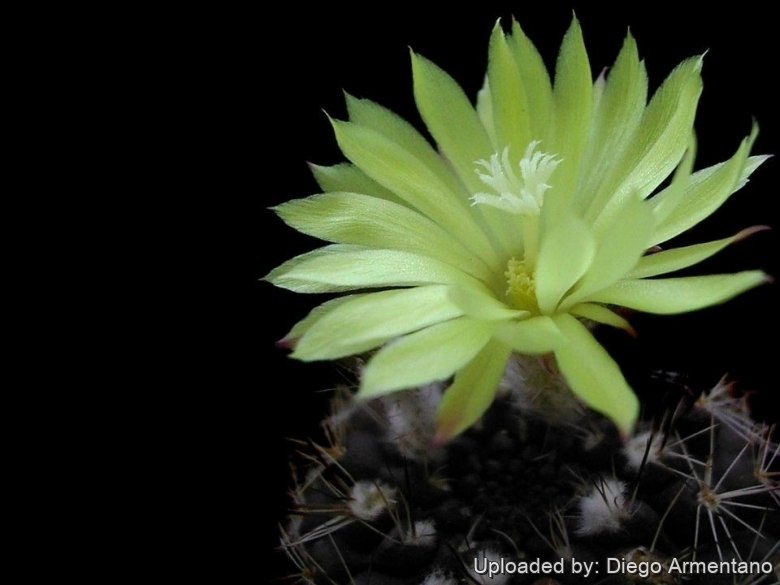
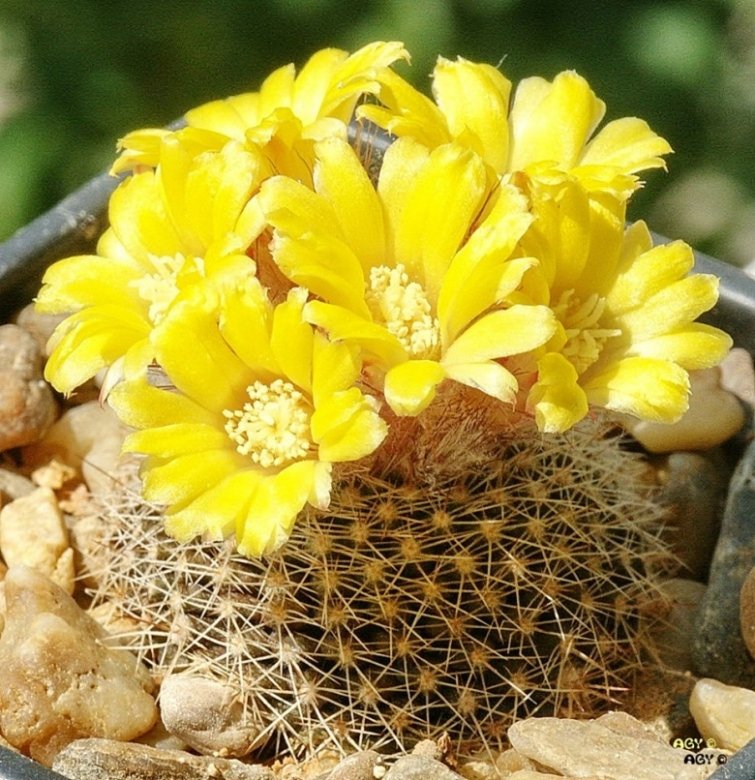
Parodia formosa is a solitary cactus species noteworthy for its ribs divided in spiralled tubercles and short, white spines. It is less flamboyant in bloom than other species of the genus and its golden yellow flowers are relatively small in comparison with its 12 cm diameter, or even larger, body.
Stem: Globose, rarely elongating in age, light green, 3-12 (or more) cm in diameter, with scanty wool apically.
Ribs: 13-26, forming more or less divided spiralled tubercles to 6 mm high.
Areoles: White.
Central spines: (1-)6-12, fine flexible, needle-like, straight, reddish brown, 3-12 mm long.
Radial spines: 20-30, lighter coloured, white or brown-tipped, 3-8 mm long.
Flowers: Sulphur yellow to orange from the top, to 1,6-4 cm long, 1,5-4,5 in diameter; pericarpels and floral tubes with white wool and often several bristles.
Blooming: Spring-Summer.
Fruits: Globose 8 mm in diameter.
Seeds: Brownish glossy.
Origin and Habitat
Jujuy and Tucumán (Argentina), and in Tarija and Santa Cruz (Bolivia). It may also occur in Salta. The known localities are far away from each other, and it is not known whether they represent isolated populations or if the species is common over all of its extent of occurrence.
Altitude: 900 to 1600 (-2200?) metres above sea level.
Habitat and Ecology: It occurs in rocky outcrops within the forests of seasonally dry inter-Andean valleys. It is locally abundant. There are no known threats to this cactus.
Cultivation and Propagation
Parodia formosa is an easy to grow tropical cactus, more cold tolerant than most and less fussy regarding soil conditions.
Growth rate: It is a relatively rapidly growing and easily flowering species that will make clumps given the best conditions.
Soils: It likes very porous standard cactus mix soil.
Repotting: Use pot with good drainage.
Watering: Water regularly in summer, but do not overwater (Rot prone), keep dry in winter.
Fertilization: Feed with a high potassium fertilizer in summer.
Hardiness: Reputedly sensitive to frost, but less so if kept on the dry side prior to, and during, cold weather (hardy to -5° C for short periods). However warmth throughout the year will increase the grower’s success (8-12°C during rest season).
Exposition: Outside bright but partially filtered sunlight or afternoon shade, inside it needs bright light, and some direct sun. Subject to sunburn if exposed to direct sun for too long. Tends to bronze in strong light, which encourages flowering and heavy wool and spine production.
Uses: It is an excellent plant for container growing. It always looks good and stays small. It look fine in a cold greenhouse and frame or outdoor in a rockery.
Pests & diseases: It may be attractive to a variety of insects, but plants in good condition should be nearly pest-free, particularly if they are grown in a mineral potting-mix, with good exposure and ventilation. Nonetheless, there are several pests to watch for:
- Red spiders: Red spiders may be effectively rubbed up by watering the plants from above.
- Mealy bugs: Mealy bugs occasionally develop aerial into the new growth among the wool with disfiguring results, but the worst types develop underground on the roots and are invisible except by their effects.
- Scales: Scales are rarely a problem.
- Rot: Rot is only a minor problem with cacti if the plants are watered and “aired” correctly. If they are not, fungicides won’t help all that much.
Propagation: Direct sow after last frost. Seeds germinate in 7-14 days at 21-27° C in spring, remove the glass cover gradually as the plants develops and keep ventilated, no full sun for young plants!
Bibliography
Major references and further lectures
-
James Cullen, Sabina G. Knees, H. Suzanne Cubey “The European Garden Flora Flowering Plants: A Manual for the Identification of Plants Cultivated in Europe, Both Out-of-Doors and Under Glass” Cambridge University Press, 11/Aug/2011
-
Edward Anderson “The Cactus family” Timber Press, Incorporated, 2001
-
Barbara Segall “Botanica: the illustrated A-Z of over 10,000 garden plants and how to cultivate them” Mynah, 1997
-
David R Hunt; Nigel P Taylor; Graham Charles; International Cactaceae Systematics Group. “The New Cactus Lexicon” dh books, 2006Jackie M. Poole, William R. Carr, Dana M. Price, Jason R. Singhurst “Rare plants of Texas: a field guide” Texas A&M University Press, 30/Dec/2007
-
Lowry, M. 2013. Parodia formosa. In: IUCN 2013. “IUCN Red List of Threatened Species.” Version 2013.2. <www.iucnredlist.org>. Downloaded on 01 January 2014.
From llifle page Parodia bellavistana
Origin and Habitat
Bolivia.
Source: Parodia bellavistana, LLIFLE - Encyclopedia of living forms, CC-BY-SA, retrieved 2026-10-25.
From llifle page Parodia winbergii
Description
Parodia winbergii is one of the varieties of Parodia formosa which is a widespread and morphologically variable taxon. It is a small globular cactus distinguished from the type species for its dwarf fresh green stems with yellow to red-brown bristle like spines, and many yellow flowers, but most botanist agree on the fact that all the varieties described until now should all be included in the Parodia formosa. Flowers appear most heavily in spring and summer from the top. Parodia winbergii belongs to a group of very easily cultivated plants, decorative with pleasing appearance of stem and flower alike.
Origin and Habitat
Valle Grande to San Francisco, Jujuy, Argentina
Altitude range: 1200-1900 metres above sea level.
Cultivation and Propagation
Parodia winbergii is an easy to grow tropical cactus, more cold tolerant than most and less fussy regarding soil conditions.
Growth rate: It is a relatively rapidly growing and easily flowering species that will make clumps given the best conditions.
Soils: It likes very porous standard cactus mix soil.
Repotting: Use pot with good drainage.
Watering: Water regularly in summer, but do not overwater (Rot prone), keep dry in winter.
Fertilization: Feed with a high potassium fertilizer in summer.
Hardiness: Reputedly sensitive to frost, but less so if kept on the dry side prior to, and during, cold weather (hardy to -5° C for short periods). However warmth throughout the year will increase the grower’s success (8-12°C during rest season).
Exposition: Outside bright but partially filtered sunlight or afternoon shade, inside it needs bright light, and some direct sun. Subject to sunburn if exposed to direct sun for too long. Tends to bronze in strong light, which encourages flowering and heavy wool and spine production.
Uses: It is an excellent plant for container growing. It always looks good and stays small. It look fine in a cold greenhouse and frame or outdoor in a rockery.
Pests & diseases: It may be attractive to a variety of insects, but plants in good condition should be nearly pest-free, particularly if they are grown in a mineral potting-mix, with good exposure and ventilation. Nonetheless, there are several pests to watch for:
- Red spiders: Red spiders may be effectively rubbed up by watering the plants from above.
- Mealy bugs: Mealy bugs occasionally develop aerial into the new growth among the wool with disfiguring results, but the worst types develop underground on the roots and are invisible except by their effects.
- Scales: Scales are rarely a problem.
- Rot: Rot is only a minor problem with cacti if the plants are watered and “aired” correctly. If they are not, fungicides won’t help all that much.
Propagation: Direct sow after last frost. Seeds germinate in 7-14 days at 21-27° C in spring, remove the glass cover gradually as the plants develops and keep ventilated, no full sun for young plants!
Bibliography
Major references and further lectures
- Weskamp W. 1996 “Parodia winbergii Weskamp spec. nov.” Kakt. And. Sukk. 47. (7): 157-159 (1996)
Source: Parodia winbergii, LLIFLE - Encyclopedia of living forms, CC-BY-SA, retrieved 2026-10-25.