Publication: Cactaceae Consensus Init. 4: 6. 1997 [Oct 1997]
From llifle page Echinocactus polyacanthus
Description
Usually solitary (in the standard form), or branching.
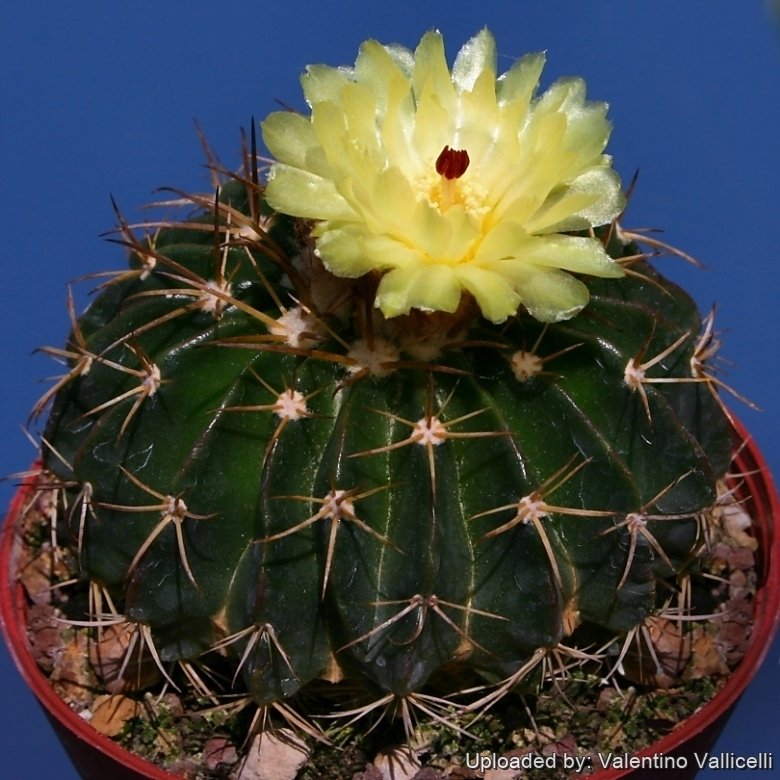
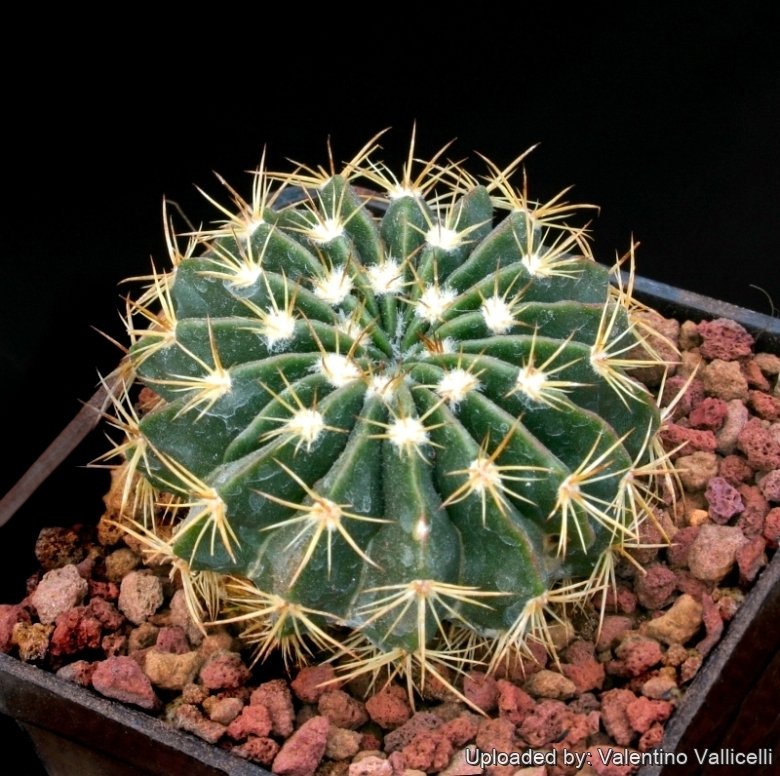
Stem: Bright or dark green, globose to short cylindrical. The apex is depressed and filled with whitish-grey wool.
Ribs: Well marked and sharp, with scarcely prominent chinned tubercles. The crest of the ribs typically take on a purple red hue in full sun.
Areoles: Well spaced, woolly, recessed .
Spines: Several, yellowish, strong, about 20-25 mm long, spreading or curved down and backward.
Flowers: Small, lemon yellow with glossy shining petals, up to about 2-3 cm in diameter, standing near the top, and decorated with a red pistil which emphasizes the yellow of the petals. The buds are tomentose.
Blooming season: They bloom annually around June-July.
Remarks: Notocactus langsdorfi, together with the subordinated taxa (‘leprosorum’, ‘longispinum’, ‘pulvinatus’, ediewarasii’, ‘multiceps’ and ‘prolifer’), form a group of very similar and controversial southern Brasilian plants bearing small flowers and strong spination.
Origin and Habitat
Southern Brazil, Rio Grande do Sul.
Habitat: This species usually grows between rocks.
Cultivation and Propagation
It is easy to grow. They like a warm bright location, does great in partial shade avoid full sun. They need good drainage and prefer a neutral to slightly acidic compost with plenty of extra grit. Water and feed during the summer. Best if watered with rain water. Keep above 0°C and rather dry in winter, rot easily if the substrate is wet and cold, tends to lose its roots in winter.
Propagation: Seeds
Source: Echinocactus polyacanthus, LLIFLE - Encyclopedia of living forms, CC-BY-SA, retrieved 2026-10-25.