Publication: Kakteen (Berger) 344. 1929 (Often mispelled: maassi, masii, masi, massii or massi)
Description
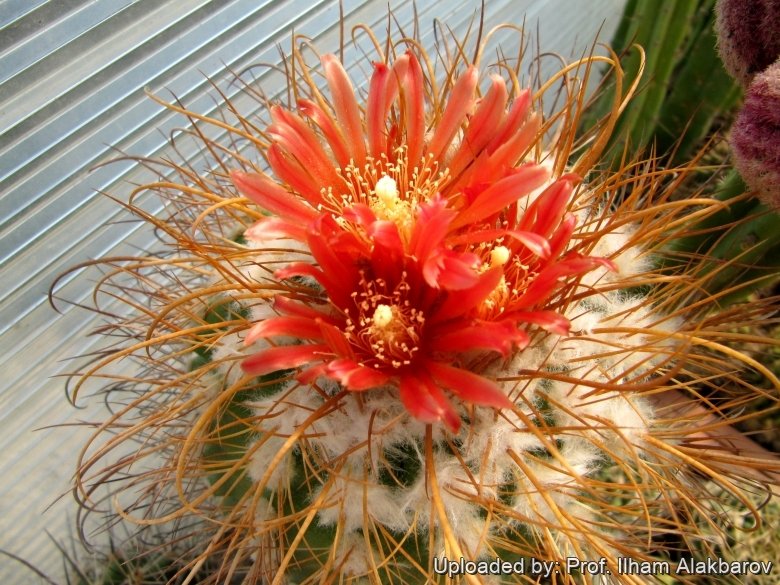
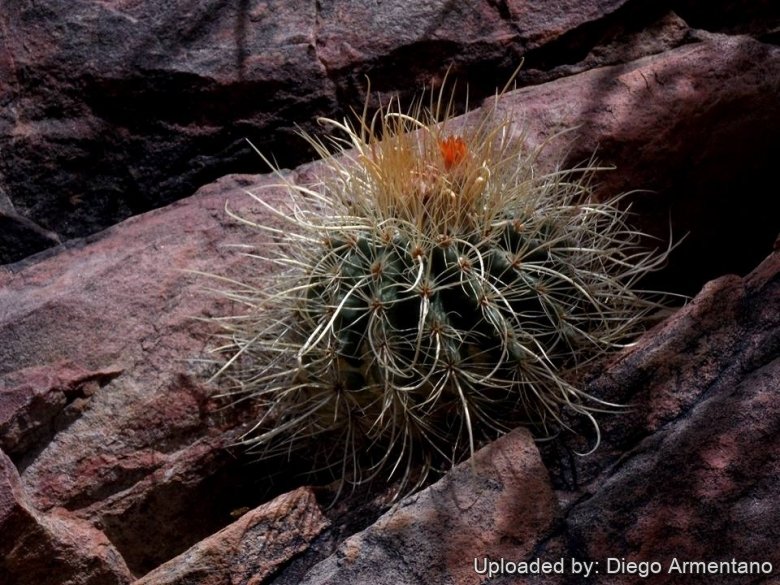
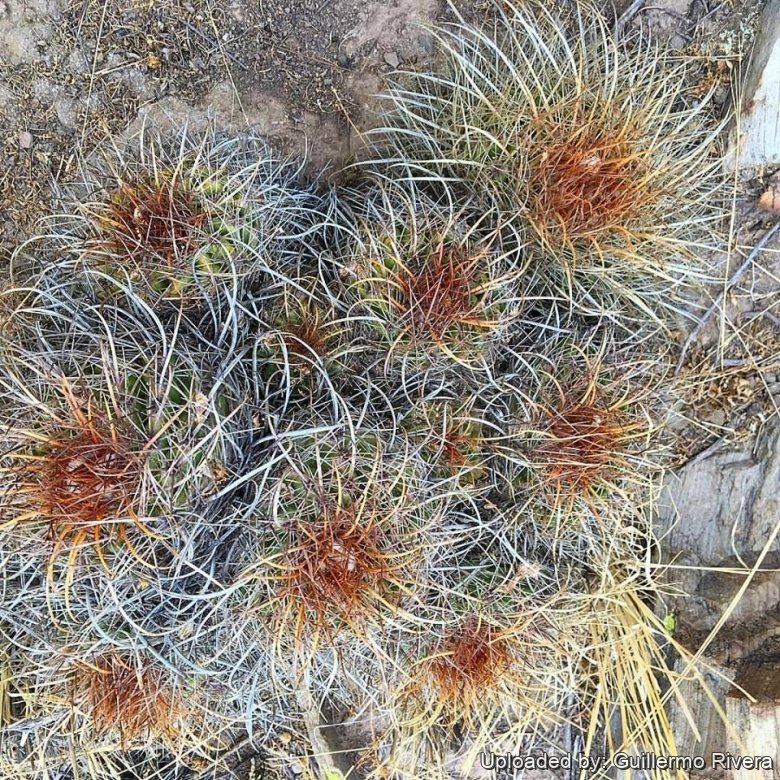
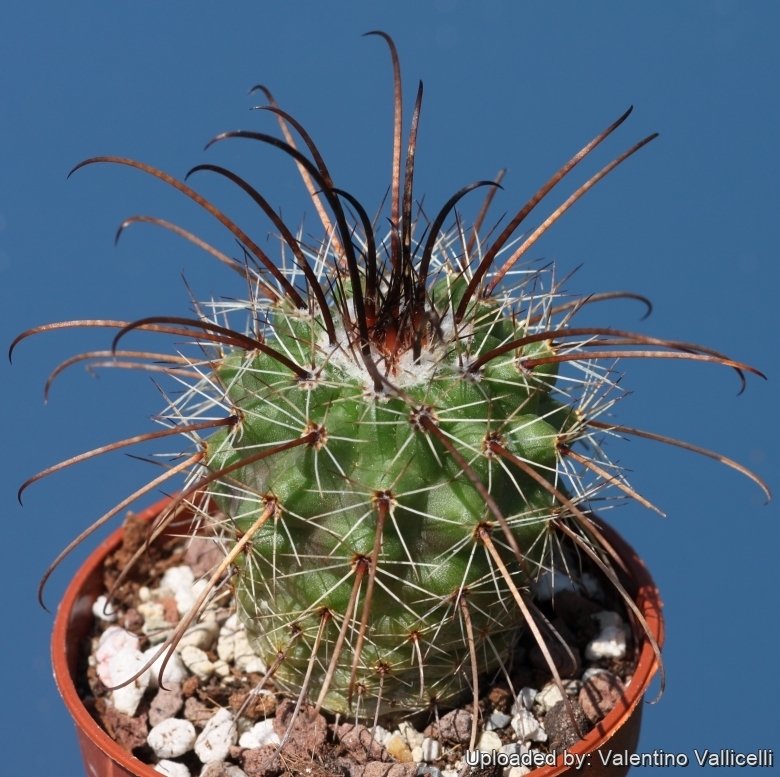
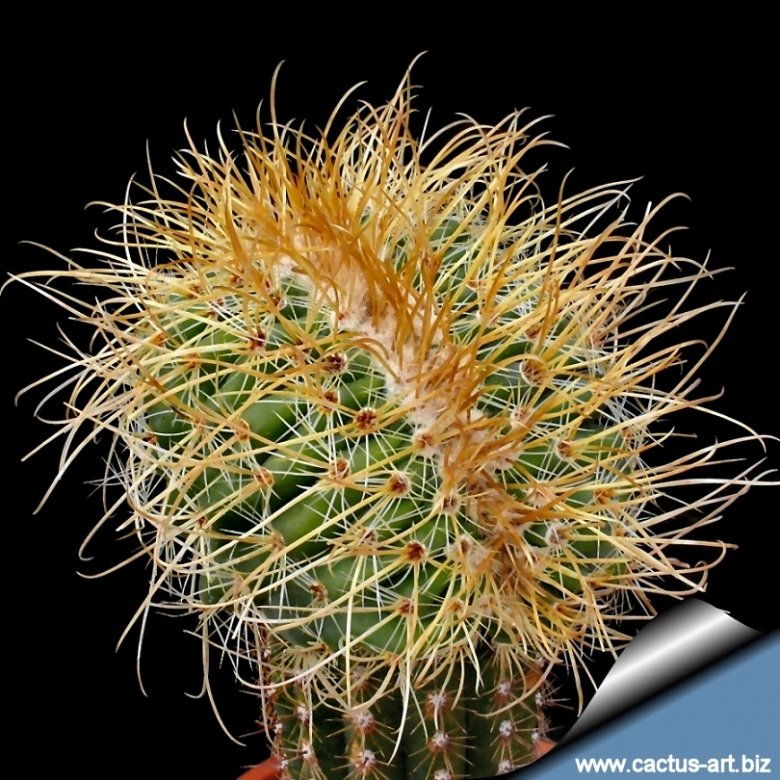
Parodia maassii is a small globular South American cactus species with long hooked spines and yellow to red flowers. The extensive distribution range of this species has led to the formation of many local forms or varieties which in the years have been formally named. Most of these names are not accepted by many botanists that treat them as synonyms, but they still have a value for a collector because they identify plants with particular characters.
Habit: Solitary or clumping.
Stem: The plant presents an extended spherical stem, mid-green to intense green in colour, 15 cm. wide, with the apical part densely covered with white wool.
Ribs: 13- 21, chinned and arranged in spiral.
Areoles: Big and woolly at first, but they become naked with age.
Spines: Curved, dense, and variably coloured (yellowish or amber, but also white, pale to dark brown, brick red or nearly black).
Radial spines: 8-10 (or more). Usually yellowish or amber at first and white later, 5-10 mm. long, opened on the outside and a little curved inwardly.
Central spines: 1-4 (or more), strong, measuring between 3 and 7 cm. They are yellow on the upper part of the plant and go upwards. In older parts they become clear yellow, and go downwards.
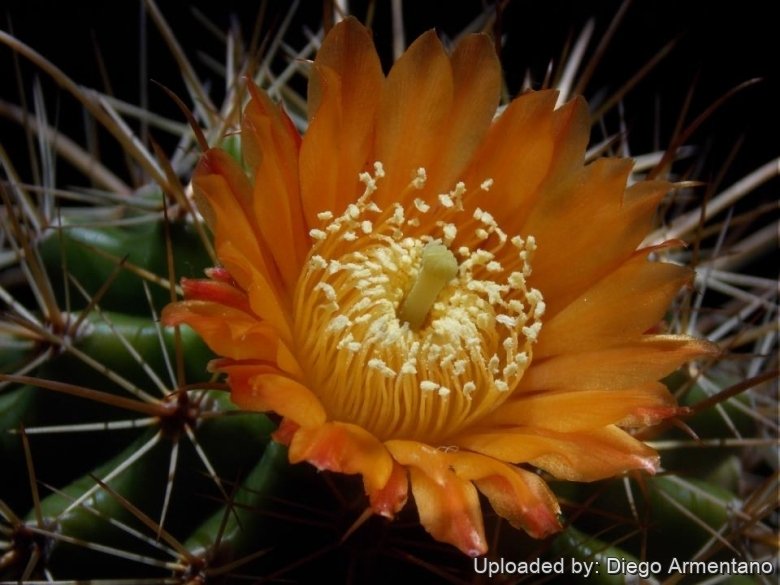
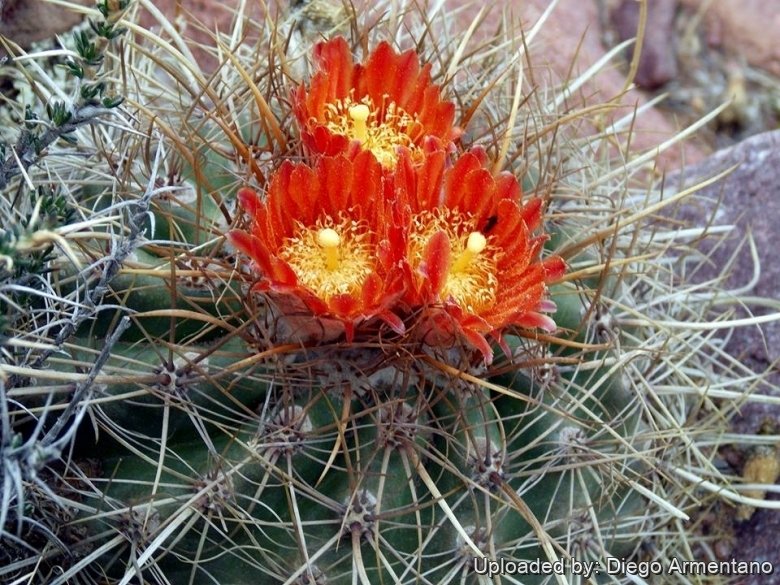
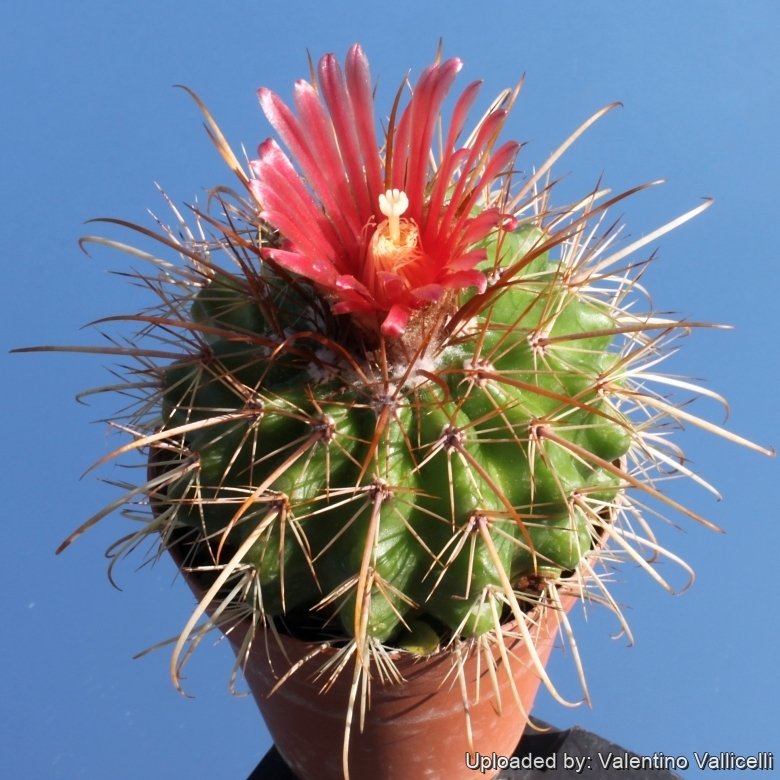
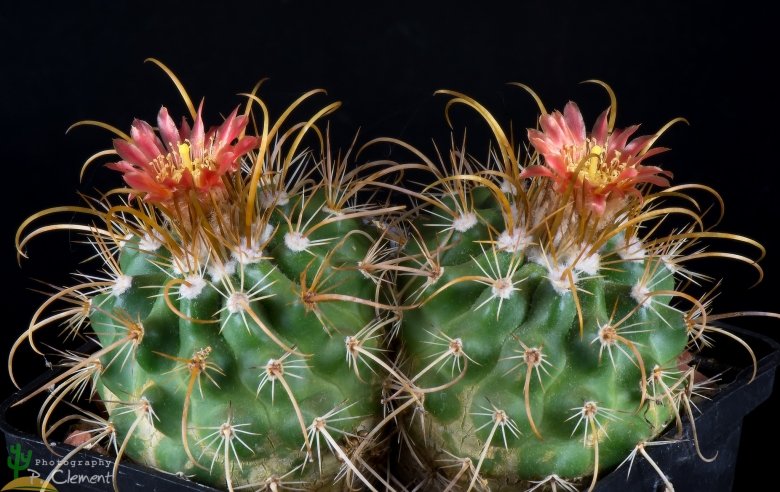
Flowers: Funnel-shaped, large coppery-yellow or orange, but they can also be carmine or red with an orange centre. 3 (or more) cm across.
Blooming season: Spring and summer, they usually appear one by one in succession.
Origin and Habitat
It is native to Southern Bolivia (This species occurs in Argentina in Jujuy and Salta, and in Bolivia (Chuquisaca, Oruro, Potosi and Tarija). The species is widespread and common.
Altitude: It grows at elevations of 3,000 to 4,200 metres above sea level.
Habitat and Ecology: Parodia maassii grows in high altitude grasslands on rocky outcrops. It is is widespread and common. It locally collected but this is not a major threat. It is locally threatened by sheep overgrazing
Cultivation and Propagation
Parodia maassii is relatively easy to grow on its own roots and quite resistant to cultivation. The only things that can kill this plant are cold and overwatering. Nevertheless, it is appropriate to provide adequate growing conditions in order to obtain compact plant with many flowers.
Soil: Use a an open and free draining mineral compost with little organic matter (peat, humus) that allows therefore roots to breath (as it is rot prone). Outdoors a well-draining rocky or sandy soil is ideal.
Pots: It needs a relatively shallow pot to accommodate its fibrous roots and provide a very good drainage. It may stay in the same pot for many years.
Watering: Regular water in summer. Keep rather dry in winter, except for a quick, periodic misting on warmer days in late winter. It rots easily if the substrate is wet and cold, and tends to lose its roots in winter.
Fertilization: Fertilize with a low nitrogen fertilizer every 6 to 8 weeks, from mid-spring to late summer.
Hardiness: Keep dry at 5- 10° C in winter, but can tolerate sporadic light frost if kept on the dry side prior to, and during, cold weather.
Exposition: The plant tolerates very bright situations, if kept too dark they may become overly lush and greener and could be prone to rotting due to over watering. Strong light encourages flowering and heavy wool and spine production, but is likely to suffer from sun scorch or stunted growth if over exposed to direct sunlight during the hottest part of the day in summer. If your climate is warm enough to grow this plant outside, be sure that soil is well drained and sun if full, but with protection from strong mid-day rays.
Pests & diseases: It may be attractive to a variety of insects, but plants in good condition should be nearly pest-free, particularly if they are grown in a mineral potting-mix, with good exposure and ventilation. Nonetheless, watch carefully for any significant decline in health. This may signal a pest problem that should be dealt with quickly in order to prevent scarring, stunting and even death.
- Red spiders: Red spiders may be effectively rubbed up by watering or misting the plants from above.
- Mealy bugs: Mealy bugs occasionally develop aerial into the new growth among the leaves with disfiguring results, but the worst types develop underground on the roots and are invisible except by their effects. Eliminate mealybug infestations by dabbing the critters with cotton swabs dipped in alcohol or by soaking the succulent’s roots in a systemic insecticide.
- Scales: Scales are rarely a problem.
- Rot: This species is particularly easy and accommodating, seldom suffer of cryptogamic diseases. Rot it is only a minor problem with cacti if the plants are watered and “aired” correctly. If they are not, fungicides won’t help all that much.
Propagation: By Seeds. The seeds of this plant are extremely small, and must be sown on the surface of the germination substrate (not buried!!) But the seedlings after germination are so minuscule and delicate that it is quite problematic to keep them alive. So for this species one usually uses the baggy germination technique (in a sterilized pot hermetically closed in a plastic bag.
Bibliography
Major references and further lectures
-
James Cullen, Sabina G. Knees, H. Suzanne Cubey “The European Garden Flora Flowering Plants: A Manual for the Identification of Plants Cultivated in Europe, Both Out-of-Doors and Under Glass” Cambridge University Press, 11/Aug./2011
-
David Hunt, Nigel Taylor “The New Cactus Lexicon” DH Books, 2006
-
Edward F. Anderson “The Cactus Family” Timber Press, 2001
-
Kiesling, R., Lowry, M. & Ortega-Baes, P. 2013. Parodia maassii. The IUCN Red List of Threatened Species 2013: e.T151775A560046. . Downloaded on 27 February 2016.
From llifle page Parodia maxima
Description
Parodia maxima is one of the innumerable form of Parodia maassii which is one of the most widespread and morphologically variable taxon. It is a small globular cactus distinguished from the type species for its longer cream to straw-yellow hooked spines and yellow flowers and, as its name suggests, this is one of the largest forms, which in time will make an impressive plant for the show bench. The names Parodia maxima is not accepted by many botanists that treat it as synonym, but it still has a value for a collector because they identify plants with particular characters.
Habit: Solitary cactus (unless injured) until very old age, or with few branches from ground level when old.
Stem: The plant presents an extended spherical stem, mid-green to intense green in colour, 15 cm wide, with the apical part densely covered with white wool.
Ribs: 13- 21, chinned and arranged in spiral.
Areoles: Big and woolly at first, but they become naked with age.
Spines: Curved, dense, and variably coloured.
Radial spines: 8-10 (or more). Usually yellowish or amber at first and white later, 5-10 mm. long, opened on the outside and a little curved inwardly.
Central spines: 1-4 (or more), strong, up to 7 cm long brown and go upwards. In older parts they become greysh, and go downwards.
Flowers: Funnel-shaped, large coppery-red, carmine or red, 3 (or more) cm across.
Blooming season: Spring and summer, they usually appear one by one in succession.
Origin and Habitat
Cieneguillas, Paicho Valley, and adjacent areas, Tarija, Bolivia
Altitude: 2600-3700(-4000) metres above sea level.
Habitat: Steep slopes, gravelly hills and flat rocky areas
Cultivation and Propagation
Parodia maxima is relatively easy to grow on its own roots and quite resistant to cultivation. The only things that can kill this plant are cold and overwatering. Nevertheless, it is appropriate to provide adequate growing conditions in order to obtain compact plant with many flowers.
Soil: Use a an open and free draining mineral compost with little organic matter (peat, humus) that allows therefore roots to breath (as it is rot prone). Outdoors a well-draining rocky or sandy soil is ideal.
Pots: It needs a relatively shallow pot to accommodate its fibrous roots and provide a very good drainage. It may stay in the same pot for many years.
Watering: Regular water in summer. Keep rather dry in winter, except for a quick, periodic misting on warmer days in late winter. It rots easily if the substrate is wet and cold, and tends to lose its roots in winter.
Fertilization: Fertilize with a low nitrogen fertilizer every 6 to 8 weeks, from mid-spring to late summer.
Hardiness: Keep dry at 5- 10° C in winter, but can tolerate sporadic light frost if kept on the dry side prior to, and during, cold weather.
Exposition: The plant tolerates very bright situations, if kept too dark they may become overly lush and greener and could be prone to rotting due to over watering. Strong light encourages flowering and heavy wool and spine production, but is likely to suffer from sun scorch or stunted growth if over exposed to direct sunlight during the hottest part of the day in summer. If your climate is warm enough to grow this plant outside, be sure that soil is well drained and sun if full, but with protection from strong mid-day rays.
Pests & diseases: It may be attractive to a variety of insects, but plants in good condition should be nearly pest-free, particularly if they are grown in a mineral potting-mix, with good exposure and ventilation. Nonetheless, watch carefully for any significant decline in health. This may signal a pest problem that should be dealt with quickly in order to prevent scarring, stunting and even death.
- Red spiders: Red spiders may be effectively rubbed up by watering or misting the plants from above.
- Mealy bugs: Mealy bugs occasionally develop aerial into the new growth among the leaves with disfiguring results, but the worst types develop underground on the roots and are invisible except by their effects. Eliminate mealybug infestations by dabbing the critters with cotton swabs dipped in alcohol or by soaking the succulent’s roots in a systemic insecticide.
- Scales: Scales are rarely a problem.
- Rot: This species is particularly easy and accommodating, seldom suffer of cryptogamic diseases. Rot it is only a minor problem with cacti if the plants are watered and “aired” correctly. If they are not, fungicides won’t help all that much.
Propagation: By Seeds. The seeds of this plant are extremely small, and must be sown on the surface of the germination substrate (not buried!!) But the seedlings after germination are so minuscule and delicate that it is quite problematic to keep them alive. So for this species one usually uses the baggy germination technique (in a sterilized pot hermetically closed in a plastic bag.
Bibliography
Major references and further lectures
-
James Cullen, Sabina G. Knees, H. Suzanne Cubey “The European Garden Flora Flowering Plants: A Manual for the Identification of Plants Cultivated in Europe, Both Out-of-Doors and Under Glass” Cambridge University Press, 11/Aug./2011
-
David Hunt, Nigel Taylor “The New Cactus Lexicon” DH Books, 2006
-
Edward F. Anderson “The Cactus Family” Timber Press, 2001
Source: Parodia maxima, LLIFLE - Encyclopedia of living forms, CC-BY-SA, retrieved 2026-10-25.
From llifle page Parodia suprema
Description
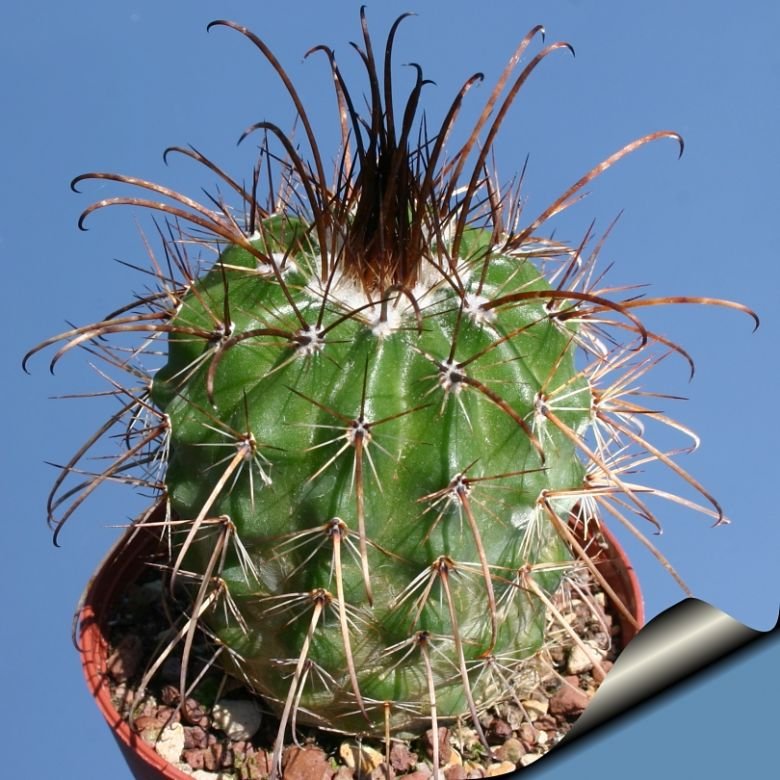
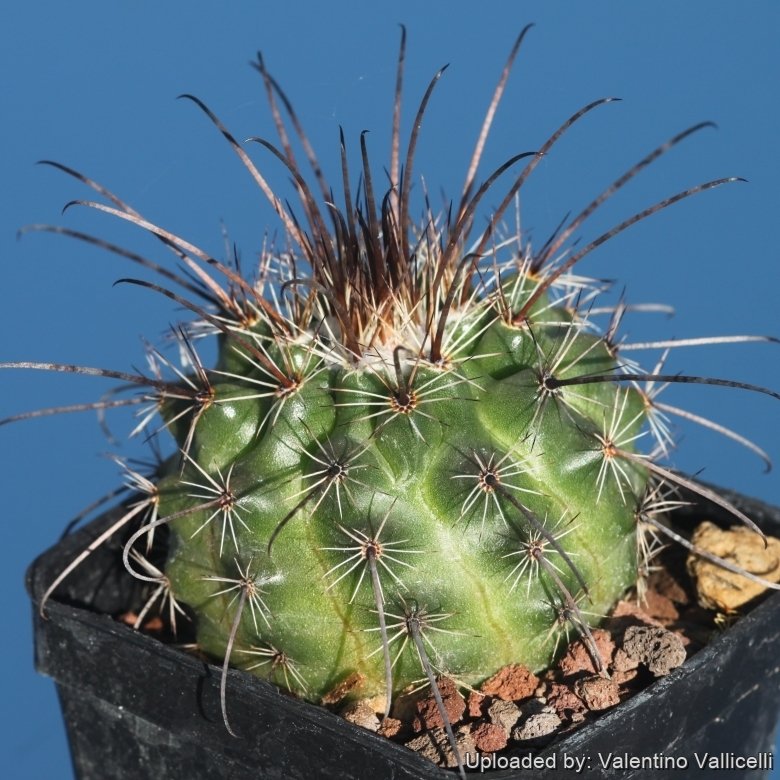
Parodia suprema is one of the innumerable forms of Parodia maassii which is one of the most widespread and morphologically variable taxon. It is a small globular cactus distinguished from the type species for its longer brown hooked spines and red flowers. The names Parodia suprema is not accepted by many botanists that treat it as synonym, but it still has a value for a collector because they identify plants with particular characters.
Habit: Solitary cactus (unless injured) until very old age, or with few branches from ground level when old.
Stem: The plant presents an extended spherical stem, mid-green to intense green in colour, 15 cm wide, with the apical part densely covered with white wool.
Ribs: 13- 21, chinned and arranged in spiral.
Areoles: Big and woolly at first, but they become naked with age.
Spines: Curved, dense, and variably coloured.
Radial spines: 8-10 (or more). Usually yellowish or amber at first and white later, 5-10 mm. long, opened on the outside and a little curved inwardly.
Central spines: 1-4 (or more), strong, up to 7 cm long brown and go upwards. In older parts they become greysh, and go downwards.
Flowers: Funnel-shaped, large coppery-red, carmine or red, 3 (or more) cm across.
Blooming season: Spring and summer, they usually appear one by one in succession.
Origin and Habitat
Paichu-valley, Sama Pass to Iscayachi and adjacent areas, Tarija, Bolivia
Altitude: (2700-)3050-3600 metres above sea level.
Habitat: It grows under extreme environmental conditions in steep stony slopes and gravelly hills, together with Gymnocalycium armatum, Parodia iscayachensis, Parodia maxima, and Oreocereus celsianus.
Cultivation and Propagation
Parodia suprema is relatively easy to grow on its own roots and quite resistant to cultivation. The only things that can kill this plant are cold and overwatering. Nevertheless, it is appropriate to provide adequate growing conditions in order to obtain compact plant with many flowers.
Soil: Use a an open and free draining mineral compost with little organic matter (peat, humus) that allows therefore roots to breath (as it is rot prone). Outdoors a well-draining rocky or sandy soil is ideal.
Pots: It needs a relatively shallow pot to accommodate its fibrous roots and provide a very good drainage. It may stay in the same pot for many years.
Watering: Regular water in summer. Keep rather dry in winter, except for a quick, periodic misting on warmer days in late winter. It rots easily if the substrate is wet and cold, and tends to lose its roots in winter.
Fertilization: Fertilize with a low nitrogen fertilizer every 6 to 8 weeks, from mid-spring to late summer.
Hardiness: Keep dry at 5- 10° C in winter, but can tolerate sporadic light frost if kept on the dry side prior to, and during, cold weather.
Exposition: The plant tolerates very bright situations, if kept too dark they may become overly lush and greener and could be prone to rotting due to over watering. Strong light encourages flowering and heavy wool and spine production, but is likely to suffer from sun scorch or stunted growth if over exposed to direct sunlight during the hottest part of the day in summer. If your climate is warm enough to grow this plant outside, be sure that soil is well drained and sun if full, but with protection from strong mid-day rays.
Pests & diseases: It may be attractive to a variety of insects, but plants in good condition should be nearly pest-free, particularly if they are grown in a mineral potting-mix, with good exposure and ventilation. Nonetheless, watch carefully for any significant decline in health. This may signal a pest problem that should be dealt with quickly in order to prevent scarring, stunting and even death.
- Red spiders: Red spiders may be effectively rubbed up by watering or misting the plants from above.
- Mealy bugs: Mealy bugs occasionally develop aerial into the new growth among the leaves with disfiguring results, but the worst types develop underground on the roots and are invisible except by their effects. Eliminate mealybug infestations by dabbing the critters with cotton swabs dipped in alcohol or by soaking the succulent’s roots in a systemic insecticide.
- Scales: Scales are rarely a problem.
- Rot: This species is particularly easy and accommodating, seldom suffer of cryptogamic diseases. Rot it is only a minor problem with cacti if the plants are watered and “aired” correctly. If they are not, fungicides won’t help all that much.
Propagation: By Seeds. The seeds of this plant are extremely small, and must be sown on the surface of the germination substrate (not buried!!) But the seedlings after germination are so minuscule and delicate that it is quite problematic to keep them alive. So for this species one usually uses the baggy germination technique (in a sterilized pot hermetically closed in a plastic bag.
Source: Parodia suprema, LLIFLE - Encyclopedia of living forms, CC-BY-SA, retrieved 2026-10-25.
From llifle page Parodia commutans var. maxima f. cristata
Description
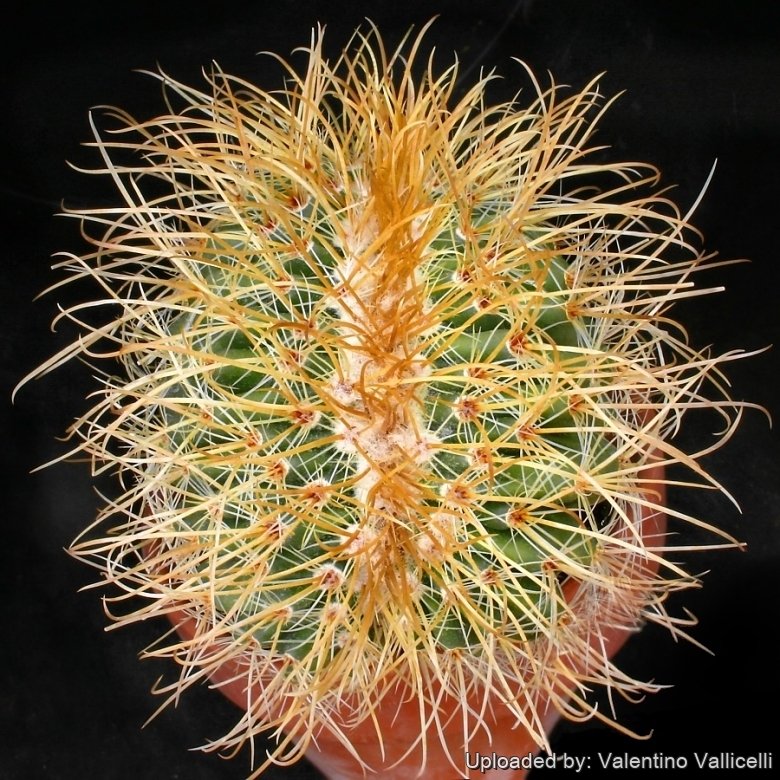
Parodia maxima is one of the innumerable form of Parodia maassii which is one of the most widespread and morphologically variable taxon. It is a globular cactus distinguished from the type species for its longer cream to straw-yellow hooked spines and yellow flowers. As its name suggests, this is one of the largest forms, which in time will make an impressive plant. The crested form Parodia maxima f. cristata - despite to its beauty - is still very rare and sought after by collectors, for its long and showy central spines.
Stem: Fan shaped, flattened on top, depressed along the line meristem, mid-green to intense green in colour, up to 15 cm thick, with the apical part densely covered with white wool.
Ribs: Chinned.
Areoles: Big and woolly at first, but they become naked with age.
Spines: Curved, dense, and variably coloured.
Radial spines: 8-10 (or more). Usually creamy-white, yellowish or amber at first and white later, 5-10 mm long, opened on the outside and a little curved inwardly.
Central spines: 1-4 (or more), strong, up to 7 cm long creamy-yellw to straw coloured and go upwards. In older parts they become greyish, and go downwards.
Flowers: Funnel-shaped, large usually yellow, 3 (or more) cm across.
Blooming season: Spring and summer, they usually appear one by one in succession.
Origin and Habitat
Garden origin (Nursery produced cultivar) The wild typecomes from the high mountains from Carrizal to Oroya in Bolivia.
Cultivation and Propagation
Although regarded as a choice and difficult plant is not too difficult in a greenhouse, although grows quite slowly. It is sometime seen as a grafted plant but grows very well on its own roots too.
Soil: Use mineral well permeable mineral soil with little organic matter (peat, humus).
Exposure: They need a good amount of light shade to full sun this help to keep the plants healthy, although slow growth.
Watering: Water sparingly from March till October (weekly during summertime, if the weather is sunny enough) , with a little fertilizer added. Less or no water during cold winter months, or when night temperatures remain below 10° to prevent root loss. It is sensitive to overwatering (rot prone).
Fertilization: Feeding may not be necessary at all if the compost is fresh then, feed in summer only if the plant hasn’t been repotted recently. Do not feed the plants from September onwards as this can cause lush growth which can be fatal during the darker cold months.
Hardiness: Keep perfectly dry in winter at temperatures from 5 to 15 degrees centigrade. (but it is relatively cold resistant and hardy to -5° C, or possibly colder for short periods) In the rest period no high atmospheric humidity!! (Temperature Zone: USDA 9-11)
Crested growth: Unlike ‘monstrose’ varieties of plants, where the variation from normal growth is due to genetic mutation, crested growth can occur on normal plants. Sometimes it’s due to variances in light intensity, or damage, but generally the causes are unknown. A crested plant may have some areas growing normally, and a cresting plant that looks like a brain, may revert to normal growth for no apparent reason. If you have any of the crested part left you need to remove the normal growth and leave the crested part behind this will need to be done regularly.
Propagation: Grafting or cuttings. Plants are usually grafted onto column-shaped cacti but proved to be able to produce their own roots if degrafted. Cuttings will take root in a minimum temperature of 20° C (but better in hot weather). Cuttings of healthy shoots can be taken in the spring and summer. Cut the stem with a sharp, sterile knife, leave the cutting in a warm, dry place for a week or weeks (depending on how thick the cutting is) until a callus forms over the wound. Once the callus forms, the cutting may be inserted in a container filled with firmed cactus potting mix topped with a surface layer of coarse grit. They should be placed in the coarse grit only; this prevents the cut end from becoming too wet and allows the roots to penetrate the rich compost underneath. The cuttings should root in 2 to 6 weeks. Large crested piece must be placed on the soil surface without burying the plant base down in the soil.
Source: Parodia commutans var. maxima f. cristata, LLIFLE - Encyclopedia of living forms, CC-BY-SA, retrieved 2026-10-25.
Cultivars and forms (2)
Gallery