Publication: Anales Soc. Ci. Argent. 96: 70. 1923
Description
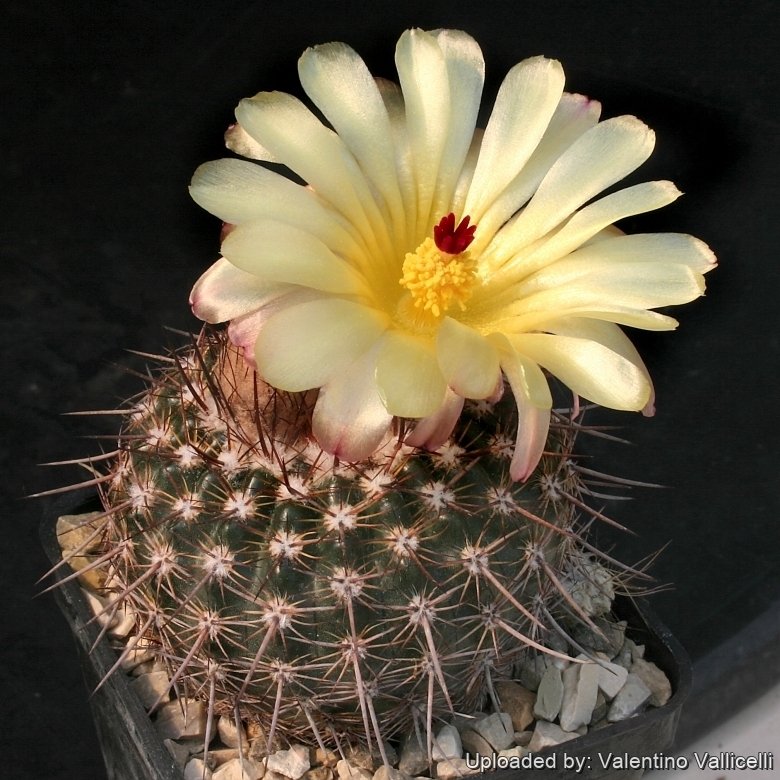
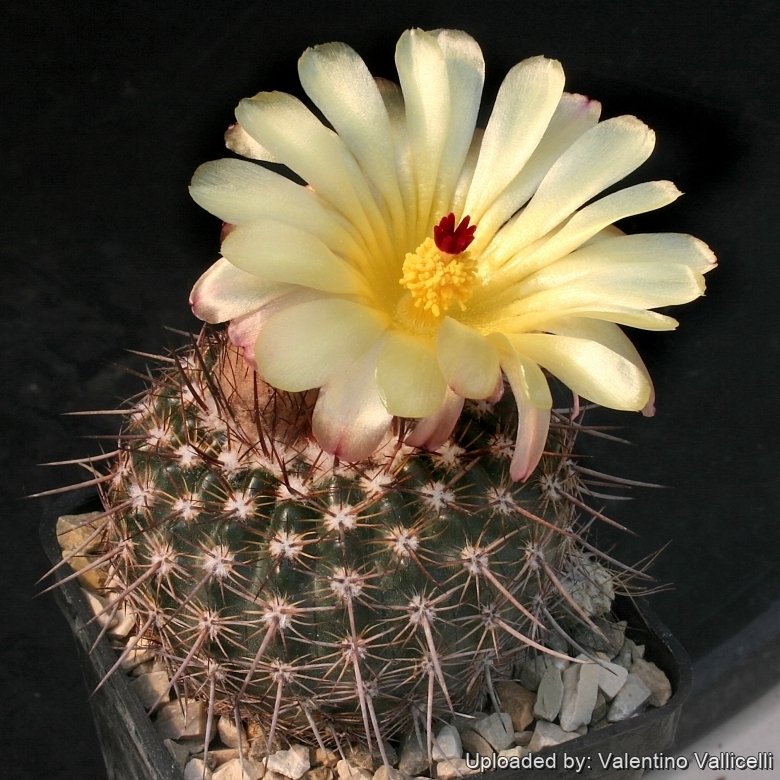
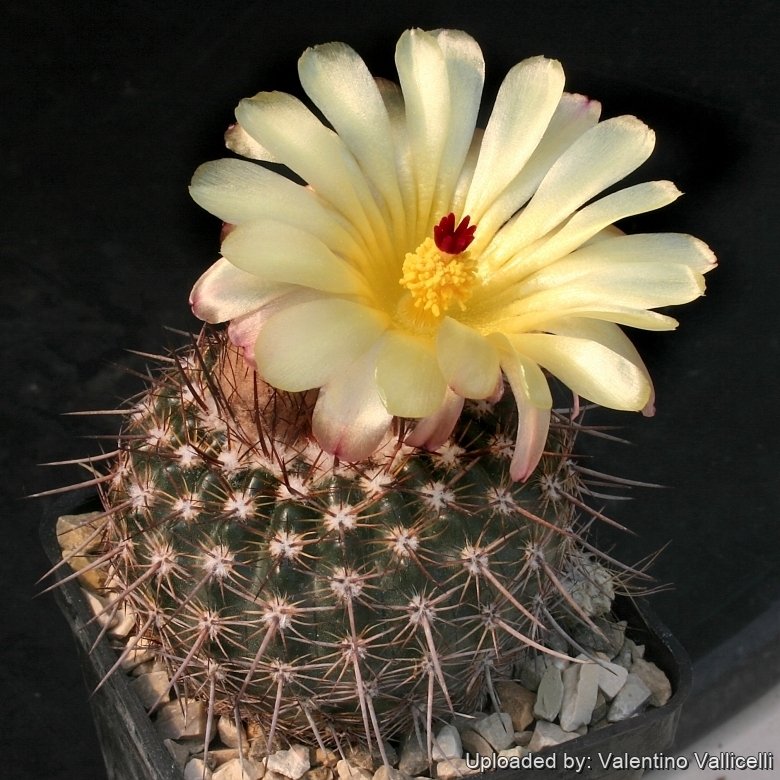
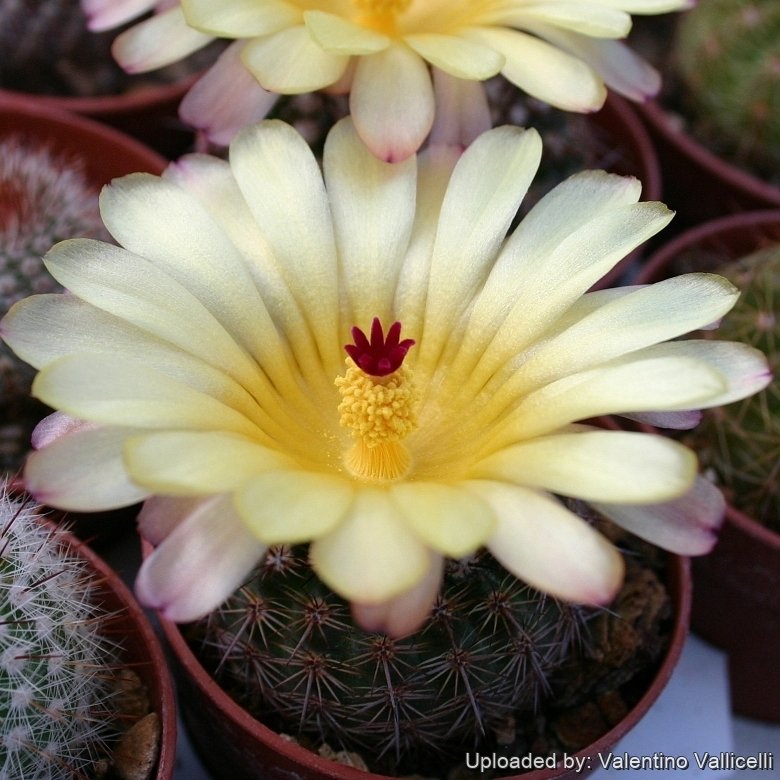
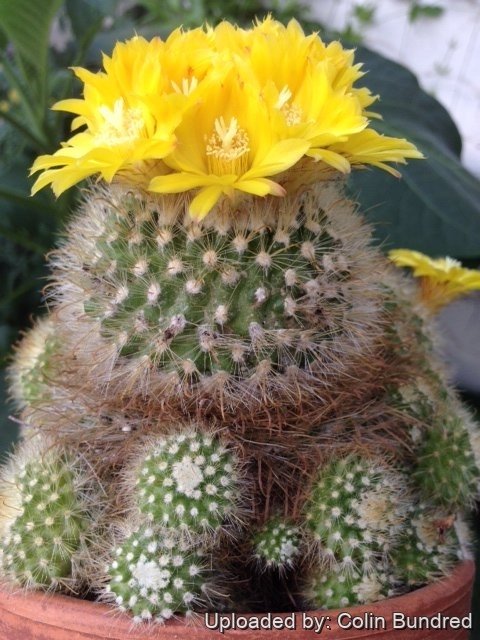
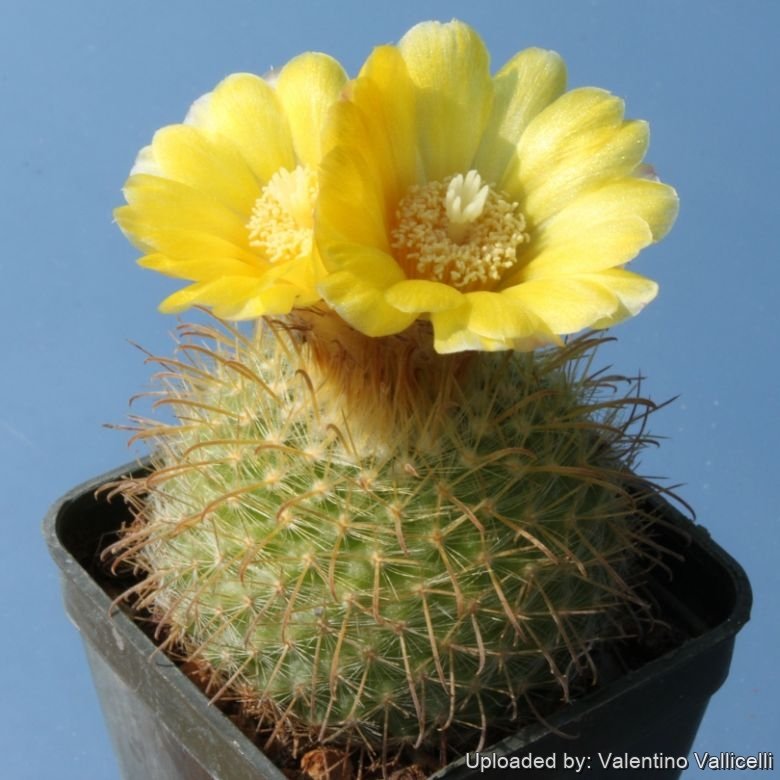
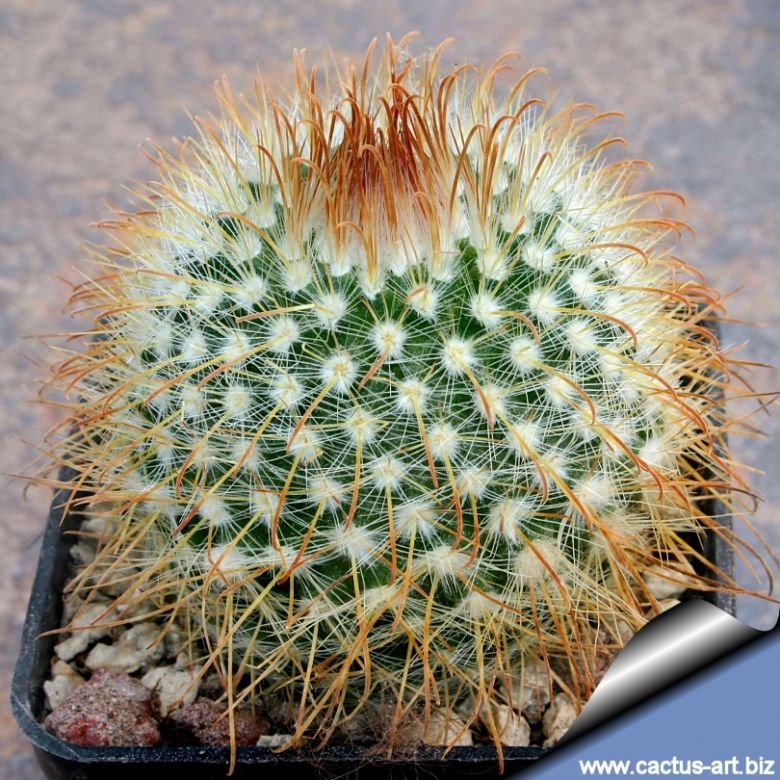
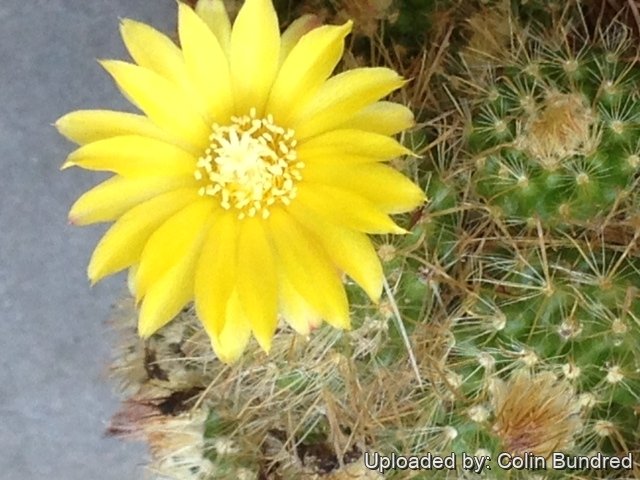
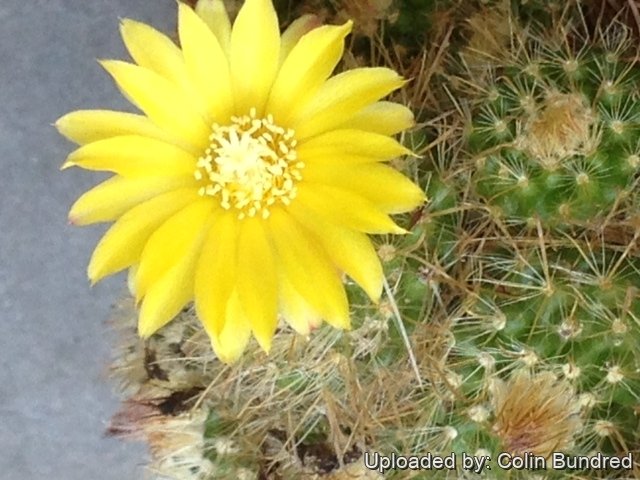
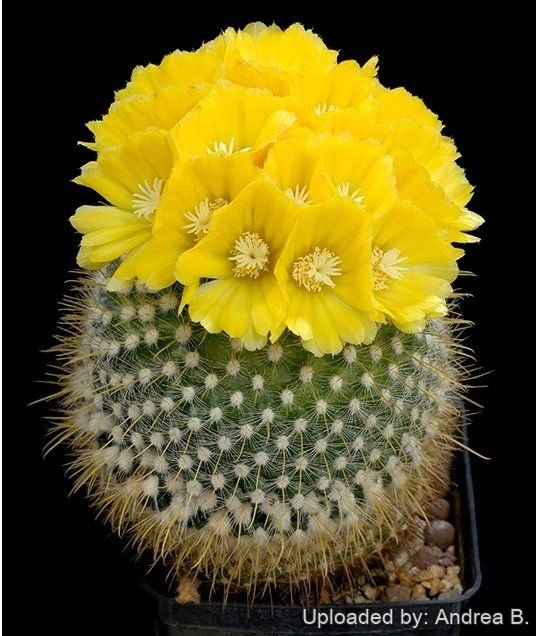
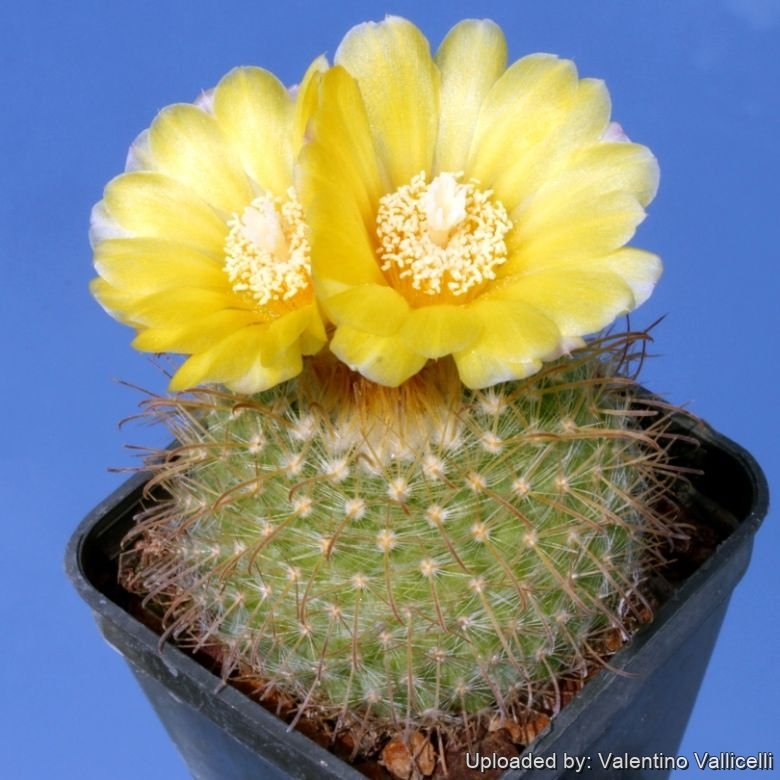
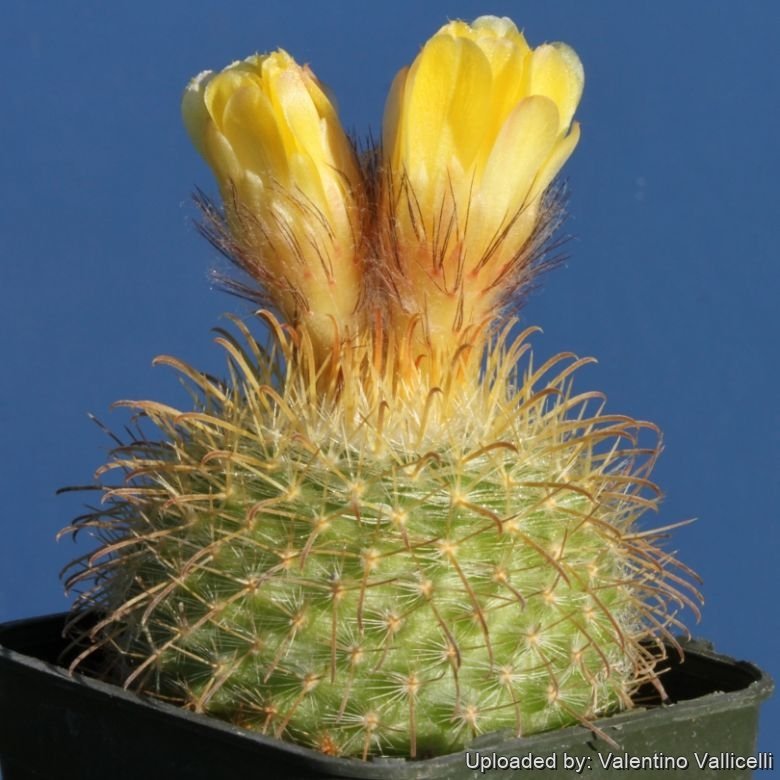
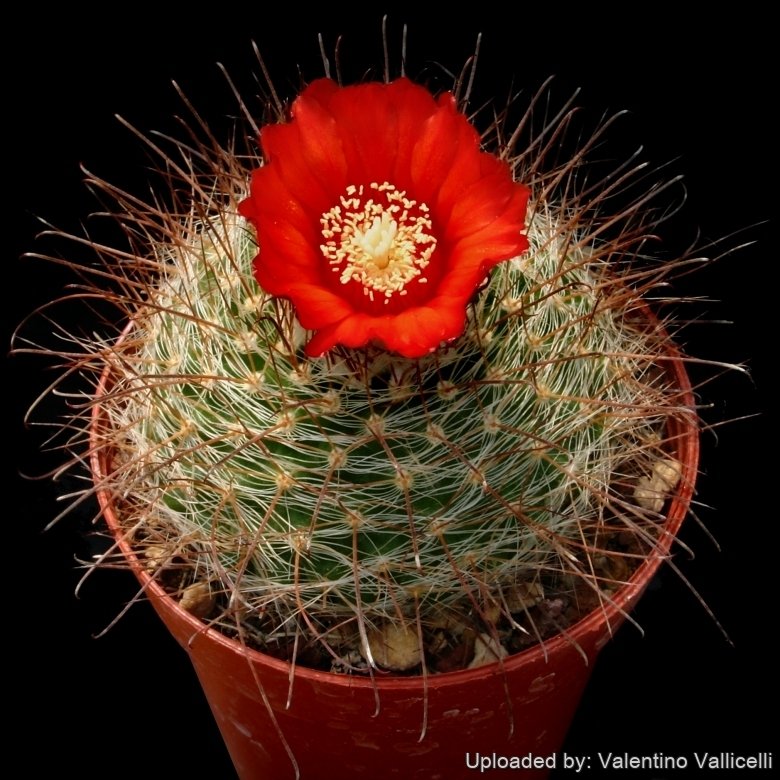
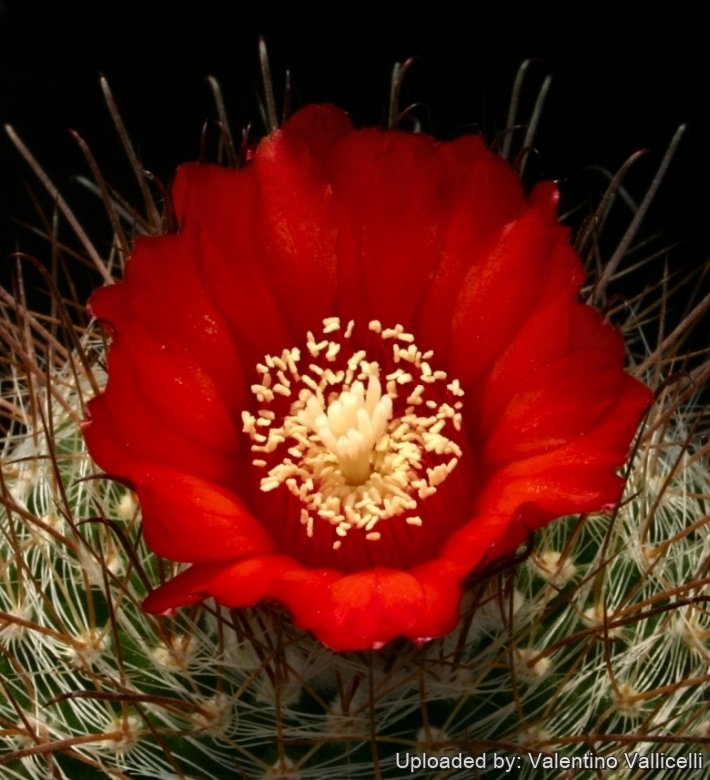
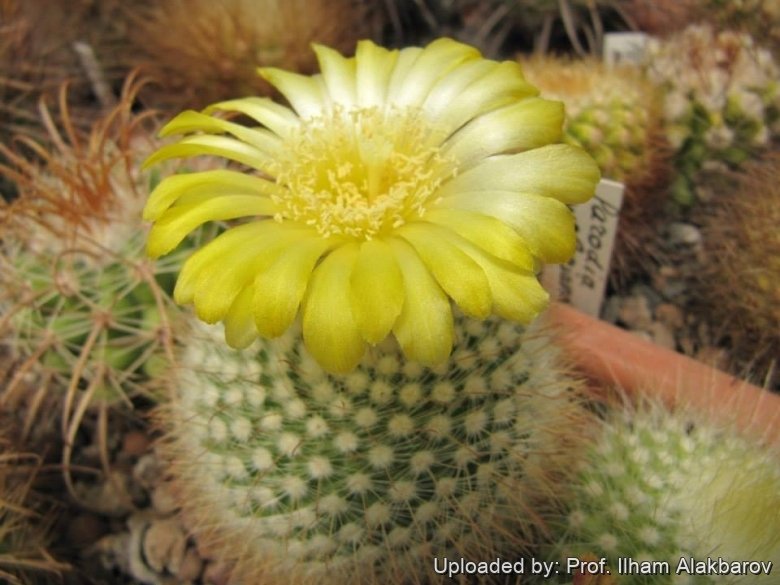
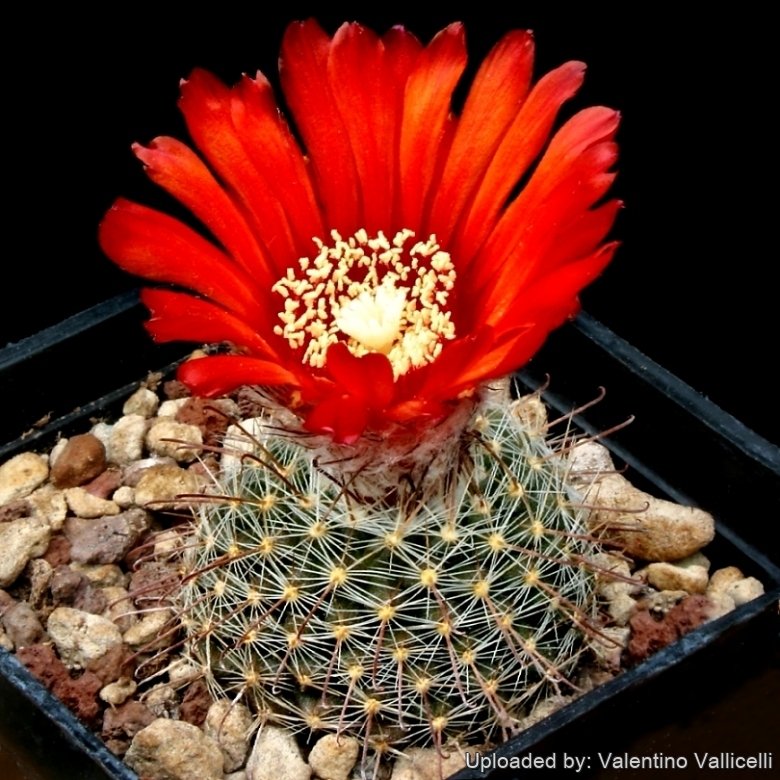
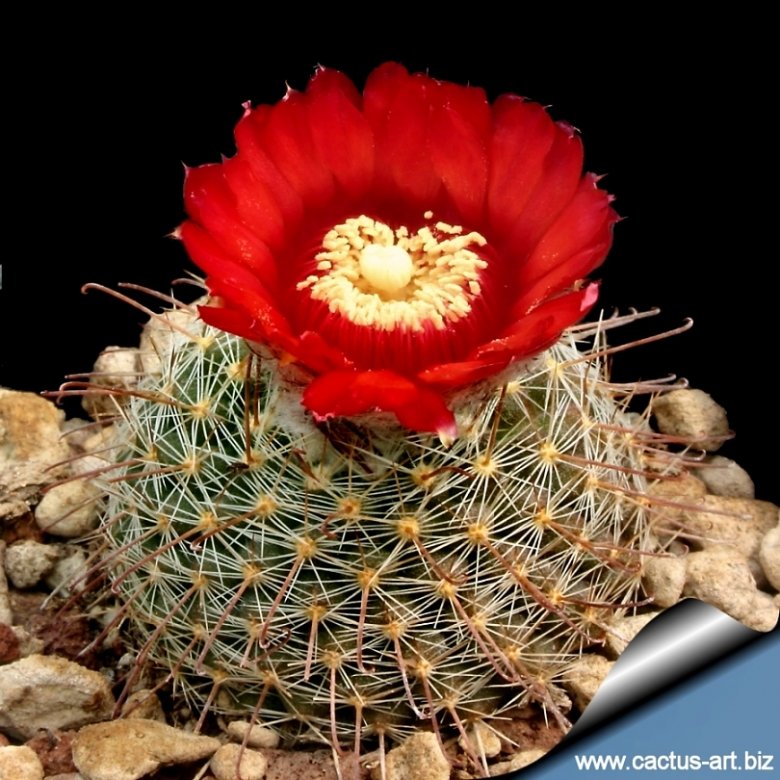
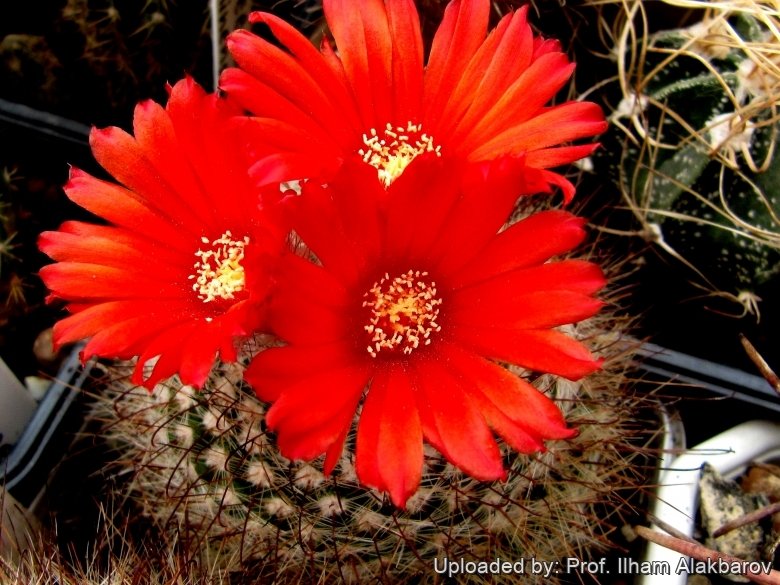
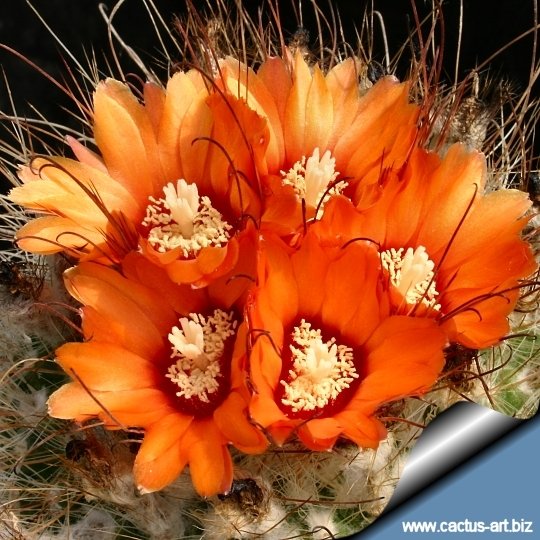
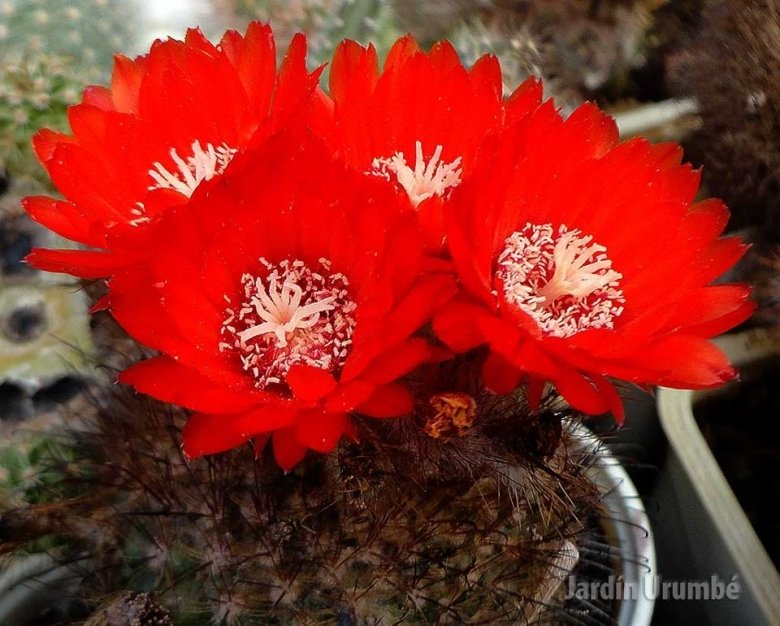
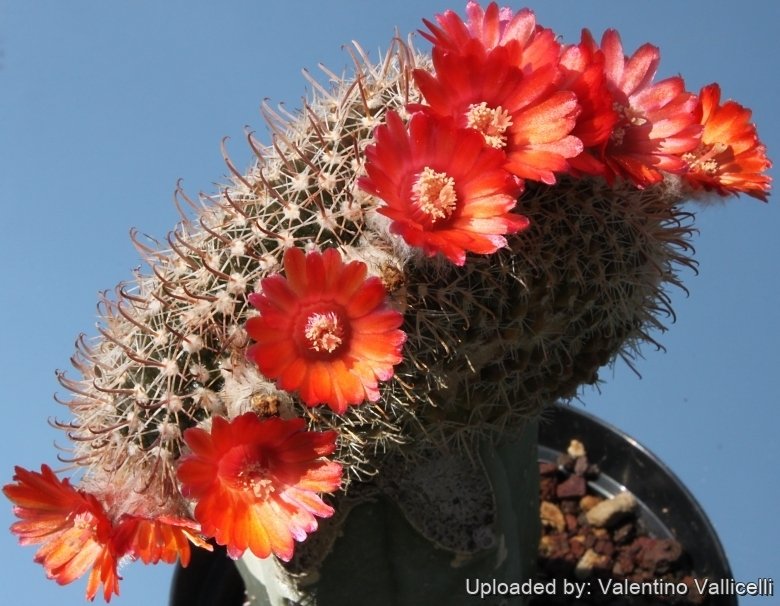
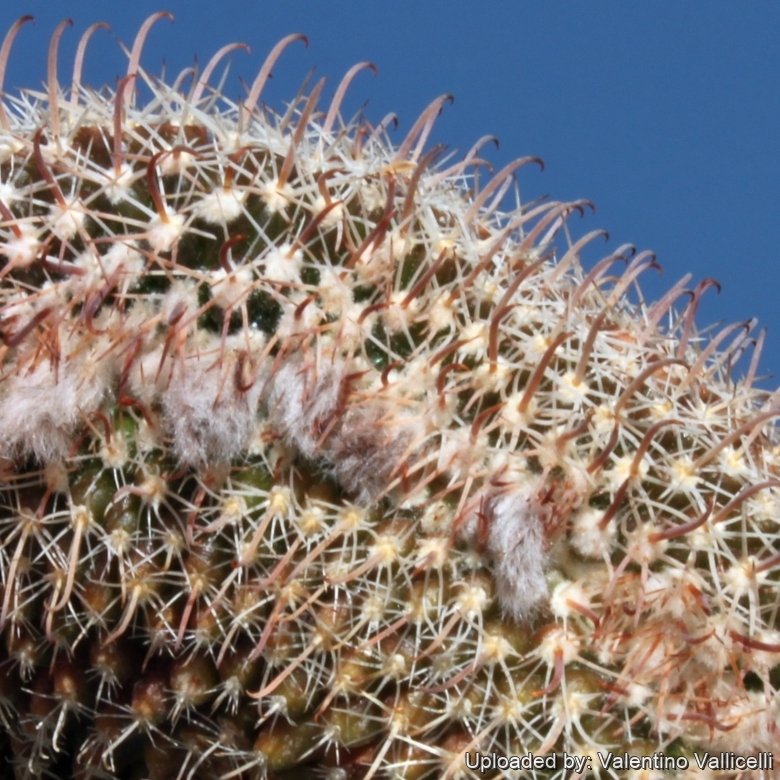
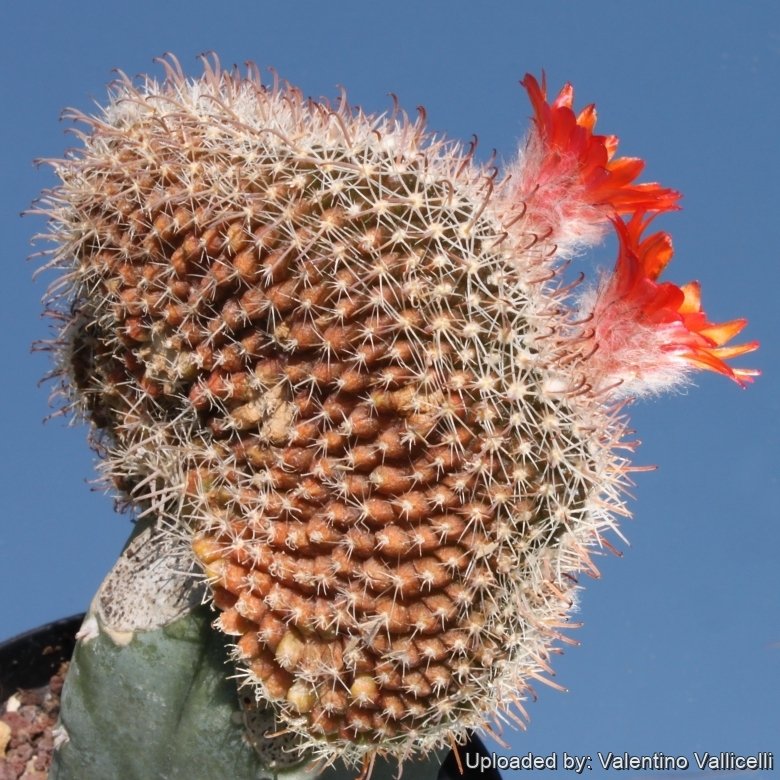
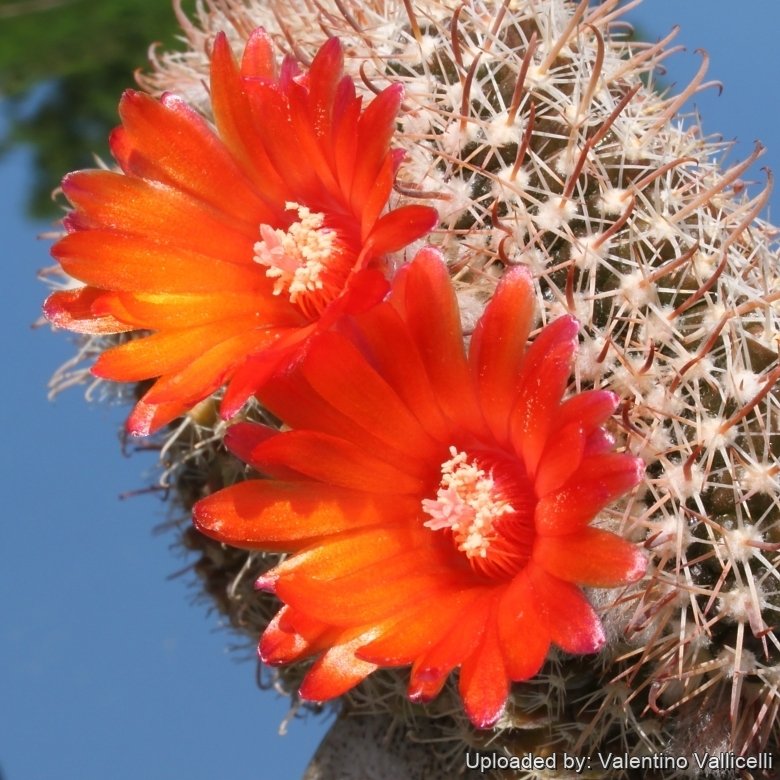
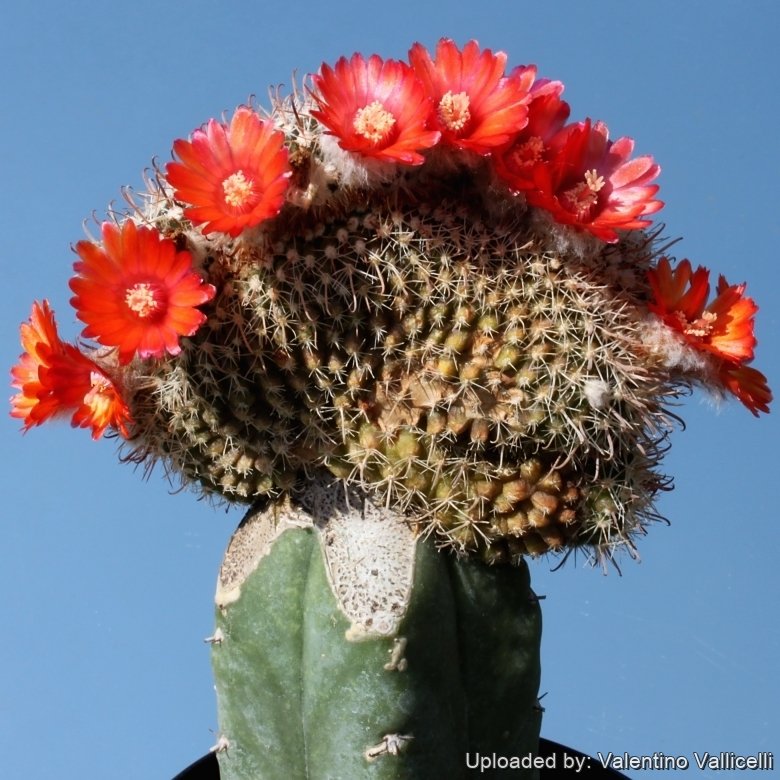
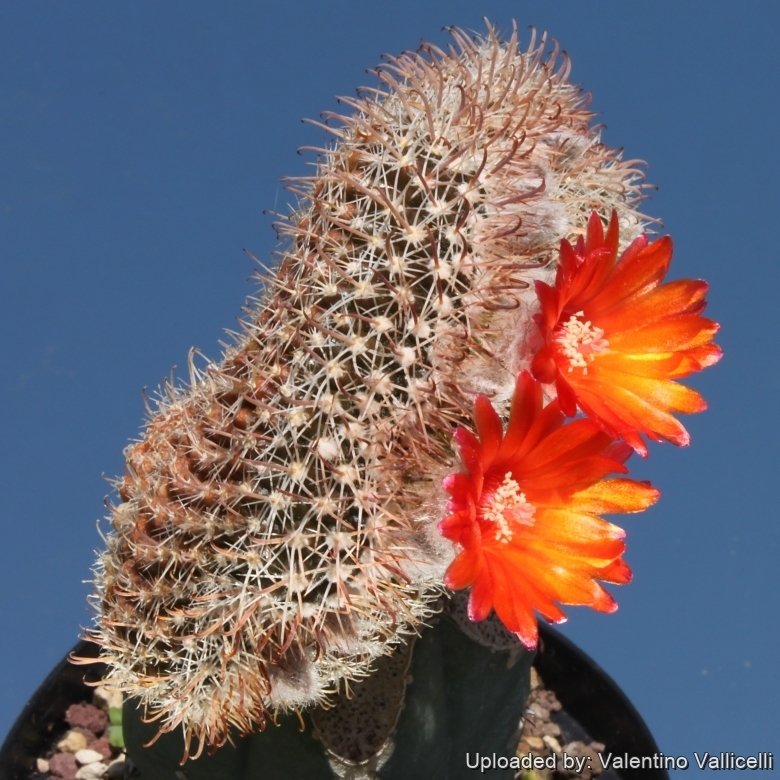
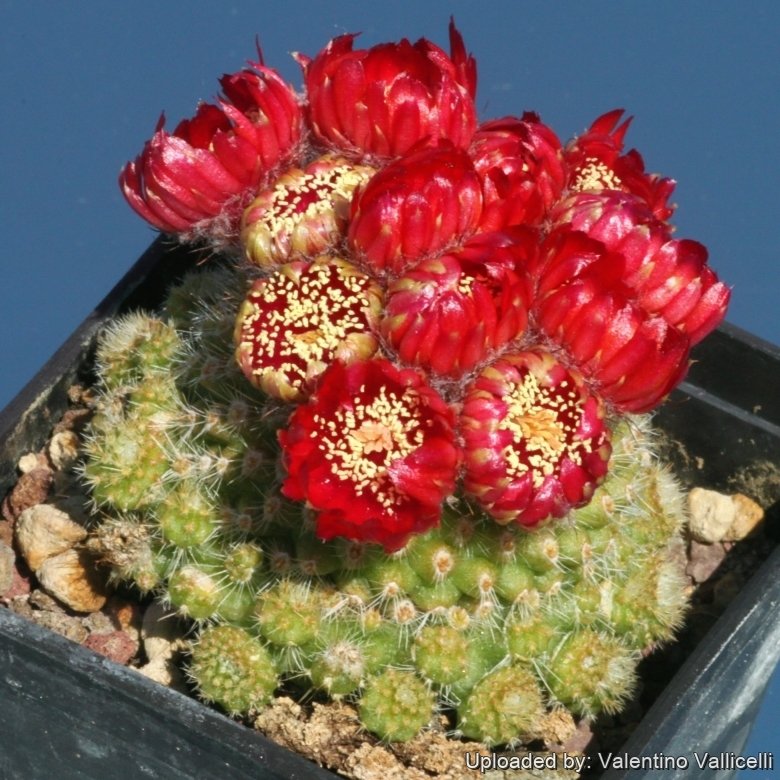
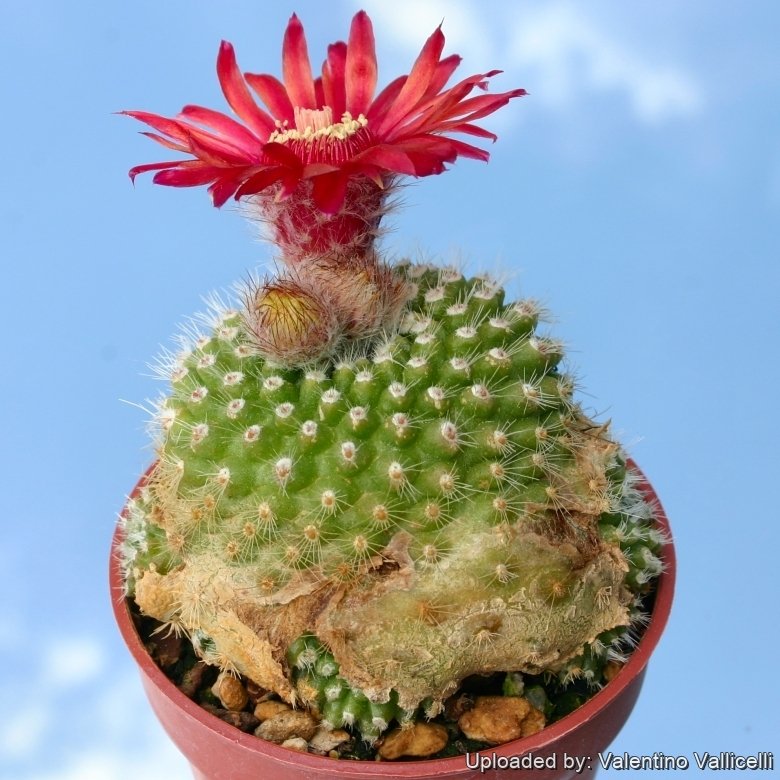
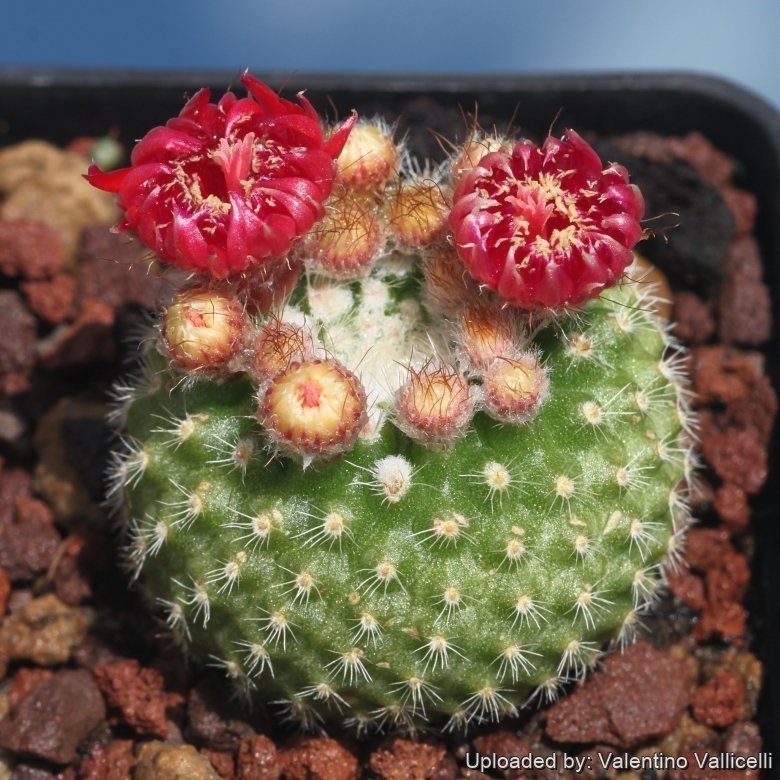
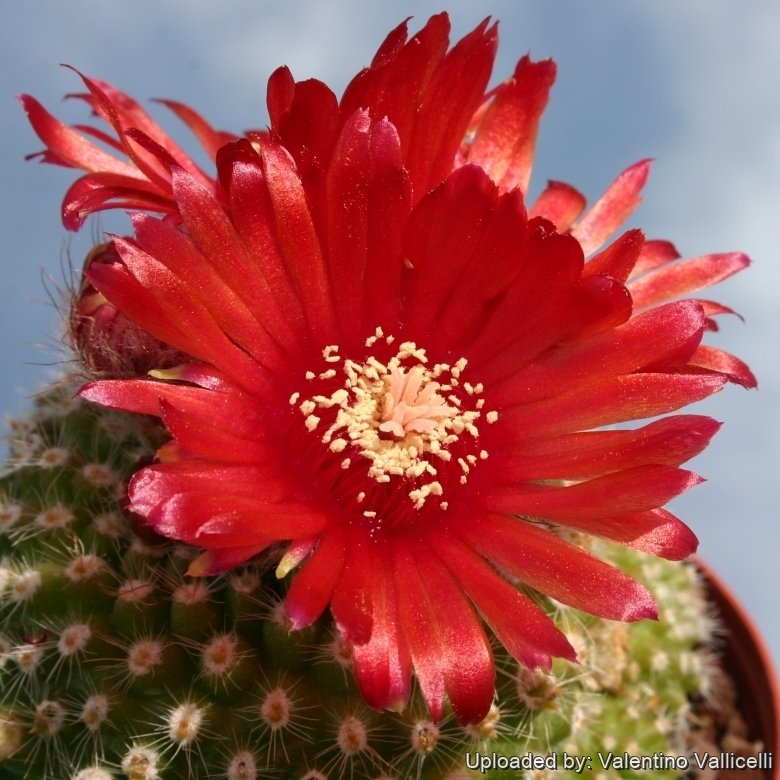
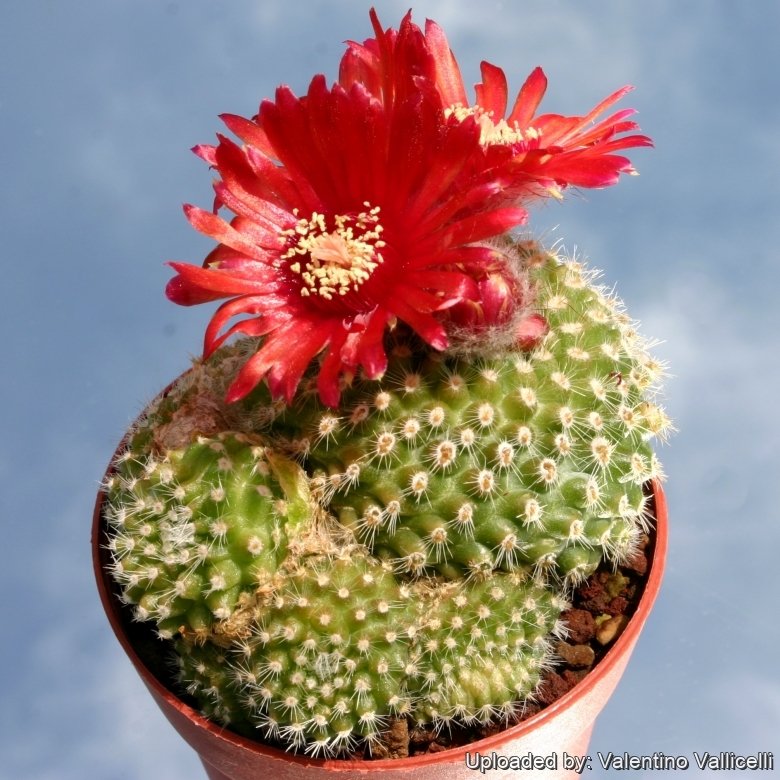
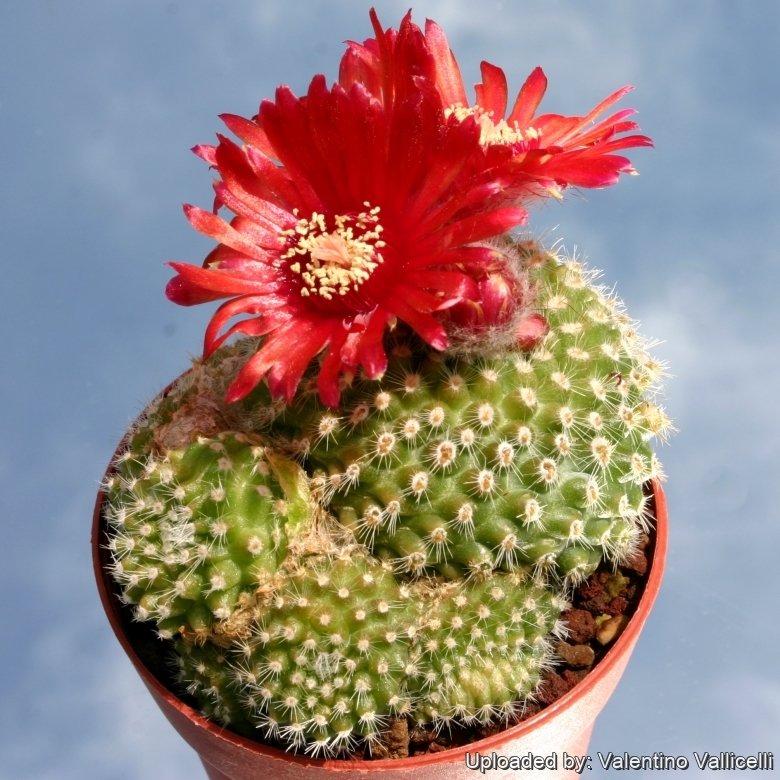
Parodia microsperma is a compact small to medium-sized, perennial cactus densely covered in dense white, yellow or brown spines and red, central spines, some of which are hooked. The new name refers to the small seeds. It bears blood-red, occasionally yellow flowers in spring. It is an extremely variable species with several local or morphological forms (previously considered independent species). Two subspecies are recognized, the nominate form and subsp. horrida.
Habit: It is usually solitary, but can form small clusters.
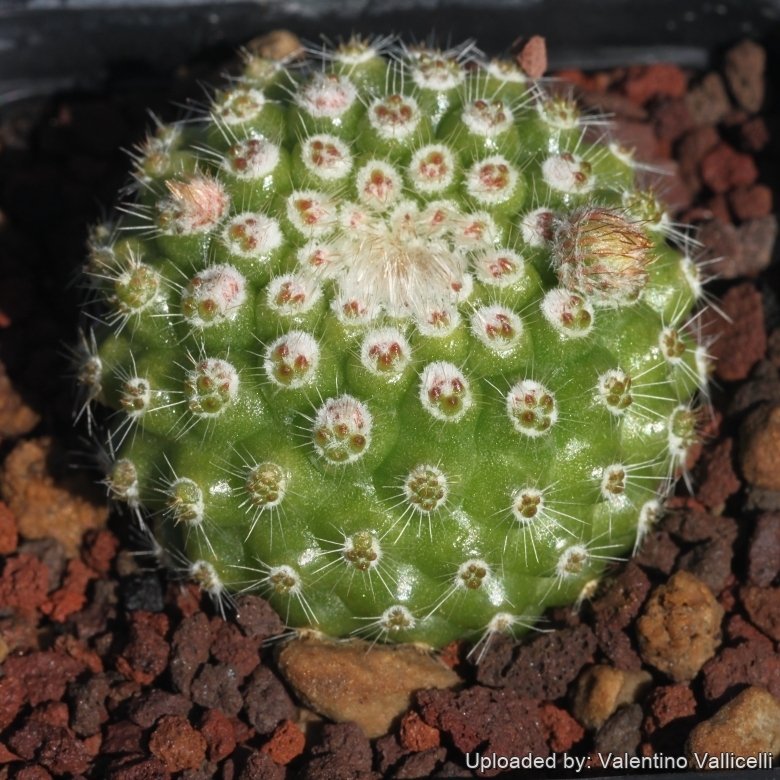
Stem: Spherical when young, but with age it often develops a short cylindrical shape, light green or bluish-green up to (5-)6-7(-10) cm in diameter and 5-20 cm tall (or more).
Ribs: 13-21 more or less divided into spiralled, conical tubercles 4-5 mm in diameter 3 mm long.
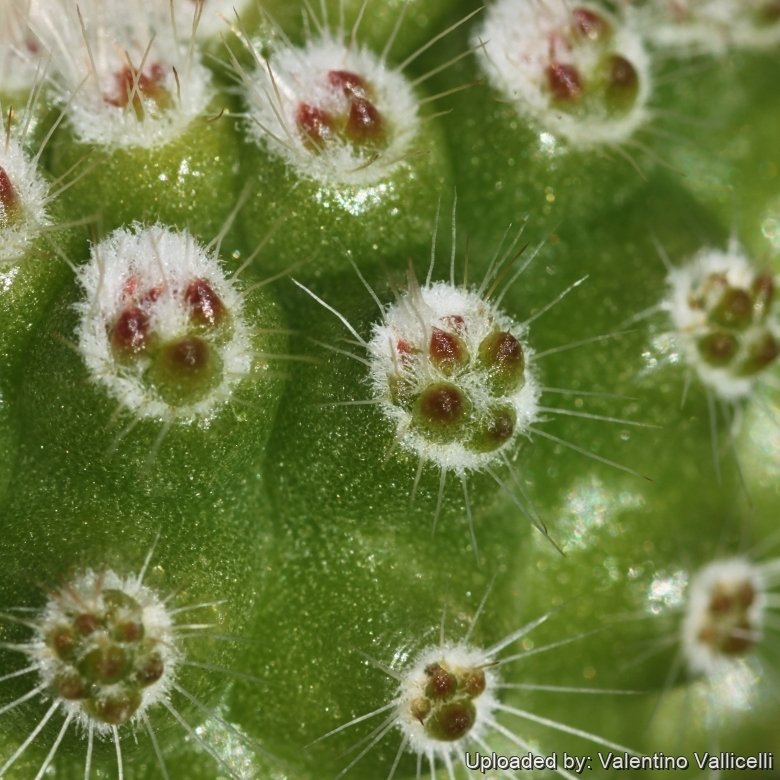
Areoles: 1,5 mm in diameter with white-yellowish tomentum that fade away as they age.
Radial spines: (7-)11-13(-30) thin, bristly, white, up to 4-8 mm long.
Central spines: 3-4, short, of which the upper three are honey-yellow to reddish-brown or darker with a reddish tip, while the lowermost more long hooked at apex and strong 5-20 mm long, rarely to 50 mm.
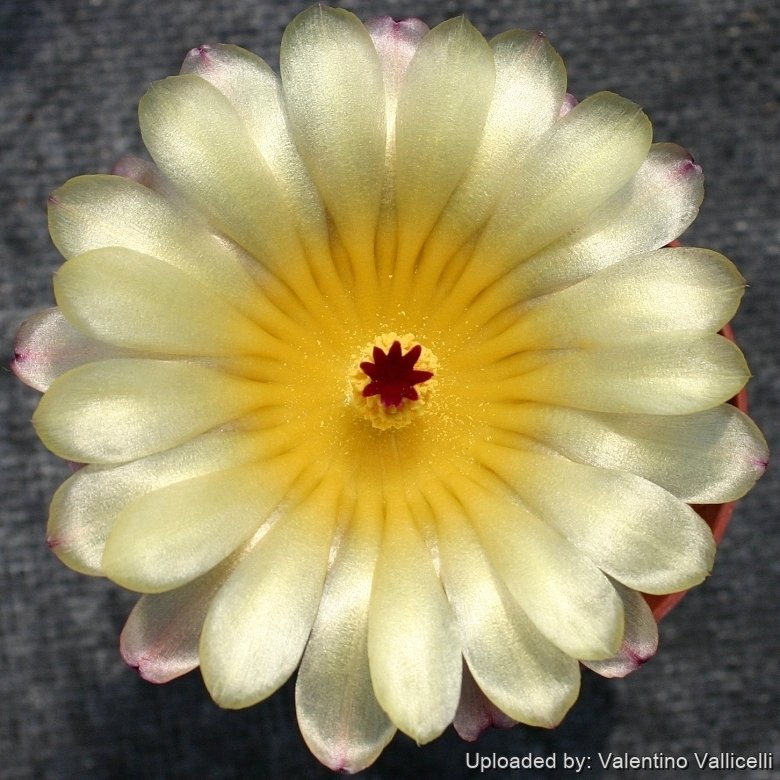
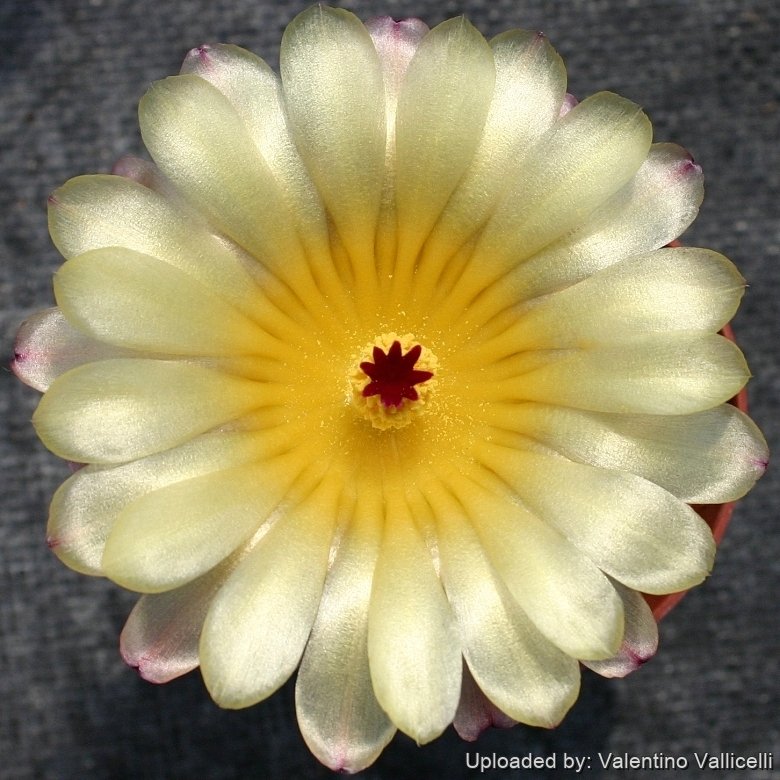
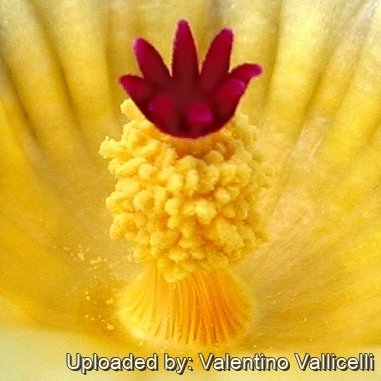
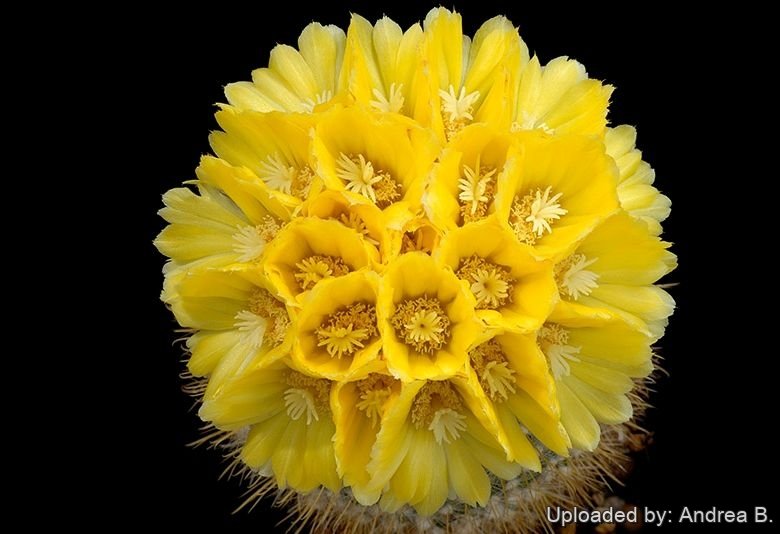
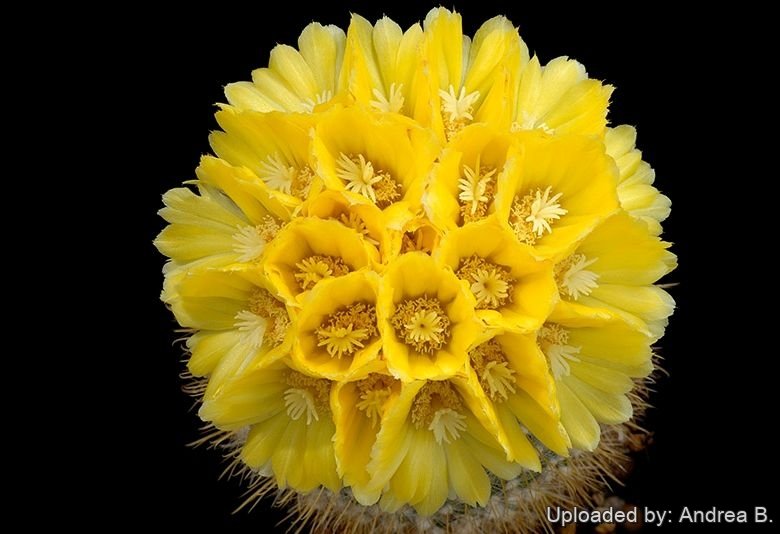
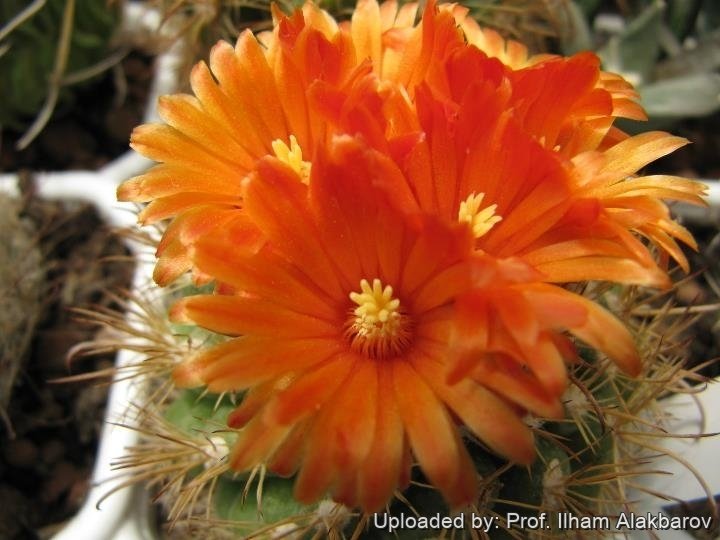
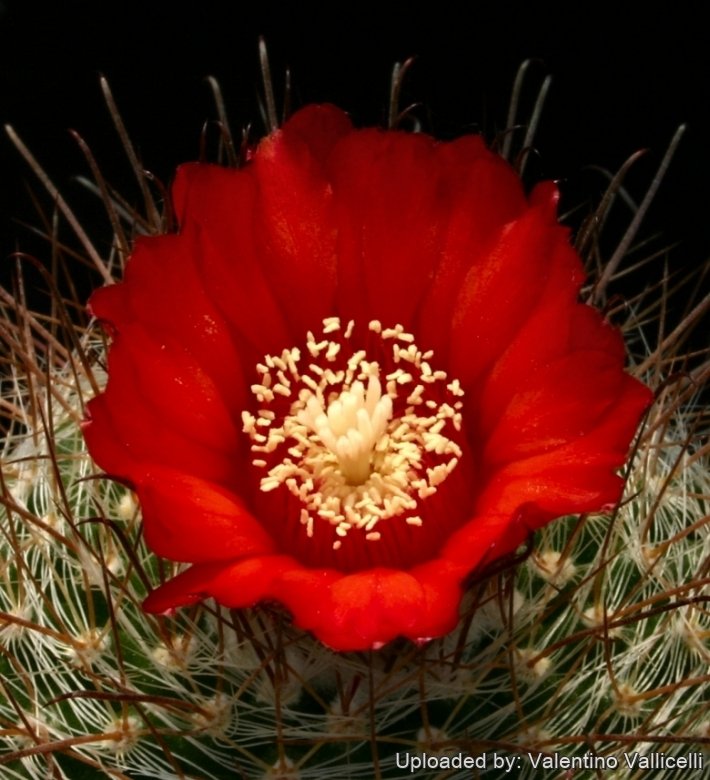
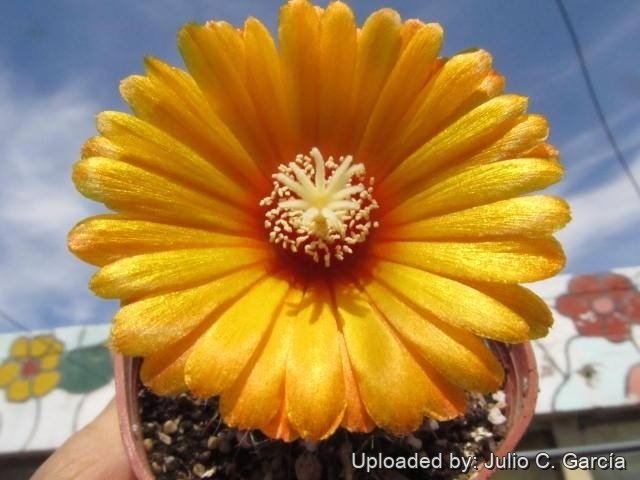
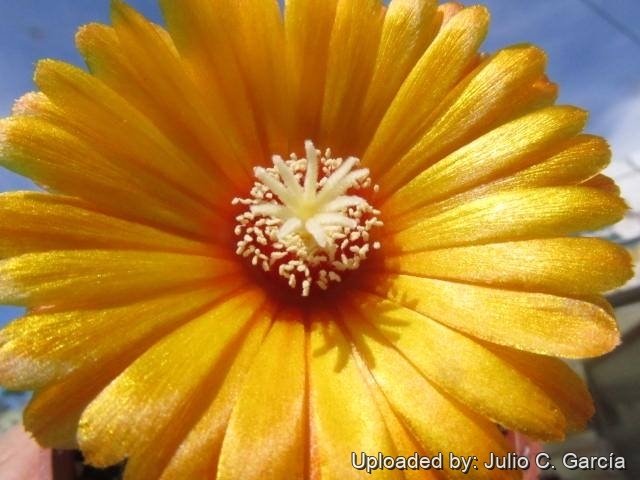
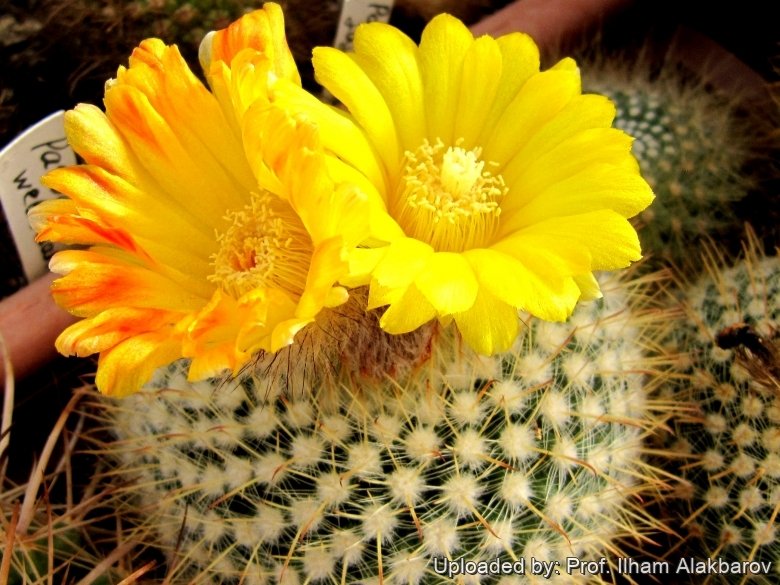
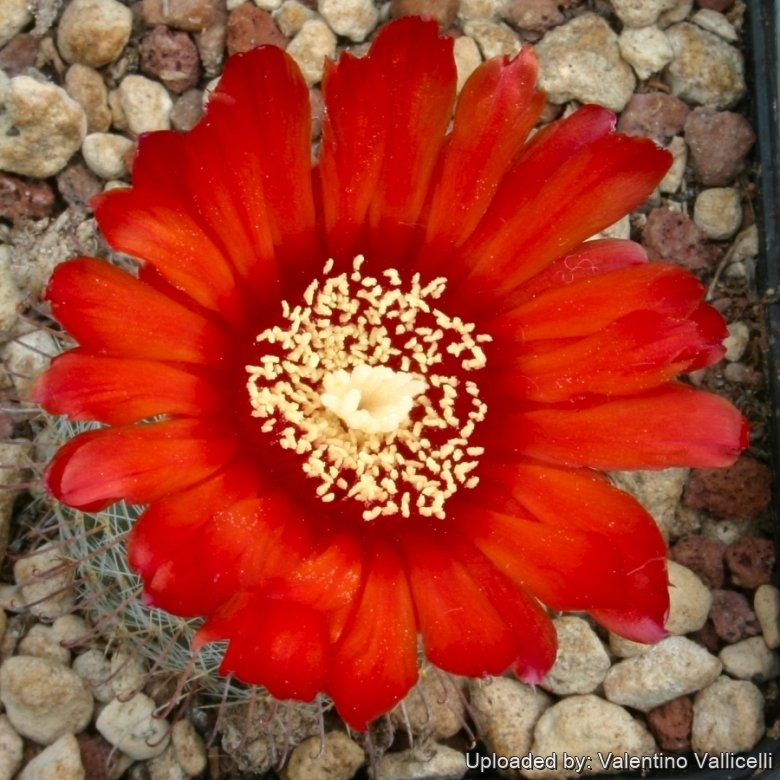
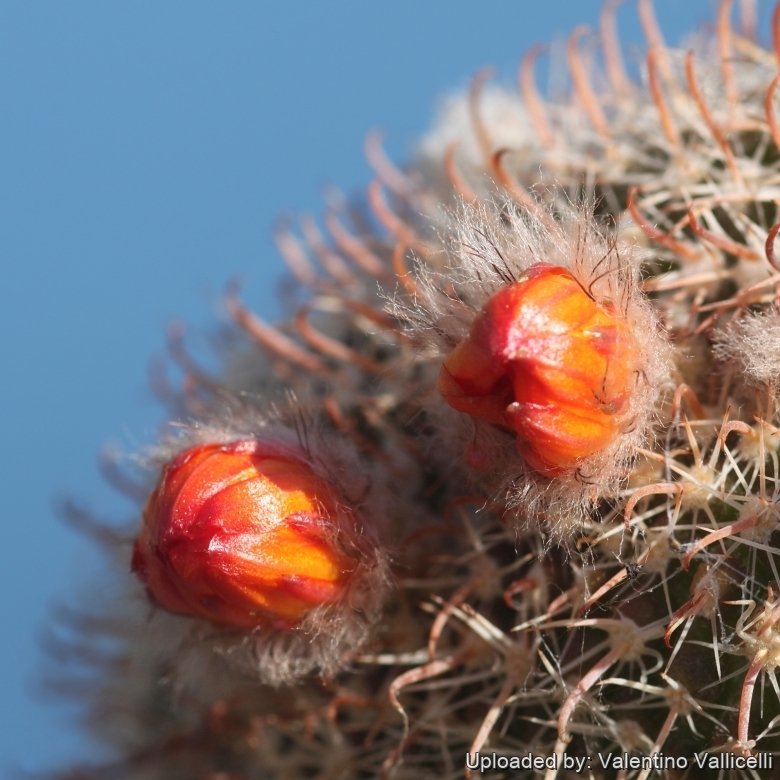
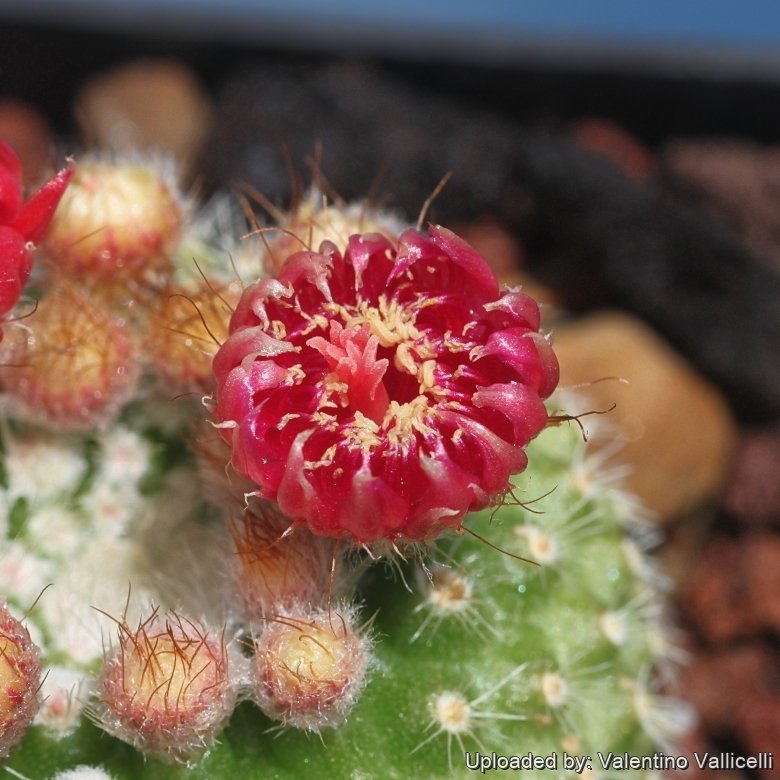
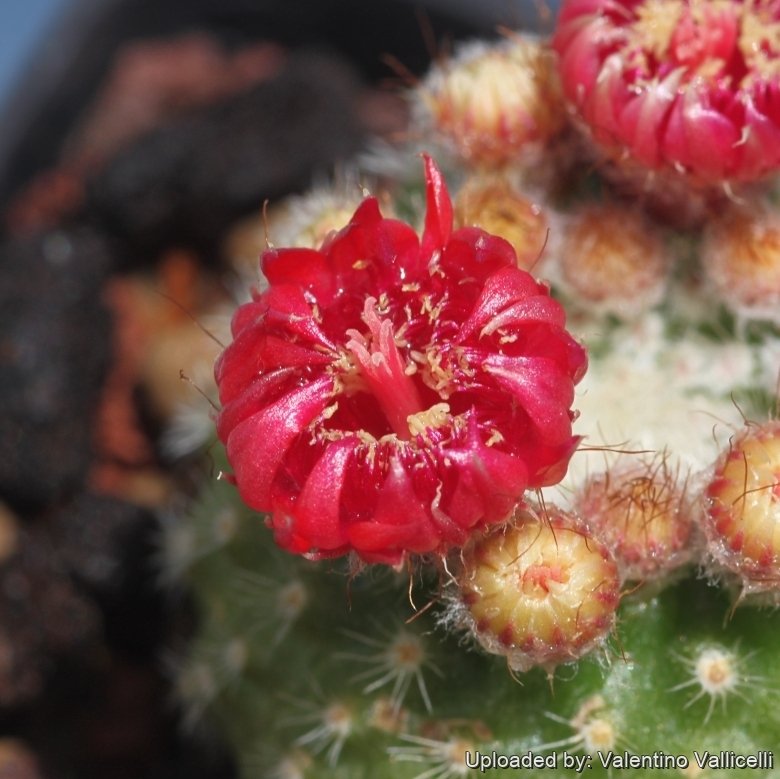
Flowers: Bright yellow, orange or red, infundibuliform on the plant apex 2,5-3,5 mm long, 40-50 mm in diameter. External tepals spatulate or lanceolate. Pericarpel and tube with wool and bristles throughout. The filaments bear cream-yellowish anthers. Stile white-yellowish bearing a 12 lobed stigma.
Blooming season: Produces several flowers simultaneously in early summer (while in Parodia maassii they usually appear one by one), the flowers remain open for about three days.
Fruit: Nearly spherical to ovoidal about 4-5 mm in diameter, with basal dehiscence.
Seeds: Very small, to only 0,4-0,5 mm long including the large white caruncle, seed-coat smooth, brown and shining.
Origin and Habitat
Argentina (Jujuy, Salta, Tucumán, Catamarca, La Rioja, northeastern San Juan and northwestern Santiago del Estero provinces) and probably in Bolivia (Tarija, San Pedro)
Altitude: 500 and 2,000 metres above sea level.
Habitat and Ecology: Parodia microsperma has a wide range, is locally abundant and grows on rocky soils in Monte and Chaco habitat. It is affected by agricultural activities.
Cultivation and Propagation
Parodia microsperma is relatively easy to grow on its own roots and quite resistant to cultivation. The only things that can kill this plant are cold and overwatering. Nevertheless, it is appropriate to provide adequate growing conditions in order to obtain compact plant with many flowers.
Soil: Use a an open and free draining mineral compost with little organic matter (peat, humus) that allows therefore roots to breath (as it is rot prone). Outdoors a well-draining rocky or sandy soil is ideal.
Pots: It needs a relatively shallow pot to accommodate its fibrous roots and provide a very good drainage. It may stay in the same pot for many years.
Watering: Needs regular water in summer. Keep rather dry in winter, tends to lose its roots in winter.
Fertilization: Feed with a high potassium fertilizer in summer during the growing season diluted to one-fourth potency and mix into the watering can for application.
Hardiness: Keep dry at 5- 10° C in winter, but can tolerate sporadic light frost if kept on the dry side prior to, and during, cold weather.
Exposition: The plant tolerates very bright situations, if kept too dark they may become overly lush and greener and could be prone to rotting due to over watering. Strong light encourages flowering and heavy wool and spine production, but is likely to suffer from sun scorch or stunted growth if over exposed to direct sunlight during the hottest part of the day in summer.
Pests & diseases: It may be attractive to a variety of insects, but plants in good condition should be nearly pest-free, particularly if they are grown in a mineral potting-mix, with good exposure and ventilation. Nonetheless, watch carefully for any significant decline in health. This may signal a pest problem that should be dealt with quickly in order to prevent scarring, stunting and even death.
- Red spiders: Red spiders may be effectively rubbed up by watering or misting the plants from above.
- Mealy bugs: Mealy bugs occasionally develop aerial into the new growth among the leaves with disfiguring results, but the worst types develop underground on the roots and are invisible except by their effects. Eliminate mealybug infestations by dabbing the critters with cotton swabs dipped in alcohol or by soaking the succulent’s roots in a systemic insecticide.
- Scales: Scales are rarely a problem.
- Rot: This species is particularly easy and accommodating, seldom suffer of cryptogamic diseases. Rot it is only a minor problem with cacti if the plants are watered and “aired” correctly. If they are not, fungicides won’t help all that much.
Propagation: By Seeds. The seed of this plant are extremely small and must be sown on the surface of the germination substrate (not buried!!) But the seedlings after germination are so minuscule and delicate that it is quite problematic to keep them alive. So for this species it is usually used the baggy germination technique (in a sterilized pot hermetically closed in a plastic sachet)
Bibliography
Major references and further lectures
-
Gerhard Gröner, Erich Götz “Beautiful Cacti: A Basic Grower’s Guide” Sterling, 1992
-
Backeberg C., “Das Kakteenlexikon” 1966
-
Krainz, Hans et al. “Die Kakteen” 1956-1975
-
Hans Hecht “BLV-Handbuch der Kakteen” BLV-Verlagsgesellschaft, 1982
-
- E Haustein “Der Kosmos Kakteenfuehrer (the Kosmos Cactus Guide)” Balogh Scientific Books, United States, 01/Dec/1998
-
Kessler H., “Die FR-Parodien” Stachelpost, 7 : 223-224, 247, 1970
-
Ritter F., “Kakteen in Südamerika”, 1980
-
Weskamp W., “Die Gattung Parodia” 1987
-
Kiesling, R. & Ortega-Baes, P. 2013. Parodia microsperma. In: IUCN 2013. “IUCN Red List of Threatened Species”. Version 2013.2. <www.iucnredlist.org>. Downloaded on 04 March 2014.
-
Edward Anderson “The Cactus family” Timber Press, Incorporated, 2001
-
James Cullen, Sabina G. Knees, H. Suzanne Cubey “The European Garden Flora Flowering Plants: A Manual for the Identification of Plants Cultivated in Europe, Both Out-of-Doors and Under Glass” Cambridge University Press, 11/Aug/2011
-
David R Hunt; Nigel P Taylor; Graham Charles; International Cactaceae Systematics Group. “The New Cactus Lexicon” dh books, 2006
-
Urs Eggli, Leonard E. Newton “Etymological Dictionary of Succulent Plant Names” Springer, Berlin/Heidelberg 2010
-
Willy Cullmann, Erich Götz (Dozent Dr.), Gerhard Gröner “The encyclopedia of cacti” Portland, OR: Timber Press, 1986
From llifle page Echinocactus microspermus var. erythranthus
Description
This is an easy plant to cultivate. It likes to be kept cool and need only a short rest in winter, it can can tolerate light frost. Grow in full or light shade sun but doesn’t like full, hot blazing sun in the central summer month. Water occasionally in winter so the roots do not dry out completely and water regularly in summer. Some growers suggest to use exclusively rain water. But be careful as it will rot easily if the substrate is wet and cold. Tends to lose its roots in winter.
The root system of this plant is comparatively small and it is best to grow it in a shallow pot using a neutral to slightly acidic compost with plenty of extra grit. Give an occasional tonic of sequestrated iron.
Propagation: Usually by seeds as it seldom produces offsets.
Source: Echinocactus microspermus var. erythranthus, LLIFLE - Encyclopedia of living forms, CC-BY-SA, retrieved 2026-10-25.
From llifle page Parodia aconquijaensis
Cultivation and Propagation
Parodia aconquijaensis is an easy to grow tropical cactus, more cold tolerant than most and less fussy regarding soil conditions.
Growth rate: It is a relatively rapidly growing and easily flowering species that will make clumps given the best conditions.
Soils: It likes very porous standard cactus mix soil.
Repotting: Use pot with good drainage.
Watering: Water regularly in summer, but do not overwater (Rot prone), keep dry in winter. It rot easily if the substrate is wet and cold, tends to lose its roots in winter. Best if watered with rain water.
Fertilization: Feed it once during the growing season with a fertilizer specifically formulated for cactus and succulents (poor in nitrogen), including all micro nutrients and trace elements diluted to ½ the strength recommended on the label. It thrives in poor soils and need a limited supplies of fertilizer to avoid the plants developing excess vegetation, which is easily attacked by fungal diseases.
Hardiness: Reputedly sensitive to frost , but less so if kept on the dry side prior to, and during, cold weather (hardy to -5° C for short periods). However warmth throughout the year will increase the grower’s success (8-12°C during rest season).
Exposition: Outside bright but partially filtered sunlight or afternoon shade, inside it needs bright light, and some direct sun. Subject to sunburn if exposed to direct sun for too long. Tends to bronze in strong light, which encourages flowering and heavy wool and spine production.
Uses: It is an excellent plant for container growing. It always looks good and stays small. It look fine in a cold greenhouse and frame or outdoor in a rockery.
Pests & diseases: It may be attractive to a variety of insects, but plants in good condition should be nearly pest-free, particularly if they are grown in a mineral potting-mix, with good exposure and ventilation. Nonetheless, there are several pests to watch for:
- Red spiders: Sensitive to red spider mite. Overhead watering is helpful in controlling mites.
- Mealy bugs: Occasionally mealy bugs they develop aerial into the new growth among the wool with disfiguring results, but the worst types develop underground on the roots and are invisible except by their effects.
- Scales: Scales are rarely a problem.
- Rot: Rot it is only a minor problem with notocacti if the plants are watered and “aired” correctly. If they are not, fungicides won’t help all that much.
Propagation: Direct sow after last frost or rarely cutting. Seeds germinate in 7-14 days at 21-27° C in spring, remove the glass cover gradually as the plants develops and keep ventilated, no full sun for young plants! To make a cutting twist off a branch and permit it to dry out a couple of weeks, lay it on the soil and insert the stem end partially into the soil. Try to keep the cutting somewhat upright so that the roots are able to grow downward.
Source: Parodia aconquijaensis, LLIFLE - Encyclopedia of living forms, CC-BY-SA, retrieved 2026-10-25.
From llifle page Parodia aureispina
Description
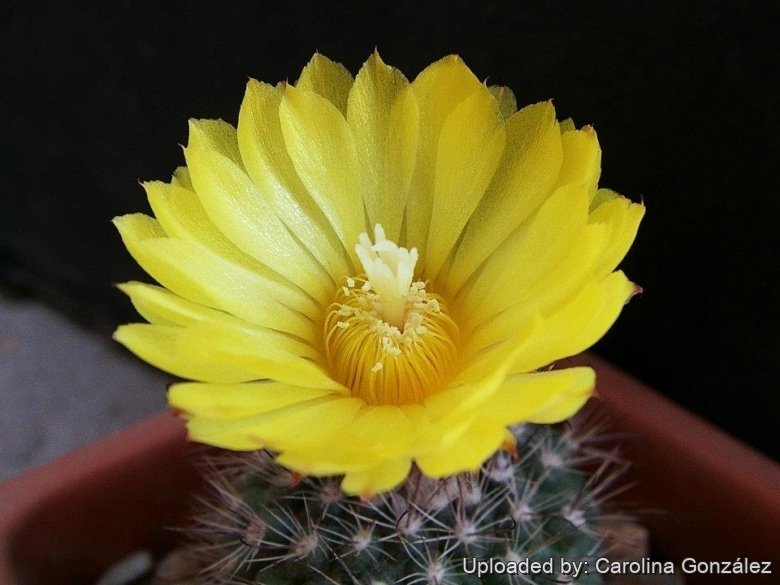
Parodia aureispina is only a variant of the extremely variable Parodia microsperma. Characteristic of this frequently offered cactus are its strong, yellow spination and its yellow flowers.
Similar varieties: It is very similar (if not the same) with Parodia mutabilis and Parodia aurihamata, and the three plants are not readily distinguishable, if not for the geographical provenance.
Habit: Compact small to medium-sized cacti densely covered in dense white and yellow spines. Usually solitary, but can forms small clusters.
Stem: Globose or cylindrical, light green or bluish-green up to 6-7(-9) cm in diameter and 10 cm tall (or more)
Ribs: 13-21 spiraling with conical tubercles 4-5 mm in diameter 3 mm long.
Areoles: 1,5 mm in diameter with white-yellowish tomentum that fade away as they age.
Radial spines: 11-13 thin,bristly, white, up to 7 mm long.
Central spines: 4, Short, hooked of which the upper three are honey-yellow to reddish-brown with a reddish tip, while the lower one is more long and strong.
Flowers: Bright yellow, infundibuliform on the plant apex 2,5 mm long, 40 mm in diameter. External tepals spatulate or lanceolate, denticulate yellowish-orange.The throat is yellow, the filaments bear cream-yellowish anthers. Stile white-yellowish bearing a 12 lobed stigma.
Blooming season: Produces several flowers simultaneously in early summer (while at Parodia maassii they usually appear one by one), the flowers remain open for about three days.
Fruit: Ovoidal 6x5 mm, with basal dehiscence.
Seeds: Very small 0,4mm long, brown smooth and shining.
Origin and Habitat
Southern Bolivia, northern Argentina.
Cultivation and Propagation
It is relatively easy to grow on its own roots.
Soil: Grow it in an open sandy-gritty cactus compost.
Pots: It needs a relatively shallow pot to accommodate its fibrous roots and provide a very good drainage. It may stay in the same pot for many years.
Watering: Needs regular water in summer. Keep rather dry in winter, tends to lose its roots in winter.
Hardiness: Can tolerate light frost (-1C°)
Propagation: By Seeds. The seed of this plant are extremely small and must be sown on the surface of the germination substrate (not buried!!) But the seedlings after germination are so minuscule and delicate that it is quite problematic to keep them alive. So for this species it is usually used the baggy germination technique (in a sterilized pot hermetically closed in a plastic sachet)
Source: Parodia aureispina, LLIFLE - Encyclopedia of living forms, CC-BY-SA, retrieved 2026-10-25.
From llifle page Parodia belenensis
Origin and Habitat
Argentina Northwest (Catamarca).
Source: Parodia belenensis, LLIFLE - Encyclopedia of living forms, CC-BY-SA, retrieved 2026-10-25.
From llifle page Parodia cabracorralensis
Origin and Habitat
Salta (Argentina. Southern America)
Source: Parodia cabracorralensis, LLIFLE - Encyclopedia of living forms, CC-BY-SA, retrieved 2026-10-25.
From llifle page Parodia cebilarensis
Origin and Habitat
Argentina Northwest (Salta).
Source: Parodia cebilarensis, LLIFLE - Encyclopedia of living forms, CC-BY-SA, retrieved 2026-10-25.
From llifle page Parodia dichroacantha
Description
Parodia dichroacantha is a globular to cylindrical cactus covered with strong hooked central spines at the top of which emerge bright orange-red flowers.
Stem: Fan-shaped, 4-7 in thick and up to 20 or more cm in width, dark green to reddish-grey.
Central spine: Hooked, strong, pale-brown, grey-brown, red-brown or brown-chocolate.
Radial spines: Rigid.
Flowers: Orange, orange-red to Scarlet (but also yellow).
Blooming season: Summer.
Origin and Habitat
Salta, Northwest Cafayate (and Tucumán?)
Source: Parodia dichroacantha, LLIFLE - Encyclopedia of living forms, CC-BY-SA, retrieved 2026-10-25.
From llifle page Parodia herzogii
Description
Usually solitary globose or cylindrical, up to 6 cm tall, 10 cm wide.
Flowers: Deep orange to blood red diameter 4cm.
Cultivation and Propagation
It is relatively easy to grow on its own roots and quite resistant to cultivation. The only things that can kill this plant are cold and overwatering. Nevertheless, it is appropriate to provide adequate growing conditions in order to obtain compact plant with many flowers.
Soil: Use a an open and free draining mineral compost with little organic matter (peat, humus) that allows therefore roots to breath (as it is rot prone). Outdoors a well-draining rocky or sandy soil is ideal.
Pots: It needs a relatively shallow pot to accommodate its fibrous roots and provide a very good drainage. It may stay in the same pot for many years.
Watering: Needs regular water in summer. Keep rather dry in winter, tends to lose its roots in winter.
Fertilization: Feed with a high potassium fertilizer in summer during the growing season diluted to one-fourth potency and mix into the watering can for application.
Hardiness: Keep dry at 5- 10° C in winter, but can tolerate sporadic light frost if kept on the dry side prior to, and during, cold weather.
Exposition: The plant tolerates very bright situations, if kept too dark they may become overly lush and greener and could be prone to rotting due to over watering. Strong light encourages flowering and heavy wool and spine production, but is likely to suffer from sun scorch or stunted growth if over exposed to direct sunlight during the hottest part of the day in summer.
Pests & diseases: It may be attractive to a variety of insects, but plants in good condition should be nearly pest-free, particularly if they are grown in a mineral potting-mix, with good exposure and ventilation. Nonetheless, watch carefully for any significant decline in health. This may signal a pest problem that should be dealt with quickly in order to prevent scarring, stunting and even death.
- Red spiders: Red spiders may be effectively rubbed up by watering or misting the plants from above.
- Mealy bugs: Mealy bugs occasionally develop aerial into the new growth among the leaves with disfiguring results, but the worst types develop underground on the roots and are invisible except by their effects. Eliminate mealybug infestations by dabbing the critters with cotton swabs dipped in alcohol or by soaking the succulent’s roots in a systemic insecticide.
- Scales: Scales are rarely a problem.
- Rot: This species is particularly easy and accommodating, seldom suffer of cryptogamic diseases. Rot it is only a minor problem with cacti if the plants are watered and “aired” correctly. If they are not, fungicides won’t help all that much.
Propagation: By Seeds. The seed of this plant are extremely small and must be sown on the surface of the germination substrate (not buried!!) But the seedlings after germination are so minuscule and delicate that it is quite problematic to keep them alive. So for this species it is usually used the baggy germination technique (in a sterilized pot hermetically closed in a plastic sachet)
Source: Parodia herzogii, LLIFLE - Encyclopedia of living forms, CC-BY-SA, retrieved 2026-10-25.
From llifle page Parodia malyana
Description
Parodia microsperma var. malyana (Parodia malyana) is only a geographical form of the extremely variable Parodia microsperma. Characteristic of this frequently offered cactus are its short reddish central spines and flowers ranging from yellow to orange and red. However it is very similar to other form of Parodia microsperma, and the plants are not readily distinguishable, if not for the geographical provenance.
Habit: It is a compact small to medium-sized, perennial cactus usually solitary, but can form small clusters.
Stem: Spherical when young, but with age it often develops a short cylindrical shape, light green or bluish-green up to (5-)6-7(-10) cm in diameter and 5-20 cm tall (or more).
Ribs: 13-21 more or less d ivided into spiralled, conical tubercles 4-5 mm in diameter 3 mm long.
Areoles: 1,5 mm in diameter with white-yellowish tomentum that fade away as they age.
Radial spines: 20-50 thin, or more, very fine, white.
Central spines: 3-4, short, mostly reddish or brownish of which the lowermost more long hooked at apex and strong 4-10 mm long.
Flowers: Bright yellow, orange or red, infundibuliform on the plant apex 2,5-3,5 mm long, 40-50 mm in diameter. External tepals spatulate or lanceolate. Pericarpel and tube with wool and bristles throughout. The filaments bear cream-yellowish anthers. Stile white-yellowish bearing a 12 lobed stigma.
Blooming season: Produces several flowers simultaneously in early summer (while on Parodia maassii they usually appear one by one), the flowers remain open for about three days.
Fruit: Nearly spherical to ovoidal about 4-5 mm in diameter, with basal dehiscence.
Seeds: Very small, to only 0,4-0,5 mm long including the large white caruncle, seed-coat smooth, brown and shining.
Origin and Habitat
Catamarca, Argentina
Altitude range: 1000-2800 metres above sea level.
Habitat: Parodia microsperma var. malyana grows on rocky soils togheter with Gymnocalycium baldianum, Notocactus submammulosus, and Lobivia aurea.
Source: Parodia malyana, LLIFLE - Encyclopedia of living forms, CC-BY-SA, retrieved 2026-10-25.
From llifle page Parodia microthele
Origin and Habitat
Cultivated form.
Source: Parodia microthele, LLIFLE - Encyclopedia of living forms, CC-BY-SA, retrieved 2026-10-25.
From llifle page Parodia mutabilis
Description
Parodia microsperma var. mutabilis (Parodia mutabilis) is only a variant of the extremely variable Parodia microsperma. Characteristic of this frequently offered cactus are its strong, yellow spination and its yellow flowers.
Similar varieties: It is very similar (if not the same) with Parodia aureispina and Parodia aurihamata, and the three plants are not readily distinguishable, if not for the geographical provenance.
Habit: It is a compact small to medium-sized, perennial cactus usually solitary, but can form small clusters.
Stem: Spherical when young, but with age it often develops a short cylindrical shape, light green or bluish-green up to (5-)6-7(-10) cm in diameter and 5-20 cm tall (or more).
Ribs: 13-21 more or less d ivided into spiralled, conical tubercles 4-5 mm in diameter 3 mm long.
Areoles: 1,5 mm in diameter with white-yellowish tomentum that fade away as they age.
Radial spines: 20-50 thin, or more, very fine, white..
Central spines: 3-4, short, mostly yellow, but also reddish or brownish of which the lowermost more long hooked at apex and strong 4-10 mm long.
Flowers: Bright yellow, infundibuliform on the plant apex 2,5-3,5 mm long, 40-50 mm in diameter. External tepals spatulate or lanceolate. Pericarpel and tube with wool and bristles throughout. The filaments bear cream-yellowish anthers. Stile white-yellowish bearing a 12 lobed stigma.
Blooming season: Produces several flowers simultaneously in early summer (while on Parodia maassii they usually appear one by one), the flowers remain open for about three days.
Fruit: Nearly spherical to ovoidal about 4-5 mm in diameter, with basal dehiscence.
Seeds: Very small, to only 0,4-0,5 mm long including the large white caruncle, seed-coat smooth, brown and shining.
Origin and Habitat
Northern Argentina ( Salta)
Altitude: 1600-2500 metres above sea level.
Habitat and Ecology: It is locally abundant and grows on rocky soils together with Echinopsis silvestrii.
Cultivation and Propagation
Parodia mutabilis is relatively easy to grow on its own roots and quite resistant to cultivation. The only things that can kill this plant are cold and overwatering. Nevertheless, it is appropriate to provide adequate growing conditions in order to obtain compact plant with many flowers.
Soil: Use a an open and free draining mineral compost with little organic matter (peat, humus) that allows therefore roots to breath (as it is rot prone). Outdoors a well-draining rocky or sandy soil is ideal.
Pots: It needs a relatively shallow pot to accommodate its fibrous roots and provide a very good drainage. It may stay in the same pot for many years.
Watering: Needs regular water in summer. Keep rather dry in winter, tends to lose its roots in winter.
Fertilization: Feed with a high potassium fertilizer in summer during the growing season diluted to one-fourth potency and mix into the watering can for application.
Hardiness: Keep dry at 5- 10° C in winter, but can tolerate sporadic light frost if kept on the dry side prior to, and during, cold weather.
Exposition: The plant tolerates very bright situations, if kept too dark they may become overly lush and greener and could be prone to rotting due to over watering. Strong light encourages flowering and heavy wool and spine production, but is likely to suffer from sun scorch or stunted growth if over exposed to direct sunlight during the hottest part of the day in summer.
Pests & diseases: It may be attractive to a variety of insects, but plants in good condition should be nearly pest-free, particularly if they are grown in a mineral potting-mix, with good exposure and ventilation. Nonetheless, watch carefully for any significant decline in health. This may signal a pest problem that should be dealt with quickly in order to prevent scarring, stunting and even death.
- Red spiders: Red spiders may be effectively rubbed up by watering or misting the plants from above.
- Mealy bugs: Mealy bugs occasionally develop aerial into the new growth among the leaves with disfiguring results, but the worst types develop underground on the roots and are invisible except by their effects. Eliminate mealybug infestations by dabbing the critters with cotton swabs dipped in alcohol or by soaking the succulent’s roots in a systemic insecticide.
- Scales: Scales are rarely a problem.
- Rot: This species is particularly easy and accommodating, seldom suffer of cryptogamic diseases. Rot it is only a minor problem with cacti if the plants are watered and “aired” correctly. If they are not, fungicides won’t help all that much.
Propagation: By Seeds. The seed of this plant are extremely small and must be sown on the surface of the germination substrate (not buried!!) But the seedlings after germination are so minuscule and delicate that it is quite problematic to keep them alive. So for this species it is usually used the baggy germination technique (in a sterilized pot hermetically closed in a plastic sachet)
Source: Parodia mutabilis, LLIFLE - Encyclopedia of living forms, CC-BY-SA, retrieved 2026-10-25.
From llifle page Parodia mutabilis var. sanguiniflora
Description
Parodia microsperma subs. sanguiniflora best known as Parodia sanguiniflora is only a variant of the extremely variable Parodia microsperma. Characteristic of this cactus are its carmine to brownish-cinnabar filaments of the stamens (hence the name) and its blood red flowers.
Similar varieties: It is very similar (if not the same) with Parodia microsperma var. rubristaminea, and the two plants are not readily distinguishable, if not for the geographical provenance.
Habit: Usually solitary globose or cylindrical, up to 18 cm tall, 9 cm wide.
Radial spines: 10 to 18, 4-10 mm long, usually straight, more or less sideways directed.
Central spines: Hooked usually 4, sometimes 3-7.
Flowers: Blood red diameter 2,5-4cm. Filaments of the stamens carmine to brownish-cinnabar. Stylus reddish to pale yellowish; Stigma light-yellow to nearly white.
Fruit: Fruit globular, green, lower half naked and upper with white wool and fine bristles. Flesh greasy, so that the seeds can fall only after the fruit has dried.
Source: Parodia mutabilis var. sanguiniflora, LLIFLE - Encyclopedia of living forms, CC-BY-SA, retrieved 2026-10-25.
From llifle page Parodia nana
Origin and Habitat
Catamarca (Argentina)
Source: Parodia nana, LLIFLE - Encyclopedia of living forms, CC-BY-SA, retrieved 2026-10-25.
From llifle page Parodia rubristaminea
Description
Parodia microsperma var. rubristaminea best known as Parodia rubristaminea is only a variant of the extremely variable Parodia microsperma. Characteristic of this cactus are its carmine to brownish-cinnabar filaments of the stamens (hence the name) and its blood red flowers.
Similar varieties: It is very similar (if not the same) with Parodia microsperma subs. sanguiniflora, and the two plants are not readily distinguishable, if not for the geographical provenance.
Habit: Usually solitary globose or cylindrical, up to 18 cm tall, 9 cm wide.
Radial spines: 10 to18, 4-10 mm long, usually straight, more or less sideways directed.
Central spines: hooked usually 4, sometimes 3-7.
Flowers: Blood red diameter 2,5-4cm. Filaments of the stamens carmine to brownish-cinnabar. Stylus reddish to pale yellowish; Stigma light-yellow to nearly white.
Fruit: Fruit globular, green, lower half naked and upper with white wool and fine bristles. Flesh greasy, so that the seeds can fall only after the fruit has dried.
Origin and Habitat
Cafayate to Alemania, Salta, Argentina.
Altitude: 1200-2300 metres above sea level.
Cultivation and Propagation
Parodia microsperma var. rubristaminea is relatively easy to grow on its own roots and quite resistant to cultivation. The only things that can kill this plant are cold and overwatering. Nevertheless, it is appropriate to provide adequate growing conditions in order to obtain compact plant with many flowers.
Soil: Use a an open and free draining mineral compost with little organic matter (peat, humus) that allows therefore roots to breath (as it is rot prone). Outdoors a well-draining rocky or sandy soil is ideal.
Pots: It needs a relatively shallow pot to accommodate its fibrous roots and provide a very good drainage. It may stay in the same pot for many years.
Watering: Needs regular water in summer. Keep rather dry in winter, tends to lose its roots in winter.
Fertilization: Feed with a high potassium fertilizer in summer during the growing season diluted to one-fourth potency and mix into the watering can for application.
Hardiness: Keep dry at 5- 10° C in winter, but can tolerate sporadic light frost if kept on the dry side prior to, and during, cold weather.
Exposition: The plant tolerates very bright situations, if kept too dark they may become overly lush and greener and could be prone to rotting due to over watering. Strong light encourages flowering and heavy wool and spine production, but is likely to suffer from sun scorch or stunted growth if over exposed to direct sunlight during the hottest part of the day in summer.
Pests & diseases: It may be attractive to a variety of insects, but plants in good condition should be nearly pest-free, particularly if they are grown in a mineral potting-mix, with good exposure and ventilation. Nonetheless, watch carefully for any significant decline in health. This may signal a pest problem that should be dealt with quickly in order to prevent scarring, stunting and even death.
- Red spiders: Red spiders may be effectively rubbed up by watering or misting the plants from above.
- Mealy bugs: Mealy bugs occasionally develop aerial into the new growth among the leaves with disfiguring results, but the worst types develop underground on the roots and are invisible except by their effects. Eliminate mealybug infestations by dabbing the critters with cotton swabs dipped in alcohol or by soaking the succulent’s roots in a systemic insecticide.
- Scales: Scales are rarely a problem.
- Rot: This species is particularly easy and accommodating, seldom suffer of cryptogamic diseases. Rot it is only a minor problem with cacti if the plants are watered and “aired” correctly. If they are not, fungicides won’t help all that much.
Propagation: By Seeds. The seed of this plant are extremely small and must be sown on the surface of the germination substrate (not buried!!) But the seedlings after germination are so minuscule and delicate that it is quite problematic to keep them alive. So for this species it is usually used the baggy germination technique (in a sterilized pot hermetically closed in a plastic sachet)
Source: Parodia rubristaminea, LLIFLE - Encyclopedia of living forms, CC-BY-SA, retrieved 2026-10-25.
From llifle page Parodia setifera
Description
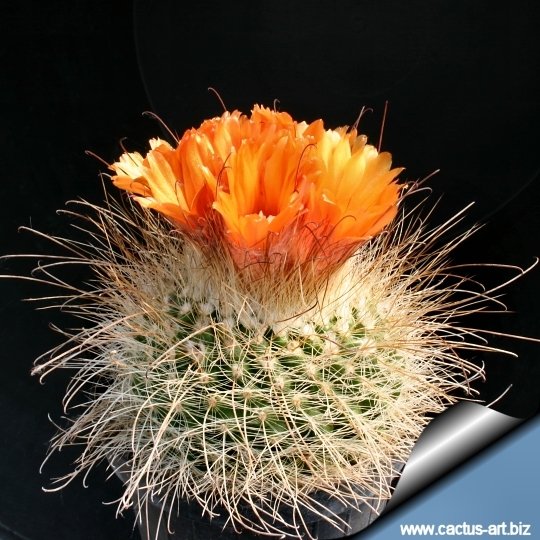
Parodia microsperma var. setifera is a morphological or geographical form of the extremely variable Parodia microsperma. Characteristic of this frequently offered cactus are its thin bristly radial spines and its yellow flowers.
Derivation of specific name: The specific name “setifera” means “bearing silky bristles”, probably in reference of the thin silky spines of this species.
Stems: Solitary, when young flattened-spherical, up to 80 mm wide, dark green, becoming elongate as high as 150 mm or more in older specimens; crown woolly and slightly depressed.
Ribs: About 18 narrow, 6 mm high, not slitted in tubercles with areoles separated only by shallow grooves so that the ribs can be easily defined.
Areoles: Oval, slightly white tomentose, 6 mm apart.
Radial spines: About 20 white, thin, bristle-like, 5-8 mm long.
Central spines: 3-4 needle-like, reddish to black, usually lighter toward the base, 10-30 mm long; the lowermost one the longest, hooked or slightly bent at the tip, other central spines straight.
All central spines at first almost vertical, with time the strongest ones curve downwards.
Flowers: About 35 mm long and wide, pale yellow. Pericarpel 6 mm wide, yellow-green at base, scales about 1 mm long pink in the upper half, with short wavy bristles. Floral-tube yellow, with narrow, about 2 mm long, pink scales, with abundant white hair and dark bristles. Tepals inside and outside pure yellow with no traces of red colour, 4-5 mm wide. Filaments yellow.
Fruits: Spherical, thin, brownish-green or reddish-brown.
Seeds: Sbout 0.3 mm in diameter, medium brown, shiny.
Origin and Habitat
Salta, Argentina.
Altitude range: 600 to 2.500 metres above sea level.
Bibliography
Major references and further lectures
-
Backeberg C., “Die Cactaceae”, 3 : 1595, 1959
-
Backeberg C., Knuth F. M., “Kaktus-ABC”, p. 272, 1935
-
Brandt F. H., “Kakt. Orch.-Rundschau”, 3 : 37, 1982
-
Buining A. F., “Succulenta”, 44 : 37, 1965
-
Cocker W. De, “Cactus, Antwerpen”, p. 72-76, 1969
-
Hummel U., “Formenkreis Parodia setifera, rukopis”, 1986
-
Köhler U., “Kakt. und and. Sukk.”, 14 : 177, 1963
-
Werdermann E., “Blüh. Kakt.”, tab. 144, 1938
-
Weskamp W., “Kakt. und and. Sukk.”, 32 : 183-184, 1981
-
Miroslav Veverka. “Parodia setifera Backeb. var. setifera” Chrudimský kaktusář on line http://www.cact.cz/galerie\_test/detail.php?id=99
Source: Parodia setifera, LLIFLE - Encyclopedia of living forms, CC-BY-SA, retrieved 2026-10-25.
From llifle page Parodia setifera var. jujuyensis
Origin and Habitat
Jujuy (Argentina Northwest, Southern America)
Source: Parodia setifera var. jujuyensis, LLIFLE - Encyclopedia of living forms, CC-BY-SA, retrieved 2026-10-25.
From llifle page Parodia talaensis
Description
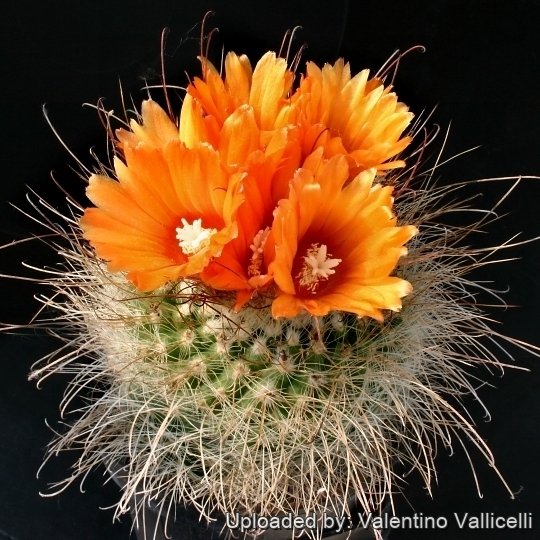
Parodia talaensis is one of the innumerable forms of the very variable Parodia microsperma with bright orange flowers. It is a compact small to medium-sized cactus densely covered in dense white and yellow spines. Usually solitary, but can forms small clusters.
Stem: Green globose or cylindrical 6-9 cm in diameter and up to10 cm tall.
Ribs: 13-21 spiraling with conical tubercles 4-5 mm in diameter 3 mm long.
Areoles: 1,5 mm in diameter with white-yellowish tomentum that fade away as they age.
Radial spines: 11-13 thin,bristly, white, up to 7 mm long.
Central spines: 4, short, hooked of which the upper three are honey-yellow with a reddish tip, while the lower one is more long and strong.
Flowers: Bright orange, infundibuliform on the plant apex 2,5 mm long, 40 mm in diameter. External tepals spatulate or lanceolate, denticulate yellowish-orange. The filaments bear cream-yellowish anthers. Stile white-yellowish bearing a up to 12 lobed stigma.
Blooming season: Produces several flowers simultaneously in early summer (while in Parodia maassii the flowers usually appear one by one), the flowers remain open for about three days.
Fruit: Ovoidal 6x5 mm, with basal dehiscence.
Seeds: Very small 0,4 mm long, brown smooth and shining.
Origin and Habitat
Salta / Tucuman (Tala, Embalse, Cadillal, El Brete) Argentina
Altitude: 620-1800 metres above sea level.
Cultivation and Propagation
It is relatively easy to grow on its own roots.
Soil: Grow it in an open sandy-gritty cactus compost.
Pots: It needs a relatively shallow pot to accommodate its fibrous roots and provide a very good drainage. It may stay in the same pot for many years.
Watering: Water in moderation, it prefer a completely dry place during winter. Mature individuals easily rot and die especially after planting so be extremely cautious with watering. Keep dry in winter or when night temperatures remain below 10° C. Water it less than average if in bigger pots.
Special need: Provide very good ventilation. Nearly all problems occur as a result of overwatering and poor ventilation, especially when weather conditions are dull and cool or very humid.
Fertilization: Feed them once during the growing season with a fertilizer specifically formulated for cactus and succulents (high potash fertilizer with a dilute low nitrogen), including all micro nutrients and trace elements diluted to ½ the strength recommended on the label. They thrive in poor soils and need a limited supplies of fertilizer to avoid the plants developing excess vegetation, which is easily attacked by fungal diseases.
Exposure: It will do its best with lots of sun and become stressed with inadequate light which could result in poor growth and unnatural shape.
Hardiness: It likes warmth (recommended minimum winter temperature 5° C) however plants kept perfectly dry can can survive low temperatures, approx. -5°, but for safe cultivation it is best to avoid freezing temperatures.
Use: This is a good pot plant suited for a non heated green house. It can be also cultivated outdoors in raised beds, terraces if sheltered from winter rain. This cactus continues to be, a particular prize among collectors
Pests & diseases: These cacti may be attractive to a variety of insects, but plants in good condition should be nearly pest-free, particularly if they are grown in a mineral potting-mix, with good exposure and ventilation. Nonetheless, there are several pests to watch for:
- Red spiders: Red spiders may be effectively rubbed up by misting the plants from above.
- Mealy bugs: Mealy bugs occasionally they develop aerial into the new leaves and flowers with disfiguring results, but the worst types develop underground on the roots and are invisible except by their effects.
- Rot: Rot is only a minor problem if the plants are watered and “aired” correctly. If they are not, fungicides won’t help all that much.
Propagation: Seeds. The seeds can be sown in pots of fine, well-drained sandy soil, any time during the spring when temperatures are warm. Cover the seeds with a fine layer of grit and water from below with a fungicide to prevent damping off. For the 1-2 weeks cover the pots with a sheet of glass/clear perspex to keep the humidity levels high. Remove the glass and replace it with light shade-cloth and mist once or twice a day for the next two weeks after which most seeds should have germinated. From then on mistings can be reduced to every second and then every third day as the little plants grow.
Bibliography
Major references and further lectures
-
Edward Anderson “The Cactus family” Timber Press, Incorporated, 2001
-
James Cullen, Sabina G. Knees, H. Suzanne Cubey “The European Garden Flora Flowering Plants: A Manual for the Identification of Plants Cultivated in Europe, Both Out-of-Doors and Under Glass” Cambridge University Press, 11/Aug/2011
-
David R Hunt; Nigel P Taylor; Graham Charles; International Cactaceae Systematics Group. “The New Cactus Lexicon” dh books, 2006
-
Nathaniel Lord Britton, Joseph Nelson Rose “Cactaceae: Descriptions and Illustrations of Plants of the Cactus Family” Courier Dover Publications, 1963
Source: Parodia talaensis, LLIFLE - Encyclopedia of living forms, CC-BY-SA, retrieved 2026-10-25.
From llifle page Parodia weberiana
Description
Parodia microsperma var. weberiana, fistly decribed as Parodia weberiana by F.H.Brandt in 1969, is generally included within (as a synonym of) Parodia microsperma, suggesting that there is not really a fundamental difference between the two, and hard to name accurately without knowing where they come from. It has large, mostly orange red to golden yellow flowers. Regrettably most plants in cultivation under this name seldom match up to the original description, being usually raised from commercial seed which has often been wrongly identified.
Derivation of specific name: This member of the Cactaceae family was given this name by A. Weber. Weber’s Parodia.
Stem: Flattened-globose to globose, up to 7 cm high, 10 cm Ø, green.
Ribs: 21, dissolved in spiral tubercles.
Areoles: Almost nacked.
Radial spines: 15 up to 1 cm long, speading, whitish-yellow
Central spines: 4, variable, horn coloured to red brown, 1 of which approximately 1.5 cm long, the strongest, downward pointing, hooked and darker.
Flowers:* Buds grass green. Flowers 5 cm in diameter orange red to golden yellow. Stamens, anthers, style and stigma-lobes white.
Fruits: Brownish.
Seeds: Very small, round, testa smooth, shiny, brownish.
Note: This plant was previously known in cultivation as Parodia formosa var. roseiflora hort.
Origin and Habitat
Parodia microsperma var. weberiana is endemic to Salta (El Naranjo, El Tala), Argentina.
Altitude range: About 1100-2000 metres above sea level.
Habitat and ecology: This species grows among rocks on cliffs of river valleys.
Cultivation and Propagation
Parodia microsperma, and all it varieties, is relatively easy to grow on its own roots and quite resistant to cultivation. The only things that can kill this plant are cold and overwatering. Nevertheless, it is appropriate to provide adequate growing conditions in order to obtain compact plant with many flowers.
Soil: Use a an open and free draining mineral compost with little organic matter (peat, humus) that allows therefore roots to breath (as it is rot prone). Outdoors a well-draining rocky or sandy soil is ideal.
Pots: It needs a relatively shallow pot to accommodate its fibrous roots and provide a very good drainage. It may stay in the same pot for many years.
Watering: Needs regular water in summer. Keep rather dry in winter, tends to lose its roots in winter.
Fertilization: Feed with a high potassium fertilizer in summer during the growing season diluted to one-fourth potency and mix into the watering can for application.
Hardiness: Keep dry at 5- 10° C in winter, but can tolerate sporadic light frost if kept on the dry side prior to, and during, cold weather.
Exposition: The plant tolerates very bright situations, if kept too dark they may become overly lush and greener and could be prone to rotting due to over watering. Strong light encourages flowering and heavy wool and spine production, but is likely to suffer from sun scorch or stunted growth if over exposed to direct sunlight during the hottest part of the day in summer.
Pests & diseases: It may be attractive to a variety of insects, but plants in good condition should be nearly pest-free, particularly if they are grown in a mineral potting-mix, with good exposure and ventilation. Nonetheless, watch carefully for any significant decline in health. This may signal a pest problem that should be dealt with quickly in order to prevent scarring, stunting and even death.
- Red spiders: Red spiders may be effectively rubbed up by watering or misting the plants from above.
- Mealy bugs: Mealy bugs occasionally develop aerial into the new growth among the leaves with disfiguring results, but the worst types develop underground on the roots and are invisible except by their effects. Eliminate mealybug infestations by dabbing the critters with cotton swabs dipped in alcohol or by soaking the succulent’s roots in a systemic insecticide.
- Scales: Scales are rarely a problem.
- Rot: This species is particularly easy and accommodating, seldom suffer of cryptogamic diseases. Rot it is only a minor problem with cacti if the plants are watered and “aired” correctly. If they are not, fungicides won’t help all that much.
Propagation: By Seeds. The seed of this plant are extremely small and must be sown on the surface of the germination substrate (not buried!!) But the seedlings after germination are so minuscule and delicate that it is quite problematic to keep them alive. So for this species it is usually used the baggy germination technique (in a sterilized pot hermetically closed in a plastic sachet)
Bibliography
Major references and further lectures
-
Walther Haage “Kakteen von A bis Z” Neumann Verlag, 1981
-
Parodia weberiana in Cacti collection-Holzheu www.Kakteensammlung- Holzheu.de
Source: Parodia weberiana, LLIFLE - Encyclopedia of living forms, CC-BY-SA, retrieved 2026-10-25.
From llifle page Parodia dichroacantha f. cristata
Description
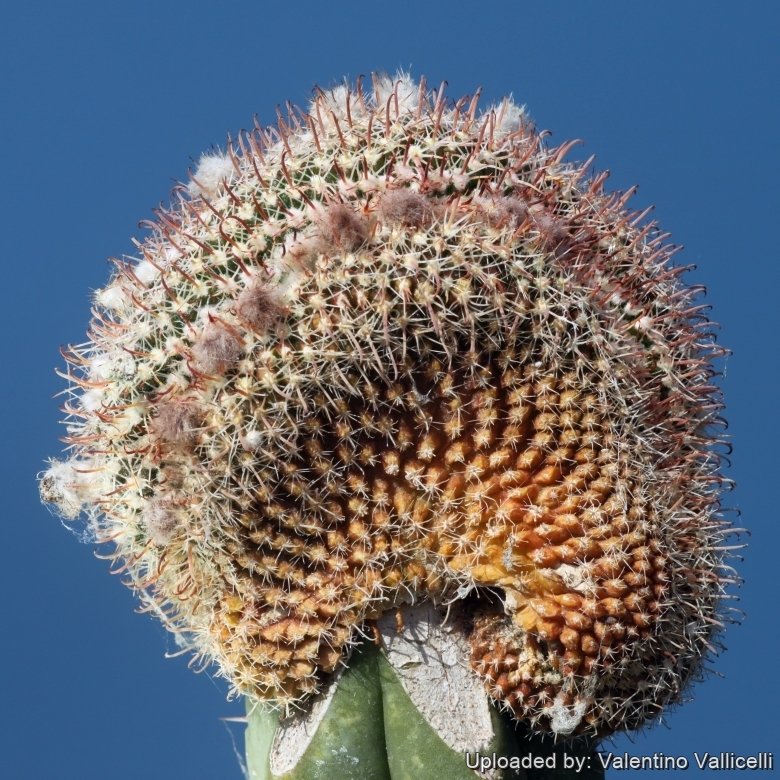
The typical Parodia dichroacantha is a globular to cylindrical cactus covered with strong hooked central spines at the top of which emerge bright orange-red flowers. The crested form (Parodia microsperma var. dichroacantha f. cristata) is very rare and blooms profusely from the linear meristem forming very showy fans of flowers.
Stem: Fan-shaped, 4-7 in thick and up to 20 or more cm in width, dark green to reddish-grey.
Central spine: Hooked, strong, pale-brown, grey-brown, red-brown or brown-chocolate.
Radial spines: Rigid.
Flowers: Orange, orange-red to Scarlet (but also yellow).
Blooming season: Summer.
Origin and Habitat
Garden origin (Nursery produced cultivar)
Cultivation and Propagation
Although regarded as a choice and difficult plant is not too difficult in a greenhouse, although grows quite slowly. It is sometime seen as a grafted plant but grows very well on its own roots too.
Soil: Use mineral well permeable mineral soil with little organic matter (peat, humus).
Exposure: They need a good amount of light shade to full sun this help to keep the plants healthy, although slow growth.
Watering: Water sparingly from March till October (weekly during summertime, if the weather is sunny enough) , with a little fertilizer added. Less or no water during cold winter months, or when night temperatures remain below 10° to prevent root loss. It is sensitive to overwatering (rot prone).
Fertilization: Feeding may not be necessary at all if the compost is fresh then, feed in summer only if the plant hasn’t been repotted recently. Do not feed the plants from September onwards as this can cause lush growth which can be fatal during the darker cold months.
Hardiness: Keep perfectly dry in winter at temperatures from 5 to 15 degrees centigrade. (but it is relatively cold resistant and hardy to -5° C, or possibly colder for short periods) In the rest period no high atmospheric humidity!! (Temperature Zone: USDA 9-11)
Crested growth: Unlike ‘monstrose’ varieties of plants, where the variation from normal growth is due to genetic mutation, crested growth can occur on normal plants. Sometimes it’s due to variances in light intensity, or damage, but generally the causes are unknown. A crested plant may have some areas growing normally, and a cresting plant that looks like a brain, may revert to normal growth for no apparent reason. If you have any of the crested part left you need to remove the normal growth and leave the crested part behind this will need to be done regularly.
Propagation: Grafting or cuttings. Plants are usually grafted onto column-shaped cacti but proved to be able to produce their own roots if degrafted. Cuttings will take root in a minimum temperature of 20° C (but better in hot weather). Cuttings of healthy shoots can be taken in the spring and summer. Cut the stem with a sharp, sterile knife, leave the cutting in a warm, dry place for a week or weeks (depending on how thick the cutting is) until a callus forms over the wound. Once the callus forms, the cutting may be inserted in a container filled with firmed cactus potting mix topped with a surface layer of coarse grit. They should be placed in the coarse grit only; this prevents the cut end from becoming too wet and allows the roots to penetrate the rich compost underneath. The cuttings should root in 2 to 6 weeks. Large crested piece must be placed on the soil surface without burying the plant base down in the soil.
Source: Parodia dichroacantha f. cristata, LLIFLE - Encyclopedia of living forms, CC-BY-SA, retrieved 2026-10-25.
From llifle page Parodia sanguiniflora f. brevispina monstruosa
Description
Parodia microsperma subs. sanguiniflora f. brevispina (monstruosa) is a monstrous plant with short spines that blooms abundantly just as a small specimen. This form reproduces both vegetatively and also by seeds and it is possible to find clones with different degrees of monstrosity or deformity. The flowers shows a great degree of variability too. Maybe we can call it a freak?
Habit: It is a highly branching cactus that forms large clumps.
Stems: Globose up to 9 cm tall and wide freely branching and retaining the basic spherical structure with spiralling tubercled ribs.
Spines: Very short, thin, white, bristly, straight, spreading.
Leaves: A most peculiar trait of this plant are the vestigial leaves on young areoles. This is an ancestral trait not manifested in the normal plant. This trait is revealed thanks to a mutation that permits this odd cultivar to show the characteristic of bearing leaves, reminding us of an ancient era when its cacti ancestors were normal leafed plants. “Leaves” are very small, green cone-like, less than 2 mm tall in clusters of 4 to 10 among the spines at the tubercles tip.
Central spines: Not seen.
Flowers: Blood red, variable, almost normal to more or less monstrous with extremely short petals. The flower’s size varies from less than 1 cm in diameter in the more monstrous clones to up to 4 cm. in diameter in the lesser monstrous forms. Filaments of the stamens carmine anthers creamy-white. Stylus reddish, stigma light-pink to nearly white.
Fruit: Not seen.
Cultivation and Propagation
It is relatively easy to grow on its own roots and quite resistant to cultivation. The only things that can kill this plant are cold and overwatering. Nevertheless, it is appropriate to provide adequate growing conditions in order to obtain compact plant with many flowers.
Soil: Use a an open and free draining mineral compost with little organic matter (peat, humus) that allows therefore roots to breath (as it is rot prone). Outdoors a well-draining rocky or sandy soil is ideal.
Pots: It needs a relatively shallow pot to accommodate its fibrous roots and provide a very good drainage. It may stay in the same pot for many years.
Watering: Needs regular water in summer. Keep rather dry in winter, tends to lose its roots in winter.
Fertilization: Feed with a high potassium fertilizer in summer during the growing season diluted to one-fourth potency and mix into the watering can for application.
Hardiness: Keep dry at 5- 10° C in winter, but can tolerate sporadic light frost if kept on the dry side prior to, and during, cold weather.
Exposition: The plant tolerates very bright situations, if kept too dark they may become overly lush and greener and could be prone to rotting due to over watering. Strong light encourages flowering and heavy wool and spine production, but is likely to suffer from sun scorch or stunted growth if over exposed to direct sunlight during the hottest part of the day in summer.
Pests & diseases: It may be attractive to a variety of insects, but plants in good condition should be nearly pest-free, particularly if they are grown in a mineral potting-mix, with good exposure and ventilation. Nonetheless, watch carefully for any significant decline in health. This may signal a pest problem that should be dealt with quickly in order to prevent scarring, stunting and even death.
- Red spiders: Red spiders may be effectively rubbed up by watering or misting the plants from above.
- Mealy bugs: Mealy bugs occasionally develop aerial into the new growth among the leaves with disfiguring results, but the worst types develop underground on the roots and are invisible except by their effects. Eliminate mealybug infestations by dabbing the critters with cotton swabs dipped in alcohol or by soaking the succulent’s roots in a systemic insecticide.
- Scales: Scales are rarely a problem.
- Rot: This species is particularly easy and accommodating, seldom suffer of cryptogamic diseases. Rot it is only a minor problem with cacti if the plants are watered and “aired” correctly. If they are not, fungicides won’t help all that much.
Propagation: By Seeds or cuttings. The seed of this plant are extremely small and must be sown on the surface of the germination substrate (not buried!!) But the seedlings after germination are so minuscule and delicate that it is quite problematic to keep them alive. So for this species it is usually used the baggy germination technique (in a sterilized pot hermetically closed in a plastic sachet)
Source: Parodia sanguiniflora f. brevispina monstruosa, LLIFLE - Encyclopedia of living forms, CC-BY-SA, retrieved 2026-10-25.
Cultivars and forms (21)
Subspecies (3)
Varieties (16)
- Parodia microsperma var. belenensis
- Parodia microsperma var. cabracorralensis
- Parodia microsperma var. cebilarensis
- Parodia microsperma var. dichroacantha
- Parodia microsperma var. erythrantha
- Parodia microsperma var. guachipasana
- Parodia microsperma var. herzogii
- Parodia microsperma var. jujuyensis
- Parodia microsperma var. lembckei
- Parodia microsperma var. malyana
- Parodia microsperma var. microthele
- Parodia microsperma var. mutabilis
- Parodia microsperma var. nana
- Parodia microsperma var. rubristaminea
- Parodia microsperma var. setifera
- Parodia microsperma var. weberiana
Gallery