Publication: Cactaceae Consensus Init. 6: 12. 1998
Description
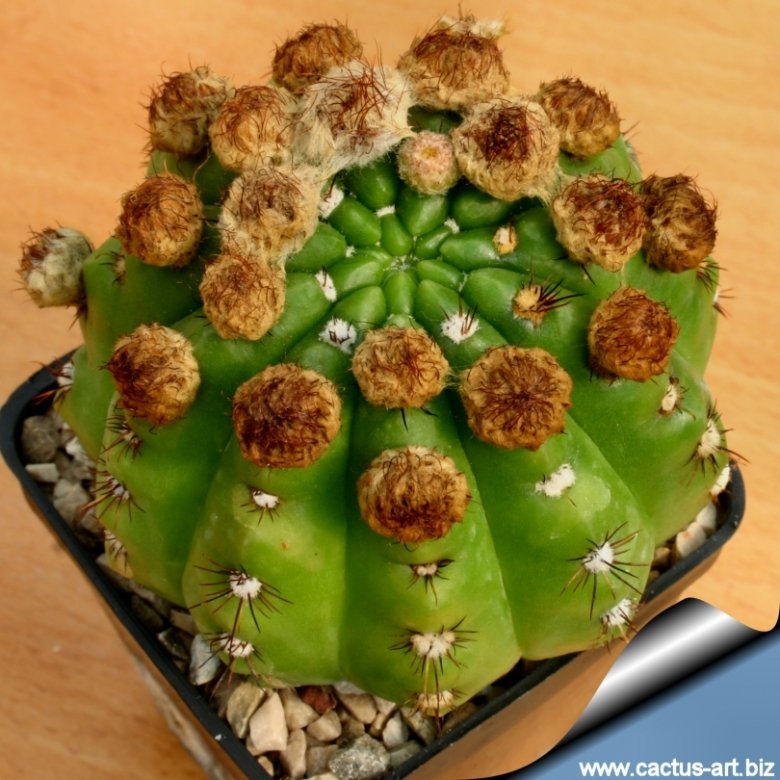
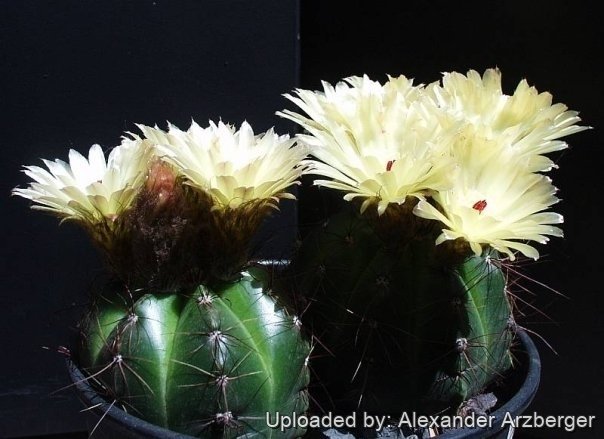
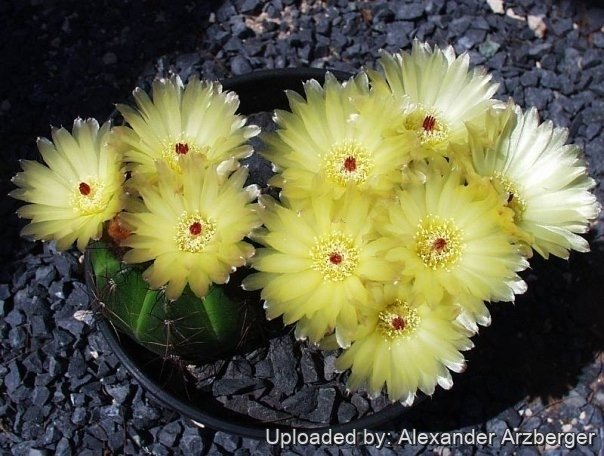
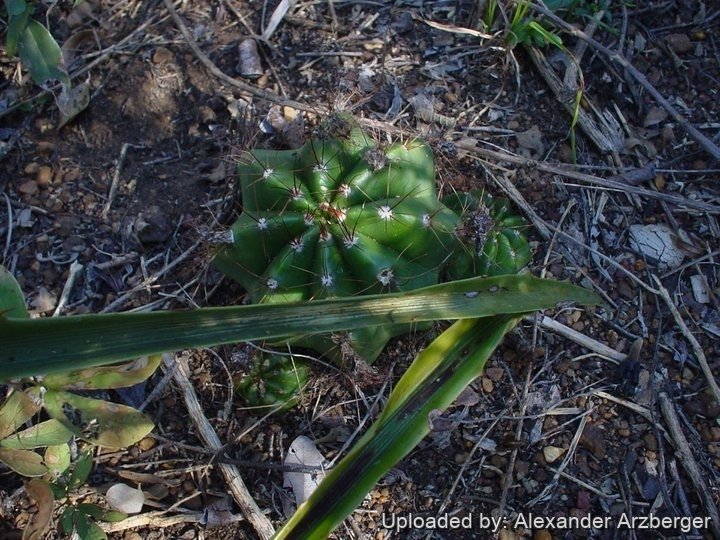
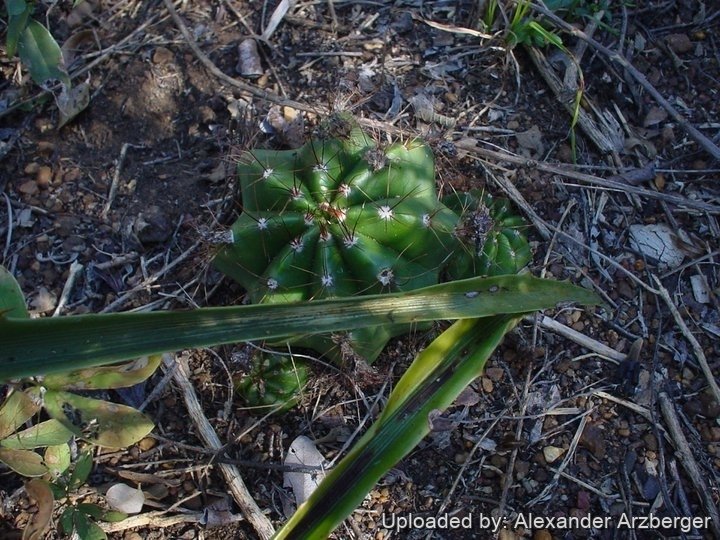
Parodia oxycostata, better known as Notocactus oxycostatus, is a common attractive dwarf clumping cactus that flowers at an early age. This is one of the most variable species in the genus and has lots of unnecessary synonyms and comprises a multitude of different local forms. But where each form is linked to others by populations of plants with intermediate characteristics. This species is in cultivation with many cultivated and propagated forms.
Habit: Plants solitary, only rarely offsetting into small clusters in time.
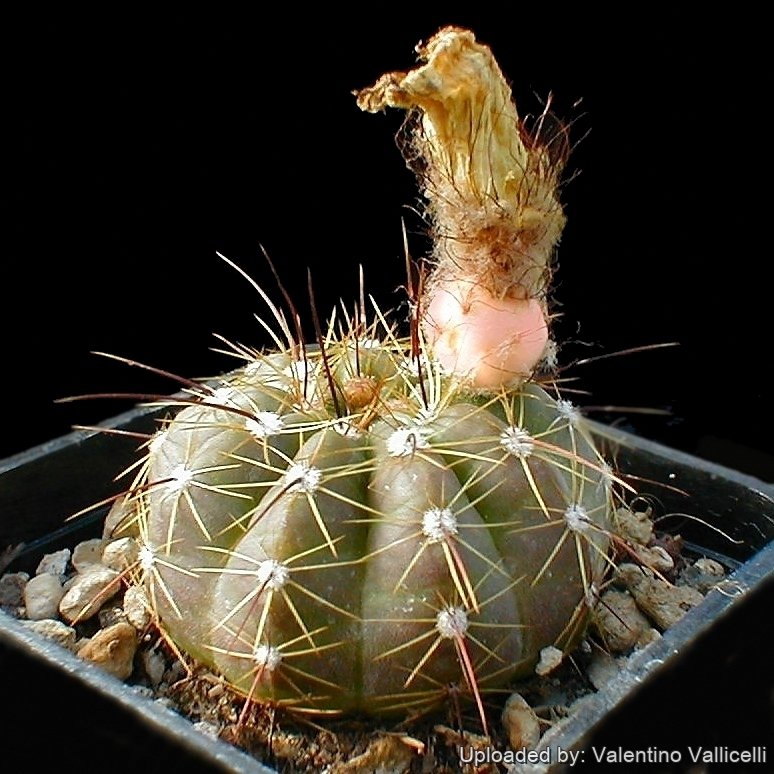
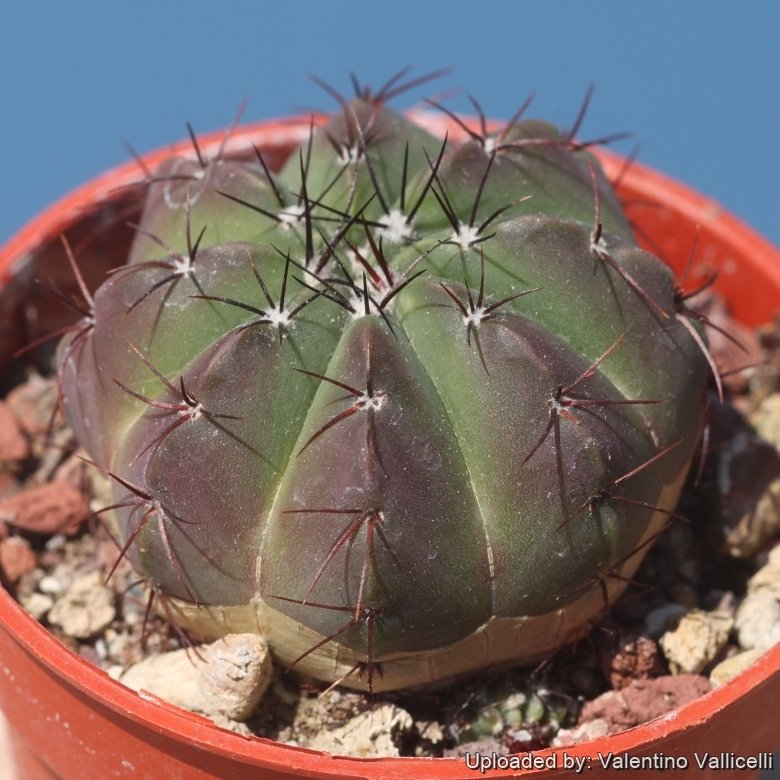
Stem: Flattened globose to globose, grey-green, to 9 cm high and in diameter.
Ribs: 6-12, acute, with chinlike protrusions between the areoles.
Areoles: Round, white at first, later grey, then naked.
Spines: Reddish brown to bright yellow, becoming lighter with age, flattened, twisted.
Central spine: 1, pointing downward, upto 20 mm long.
Radial spines: Usually only 2, one pointing downward, 16-25 mm long, sometimes with as many as 8 additional small spines to 6 mm long.
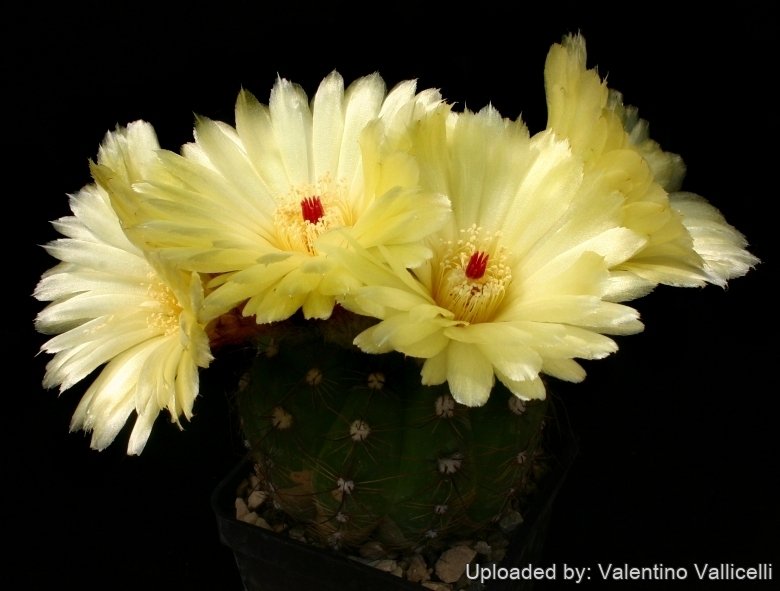
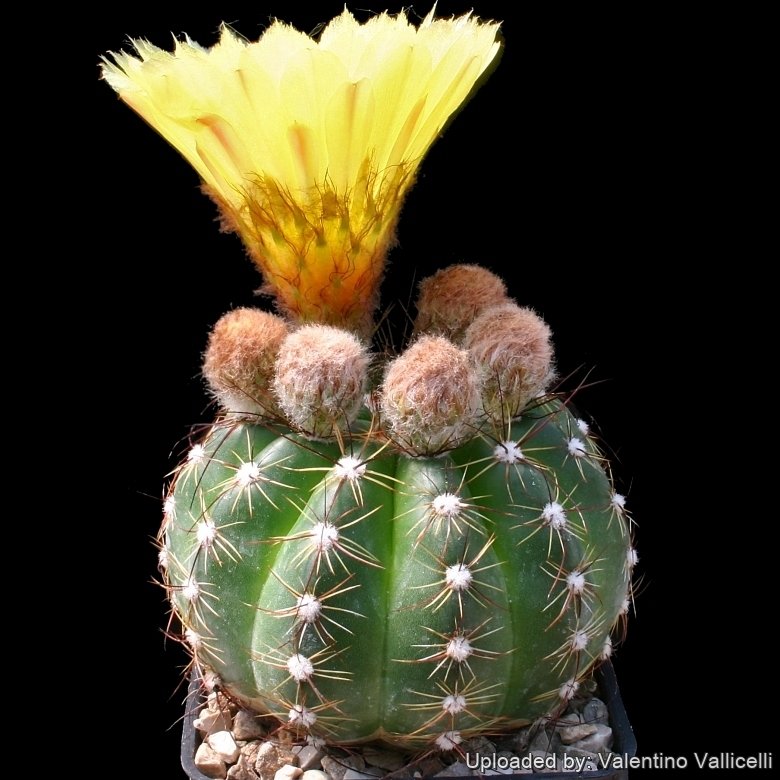
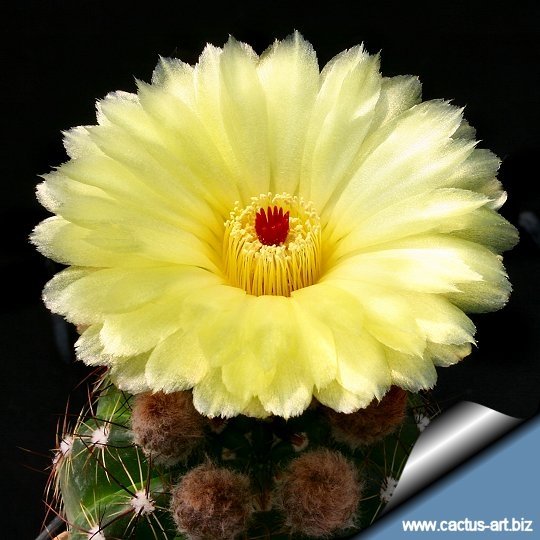
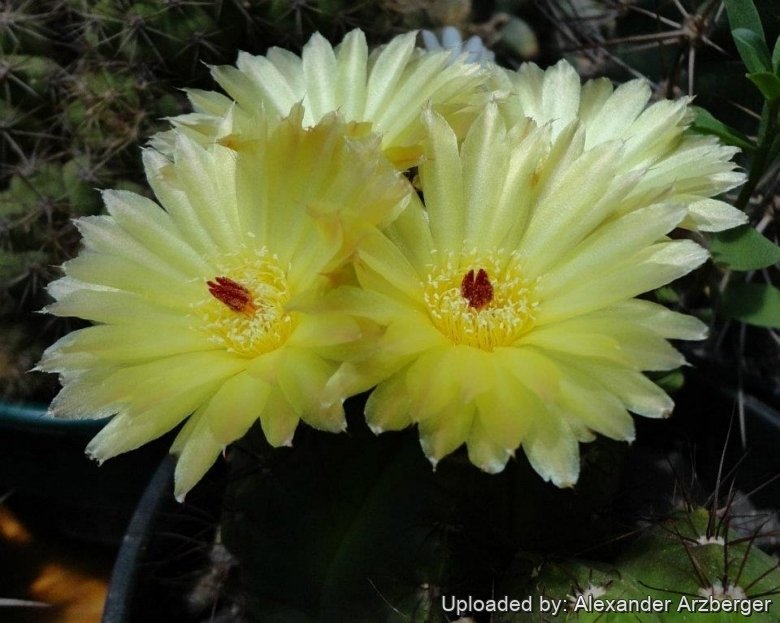
Flowers: Borne several at a time apically, bell-fnnel shaped to sometimes urn shaped, yellow, to 1 cm long and 4,5 cm in diameter; pericarpels and floral tubes with scales, white wool, and reddish brown bristles in clusters. Stigma red.
Blooming season: Flowering occurs in summer through early fall and will bloom several times during warm weather.
Fruits: With yellowish grey wool and reddish brown bristles, 2,5-2,7 cm long.
Seeds: Helmet shaped, shiny black.
Origin and Habitat
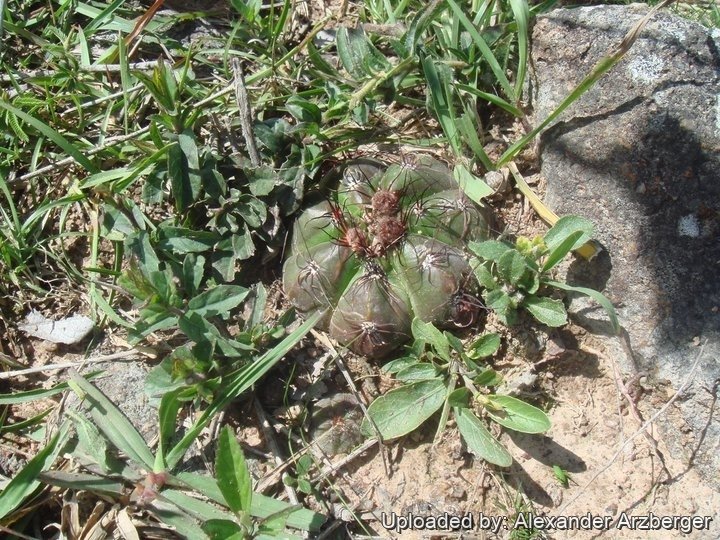
Parodia oxycostata has a very wide range, Rio Grande do Sul, Brazil, as well as from Argentina, Paraguay and Uruguay, Southern America (extent of occurrence 120,000 km2)
Altitude: It grows at elevations of up to 500 meters above sea level.
Habitat: The species is not very abundant, and grows in several fragmented subpopulatations mostly on rocky outcrops and stony fields, in grasslands or pampas. The generation length is 10 years. Parodia oxycostata and Parodia ottonis grow sympatrically in Rio Grande do Sul.
Cultivation and Propagation
Parodia oxycostata is a summer grower species easy to grow and to bloom. It makes a very suitable indoor plants for any luminous windowsills.
Growth rate: It is a moderately fast growing and easily flowering species.
Soil: Use mineral well permeable substratum with little organic matter (peat, humus), plants may become too elongated if compost is too rich.
Repotting: Re-pot every 2 years. Use pot with good drainage.
Fertilization: It grows much faster with a low nitrogen content fertilizer in spring and summer.
Watering: Requires careful watering to keep plant compact. Water sparingly from March till October, the thin, fibrous roots suffer if there is humidity, therefore the plant should be watered only when the surrounding terrain is dry. Keep dry as soon as the temperature starts dropping in October and keep it perfectly dry in winter at temperatures from 5 to 15 degrees centigrade.
Hardiness: They need to be kept in a cool place during winter rest and are somewhat resistant to frost if kept on the dry side prior to, and during, cold weather ( they are hardy to -5 C ° C, for short periods). Although it is one of the easier Parodia to grow, it tends to rot in winter during the resting phase, if kept wet. In the rest period no high atmospheric humidity!!
Sun Exposure: Requires full sun in winter and some protection in summer, its colour tends to richer and darker when grown in light shade.
Uses: It is an excellent plant for container growing. It always looks good and stays small.
Pests & diseases: It may be attractive to a variety of insects, but plants in good condition should be nearly pest-free, particularly if they are grown in a mineral potting-mix, with good exposure and ventilation. Nonetheless, there are several pests to watch for:
- Red spiders: Red spiders may be effectively rubbed up by watering the infested plants from above.
- Mealy bugs: Mealy bugs occasionally develop aerial into the new growth among the wool with disfiguring results, but the worst types develop underground on the roots and are invisible except by their effects.
- Scales: Scales are rarely a problem.
- Rot: Rot is only a minor problem with cacti if the plants are watered and “aired” correctly. If they are not, fungicides won’t help all that much. To prevent rottenness it is also advisable to surround its root neck by very rough sand or grit, this help a fast water drainage.
Propagation: Almost exclusively by seed. Cutting scions from a flourishing plant may also been used to propagate this plant.
Bibliography
Major references and further lectures
-
Tony Mace “Notocactus: a review of the genus incorporating Brasilicactus, Eriocactus and Wigginsia” Editorial Board/National Cactus & Succulent Society, 1975
-
Edward Anderson “The Cactus family” Timber Press, Incorporated, 2001
-
James Cullen, Sabina G. Knees, H. Suzanne Cubey “The European Garden Flora Flowering Plants: A Manual for the Identification of Plants Cultivated in Europe, Both Out-of-Doors and Under Glass” Cambridge University Press, 11/Aug/2011
-
David R Hunt; Nigel P Taylor; Graham Charles; International Cactaceae Systematics Group. “The New Cactus Lexicon” dh books, 2006
-
Larocca, J. & Machado, M. 2013. Parodia oxycostata. In: IUCN 2013. “IUCN Red List of Threatened Species.” Version 2013.1. <www.iucnredlist.org>. Downloaded on 29 October 2013.
-
H. Krainz “Die Kakteen: eine Gesamtdarstellung der eingeführten Arten nebst Anzucht- und Pflege-Anweisungen,” Parts 1-16” Franck, 1956
-
Friedrich Ritter “Kakteen in Suedamerika: Ergebnisse Meiner 20 Jaehrigen Feldforschungen” F. Ritter Selbstverlag, 1979
-
Haustein, Erik. “Der Kosmos-Kakteenführer.” Kosmos / Gesellschaft der Naturfreunde., Stuttgart, 1983
-
Mariella Pizzetti, Giuseppe Mazza “Copertina anteriore” A. Mondadori, 1985
From llifle page Notocactus glaucinus
Description
Parodia oxycostataglaucina| (a.k.a. Notocactus glaucinus) is a local form of the wide ranging and very variable Parodia oxycostata distinguished from the latter by the waxy coating on the epidermis (From Latin “glaucinus” = “With a waxy bloom”) and pink fruits. The differences with other Parodia oxycostata are in reality very minimal and most botanist agree on the fact that both should all be included in the Parodia oxycostata, and the two plants are not readily distinguishable, if not for the geographical provenance. The “glaucina” is merely one of the several forms regarded as a mere ecotype with size or colour modified by more humid or arid conditions and merging into typical plants in cultivation. However similar plants occurs at random elsewhere.
Habit: Plants solitary, only rarely offsetting into small clusters in time. The stems are flattened globular and will bear several glossy yellow flowers around the very woolly stem apex in mid summer.
Stem: Flattened globose to globose, grey-green, to 9 cm in diameter.
Ribs: 6-12, acute, with shallow chinlike protrusions between the areoles.
Areoles: Round, white at first, later grey, then naked.
Spines: Reddish brown to bright yellow, becoming lighter with age, flattened, twisted.
Central spine: 1, pointing downward, upto 20 mm long.
Radial spines: Usually only 2, one pointing downward, 16-25 mm long, sometimes with as many as 8 additional small spines to 6 mm long.
Flowers: Borne several at a time apically, bell-fummel-shaped to sometimes urn shaped, yellow, to 1 cm long and 4,5 cm in diameter; pericarpels and floral tubes with scales, white wool, and reddish brown bristles in clusters. Stigma red.
Blooming season: Flowering occurs in summer through early fall and will bloom several times during warm weather.
Fruits: With yellowish grey wool and reddish brown bristles, 2,5-2,7 cm long.
Seeds: Helmet shaped, shiny black.
Origin and Habitat
Rio Grande do Sul, Brazil (Southern South America)
Habitat: It grows mostly on rocky outcrops and stony fields, in grasslands or pampas.
Cultivation and Propagation
They like a warm bright location, does great in partial shade avoid full sun. During winter’s rest period they should be dry and cool. It is best to avoid any frost but during the winter the temperature can be as low as 2° C without any harm so long as the compost is very dry, they like only a short winter’s rest. If the soil is allowed to be dry for too long root loss could follow but equally the same result would occur if the plants are both wet and cold. Cold spots can mar its epidermis in cold damp conditions. They need good drainage and prefer a neutral to slightly acidic compost with plenty of extra grit. Water and feed during the summer. Best if watered with rain water and given an occasional tonic of sequestrated iron.
Propagation: Usually by seeds as it seldom produces offsets.
Source: Notocactus glaucinus, LLIFLE - Encyclopedia of living forms, CC-BY-SA, retrieved 2026-10-25.
From llifle page Notocactus glaucinus var. depressus
Description
Parodia oxycostataglaucina| var. depressa (a.k.a. Notocactus glaucinus var. depressus) is a local form of the wide ranging and very variable Parodia oxycostata distinguished from the latter by the flat light green stem and pink fruits. The differences with other Parodia oxycostata are in reality very minimal and most botanist agree on the fact that both should all be included in the Parodia oxycostata, and the two plants are not readily distinguishable, if not for the geographical provenance. The “glaucina var. depressa” is merely one of the several forms regarded as a mere ecotype with size or colour modified by more humid or arid conditions and merging into typical plants in cultivation. However similar plants occurs at random elsewhere.
Habit: Plants solitary, only rarely offsetting into small clusters in time. The stems are flattened globular and will bear several glossy yellow flowers around the very woolly stem apex in mid summer.
Stem: Flattened globose to globose, grey-green, to 9 cm in diameter.
Ribs: 6-12, acute, with shallow chinlike protrusions between the areoles.
Areoles: Round, white at first, later grey, then naked.
Spines: Reddish brown to bright yellow, becoming lighter with age, flattened, twisted. Central spine: 1, pointing downward, upto 20 mm long.
Radial spines: Usually only 2, one pointing downward, 16-25 mm long, sometimes with as many as 8 additional small spines to 6 mm long.
Flowers: Borne several at a time apically, bell-fummel-shaped to sometimes urn shaped, yellow, to 1 cm long and 4,5 cm in diameter; pericarpels and floral tubes with scales, white wool, and reddish brown bristles in clusters. Stigma red.
Blooming season: Flowering occurs in summer through early fall and will bloom several times during warm weather.
Fruits: With yellowish grey wool and reddish brown bristles, 2,5-2,7 cm long.
Seeds: Helmet shaped, shiny black.
Origin and Habitat
Sao Francisco de Assis, Rio Grande do Sul, Brazil(Southern America)
Habitat: It grows mostly on rocky outcrops and stony fields, in grasslands or pampas.
Cultivation and Propagation
Parodia glaucina var. depressa is a summer grower species easy to grow and to bloom. It makes a very suitable indoor plants for any luminous windowsills.
Growth rate: It is a moderately fast growing and easily flowering species.
Soil: Use mineral well permeable substratum with little organic matter (peat, humus), plants may become too elongated if compost is too rich.
Repotting: Re-pot every 2 years. Use pot with good drainage.
Fertilization: It grows much faster with a low nitrogen content fertilizer in spring and summer.
Watering: Requires careful watering to keep plant compact. Water sparingly from March till October, the thin, fibrous roots suffer if there is humidity, therefore the plant should be watered only when the surrounding terrain is dry. Keep dry as soon as the temperature starts dropping in October and keep it perfectly dry in winter at temperatures from 5 to 15 degrees centigrade.
Hardiness: They need to be kept in a cool place during winter rest and are somewhat resistant to frost if kept on the dry side prior to, and during, cold weather ( they are hardy to -5 C ° C, for short periods). Although it is one of the easier Parodia to grow, it tends to rot in winter during the resting phase, if kept wet. In the rest period no high atmospheric humidity!!
Sun Exposure: Requires full sun in winter and some protection in summer, its colour tends to richer and darker when grown in light shade.
Uses: It is an excellent plant for container growing. It always looks good and stays small.
Pests & diseases: It may be attractive to a variety of insects, but plants in good condition should be nearly pest-free, particularly if they are grown in a mineral potting-mix, with good exposure and ventilation. Nonetheless, there are several pests to watch for:
- Red spiders: Red spiders may be effectively rubbed up by watering the infested plants from above.
- Mealy bugs: Mealy bugs occasionally develop aerial into the new growth among the wool with disfiguring results, but the worst types develop underground on the roots and are invisible except by their effects.
- Scales: Scales are rarely a problem.
- Rot: Rot is only a minor problem with cacti if the plants are watered and “aired” correctly. If they are not, fungicides won’t help all that much. To prevent rottenness it is also advisable to surround its root neck by very rough sand or grit, this help a fast water drainage.
Propagation: Almost exclusively by seed. Cutting scions from a flourishing plant may also been used to propagate this plant.
Source: Notocactus glaucinus var. depressus, LLIFLE - Encyclopedia of living forms, CC-BY-SA, retrieved 2026-10-25.
From llifle page Notocactus oxycostatus var. occidentalis
Description
Notocactus oxycostatus var. occidentalis is one of the morphological or geographical form of the widespread and very variable Notocactus oxycostatus. It has fattened stems to 60 mm in diameter, clustering with time, and start flowering at an early age, often when only 35 mm in diameter. As with many notocacti, the yellow flowers are produced in profusion from the crown. It is close to Notocactus ottonis.
Derivation of specific name: ‘occidentalis’ for the occurrence in the far western part of the area of distribution (central Paraguay).
Stem: Flattened spherical, 20-50 mm tall and 30-60 mm (sometimes up to 70 mm) in diameter, dark blue-green to olive green, sometimes violet brown in the sun.
Ribs: Mostly 7, vertical, to 30 mm wide and 15 mm tall almost triangular in cross-section. The sharp rib edges are broken into humps and valleys (up to 2 mm deep).
Areoles: Roundish, small, white woolly, slightly recessed and 8 -12 mm apart mostly 2 mm high and 5 mm wide.
Radial spines: 5, rarely 7, spreading, curved, 5-20 mm long brown, occasionally dark brownish-black and soft or lighter amber-brown.
Central spine: 1 neither stronger nor longer.
Flowers: Several at a time from the apex, lemon-yellow 40-60 mm long and 50-70 mm wide. Buds covered by dark brown wool. Pericarpel green wrapped with brown wool and long stinging bristles. Bracts on the tube 5-10 mm long with brown wool and 2-3 bristles in the axil. Tepals lanceolate, shiny, lemon-yellow, often reddish in the outside, about 6 mm wide and 25-36 mm long. Stamens yellow 9-13 mm long. Style grooved 20-22 mm long and 2 mm thick, the 7-8 purple stigma lobes are 3-4 mm long. The plant is self-fertile.
Fruit: Barrel-shaped, 5 mm wide and 11 mm long, withering when ripe, splitting open along irregular fissures.
Seeds: 0.9 mm wide and 1.1 mm long, cap-shaped. Testa glossy black.
Origin and Habitat
Notocactus oxycostatus var. occidentalis is endemic to Piribebuy and adjacent areas, Cordillera. (Minifundia region), Paraguarí and Missiones, in Central Paraguay (700-800 km west of the State of Rio Grande du Sul, which is the main area of distribution of Notocactus oxycostatus).
Cultivation and Propagation
They like a warm bright location, does great in partial shade avoid full sun. During winter’s rest period they should be dry and cool. It is best to avoid any frost but during the winter the temperature can be as low as 2° C without any harm so long as the compost is very dry, they like only a short winter’s rest. If the soil is allowed to be dry for too long root loss could follow but equally the same result would occur if the plants are both wet and cold. Cold spots can mar its epidermis in cold damp conditions. They need good drainage and prefer a neutral to slightly acidic compost with plenty of extra grit. Water and feed during the summer. Best if watered with rain water and given an occasional tonic of sequestrated iron.
Propagation: Usually by seeds, or (rarely) by offsets.
Bibliography
Major references and further lectures
- Gerloff, N. “Notocactus oxycostatus var. occidentalis N. Gerloff 2003” in Internoto 24(3-4): 76 (75-80; figs.). 2003
Source: Notocactus oxycostatus var. occidentalis, LLIFLE - Encyclopedia of living forms, CC-BY-SA, retrieved 2026-10-25.
From llifle page Notocactus oxycostatus f. securituberculatus
Description
Parodia oxycostata f. securituberculata (a.k.a. Notocactus securituberculatus) is a local form of the wide ranging and very variable Parodia oxycostata distinguished from the latter by sharp bluish ribs that redden if exposed to strong sun light and under stress conditions. The differences with other Parodia oxycostata are in reality very minimal and most botanist agree on the fact that both should all be included in the Parodia oxycostata, and the two plants are not readily distinguishable, if not for the geographical provenance. The “securituberculata” is merely one of the several forms regarded as a mere ecotype with size or colour modified by more humid or arid conditions and merging into typical plants in cultivation. However similar plants occurs at random elsewhere.
Habit: Plants solitary, only rarely offsetting into small clusters in time. The stems are flattened globular and will bear several glossy yellow flowers around the very woolly stem apex in mid summer.
Stem: Flattened globose to globose, grey-green, to 9 cm in diameter.
Ribs: 6-12, acute, with shallow chinlike protrusions between the areoles.
Areoles: Round, white at first, later grey, then naked.
Spines: Reddish brown to bright yellow, becoming lighter with age, flattened, twisted.
Central spine: 1, pointing downward, upto 20 mm long.
Radial spines: Usually only 2, one pointing downward, 16-25 mm long, sometimes with as many as 8 additional small spines to 6 mm long.
Flowers: Borne several at a time apically, bell-fummel-shaped to sometimes urn shaped, yellow, to 1 cm long and 4,5 cm in diameter; pericarpels and floral tubes with scales, white wool, and reddish brown bristles in clusters. Stigma red.
Blooming season: Flowering occurs in summer through early fall and will bloom several times during warm weather.
Fruits: With yellowish grey wool and reddish brown bristles, 2,5-2,7 cm long.
Seeds: Helmet shaped, shiny black.
Origin and Habitat
Quevedos and adjacent area, Rio Grande do Sul, Brazil (Southern South America)
Habitat: It grows mostly on rocky outcrops and stony fields, in grasslands or pampas.
Source: Notocactus oxycostatus f. securituberculatus, LLIFLE - Encyclopedia of living forms, CC-BY-SA, retrieved 2026-10-25.
Gallery