Publication: Succulenta (Netherlands) 1959, 17 (1959).
Description
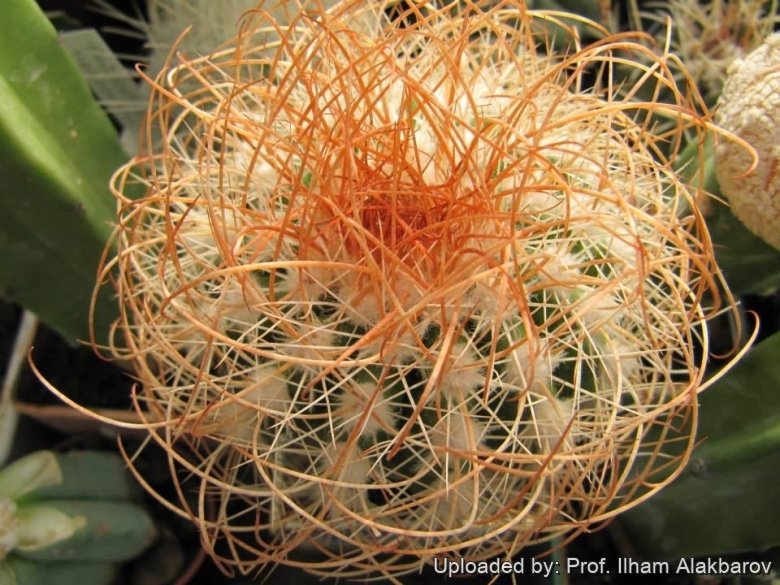
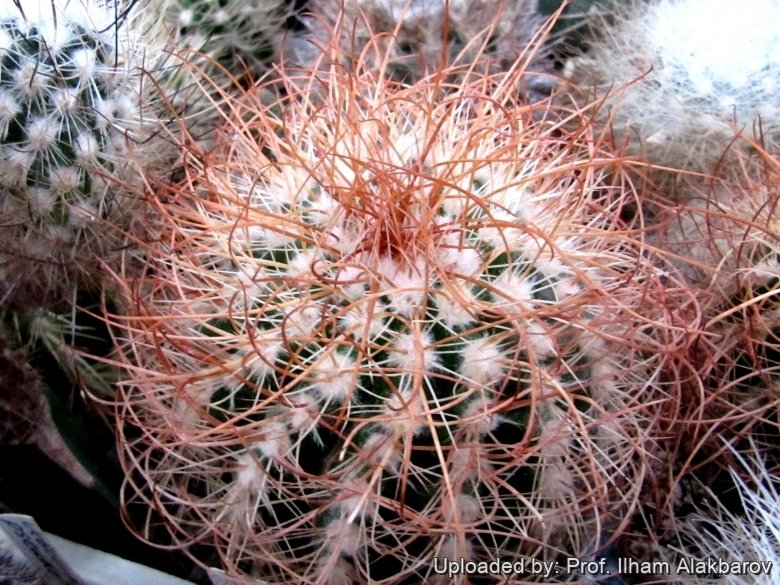
Parodia ritteri is a cute columnar cactus with beautiful rose to whitish spines and blood-red to yellowish-brown flowers. The several synonyms refers to previously described species, so similar and intermingled that it is almost impossible to name them accurately without knowing where they come from. It is not surprising to have caused so much difficulty, because you can find plants with slightly different characteristics growing cheek by jowl in many parts of the areal. Whatever they are called they are all lovely plants meriting a place in any cactus collection.
Habit: This species is usually solitary, sometimes forming clumps.
Stems: Globose at first, becoming cylindrical, green with white woolly tips, approx 30-50 cm tall, 8-10 cm Ø.
Ribs: 15-21, tuberculate at first, later less so.
Areoles: Woolly, brownish to whitish.
Central spine(s): One increasing to four with time rose to whitish, not readily distinguishable from the radials.
Radial spines: 10-14, more or less erect, rose to whitish, 14-40 mm long.
Flowers: Borne several at a time apically, funnel-shaped, blood-red, brownish-red or yellowish-brown , 2.5-3.5 cm long; pericarpels covered with white wool. Stigma lobes bright yellow.
Blooming season: Flowering occurs in summer through early fall and will bloom several times during warm weather.
Fruits: 4-8 mm long red with conspicuous white wool, usually thicker than long.
Seeds: Black about 0.7 millimetres long and 0.5 millimetres wide, which are finely tuberculate.
Origin and Habitat
Chuquisaca, Potosí and Tarija, Bolivia. (extent of occurrence 3,900 km2)
Altitude: 2300 to 3200 metres above sea level.
Habitat and Ecology: Parodia ritteri grows in prepuna on rocky slopes and steep valley walls. It is very abundant and its population is stable. There are no known major threats to this cactus.
Cultivation and Propagation
Parodia ritteri is relatively easy to grow on its own roots.
Soil: Grow it in an open sandy-gritty cactus compost.
Pots: It needs a relatively shallow pot to accommodate its fibrous roots and provide a very good drainage. It may stay in the same pot for many years.
Watering: Water in moderation, it prefer a completely dry place during winter. Mature individuals easily rot and die especially after planting so be extremely cautious with watering. Keep dry in winter or when night temperatures remain below 10° C. Water it less than average if in bigger pots.
Special need: Provide very good ventilation. Nearly all problems occur as a result of overwatering and poor ventilation, especially when weather conditions are dull and cool or very humid.
Fertilization: Feed them once during the growing season with a fertilizer specifically formulated for cactus and succulents (high potash fertilizer with a dilute low nitrogen), including all micro nutrients and trace elements diluted to ½ the strength recommended on the label. They thrive in poor soils and need a limited supplies of fertilizer to avoid the plants developing excess vegetation, which is easily attacked by fungal diseases.
Exposure: It will do its best with lots of sun and become stressed with inadequate light which could result in poor growth and unnatural shape.
Hardiness: It likes warmth (recommended minimum winter temperature 5° C) however plants kept perfectly dry can can survive low temperatures, approx. -5°, but for safe cultivation it is best to avoid freezing temperatures.
Use: This is a good pot plant suited for a non heated green house. It can be also cultivated outdoors in raised beds, terraces if sheltered from winter rain. This cactus continues to be, a particular prize among collectors
Pests & diseases: These cacti may be attractive to a variety of insects, but plants in good condition should be nearly pest-free, particularly if they are grown in a mineral potting-mix, with good exposure and ventilation. Nonetheless, there are several pests to watch for:
- Red spiders: Red spiders may be effectively rubbed up by misting the plants from above.
- Mealy bugs: Mealy bugs occasionally they develop aerial into the new leaves and flowers with disfiguring results, but the worst types develop underground on the roots and are invisible except by their effects.
- Rot: Rot is only a minor problem if the plants are watered and “aired” correctly. If they are not, fungicides won’t help all that much.
Propagation: Seeds. The seeds can be sown in pots of fine, well-drained sandy soil, any time during the spring when temperatures are warm. Cover the seeds with a fine layer of grit and water from below with a fungicide to prevent damping off. For the 1-2 weeks cover the pots with a sheet of glass/clear perspex to keep the humidity levels high. Remove the glass and replace it with light shade-cloth and mist once or twice a day for the next two weeks after which most seeds should have germinated. From then on mistings can be reduced to every second and then every third day as the little plants grow.
Bibliography
Major references and further lectures
-
Lowry, M. & Carr, J. 2013. Parodia ritteri. In: IUCN 2013. “IUCN Red List of Threatened Species.” Version 2013.2. <www.iucnredlist.org>. Downloaded on 28 February 2014.
-
Edward Anderson “The Cactus family” Timber Press, Incorporated, 2001
-
James Cullen, Sabina G. Knees, H. Suzanne Cubey “The European Garden Flora Flowering Plants: A Manual for the Identification of Plants Cultivated in Europe, Both Out-of-Doors and Under Glass” Cambridge University Press, 11/Aug/2011
-
David R Hunt; Nigel P Taylor; Graham Charles; International Cactaceae Systematics Group. “The New Cactus Lexicon” dh books, 2006
-
Urs Eggli, Leonard E. Newton “Etymological Dictionary of Succulent Plant Names” Springer, Berlin/Heidelberg 2010,
-
Succulenta. 2: 17–20 1959
From llifle page Parodia roseoalba
Description
Parodia roseoalba is a nice morphological form of the variable Parodia ritteri that grows singly or more often forms clumps and is distinguished for the conspicuous creamy-white, yellow or amber central spines that envelop the body. The plants are quite variable and it becomes almost impossible to distinguish the different forms from one another if not for geographical provenance so most authors choose to lump them together.
Stem: 120-150 mm Ø, light green, with a crown of white wool.
Ribs: Mostly 13, rarely up to 16, 15-20 mm high.
Areoles: With white felt.
Spines: Creamy-white to reddish-brown.
Radial spines: 12-16 light cream-white to white, thin, needle-like, 20-50 mm long, upper and lower ones roughly equally long.
Central spines: 3-6 needle-like, stronger than radials, 30-70 mm long, lower ones longer the other a little shorter, in younger plants the lower central noticeably hooked, in mature plants only slightly curved to almost straight.
Flowers: 25-40 mm long yellow to brownish-orange or pinkish, tepals 12-20 mm long and 2-4 mm broad, central strip more or less pronounced, crimson, 1-2 mm wide, wider downward, margins of tepals brownish. Pericarpel spherical, 6-7 mm, wrapped in white woolly hairs; floral-tube 11-15 mm long, 11-13 mm wide white, red and brown more or less densely covered by white woolly hairs often lacking; filaments basally yellow reddish-brown above, pistil pale yellow protruding above the anthers.
Fruits: Spherical, covered with fine white wool, with broad basal opening at maturity.
Seeds: Ovoid, 1.0 x 0.8 mm, black, finely tubercled.
Origin and Habitat
Chuquisaca and Tarija, Bolivia
Altituse range: Around 2400-3500 metres above sea level.
Habitat and Ecology: Parodia rubida grows on steep slopes made up of red sedimentary rooks containing iron together with other cactus species such as Parodia maassii (= Parodia splendens) and Weingartia cintiensis. The area is almost deprived of green vegetation.
Cultivation and Propagation
Parodia roseoalba is relatively easy to grow on its own roots.
Soil: Grow it in an open sandy-gritty cactus compost.
Pots: It needs a relatively shallow pot to accommodate its fibrous roots and provide a very good drainage. It may stay in the same pot for many years.
Watering: Water in moderation, it prefer a completely dry place during winter. Mature individuals easily rot and die especially after planting so be extremely cautious with watering. Keep dry in winter or when night temperatures remain below 10° C. Water it less than average if in bigger pots.
Special need: Provide very good ventilation. Nearly all problems occur as a result of overwatering and poor ventilation, especially when weather conditions are dull and cool or very humid.
Fertilization: Feed them once during the growing season with a fertilizer specifically formulated for cactus and succulents (high potash fertilizer with a dilute low nitrogen), including all micro nutrients and trace elements diluted to ½ the strength recommended on the label. They thrive in poor soils and need a limited supplies of fertilizer to avoid the plants developing excess vegetation, which is easily attacked by fungal diseases.
Exposure: It will do its best with lots of sun and become stressed with inadequate light which could result in poor growth and unnatural shape.
Hardiness: It likes warmth (recommended minimum winter temperature 5° C) however plants kept perfectly dry can can survive low temperatures, approx. -5°, but for safe cultivation it is best to avoid freezing temperatures.
Use: This is a good pot plant suited for a non heated green house. It can be also cultivated outdoors in raised beds, terraces if sheltered from winter rain. This cactus continues to be, a particular prize among collectors
Pests & diseases: These cacti may be attractive to a variety of insects, but plants in good condition should be nearly pest-free, particularly if they are grown in a mineral potting-mix, with good exposure and ventilation. Nonetheless, there are several pests to watch for:
- Red spiders: Red spiders may be effectively rubbed up by misting the plants from above.
- Mealy bugs: Mealy bugs occasionally they develop aerial into the new leaves and flowers with disfiguring results, but the worst types develop underground on the roots and are invisible except by their effects.
- Rot: Rot is only a minor problem if the plants are watered and “aired” correctly. If they are not, fungicides won’t help all that much.
Propagation: Seeds. The seeds can be sown in pots of fine, well-drained sandy soil, any time during the spring when temperatures are warm. Cover the seeds with a fine layer of grit and water from below with a fungicide to prevent damping off. For the 1-2 weeks cover the pots with a sheet of glass/clear perspex to keep the humidity levels high. Remove the glass and replace it with light shade-cloth and mist once or twice a day for the next two weeks after which most seeds should have germinated. From then on mistings can be reduced to every second and then every third day as the little plants grow.
Bibliography
Major references and further lectures
-
Backeberg C. “Das Kakteenlexikon” p. 348, 1966
-
De Vos W. “Parodia rubida” Cactusvrienden, 22 : 128-200, 1982
-
Jelínek J. “Parodia Speg.;” Kaktusy 79, 15 : 113, 1979
-
Kessler H., “Parodien aus den bolivianischen Anden” Kakt. und and. Sukk., 21 : 70, 1970
-
Kessler H., “Die FR-Parodien” Stachelpost, 7 : 223-224, 247, 1970
-
Ritter F., “Kakteen in Südamerika” 2 : 519, 1980
-
Weskamp W., “Die Gattung Parodia” p. 283-284, 1987
-
Lowry, M. & Carr, J. 2013. Parodia ritteri. In: IUCN 2013. “IUCN Red List of Threatened Species.” Version 2013.2. <www.iucnredlist.org>. Downloaded on 28 February 2014.
-
Edward Anderson “The Cactus family” Timber Press, Incorporated, 2001
-
James Cullen, Sabina G. Knees, H. Suzanne Cubey “The European Garden Flora Flowering Plants: A Manual for the Identification of Plants Cultivated in Europe, Both Out-of-Doors and Under Glass” Cambridge University Press, 11/Aug/2011
-
David R Hunt; Nigel P Taylor; Graham Charles; International Cactaceae Systematics Group. “The New Cactus Lexicon” dh books, 2006
-
Urs Eggli, Leonard E. Newton “Etymological Dictionary of Succulent Plant Names” Springer, Berlin/Heidelberg 2010
-
Václav Drbal of Moravian, Zden?k Vorá?ek. Miroslav Veverka. “Parodia rubida Ritt.” <http://www.cact.cz/galerie\_test/detail.php?id=424 > Downloaded on 28 February 2014.
Source: Parodia roseoalba, LLIFLE - Encyclopedia of living forms, CC-BY-SA, retrieved 2026-10-25.
From llifle page Parodia rubida
Description
Parodia rubida is a nice morphological form of the variable Parodia ritteri distinguished for the heavy central spines varying from light tan to reddish-brown. The most popular, however, are specimens with reddish spines, which also gave the species name.
Stem: 150-160 mm Ø, with a crown of white wool.
Ribs: Mostly 13, rarely up to 16, 15-20 mm high.
Areoles: With white felt.
Spines: Orange-yellow to reddish-brown.
Radial spines: 12-16 light cream-brown to white, thin, needle-like, 20-50 mm long, upper and lower ones roughly equally long.
Central spines: 3-6, stronger than radials, 30-70 mm long, lower ones longer the other a little shorter, in younger plants the lower central noticeably hooked, in mature plants only slightly curved to almost straight.
Flowers: 25-40 mm long brownish-orange, but also in various shades of pink, tepals 12-20 mm long and 2-4 mm broad, central strip more or less pronounced, crimson, 1-2 mm wide, wider downward, margins of tepals brownish. Pericarpel spherical, 6-7 mm, wrapped in white woolly hairs; floral-tube 11-15 mm long, 11-13 mm wide white, red and brown more or less densely covered by white woolly hairs often lacking; filaments basally yellow reddish-brown above, pistil pale yellow protruding above the anthers.
Fruits: Spherical, covered with fine white wool, with broad basal opening at maturity.
Seeds: Ovoid, 1.0 x 0.8 mm, black, finely tubercled.
Origin and Habitat
Potosí and Chuquisaca, Bolivia
Type locality: Near La Torre, dept. Chuquisaca (Bolivia). FR 725
Altitude: Around 2400-2800 metres above sea level.
Habitat and Ecology: Parodia rubida grows on steep wooded rocky area and low west facing sandstone slopes.
Cultivation and Propagation
Parodia rubida is relatively easy to grow on its own roots.
Soil: Grow it in an open sandy-gritty cactus compost.
Pots: It needs a relatively shallow pot to accommodate its fibrous roots and provide a very good drainage. It may stay in the same pot for many years.
Watering: Water in moderation, it prefer a completely dry place during winter. Mature individuals easily rot and die especially after planting so be extremely cautious with watering. Keep dry in winter or when night temperatures remain below 10° C. Water it less than average if in bigger pots.
Special need: Provide very good ventilation. Nearly all problems occur as a result of overwatering and poor ventilation, especially when weather conditions are dull and cool or very humid.
Fertilization: Feed them once during the growing season with a fertilizer specifically formulated for cactus and succulents (high potash fertilizer with a dilute low nitrogen), including all micro nutrients and trace elements diluted to ½ the strength recommended on the label. They thrive in poor soils and need a limited supplies of fertilizer to avoid the plants developing excess vegetation, which is easily attacked by fungal diseases.
Exposure: It will do its best with lots of sun and become stressed with inadequate light which could result in poor growth and unnatural shape.
Hardiness: It likes warmth (recommended minimum winter temperature 5° C) however plants kept perfectly dry can can survive low temperatures, approx. -5°, but for safe cultivation it is best to avoid freezing temperatures.
Use: This is a good pot plant suited for a non heated green house. It can be also cultivated outdoors in raised beds, terraces if sheltered from winter rain. This cactus continues to be, a particular prize among collectors
Pests & diseases: These cacti may be attractive to a variety of insects, but plants in good condition should be nearly pest-free, particularly if they are grown in a mineral potting-mix, with good exposure and ventilation. Nonetheless, there are several pests to watch for:
- Red spiders: Red spiders may be effectively rubbed up by misting the plants from above.
- Mealy bugs: Mealy bugs occasionally they develop aerial into the new leaves and flowers with disfiguring results, but the worst types develop underground on the roots and are invisible except by their effects.
- Rot: Rot is only a minor problem if the plants are watered and “aired” correctly. If they are not, fungicides won’t help all that much.
Propagation: Seeds. The seeds can be sown in pots of fine, well-drained sandy soil, any time during the spring when temperatures are warm. Cover the seeds with a fine layer of grit and water from below with a fungicide to prevent damping off. For the 1-2 weeks cover the pots with a sheet of glass/clear perspex to keep the humidity levels high. Remove the glass and replace it with light shade-cloth and mist once or twice a day for the next two weeks after which most seeds should have germinated. From then on mistings can be reduced to every second and then every third day as the little plants grow.
Source: Parodia rubida, LLIFLE - Encyclopedia of living forms, CC-BY-SA, retrieved 2026-10-25.