Publication: Kakteen Orch. Rundschau 1982(4): 62 (1982)
Description
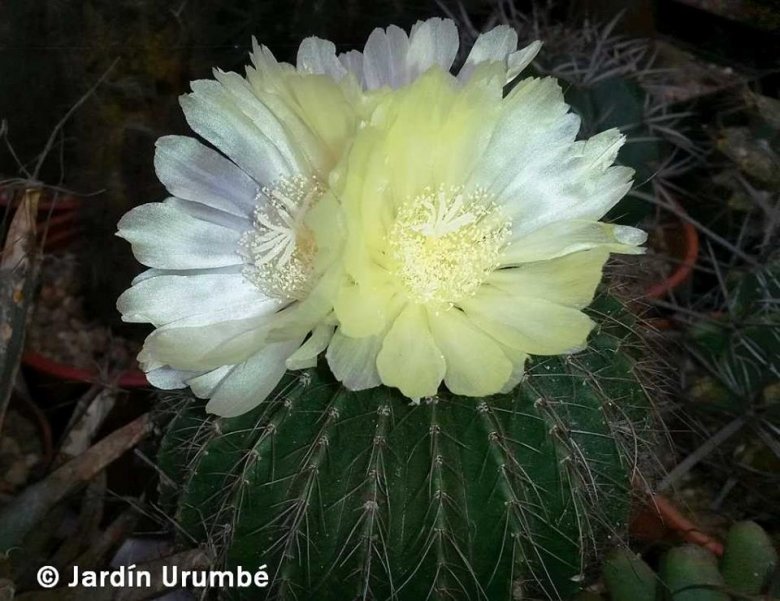
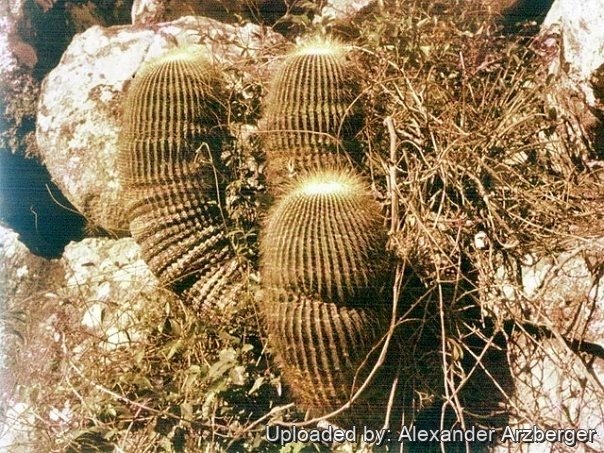
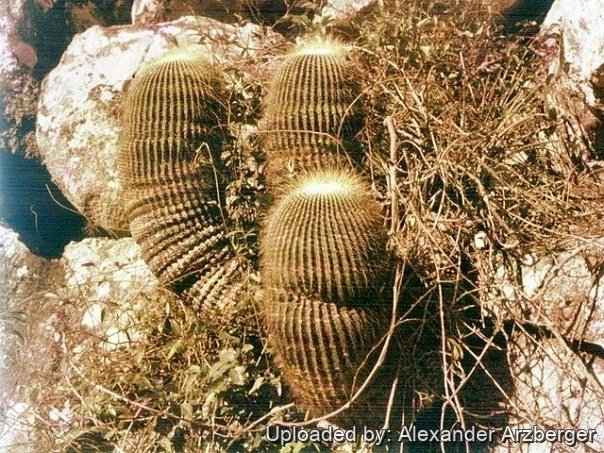
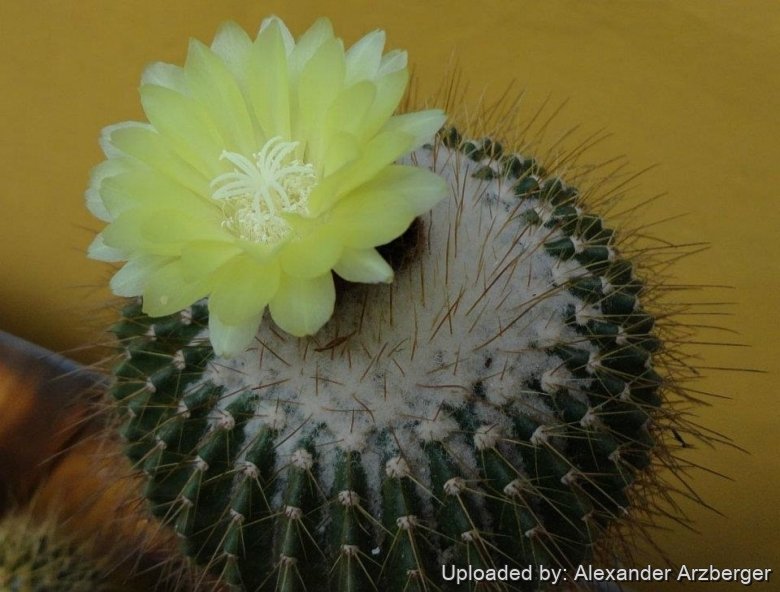
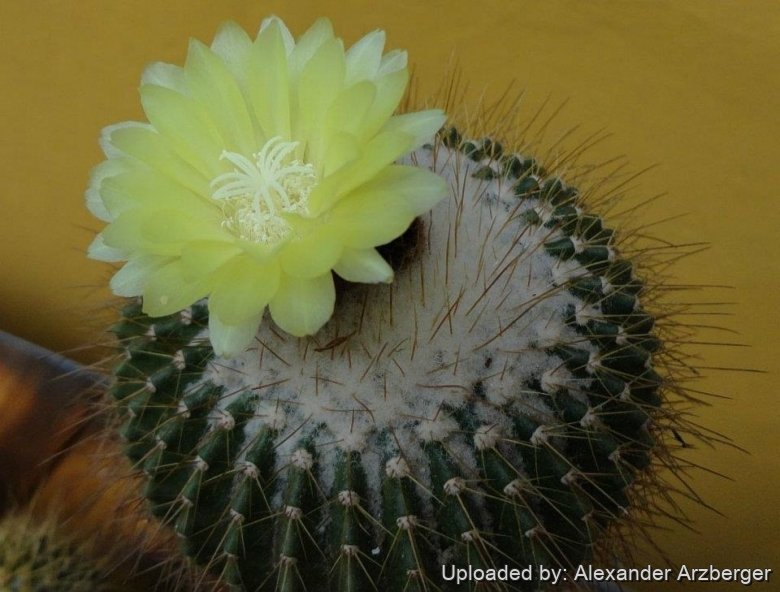
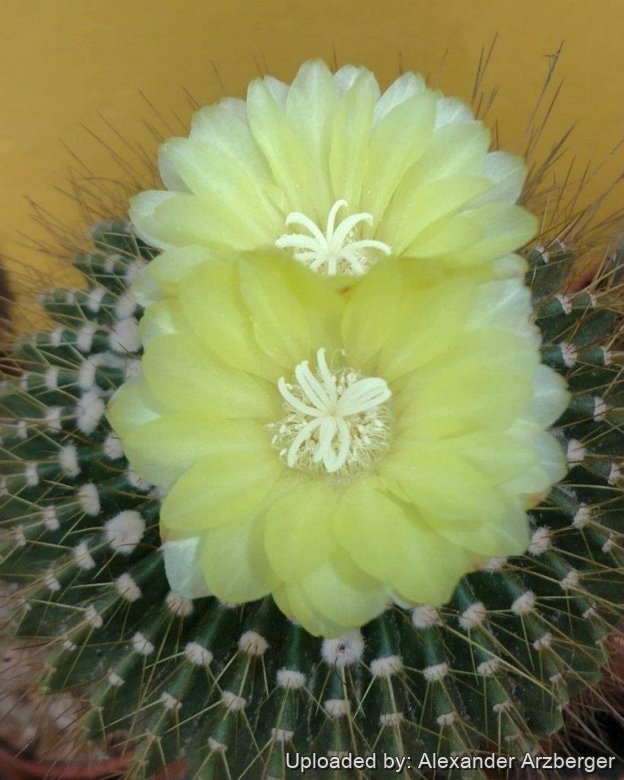
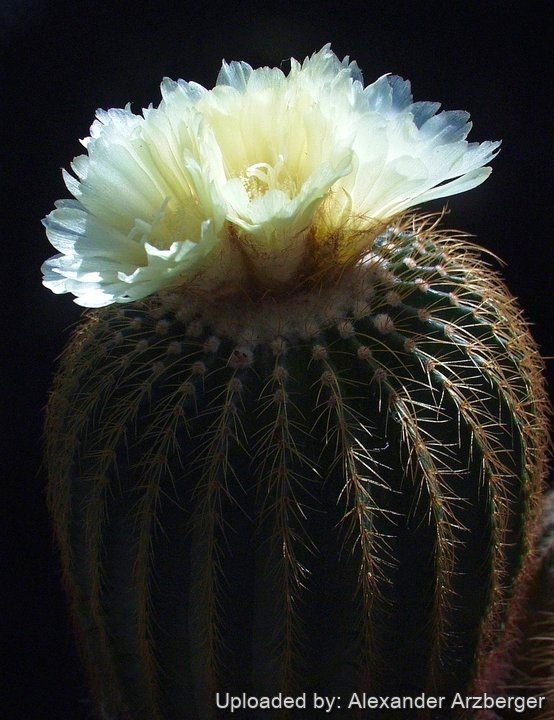
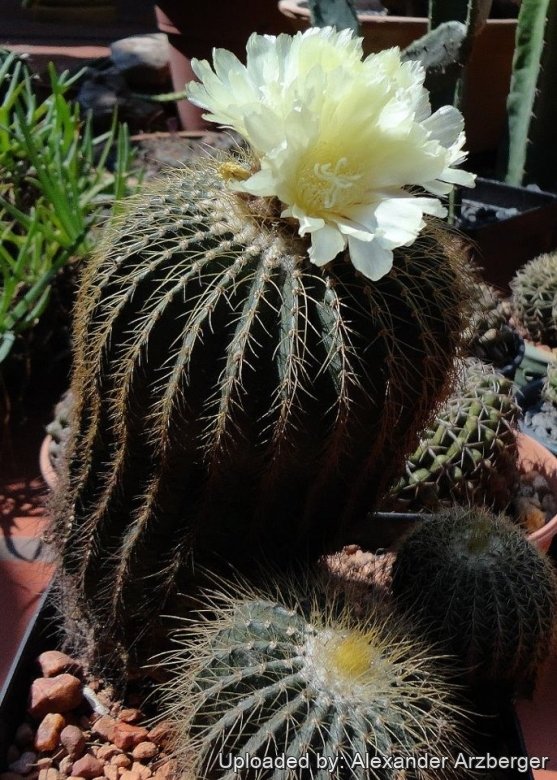
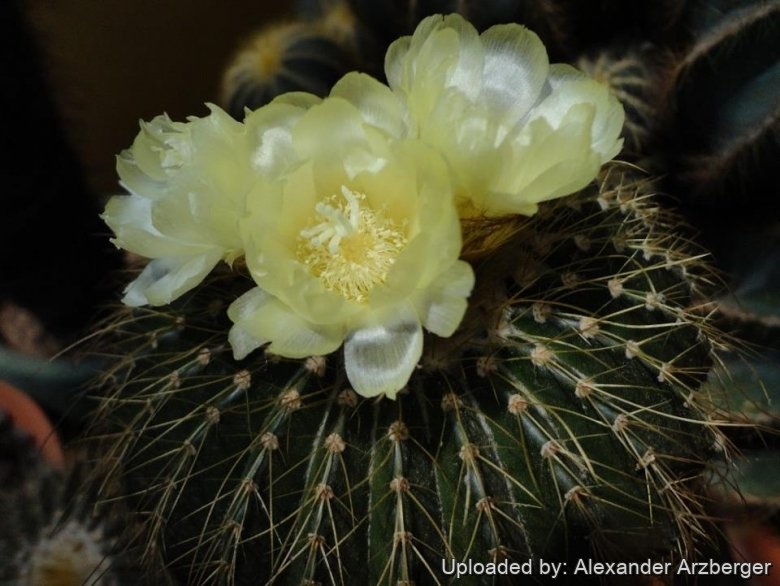
Parodia schumanniana is one of the larger species of the genus, with a dark green, rounded body densely clothed with yellowish to brownish spines growing up to 1,8 metres high. Large yellow blooms develop in summer at the crown of the plant and are followed by round green fruit. Two subspecies are recognized, the nominate form and the smaller subsp. claviceps (F.Ritter) Hofacker & P.J.Braun.
Habit: Plants usually solitary, shortly columnar.
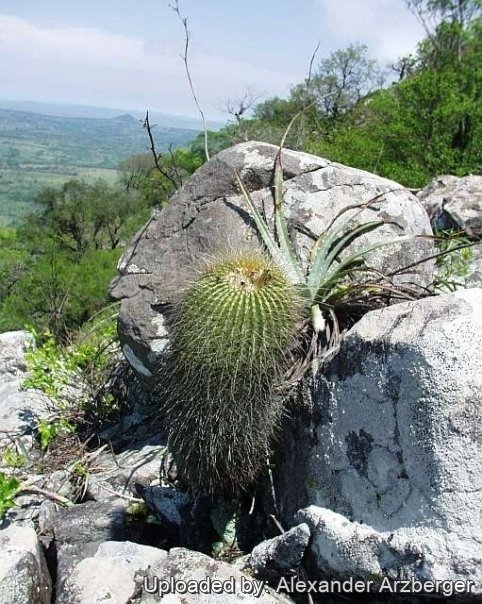
Stem: Depressed spherical as a young plant, with apex more or less inclined, becoming cylindrical with age, bright to dark green, mostly 0,5-1 m hight, occassionally up to 1,8 m high and 15-25(-30) cm in diameter (flowering when much smaller).
Ribs: 21-48 (fewer in immature specimens), well defined, straight, acute, not tubercled.
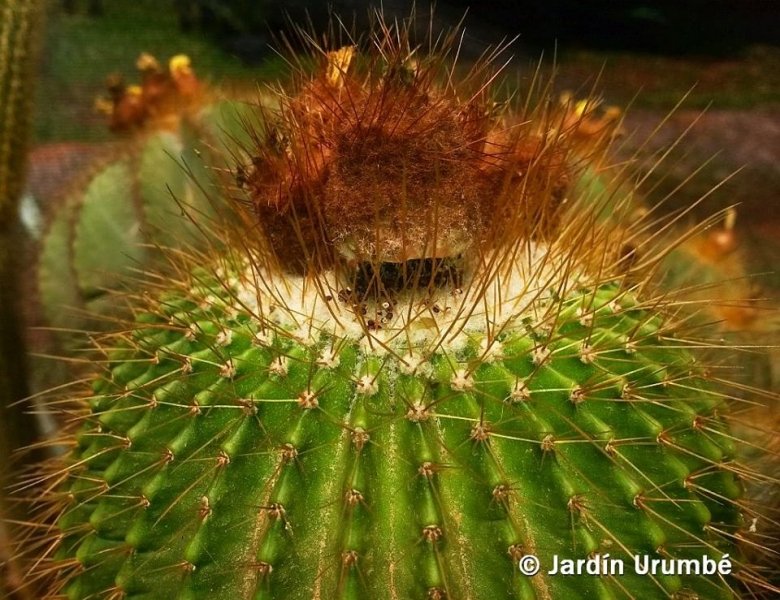
Areoles: Very woolly apically, later less so.
Spines: Bristle-like, straight to slightly arched, golden yellow to brown or reddish, later grey Radial and centrals similar flexible and unequal.
Central spines: (1-)3-4, sometimes absent, 10-30 mm long.
Radial spines: Mostly 4, in two pairs, 7-50 mm long.
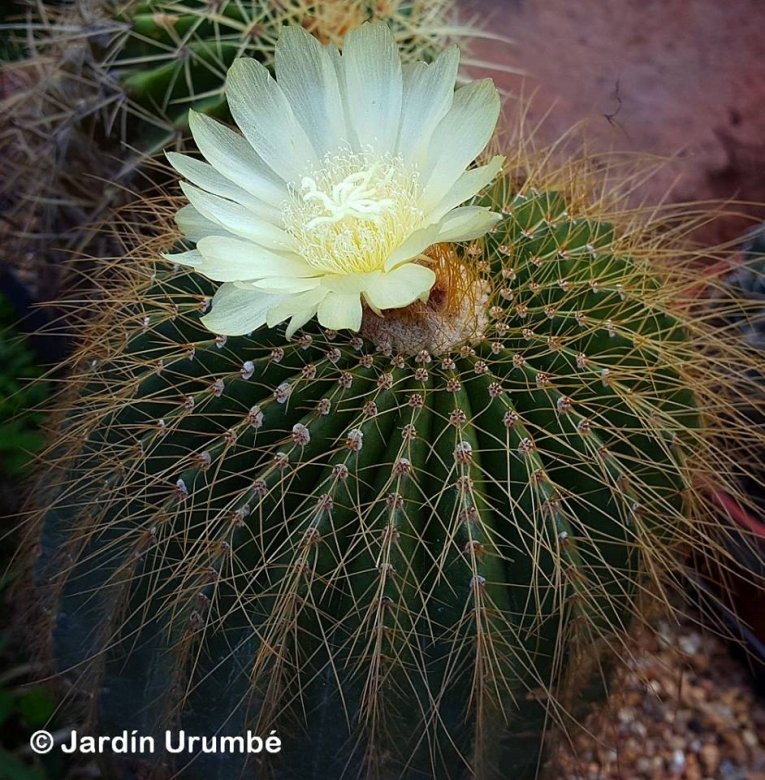
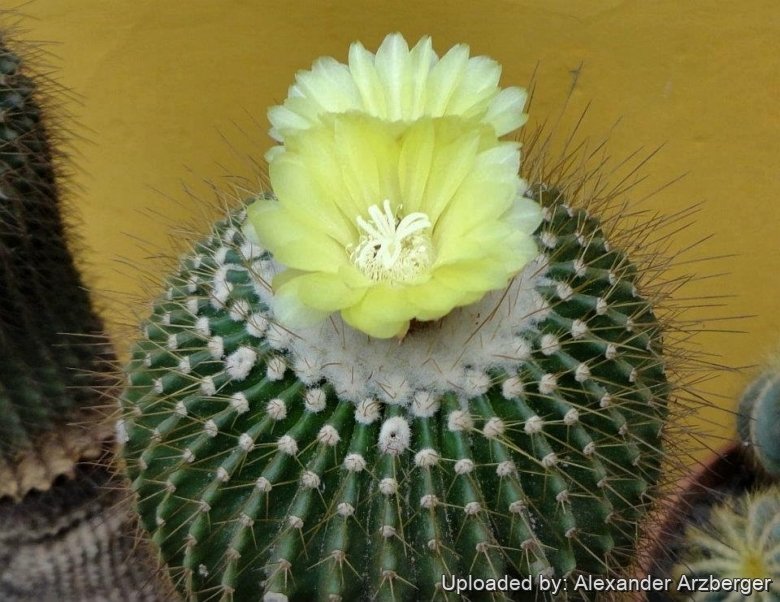
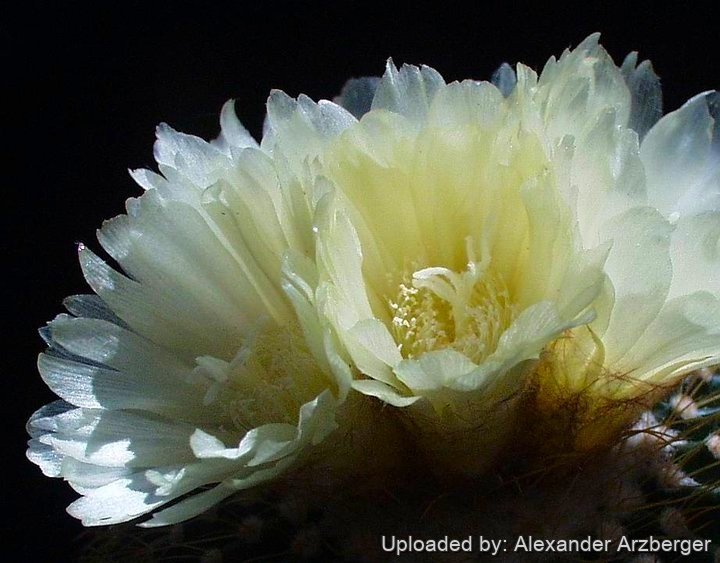
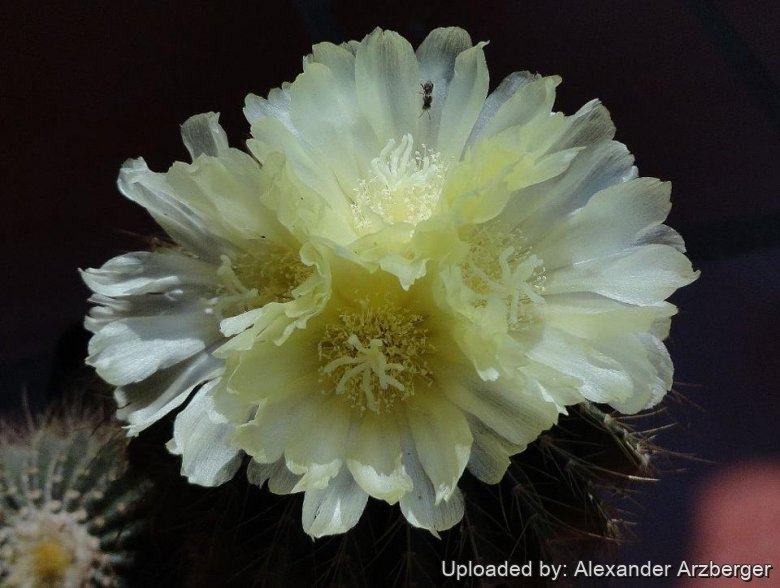
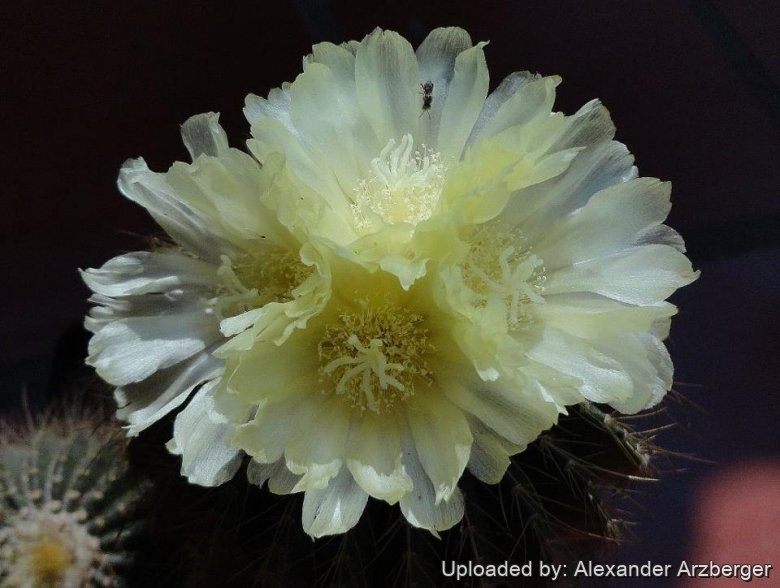
Flowers: Apical, funnel-shaped lemon yellow to golden yellow, 4-4.5 cm long, 4.5-6.5 cm in diameter; pericarpels and floral tubes, about 2-2,5 cm long, densely clothed with wool and bristles. Stigma-lobes cream coloured.
Fruits: Globose to ovoid, brownish, with dense wool and bristles, dry at maturity, 1-1.5 cm in diameter.
Seeds: Bell shaped, widest at hilum, shiny reddish brown, nearly smooth.
Origin and Habitat
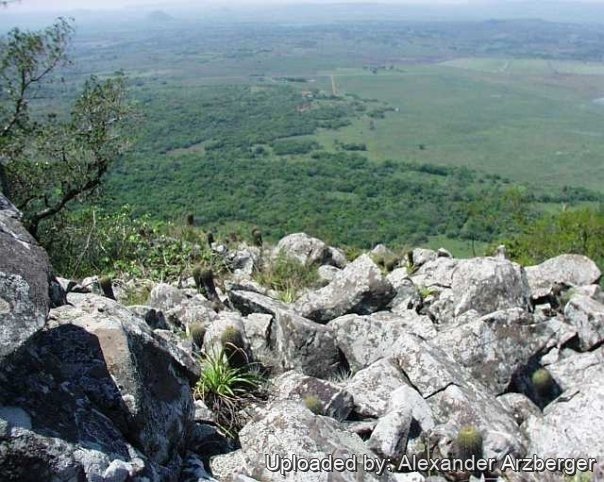
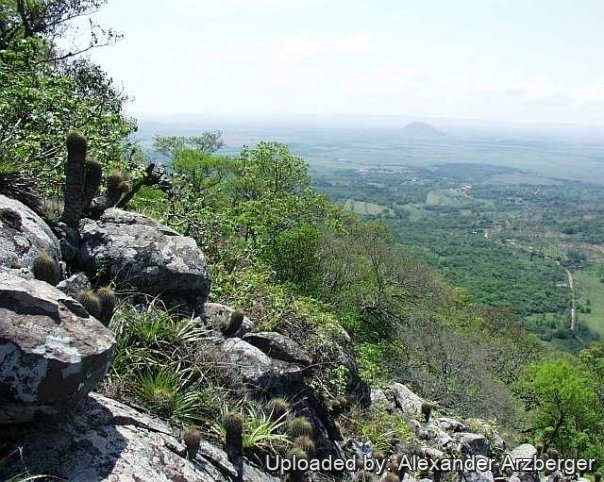
Brazil, southern Paraguay (Paraguarí and Guairá departments), and north-eastern Argentina ( Misiones: Santa Ana, Teyucuaré, departments). Parodia schumanniana is abundant where it occurs, but it is sparsely distributed (extent of occurrence is 16 km2).
Altitude: It occurs at elevations between 300 and 700 m above sea level.
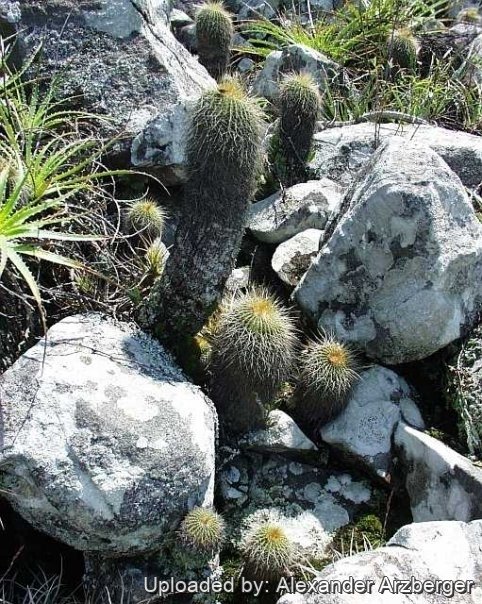
Habitat and Ecology: This species grows in open areas in deciduous rainforests on steep hills on granite and sandstone slag heaps. Their bodies are often overgrown with red and yellow shrub lichens — a sign of the high humidity in the air. Generation length is 5 years. In Brazil the major threats are dam construction and landslides resulting from the erosion caused by agriculture. In Paraguay the major threat is illegal collecting.
Cultivation and Propagation
Frost Tolerant as low as -4°C (or possibly colder) but in cultivation it is best to avoid any frost when during the winter the temperature can go down to 2° C without any harm so long as the compost is very dry. During the summer it is best to keep the plants outside where the temperature can rise to over 30 C with no harm to the plant.
Allows good drainage and use a an open and free draining mineral compost that allows therefore roots to breath.
They like only a short winter’s rest and should be kept almost completely dry during the winter months, If the soil is allowed to be dry for too long root loss could follow but equally the same result would occur if the plants are both wet and cold. From March onwards the plant will begin to grow and watering should be increased gradually until late May when the plant should be in full growth.
Water regularly during the summer so long as the plant pot is allowed to drain and not sit in a tray of water. During hot weather you may need to water the plants more frequently so long as the plant is actively growing. From late September watering should be reduced to force the plant to go in to a state of semi dormancy, by October you should be back in to the winter watering regime.
Need full sun avoiding only the harshest summer sun, if kept too dark they may become overly lush and could be prone to rotting due to over watering, they will also be shy to produce flowers.
Feeding may not be necessary at all if the compost is fresh then, feed in summer only if the plant hasn’t been repotted recently. Do not feed the plants from September onwards as this can cause lush growth which can be fatal during the darker cold months.
Repotting should be done every other year or every three years, annual potting is not necessary. Do not be tempted to over pot as this will cause the unused compost to go stagnant and you may loose the plant.
Propagation: Seed sowing and cuttings.
Bibliography
Major references and further lectures
-
Edward Anderson “The Cactus family” Timber Press, Incorporated, 2001
-
James Cullen, Sabina G. Knees, H. Suzanne Cubey “The European Garden Flora Flowering Plants: A Manual for the Identification of Plants Cultivated in Europe, Both Out-of-Doors and Under Glass” Cambridge University Press, 11/Aug/2011
-
Pin, A., Oakley, L., Larocca, J. & Machado, M. 2013. Parodia schumanniana. In: IUCN 2013. “IUCN Red List of Threatened Species.” Version 2013.2. <www.iucnredlist.org>. Downloaded on 06 March 2014.
-
David Hunt, Nigel Taylor “The New Cactus Lexicon” DH Books, 2006
-
Friedrich Ritter “Kakteen in Suedamerika: Ergebnisse Meiner 20 Jaehrigen Feldforschungen” F. Ritter Selbstverlag, 1979
-
Krainz, Hans (Hrsg.) “Die Kakteen” 1957-1975 Franckh’sche Verlagshandlung
-
Hiroshi Hirao “Colour encyclopaedia of cacti” Seibundo Shinkosha, 1979
-
Haustein, Erik. “Der Kosmos-Kakteenführer.” Kosmos / Gesellschaft der Naturfreunde., Stuttgart, 1983
-
Mariella Pizzetti, Giuseppe Mazza “Piante grasse: le cactacee” A. Mondadori, 1985
-
Roberto Kiesling, Omar E. Ferrari “Cien cactus argentinos” Editorial Albatros, 2005
-
Barbara Segall “Botanica: the illustrated A-Z of over 10,000 garden plants and how to cultivate them” Mynah, 1997
-
Hans Hecht “Cacti & succulents” Sterling Pub. Co., 1997
-
Urs Eggli, Leonard E. Newton “Etymological Dictionary of Succulent Plant Names” Springer, Berlin/Heidelberg 2010
-
[Ernst August Nicolai] “Echinocactus Schumannianus Nicolai” In: Monatsschrift für Kakteenkunde. 3:12, 175 1893
-
F. H. Brandt “Die Gliederung der Gattung Parodia Spegazzini.” In: Kakteen- und Orchideen-Rundschau. 7: 4, 62 1982
-
H. Quehl “Neuheiten (Fortsetzungund Schluß aus No. 3)”. In: Monatsschrift für Kakteenkunde. 9: 5 1899
From llifle page Echinocactus grossei
Description
Parodia grossei ( Eriocactus grossei ) is only a form of Parodia schumanniana and most authors choose to lump them together. It is one of the largest species of the genus and distinguishes for having only 3 to7 long bristly white spines. Schumann originally described it with 16 ribs and four radial spines. It has a white, woolly crown and bright yellow flowers appear atop the plant in summer.
Stem: Globose to depressed or sometimes cylindric, sometimes up to 1.7 meters high and up to 30 cm thick.
Ribs: Usually 16, acute, somewhat crenate.
Areoles: Small, circular.
Spines: 3 to 7(-8), spreading, acicular, curved, white or brownish, the longer one 4 cm long.
Flower: Large, funnelform, citron-yellow, 4 cm long, when fully expanded broader than long. Perianth-segments oblanceolate to spatulate, obtuse, serrate above. Stamens numerous, short. Style slender, longer than the stamens; stigma-lobes 12 to 17, linear, white, recurved. Scales on the ovary numerous, linear, purplish, with wool and bristles in their axils.
Fruit: Short oblong, 2.5 cm long, 2 cm. in diameter.
Seeds: Bell shaped, 0.8(-2?) mm long and 0.8 mm thick, glossy reddish-black or black.
Origin and Habitat
Paraguay, between Carepegua and south-east of the Cerro Acahay, department Paraguarí, (it is one of the most southerly species of Eriocactus).
Altitude range: Around 500 metres above sea level.
Bibliography
Major references and further lectures
-
Friedrich Ritter “Kakteen in Südamerika: Ergebnisse meiner 20 jährigen Feldforschungen” volume 1 Selbstverlag, 1979
-
Cactus and Succulent Journal of Great Britain, Volumes 29-33 Cactus and Succulent Society of Great Britain, 1967
-
N. L. Britton, J. N. Rose “The Cactaceae. Descriptions and Illustrations of Plants of the Cactus Family.” Volume 3, The Carnegie Institution of Washington, Washington 1922.
Source: Echinocactus grossei, LLIFLE - Encyclopedia of living forms, CC-BY-SA, retrieved 2026-10-25.
From llifle page Eriocactus ampliocostatus
Description
Parodia ampliocostata, also known as Eriocactus ampliocostatus, is a local or morphological form of the very variable Parodia schumanniana (syn: Notocactus schumannianus), but not sufficiently differentiated and considered merely a local variant of the latter (if not the same). The key difference by which the two were separated, namely the presence of a higher number of ribs, larger rib height, higher spine number, different spine colour, multiple central spines, of which the lowest one conspicuously longer and pale yellow anthers, appear to fall within the natural variation of Parodia schumanniana and it should be synonymized with the latter.
The following description of this species is based on Eriocactus ampliocostatus F.Ritter 1979 sensu stricto (Collector’s number referred here is FR 1182).
Stems: Cylindrical up 1.80 m long and 30 cm thick.
Ribs: 32-48, about 10 mm hight.
Areoles: Less woolly.
Marginal spines. about 5, gold or brown, later brown or grey, the lower pair up to 10 mm long, the uppermost unpaired, ca. 7 mm long or shorter.
Central spines: 3 (-4) the upper two ca. 10 mm long, the lower one up to the 3 cm long.
Flowers. 4 cm long, opening approximately 4.5 cm wide. Scales of the ovary, very narrow, about 5 mm long (3/4 of which consisting in a dark dry awn), wrapped by tight white woolly hairs, the upper scales each have a bristle in the axil. Tube about 10-12 mm long and 3-4 mm wide, yellow inside, funnel-shaped, campanulate to almost bowl-shaped, outside with brown hairs, and long awned scales. Perianth segments spatulate pale yellow to golden yellow ca 2 cm long
and 6-8 mm wide. Stamens pale yellow, 5-10 mm long, the lower upright, the upper bent inwards. Anthers pale yellow. Style light yellow, about 17 mm long, stigma-lobes 10-12 pale yellow ca. 6 mm long.
Seeds: Dark brown, a little smaller than in Parodia schumanniana, about 0.7 mm long, bell-shaped.
Origin and Habitat
Parodia ampliocostata dwells in the Cordillera de los Altos, on the northern border of the Paraguarí department, Paraguay.
Habitat and ecology. Parodia ampliocostata grows between large granite boulders.
Bibliography
Major references and further lectures
- Friedrich Ritter “Kakteen in Südamerika: Ergebnisse meiner 20 jährigen Feldforschungen” volume 1 Selbstverlag, 1979
Source: Eriocactus ampliocostatus, LLIFLE - Encyclopedia of living forms, CC-BY-SA, retrieved 2026-10-25.
From llifle page Eriocactus grossei var. aureispinus
Description
As the name implies Parodia grossei var. aureispina is a distinct yellow spined form of Parodia grossei (syn: Parodia schumanniana). It distinguishes from Parodia grossei by its smaller and shorter stems (less than 20 cm thick and 1 metre long), while the number of ribs (about 16) is the same. The spines are much weaker, golden yellow to reddish yellow (brown), but more numerous 8-11, all similar, the lowermost longer. Occasionally 1 to 3 central spines are present a the bottom and (rarely) an additional central spine is formed among the upper 4 radial spines. The seedlings are similar to standard Parodia grossei but the spines are more numerous (often two time more numerous), radial and central are all very similar, but the lowermost radial are noticeably longer.
Flowers and seeds: Like Parodia grossei.
Seeds. Red brown, campanulate, 0.7 mm long, circumference at the hilum 0.7 mm and 0.5 mm thick, testa with very fine elongated warts arranged in rows. The hilum is dirty white, large a the whole basal size of the test, and has an elevated ring around. The centre of the hilum is raised (not flat) and the micropyle is not or hardly visible.
Origin and Habitat
Paraguay, Cerro Acati, Colonia Indipendencia, Depart. Guairá and also Cerro Pelado near Villarica.
Source: Eriocactus grossei var. aureispinus, LLIFLE - Encyclopedia of living forms, CC-BY-SA, retrieved 2026-10-25.
Cultivars and forms (1)
Subspecies (1)
Gallery