Publication: Cactaceae Consensus Init. 4: 6. 1997 [Oct 1997]
Description
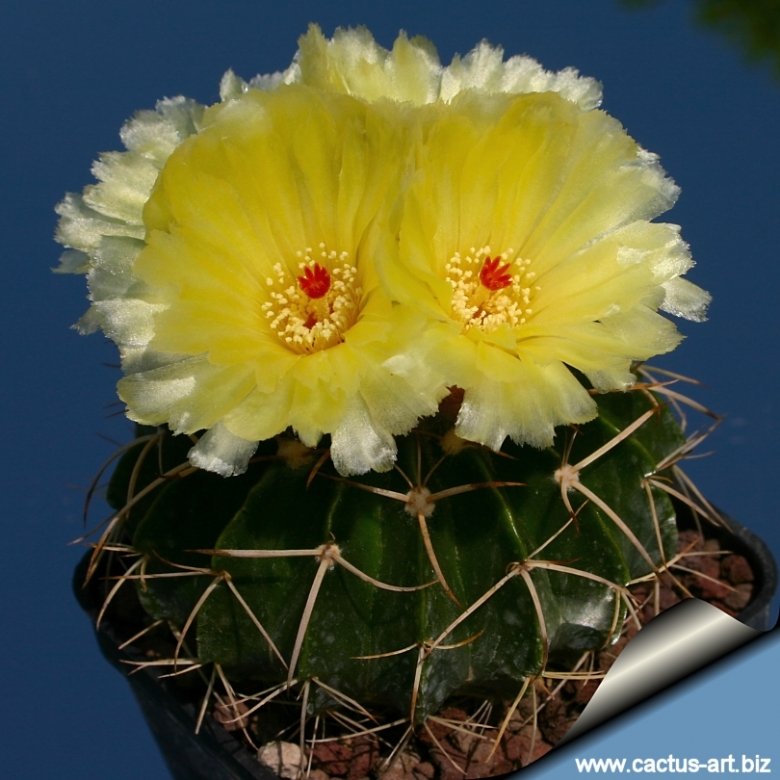
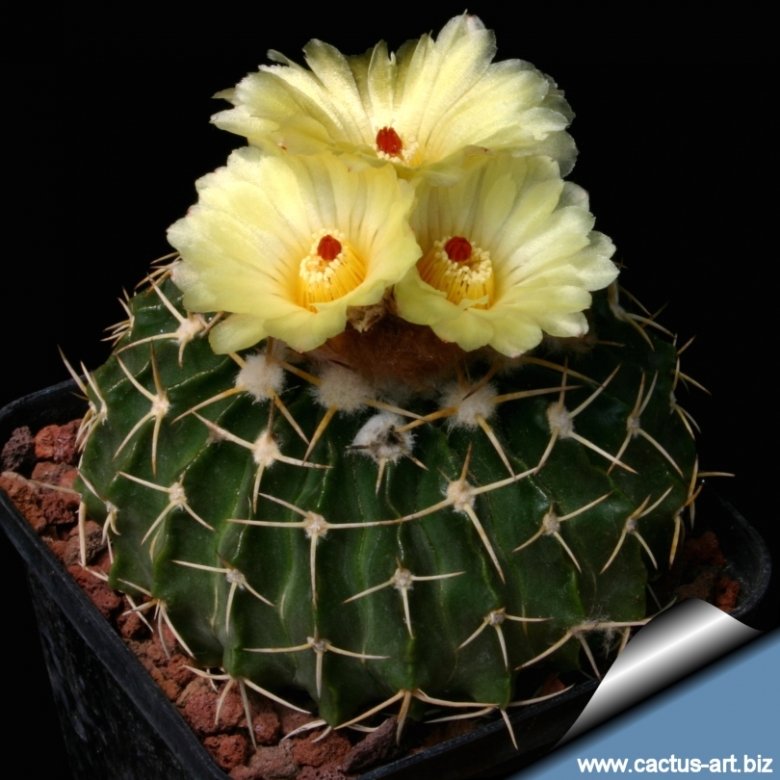
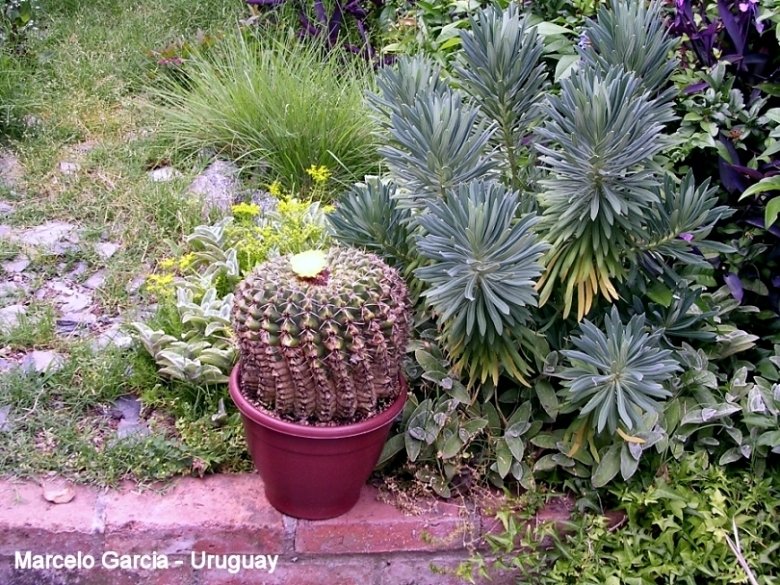
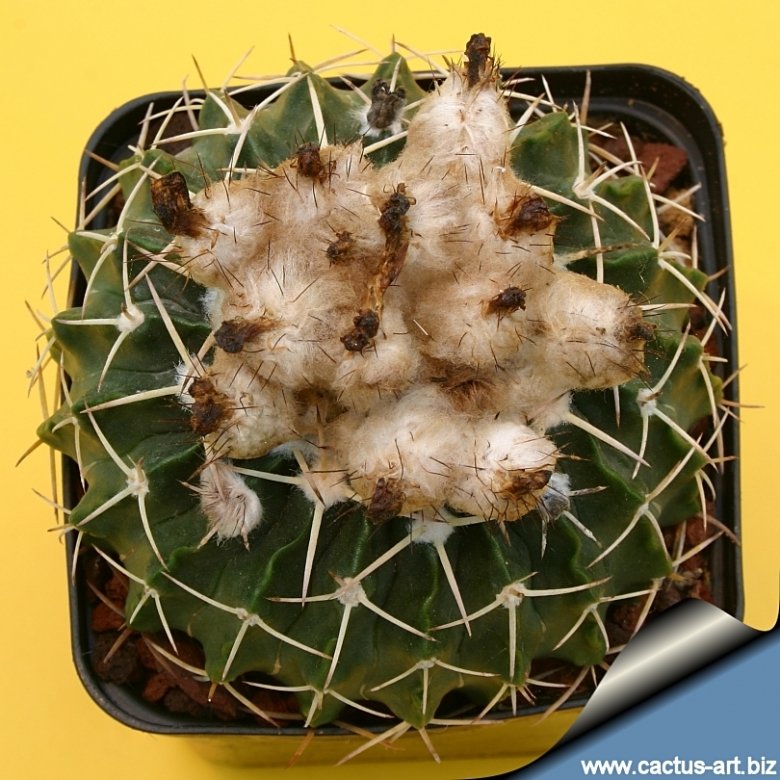
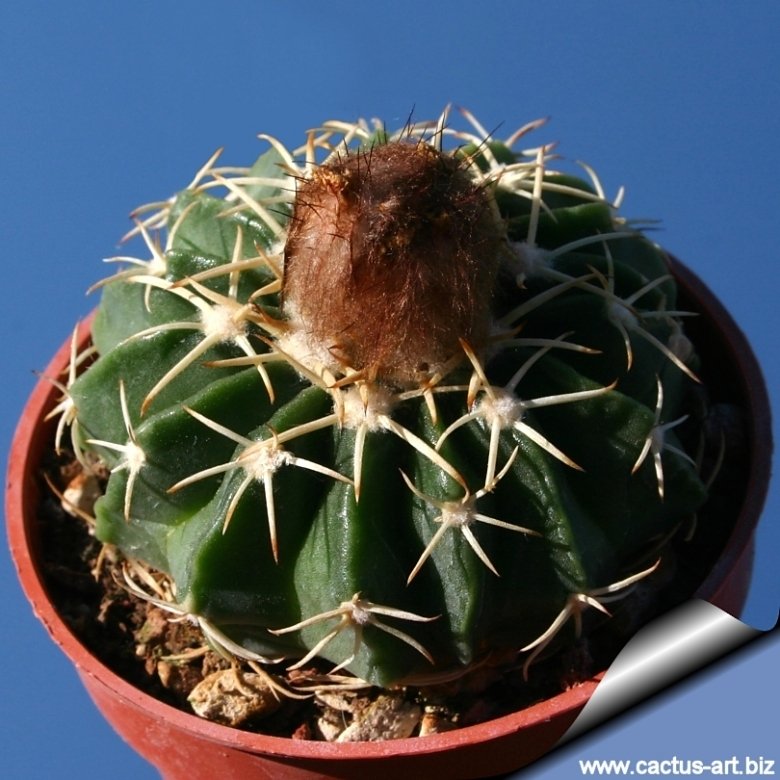
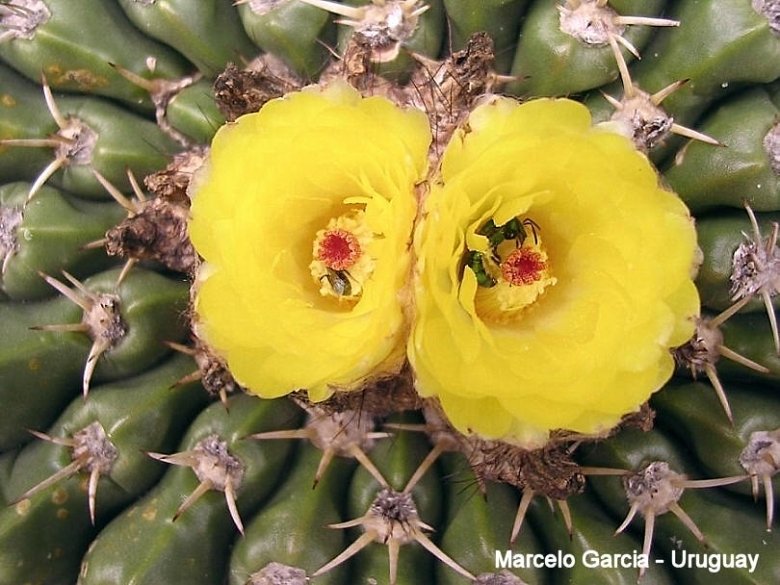
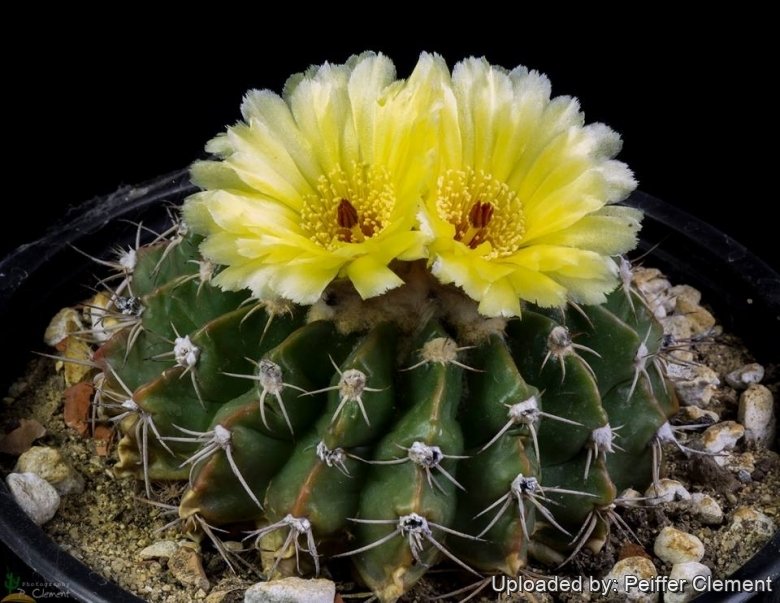
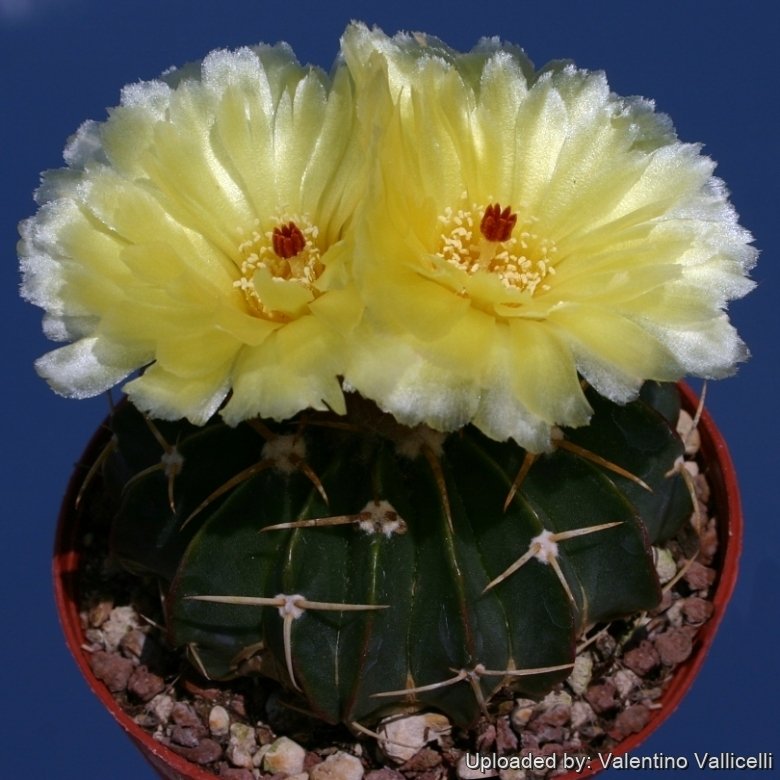
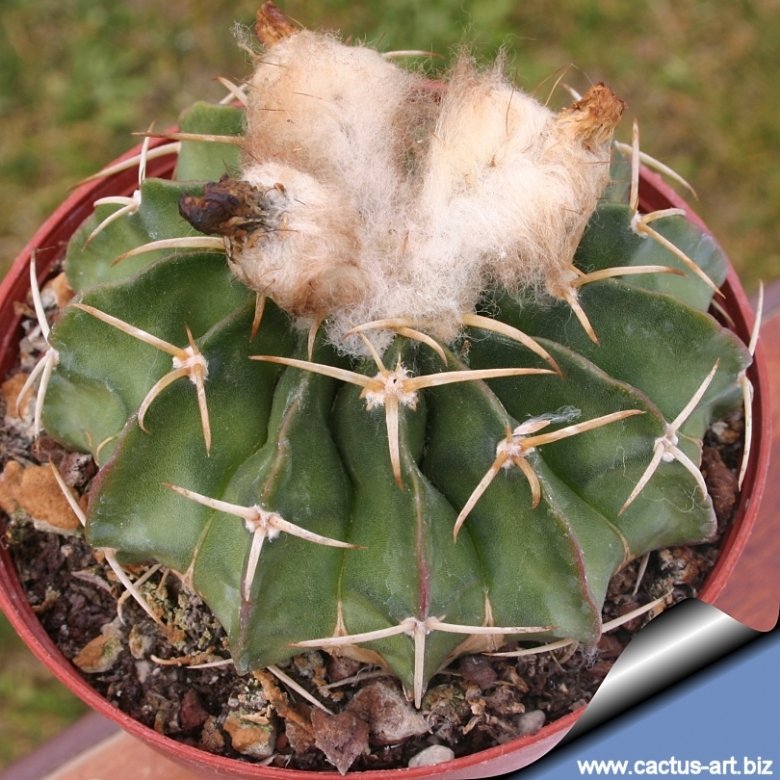
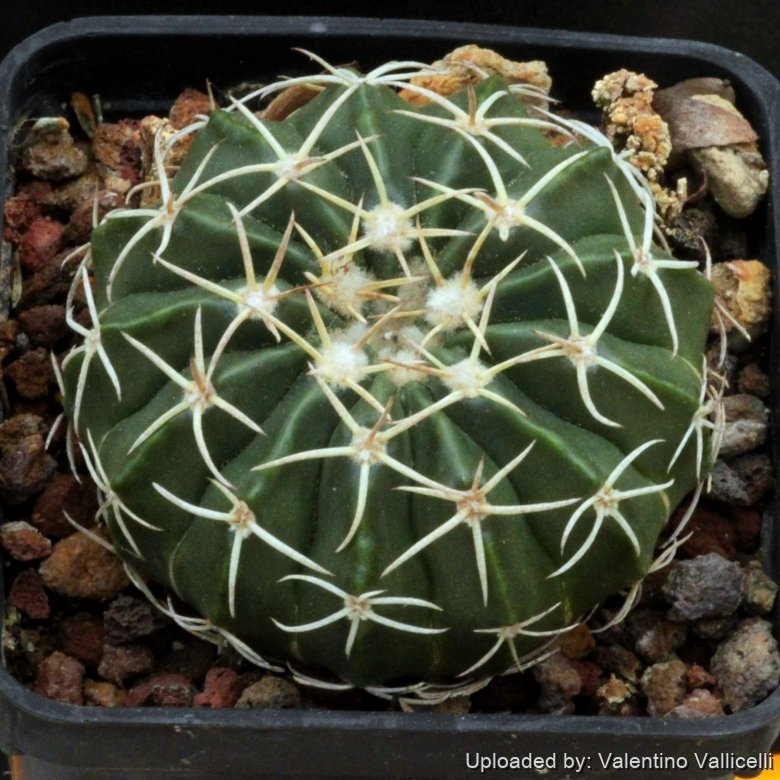
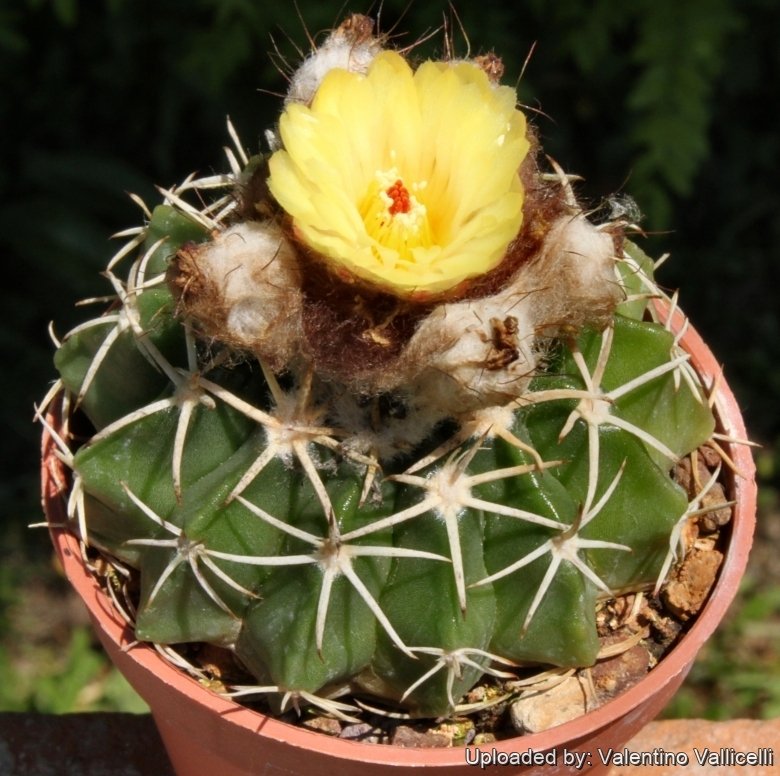
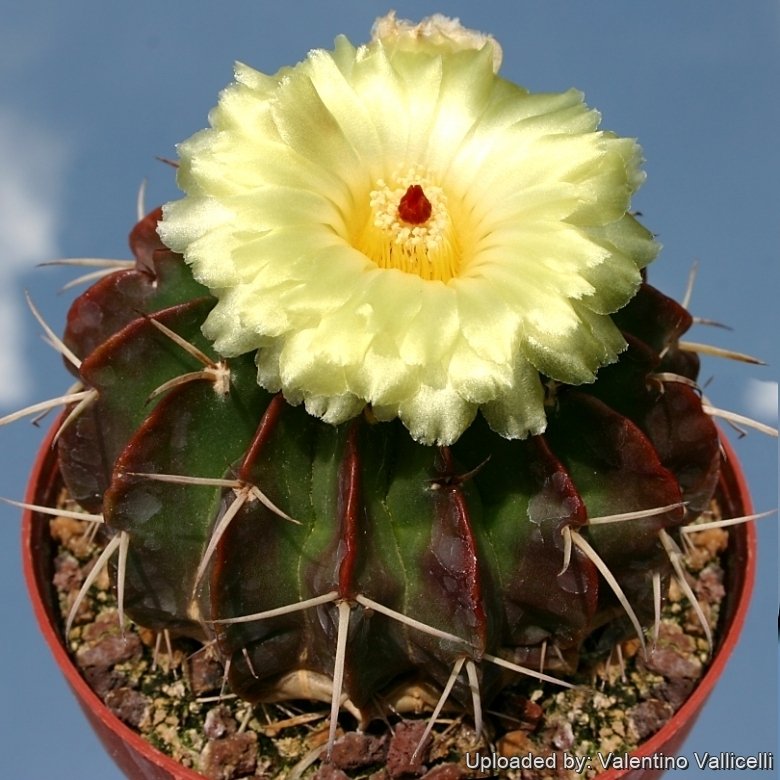
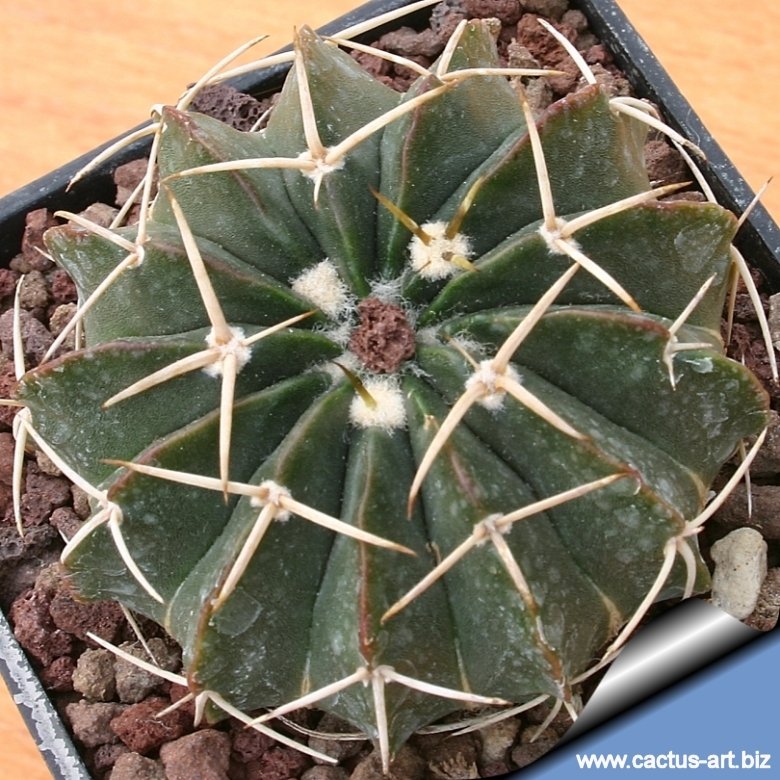
Parodia sellowii best known as: Notocactus sellowii (one of the Wigginsia type members of the genus) is a flattened globular cactus from Brazil, Uruguay and Argentina, about 15 cm diameter producing several yellow flowers together around the
very woolly stem apex. It is a widespread, extremely variable species that has received numerous unnecessary names (at least 120), representing no more than local phenotypes.
Habit: Usually solitary.
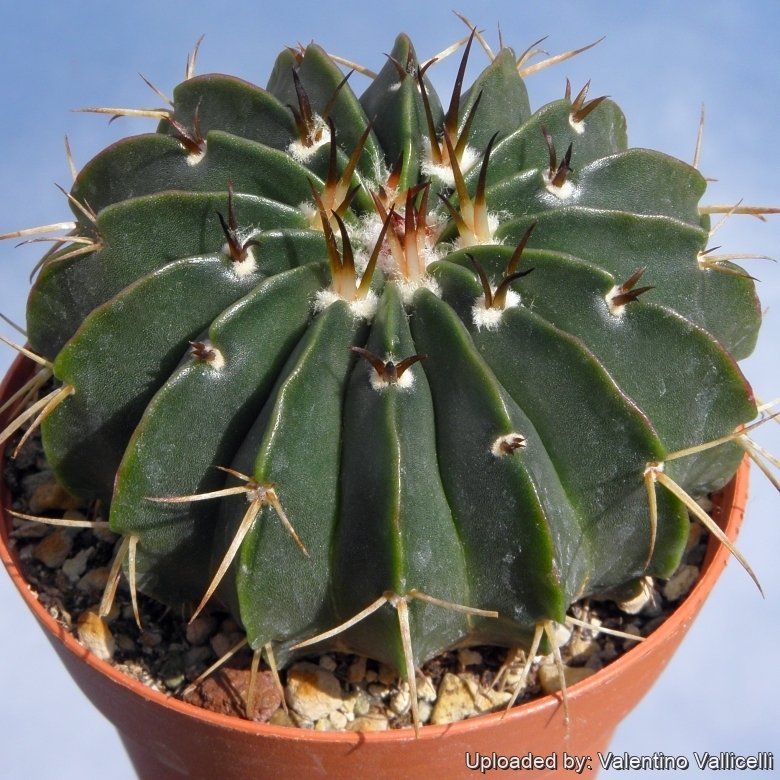
Stem: Broadly orbicular flattened and growing partly underground, but the plant’s stem in cultivation is usually globular or ovoidal and aerial, up to 20 cm tall, 15 cm in diameter, bright glossy green, dark green or grey-green. The apex is depressed and filled with whitish-grey wool.
Ribs: (12-)16-18(-22), at maturity well marked, shallow more or less sharp, with scarcely prominent chinned tubercles. The crest of the ribs typically turns a purple red colour in full sun.
Areoles: Well spaced, woolly, recessed, 15-20 mm in diameter.
Radial spines: 4 to 10 (-12), yellowish, sturdy, about 20 mm long, curved down or backward.
Central spines: 0 or 1, slightly heavier but not very different from the the radials.
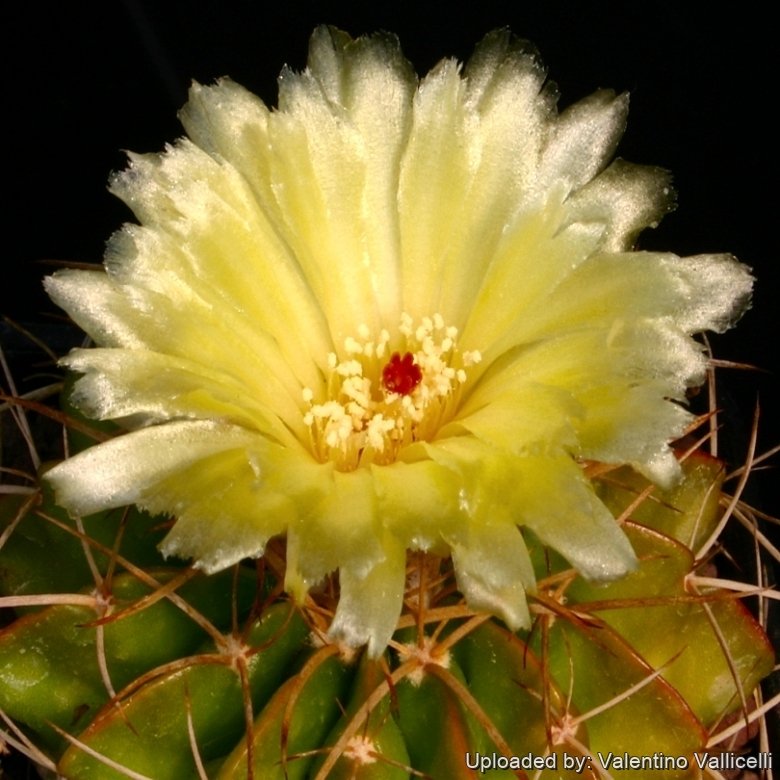
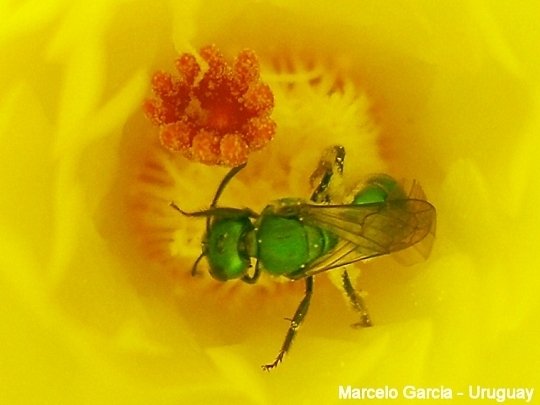
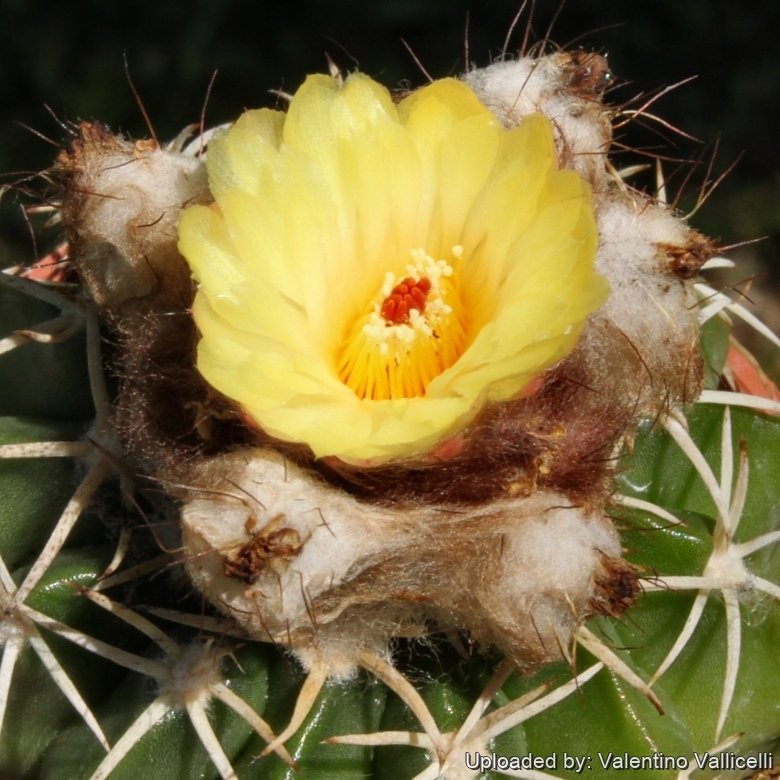
Flowers: Lemon yellow with glossy petals (sometime shaded with pink), up to about 4-5 cm in diameter, and standing near the top, decorated with about 8 to 10 red pistil lobes which emphasize the yellow of the petals. The buds are tomentose.
Blooming season: They bloom annually around July.
Fruits: Fleshy reddish to purple, about 10 mm long.
Seeds: 1 mm, long, black.
Remarks: When the plants become older they look quite different from the juvenile forms, and this is evident when we can observe a seedling growing next to an older plant - the younger plant is smoother and the older plants have ribs and tubercles - one would almost think they were different species.
Origin and Habitat
Parodia sellowii is native to southern Brazil (Rivera, Lavalleja, Treinta y Tres, Artigas, Cerro Largo, Maldonado), Uruguay and North Argentina. It has a wide range, a very large extent of occurrence, and it is locally abundant.
Altitude: It can be found at elevations between 0 and 420 meters above sea level.
Habitat: This cactus grows on rocky outcrops in grasslands or pampas. The major threat to this species is cattle and sheep grazing because the specimens are ingested and trampled.
Cultivation and Propagation
Parodia sellowii is an easy to grow tropical cactus that like a warm bright location, but more cold tolerant than most and less fussy regarding soil conditions.
Growth rate: It is a relatively rapidly growing and easily flowering species.
Soils: It prefer a very porous neutral to slightly acidic compost with plenty of extra grit.
Repotting: Use pot with good drainage.
Watering: Water regularly in summer, but do not overwater, keep dry in winter. It rot easily if the substrate is wet and cold, tends to lose its roots in winter. Best if watered with rain water.
Fertilization: Feed it once during the growing season with a fertilizer specifically formulated for cactus and succulents (poor in nitrogen), including all micro nutrients and trace elements diluted to ½ the strength recommended on the label. It thrives in poor soils and need a limited supplies of fertilizer to avoid the plants developing excess vegetation, which is easily attacked by fungal diseases.
Hardiness: Reputedly sensitive to frost , but less so if kept on the dry side prior to, and during, cold weather (hardy to -5° C for short periods). However warmth throughout the year will increase the grower’s success (8-12°C during rest season).
Exposition: Outside bright filtered sunlight or afternoon shade, avoid full sun. Inside it needs bright light, and some direct sun. Subject to sunburn if exposed to direct sun for too long. Tends to bronze in strong light, which encourages flowering and heavy wool and spine production.
Uses: It is an excellent plant for container growing. It always looks good and stays small. It look fine in a cold greenhouse and frame or outdoor in a rockery.
Pests & diseases: It may be attractive to a variety of insects, but plants in good condition should be nearly pest-free, particularly if they are grown in a mineral potting-mix, with good exposure and ventilation. Nonetheless, there are several pests to watch for:
- Red spiders: Sensitive to red spider mite. Overhead watering is helpful in controlling mites.
- Mealy bugs: Occasionally mealy bugs they develop aerial into the new growth among the wool with disfiguring results, but the worst types develop underground on the roots and are invisible except by their effects.
- Scales: Scales are rarely a problem.
- Rot: Rot it is only a minor problem with cacti if the plants are watered and “aired” correctly. If they are not, fungicides won’t help all that much.
Propagation: Direct sow after last frost. Seeds germinate in 7-14 days at 21-27° C in spring, remove the glass cover gradually as the plants develops and keep ventilated, no full sun for young plants!
Notes
All species of genera Notocactus, Wigginsia and Malacocarpus have recently been transferred to genus Parodia, so the names of several plants previously accepted are now all synonyms of Parodia sellowii.
Bibliography
Major references and further lectures
-
Tony Mace “Notocactus: a review of the genus incorporating Brasilicactus, Eriocactus and Wigginsia” Editorial Board/National Cactus & Succulent Society, 1975
-
Edward Anderson “The Cactus family” Timber Press, Incorporated, 2001
-
James Cullen, Sabina G. Knees, H. Suzanne Cubey “The European Garden Flora Flowering Plants: A Manual for the Identification of Plants Cultivated in Europe, Both Out-of-Doors and Under Glass” Cambridge University Press, 11/Aug/2011
-
David R Hunt; Nigel P Taylor; Graham Charles; International Cactaceae Systematics Group. “The New Cactus Lexicon” dh books, 2006
-
Clive Innes “Complete Handbook of Cacti and Succulents” Van Nostrand Reinhold Company, 01/dic/1981
-
Urs Eggli, Leonard E. Newton: “Etymological Dictionary of Succulent Plant Names.” Springer, Berlin/Heidelberg 2010
From llifle page Echinocactus acuatus var. corynodes
Description
Parodia sellowii var. corynodes best known as Wigginsia corynodes is a local or morphological form of the wide ranging and very variable Parodia sellowii distinguished by dark olive-green body, with thirteen to sixteen, deep ribs and clusters of seven to twelve dark-zoned, yellow spines. The differences with other Parodia sellowii are in reality very minimal and most botanist agree on the fact that both should all be included in the Parodia sellowii, and the two plants are not readily
Habit: This species is a low growing cactus usually solitary starting out spiny then becoming more woolly.
Stem: Broadly orbicular flattened and growing partly underground, often narrowed at the base, depressed and woolly at the top, dark olive-green, not over 15 cm tall and 10-18 cm broad (but often in cultivation, with age, forms a dark green cylindrical stem up to 22 cm tall).
Ribs: 13-16(-20), vertical, at maturity well marked, acute, deeply notched. Furrows narrow, sharp.
Areoles: Well spaced, woolly, recessed, 15-20 mm in diameter.
Radial spines: 6-9(-12), dark-zoned, yellow, rigid, sturdy, the 3 lower longer and stronger (15 to 18 mm long), initially red, later brownish, all spines darker at the top.
Central spines: One central, erect, subulate, brown, up to 2 cm long slightly heavier but not very different from the the radials, but often the spine clusters may be without centrals.
Flowers: Numerous protruding from the whitish felt at stems apexes, glossy golden-yellow with with outer petals greenish, up to about 5 cm in diameter, and standing near the top. The buds are tightly wrapped by brown wool. Tepals in two rows, linear, denticulate at the tip, translucent, sulfur yellow. Stamens yellow, with white anthers. Stile longer, sulfur yellow. Stigma-lobes 8-12 carmine-red.
Blooming season: They bloom annually from June to September. Flowers opened several days in the sunshine.
Fruits: Oblongish, fleshy sooty-red.
Origin and Habitat
Southern Brazil, Uruguay and Argentina.
Cultivation and Propagation
Parodia sellowii var. corynodes is an easy to grow tropical cactus that like a warm bright location, but more cold tolerant than most and less fussy regarding soil conditions.
Growth rate: It is a relatively rapidly growing and easily flowering species.
Soils: It prefer a very porous neutral to slightly acidic compost with plenty of extra grit.
Repotting: Use pot with good drainage.
Watering: Water regularly in summer, but do not overwater, keep dry in winter. It rot easily if the substrate is wet and cold, tends to lose its roots in winter. Best if watered with rain water.
Fertilization: Feed it once during the growing season with a fertilizer specifically formulated for cactus and succulents (poor in nitrogen), including all micro nutrients and trace elements diluted to ½ the strength recommended on the label. It thrives in poor soils and need a limited supplies of fertilizer to avoid the plants developing excess vegetation, which is easily attacked by fungal diseases.
Hardiness: Reputedly sensitive to frost , but less so if kept on the dry side prior to, and during, cold weather (hardy to -5° C for short periods). However warmth throughout the year will increase the grower’s success (8-12°C during rest season).
Exposition: Outside bright filtered sunlight or afternoon shade, avoid full sun. Inside it needs bright light, and some direct sun. Subject to sunburn if exposed to direct sun for too long. Tends to bronze in strong light, which encourages flowering and heavy wool and spine production.
Uses: It is an excellent plant for container growing. It always looks good and stays small. It look fine in a cold greenhouse and frame or outdoor in a rockery.
Pests & diseases: It may be attractive to a variety of insects, but plants in good condition should be nearly pest-free, particularly if they are grown in a mineral potting-mix, with good exposure and ventilation. Nonetheless, there are several pests to watch for:
- Red spiders: Sensitive to red spider mite. Overhead watering is helpful in controlling mites.
- Mealy bugs: Occasionally mealy bugs they develop aerial into the new growth among the wool with disfiguring results, but the worst types develop underground on the roots and are invisible except by their effects.
- Scales: Scales are rarely a problem.
- Rot: Rot it is only a minor problem with cacti if the plants are watered and “aired” correctly. If they are not, fungicides won’t help all that much.
Propagation: Direct sow after last frost. Seeds germinate in 7-14 days at 21-27° C in spring, remove the glass cover gradually as the plants develops and keep ventilated, no full sun for young plants!
Bibliography
Major references and further lectures
-
Thomas H. Everett “The New York Botanical Garden Illustrated Encyclopedia of Horticulture” Taylor & Francis, 1982
-
Alfred Byrd Graf “Exotica, series 4 international: pictorial cyclopedia of exotic plants from tropical and near-tropic regions” Roehrs Co. Publishers, 1985
-
Margaret J. Martin, Peter Richard Chapman, Hugh Ambrose Auger “Cacti and their cultivation” Scribner’s, 1975
-
Clive Innes “Complete Handbook of Cacti and Succulents” Van Nostrand Reinhold Company, 01/dic/1981
-
Carl Friedrich Förster, Theodor Rümpler “Carl Friedrich Förster’s Handbuch der Cacteenkunde” Wöller, 1885
-
Major references and further lectures
-
Tony Mace “Notocactus: a review of the genus incorporating Brasilicactus, Eriocactus and Wigginsia” Editorial Board/National Cactus & Succulent Society, 1975
-
Edward Anderson “The Cactus family” Timber Press, Incorporated, 2001
-
James Cullen, Sabina G. Knees, H. Suzanne Cubey “The European Garden Flora Flowering Plants: A Manual for the Identification of Plants Cultivated in Europe, Both Out-of-Doors and Under Glass” Cambridge University Press, 11/Aug/2011
-
David R Hunt; Nigel P Taylor; Graham Charles; International Cactaceae Systematics Group. “The New Cactus Lexicon” dh books, 2006
-
Urs Eggli, Leonard E. Newton: “Etymological Dictionary of Succulent Plant Names.” Springer, Berlin/Heidelberg 2010
Source: Echinocactus acuatus var. corynodes, LLIFLE - Encyclopedia of living forms, CC-BY-SA, retrieved 2026-10-25.
From llifle page Echinocactus fricii
Description
Wigginsia fricii (a.k.a., Notocactus fricii, or Malacocarpus fricii) is a local or morphological form of the widespread and variable Parodia sellowii. It has spherical flattened stems, up to 10 cm in diameter with yellow flowers about 30 mm long, at the stem apex. However the distinguishing characteristics of Wigginsia fricii, appear to fall within the natural variation of Parodia sellowii and it should be synonymized with the latter. This species was found on the coast by Mr. Fric jr. K. Schumann has devoted it to him, but without describing it.
Stem: Disc-shaped, about 4 cm high and 6-10 cm wide, glossy light or dark green. Crown woolly.
Ribs: 15-20, tubercled, 10-12 mm high, edges very sharp.
Areoles: 3-4 per ribs, over the the tubercles, nearly circular, very large, dense yellowish-white, woolly.
Radial spines: 6-7, yellowish or whitish, unequal, curved, pliable, not piercing.
Central spines: Absent or tiny.
Flowers: Yellowish, around 3 cm long, sunken in the whitish (sometimes dark brown) woolly crown, and enveloped by a layer dark bristles. Outer perianth-segments yellowish or reddish. Inner perianth-segments delicate yellow, wedge shaped. Stygma lobes protruding above the stamens ring.
Origin and Habitat
This species was found on the coast of Uruguay.
Cultivation and Propagation
Wigginsia fricii is an easy to grow tropical cactus that like a warm bright location, but more cold tolerant than most. It requires a slightly acidic, permeable and nutritious substrate, regular watering and bright location.
Growth rate: It is a relatively rapidly growing and easily flowering species.
Soils: It prefer a very porous neutral to slightly acidic compost with plenty of extra grit.
Repotting: Use pot with good drainage.
Watering: Water regularly in summer, but do not overwater, keep dry in winter. It rot easily if the substrate is wet and cold, tends to lose its roots in winter. Best if watered with rain water.
Fertilization: Feed it once during the growing season with a fertilizer specifically formulated for cactus and succulents (poor in nitrogen), including all micro nutrients and trace elements diluted to ? the strength recommended on the label. It thrives in poor soils and need a limited supplies of fertilizer to avoid the plants developing excess vegetation, which is easily attacked by fungal diseases.
Hardiness: Reputedly sensitive to frost , but less so if kept on the dry side prior to, and during, cold weather (hardy to -5
Bibliography
Major references and further lectures
-
Willy Cullmann, Erich Gotz (Dozent Dr.), Gerhard Groner “The encyclopedia of cacti”, Timber Press, 1987
-
Erhaltungssammlung Notokakteen, Palmengarten der Stadt Frankfurt am Main
“Notocactus, Teil D, Alberto Vojtech Fric und seine Notokakteen” 2002 web: <https://www.docme.ru/doc/1697379/fri%C4%8D-a.v.---notocactus—nemeckij—2002-\>
Source: Echinocactus fricii, LLIFLE - Encyclopedia of living forms, CC-BY-SA, retrieved 2026-10-25.
From llifle page Echinocactus macrocanthus
Description
Parodia sellowii var. macracantha best known as: Wigginsia macracantha is the Colombian form of the wide ranging and very variable Parodia sellowii. It distinguishes by having somewhat stouter spines and larger flowers. The differences with other Parodia sellowii are in reality very minimal and most botanist agree on the fact that it should be included in the Parodia sellowii, and the two plants are not readily distinguishable, if not for the fruit colour. This species is a low growing cactus about 15 cm diameter starting out spiny then becoming more woolly. The stems are flattened globular and will bear several glossy yellow flowers around the very woolly stem apex in mid summer.
Habit: Usually solitary.
Stem: Bright or dark green, globose to short cylindrical up to 20 cm tall, 15 cm in diameter. The apex is depressed and filled with whitish-grey wool.
Ribs: About 12 to 14 at maturity well marked and sharp whit scarcely prominent chinned tubercles. The crest of the ribs typically take a purple red colour in full sun.
Areoles: Well spaced, woolly, recessed 15-20 mm apart.
Spines: Few, (usually only three) longer and stronger than in the standar species yellowish, sturdy, about 20-25 mm long curved down or backward of which 1 radial spine slightly heavier but not very different from the the radials.
Flowers: Large, lemon yellow with glossy petals to about 5 cm in diameter and stand near the top, decorated with about 8 to 10 red pistil lobes which emphasize the yellow of the petals. The buds are tomentose.
Blooming season: They bloom annually about in June-July.
Fruits: Fleshy reddish to purple about 10 mm long.
Seeds: 1 mm long black.
Origin and Habitat
Parodia sellowii var. macracantha is native to Uruguay.
Habitat: This cactus grows on rocky outcrops in grasslands or pampas.
Cultivation and Propagation
Parodia sellowii var. macracantha is an easy to grow tropical cactus that like a warm bright location, but more cold tolerant than most and less fussy regarding soil conditions.
Growth rate: It is a relatively rapidly growing and easily flowering species.
Soils: It prefer a very porous neutral to slightly acidic compost with plenty of extra grit.
Repotting: Use pot with good drainage.
Watering: Water regularly in summer, but do not overwater, keep dry in winter. It rot easily if the substrate is wet and cold, tends to lose its roots in winter. Best if watered with rain water.
Fertilization: Feed it once during the growing season with a fertilizer specifically formulated for cactus and succulents (poor in nitrogen), including all micro nutrients and trace elements diluted to ½ the strength recommended on the label. It thrives in poor soils and need a limited supplies of fertilizer to avoid the plants developing excess vegetation, which is easily attacked by fungal diseases.
Hardiness: Reputedly sensitive to frost , but less so if kept on the dry side prior to, and during, cold weather (hardy to -5° C for short periods). However warmth throughout the year will increase the grower’s success (8-12°C during rest season).
Exposition: Outside bright filtered sunlight or afternoon shade, avoid full sun. Inside it needs bright light, and some direct sun. Subject to sunburn if exposed to direct sun for too long. Tends to bronze in strong light, which encourages flowering and heavy wool and spine production.
Uses: It is an excellent plant for container growing. It always looks good and stays small. It look fine in a cold greenhouse and frame or outdoor in a rockery.
Pests & diseases: It may be attractive to a variety of insects, but plants in good condition should be nearly pest-free, particularly if they are grown in a mineral potting-mix, with good exposure and ventilation. Nonetheless, there are several pests to watch for:
- Red spiders: Sensitive to red spider mite. Overhead watering is helpful in controlling mites.
- Mealy bugs: Occasionally mealy bugs they develop aerial into the new growth among the wool with disfiguring results, but the worst types develop underground on the roots and are invisible except by their effects.
- Scales: Scales are rarely a problem.
- Rot: Rot it is only a minor problem with cacti if the plants are watered and “aired” correctly. If they are not, fungicides won’t help all that much.
Propagation: Direct sow after last frost. Seeds germinate in 7-14 days at 21-27° C in spring, remove the glass cover gradually as the plants develops and keep ventilated, no full sun for young plants!
Source: Echinocactus macrocanthus, LLIFLE - Encyclopedia of living forms, CC-BY-SA, retrieved 2026-10-25.
From llifle page Echinocactus sessiliflorus
Description
Wigginsia sessiflora (a.k.a., Notocactus sessiliflorus, or Malacocarpus sessiliflorus) is a local or morphological form of the widespread and variable Parodia sellowii. It has spherical flattened stems, up to 20 cm in diameter with small yellow flowers about 25 mm wide, at the stem apex. However the distinguishing characteristics of Wigginsia sessiflora, appear to fall within the natural variation of Parodia sellowii and it should be synonymized with the latter. One of the typical features of (Wigginsia sessiflora), is the flower which is significantly smaller than most other Wigginsia, except only the closely related and very similar Wigginsia vorwerkiana.
Stem: Spherical flattened, up to 200 mm wide, dark green, grey-green or brown-green. Ribs: Initially few, later up to 30, sharp, swollen around areoles.
Radial spines: Initially only 2-4, later 4-5, to 20 mm long, 3 curved downard.
Central spines: Nome, rarely 1. All spines dull white to horn coloured.
Flowers: Small about 25 mm wide, yellow; Petals lanceolate, tip somewhat rounded. The species is self-fertile.
Fruit: Pink.
Seeds: dark brown to black, 1.2 mm long and 1.1 mm wide.
Varieties: A few varieties namely var. debilacantha, var. martinii, var. paucicostata, var. stegmannii where previously assigned to Wigginsia sessiliflora. The last three varieties were sometimes considered separate species.
Origin and Habitat
Northern Argentina, where the species occurs in three areas: Sierra Lihuel - Calel, Sierra de Tandil, and Sierra de la Ventana and (maybe) Uruguay (Paso del Cerro)
Habitat and ecology: this species grows in the Pampa grasslands together with Gymnocalycium parvulum, Gymnocalycium gibbosum, Gymnocalycium bicolor, Lobivia aurea, Frailea astrerioides, TrichoSN’>7680’ alt=‘6944’>Cereus candicans#SN#7679’>Tricho[[Cereus candicansSN’ style=‘border:none;’>, CylindrSN’>28226’ alt=‘32053’>Opuntia tunicata#SN#28228’>Cylindr[[Opuntia tunicataSN’ style=‘border:none;’>, Cereus aethiops, Parodia submammulosa, Opuntia pampeana, Opuntia sulphurea, Notocactus submammulosus and the epiphyte or lithophyte bromeliad Tillandsia gilliessi, Tillandsia bryoides and Tillandsia myosura.
Cultivation and Propagation
Wigginsia sessiflora is an easy to grow tropical cactus that like a warm bright location, but more cold tolerant than most. It requires a slightly acidic, permeable and nutritious substrate, regular watering and bright location.
Growth rate: It is a relatively rapidly growing and easily flowering species.
Soils: It prefer a very porous neutral to slightly acidic compost with plenty of extra grit.
Repotting: Use pot with good drainage.
Watering: Water regularly in summer, but do not overwater, keep dry in winter. It rot easily if the substrate is wet and cold, tends to lose its roots in winter. Best if watered with rain water.
Fertilization: Feed it once during the growing season with a fertilizer specifically formulated for cactus and succulents (poor in nitrogen), including all micro nutrients and trace elements diluted to ½ the strength recommended on the label. It thrives in poor soils and need a limited supplies of fertilizer to avoid the plants developing excess vegetation, which is easily attacked by fungal diseases.
Hardiness: Reputedly sensitive to frost , but less so if kept on the dry side prior to, and during, cold weather (hardy to -5° C for short periods). However warmth throughout the year will increase the grower’s success (8-12°C during rest season).
Exposition: Outside bright filtered sunlight or afternoon shade, avoid full sun. Inside it needs bright light, and some direct sun. Subject to sunburn if exposed to direct sun for too long. Tends to bronze in strong light, which encourages flowering and heavy wool and spine production.
Uses: It is an excellent plant for container growing. It always looks good and stays small. It look fine in a cold greenhouse and frame or outdoor in a rockery.
Pests & diseases: It may be attractive to a variety of insects, but plants in good condition should be nearly pest-free, particularly if they are grown in a mineral potting-mix, with good exposure and ventilation. Nonetheless, there are several pests to watch for:
- Red spiders: Sensitive to red spider mite. Overhead watering is helpful in controlling mites.
- Mealy bugs: Occasionally mealy bugs they develop aerial into the new growth among the wool with disfiguring results, but the worst types develop underground on the roots and are invisible except by their effects.
- Scales: Scales are rarely a problem.
- Rot: Rot it is only a minor problem with cacti if the plants are watered and “aired” correctly. If they are not, fungicides won’t help all that much.
Propagation: Direct sow after last frost. Seeds germinate in 7-14 days at 21-27° C in spring, remove the glass cover gradually as the plants develops and keep ventilated, no full sun for young plants!
Bibliography
Major references and further lectures
-
Zulma E. Rúgolo de Agrasar, Pedro E. Steibel, Héctor O. Troiani “Manual ilustrado de las gramíneas de la provincia de La Pampa” Universidad Nacional de La Pampa, 2005
-
Havlíček R., “Notocactus (podrod Malacocarpus sensu Buxb.) sessiliflorus (Hook.) Krainz,” Kaktusy 79, 15 : 102-104, 1979
-
Mace T., “Notocactus - a review of the genus”, p. 68, 1978
-
Schäfer G., “Die Gattung Notocactus”, Kakteen, Sukkulenten, 14 : 93, 1979
-
Stuchlík S., “Představujeme zajímavé rostliny”, Minimus, 18 : 27, 1987
-
S.Stuchlíka, “WIGGINSIA SESSILIFLORA (Mackie ex Hook.) D.M.Porter var. SESSILIFLORA” retrieved 12 March 2016 from <http://www.cact.cz/galerie\_test/detail.php?id=479\>
Source: Echinocactus sessiliflorus, LLIFLE - Encyclopedia of living forms, CC-BY-SA, retrieved 2026-10-25.
From llifle page Echinocactus vorwerkianus
Description
Wigginsia vorwerkiana is the Colombian form of the wide ranging and very variable Parodia sellowii. The differences with other Parodia sellowii are in reality very minimal and most botanist agree on the fact that both should all be included in the Parodia sellowii, and the two plants are not readily distinguishable, if not for the geographical provenance. This species is a low growing cactus about 15 cm diameter starting out spiny then becoming more woolly. The stems are flattened globular and will bear several glossy yellow flowers around the very woolly stem apex in mid summer. One of the typical features of Wigginsia vorwerkiana, is the flower which is significantly smaller than most other Wigginsia (mostly about 2.5-3 cm in diameter), except only the closely related and small-flowered Wigginsia sessiflora.
Origin and Habitat
Colombia (Western South America, Southern America)
Cultivation and Propagation
Parodia sellowii var. vorwerkiana is an easy to grow tropical cactus that like a warm bright location, but more cold tolerant than most and less fussy regarding soil conditions.
Growth rate: It is a relatively rapidly growing and easily flowering species.
Soils: It prefer a very porous neutral to slightly acidic compost with plenty of extra grit.
Repotting: Use pot with good drainage.
Watering: Water regularly in summer, but do not overwater, keep dry in winter. It rot easily if the substrate is wet and cold, tends to lose its roots in winter. Best if watered with rain water.
Fertilization: Feed it once during the growing season with a fertilizer specifically formulated for cactus and succulents (poor in nitrogen), including all micro nutrients and trace elements diluted to ½ the strength recommended on the label. It thrives in poor soils and need a limited supplies of fertilizer to avoid the plants developing excess vegetation, which is easily attacked by fungal diseases.
Hardiness: Reputedly sensitive to frost , but less so if kept on the dry side prior to, and during, cold weather (hardy to -5° C for short periods). However warmth throughout the year will increase the grower’s success (8-12°C during rest season).
Exposition: Outside bright filtered sunlight or afternoon shade, avoid full sun. Inside it needs bright light, and some direct sun. Subject to sunburn if exposed to direct sun for too long. Tends to bronze in strong light, which encourages flowering and heavy wool and spine production.
Uses: It is an excellent plant for container growing. It always looks good and stays small. It look fine in a cold greenhouse and frame or outdoor in a rockery.
Pests & diseases: It may be attractive to a variety of insects, but plants in good condition should be nearly pest-free, particularly if they are grown in a mineral potting-mix, with good exposure and ventilation. Nonetheless, there are several pests to watch for:
- Red spiders: Sensitive to red spider mite. Overhead watering is helpful in controlling mites.
- Mealy bugs: Occasionally mealy bugs they develop aerial into the new growth among the wool with disfiguring results, but the worst types develop underground on the roots and are invisible except by their effects.
- Scales: Scales are rarely a problem.
- Rot: Rot it is only a minor problem with cacti if the plants are watered and “aired” correctly. If they are not, fungicides won’t help all that much.
Propagation: Direct sow after last frost. Seeds germinate in 7-14 days at 21-27° C in spring, remove the glass cover gradually as the plants develops and keep ventilated, no full sun for young plants!
Source: Echinocactus vorwerkianus, LLIFLE - Encyclopedia of living forms, CC-BY-SA, retrieved 2026-10-25.
From llifle page Malacocarpus beltranii
Origin and Habitat
Uruguay (Southern South America, Southern America)
Source: Malacocarpus beltranii, LLIFLE - Encyclopedia of living forms, CC-BY-SA, retrieved 2026-10-25.
From llifle page Malacocarpus leucocarpus
Description
Parodia sellowii var. leucocarpa best known as: Wigginsia leucocarpa is the Colombian form of the wide ranging and very variable Parodia sellowii. It distinguishes by having light-coloured fruits white to pale-pink (not purple). The differences with other Parodia sellowii are in reality very minimal and most botanist agree on the fact that it should be included in the Parodia sellowii, and the two plants are not readily distinguishable, if not for the fruit colour. This species is a low growing cactus about 15 cm diameter starting out spiny then becoming more woolly. The stems are flattened globular and will bear several glossy yellow flowers around the very woolly stem apex in mid summer.
Habit: Usually solitary.
Stem: Metallic-grey to bluish?grey that in full sun take a beautiful purple tinge, globose to short cylindrical up to 20 cm tall, 15 cm in diameter. The apex is depressed and filled with whitish-grey wool.
Ribs: Well marked and sharp whit scarcely prominent chinned tubercles. The crest of the ribs typically take a purple red colour in full sun.
Areoles: Well spaced, woolly, recessed 15-20 mm apart.
Spines: Few, (usually only three) longer and stronger than in the standar species yellowish, sturdy, about 20-25 mm long curved down or backward of which 1 radial spine slightly heavier but not very different from the the radials.
Flowers: Large, many petaled, lemon yellow with glossy petals to about 5 cm in diameter and stand near the top, decorated with about 8 to 10 red pistil lobes which emphasize the yellow of the petals. The buds are tomentose.
Blooming season: They bloom annually about in June-July.
Fruits: Fleshy white about 10 mm long.
Seeds: 1 mm long black.
Cultivation and Propagation
Parodia sellowii var. leucocarpa is an easy to grow tropical cactus that like a warm bright location, but more cold tolerant than most and less fussy regarding soil conditions.
Growth rate: It is a relatively rapidly growing and easily flowering species.
Soils: It prefer a very porous neutral to slightly acidic compost with plenty of extra grit.
Repotting: Use pot with good drainage.
Watering: Water regularly in summer, but do not overwater, keep dry in winter. It rot easily if the substrate is wet and cold, tends to lose its roots in winter. Best if watered with rain water.
Fertilization: Feed it once during the growing season with a fertilizer specifically formulated for cactus and succulents (poor in nitrogen), including all micro nutrients and trace elements diluted to ½ the strength recommended on the label. It thrives in poor soils and need a limited supplies of fertilizer to avoid the plants developing excess vegetation, which is easily attacked by fungal diseases.
Hardiness: Reputedly sensitive to frost , but less so if kept on the dry side prior to, and during, cold weather (hardy to -5° C for short periods). However warmth throughout the year will increase the grower’s success (8-12°C during rest season).
Exposition: Outside bright filtered sunlight or afternoon shade, avoid full sun. Inside it needs bright light, and some direct sun. Subject to sunburn if exposed to direct sun for too long. Tends to bronze in strong light, which encourages flowering and heavy wool and spine production.
Uses: It is an excellent plant for container growing. It always looks good and stays small. It look fine in a cold greenhouse and frame or outdoor in a rockery.
Pests & diseases: It may be attractive to a variety of insects, but plants in good condition should be nearly pest-free, particularly if they are grown in a mineral potting-mix, with good exposure and ventilation. Nonetheless, there are several pests to watch for:
- Red spiders: Sensitive to red spider mite. Overhead watering is helpful in controlling mites.
- Mealy bugs: Occasionally mealy bugs they develop aerial into the new growth among the wool with disfiguring results, but the worst types develop underground on the roots and are invisible except by their effects.
- Scales: Scales are rarely a problem.
- Rot: Rot it is only a minor problem with cacti if the plants are watered and “aired” correctly. If they are not, fungicides won’t help all that much.
Propagation: Direct sow after last frost. Seeds germinate in 7-14 days at 21-27° C in spring, remove the glass cover gradually as the plants develops and keep ventilated, no full sun for young plants!
Source: Malacocarpus leucocarpus, LLIFLE - Encyclopedia of living forms, CC-BY-SA, retrieved 2026-10-25.
Gallery