Publication: Cactaceae Consensus Init. 4: 6. 1997 [Oct 1997]
Description
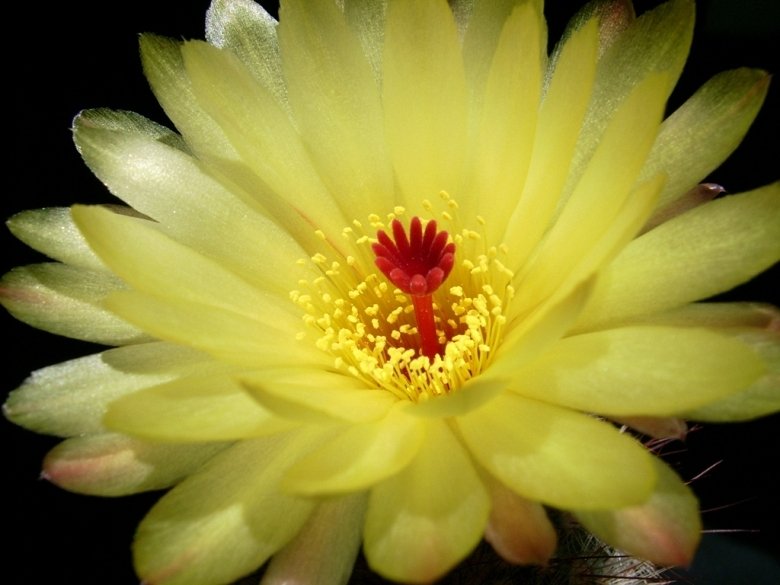
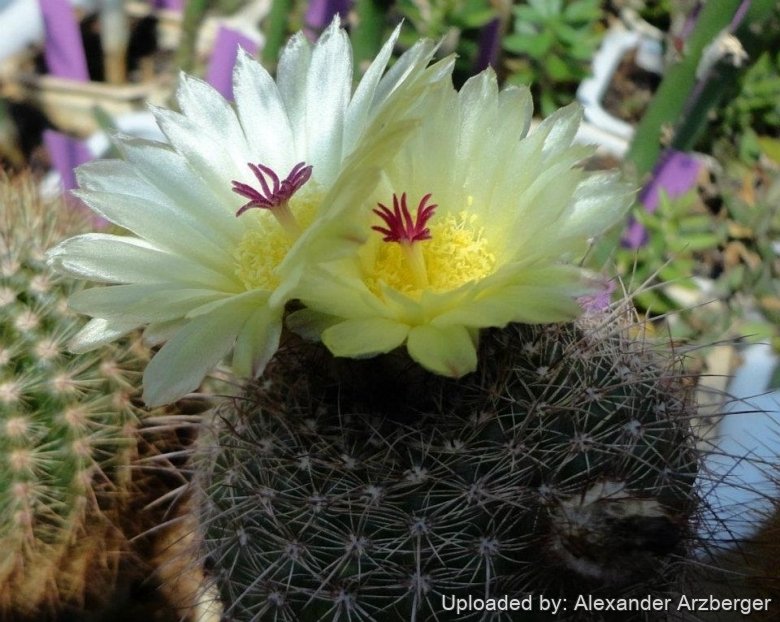
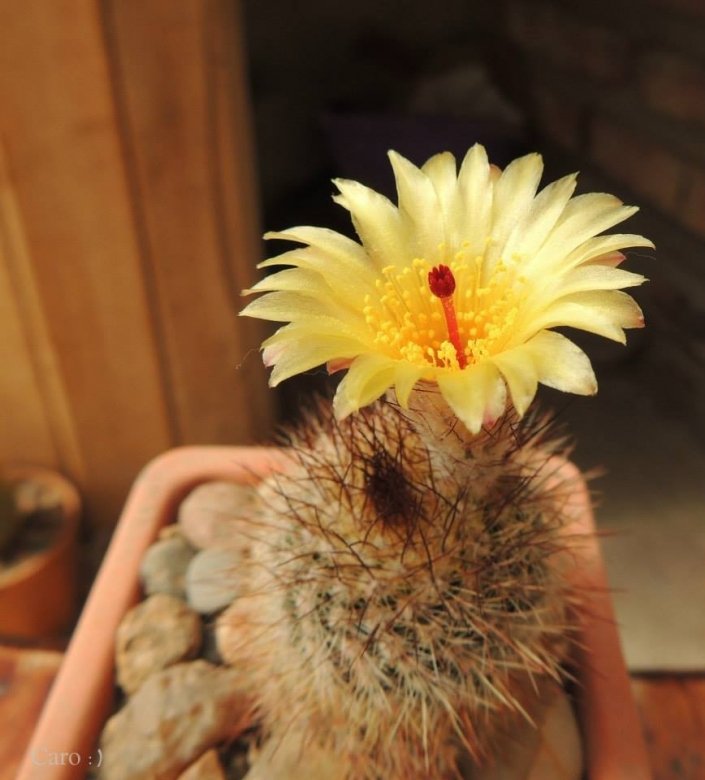
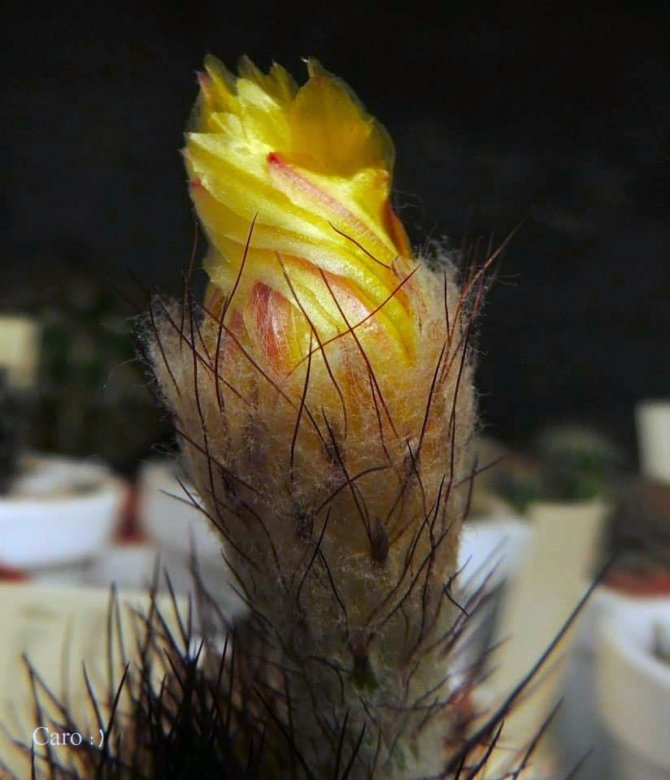
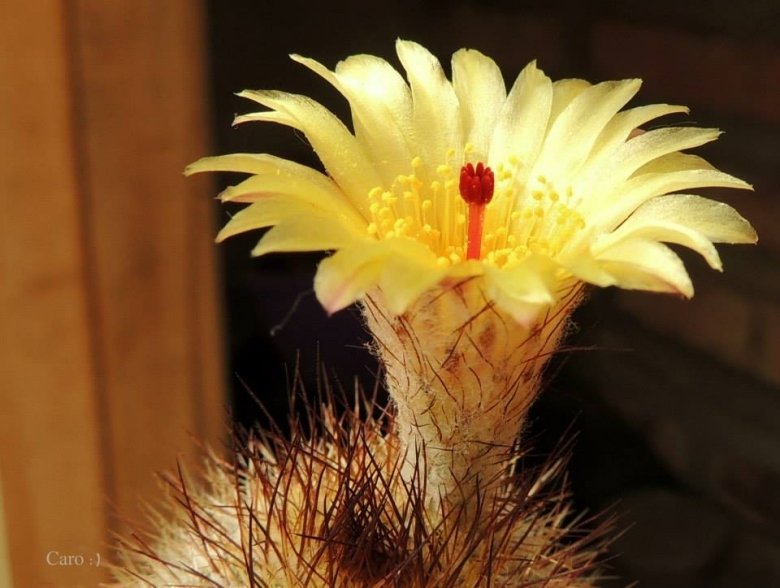
Parodia tabularis, best known as Notocactus tabularis, is a small cactus species with stems thickly clothed with dense white and brown, darker-tipped spines. The flowers are glossy yellow with contrasting carmine stigma lobes.
Habit: It is a solitary perennial stem succulent. Multiple branches may also been produced when the apex is damaged.
Stem: Globose often flattened apically or short-columnar 8-10 cm across, bluish-green.
Ribs: 16-18(-23), somewhat crenate, obtuse, glaucous.
Radial spines: (12-)16 to 18, acicular, spreading, whitish, to 10 mm long.
Central spines: 3 to 4 forming a cross, curving slightly, white with brown tips, to 12 mm long.
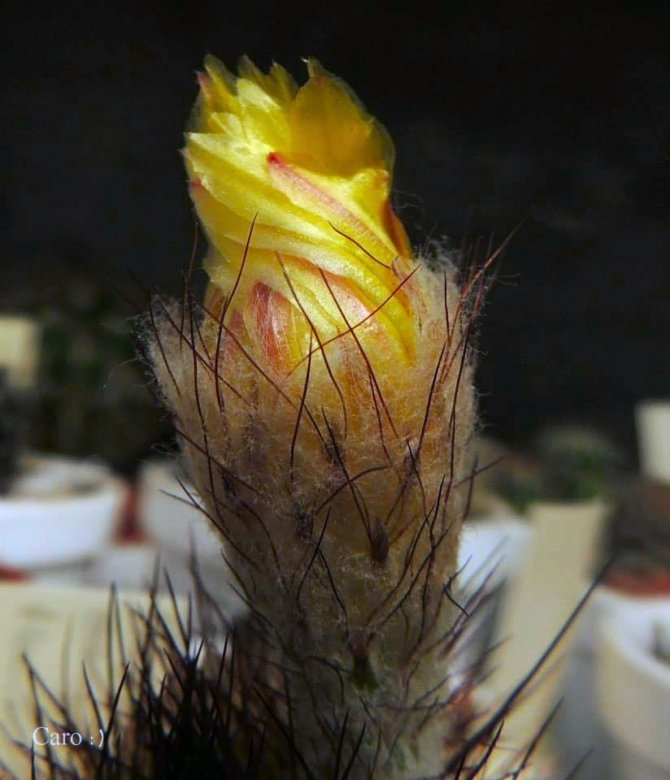
Flowers: Glossy yellow, coming from near the apex of the plant, about 5-6 cm long; perianth-segments narrow, acute; scales of ovary and floral tubes bearing dense white wool and long brown bristles in their axils. Stigma lobes carmine red to purple.
Fruits: Egg-shaped, yellowish green, to 1,2 cm long and 0,7 cm across.
Seeds: Hemispheric or cap-shaped with a broad truncate base, brownish-black, papillose-roughened, about 1 mm broad.
Origin and Habitat
Brazil and Uruguay at low altitudes.
Cultivation and Propagation
This is an easy plant to cultivate. It require a mineral-based potting mix with a good drainage. Can support quite some water during the growing season but pot plants in winter are wet-sensitive and needs to be kept dry (rots easily if soil is wet and cold). Usually it is recommended to over-winter this plant in a bright and warm greenhouse with at least 8-10° C , but it has proved to tolerate temperatures as low as -5° C for short periods.
Sun Exposure: Light shade to full sun but doesn’t like full, hot blazing sun in the central summer month.
Propagation: Seeds, cuttings. Not too difficult to raise from seed.
Bibliography
Major references and further lectures
-
Edward Anderson “The Cactus family” Timber Press, Incorporated, 2001
-
Nathaniel Lord Britton, Joseph Nelson Rose “Cactaceae: Descriptions and Illustrations of Plants of the Cactus Family” vol. 4 The Carnegie Institution of Washington, Washington 1923
-
James Cullen, Sabina G. Knees, H. Suzanne Cubey “The European Garden Flora Flowering Plants: A Manual for the Identification of Plants Cultivated in Europe, Both Out-of-Doors and Under Glass” Cambridge University Press, 11/Aug/2011
-
David R Hunt; Nigel P Taylor; Graham Charles; International Cactaceae Systematics Group. “The New Cactus Lexicon” dh books, 2006
From llifle page Notocactus brederooianus
Description
Notocactus brederooianus is a small globular cactus, with white or yellowish-white radial spines, and red centrals. It represent a link between Notocactus tabularis (Parodia tabularis) to which it is synonymized and Notocactus scopa (Parodia scopa).
Derivation of specific name: It has been named after the Dutchman A. J. Brederoo author of numerous articles in cactus and succulents journals.
Stem: Solitary, globose to pyriform, green, 7-10 cm long and 6-8 cm wide. Crown flattened, concave in the centre, about 5 mm deep, concealed by spines.
Roots: Fibrous.
Ribs: 20-22, 9-10 mm hight, 2-3 mm wide, slightly twisted.
Areoles: Brown, circular, approximately 1.5 mm wide in the upper part of the stem with white wool, about 3 mm apart.
Spines: Soft. radial spines glassy white, very numerous (35-40), spreading, 5-10 mm long; central 6, dark reddish brown, flexible, upright, three of which stronger up to13-18 mm long, the shorter 10 to 12 mm long.
Flowers: Buds about 15 mm long and 10 mm wide, with grey-brown wool and long brown hair. Flowers funnel-shaped, 6-7 cm long, as well as broad; flower tube green, with grey wool and long brown hair. Tepals broadly lanceolate, 45 mm long and 7 mm wide, shiny yellow with a special metallic shine; outer tepals smaller with a greenish stripe in the outside. Filaments 12 mm long, yellow, the lowermost slightly reddish at the base. Anthers ochre, very rich in pollen. Pistil c. 25 mm long, 1 mm wide, red. Stigma magenta, with 10 lobes, 5 mm long. Ovary 12 mm long and 5 mm wide.
Fruits: Ovate, yellowish green, 12 mm long and 7 mm wide.
Seeds: About 1 mm long and 0.8 mm wide.
Origin and Habitat
Cerro Parfido, Route 8 Km 153, Lavalleja, Uruguay.
Habitat and ecology: This specie grows in a small rocky area about 500 m long and 200 m wide. The plants are very small and difficult to find among the rock. Accompanying cactus species are Notocactus obscurus nn (PR 81a) and almost a meter high form of Notocactus scopa. The population is probably affect by goats and fires, even though this poses a minor threat. After fire the plants look like small burned cucumbers while deprived of their spines, those burned plants later start growing again and readily produce their beautiful spines.
Cultivation and Propagation
This is an easy plant to cultivate. It require a mineral-based potting mix with a good drainage. Can support quite some water during the growing season but pot plants in winter are wet-sensitive and needs to be kept dry (rots easily if soil is wet and cold). Usually it is recommended to over-winter this plant in a bright and warm greenhouse with at least 8-10° C, but it has proved to tolerate temperatures as low as -5° C for short periods.
Sun Exposure: Light shade to full sun but doesn’t like full, hot blazing sun in the central summer month.
Propagation: Seeds, cuttings. Not too difficult to raise from seed. Sow be in a sterile environment. It is recommended to graft seedlings to speed growth. Plants on their own roots grow very slowly but live longer than the grafted ones.
Bibliography
Major references and further lectures
-
Gebauer A., “Die Erstbeschreibungen des Jahres 1985, Notocactus”, p. 17, 1987
-
Prestlé K. H., “Notocactus brederooianus Prestlé und sein dunkler Begleiter N. obscurus nom. prov.”, Internoto, 17: 66 - 69, 1996
-
Stuchlík S., “Notocactus brederooianus Prestlé”, Kaktusy, 25: 59 - 61, 1989
-
Stuchlík S., “Rod Notocactus - monografie”, p. 25 - 26, 1993
Source: Notocactus brederooianus, LLIFLE - Encyclopedia of living forms, CC-BY-SA, retrieved 2026-10-25.
Cultivars and forms (2)
Gallery