Publication: Cact. Succ. J. (Los Angeles) 23: 97 (figs. 51-52). 1951
Description
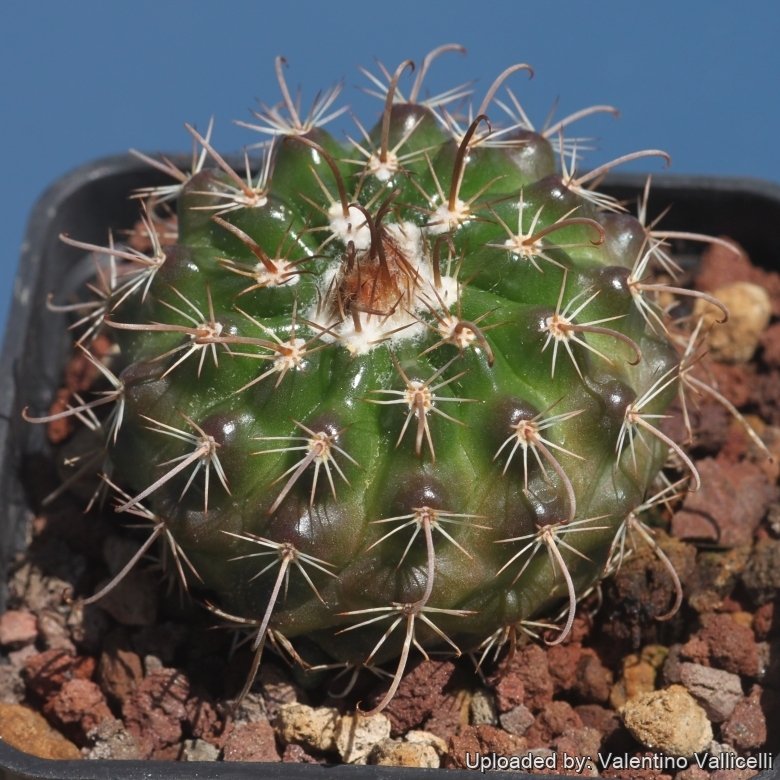
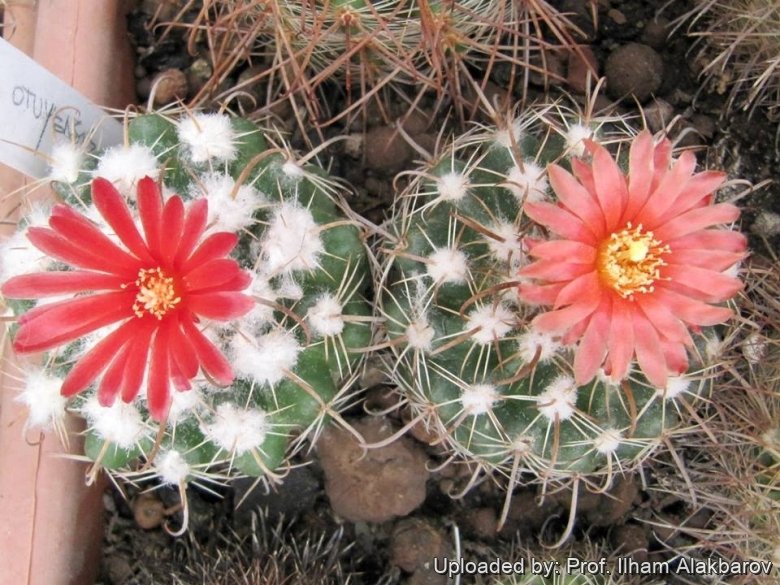
Parodia tuberculata is a simple or rarely clustering globular cactus species with small orange-red blooms. It is a morphologically variable taxon growing widespread in the mountains of Bolivia and has received numerous unnecessary names.
Stem: Depressed-spherical 4-5 cm tall, 7-11 cm across, grey-green, apex not very woolly.
Ribs: 13-20 spiralled strongly tuberculate at first.
Tubercles: Large round. Parastichy number 8-13 (Double visible spirals pattern in the position of a tubercle on the axis).
Areoles: Grey or whitish, woolly at first.
Central spines: 1-4 one hooked, turned downward brown to blackish or grey. 13-18(-25) mm long.
Radial spines: 7 to 11 mostly grey-coloured up to 10 mm long, needle-like, spreading, flattened against the stem surface.
Flowers: Smallish, campanulate, 3 to 5 flowers at a time clustered around the meristem, 1,8-2,7 long and 1 cm yellowish-orange to dull red-orange. Pericarpels and floral tubes very short with dense white hairs and scales.
Blooming season: Blooms are produced over a long period in late spring to mid Summer.
Fruit: Spherical 6-7 mm, purple, naked.
Seeds: Oblong 0,8 x 1,25 mm, caruncle conspicuous, seed-coat finely tuberculate dull black.
Origin and Habitat
Bolivia (Potosi. Chuquisaca)
Altitude: 2600-3200 metres above sea level.
Habitat: It is found in high, dry, rocky grasslands in rocky slopes of the Andes in fully exposed sites. Parodia tuberculata and Rebutia fiebrigii var. deusiseta grow nearby.
Cultivation and Propagation
Parodia tuberculata is a summer grower species that is easy to cultivate and recommended for beginners. The whole Parodia tuberculata complex has delightful flowers and the plants remain compact. Another advantage is that the plants are cold hardy in winter if kept dry.
Growth rate: It is a slow growing but easily flowering species.
Soils: This species is easy to cultivate in a very open mineral mix with at least 50% sand or pumice grit and a pH slightly on the acidic side.
Repotting: It is better that they are repotted regularly. Pots should be only slightly larger than the plant and root system. Repotting will increase the number of flowers produced. Repotting is best done at the end of winter, but can be done at other times, too. Do not water for a couple of weeks after repotting, to reduce risk of root rot via broken roots. A layer of ‘pea’ gravel at the bottom of the pot improves drainage. A layer of decorative gravel as a top dressing helps prevent the caking of the potting mix, which decreases the rate of water absorption. It also keeps the perlite and pumice from blowing everywhere, and looks nice.
Watering: It requires full sun or light shade and careful watering to keep plant compact, and maintain strong and dense spines and allow the pot to dry out between waterings. Keep dry in winter at a minimum temperature of 0°C. It tends to rot if too wet. The plants can be placed outdoors in April, but protected from rain and direct sunlight. Water them thoroughly when placed out, and again in two weeks, and again in one week. After one month the plants are ready to be placed out in full sun and full rain for the summer. During dry spells the collection is watered once a week, during hot dry spells, twice a week.
Fertilization: Feed with a high potassium fertilizer in summer.
Hardiness: It is reputedly resistant to frost if kept on the dry side prior to, and during, cold weather and requires a winter rest period (hardy to -7° C, or less for short periods). Parodias grow in nature at high altitudes, and do not thrive well at high temperatures in cultivation. They will often go dormant in mid-summer, and resume growth again when the weather cools in late August. They can tolerate amazingly low temperatures for long periods of time. All species can take a frost, even when not bone dry. It is generally accepted that plants kept at too high a temperature, or watered too much during the winter rest period, will not bloom the following year. They will be perfectly happy in pots outdoors from April to September if protected from torrential rain and hail.
Exposition: The plant tolerates extremely bright situations but enjoys filtered sunlight or afternoon shade, inside it needs bright light, and some direct sun. Tends to bronze in strong light, which encourages flowering and heavy spine production, but is likely to suffer from sun scorch or stunted growth if over exposed to direct sunlight during the hottest part of the day in summer.
Uses: It is an excellent plant for container growing. It always looks good and stays small. It look fine in a cold greenhouse and frame or outdoor in a rockery.
Pests & diseases: All, especially the young, are susceptible to red spider mites.
Rot: This species is particularly easy and accommodating, seldom suffer of cryptogamic diseases. Rot it is only a minor problem with cacti if the plants are watered and “aired” correctly. If they are not, fungicides won’t help all that much.
Propagation: Offsets, seeds. The seed of this plant are small and must be sown on the surface of the germination substrate (not buried!!) But the seedlings after germination are so minuscule and delicate that it is quite problematic to keep them alive. So for this species it is usually used the baggy germination technique (in a sterilized pot hermetically closed in a plastic sachet)
Note: It would appear that in cultivation they grow larger and cluster more vigorously than in habitat.
Bibliography
Major references and further lectures
-
Hiroshi Hirao “Colour encyclopaedia of cacti” Seibundo Shinkosha, 1979
-
Friedrich Ritter “Kakteen in Südamerika: Argentinien, Bolivien” Volume 2 1980
-
Stuart Max Walters “The European garden flora. 3.[Angiospermae], Dicotyledons. [Casuarinaceae to Aristolochiaceae]” Cambridge University Press, 1989
-
Edward Anderson “The Cactus family” Timber Press, Incorporated, 2001
-
James Cullen, Sabina G. Knees, H. Suzanne Cubey “The European Garden Flora Flowering Plants: A Manual for the Identification of Plants Cultivated in Europe, Both Out-of-Doors and Under Glass” Cambridge University Press, 11/Aug/2011
-
David R Hunt; Nigel P Taylor; Graham Charles; International Cactaceae Systematics Group. “The New Cactus Lexicon” dh books, 2006
From llifle page Parodia otuyensis
Description
Parodia otuyensis is one of the several forms of the morphologically variable Parodia tuberculata with dark orangish-red flowers. It is a compact small to medium-sized cactus covered with dark brown hooks. Usually solitary, but can forms small clusters.
Roots: Short and fleshy.
Stem: Depressed-spherical 4-5 cm tall, 4-11 cm accross, grey-green, apex sunken, not very woolly.
Ribs: 13-20, 7-100 mm tall, spiralled slightly tuberculate.
Tubercles: Larger than tall round approx. 7 mm in diameter. Parastichy number 8-13 (Double visible spirals pattern in the position of a tubercle on the axis).
Areoles: 2-3 mm wide, 7-10 mm apart, round, whitish, woolly at first, later grey almost naked.
Central spines: 1-4 one hooked, turned downward brown to blackish turning grey, 13-18 mm long.
Radial spines: 7 to 9 mostly grey-coloured up to 10 mm long, needle-like, spreading, flattened against the stem surface.
Flowers: Smallish, campanulate, 3 to 5 flowers at a time clustered around the meristem, 1,8-2,7 long and 1 cm yellowish-orange to dull red-orange. Pericarpels and floral tubes very short with dense white hairs and scales.
Blooming season: Blooms are produced over a long period in late spring to mid Summer.
Fruit: Spherical 6-7 mm, purple, naked
Seeds: oblong 0,8-1,25 mm. caruncle conspicuous, seed-coat tuberculate black. I. GI I. Blooming season: Spring-summer.
Seeds: Finely tuberculate., dull black.
Origin and Habitat
Otuyo and adjacent areas, Potosí, Bolivia
Altitude: 2800-3200
Cultivation and Propagation
Parodia tuberculata is a summer grower species that is easy to cultivate and recommended for beginners. It has delightful flowers and the plants remain compact. Another advantage is that the plants are cold hardy in winter if kept dry.
Growth rate: It is a slow growing but easily flowering species.
Soils: This species is easy to cultivate in a very open mineral mix with at least 50% sand or pumice grit and a pH slightly on the acidic side.
Repotting: It is better that they are repotted regularly. Pots should be only slightly larger than the plant and root system. Repotting will increase the number of flowers produced. Repotting is best done at the end of winter, but can be done at other times, too. Do not water for a couple of weeks after repotting, to reduce risk of root rot via broken roots. A layer of ‘pea’ gravel at the bottom of the pot improves drainage. A layer of decorative gravel as a top dressing helps prevent the caking of the potting mix, which decreases the rate of water absorption. It also keeps the perlite and pumice from blowing everywhere, and looks nice.
Watering: It requires full sun or light shade and careful watering to keep plant compact, and maintain strong and dense spines and allow the pot to dry out between waterings. Keep dry in winter at a minimum temperature of 0°C. It tends to rot if too wet. The plants can be placed outdoors in April, but protected from rain and direct sunlight. Water them thoroughly when placed out, and again in two weeks, and again in one week. After one month the plants are ready to be placed out in full sun and full rain for the summer. During dry spells the collection is watered once a week, during hot dry spells, twice a week.
Fertilization: Feed with a high potassium fertilizer in summer.
Hardiness: It is reputedly resistant to frost if kept on the dry side prior to, and during, cold weather and requires a winter rest period (hardy to -7° C, or less for short periods). Parodias grow in nature at high altitudes, and do not thrive well at high temperatures in cultivation. They will often go dormant in mid-summer, and resume growth again when the weather cools in late August. They can tolerate amazingly low temperatures for long periods of time. All species can take a frost, even when not bone dry. It is generally accepted that plants kept at too high a temperature, or watered too much during the winter rest period, will not bloom the following year. They will be perfectly happy in pots outdoors from April to September if protected from torrential rain and hail.
Exposition: The plant tolerates extremely bright situations but enjoys filtered sunlight or afternoon shade, inside it needs bright light, and some direct sun. Tends to bronze in strong light, which encourages flowering and heavy spine production, but is likely to suffer from sun scorch or stunted growth if over exposed to direct sunlight during the hottest part of the day in summer.
Uses: It is an excellent plant for container growing. It always looks good and stays small. It look fine in a cold greenhouse and frame or outdoor in a rockery.
Pests & diseases: All, especially the young, are susceptible to red spider mites.
Rot: This species is particularly easy and accommodating, seldom suffer of cryptogamic diseases. Rot it is only a minor problem with cacti if the plants are watered and “aired” correctly. If they are not, fungicides won’t help all that much.
Propagation: Offsets, seeds. The seed of this plant are small and must be sown on the surface of the germination substrate (not buried!!) But the seedlings after germination are so minuscule and delicate that it is quite problematic to keep them alive. So for this species it is usually used the baggy germination technique (in a sterilized pot hermetically closed in a plastic sachet)
Note: It would appear that in cultivation they grow larger and cluster more vigorously than in habitat.
Source: Parodia otuyensis, LLIFLE - Encyclopedia of living forms, CC-BY-SA, retrieved 2026-10-25.