Publication: Cactaceae Consensus Init. 6: 12, nom. nov. 1998 [replaced synonym: Notocactus uebelmannianus Buining]
Description
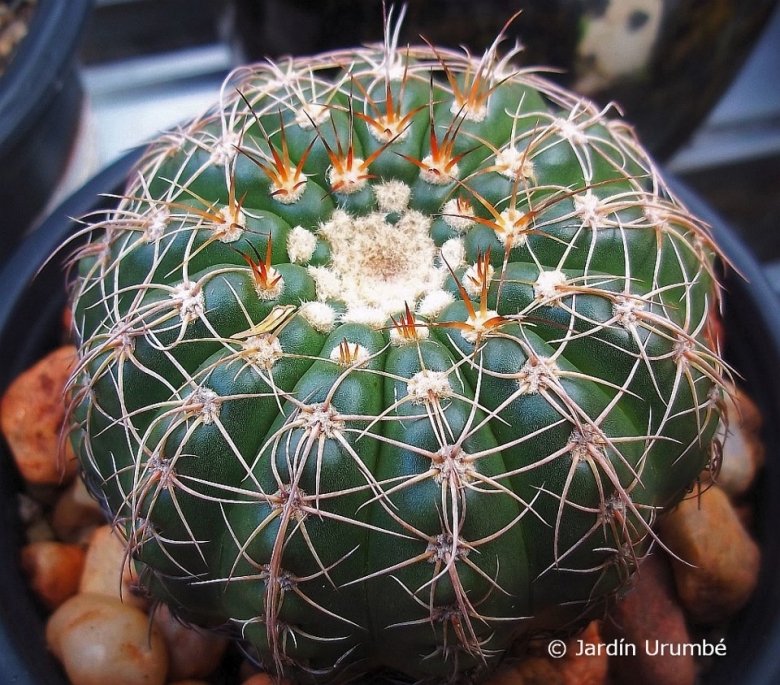
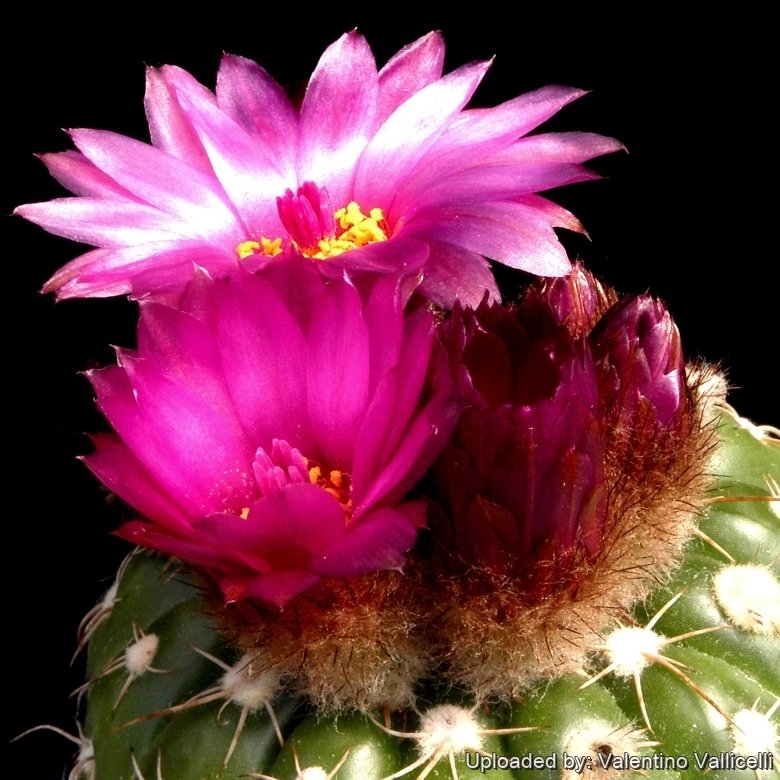
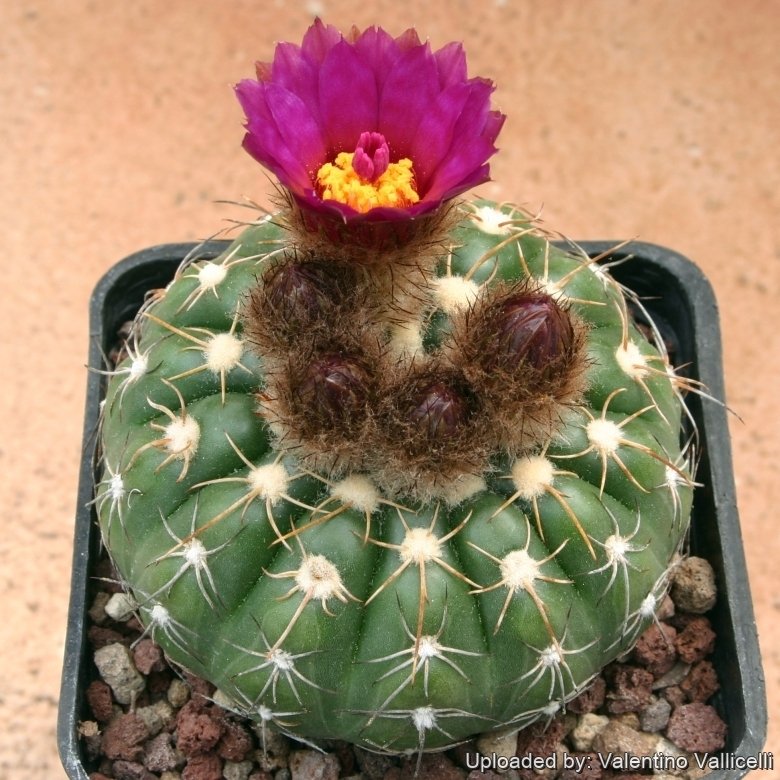
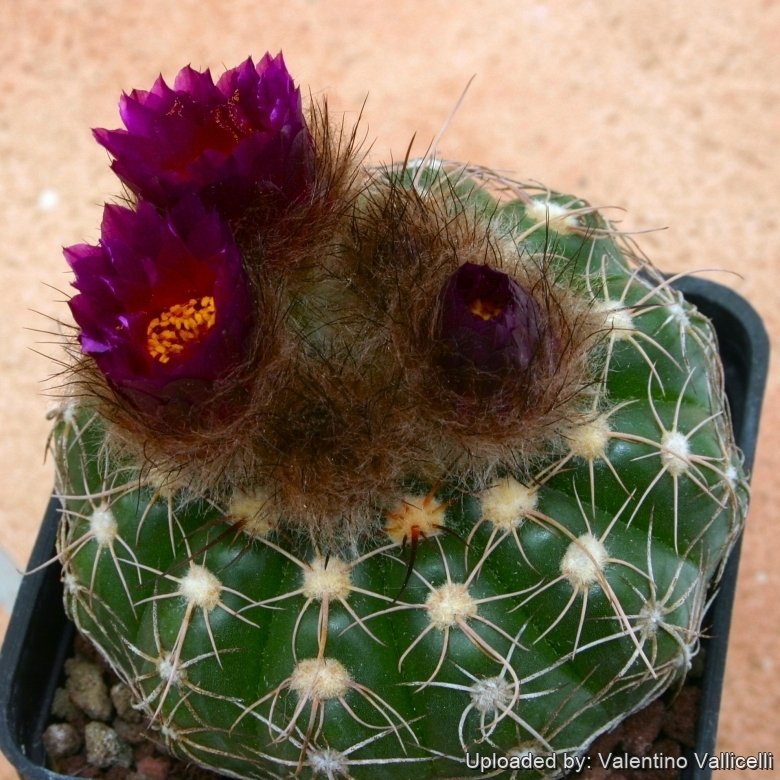
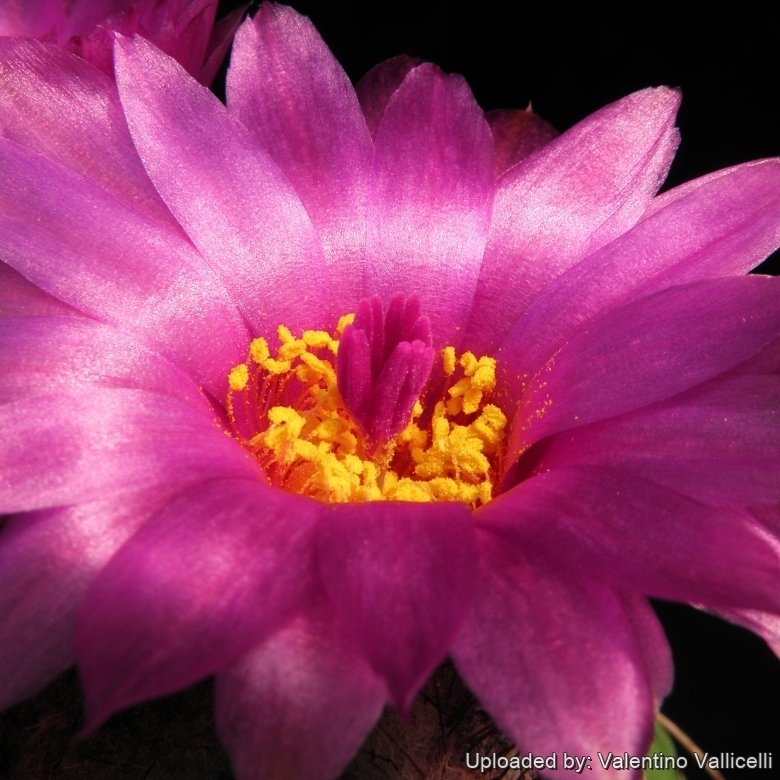
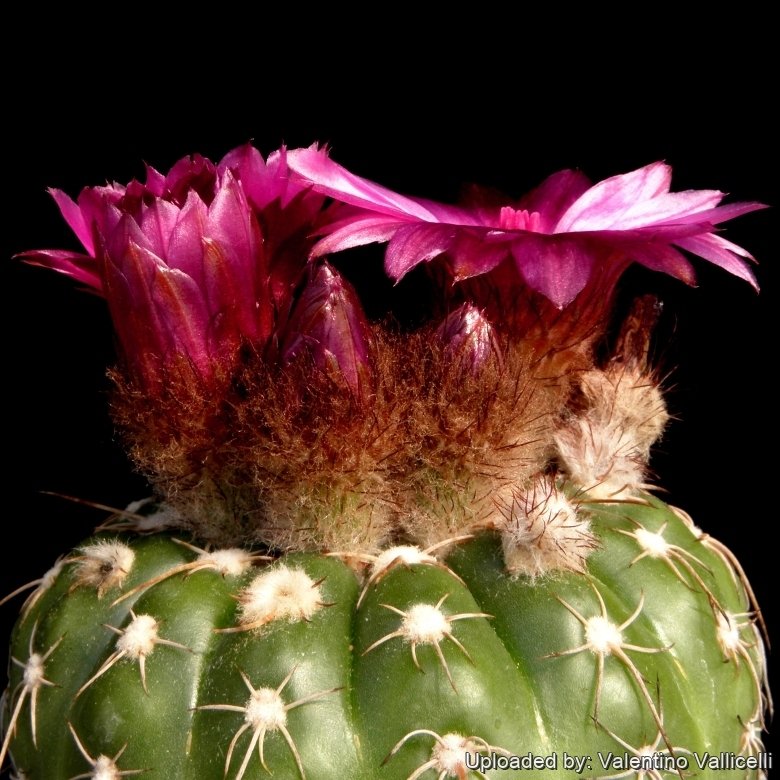
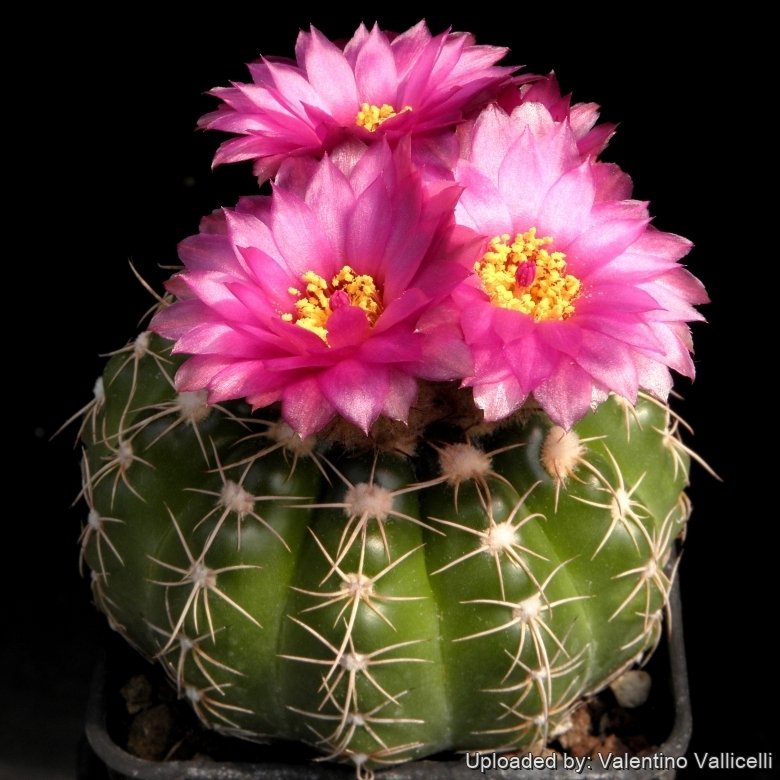
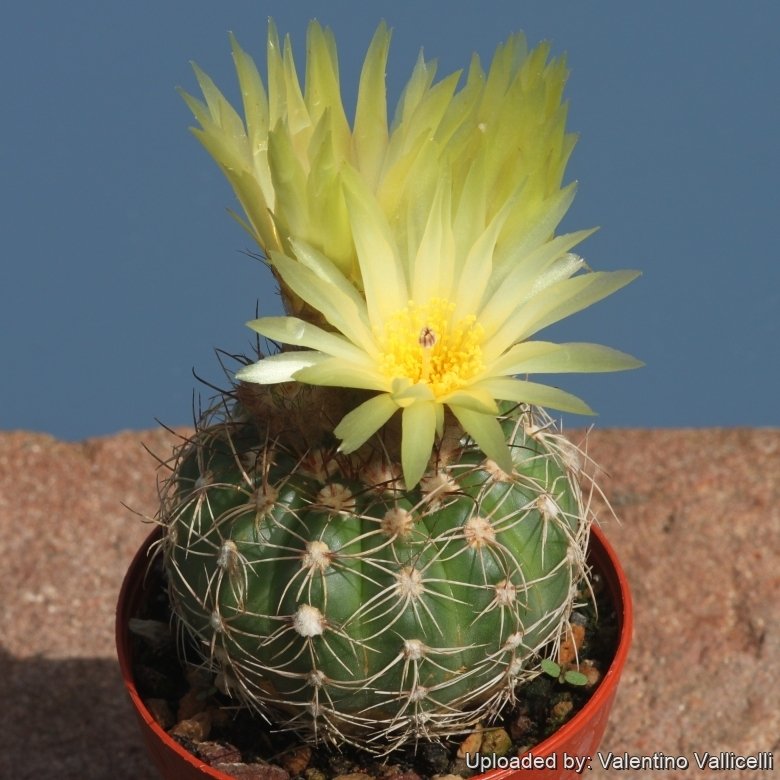
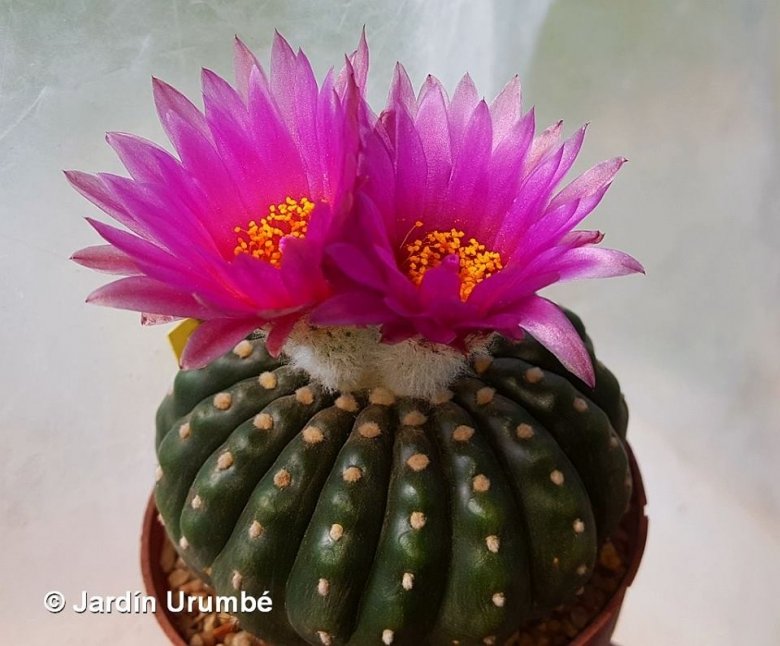
Parodia werneri is a a nice cactus usually solitary, sometimes branching basally to form small clumps. It has glossy green body with appressed spines and bears a ring of the most amazing magenta to royal purple flowers every spring.
Replaced synonym: Notocactus uebelmannianus Buining, Kakt. and. Sukk. 19(9): 175-176 (1968), non Parodia uebelrnannlana Ritter, Kakt. Siidamer. 2: 425-426 (1980). On transfer to Parodia since a Parodia uebelmanniana already existed the name of uebelmannianus was changed to Parodia werneri, hence the name Parodia werneri is the current accepted Scientific name but many growers and plant sellers still use the old name Notocactus uebelmannianus, so you may come across it under both names.
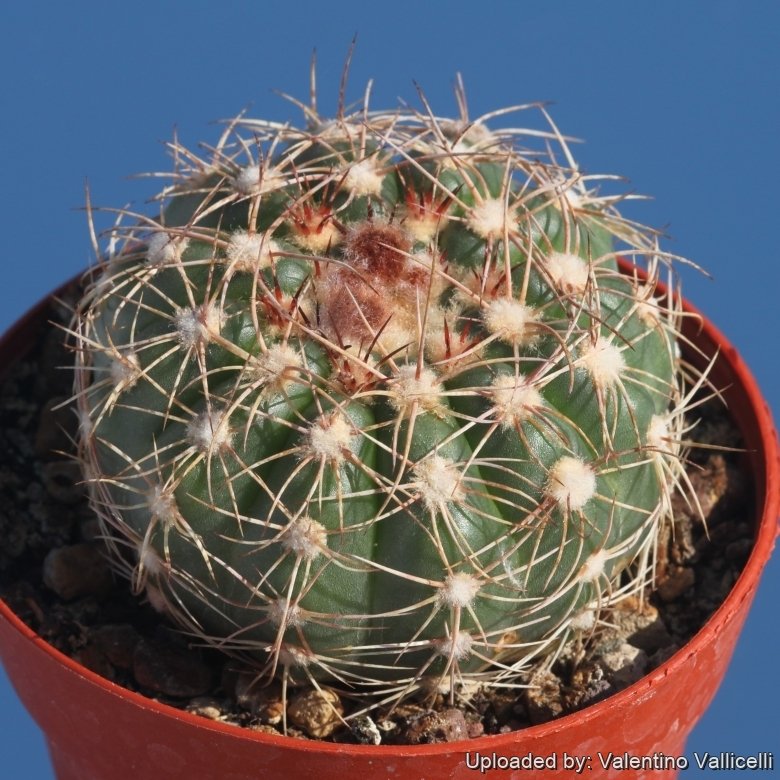
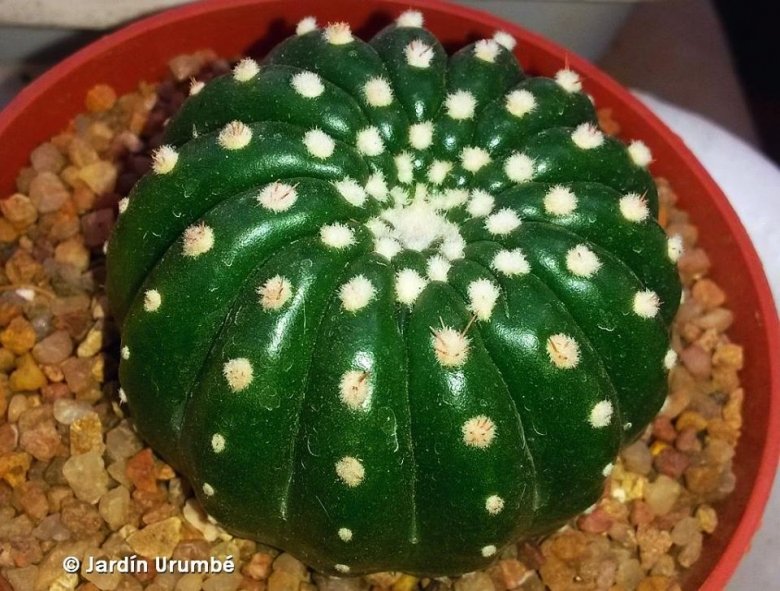
Stem: Shiny dark green, globular or short/squatty up to 12 cm tall and 17 cm in diameter.
Ribs: 12-16, flat, round, more ore less chinlike.
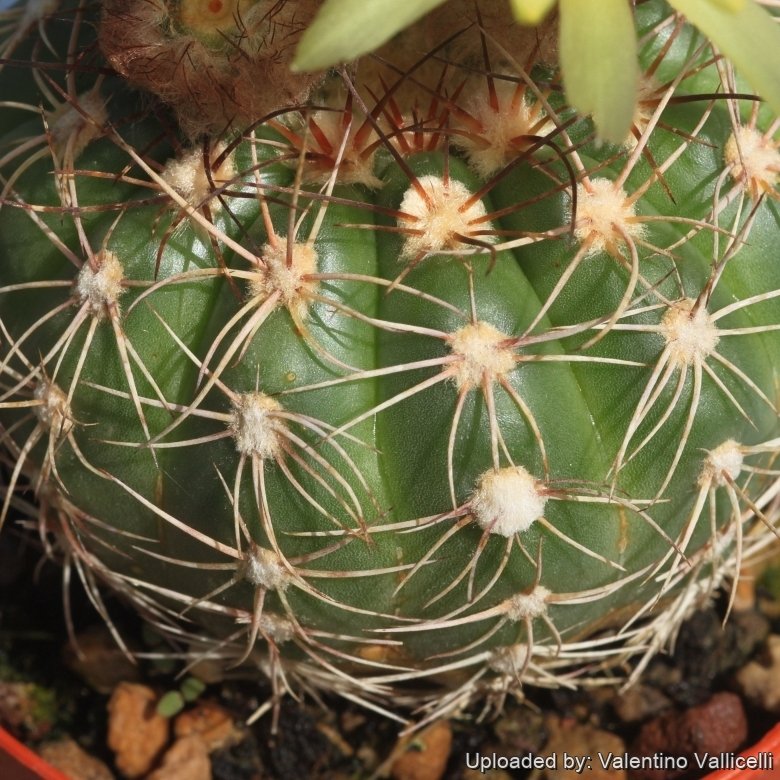
Areoles: Round, large, dull white or creamy white-felted, each with a shallow groove below.
Central spines: Usually absent.
Radial spines: About 6 spider-like, 10 to 30 mm long, appressed against the stem body, one pointing downward, unequal, white to greyish.
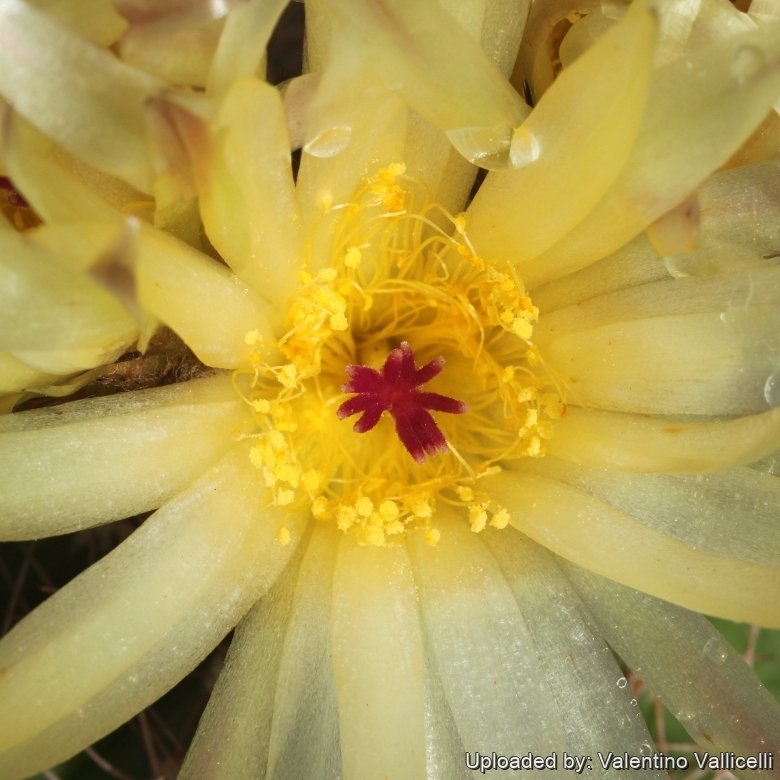
Flower: Small about 5 cm in diameter, short funnel-form, shiny, wine red to deep magenta of various tones, or pure yellow (Parodia werneri f. flaviflora). Both purple and yellow flower colours can exist side by side in some populations and the yellow being the most abundant. Therefore the more commercial but less representative purple flowered form was made the species and the more typical yellow flowered the variety.
Blooming season: Spring to early summer, once it reaches about 7 cm in diameter if kept well it will flower every year.
Origin and Habitat
It is native to Brazil in the area of Rio Grande Do Sul
Habitat: It grows in flattened rocky terrains amongst agricultural land. It is seriously endangered in its native habitat as much of the land is cultivated for arable crops or grazing pasture.
Cultivation and Propagation
Parodia werneri (syn: Notocactus uebelmannianus) is easy to grow and quite resistant to neglect. Nevertheless, it is appropriate to provide adequate growing conditions in order to obtain abundant blooms.
Growth rate: It is a relatively rapidly growing species that will make large clumps given the best conditions.
Soils: It needs a standard cactus mix soil with an excellent drainage. Prefer a low pH compost, avoid substrata too rich in limestone.
Repotting: This plant needs plenty of space for its roots, repotting should be done every other year or when the it has outgrown its pot. It is rot prone and should be planted in a shallow pot. Use pot with good drainage.
Watering: Needs regular water in spring to autumn in summer (it is more demanding than other cactus), but do not overwater, keep dry in winter or give them a very small amount about once a month in winter to prevent shrinkage and root loss.
Fertilization: Feed with a high potassium fertilizer in summer. Regular water in spring to autumn. I tend to
Hardiness: It is moderately frost resistant if kept dry and hardy to -4° C for short periods (depending on varieties and growing conditions). However warmth throughout the year will increase the grower’s success (at temperatures from 5 to 15 degrees centigrade during rest season).
Exposition: The plant tolerates bright situations which encourages flowering and heavy spine production, but is likely to suffer from sun scorch or stunted growth if over exposed to direct sunlight during the hottest part of the day in summer. It grows well with filtered sunlight or afternoon shade.
Uses: It is an excellent plant for container growing. It look fine in a cold greenhouse and frame or outdoor in a rockery. It is also used as a rootstock for grafting delicate and slow growing cactus species.
Pests & diseases: It may be attractive to a variety of insects, but plants in good condition should be nearly pest-free, particularly if they are grown in a mineral potting-mix, with good exposure and ventilation. Nonetheless, there are several pests to watch for:
- Red spiders: Red spiders may be effectively rubbed up by watering the plants from above.
- Mealy bugs: Mealy bugs occasionally develop aerial into the new growth among the wool with disfiguring results, but the worst types develop underground on the roots and are invisible except by their effects.
- Scales: Scales are rarely a problem.
- Rot: This species is particularly easy and accommodating, seldom suffer of cryptogamic diseases. Rot it is only a minor problem with cacti if the plants are watered and “aired” correctly.
Propagation: Direct sow after last frost, offsets (if available) . Seeds germinate in 7-14 days at 21-27° C in spring, remove gradually the glass cover as soon the plants will be well rooted (ca 1-2 weeks) and keep ventilated, no full sun for young plants! To make a cutting twist off a branch and permit it to dry out a couple of weeks, lay it on the soil and insert the stem end partially into the soil. Try to keep the cutting somewhat upright so that the roots are able to grow downward.
Bibliography
Major references and further lectures
-
David R. Hunt “Cactaceae Systematics Initiatives: Bulletin of the International Cactaceae” Systematics Group.
-
Curt Backeberg “Cactus Lexicon” Sterling Publishing Company, Incorporated, 1978
-
Hiroshi Hirao “Colour encyclopaedia of cacti” Japan 1979 (Japanese language and script)
-
Willy Cullmann, Erich Götz (Dozent Dr.), Gerhard Gröner “The encyclopedia of cacti” Portland, OR: Timber Press, 1986
-
David Hunt, Nigel Taylor “The New Cactus Lexicon” DH Books, 2006 ISBN 0953813444, 9780953813445
-
Hans Hecht “BLV-Handbuch der Kakteen” BLV, 1991 (German language and script)
-
Edward Anderson “The Cactus family” Timber Press, Incorporated, 2001
-
James Cullen, Sabina G. Knees, H. Suzanne Cubey “The European Garden Flora Flowering Plants: A Manual for the Identification of Plants Cultivated in Europe, Both Out-of-Doors and Under Glass” Cambridge University Press, 11/Aug/2011
-
N. L. Britton, J. N. Rose “The Cactaceae. Descriptions and Illustrations of Plants of the
From llifle page Notocactus arachnitis
Description
Parodia arachnitis (Notocactus) ( = Parodia werneri accepted scientific name) is usually a solitary cactus that sometime forms multi-headed clumps. It is a very close ally of Parodia crassigibba.
Stem: Simple, depressed-spherical up to 12 cm tall and 17 cm in diameter, dark green: ribs very low, rounded, with broad chin-like tubercles between the areoles.
Areoles: Whitish.
Radial spines: 10-14 varable more or less addpressed or slightly projecting, unequal in length, approximatively 5-30 mm long, mostly curved, whitish, yellow-white, grey or pale brown
Central spines: Usually absent or one.
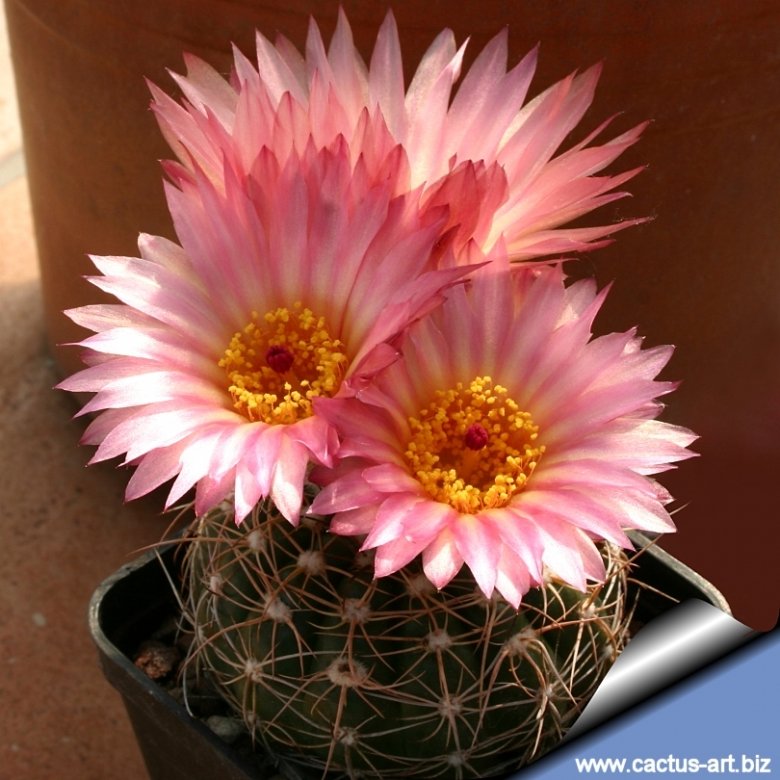
Flowers: Rather variable in size, funnel-shaped, form and colour approx 3,7 cm long, white-yellow to sulphur-yellow (or reddish pink). The corolla tube is covered with wool-white to pale brown bristles.
Flowers: Spring-summer.
Fruit: Barrel-shaped, redish, 0,5-1,5 cm long.
Seeds: Cap-shaped, black to 1,4 x 1,4 mm. Hilum corky, seed-coat minutely roughened under a lens.
Origin and Habitat
Brazil, Rio Grande do Sul, Serra do Herval
Cultivation and Propagation
Notocactus arachnites is an easy to grow tropical notocactus, more cold tolerant than most and less fussy regarding soil conditions.
Growth rate: It is a relatively rapidly growing and easily flowering species that will make clumps given the best conditions.
Soils: It likes very porous standard cactus mix soil.
Repotting: Use pot with good drainage.
Watering: Water regularly in summer, but do not overwater (Rot prone), keep dry in winter.
Fertilization: Feed with a high potassium fertilizer in summer.
Hardiness: Reputedly sensitive to frost, but less so if kept on the dry side prior to, and during, cold weather (hardy to -5° C for short periods). However warmth throughout the year will increase the grower’s success (8-12°C during rest season).
Exposition: Outside bright but partially filtered sunlight or afternoon shade, inside it needs bright light, and some direct sun. Subject to sunburn if exposed to direct sun for too long. Tends to bronze in strong light, which encourages flowering and heavy wool and spine production.
Uses: It is an excellent plant for container growing. It always looks good and stays small. It look fine in a cold greenhouse and frame or outdoor in a rockery.
Pests & diseases: It may be attractive to a variety of insects, but plants in good condition should be nearly pest-free, particularly if they are grown in a mineral potting-mix, with good exposure and ventilation. Nonetheless, there are several pests to watch for:
- Red spiders: Red spiders may be effectively rubbed up by watering the plants from above.
- Mealy bugs: Mealy bugs occasionally develop aerial into the new growth among the wool with disfiguring results, but the worst types develop underground on the roots and are invisible except by their effects.
- Scales: Scales are rarely a problem.
- Rot: Rot is only a minor problem with cacti if the plants are watered and “aired” correctly. If they are not, fungicides won’t help all that much.
Propagation: Division, direct sow after last frost. Seeds germinate in 7-14 days at 21-27° C in spring, remove the glass cover gradually as the plants develops and keep ventilated, no full sun for young plants! To make a cutting twist off a branch and permit it to dry out a couple of weeks, lay it on the soil and insert the stem end partially into the soil. Try to keep the cutting somewhat upright so that the roots are able to grow downward.
Bibliography
Major references and further lectures
-
Curt Backeberg “Cactus Lexicon” Sterling Publishing Company, Incorporated, 1978Edward
-
F. Anderson (2001) “ The Cactus Family”.
-
Hiroshi Hirao “Colour encyclopaedia of cacti” Japan 1979 (Japanese language and script)
-
Willy Cullmann, Erich Götz (Dozent Dr.), Gerhard Gröner “The encyclopedia of cacti” Portland, OR: Timber Press, 1986
-
David Hunt, Nigel Taylor “The New Cactus Lexicon” DH Books, 2006 ISBN 0953813444, 9780953813445
-
Edward F. Anderson: “Das Grosse Kakteen-Lexikon.” Eugen Ulmer KG, 2005 (übersetzt von Urs Eggli), ISBN 3-8001-4573-1
-
Hans Hecht “BLV-Handbuch der Kakteen” BLV, 1991 (German language and script)
Source: Notocactus arachnitis, LLIFLE - Encyclopedia of living forms, CC-BY-SA, retrieved 2026-10-25.
From llifle page Notocactus arachnitis f. darilhoensis
Origin and Habitat
Brazil South (Rio Grande do Sul).
Type locality: Tafelberg auf dem Gelände der Fazenda Darilho Martins Urruth, 12km westlich von Santana da Boa Vista
Source: Notocactus arachnitis f. darilhoensis, LLIFLE - Encyclopedia of living forms, CC-BY-SA, retrieved 2026-10-25.
From llifle page Notocactus arachnitis var. minor
Origin and Habitat
Brazil (Southern America)
Source: Notocactus arachnitis var. minor, LLIFLE - Encyclopedia of living forms, CC-BY-SA, retrieved 2026-10-25.
From llifle page Notocactus uebelmannianus f. flaviflorus
Origin and Habitat
Brazil South (Rio Grande do Sul).
Source: Notocactus uebelmannianus f. flaviflorus, LLIFLE - Encyclopedia of living forms, CC-BY-SA, retrieved 2026-10-25.
From llifle page Notocactus uebelmannianus f. variegatus
Description
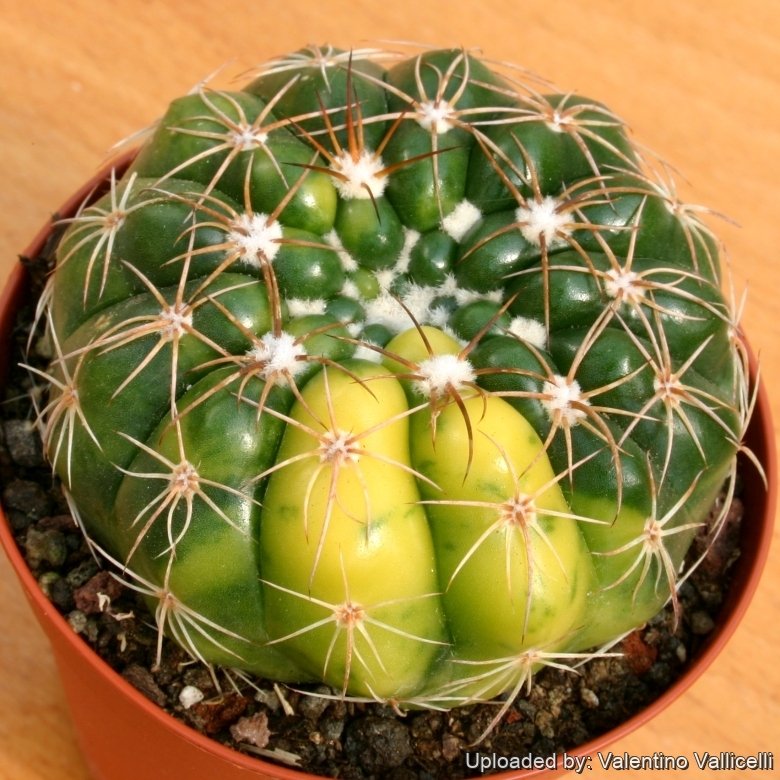
Variegated Parodia werneri (syn: Notocactus uebelmannianus) are very rare in cultivation and some of these variegated plants are particularly priced by collectors. All variegates are mutants. Something has gone wrong with the cellular structure of the growth tip (apical meristem) of the plant. As a result of this mutation, chlorophyll is missing from some or all layers of the plant epidermis. The odd variegate appears in many seedling batches in a small percentage (especially among hybrid seeds) and are generally separated from normal plants. Variegated plants grow slower and are generally smaller than non-variegates of the same species. Coloured areas are also generally weaker, and more susceptible to fungus, sunburn and other defects. A large well grown variegate Parodia is truly an achievement. These are harder to grow well than they appear.
Habit: The standard Parodia werneri is a nice cactus usually solitary, sometimes branching basally to form small clumps. It has glossy green body with appressed spines and bears a ring of the most amazing magenta to royal purple flowers every spring.
Stem: Shiny dark green with sectors, patches or stripes with distinct shades of yellow or orange, globular or short/squatty up to 12 cm tall and 17 cm in diameter.
Ribs: 12-16, flat, round, more ore less chinlike.
Areoles: Round, large, dull white or creamy white-felted, each with a shallow groove below.
Central spines: Usually absent.
Radial spines: About 6 spider-like, 10 to 30 mm long, appressed against the stem body, one pointing downward, unequal, white to greyish.
Flower: Small about 5 cm in diameter, short funnel-form, shiny, wine red to deep magenta of various tones, or pure yellow (Parodia werneri f. flaviflora). Both purple and yellow flower colours can exist side by side in some populations and the yellow being the most abundant. Therefore the more commercial but less representative purple flowered form was made the species and the more typical yellow flowered the variety.
Blooming season: Spring to early summer, once it reaches about 7 cm in diameter if kept well it will flower every year.
Origin and Habitat
Garden origin (Nursery produced cultivar)
Cultivation and Propagation
Variegated cacti are regarded as choice and difficult in cultivation, but despite that many of them are relatively easy to grow. But be aware that they cannot tolerate prolonged exposure to direct sun light (especially during the hottest summer days), so grow them in half-shade or under filtered sun. They are sometime seen as grafted plants, but some of this colourful plants (those with some chlorophyll) are able to grow on their own roots and are priced by collectors.
Soil: Use mineral well-permeable substratum with little organic matter (peat, humus).
Watering: Water sparingly from March till October, and keep perfectly dry in winter, at temperatures from 5 to 15 degrees centigrade. (In general these plants are more tender and cannot endure freezing temperatures). In the rest period no high atmospheric humidity!!
Propagation: By seeds, grafting or cutting. Because the variegation is due to the presence of two kinds of plant tissue, propagating the plant must be by a vegetative method of propagation that preserves both types of tissue in relation to each other. A most common way way to cultivate this partially de-coloured cultivars is to graft them onto another cactus which has chlorophyll and which will provide sugar to the mutant scion. The chlorophyll containing bottom part of the graft, called the stock, can be any number of different columnar cactus species.
Remarks: Seeds from variegated parents often give raise to some variegated seedlings too.
Source: Notocactus uebelmannianus f. variegatus, LLIFLE - Encyclopedia of living forms, CC-BY-SA, retrieved 2026-10-25.
From llifle page Notocactus uebelmannianus f. inermis
Description
Parodia werneri f. inermis is the nice spineless form of Parodia werneri (syn: Notocactus uebelmannianus). The spines are present but extremely reduced only about 1 mm long and completely disappear in the wool of areoles, all the other characteristics namely size and shape of stems, flowers, fruits, roots etc. clearly show that they are conspecific.
For more details see: Parodia werneri
Origin and Habitat
Garden origin (Nursery produced). The wild species occurs over a considerable range in the area of Rio Grande Do Sul, Brazil.
Source: Notocactus uebelmannianus f. inermis, LLIFLE - Encyclopedia of living forms, CC-BY-SA, retrieved 2026-10-25.
Cultivars and forms (4)
Gallery