Publication: Cact. Succ. J. Gr. Brit. xix. 67 (1957)
Description
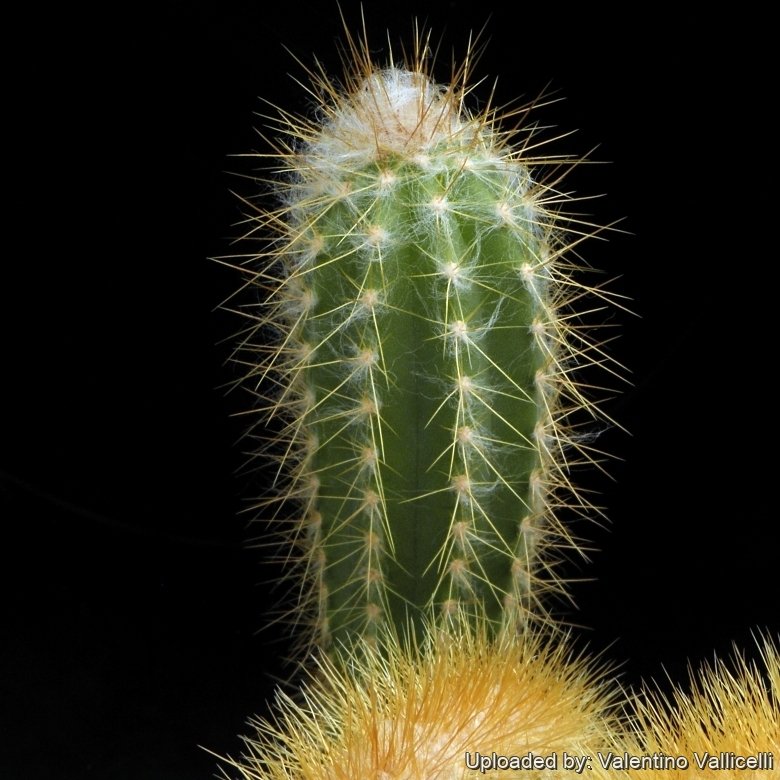
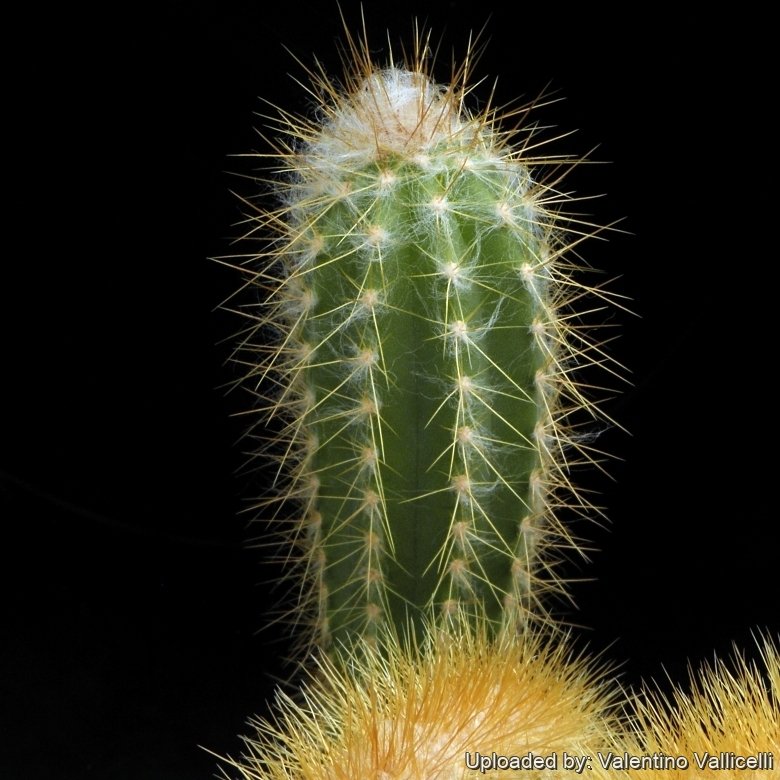
Pilosocereus royenii is an attractive blue-stemmed, tree-like cactus species. It is relatively large sized with tufts of whitish hairs near the branch ends, elongated flowers, and red-purple fruits. It is quite variable and has had at least 30 scientific synonyms.
Habit: Plants treelike, branching basally or above the ground, 2-8 m high, often with well-defined trunks. A 5 metres tall individual may be over 100 years old.
Roots: The root system is broad and near the surface to rapidly a absorb water from even the lightest rains.
Trunk: Up to 60 cm in diameter or larger, covered by a very thin, relatively smooth bark and reddish-brown.
Branches: Mostly vertical or sometimes ascending, stout, blue-green, (5-)7-9(-10) cm in diameter arising 30-60 above ground from a single trunk. Branches may branch again, and those yet again. The thick green skin on the branches carries out photosynthesis. Older basal parts of the branches often form a thick bark.
Ribs: 6-11 vertical.
Spines: Variable, white-grey, yellowish to reddish.
Central spines: 1-6, 32-60 mm long.
Radial spines: About 9, 19-26 mm long
Pseudocephalium: As Pilosocereus cacti age, they produce what is called a ‘pseudocephalium’, but in Pilosocereus royenii the fertile portion is not well differentiated from normal vegetative parts. Flower-bearing areoles subapical and lateral, on one to three ribs, with long white hairs.
Flowers: Fleshy, whitish-green, rose pink or purple-red, to 5 cm long, 2,5-4 cm in diameter. They extend horizontallv out from the branches and open at night, but last into the next day.
Blooming season: Flowers are found year-round when rainfall is adequate .
Fruits: Depressed globose, pulp white or red. Fruits are edible, juicy and sweet and contain many tiny black seeds. Fruits do not have spines. They are usually found year-round.
Origin and Habitat
Yucatan Peninsula (Mexico), Bahamas, Dominican Republic, Puerto Rico Jamaica, Tobago, U.S. Virgin Islands, and Lesser Antilles.
Habitat: Pilosocereus royenii is one of the most common cacti in the Caribbean that may be found scattered in most of the islands in dry sites from exposed beach benches to rocky cliffs, plains and hillsides and is often the most conspicuous cactus species. Other plants found in the same range comprise: Stenocereus hystrix amd Plumeria obtusa.
Ecology: Branches often have cavities about 5 cm in diameter, representing the predator-resistant nesting sites of small doves and other birds. Flower are pollinated by bats.
Cultivation and Propagation
Pilosocereus royenii is a summer-growing and easy cactus to grow. It makes great potted specimens.
Growth rate: It grows well, though slowly, but it possible to increase the speed of growth to some extent by providing adequate amount of water, warmth, and an all-purpose liquid fertilizer diluted half strength during the active growing season, but it’s susceptible to rotting if too wet. Most plants will offset readily, and clumps can be produced in a few years. It will fill a large pot or pan in time however, so space is needed if it is to show of its best.
Soil: It needs a very porous, slightly acidic potting medium (add pumice, vulcanite, and perlite). Outdoors it does well on poor, rocky soils.
Exposure: It likes a sunny position also blasting sun in summer. If grown indoor provide 4 to 6 hours, or more, direct morning or afternoon sun.
Aerosol salt tolerance: It is very salt resistant and may be grown near the sea.
Wind resistance: It endures strong winds.
Watering: It should be watered regularly in Summer allowing to dry before watering again and kept drier in Winter. It is very drought-tolerant, but seems to do better with a little more water than most cacti.
Hardiness: It can be grown outdoors in frost-free climates, needs anyway to kept above 12 °C and dry in winter. But it can tolerate temperatures down to 5° C (or even 0° C) for very short periods if very dry and ventilated. During winter month, put them in a cool luminous place and encourage them to enter winter dormancy by withholding water and fertiliser over the winter as they will etiolate, or become thin, due to lower levels of light.
Maintenance: Repot every two years. Needs lots and lots of space to grow, use large shallow container or bowl filled with very porous compost. It like pots with generous drain holes.
Ornamental uses: The striking candelabra growth form and minimal care required make this an excellent landscape accent plant on dry sites. It is also a robust plant that helps to stabilize poor soils. Young specimens do well as pot plants if given at least 5 hours of direct sunlight each day.
Edible uses: The sweet fruits may be eaten fresh, made into a beverage or pre-served as a condiment.
Traditional uses:The skeletal open network of wood fibres remaining after the death of the cactus has been used in various craft work.. Chunks of the branches have been used as bait in fish traps.
Medicinal uses: Reports of medicinal uses were not found.
Pest & diseases: They are susceptible to fungal diseases if overwatered, but are not nearly as sensitive as many other cacti, especially in warm weather. If kept damp through cold periods, they will invariably suffer.
Remarks: Do not use fatty products (like horticultural oil, neem oil, mineral oil, and insecticidal soaps) that can fade and ruin the characteristic blue colouration of the epidermis!
Propagation: Seeds or cuttings. The seeds may be germinated and grown in containers. Their main requirements consist of high humidity levels, free-draining soil mix, and enough water, light, and nutrition.
Bibliography
Major references and further lectures
-
James Cullen, Sabina G. Knees, H. Suzanne Cubey “The European Garden Flora Flowering Plants: A Manual for the Identification of Plants Cultivated in Europe, Both Out-of-Doors and Under Glass” Cambridge University Press, 11/Aug./2011
-
David Hunt, Nigel Taylor “The New Cactus Lexicon” DH Books, 2006
-
Edward F. Anderson “The Cactus Family” Timber Press, 2001
-
M.M. Grandtner “Elsevier’s Dictionary of Trees: Volume 1: North America, Volume 1” Elsevier, 08/apr/2005
-
T. Kent Kirk “Tropical Trees of Florida and the Virgin Islands: A Guide to Identification, Characteristics and Uses” Pineapple Press Inc, 2009
-
David W. Nellis “Seashore Plants of South Florida and the Caribbean: A Guide to Identification and Propagation of Xeriscape Plants” Pineapple Press Inc, 01/gen/1994
-
Cactus and Succulent Journal of Great Britain. Band 19, Nr. 3, London page. 67. 1957
-
Edwin Miner Solá “Arboles de Puerto Rico y exóticos” E. Miner Solá, 2000
From llifle page Cephalocereus gaumeri
Description
Gasteraworthias are horticultural crosses between Gasteria and Haworthia. These bigeneric hybrids are usually diploids and have been received the status of new genus. The shapes and sizes of these plants are quite variable due to the hybrid origin and usually halfway between the two parents. Most of them have dark green spotted leaves. They are strong and easy to grow.
Flowers: The flowers of the genus Gasteria are hanging, tubular, red and yellow and are pollinated by birds, while those of the genus Haworthia are smaller, erect, oblique-limbed whitish and are often pollinated by bees.
The flowers of Gasterhaworthias shows intermediate features, but unlikely to suit either pollinator.
x Gasterhawortia cv. ROSAVA This is one of the nicest and adaptable cultivars characterized by short dark-green leaves spotted by contrasting raised pebbled-white dots. The leaves are thick, smooth, toothless (or with very short marginal indentation in adult specimens) . The rosettes are medium-sized and compact. It grows relatively slowly, can get quite large with time with rosettes up to 20 cm across. The Gasteria and Haworthia species used in this hybrid are unknown.
Origin and Habitat
Garden origin (Nursery produced cultivar)
Cultivation and Propagation
They are slow growing but long-lived plants of easy culture which makes them a good houseplant and can be an excellent subject for the beginning gasteriaphile (it can grow easily on window sills, verandas and in miniature succulent gardens where they are happy to share their habitat with other smaller succulent plants) Need light shade to shade, but will take full sun part of the day. They a prefer a very porous potting mix to increase drainage. During the hot summer months, the soil should be kept moist but not overly wet. The plants are fertilized only once during the growing season with a balanced fertilizer diluted to ½ the recommended strength. During the winter months, water only when the soil becomes completely dry. Frost hardy to -1°C (Or less).
Propagation: : It is propagated by the removal of offshoots or by leaf cuttings in spring or summer. To propagate by leaf cuttings, remove a leaf and let it lie for about one month (e.g. in a cool window sill), giving the wound time to heal. Then lay the leaf on its side with the basal part buried in the soil. This leaf should root within a month or two, and small plants will form at the leaf base. Young plants can be harvested the following season.
Source: Cephalocereus gaumeri, LLIFLE - Encyclopedia of living forms, CC-BY-SA, retrieved 2026-10-25.
From llifle page Cephalocereus nobilis
Description
Pilosocereus nobilis is one of the local forms of the widespread Pilosocereus royenii, it distinguishes for the branches that are green, shining when young, not at all glaucous, 8 to 10-ribbed, but not sufficiently differentiated and considered merely a local variant of the latter (if not the same). Pilosocereus royenii is quite variable and has received numerous unnecessary names of no botanical value (at least 30), representing no more than local phenotypes. Most of these names are not accepted by many botanists that treat them as synonyms, but they still have a value for a collector because they identify plants with particular characters.
Habit: Plants treelike, up to 8 m high, much branched and spreading, the ultimate branches slender, erect often with well-defined trunks. A 5 metres tall individual may be over 100 years old.
Roots: The root system is broad and near the surface to rapidly a absorb water from even the lightest rains.
Trunk: Up to 60 cm in diameter or larger covered by a is very thin, relatively smooth bark and reddish-brown.
Branches: Mostly vertical or sometimes ascending, slender, erect, green, shining when
young, not at all glaucous, 7-9 cm in diameter arising 30-60 above ground from a single trunk. Branches may branch again, and those yet again. The thick green skin on the branches carries out photosynthesis. Older basal pats of the branches often form a thick bark.
Ribs: 8-10 vertical.
Areoles: About 1 cm apart, at first producing only a little wool and this appressed against the ribs, but wool in flowering areoles very dense but short, white.
Spines: Up to 3.5 cm. long, acicular, at first yellow, soon brown.
Pseudocephalium: As Pilosocereus cacti age, they produce what is called a ‘pseudocephalium’, but in Pilosocereus nobilis the fertile portion is not well differentiated from normal vegetative parts. Flower-bearing areoles subapical and lateral, on one to three ribs, with long white hairs.
Flowers: Flower-buds obtuse or nearly truncate; flowers rose pink or purple-red fleshy 4 to 6 cm long; upper scales and outer perianth-segments broad, rounded at apex; inner perianth-segments purple; style exerted They extend horizontallv out from the branches and open at night, but last into the next day.
Blooming season: Flowers are found year-round when rainfall is adequate .
Fruits: Depressed globose, pulp white or red. Fruits are edible, juicy and sweet and contain many tiny black seeds. Fruits do not have spines. They are usually found year-round.
Origin and Habitat
West Indies, St. Christopher to Grenada.
Habitat: Pilosocereus nobilis may be found scattered in almost any dry site from exposed beach benches to rocky cliffs, plains and hillsides. with full sun and is often the most conspicuous cactus species.
Ecology: Branches often have cavities about 5 cm in diameter: the predator-resistant nesting sites of small doves and other birds. Flower are pollinated by bats.
Cultivation and Propagation
Pilosocereus nobilis is a summer-growing and easy cactus to grow. It makes great potted specimens.
Growth rate: It grows well, though slowly, but it possible to increase the speed of growth to some extent by providing adequate amount of water, warmth, and an all-purpose liquid fertilizer diluted half strength during the active growing season, but it’s susceptible to rotting if too wet. Most plants will offset readily, and clumps can be produced in a few years. It will fill a large pot or pan in time however, so space is needed if it is to show of its best..
Soil: It needs a very porous, slightly acidic potting medium (add pumice, vulcanite, and perlite). Outdoors it does well on poor, rocky soils.
Exposure: It likes a sunny position also blasting sun in summer. If grown indoor provide 4 to 6 hours, or more, direct morning or afternoon sun.
Aerosol salt tolerance: It is very salt resistant and may be grown near the sea.
Wind resistance: It endures strong winds.
Watering: It should be watered regularly in Summer allowing to dry before watering again and kept drier in Winter. It is very drought-tolerant, but seems to do better with a little more water than most cacti.
Hardiness: It can be grown outdoors in frost-free climates, needs anyway to kept above 12 °C and dry in winter. But it can tolerate temperatures down to 5° C (or even 0° C) for very short periods if very dry and ventilated. During winter month, put them in a cool luminous place and encourage them to enter winter dormancy by withholding water and fertiliser over the winter as they will etiolate, or become thin, due to lower levels of light.
Maintenance: Repot every two years. Needs lots and lots of space to grow, use large shallow container or bowl filled with very porous compost. It like pots with generous drain holes.
Ornamental uses: The striking candelabra growth form and minimal care required make this an excellent landscape accent plant on dry sites. It is also a robust plant that helps to stabilize poor soils. Young specimens do well as pot plants if given at least 5 hours of direct sunlight each day.
Edible uses: The sweet fruits may be eaten fresh, made into a beverage or pre-served as a condiment.
Traditional uses: The skeletal open network of wood fibres remaining after the death of the cactus has been used in various craft work. Chunks of the branches have been used as bait in fish traps.
Medicinal uses: Reports of medicinal uses were not found.
Pest & diseases: They are susceptible to fungal diseases if overwatered, but are not nearly as sensitive as many other cacti, especially in warm weather. If kept damp through cold periods, they will invariably suffer.
Remarks: Do not use fatty products (like horticultural oil, neem oil, mineral oil, and insecticidal soaps) that can fade and ruin the characteristic blue colouration of the epidermis!
Propagation: Seeds or cuttings. The seeds may be germinated and grown in containers. Their main requirements consist of high humidity levels, free-draining soil mix, and enough water, light, and nutrition.
Bibliography
Major references and further lectures
-
James Cullen, Sabina G. Knees, H. Suzanne Cubey “The European Garden Flora Flowering Plants: A Manual for the Identification of Plants Cultivated in Europe, Both Out-of-Doors and Under Glass” Cambridge University Press, 11/Aug./2011
-
David Hunt, Nigel Taylor “The New Cactus Lexicon” DH Books, 2006
-
Edward F. Anderson “The Cactus Family” Timber Press, 2001
-
M.M. Grandtner “Elsevier’s Dictionary of Trees: Volume 1: North America, Volume 1” Elsevier, 08/apr/2005
-
T. Kent Kirk “Tropical Trees of Florida and the Virgin Islands: A Guide to Identification, Characteristics and Uses” Pineapple Press Inc, 2009
-
David W. Nellis “Seashore Plants of South Florida and the Caribbean: A Guide to Identification and Propagation of Xeriscape Plants” Pineapple Press Inc, 01/gen/1994
-
Nathaniel Lord Britton, Joseph Nelson Rose “Cactaceae: Descriptions and Illustrations of Plants of the Cactus Family” Volume 2, 1920
Source: Cephalocereus nobilis, LLIFLE - Encyclopedia of living forms, CC-BY-SA, retrieved 2026-10-25.
From llifle page Cephalocereus nobilis f. cristatus
Description
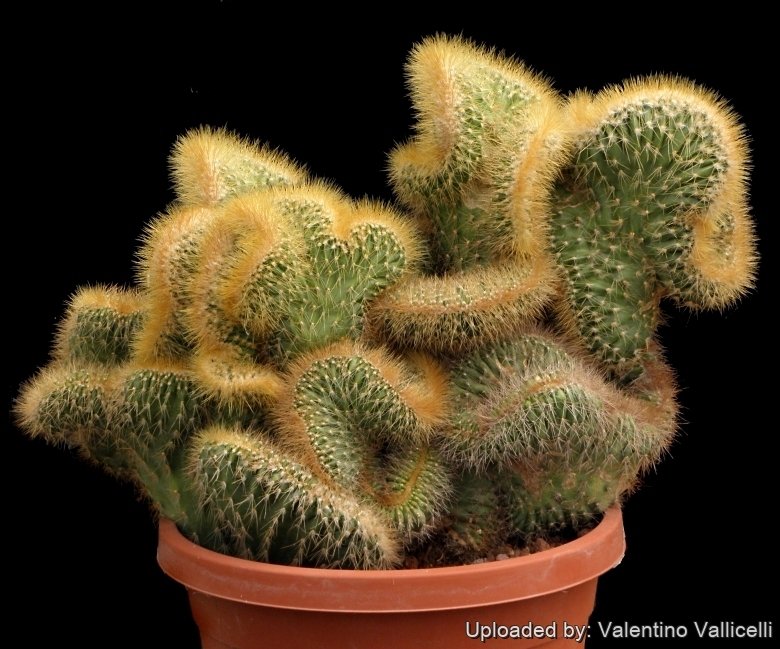
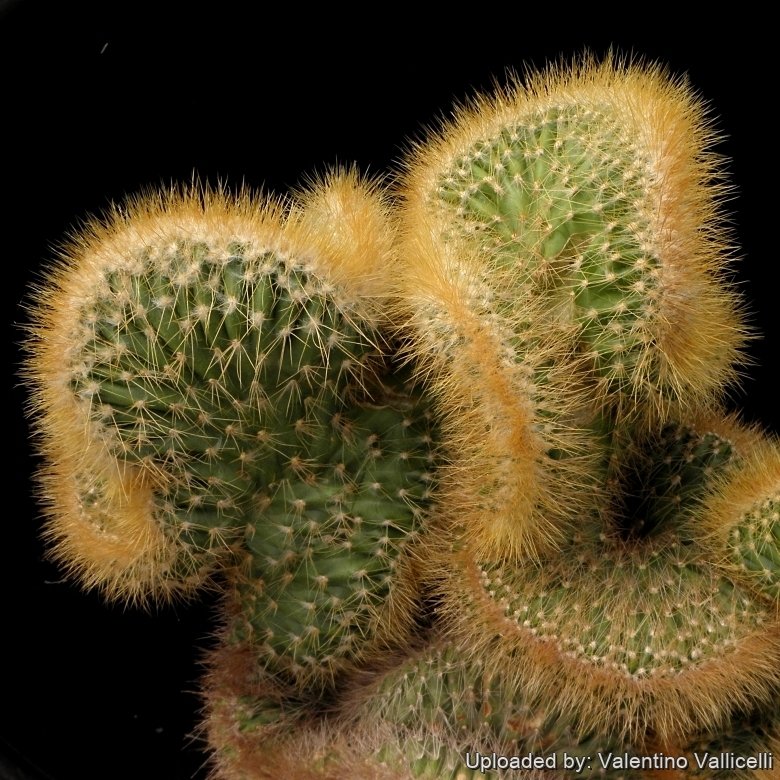
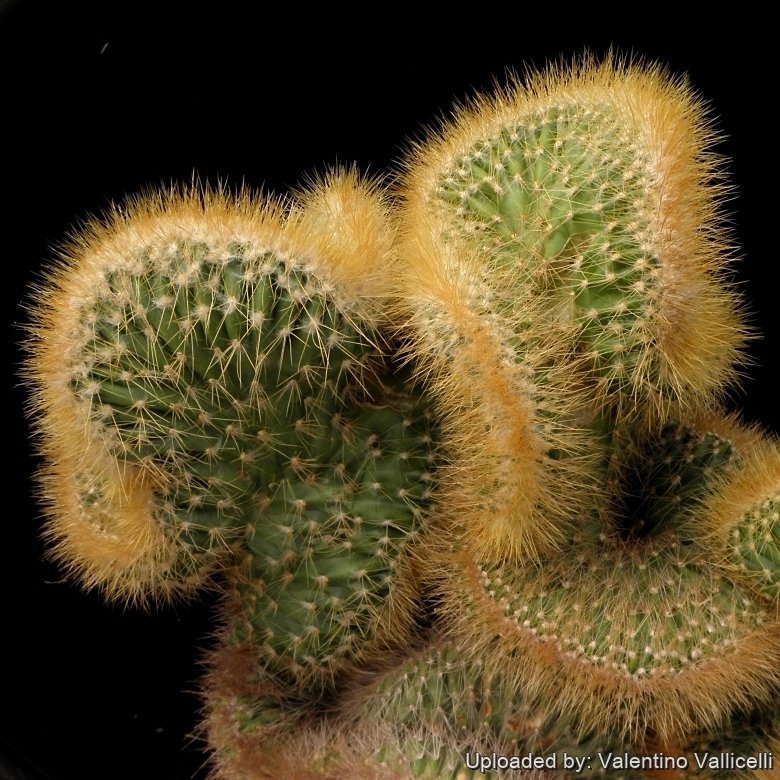
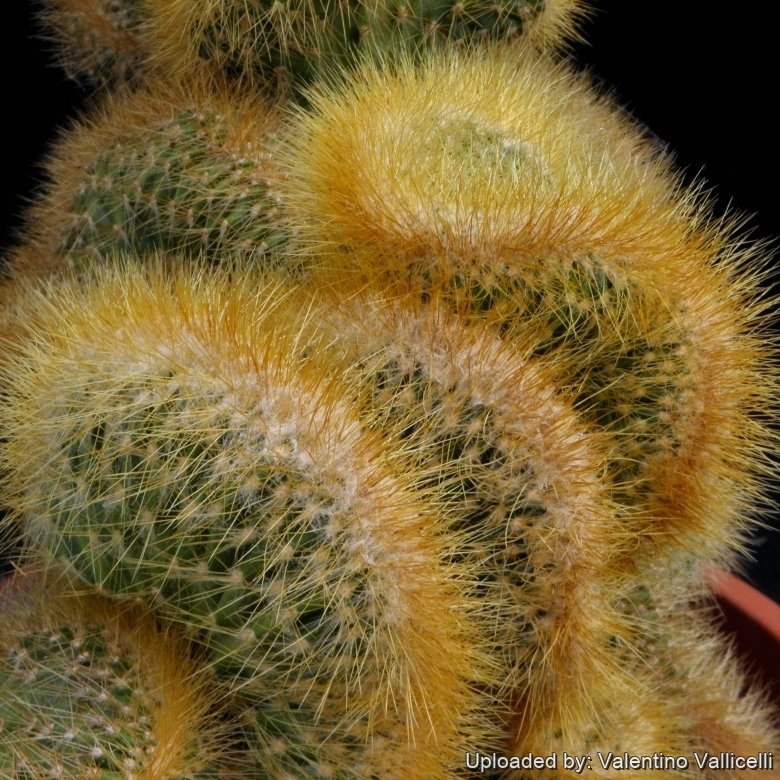
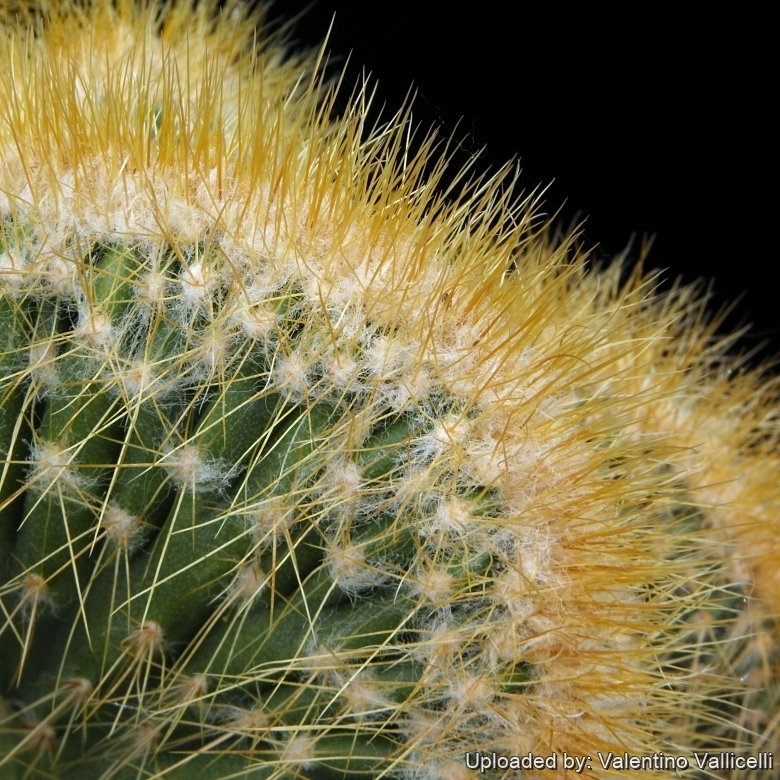
Pilosocereus nobilis is one of the local forms of the widespread Pilosocereus royenii, distinguished for the branches that are green, shining when young, not at all glaucous, 8 to 10-ribbed, but not sufficiently differentiated and considered merely a local variant of the latter (if not the same). The crested form Pilosocereus nobilis f. cristatus is nicely covered with golden yellow spines and white wool and is sought after by collectors, for its unique features. It is also very strong and can grow up to 1 m in diameter and height (or more).
Roots: The root system is broad and near the surface.
Stems: Fan shaped, about 7 cm thick, green. Older basal pats of the branches often form a thick bark.
Ribs: Rounded vertical.
Areoles: About 1 cm apart, at first producing a white little wool and this appressed against the ribs.
Spines: Up to 3,5 cm. long, acicular, at first golden-yellow or amber.
Flowers: Flower-buds obtuse or nearly truncate; flowers rose pink or purple-red fleshy 4 to 6 cm long; upper scales and outer perianth-segments broad, rounded at apex; inner perianth-segments purple; style exerted They extend horizontallv out from the branches and open at night, but last into the next day.
Blooming season: Flowers are found year-round when rainfall is adequate.
Fruits: Depressed globose, pulp white or red. Fruits are edible, juicy and sweet and contain many tiny black seeds. Fruits do not have spines. They are usually found year-round.
Origin and Habitat
Garden origin (Nursery produced cultivar). The wild species occurs in the West Indies, from St. Christopher to Grenada.
Cultivation and Propagation
Although regarded as a choice and difficult plant is not too difficult in a greenhouse, although grows quite slowly. It is sometime seen as a grafted plant but grows very well on its own roots too.
Soil: Use mineral well permeable mineral soil with little organic matter (peat, humus).
Exposure: They need a good amount of light shade to full sun this help to keep the plants healthy, although slow growth.
Watering: Water sparingly from March till October (weekly during summertime, if the weather is sunny enough) , with a little fertilizer added. Less or no water during cold winter months, or when night temperatures remain below 10° to prevent root loss. It is sensitive to overwatering (rot prone).
Fertilization: Feeding may not be necessary at all if the compost is fresh then, feed in summer only if the plant hasn’t been repotted recently. Do not feed the plants from September onwards as this can cause lush growth which can be fatal during the darker cold months.
Hardiness: Keep perfectly dry in winter at temperatures from 5 to 15 degrees centigrade. (but it is relatively cold resistant and hardy to -5° C, or possibly colder for short periods) In the rest period no high atmospheric humidity!! (Temperature Zone: USDA 9-11)
Crested growth: Unlike ‘monstrose’ varieties of plants, where the variation from normal growth is due to genetic mutation, crested growth can occur on normal plants. Sometimes it’s due to variances in light intensity, or damage, but generally the causes are unknown. A crested plant may have some areas growing normally, and a cresting plant that looks like a brain, may revert to normal growth for no apparent reason. If you have any of the crested part left you need to remove the normal growth and leave the crested part behind this will need to be done regularly.
Propagation: Grafting or cuttings. Plants are usually grafted onto column-shaped cacti but proved to be able to produce their own roots if degrafted. Cuttings will take root in a minimum temperature of 20° C (but better in hot weather). Cuttings of healthy shoots can be taken in the spring and summer. Cut the stem with a sharp, sterile knife, leave the cutting in a warm, dry place for a week or weeks (depending on how thick the cutting is) until a callus forms over the wound. Once the callus forms, the cutting may be inserted in a container filled with firmed cactus potting mix topped with a surface layer of coarse grit. They should be placed in the coarse grit only; this prevents the cut end from becoming too wet and allows the roots to penetrate the rich compost underneath. The cuttings should root in 2 to 6 weeks. Large crested piece must be placed on the soil surface without burying the plant base down in the soil.
Source: Cephalocereus nobilis f. cristatus, LLIFLE - Encyclopedia of living forms, CC-BY-SA, retrieved 2026-10-25.
Gallery