Description
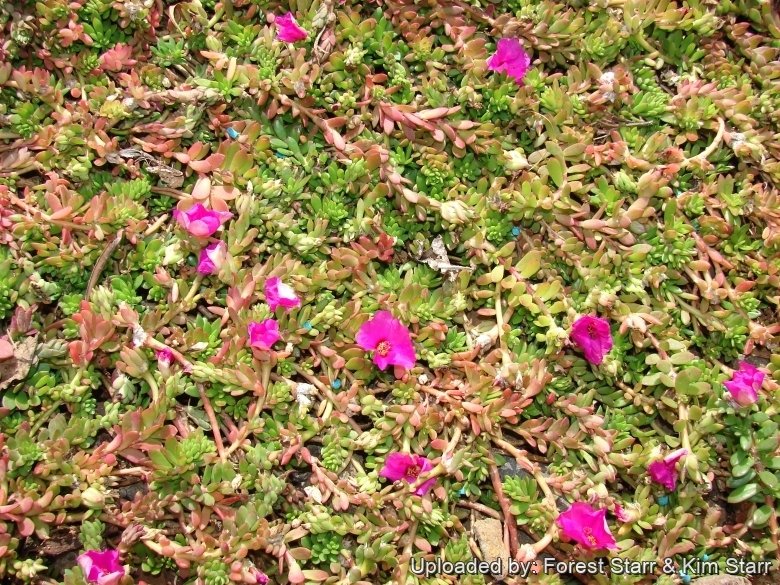
Portulaca amilis cv. Puerto Rican Hot Pink is a beautiful portulaca cultivar that appears to be derived from the Paraguayan purslane. (Portulaca amilis). It has single neon pink blooms that are just delightful. A hot pink blush surrounds the yellow centre. It is very suitable for landscapes and container gardeners. The Puerto Rico series features several different flower colours and also includes Puerto Rico Purple, which is similar to the pink except for the difference in flower colour.
Habit:* It is a prostrate or sub-erect, summer, annual herb that can reach 15-20 cm in height and spreads along the ground to form dense mats. Bright pink showy flowers are produced in terminal heads from midsummer into early autumn or all year round in tropical climates.
Roots: Fibrous.
Branches: Wiry, succulent, 5–25 cm long with dense trichomes at nodes and in inflorescence.
Leaves: Thick, flat, fleshy, arranged alternately on the stem, usually 5-30 cm long, 2-15 mm wide, Cylindrical, or slightly spatulate or oblong, slightly pointed at the tip. Abundant brownish to white hairs are present in leaf axils.
Inflorescences: Terminal, congested and surrounded by 6-8(-9) involucre-like leaves.
Flowers: Bright pink, five petaled, 20-30 mm in diameter and showy. Sepals broadly triangular-ovate, 7–10 mm long, 4–8 mm wide. Petals pink obovate, to 15 mm long. Stamens 15-45. Stigmas 7-10 mm.
Fruits: Ovoid, 2-5.5 mm in diameter, glossy yellowish, dehiscent at apex or slightly below.
Seeds: Glossy black, round, flattened, 0.4 - 0.6 mm.
Origin and Habitat
Garden origin, the natural species comes from South America.
Cultivation and Propagation
Portulaca amilis is a weed occasionally grown in temperate climates as an ornamental plant for annual bedding or as a container plant. It requires ample sunlight and well-drained soils. It requires almost no attention and spreads itself very easily. Although it survives difficult conditions, plants will produce more lush growth and flowers when provided sufficient moisture and rich soils. In places with old architecture it can grow between the stones of the road or sidewalk.
Soils: it grows well in poor, sandy or gravelly soils. The soil must be very well-drained.
Exposure: Needs full sun to flower.
Waterings: Drought tolerant, but flowers best with regular watering. Don’t water with overhead irrigation, which can damage the flowers.
Hardiness: Plant seeds or set out plants after all danger of frost has passed.
Pests and diseases: No serious insect or disease problems. Watch for aphids. Stem or root rots can be a problem in wet soils.
Garden Uses: Good for poor dry soils where many other plants struggle. Edging or ground cover for beds, rock gardens or along walks. Containers, hanging baskets. Sprawl over stone walls.
Propagation: Sow seed directly in the garden after last frost date, or start indoors 6-8 weeks earlier. Set out seedlings and purchased plants at last frost date. Plants may self-seed. Seeds are as tiny , so mix them with sand before sowing to make them easier to scatter. Seeds germination period, requires one to two weeks. In warm climates, it may self-seed. Established plants can also be propagated by cuttings.
Bibliography
Major references and further lectures
-
Urs Eggli “Illustrated Handbook of Succulent Plants: Dicotyledons” Springer Science & Business Media, 2002
-
L. B. McCarty “Color Atlas of Turfgrass Weeds” John Wiley & Sons, 15/Jan/2001
-
Walter S. Judd, Richard P. Wunderlin “First report of Portulaca amilis (Portulacaceae) in the United States.” SIDA, Contributions to Botany Vol. 9, No. 2, NOVEMBER 1981
-
Flora of North America “1 Portulaca amilis Spegazzini, Anales Soc. Ci. Argent. 92: 104, plate 6. 1921.” FNA Vol. 4 Page 496, 497, 498 <http://www.efloras.org\> Web. 23 Oct. 2014.
Gallery