Publication: Sp. Pl. 445 1753
Description
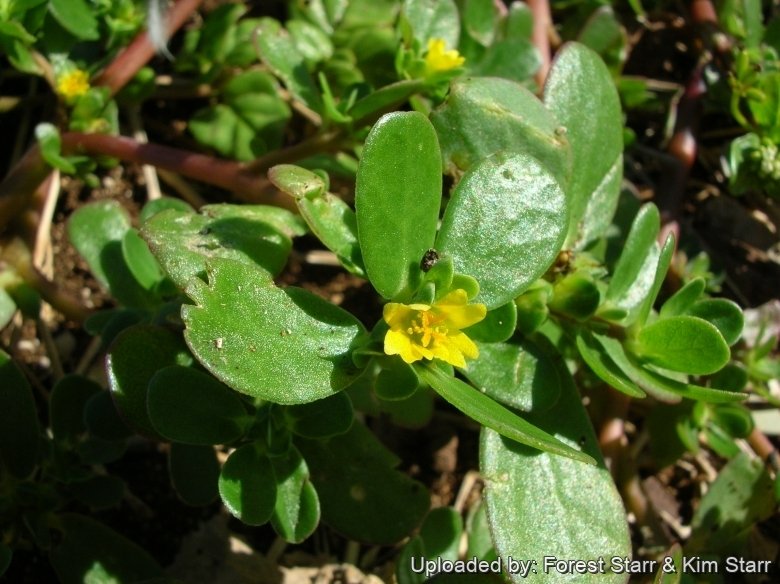
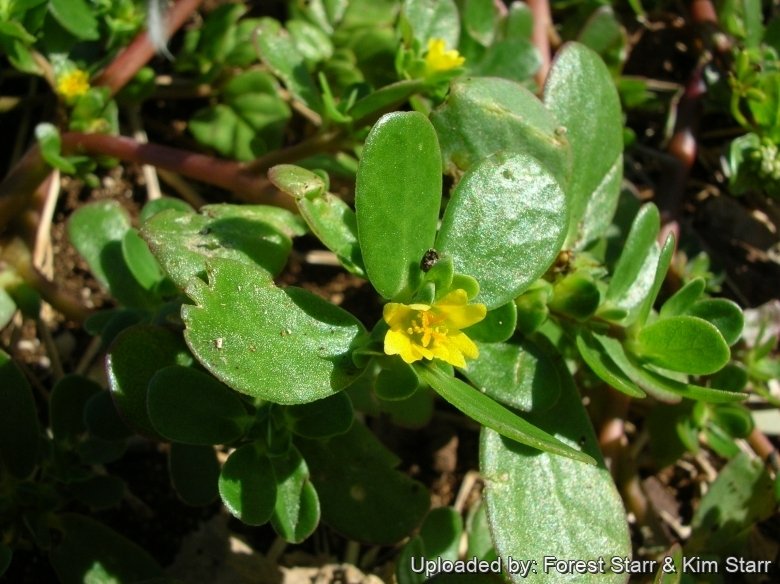
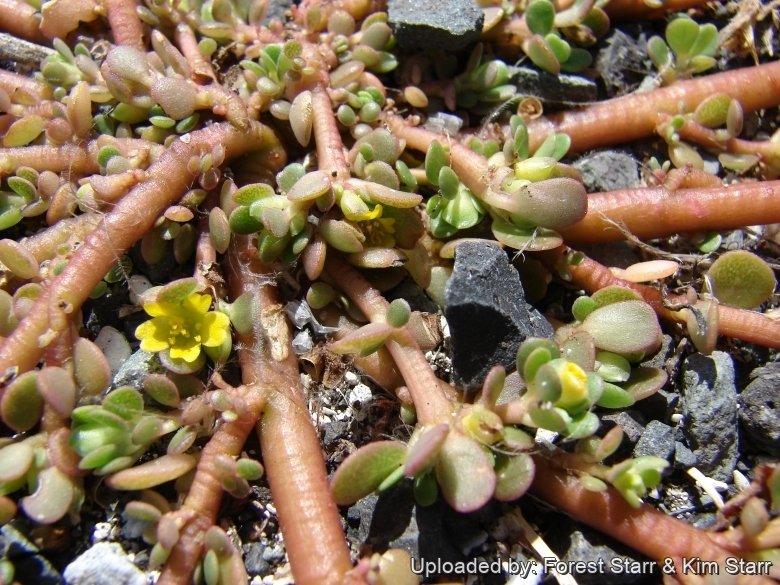
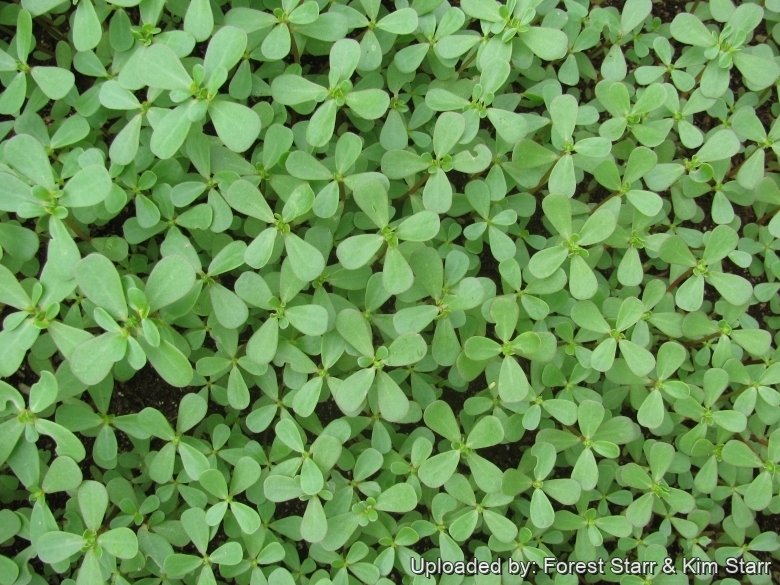
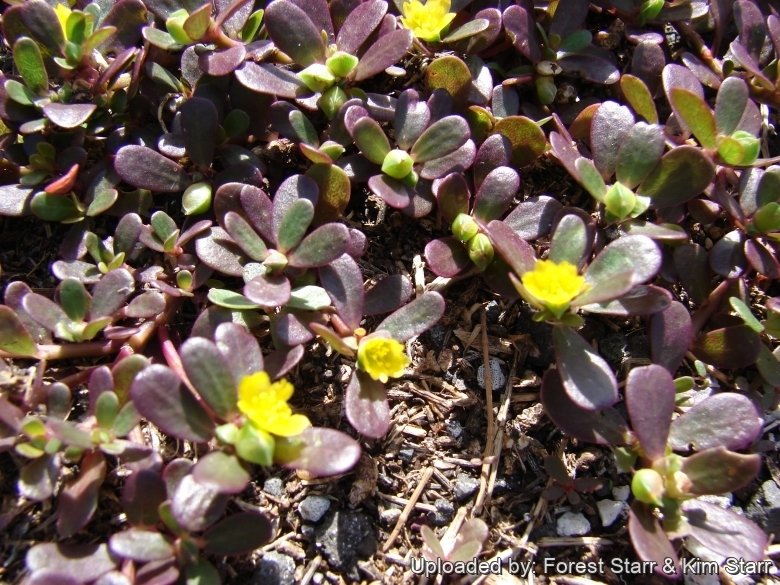
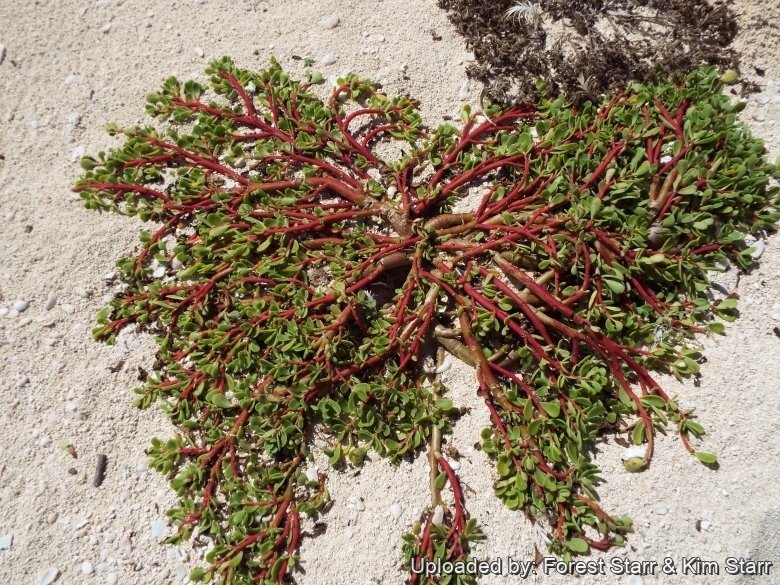
Portulaca oleracea is a annual glabrous rather fleshy succulent herb forming a spreading mat, or infrequently ascending. The bright yellow flowers have five regular parts and usually are less than 8 mm wide wide. Portulaca oleracea is a highly variable species.
Stem: Branches spreading or prostrate, smooth, up to 30(-55) cm long and up to 5 mm in diameter often reddish, trichomes at nodes and in inflorescence absent or inconspicuous, old stems glabrescent.
Root: Taproot 2-10 cm long.
Leaves: Alternate to subopposite on the branchlets, and often somewhat crowded towards the ends of the branches, green or flushed red, sessile or shortly stalked, (4-)5-28(-309 mm long (2-)3-12(13) mm wide, narrowly obovate to spathulate, flattened, apex rounded or truncate, base more or less attenuate into obscure petiole 1–3 mm long, stipular hairs very few, inconspicuous, caducous, about 0.6–1 mm long, often soon lost.
Flowers: Bright yellow, 6-10 mm wide, terminal, sessile, solitary or up to 5, surrounded by a cluster of 1-4 subverticillate leaf-like bracts and an inner whorl of triangular membranous scales, ca. 3 mm long, ovate-acuminate. The flower cluster often apparently lateral or in fork of branch because of overtopping by later growth. Sepals (2–)3–4.5(–5.5) mm long, united below into a tube 2 mm long, free portions fleshy, oblong-ovate, keeled or winged along the midline upwards. Petals dull yellow (very rarely pale pink), (3-)4–8 mm. long, united at the base, obovate-oblong to obovate, tip rounded, sometimes emarginate or bilobed. Stamens 7–12. Ovary ovoid; style short, with 3–6 subulate lobes.
Blooming season: Depending upon rainfall, the flowers appear at anytime during the year. The flowers open singly at the center of the leaf cluster for only a few hours on sunny mornings.
Fruit (capsules): Obovoid to ovoid, enveloped in the marcescent corolla, splitting near or just below middle; lid hemispherical/conical, chartaceous, constricted 2/3 up, usually with narrow, more strongly veined extension at tip which retains a few seeds within it.
Seeds: Many, c. 0.5-1 mm long, glossy dull black with no metallic sheen, reniform. Testa cells stellate with a conspicuous central tubercle, papillae few or absent; seed periphery tuberculate.
Chromosome number: 2n =54
Origin and Habitat
Portulaca oleracea maybe of ancient Asian origin is a cosmopolitan weed of temperate and tropical regions widespread in Africa, Europe and Asia through the Middle East and the Indian Subcontinent to Malesia and Australasia, it is also present but less common in North America. The species status in the New World is uncertain: in general, it is considered an exotic weed, however, there is evidence that the species was in Crawford Lake deposits (Ontario) in 1430-89 AD, suggesting that it reached North America in the pre-Columbian era. It has long been in cultivation in some European countries as a vegetable and now it is naturalised elsewhere and in some regions is considered an invasive weed.
Altitude range: 0–2500 metres above sea level.
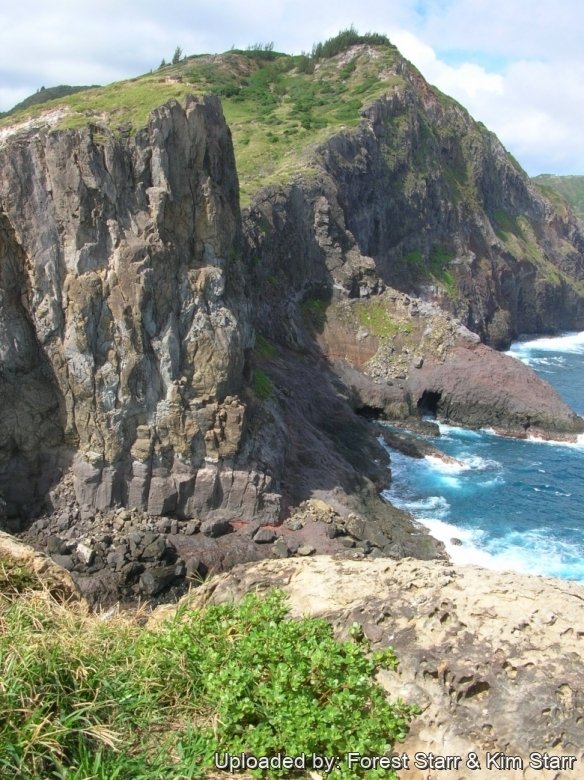
Habitat and ecology: Portulaca oleracea is a common annual weed of cultivated fields, gardens, railway tracks, and roadsides. It is very widespread in sandy waste places in warm climates.
Cultivation and Propagation
Portulaca oleracea is an aggressive weed that spreads in garden and fields with worldwide distribution in temperate to warm regions and one of the ten most noxious weeds worldwide. It is also the most winter-hardy of all the portulacas. It can spread and even travel as vegetative fragments which are tolerant of salt water and root easily everywhere on landing. It is occasionally grown as a food, Simopoulos et al. (1992) have shown Portulaca oleracea to have the highest content of omega-3 fatty acids and antioxidants of any green leafy vegetable examined to date, suggesting that common purslane should be considered for its nutritional value and not for its weediness, but not been widely cultivated . It requires sunlight and well-drained soils but is an extremely adaptable plant. Although it survives difficult conditions, plants will produce more lush growth when provided sufficient moisture and rich soils.
Soils: It grows well almost in every kind of soil comprising poor, sandy or gravelly soils
Exposure: Needs full sun to half-shade.
Waterings: Drought tolerant, but grows best with regular watering. Once plant is well established, allow them to dry out between waterings. This plant naturally grows in harsh, dry conditions and does not like wet feet, that is constant moisture in the root area.
Hardiness: Plant seeds or set out moss rose plants after all danger of frost has passed.
Pests and diseases: It is prone to attacks by slugs, ants, mealy bugs, scale, thrips, spider mites, aphids, and root mealy bugs. . These succulent plants need a well drained soil.
Edible Uses: The edible shoots are gathered from the wild for local consumption.
Young shoots are rich in vitamin and cooked and eaten as a potherb. It can also used rough in mixed salads.
medicine uses: It is uses for cutaneous, subcutaneous parasitic infection; dropsy, swellings, oedema, gout; kidneys, diuretics; pregnancy, antiaborifacients; pulmonary troubles; skin, mucosae; stomach troubles; venereal diseases.
*Propagation: *By Seeds or cuttings. To clean the seeds, air dry them at room temperature in a bowl or paper bag. Carefully rub the capsules through a strainer with the appropriate size mesh. Sow the seeds on the surface of a pre-moistened well draining mix. Germination takes about 2 to 3 weeks. In warm climates, Portulaca oleracea self-seeds, stablished plants can also be propagated by tip cuttings. Cuttings should be 5 to 12 cm long and the lower leaves should be removed. Sterile potting mix can be used as a rooting medium. The cuttings should be watered daily. They will root in a couple of weeks.
Bibliography
Major references and further lectures
-
Forest & Kim Starr “Portulaca oleracea (Pigweed)”. Plants of Hawaii. <http://www.starrenvironmental.com\>. 23 Oct. 2014.
-
Tetyana Vekslyarska “Ploidie- und Samengrößenvariation im Portulaca oleracea-Aggregat” Diplomarbeit Universität Wien, 2011 on line <http://othes.univie.ac.at/17067/1/2011-11-22\_0509094.pdf\>
-
GREUTER, W., M. BURDET & G.LONG (1989). “MED-CHECKLIST.” [vol. 4] Conservatoire & Jardin botaniques de la Ville de Genève. [p.369]
-
CASTROVIEJO S. & al. (ed.) (1990). “Flora Iberica.” vol. 2. Real Jardín Botaníco, C.S.I.C. Servicio de Publicaciones. Madrid. [p.468]
-
Fl. Eur., ed. 2 1: 138 (1993).
-
BOULOS, L. (1999). “FLORA OF EGYPT.” [vol. 1] Al Harara Publishing. Cairo. [p.50]
-
FENNANE, M., M. IBN TATTOU, J. MATHEZ, A. OUYAHYA & J. EL OUALIDI (éd.) (1999). “Flore pratique du Maroc.” vol. [1] Trav. Inst. Sci., Série Bot. 36. Rabat. [p.175]
-
H. Wild “Flora Zambesiaca” FZ, Vol 1 Part 2, page 362 1961
-
M. G. Gilbert “Flora Somalia”, Vol 1 1993 [updated by M. Thulin 2008]
-
SYLVIA M. PHILLIPS “Flora of Tropical East Africa” 2002
-
Burkill, H.M. “The useful plants of west tropical Africa,” Vol 4 1985.
-
Flora of North America Editorial Committee. “Flora of North America, volume 4” Oxford University Press, New York. 2003.
-
DANIN, A., I. BAKER & H. G. BAKER (1979). “Cytogeography and Taxonomy of the Portulaca oleracea polyploid complex.” Israel J. Bot. 27: [177-211]
-
Wikipedia contributors. “Portulaca oleracea.” Wikipedia, The Free Encyclopedia. Wikipedia, The Free Encyclopedia, 20 Oct. 2014. Web. 8 Nov. 2014.
From llifle page Portulaca fosbergii
Description
It is a single stemmed aloe about 2-3 m or taller with the leaves arranged in an apical rosette. Aloe ferox is easily confused with Aloe marlorii. bur the flowers of the later are produced on horizontal branches. This species will also hybridise with any other aloe flowering at the same time and many “Aloe ferox” in cultivation are hybrid.
Stem: Simple or ralelybranched above the base, occasionally reaching a length of 5 m and a diameter of 10-15 cm.
Rosette: with 30–60 leaves, densely aggregated at stems tip. The old leaves remain after they have dried, forming a persistent “petticoat” on the stem which give it a ragged untidy appearance if not removed.
Leaves: 50-60 per rosette, lanceolate, very rigid in texture, shallowly channelled,, pungent at the apex, arcuate-erect to spreading with the leaf tips curving slightly downwards, dull green or grey green, sometimes with a slightly blue look to them and often with a reddish-brown tinge under stress condition. Each leaf can be 50-100 cm long, x 65-150 mm wide. Leaves are furnished with copious dark brown deltoid-cuspidate prickles 3-6 mm long along the margins and often scattered on the leaf surfaces, especially on the lower surface. Young plants tend to be very spiny.
Inflorescences: The inflorescence is a tall candelabra-like branched panicle, with 5-12 erect cylindrical or narrowly conical dense racemes, each carrying a large spike-like head of many flowers up to 1 m tall..
Flowers: Showy, tubular, subclavate or ventricose and about 3 cm long, yellow-orange to bright red with inner petals tipped with white. The stamens, protruding from the mouth, are dark orange. There are also pure white or pure yellow forms, bracts ovate-acute, 7-11 x 3-6 mm, 3-many-nerved.; outer segments connate in lower third, inner segments free but dorsally adnate to outer in lower third; pedicels 3-8 mm long. Stamens and style bright red, anthers exserted 9-25 mm. Aloe ferox are pollinated by birds but honey bees also play a role in the pollination. Blooms are self-sterile and only a few ?owers per raceme mature simultaneously. The stamens produce pollen in the morning and wither in the afternoon, whereas the style is exerted on the second day of anthesis.
Blooming season: Winter, but in colder country this may be delayed until spring.
Fruit: 20-23 x 10-12 mm, yellowish grey-brown, many seeded.
Seeds: Almost black, about 5.0 x 3.0 x 0.6 mm, broadly winged.
Chromosome number: 2n = 14
Cultivation and Propagation
It is not a demanding species and usually does not give many problems in cultivation. It can be grown in a cool-warm glasshouse and put outside for the summer. In warm climates it is also an excellent garden specimen plant and is adaptable to many conditions. It needs full sun to filtered sun. It should be soaked and allowed to dry out between waterings in summer. It should be given very light watering in winter too, still allowing the compost to dry out in between. Watorlogging should be always avoided. It grows much better outdoors in spring and summer, it is also perfect for the bright windowsill. Grow it in light, fertile, well-drained soils, with a slightly acidic pH (5-6). Avoid any frost.
Maintenance: Removal of old flower stalks. During the winter months, the plants should be grown cool to initiate flower development (about 5-10°C )
Propagation: Aloe ferox does not produce suckers but can be propagated by seed and planting of the tops of old plants. Sow seed in a well drained medium in shallow trays and cover lightly with sand or the seed will blow away. Once the seeds begin to germinate, keep moist but watch out for overwatering as the seedlings could rot. Transplant into small pots once they are about 3-4cm high (approximately 6 months). Plant regeneration (micropropagation) from root and embryo tissue is successful as well.
Source: Portulaca fosbergii, LLIFLE - Encyclopedia of living forms, CC-BY-SA, retrieved 2026-10-26.
Cultivars and forms (11)
Subspecies (9)
- Portulaca oleracea subs. canariensis
- Portulaca oleracea subs. cypria
- Portulaca oleracea subs. nicaraguensis
- Portulaca oleracea subs. oleracea
- Portulaca oleracea subs. rausii
- Portulaca oleracea subs. sicula
- Portulaca oleracea subs. trituberculata
- Portulaca oleracea subs. tuberculata
- Portulaca oleracea subs. zaffranii
Gallery