Publication: Repert. Spec. Nov. Regni Veg. 33: 164 1933.
Description
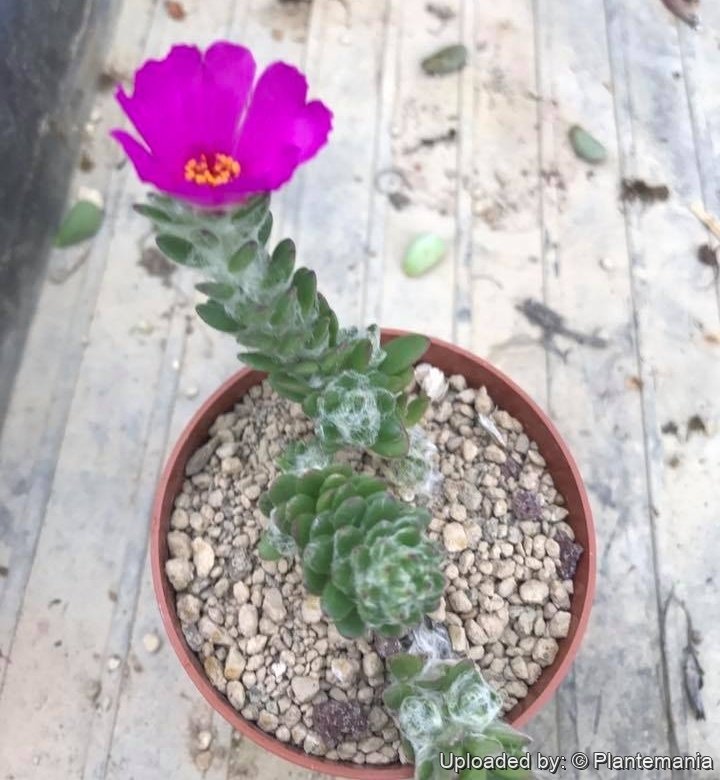
Portulaca werdermannii is a prostrate succulent species with oblong cylindrical leaves, set alternate, having many hairs in the leaf axils. The flowers are terminal, purplish-red. The usually mucronate leaf tips helps distinguish this species from other Brazilian species.
Derivation of specific name: The specific name “werdermannii” honours Prof. Dr. Erich Werdermann (1892-1959), a German botanist in Berlin, specialist on cacti and former director of the Botanischer Garten and Museum Berlin.
Roots: The roots are tuberous, the main axis is elongated and very thickened, from which originate secondary thinner roots. In P. werdermannii the main root measures 5-10 cm in length.
Stems: 15-20 cm long, green, branched. The stem nodes besides the leaves produce abundant axillary white trichomes (woolly hairs) 15-20 mm long.
Stem leaves: Sessile to sub-sessile, petiole 0.5-0.6 mm long, cylindrical. Blade 10-20 mm long, 2-5 mm wide, oblong-lanceolate, subcilindrical. The adaxial side of the leaf blade is generally convex, while the abaxial face have a small central depression visible only under the microscope and occur from the base to the apex of the leaf blade. Base rounded. Apex mucronate.
Involucral leaves: 5-10 per inflorescence. Blade 10-18 mm long, 2-4 mm wide, oblong, with a whitish cartilaginous margin, glabrous. Base rounded. Apex mucronate. Persistent.
Inflorescences: Terminal, 2-4 flowered.
Flowers: The flowers are actinomorphic, sessile, bisexual and large up to 20-30(-40) mm. They are ephemeral, usually with a single flower at a time. Sepals 8 -10 mm long, glabrous, backside concave, tip acuminate. Petals 5, inversely heart shaped, magenta, 1.5-2 cm long, 1-2 cm wide. The androecium has numerous stamens (20-35). Filaments 6-9 mm long; Anthers 1.5-2 mm long. Styles 2-4 mm long, attached at the base, forming a column; stigmatic branches 5-7, 1.5-2 mm long. In Brazil the flowers of this genus open between 10-12 AM and remain open until 2-4 PM, hence the popular name of “onze horas” (eleven hours).
Fruit: The fruit called pixidium is a sessile, pod 3-5 mm long which divides circularly into an upper and lower half, of which the former acts as a kind of hemispherical lid (aka operculum) 1-2 mm in diameter.
Seeds: 15-20 per fruit, small (0.5-0.7 mm), black, opaque.
Origin and Habitat
Chapada Diamantina, Bahia, Brazil.
Bibliography
Major references and further lectures
-
Alexa Araujo de Oliveira Paes Coelho; Ana Maria Giulietti “O gênero Portulaca L. (Portulacaceae) no Brasil - The genus Portulaca L. (Portulacaceae) in Brazil” Acta Botanica Brasilica Acta Bot. Bras. vol.24 no.3 São Paulo July/Sept. 2010 http://dx.doi.org/10.1590/S0102-33062010000300009
-
Clive Innes “Complete Handbook of Cacti and Succulents” Van Nostrand Reinhold Company, 01 December 1981
-
Urs Eggli, Leonard E. Newton “Etymological Dictionary of Succulent Plant Names” Springer Science & Business Media, 29 June 2013
Gallery