Publication: Cactaceae Consensus Init. 3: 10. 1997
Description
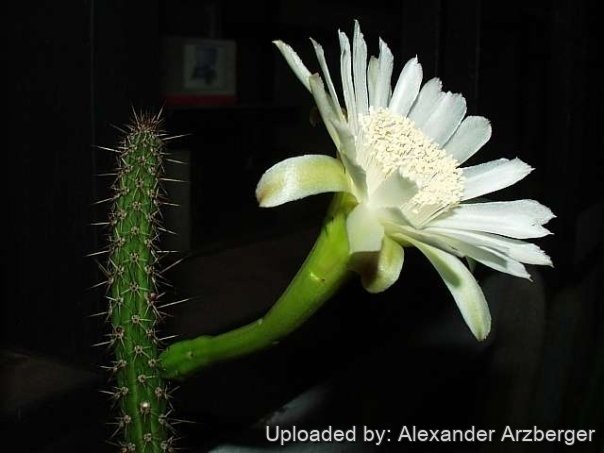
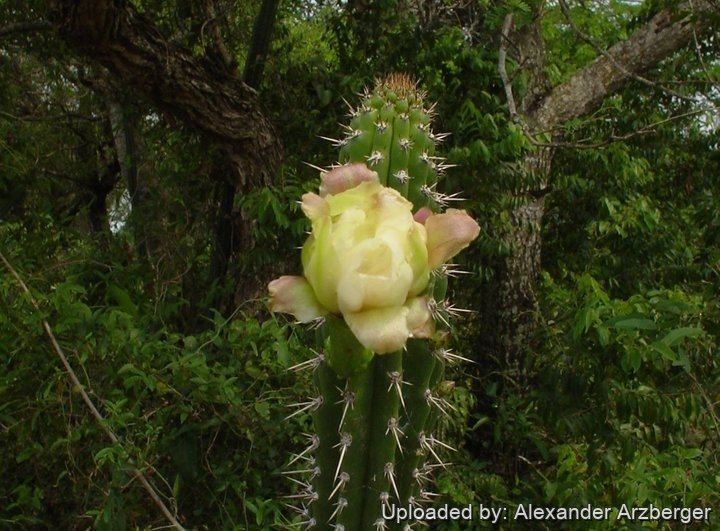
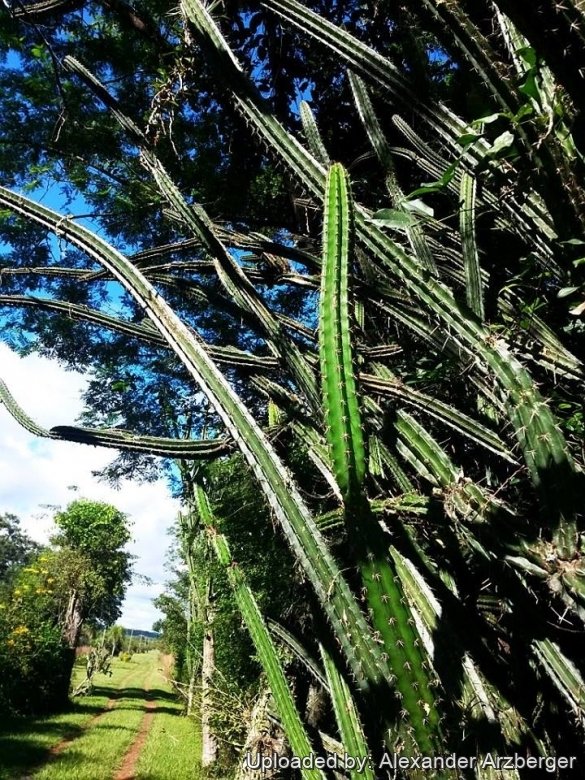
Praecereus euchlorus (Monvillea euchlora) is a shrubby, little branched, thicket-forming or clambering cactus, with rather slender, weakly erect at first, later arching or decumbent, ribbed stems. The flowers are nocturnal, funnel-shaped, white to greenish white up to 8 cm long. The fruit is oblong, fleshy, red; seeds black, obliquely obovate in outline. Praecereus euchlorus is a very variable species. Five subspecies are recognized, the nominate form, subsp. diffusus (Britton & Rose) N.P.Taylor, subsp. jaenensis (Rauh & Backeb.) Ostolaza, subsp. amazonicus (K Schum. ex Vaupel) N.P.Taylor and subsp. smithianus (Britton & Rose) N.P.Taylor.
Stems: Slender 4-8 cm in diameter, green.
Ribs: (4-)8-11(-14), low, acute.
Areoles: c. 2 cm apart, white.
Spines: As many as 20, weak, whitish, needle-like, the centrals to 3-4 cm long, black at first, the radials to 10 mm long.
Flowers: Not borne terminally, white to greenish white, 6-8 cm long, c. 4 cm across, pericarpels and floral tubes with minute scales but without hairs, bristles, or spines. Inner perianth-segments short, rounded and mucronate, white.
the production of male and female reproductive elements at different times by a hermaphroditic organism in order to ensure cross-fertilization. Various attributes observed in the floral biology of Praecereus euchlorus suggest the unusual occurrence of dichogamy in its flowers, that is to say the production of male and female reproductive elements occurs at different times in order to ensure cross-fertilization.
Fruits: Ovoid to oblong, 4-5 x 3-4 cm, red, minutely scaly, splitting on one side when mature to reveal white pulp, the withered perianth or at least the style persistent.
Origin and Habitat
This species has been reported from Argentina, Bolivia, Brazil, Colombia, Ecuador, Paraguay, Peru, and Venezuela. (subsp. euchlorus occurs in Brazil, Bolivia, Argentina, and Paraguay.)
Altitude range. In Ecuador and Peru it grows from sea level to 2,000 m. In Venezuela it grows at elevations up to 1,500 m.
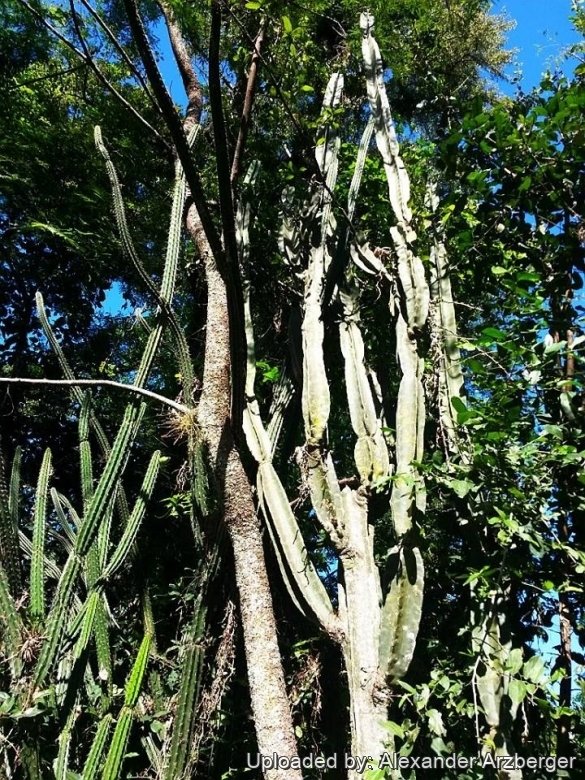
Habitat and Ecology: The species grows in slopes on rocky outcrops, in Atlantic forest and on shallow soil in tropical, seasonally dry forest. It also grows on the borders of humid forests. Praecereus euchlorus is widely distributed and locally abundant, occurs in many protected areas, and there are no major threats affecting it. The major threat to this cactus is deforestation for agriculture and cattle ranching.
Cultivation and Propagation
Praecereus euchlorus is occasionally grown as an ornamental because of its beautiful nocturnal flowers. It is a fast growing plant that form thickets, the spiny stems often high-clambering or drooping, depending on where they grow. If you can keep it warm over the winter, then Praecereus euchlorus with its lovely flowers appearing during the night, is not as difficult as it is made out to be. It rarely planted outdoors in tropical countries, where climbs trees in a semi-naturalized state. In nature it climbs into trees. Older plants in the greenhouse buds freely.
Soil: It needs a compost containing plenty of humus and sufficient moisture in summer (though quite adaptable) it can be also cultivated on split bark like Monstera or in orchid substrate.
Moisture: The plant is quite resistant to drought condition, but shouldn’t dry out totally otherwise it will turn purplish brown and look unpleasant and should be permitted to dry out entirely between watering
Fertilization: Too much fertilizer will cause a lot of lush growth at the expense of flowers.
Hardiness: Should not be kept under 5º C in winter.
Exposition: It perform best if grown in semi–shade but tolerate full sun. Extra light in the early spring will stimulate budding.
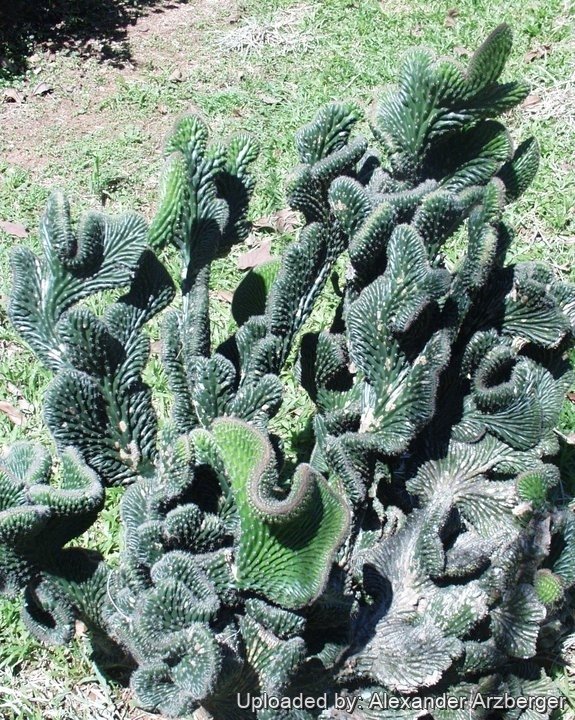
Crested growth: Unlike ‘monstrose’ varieties of plants, where the variation from normal growth is due to genetic mutation, crested growth can occur on normal plants. Sometimes it’s due to variances in light intensity, or damage, but generally the causes are unknown. A crested plant may have some areas growing normally, and a cresting plant that looks like a brain, may revert to normal growth for no apparent reason. If you have any of the crested part left you need to remove the normal growth and leave the crested part behind this will need to be done regularly.
Propagation: Grafting or cuttings. Plants are usually grafted onto column-shaped cacti but proved to be able to produce their own roots if degrafted. Cuttings will take root in a minimum temperature of 20° C (but better in hot weather). Cuttings of healthy shoots can be taken in the spring and summer. Cut the stem with a sharp, sterile knife, leave the cutting in a warm, dry place for a week or weeks (depending on how thick the cutting is) until a callus forms over the wound. Once the callus forms, the cutting may be inserted in a container filled with firmed cactus potting mix topped with a surface layer of coarse grit. They should be placed in the coarse grit only; this prevents the cut end from becoming too wet and allows the roots to penetrate the rich compost underneath. The cuttings should root in 2 to 6 weeks. Large crested piece must be placed on the soil surface without burying the plant base down in the soil.
Bibliography
Major rences and further lectures
-
Hunt, D., Taylor, N. and Charles, G. “The New Cactus Lexicon.” dh Books, Milborne Port, UK. 2006
-
Machado, M., Taylor, N.P., Braun, P., Oakley, L., Kiesling, R., Pin, A., Loaiza, C. & Ostalaza, C. 2013. Praecereus euchlorus. The IUCN Red List of Threatened Species 2013: e.T151800A562870. http://dx.doi.org/10.2305/IUCN.UK.2013-1.RLTS.T151800A562870.en. Downloaded on 04 July 2016.
-
Britton & Rose, “The Cactaceae” 2: f. 43, 46, 47 (1920) — as Cephalocereus smithianus.
-
Backeberg, “Die Cactaceae 4” 1960
-
James Cullen, Sabina G. Knees, H. Suzanne Cubey “The European Garden Flora Flowering Plants: A Manual for the Identification of Plants Cultivated in Europe, Both Out-of-Doors and Under Glass” Cambridge University Press, 11 August 2011
-
J. Hugo Cola-Sanchez & D. Shannon Croutch “Notizen zur Blütenbiologie von Praecereus euchlorus subsp. euchlorus (Cactaceae) - Notes on the floral biology of Praecereus euchlorus subsp. euchlorus (Cactaceae)” in Shumannia 5, pp. 99-103, 2008
From llifle page Monvillea euchlora f. cristata
Description
The typical Praecereus euchlorus (Monvillea euchlora) is a shrubby columnar cactus that grows often in thicket or clambering among other vegetatin, with rather slender ribbed stems, weakly erect at first, later arching or decumbent. The flowers are nocturnal, funnel-shaped, white to greenish white up to 8 cm long.
Crested form: The crested forms are cultivated for their beautiful fan-shaped stem. These plants produce monstrous crests, and crests occasionally produce normal shoots. Crested specimens are often grafted on stronger species, called the stock, that can be any number of different columnar cactus. The odd crested forms are extremely rare and may appear both on seedling batches in a very small percentage and in habitat too.
Origin and Habitat
This species has been reported from Brazil, Bolivia, Argentina, and Paraguay.
Source: Monvillea euchlora f. cristata, LLIFLE - Encyclopedia of living forms, CC-BY-SA, retrieved 2026-10-25.
Cultivars and forms (2)
Subspecies (1)
Forms (1)
Gallery