Publication: Kakteen (Berger) 46 46 1929 [Et : Borg in Cacti 53 1937.)
Description
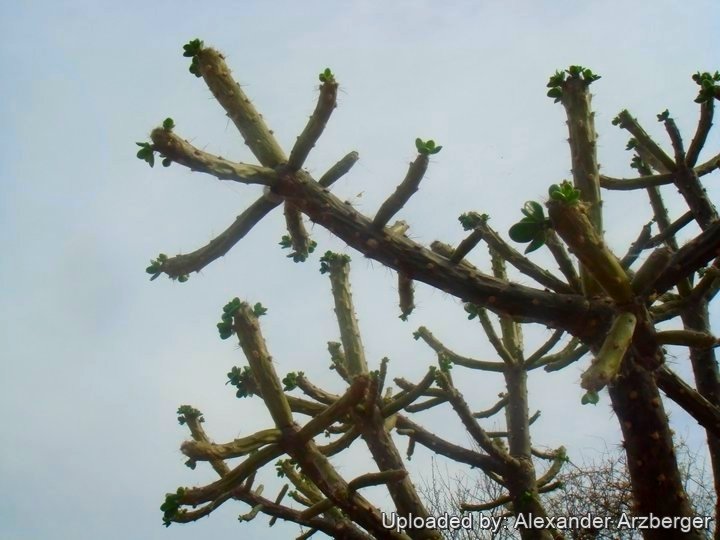
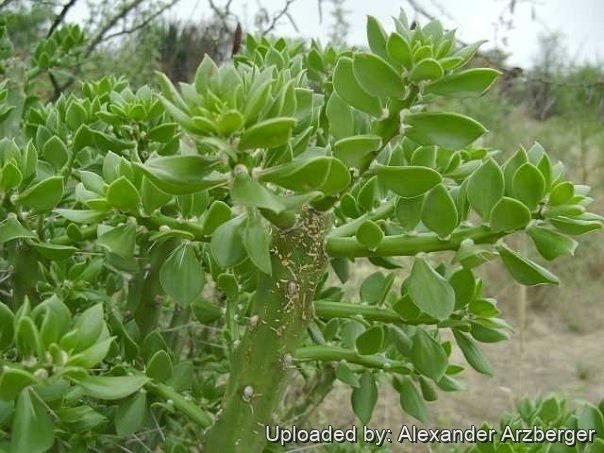
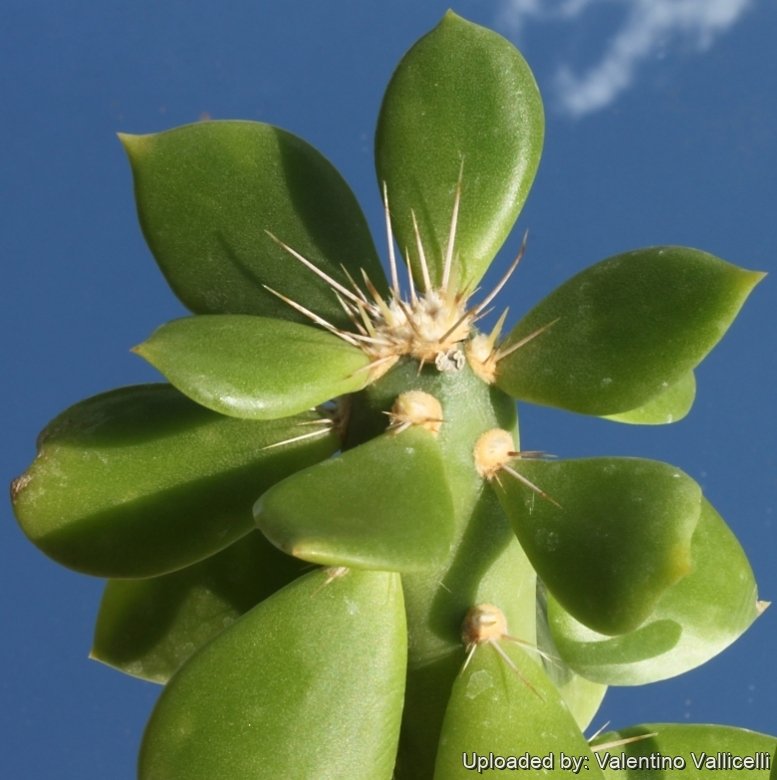
Quiabentia verticillata is a treelike or shrubby plant 2 to 15 metres high with a distinct trunk.
Derivation of specific name: ‘verticillata’ from Lat., verticillate; for the branching pattern.
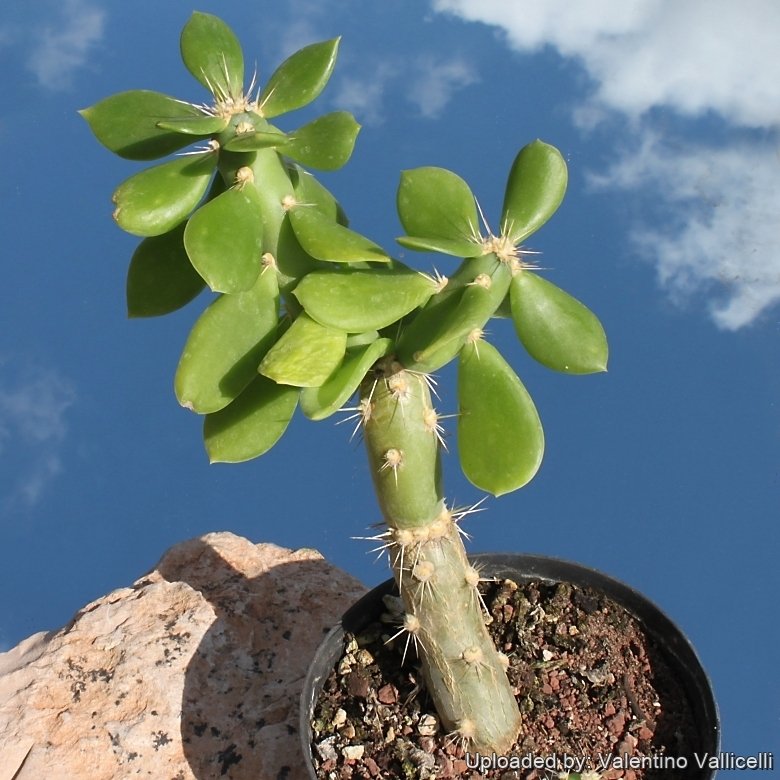
Stems: 1-3 cm thick branching off from the ends (verticillate).
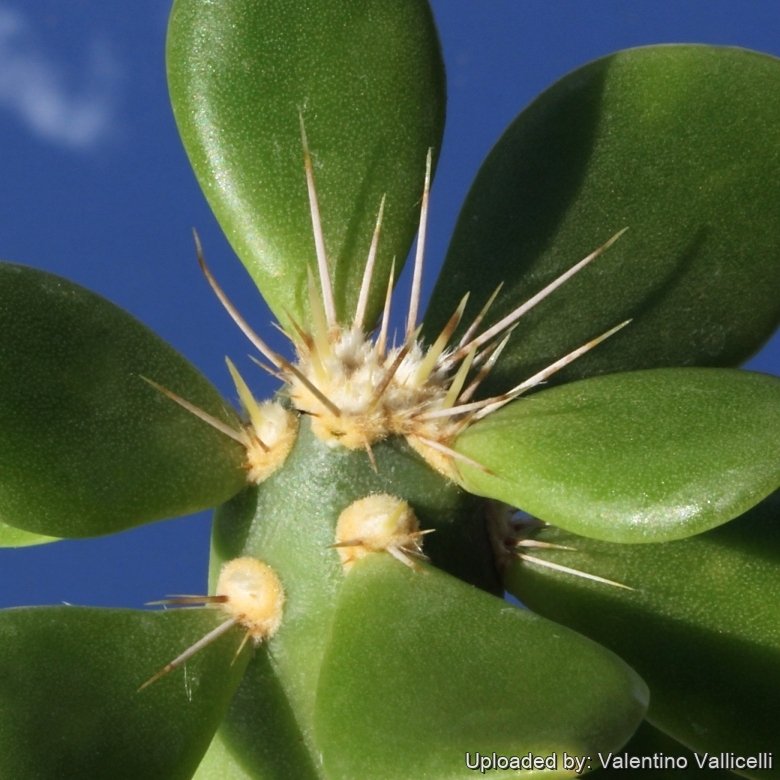
Areoles: Conspicuous with white felt and wool, somewhat persisting.
Leaves: Oval to lance shaped, almost sessile, nearly cylindrical at base, 4-5 cm long, to 2 cm broad, very succulent and almost terete.
Spines: Several, acicular, white, downward pointing, of very variable length, the three longer to 7 cm long.
Flowers: Pale red, 1.5 cm long.
Chromosome number: 2n=22
Origin and Habitat
Bolivia (Cochabamba, Chuquisaca, Formosa, Santa Cruz and Tarija), northwestern Paraguay, and northwestern Argentina (Chaco, Formosa, Jujuy and Salta). Also reported from Mato Grosso do Sul, Brasil.
Altitude range: 0 to 1000 meters above sea level.
Habitat and ecology: This species is found in dry and low-lying areas, sometimes associated with Pereskia sacharosa. It grows in clay soils. It is consumed by peccaries (Catagonus wagneri). Quiabentia verticillata has a wide distribution, is locally abundant, and there are no major threats affecting it. It is favoured by livestock grazing.
Habitat and Ecology: This species occurs in dry and low areas, sometimes associated with Pereskia sacharosa.
Cultivation and Propagation
Quiabentia verticillata is a low maintenance plant that tolerate considerable neglect and will naturalize, it is drought-tolerant; and suitable for xeriscaping, but their spines are so painful it is difficult to recommend them for home gardens. Easy to cultivate outdoor in dry, sandy or gravely, well-drained soils. May be grown in clay soils as long as drainage is good and soils do not remain wet, it is very adaptable both in acid, neutral and basic (alkaline) soils, but prefers a pH in the range 6 to 7.5.
Watering needs: Outdoors little or no water once established, in the green house irrigate regularly from March to October, keep fairly dry in winter, tolerate dry condition but suffer if exposed to prolonged and severe drought. A position at the base of a south-facing wall or somewhere that can be protected from winter rain is best for this plant, but is however resistant to moisture and rain.
Sun Exposure: Full sun (only), in semi shaded position wont produce many flowers.
Frost hardiness: They are not cold hardy, but may survived mild frosts if very dry.
Traditional uses: The leaves can satisfy the thirst in case of lack of water.
Propagation: Propagated by cuttings of segments at any time in the growing season. (Allow cut surface to callus over before planting).
Bibliography
Major references and further lectures
-
Hunt, D., Taylor, N. and Charles, G. “The New Cactus Lexicon.” dh Books, Milborne Port, UK. 2006
-
Anderson, E. F. “The cactus family” 2001
-
Urs Eggli, Leonard E. Newton “Etymological Dictionary of Succulent Plant Names” Springer Science & Business Media, 29 June 2013
-
Forzza, R. C. “Lista de espécies Flora do Brasil” Jardim Botânico do Rio de Janeiro, Rio de Janeiro.2010
-
Curt Backeberg, Frederic Marcus Knuth “Kaktus-ABC”. Kopenhagen 1936
-
Kiesling, R. and Ferrari, O.E. “100 Cactus Argentinos.” Albatros, Buenos Aires. 2009
-
Neris, N.N. “El Tagua (Catagonus wagneri): dieta y uso del hábitat en el chaco paraguayano.” Universidad Nacional Experimental de los Llanos Occidentales “Ezequiel Zamora”.1993
-
Oakley, L. & Pin, A. 2013. “Quiabentia verticillata.” The IUCN Red List of Threatened Species 2013: e.T152502A644121. http://dx.doi.org/10.2305/IUCN.UK.2013-1.RLTS.T152502A644121.en. Downloaded on 24 March 2016.
-
“Números cromosomáticos para las Cactaceae del Paraguay” retrieved 23 March 2016 from <http://www.ub.edu/botanica/cromopar/citogenetica.pdf\>
-
Michael Nee “Flora de la Región del Parque Nacional Amboró Bolivia: Magnoliidae, Hamamelidae y Caryophyllidae” Editorial FAN, 2004
From llifle page Pereskia pflanzii
Description
Quiabentia pflanzii is a form of Quiabentia verticillata, but not sufficiently differentiated and considered merely a local variant of the latter (if not the same). It is a large tree or shrubs, with fleshy, cylindrical stems and oval leaves rather straggly in habit, which may reach a height of 4 to 12 (-15) m tall in nature. Looks like a combination of a giant jade plant (Crassula ovata) and a cactus merged into one awesome tree with soft, bright green succulent leaves. Quiabentias grow so profusely in south-eastern Bolivia that they create their own forests. Because of their shiny leaves, a summer rainstorm makes the entire forest a dazzling sight, but people used to walk down the hills of the dry Chaco fear these trees because of the very dangerous falling twigs with long thorns; quiabentias have the most painful spines of all cacti.
Derivation of specific name: the species was dedicated to Karl Pflanz who discovered it in Bolivia.
Branches: Up to 4 cm in diameter with whorls of thinner branches at apex.
Areoles: White and circular.
Leaves: Fleshy, shiny, much thicker and broader than those of other opuntias, oval to diamond-shaped with pointed ends narrowed at the base, 4 cm long and 2 cm broad.
Spines: White, short and slender, pointing downward, up to 4 cm long.
Flower: Pale red.
Origin and Habitat
Paraguay and Bolivia (Western South America, Southern America).
Habitat: Typically spiny plant of the western Chaco’s dense understory.
Cultivation and Propagation
Quiabentia pflanzii is a low maintenance plant that tolerate considerable neglect and will naturalize, it is drought-tolerant; and suitable for xeriscaping, but their spines are so painful it is difficult to recommend them for home gardens. Easy to cultivate outdoor in dry, sandy or gravely, well-drained soils. May be grown in clay soils as long as drainage is good and soils do not remain wet, it is very adaptable both in acid, neutral and basic (alkaline) soils, but prefers a pH in the range 6 to 7.5.
Watering needs: Outdoors little or no water once established, in the green house irrigate regularly from March to October, keep fairly dry in winter, tolerate dry condition but suffer if exposed to prolonged and severe drought. A position at the base of a south-facing wall or somewhere that can be protected from winter rain is best for this plant, but is however resistant to moisture and rain.
Sun Exposure: Full sun (only), in semi shaded position wont produce many flowers.
Frost hardiness: They are not cold hardy, but may survived mild frosts if very dry.
Traditional uses: The leaves can satisfy the thirst in case of lack of water.
Propagation: Propagated by cuttings of segments at any time in the growing season. (Allow cut surface to callus over before planting).
Bibliography
Major references and further lectures
-
Quiabentia pflanzii in: La Revista crítica, Volumi 1-5 Grupo Editor, 1989
-
Mauseth, J., Kiesling, R., Ostolaza, C., “A Cactus Odyssey: Journeys in the Wilds of Bolivia, Peru, and Argentina”, Timber Press, USA, 2002
-
Margaret J. Martin, Peter Richard Chapman, Hugh Ambrose Auger “Cacti and their cultivation” Scribner’s, 1975
Source: Pereskia pflanzii, LLIFLE - Encyclopedia of living forms, CC-BY-SA, retrieved 2026-10-25.
From llifle page Quiabentia chacoensis
Origin and Habitat
Chaco (Argentina)
Source: Quiabentia chacoensis, LLIFLE - Encyclopedia of living forms, CC-BY-SA, retrieved 2026-10-25.
From llifle page Quiabentia chacoensis var. jujuyensis
Origin and Habitat
Jujuy (Argentina)
Source: Quiabentia chacoensis var. jujuyensis, LLIFLE - Encyclopedia of living forms, CC-BY-SA, retrieved 2026-10-25.
From llifle page Quiabentia pereziensis
Origin and Habitat
Bolivia (Western South America, Southern America)
Source: Quiabentia pereziensis, LLIFLE - Encyclopedia of living forms, CC-BY-SA, retrieved 2026-10-25.
Gallery