Publication: Bull. Misc. Inform. Kew 1895(100-101): 111. [Apr-May 1895]
Description
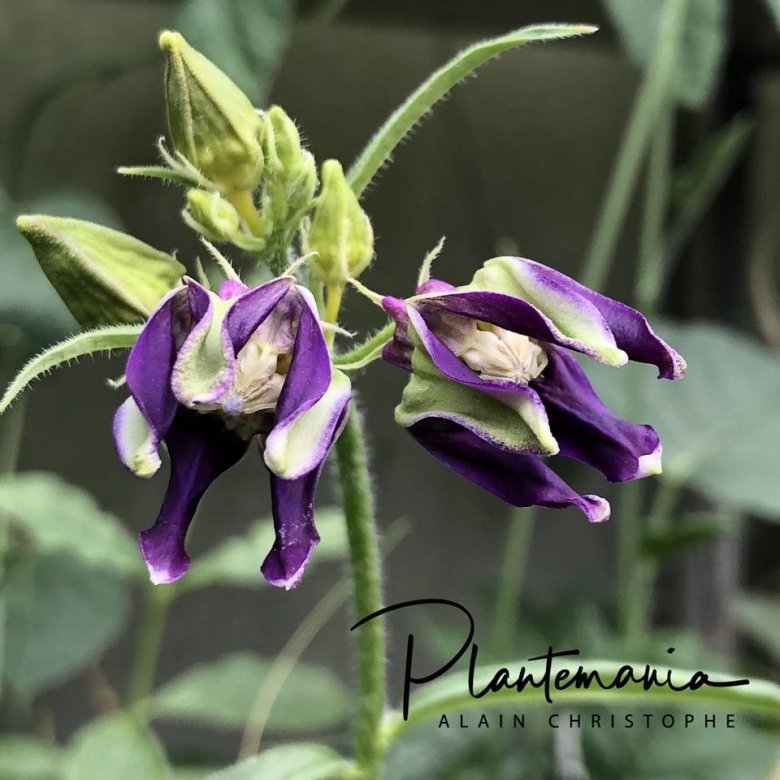
Raphionacme grandiflora (Pentagonandus grandiflorus) is a perennial caudiciform asclepiad with herbaceous, procumbent annual hairy stems up to about 30 cm long, arising from a swollen underground, more or less depressed tuber (caudex), up to 12 cm in diameter. Leaves are opposite, linear-lanceolate to ovate and woolly-hairy (subsp. grandiflorus) or glabrous (subsp. glabrescens). The large deep violet flowers are spectacular.
Derivation of specific name: ‘grandiflora’(Latin) large flowered.
Tuber (caudex): Single or multiple subterranean tubers on lateral roots, turnip-shaped, flattened, 7-12 cm diameter often with slightly bowl-shaped central area, generally hidden deep in the soil, but usually raised in cultivation, exuding a milky latex when cut.
Stem: Aerial shoot erect, solitary, rarely apically branching, herbaceous, hairy or glabrous
Leaves: Shortly petiolate, arranged in an alternate or opposite position, linear-lanceolate to narrowly obovate, 2-12 cm long, 0.5-2.5(-5) mm broad, veining prominent below; margin entire but wavy, roughly hairy on both surfaces, hairy only along the margin and on the veins or glabrous, green, lower face paler and glossy. Base cuneate-attenuate.
Inflorescences: Terminal, weakly branched 2-7-flowered, pseudo-umbels. Peduncle 1.2-3.8 cm long. Pedicels 8-16 mm hairy.
Flowers: Sepals lanceolate to ovate-lanceolate, 5-9 mm long, hairy. Corolla up to 3 cm in diameter, glabrous, pale yellowish-green on the outside, bright to deep violet on the inside. Corolla-tube campanulate, pentagonal about 6 mm in diameter. Lobes 14-20 mm lomg, 6-10 mm broad, ascending to erect often strongly deflexed in older flowers, basally with 2 parallel fleshy keels, with margins recurved. Corona whitish, with delicate blue tinge.
Blooming season (in habitat): November-February.
Fruits (follicles): Often a single or (rarely two) erect, linear-cylindrical follicle per flower up to 17 cm long, 1 cm in diameter, hairless.
Origin and Habitat
Tanzania, Zambia. Malawi. N,W Zimbabwe. Mocambique.
Altitude range: 500-1750 metres above sea level.
Habitat and ecology: Raphionacme grandiflora (Pentagonandus grandiflorus) grows in open areas in dry Mopane woodland dominated by the caesalpinaceous tree Colophospermum mopane, on highly alkaline, and poorly drained soils, temporarily waterlogged during the rainy season but drying out deeply during the dry season. The open ground cover consists of short grasses and geophytes such as Ammocharis tinneana, Chlorophytum blepharophyllum and Chlorophytum papilliferum and Aneilema johnstonei and Murdannia simplex. It is also found in dry mixed woodland in sandy or rocky areas.
Bibliography
Major references and further lectures
-
- Focke Albers, Ulrich Meve “Illustrated Handbook of Succulent Plants: Asclepiadaceae”, Volume 4 Springer Science & Business Media, 2002
-
G.A. Ellenbroek “Ecology and productivity of an African wetland system: The Kafue Flats, Zambia” Springer Science & Business Media, 06 December 2012
-
Sir William Jackson Hooker “Hooker’s Icones Plantarum”, Volume 36 t. 3583 page 426 Bentham-Moxon Trustees, 1962
-
Ellert, A.F.N. “A note on Pentagonanthus grandiflorus N.E. Br. subspecies glabrescens” Bullock Excelsa 18 Page 190. 1997.
-
Venter, H.J.T. “A Taxonomic revision of Raphionacme (Apocynaceae: Periplocoideae)” South African Journal of Botany 75(2) Pages 310 - 312. (Includes a picture). 2009
-
Hyde, M.A., Wursten, B.T., Ballings, P. & Coates Palgrave, M. (2016). “Flora of Zimbabwe: Species information: Raphionacme grandiflora.”
http://www.zimbabweflora.co.zw/speciesdata/species.php?species\_id=145360, retrieved 21 January 2016
Cultivars and forms (1)
Subspecies (1)
Gallery