Publication: Cactaceae Syst. Init. 15: 10. 2003 [Apr 2003]
Description
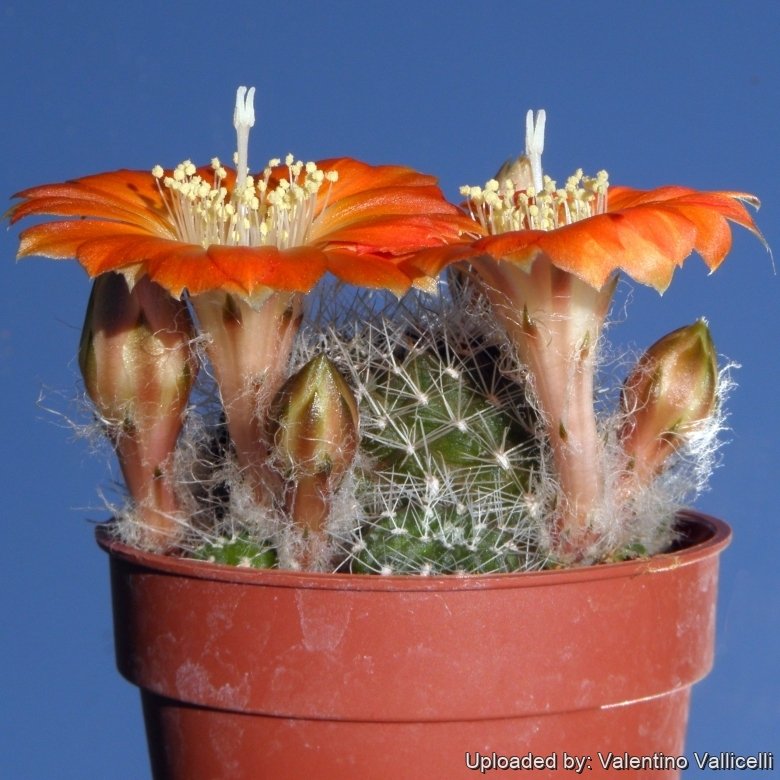
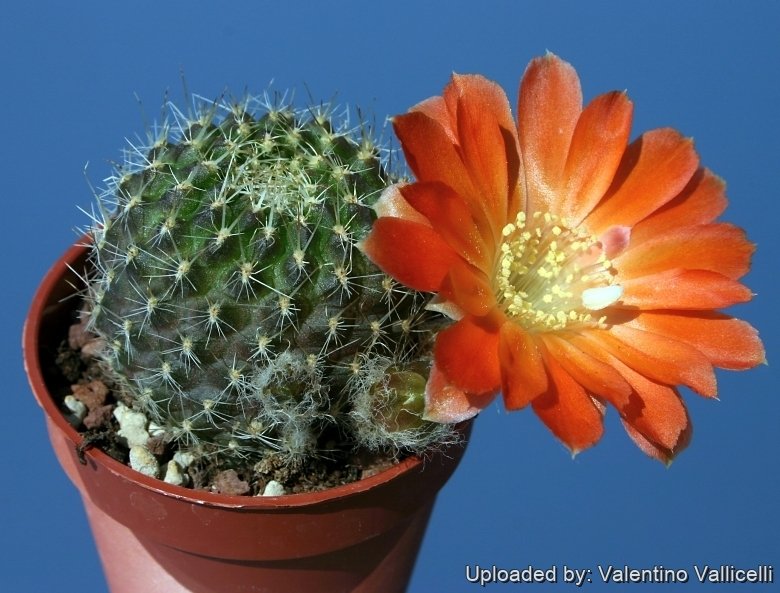
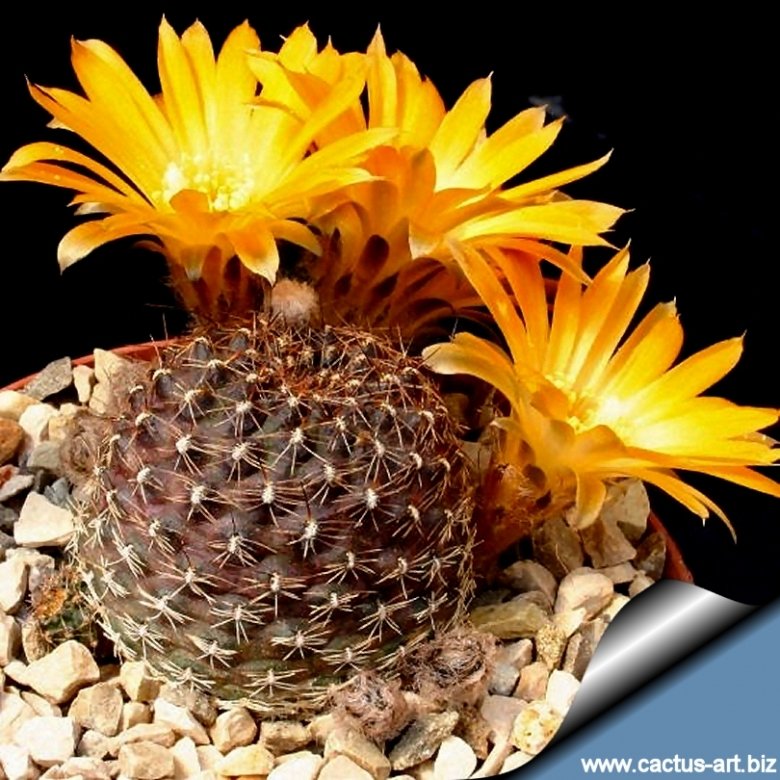
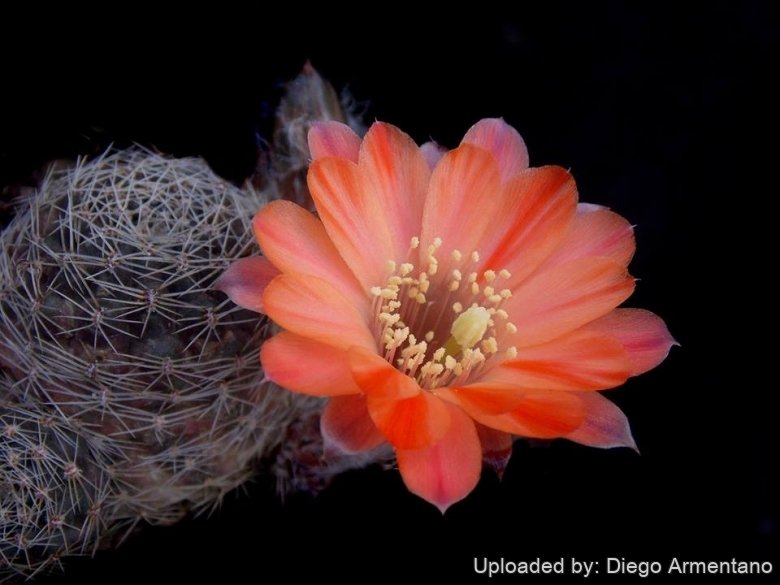
Rebutia aureiflora (also considered a subspecies of Rebutia einsteinii) is a mound-forming , perennial cactus with very large yellow, orange flowers with white throat. It is very variable regarding flowers colour and spination and there are at least fourteen described varieties and forms that in all probability they can all be included within the variation of the one species.
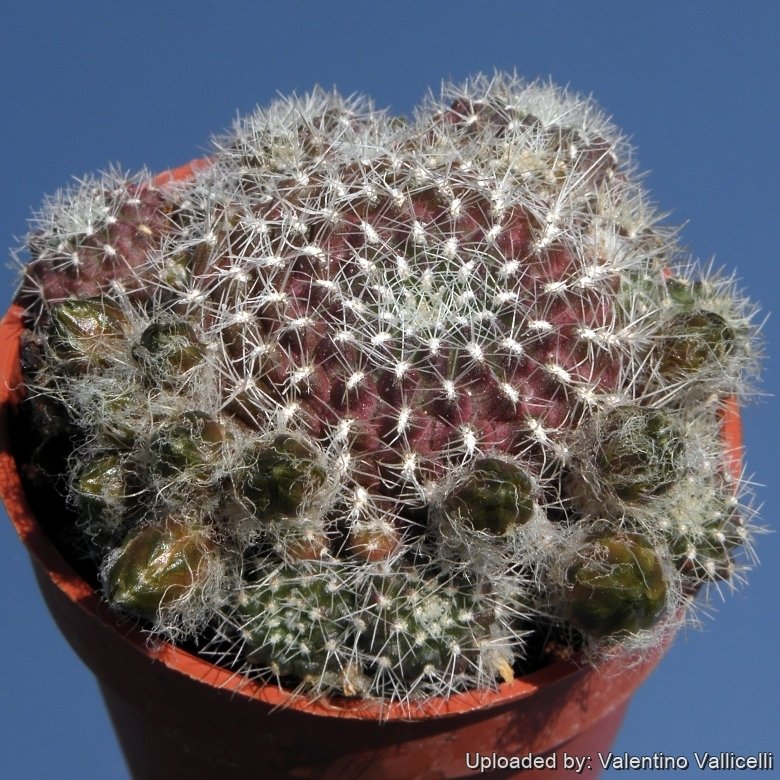
Stem: Globular or almost cylindrical in cultivation, 4-6 cm in diameter, leaf-green often brownish-red deep-purple tinged ,becoming caespitose from the base, eventually forming clumps 10 cm in diameter.
Ribs: Spiralling, forming distinct about 6 mm tall.
Areoles: Elliptical with white wool.
Spines: 15-20, extremely variable not strongly differentiated into centrals and radials.
Centrals1-4, bristle-like, rigid, stiff, greyish white to brownish, 10-20 mm long. Radials 10 to16, thinner up to 7 mm long. Seedlings and offshoots on older plants with short spines 6-8 mm long yellowish at first, becoming all white and tipped yellowish-brown. Older plants with extremely long thin flexuous spines up to 50 mm (or more) long, white tipped yellowish-brown.
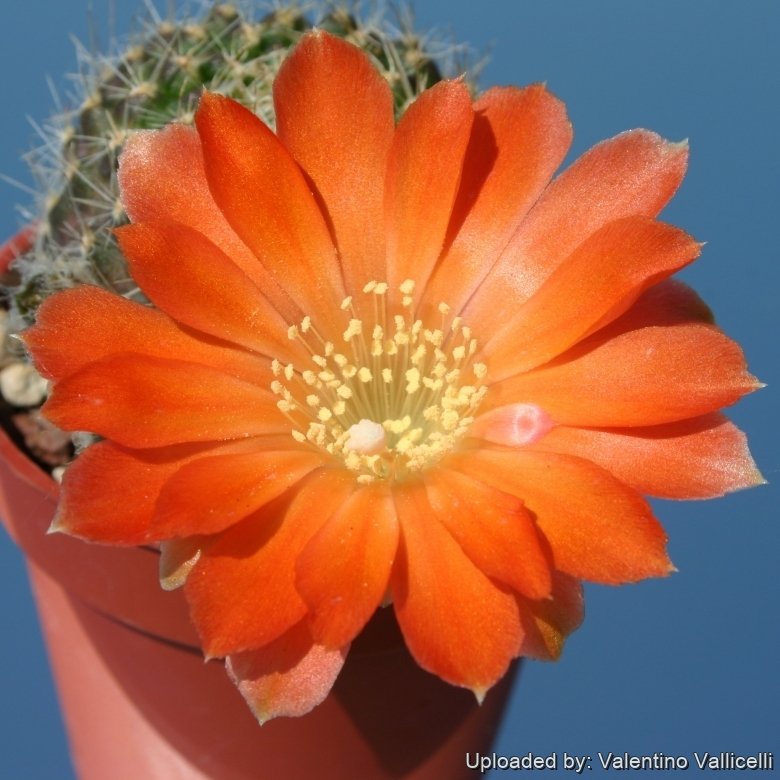
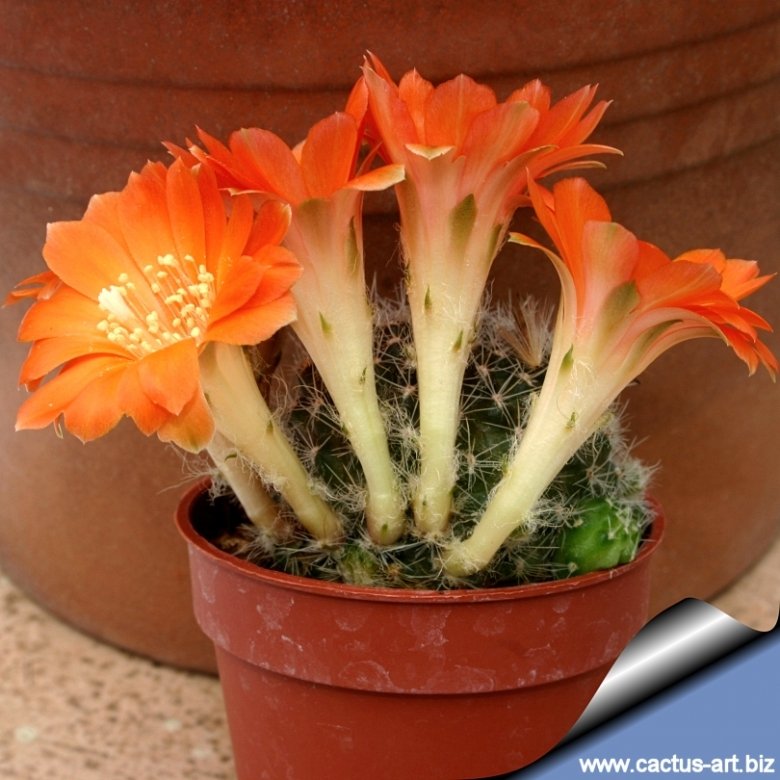
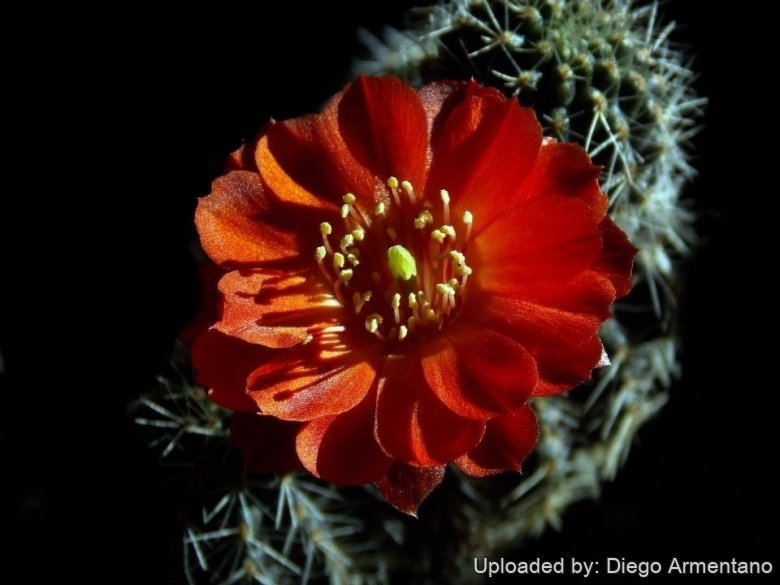
Flowers: Very large, broadly funnel-shaped, about 50 mm long and 45 mm in diameter, typically golden-yellow or orange-yellow with white throat, but sometimes red or purplish. Tube pale brownish-orange, scales small tipped greenish red, with thin flexuous hairs up to 10 mm long and an occasional bristle in the axils. Stigma yellow, style free white. Filaments white. It is self-sterile.
Blooming season: Late spring.
Fruits: Flattened-spherical about 8 mm in diameter, brownish-orange to reddish, densely covered with long hairs.
Seeds: Bell- to cap-shaped, coat warty, dull brownish-black.
Origin and Habitat
North-west Argentina near to the Salta – Jujuy border around Quebrada del Toro.
Altitude: 2200-4000 metres above sea level.
Cultivation and Propagation
Rebutia aureiflora is a summer grower species that is easy to cultivate.
Growth rate: It is a relatively rapidly growing and easily flowering species that will make clumps given the best conditions.
Soils: It likes very porous standard cactus mix soil. Prefer a neutral or low pH compost, avoid substrata rich in limestone.
Repotting: It is better that they are repotted regularly. Repotting will increase the number and size of stems and will increase the number of flowers produced. Repot yearly until reaching about 100mm in size, then every two or three years will suffice. Repotting is best done at the end of winter but can be done at other times. Do not water for a couple of weeks after repotting to reduce risk of root rot via broken roots. Use pot with good drainage.
Watering: Needs moderate to copious waterings in summer, but do not overwater (Rot prone), keep dry in winter at a minimum temperature of 0°C.
Fertilization: Feed with a high potassium fertilizer in summer.
Hardiness: Reputedly resistant to frost if kept on the dry side prior to, and during, cold weather (hardy to -4 C ° C, or less for short periods).
Exposition: The plant tolerates bright situations but enjoys filtered sunlight or afternoon shade, inside it needs bright light, and some direct sun. Tends to bronze in strong light, which encourages flowering and heavy spine production, but is likely to suffer from sun scorch or stunted growth if over exposed to direct sunlight during the hottest part of the day in summer.
Uses: It is an excellent plant for container growing. It always looks good and stays small. It look fine in a cold greenhouse and frame or outdoor in a rockery.
Pests & diseases: It may be attractive to a variety of insects, but plants in good condition should be nearly pest-free, particularly if they are grown in a mineral potting-mix, with good exposure and ventilation. Nonetheless, there are several pests to watch for:
- Red spiders: Red spiders may be effectively rubbed up by watering the plants from above.
- Mealy bugs: Mealy bugs occasionally develop aerial into the new growth among the wool with disfiguring results, but the worst types develop underground on the roots and are invisible except by their effects.
- Scales: Scales are rarely a problem.
- Rot: This species is particularly easy and accommodating, seldom suffer of cryptogamic diseases. Rot it is only a minor problem with rebutias if the plants are watered and “aired” correctly. If they are not, fungicides won’t help all that much.
Propagation: Division, direct sow after last frost. Seeds germinate in 7-14 days at 21-27° C in spring, remove gradually the glass cover as soon the plants will be well rooted (ca 1-2 weeks) and keep ventilated, no full sun for young plants! Seed Collecting: Permit fruit to ripen. Fruit must be significantly overripe before harvesting seed; clean and dry seeds. To make a cutting twist off a branch and permit it to dry out a couple of weeks, lay it on the soil and insert the stem end partially into the soil. Try to keep the cutting somewhat upright so that the roots are able to grow downward.
Bibliography
Major references and further lectures
-
Edward Anderson “The Cactus family” Timber Press, Incorporated, 2001
-
James Cullen, Sabina G. Knees, H. Suzanne Cubey “The European Garden Flora Flowering Plants: A Manual for the Identification of Plants Cultivated in Europe, Both Out-of-Doors and Under Glass” Cambridge University Press, 11/Aug/2011
-
David R Hunt; Nigel P Taylor; Graham Charles; International Cactaceae Systematics Group. “The New Cactus Lexicon” dh books, 2006
-
John Borg “Cacti: a gardener’s handbook for their identification and cultivation” Blandford P., 1970
-
B. Fearn and L. Pearcy, “The Genus Rebutia, 1895-1981” Matlock: Abbey Brook, 1981
From llifle page Acantholobivia euanthema
Description
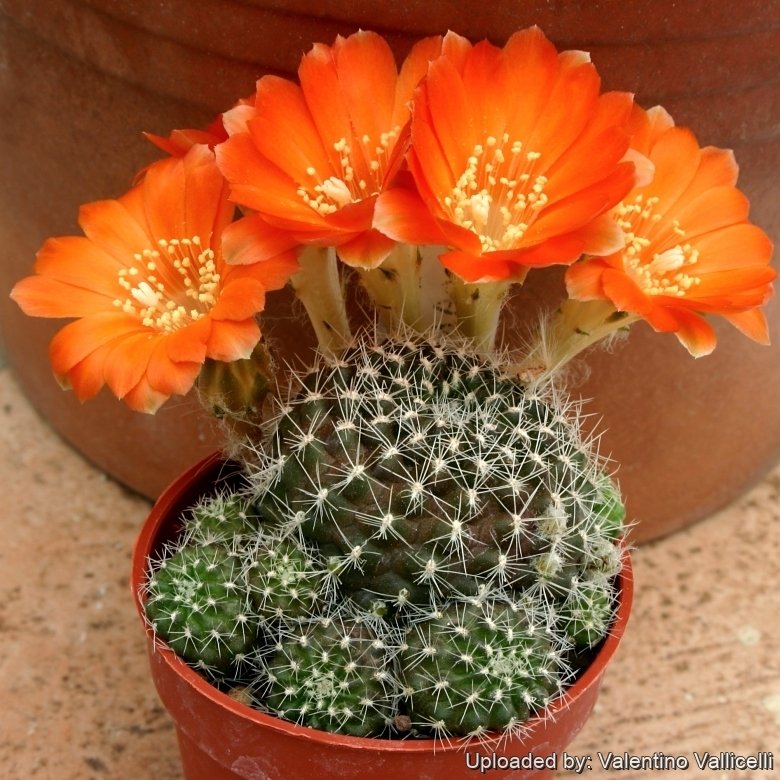
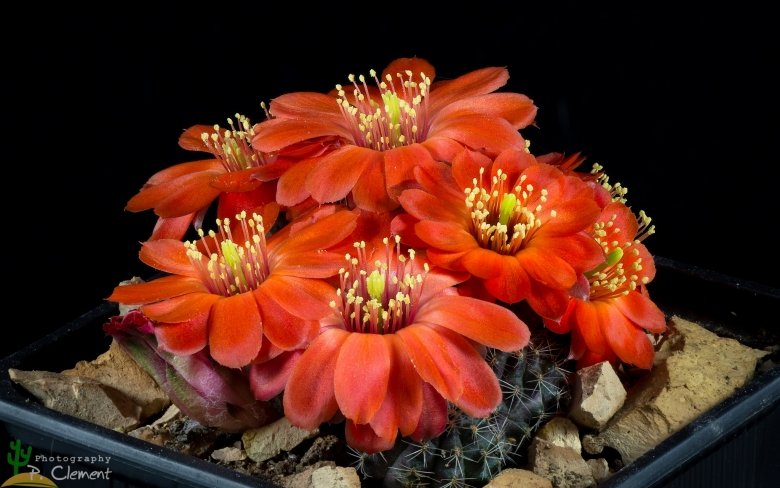
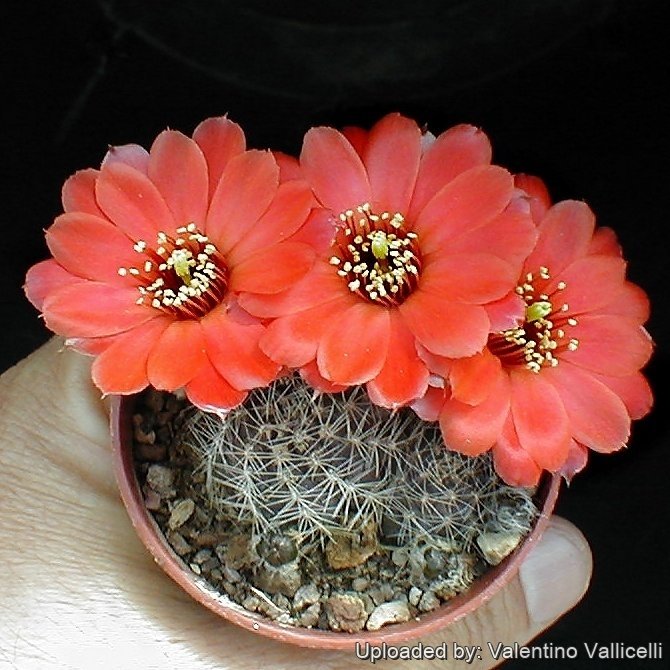
Rebutia euanthema is a popular species with very showy orange-red flowers, with small stems freely offsetting from the base forming clumps 70-80 mm in diameter. The spines are always slightly erect never appressed. Rebutia euanthema is one of the morphological or local forms of Rebutia einsteinii subs. aureiflora, and the two plants are not readily distinguishable, if not for the geographical provenance. More likely they are one and the same species. Also, you can include Rebutia euanthema as a synonym of Rebutia einsteinii subs. gonjianii, as at the top of the Quebrada de Purmamarca the red-flowered R. euanthema gradually merges into the yellow-flowered R. einsteinii subs. gonjianii.
Stem: Up to 30 mm in diameter (often more in cultivation), grey-green often tinged amethyst.
Areoles: Elliptical, light brownish in colour.
Radial spines: About 10, often pectinate, always slightly erect never appressed, up to 10mm long, white tipped brown.
Centrals spines: Absent.
Flowers: About 45 mm long and 30mm wide with orange-red petals. Flower tube very hairy with occasional bristles. Stigma and style greenish-yellow, 6-lobed, filaments lavender pink.
Fruit: Brownish-red, densely covered with white hairs.
Seeds: Dull brownish-black.
Origin and Habitat
Salta and Jujuy, Argentina. Walter Rausch collected this plant in the Quebrada de Humahuaca in Jujuy (R214) and also in Salta and Catamarca (R751 and R823). Lau recollected it in Volcán between 3200 and 3300 m above sea level (L520) and Mats Winberg collected the var. tilcarensis in Tilcaras between 3100 and 3200m above sea level (MN163).
Altitude range: 3200-4000 metres above sea level.
Habitat and ecology: This cactus occurs on dry rocky outcrops in puna together with Lobivia sublimiflora, Rebutia pseudodeminuta, Lobivia jajoiana.
Cultivation and Propagation
Rebutia euanthema is a summer grower species that is easy to cultivate.
Growth rate: It is a relatively rapidly growing and easily flowering species that will make clumps given the best conditions.
Soils: It likes very porous standard cactus mix soil. Prefer a neutral or low pH compost, avoid substrata rich in limestone.
Repotting: It is better that they are repotted regularly. Repotting will increase the number and size of stems and will increase the number of flowers produced. Repot yearly until reaching about 100mm in size, then every two or three years will suffice. Repotting is best done at the end of winter but can be done at other times. Do not water for a couple of weeks after repotting to reduce risk of root rot via broken roots. Use pot with good drainage.
Watering: Needs moderate to copious waterings in summer, but do not overwater (Rot prone), keep dry in winter at a minimum temperature of 0°C.
Fertilization: Feed with a high potassium fertilizer in summer.
Hardiness: Reputedly resistant to frost if kept on the dry side prior to, and during, cold weather (hardy to -4 C ° C, or less for short periods).
Exposition: The plant tolerates bright situations but enjoys filtered sunlight or afternoon shade, inside it needs bright light, and some direct sun. Tends to bronze in strong light, which encourages flowering and heavy spine production, but is likely to suffer from sun scorch or stunted growth if over exposed to direct sunlight during the hottest part of the day in summer.
Uses: It is an excellent plant for container growing. It always looks good and stays small. It look fine in a cold greenhouse and frame or outdoor in a rockery.
Pests & diseases: It may be attractive to a variety of insects, but plants in good condition should be nearly pest-free, particularly if they are grown in a mineral potting-mix, with good exposure and ventilation. Nonetheless, there are several pests to watch for:
- Red spiders: Red spiders may be effectively rubbed up by watering the plants from above.
- Mealy bugs: Mealy bugs occasionally develop aerial into the new growth among the wool with disfiguring results, but the worst types develop underground on the roots and are invisible except by their effects.
- Scales: Scales are rarely a problem.
- Rot: This species is particularly easy and accommodating, seldom suffer of cryptogamic diseases. Rot it is only a minor problem with rebutias if the plants are watered and “aired” correctly. If they are not, fungicides won’t help all that much.
Propagation: Division, direct sow after last frost. Seeds germinate in 7-14 days at 21-27° C in spring, remove gradually the glass cover as soon the plants will be well rooted (ca 1-2 weeks) and keep ventilated, no full sun for young plants! Seed Collecting: Permit fruit to ripen. Fruit must be significantly overripe before harvesting seed; clean and dry seeds. To make a cutting twist off a branch and permit it to dry out a couple of weeks, lay it on the soil and insert the stem end partially into the soil. Try to keep the cutting somewhat upright so that the roots are able to grow downward.
Bibliography
Major references and further lectures
-
D. Hunt, “Cactaceae Systematics Initiatives” Bulletin of the International Cactaceae Systematics Group, 1996
-
Brian Fearn and Leslie Pearcy “The Genus Rebutia 1895—1981” No. 2 of a series of illustrated guide books, Published by Abbey Brook Cactus Nursery 1981
Source: Acantholobivia euanthema, LLIFLE - Encyclopedia of living forms, CC-BY-SA, retrieved 2026-10-25.
From llifle page Mediolobivia euanthema var. oculata
Description
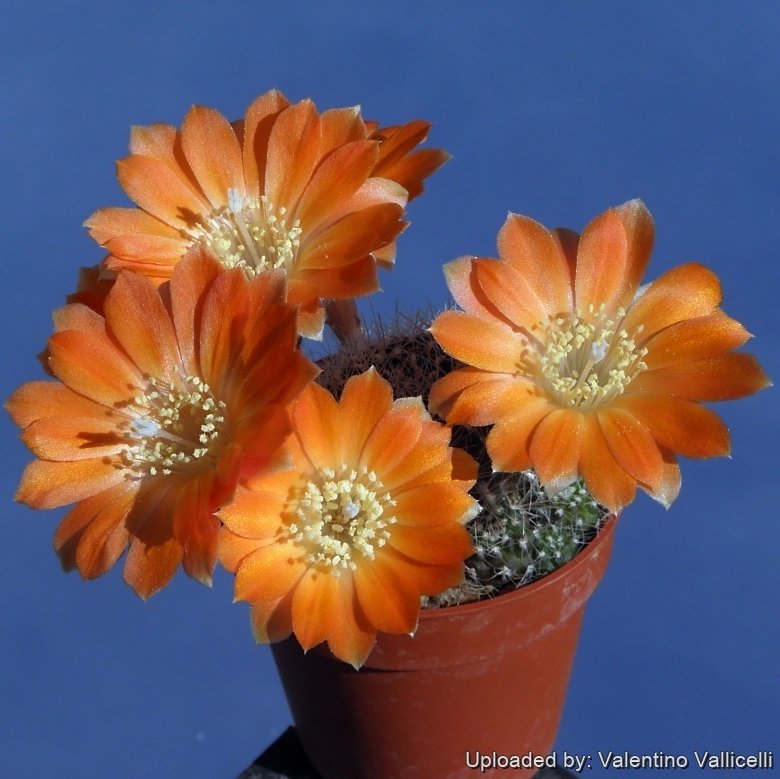
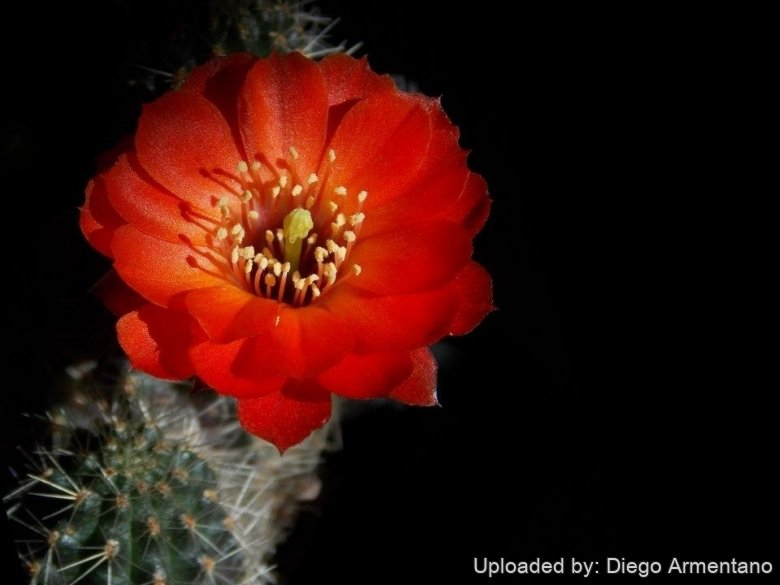
Rebutia oculata is one of the many geografical form of the widespread and morphologically variable Rebutia aureiflora. Many of its morphological and geographical variant was early classified as different independent species, but nowadays all this plant are considered part of a multiform species, where each form is linked to others by populations of plants with intermediate characteristics. Rebutia oculata has distinctive deep lateral incisions between areoles, few (6-8) radial spines less than 12 mm long, white or yellowish with brown base. Flowers 4,5 cm long, 5 cm wide, crimson with whitish throat. Outer tepals crimson. Stigma pale green.
Habit: It is a mound-forming, perennial cactus.
Stem:: Globular or almost cylindrical in cultivation, 4-6 cm in diameter, leaf-green often brownish-red deep-purple tinged, becoming caespitose from the base, eventually forming clumps 10 cm in diameter.
Ribs: Spiralling with deep lateral incisions between areoles.
Areoles: Elliptical with white wool.
Spines: Not strongly differentiated into centrals and radials. Centrals1-4, bristle-like, rigid, stiff, white or yellowish with brown base. Radials 6-8, less than 12 mm long.
Flowers: Very large, broadly funnel-shaped, about 45 mm long and 50 mm in diameter, typically crimson with whitish throat with white throat. Outer tepals dark crimson. Tube pale brownish-orange, scales small tipped greenish red, with thin flexuous hairs up to 10 mm long and an occasional bristle in the axils. Stigma pale green.
Blooming season: Late spring.
Fruits: Flattened-spherical about 8 mm in diameter, brownish-orange to reddish, densely covered with long hairs.
Seeds: Bell- to cap-shaped, coat warty, dull brownish-black.
Origin and Habitat
Challapata, Bolivia
Altitude: 4000-4100 metres above sea level.
Cultivation and Propagation
Rebutia oculata is a summer grower species that is easy to cultivate.
Growth rate: It is a relatively rapidly growing and easily flowering species that will make clumps given the best conditions.
Soils: It likes very porous standard cactus mix soil. Prefer a neutral or low pH compost, avoid substrata rich in limestone.
Repotting: It is better that they are repotted regularly. Repotting will increase the number and size of stems and will increase the number of flowers produced. Repot yearly until reaching about 100 mm in size, then every two or three years will suffice. Repotting is best done at the end of winter but can be done at other times. Do not water for a couple of weeks after repotting to reduce risk of root rot via broken roots. Use pot with good drainage.
Watering: Needs moderate to copious waterings in summer, but do not overwater (Rot prone), keep dry in winter at a minimum temperature of 0°C.
Fertilization: Feed with a high potassium fertilizer in summer.
Hardiness: Reputedly resistant to frost if kept on the dry side prior to, and during, cold weather (hardy to -4 C ° C, or less for short periods).
Exposition: The plant tolerates bright situations but enjoys filtered sunlight or afternoon shade, inside it needs bright light, and some direct sun. Tends to bronze in strong light, which encourages flowering and heavy spine production, but is likely to suffer from sun scorch or stunted growth if over exposed to direct sunlight during the hottest part of the day in summer.
Uses: It is an excellent plant for container growing. It always looks good and stays small. It look fine in a cold greenhouse and frame or outdoor in a rockery.
Pests & diseases: It may be attractive to a variety of insects, but plants in good condition should be nearly pest-free, particularly if they are grown in a mineral potting-mix, with good exposure and ventilation. Nonetheless, there are several pests to watch for:
- Red spiders: Red spiders may be effectively rubbed up by watering the plants from above.
- Mealy bugs: Mealy bugs occasionally develop aerial into the new growth among the wool with disfiguring results, but the worst types develop underground on the roots and are invisible except by their effects.
- Scales: Scales are rarely a problem.
- Rot: This species is particularly easy and accommodating, seldom suffer of cryptogamic diseases. Rot it is only a minor problem with rebutias if the plants are watered and “aired” correctly. If they are not, fungicides won’t help all that much.
Propagation: Division, direct sow after last frost. Seeds germinate in 7-14 days at 21-27° C in spring, remove gradually the glass cover as soon the plants will be well rooted (ca 1-2 weeks) and keep ventilated, no full sun for young plants! Seed Collecting: Permit fruit to ripen. Fruit must be significantly overripe before harvesting seed; clean and dry seeds. To make a cutting twist off a branch and permit it to dry out a couple of weeks, lay it on the soil and insert the stem end partially into the soil. Try to keep the cutting somewhat upright so that the roots are able to grow downward.
Source: Mediolobivia euanthema var. oculata, LLIFLE - Encyclopedia of living forms, CC-BY-SA, retrieved 2026-10-25.
From llifle page Mediolobivia aureiflora var. rubelliflora
Origin and Habitat
Salta, Argentina.
Source: Mediolobivia aureiflora var. rubelliflora, LLIFLE - Encyclopedia of living forms, CC-BY-SA, retrieved 2026-10-25.
Gallery