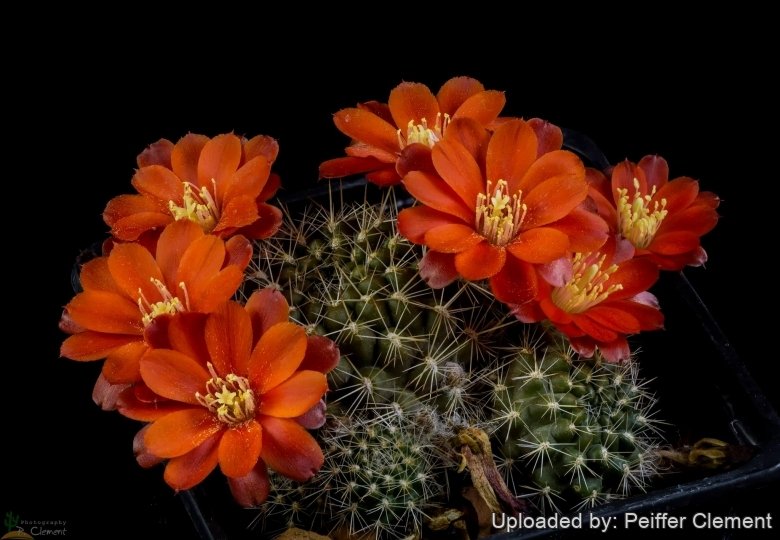
Publication: Stand. Cycl. Hort. 5: 2915. 1916
Description
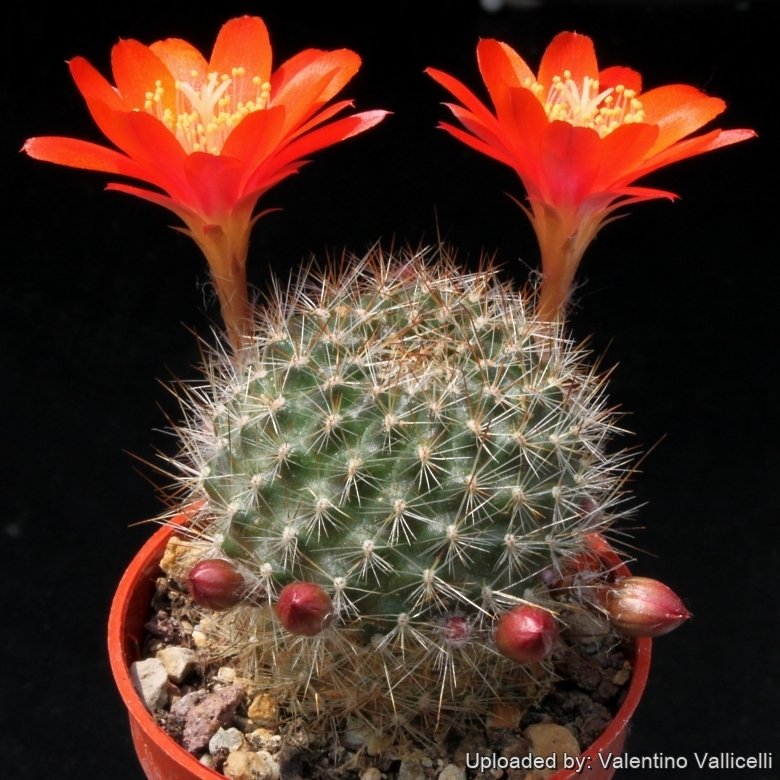
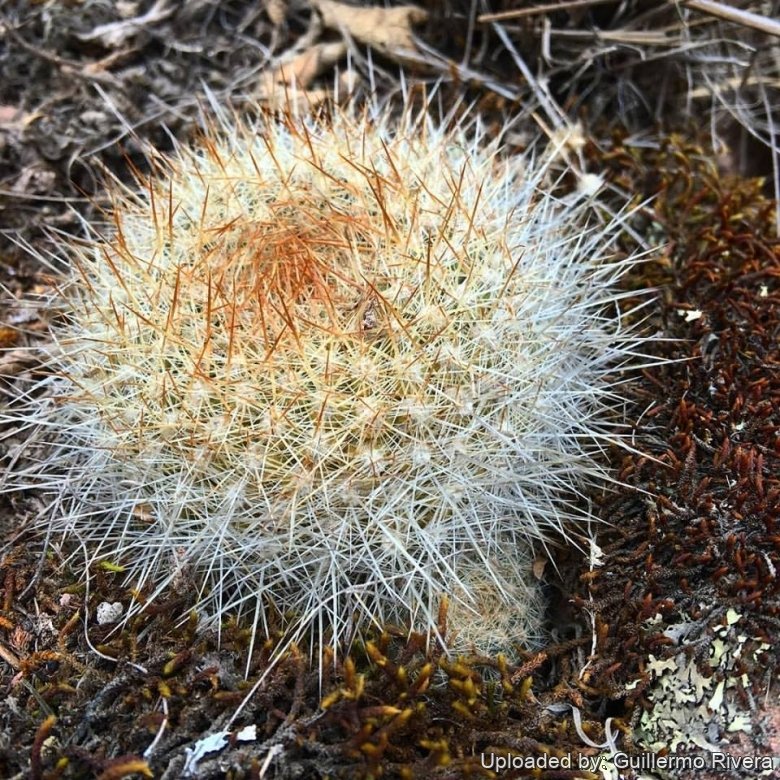
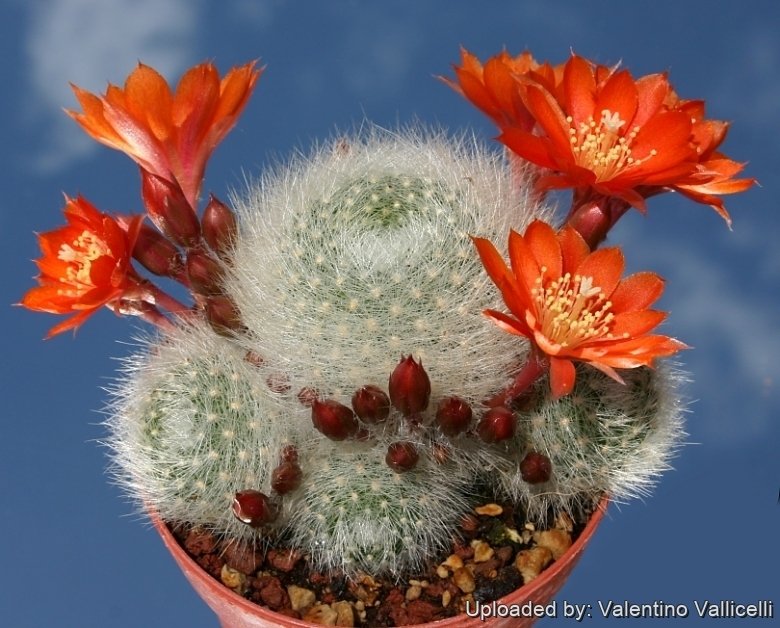
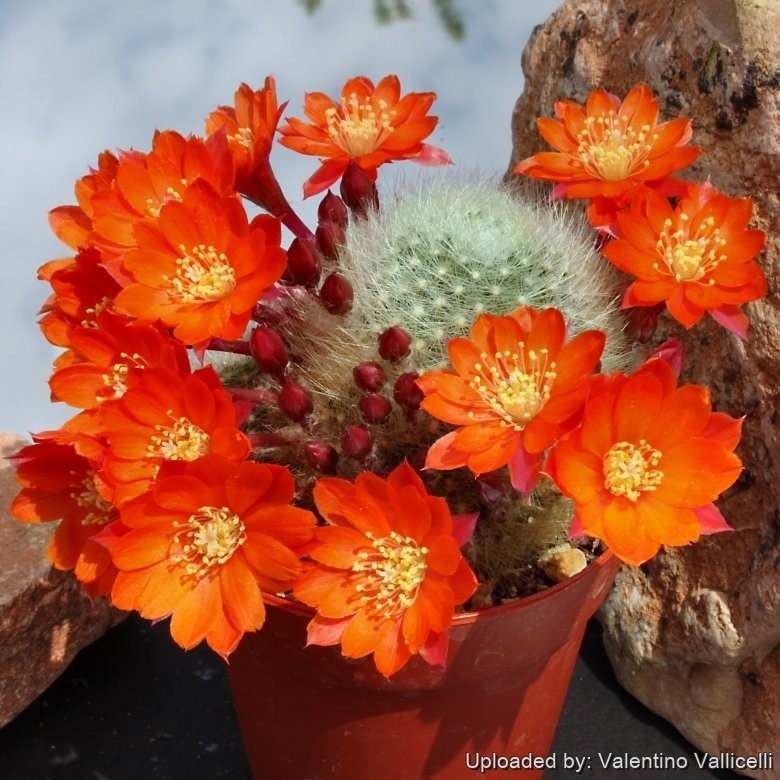
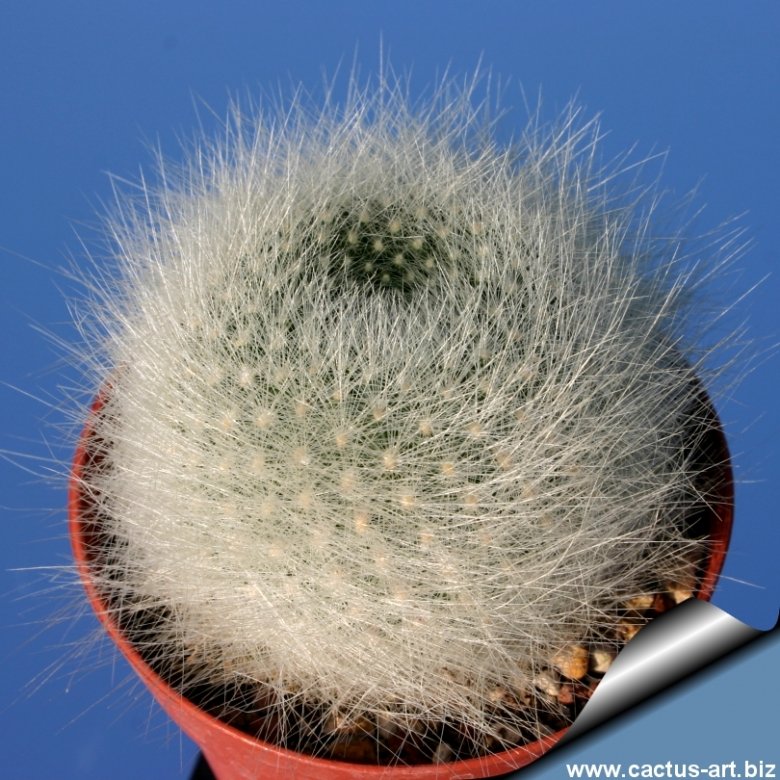
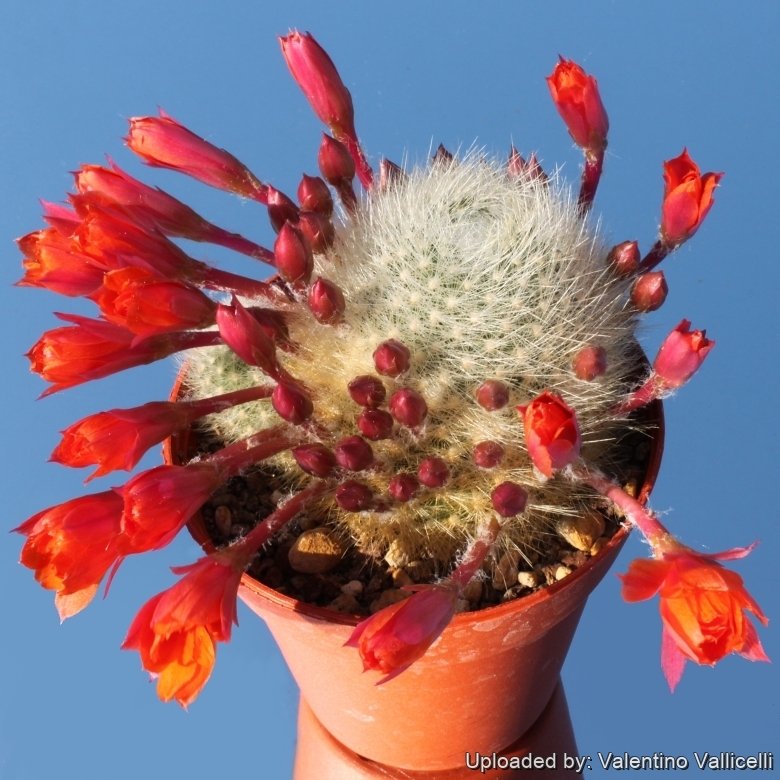
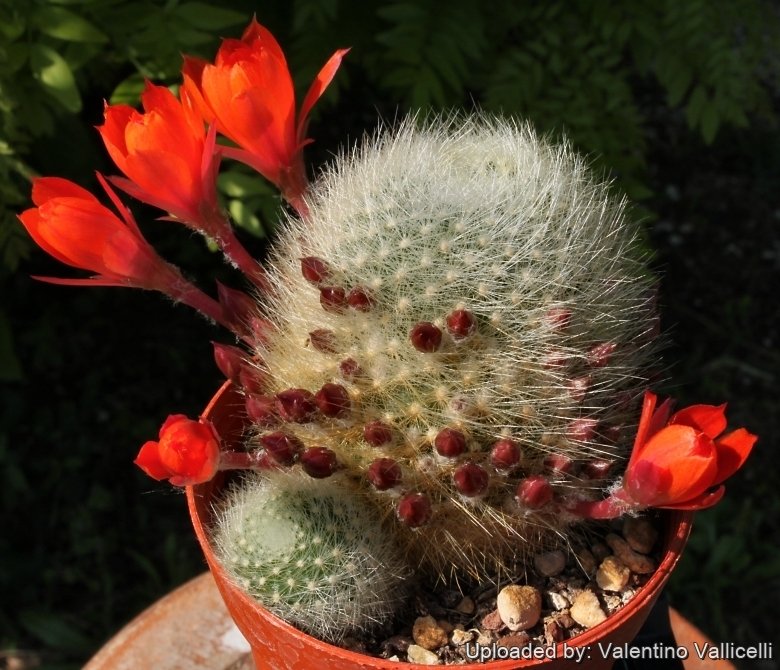
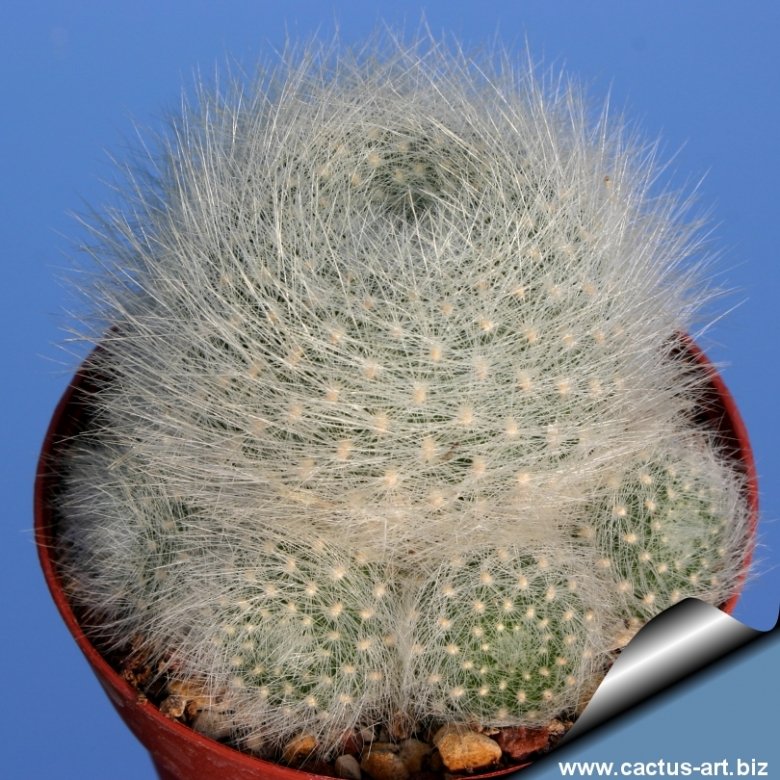
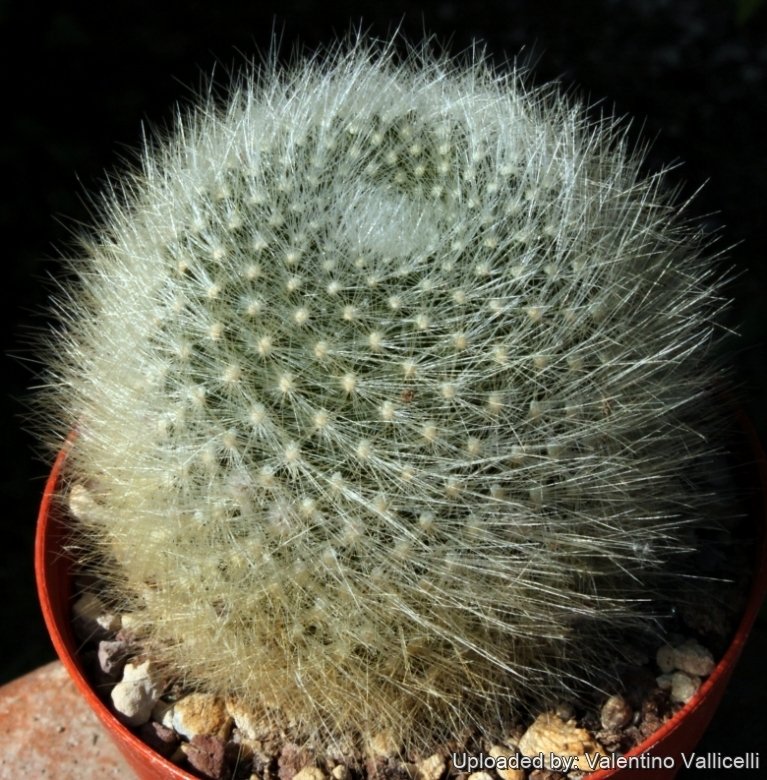
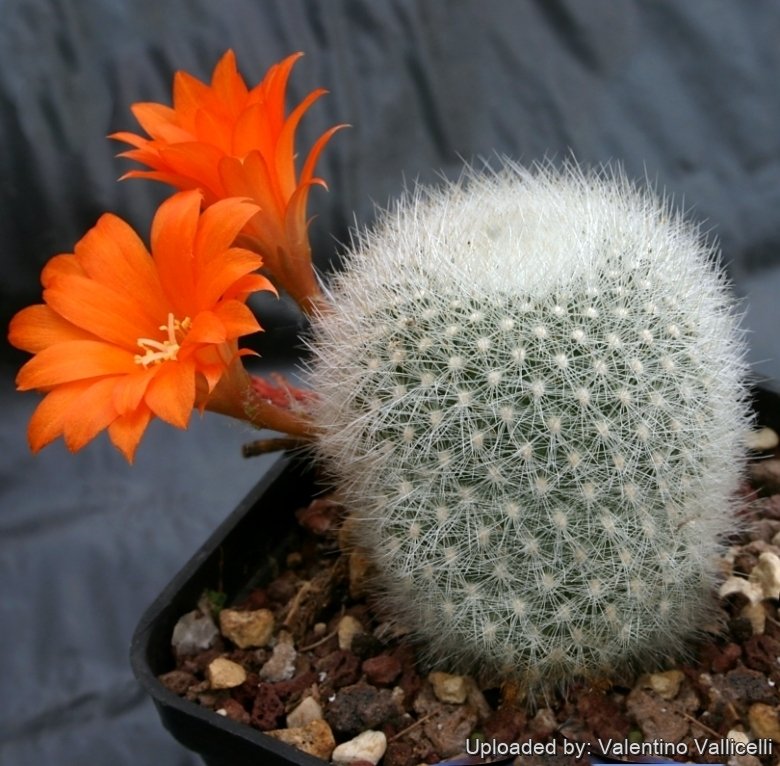
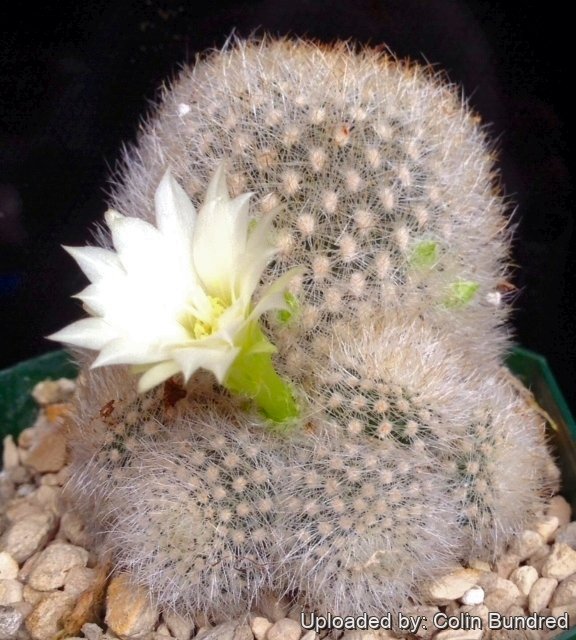
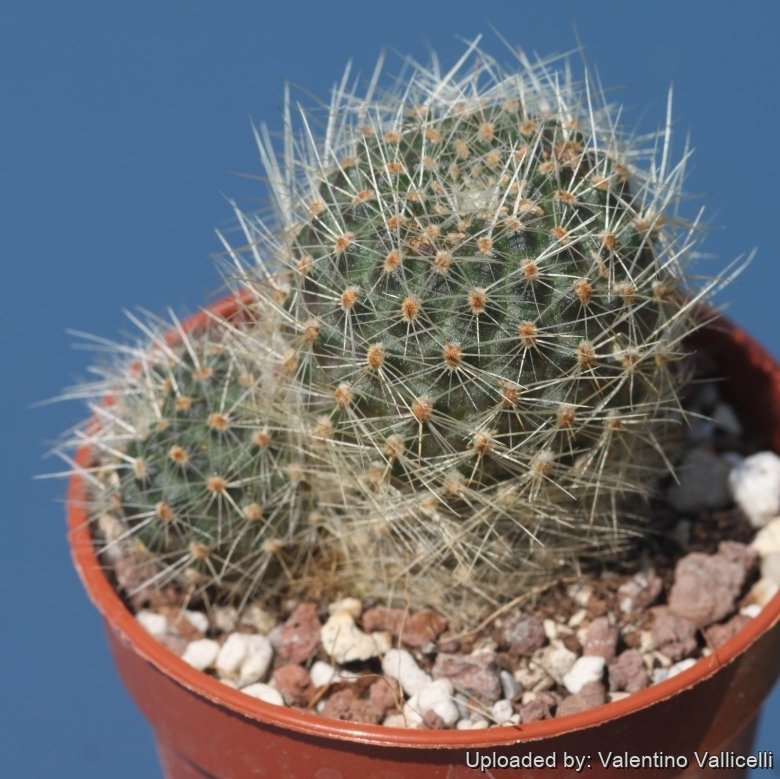
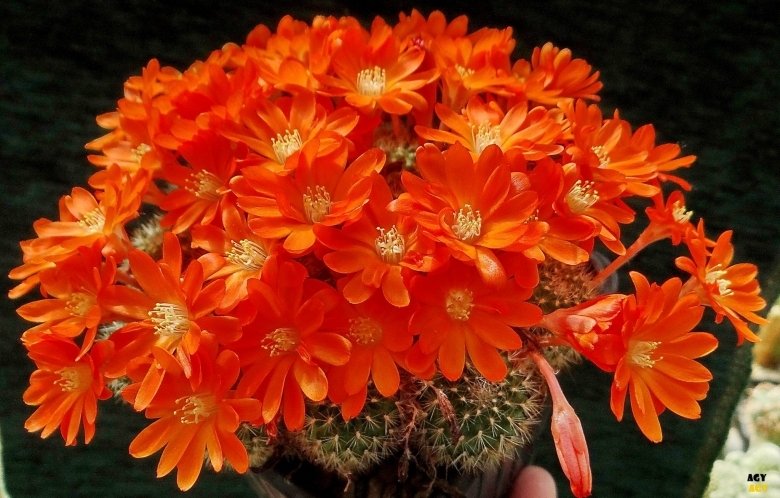
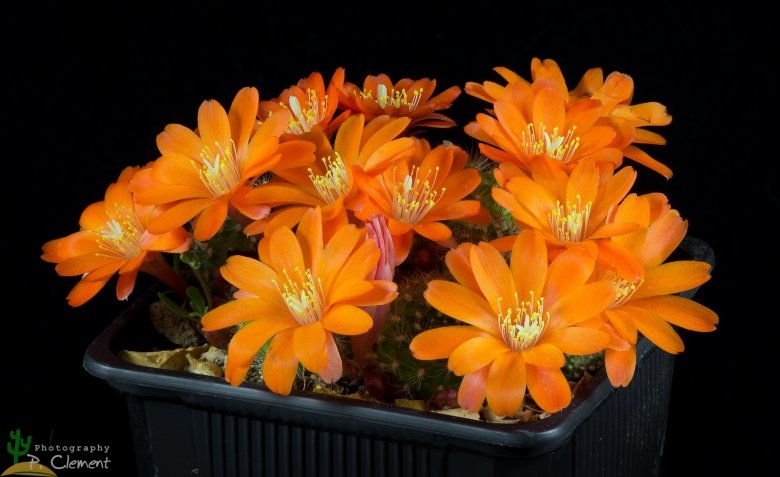
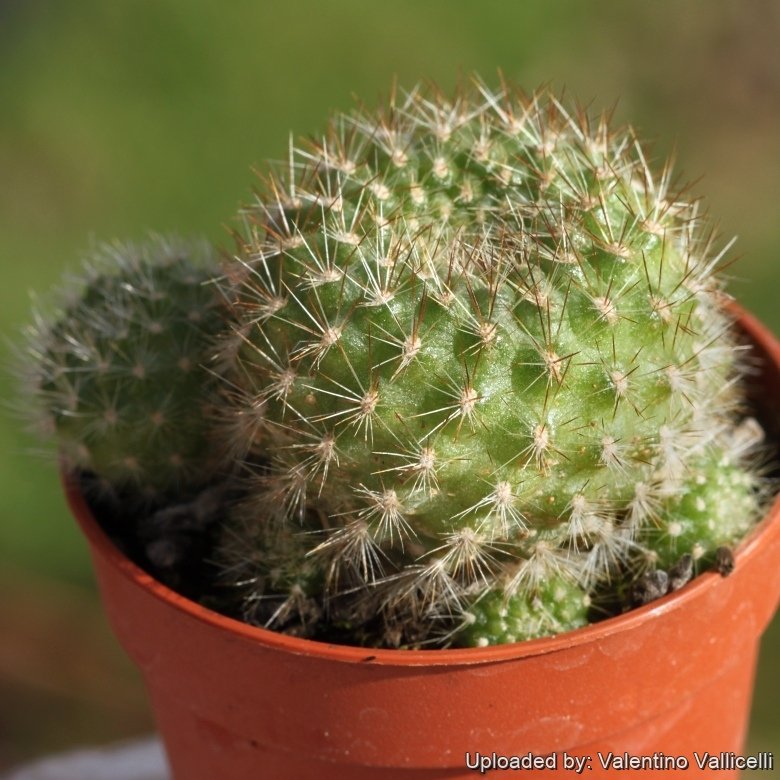
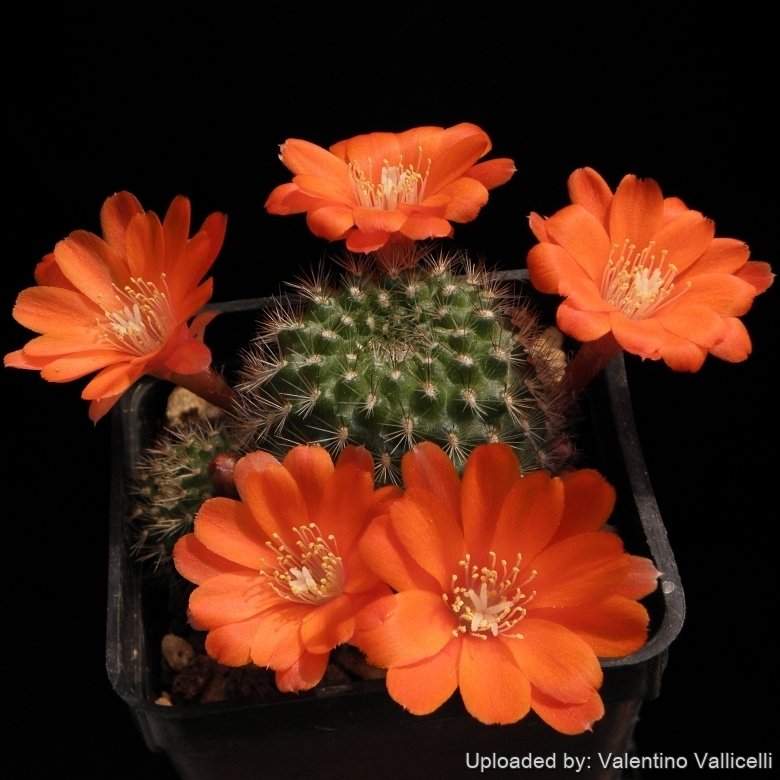
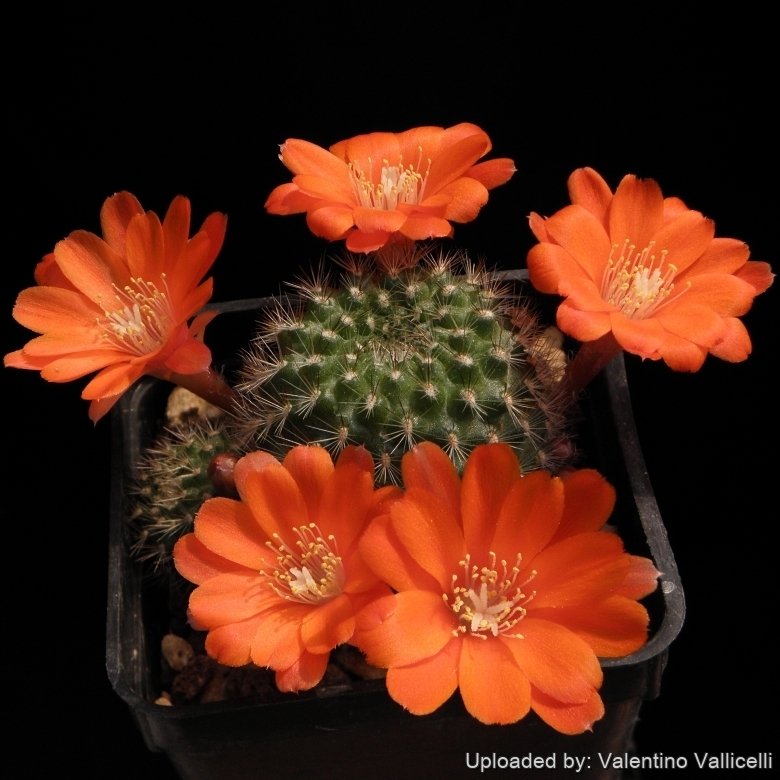
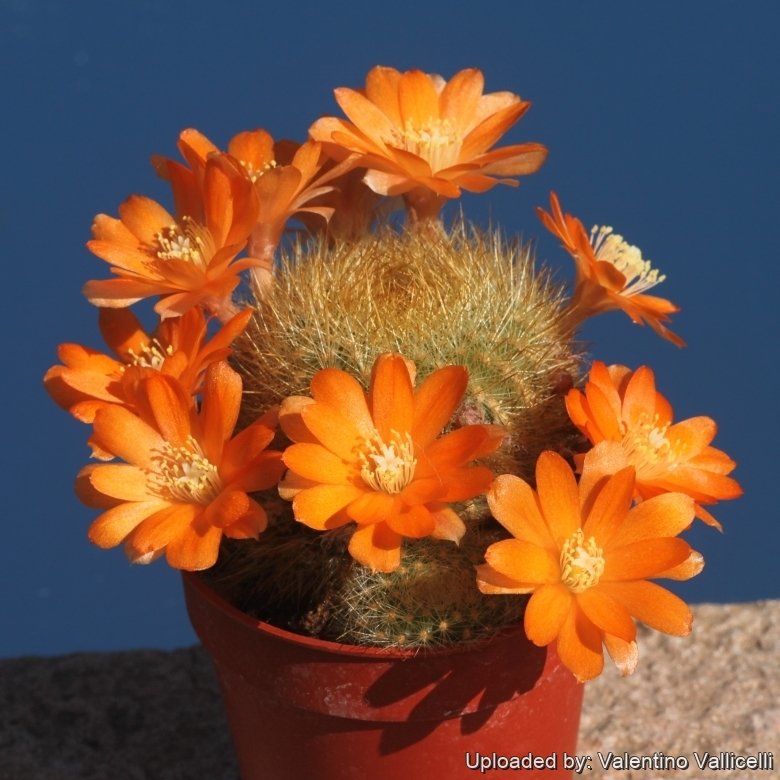
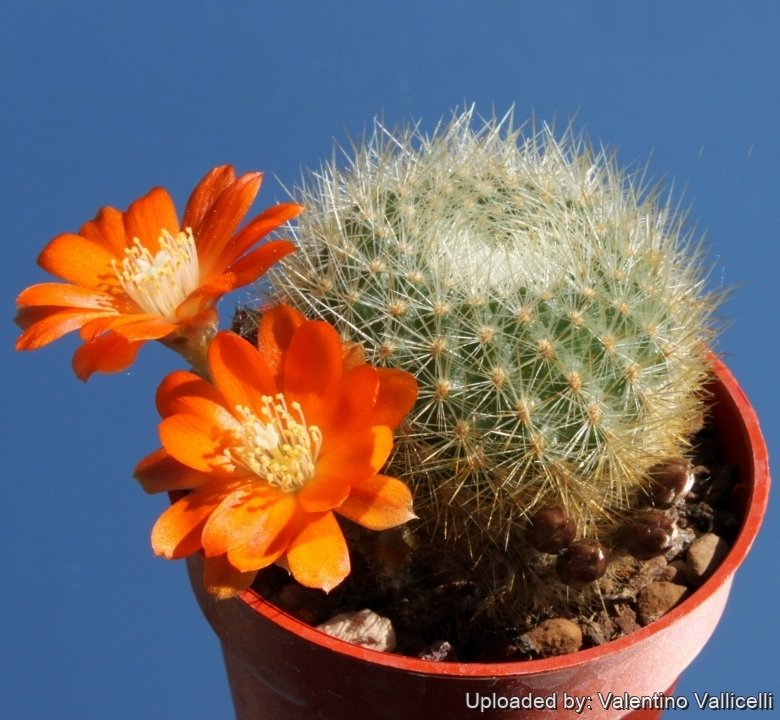
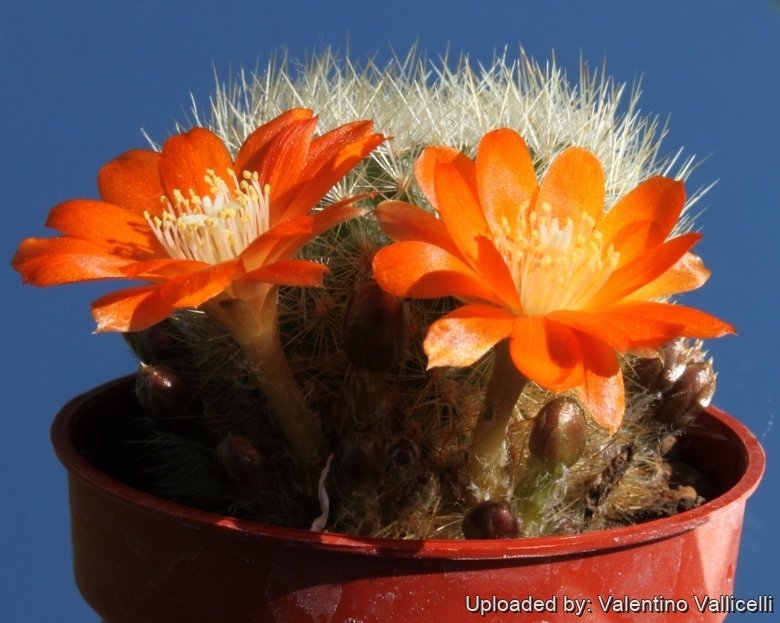
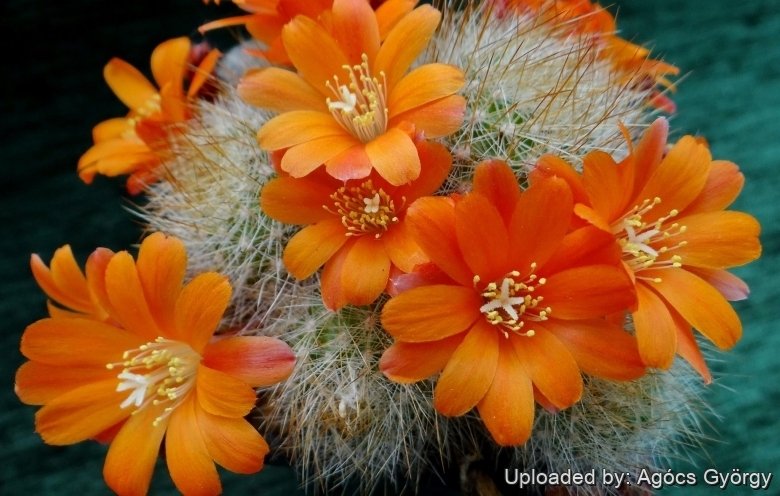
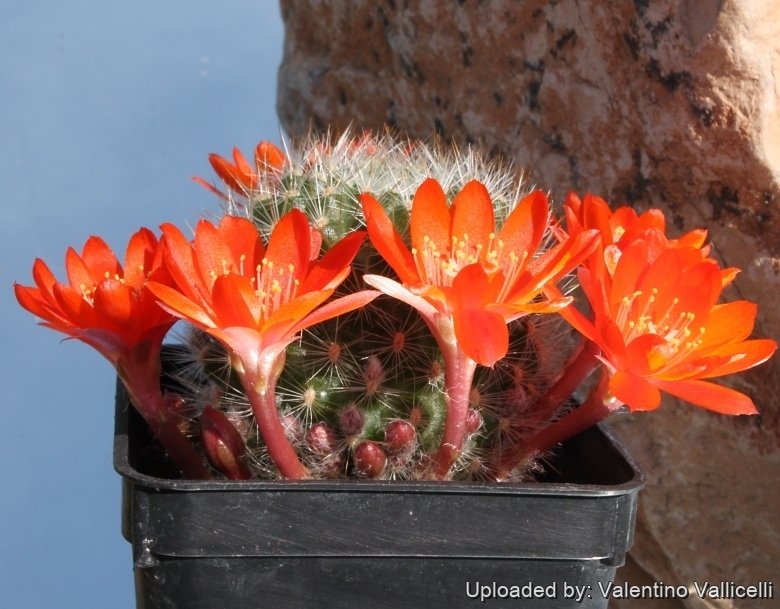
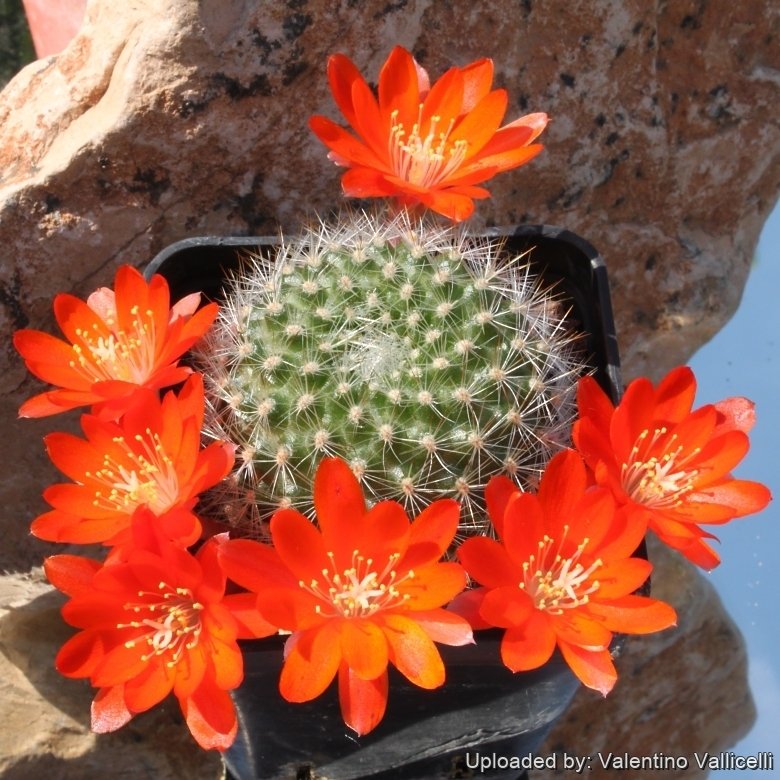
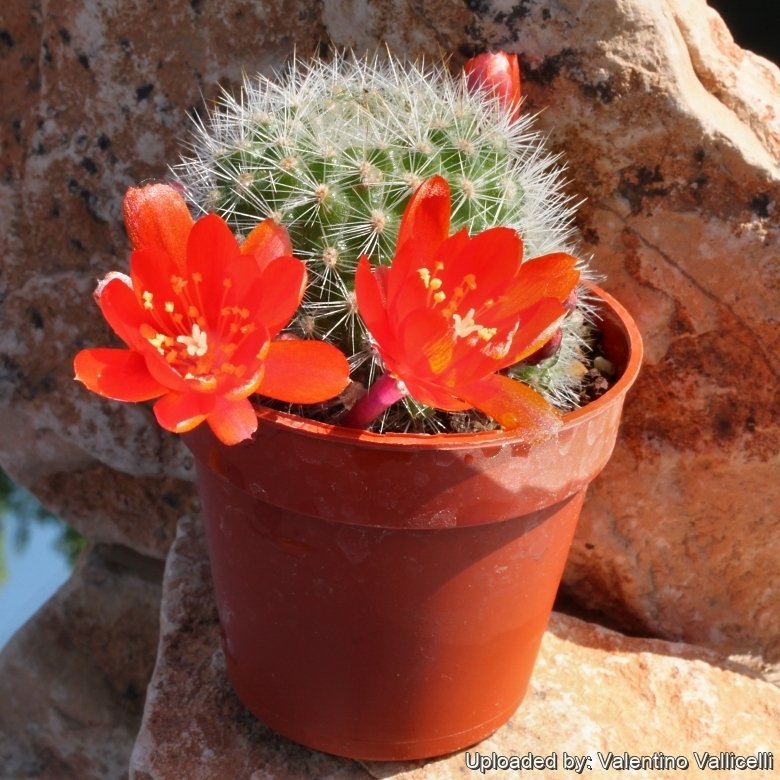
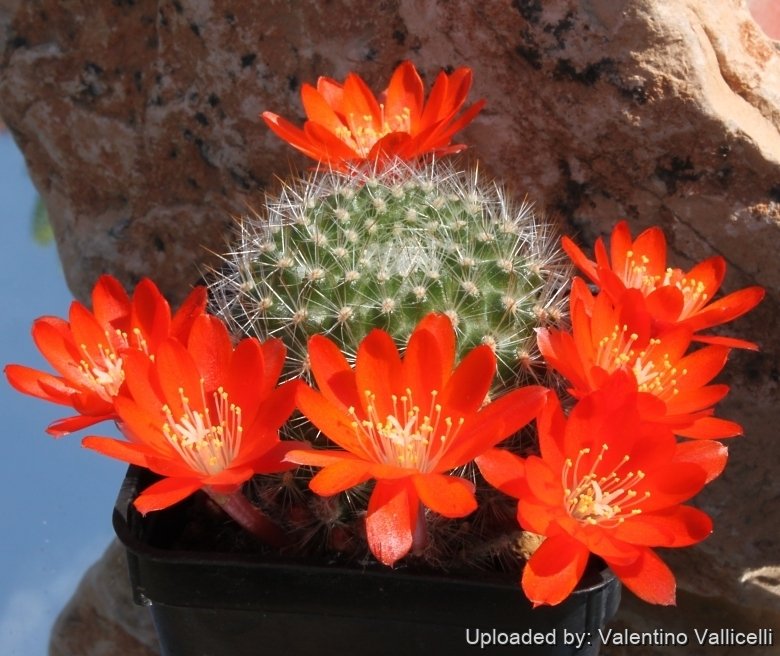
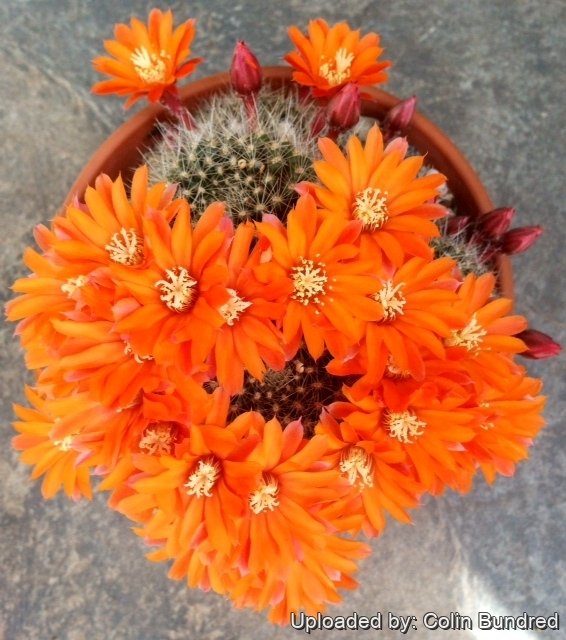
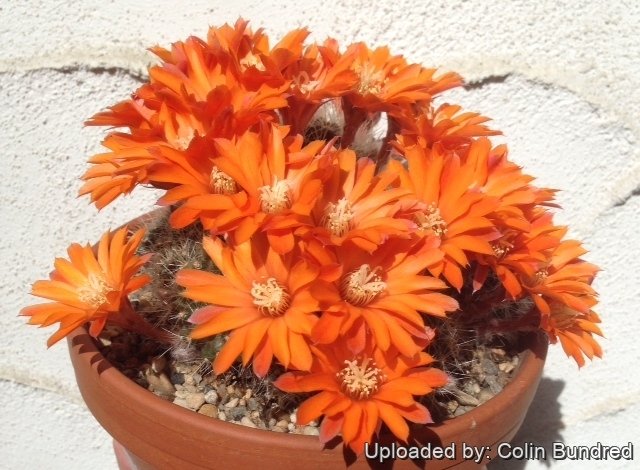
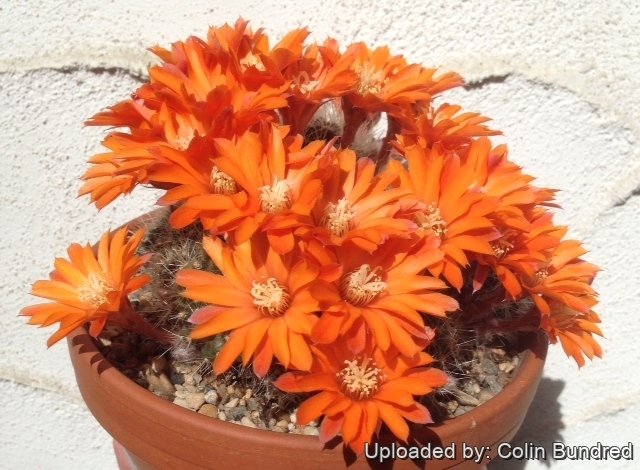
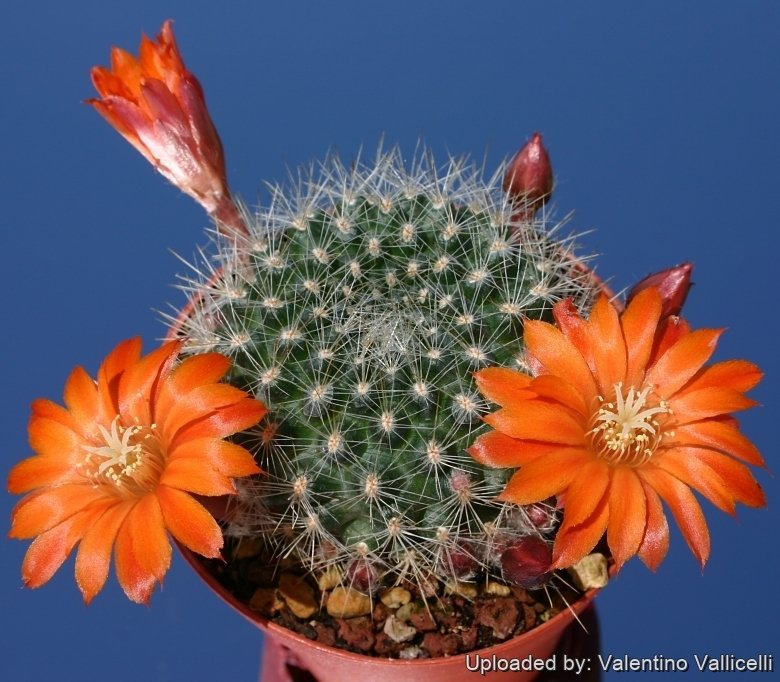
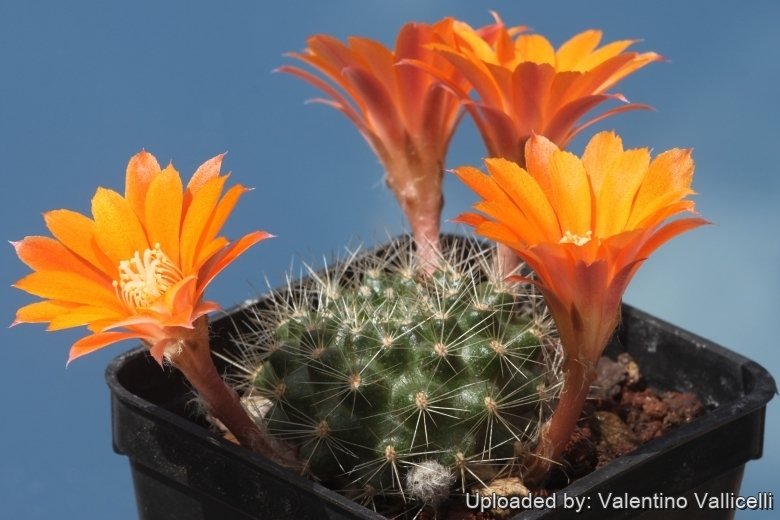
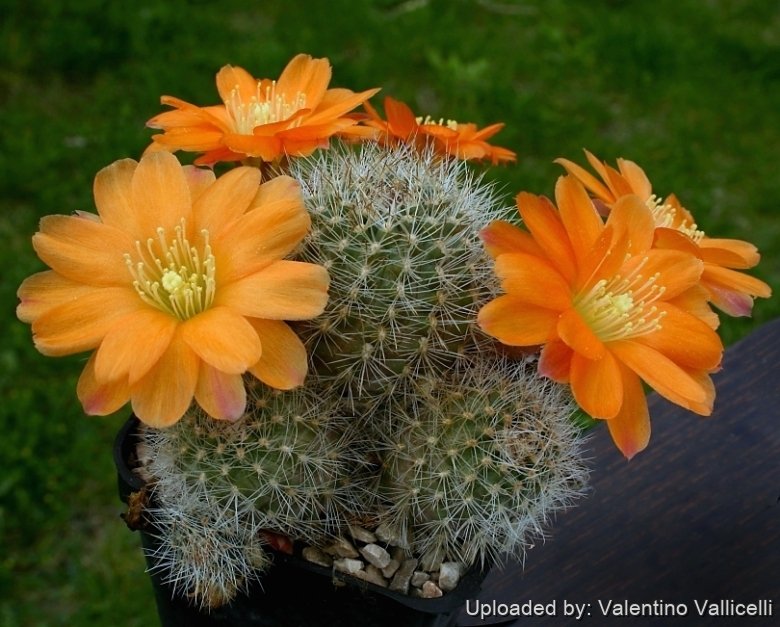
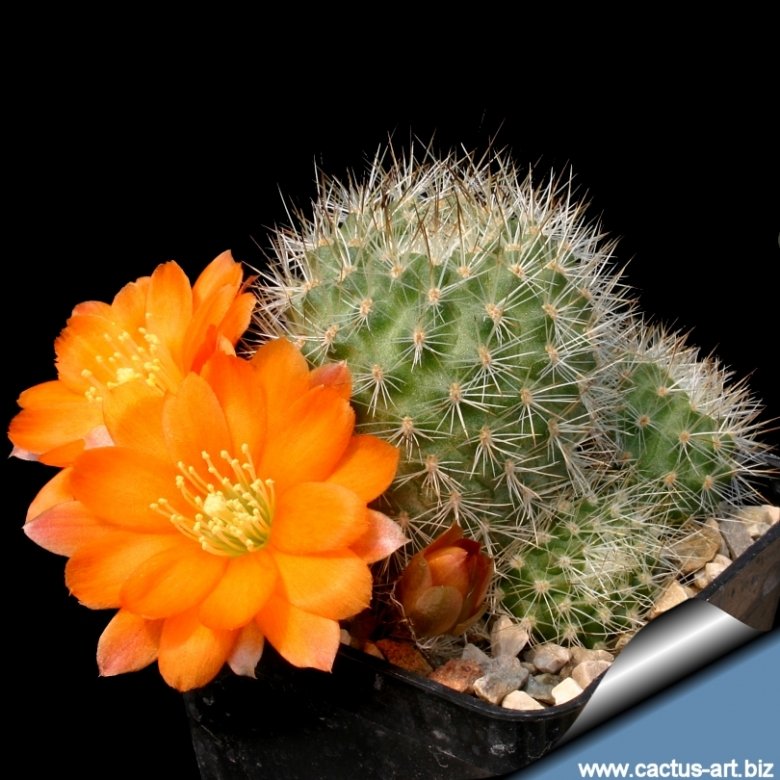
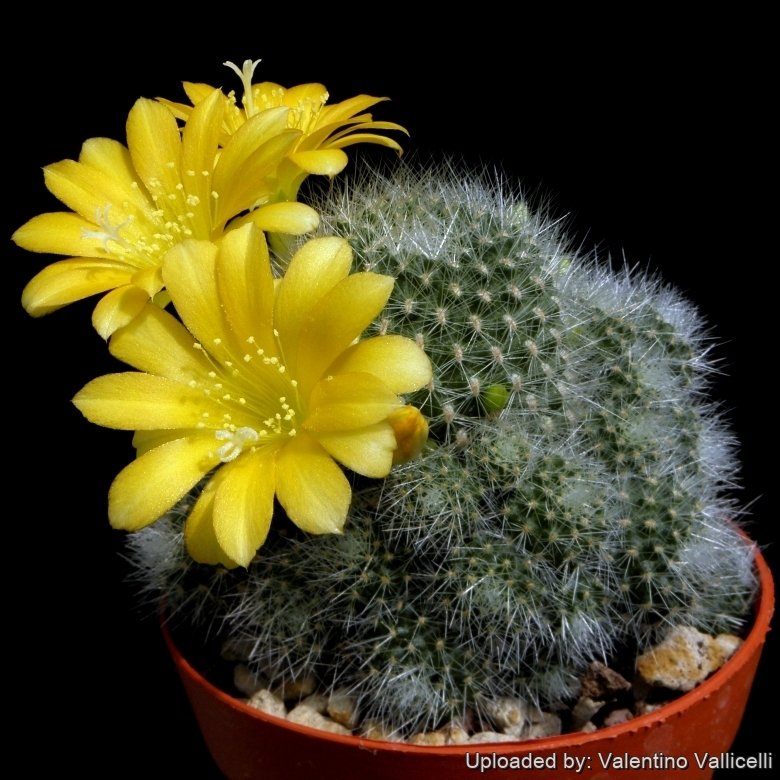
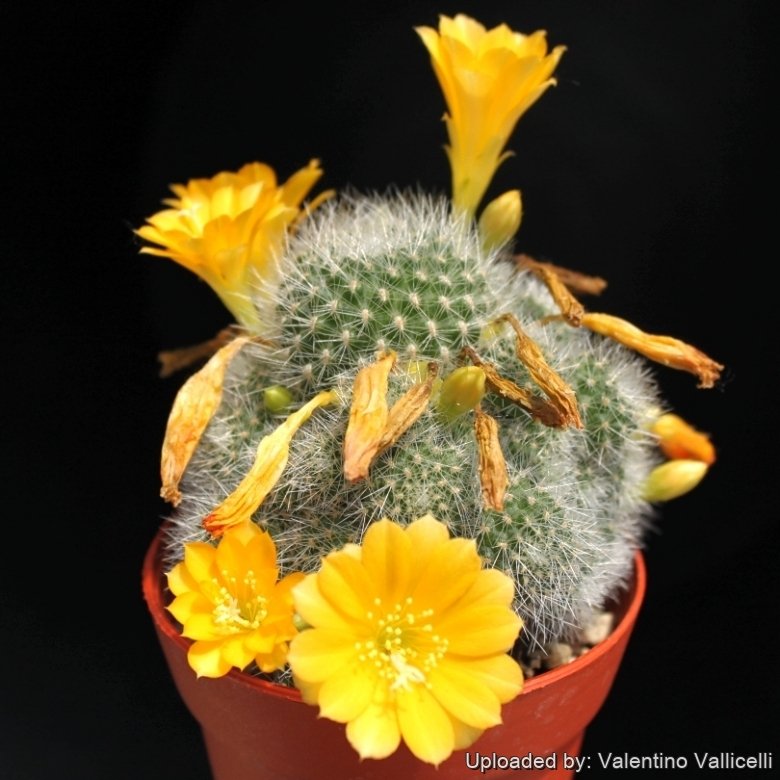
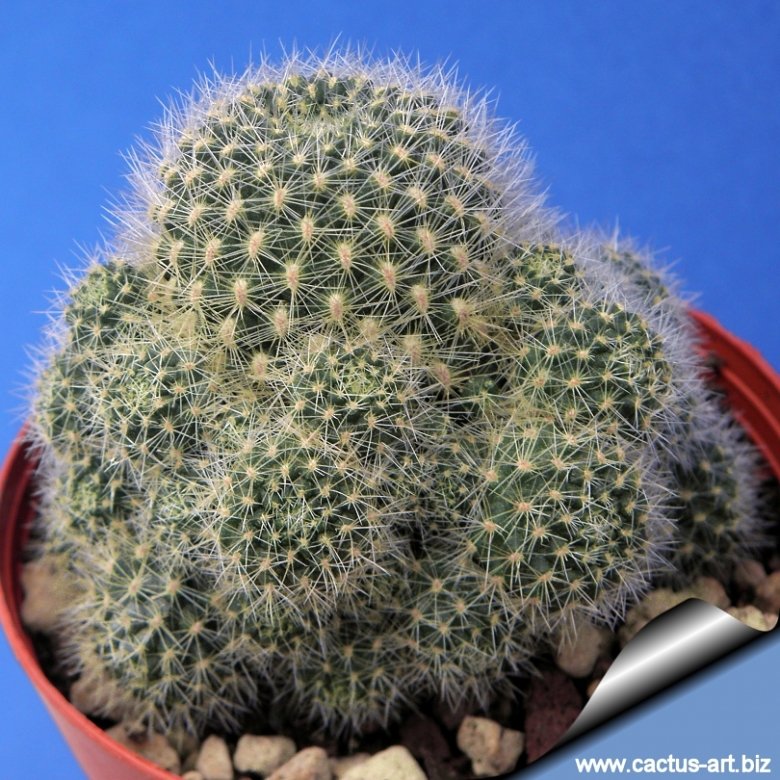
Rebutia fiebrigii is a small solitary or mound-forming cactus preading out to 15 cm with white, silky, short spines and light green tubercles thickly covering the body. It is a free-flowering species with bright vermilion blooms, but quite variable. Nowadays, under the name of Rebutia fiebrigii, botanists include several different forms, that were previously regarded as independent species.
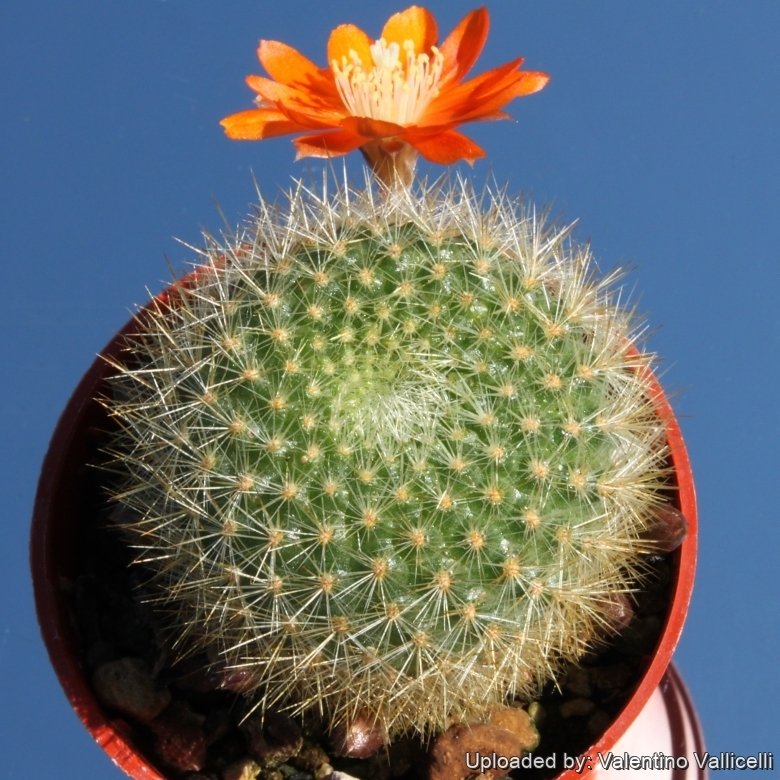
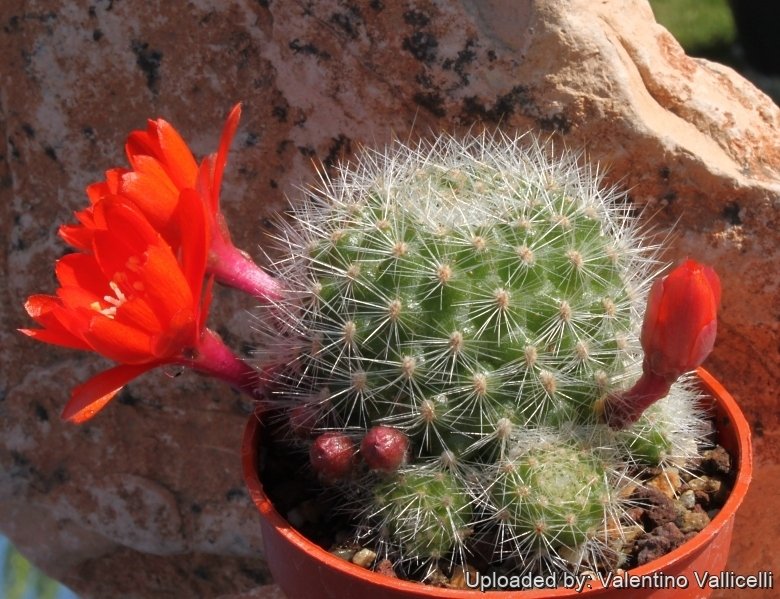
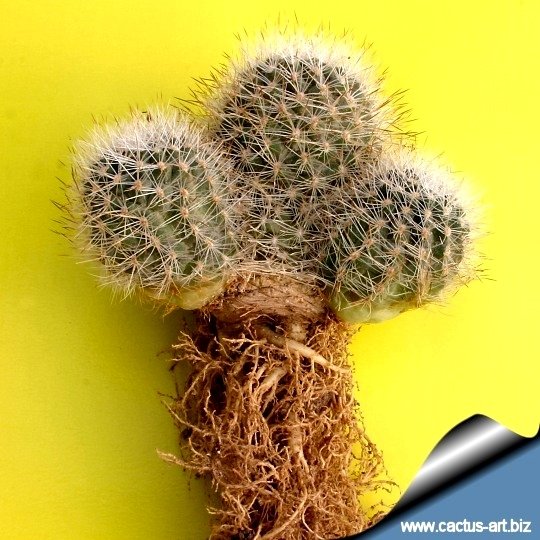
Stem: Roundish to slightly elongated, depressed at the top, 50-60 mm wide and tall, glossy green, flat, covered by distinctive tubercles similar to a Mammillaria, that are easy to see through the small spines. It grows quite close to the ground and offsets only with age. It would appear that in cultivation they grow larger and cluster more vigorously than in habitat.
Ribs: About 18, straight to spirally arranged tuberculate
Tubercles: Up to 5 mm high conical.
Areoles: Rather large, elliptical, white-tomentose.
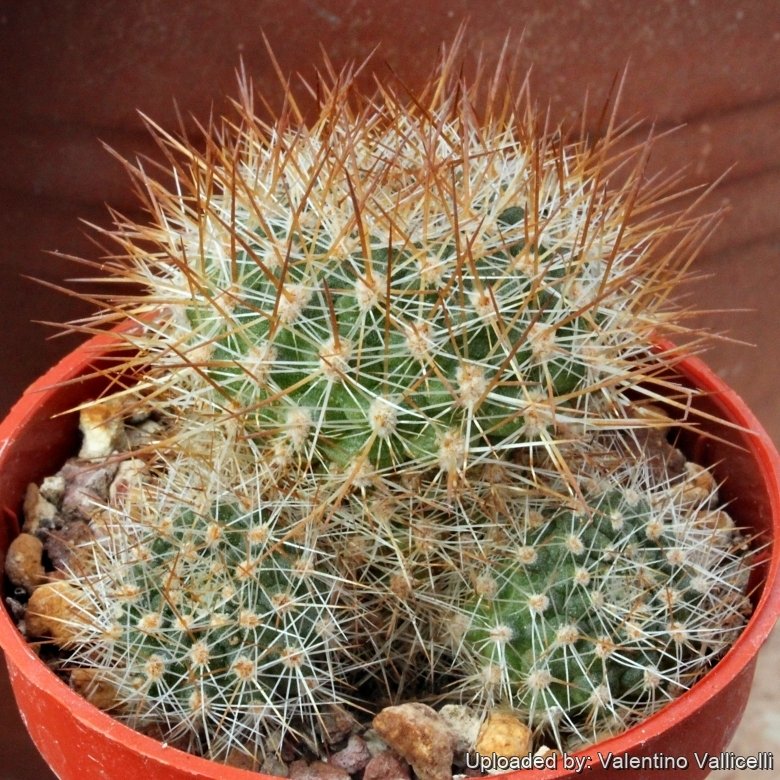
Spines: 30-40, all more or less similar, the central ones slightly larger, variously bristly, white, yellowish or pale brown, bristle-like, fine and soft.
Radial spines:About 10 mm long, white.
Central spines: 2 to 5 somewhat stronger, needle-like, to 20 mm long, light to dark brown often with brown tips.
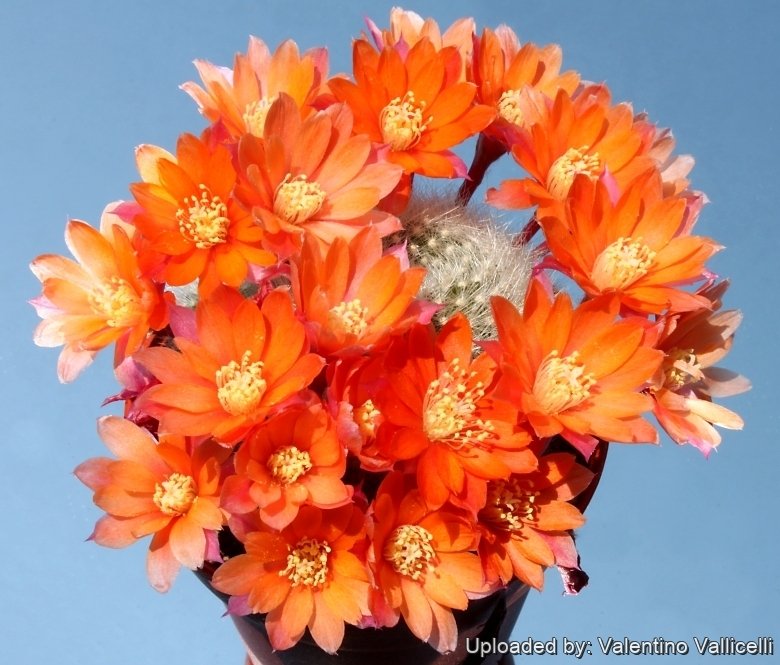
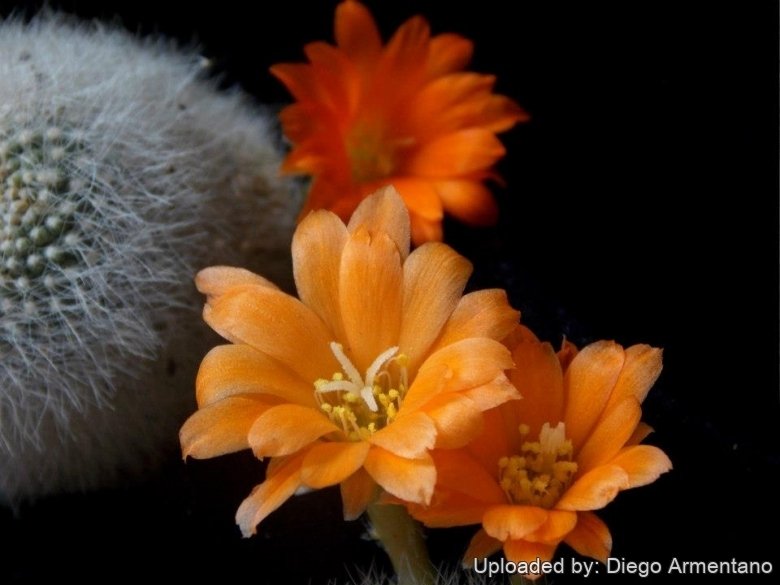
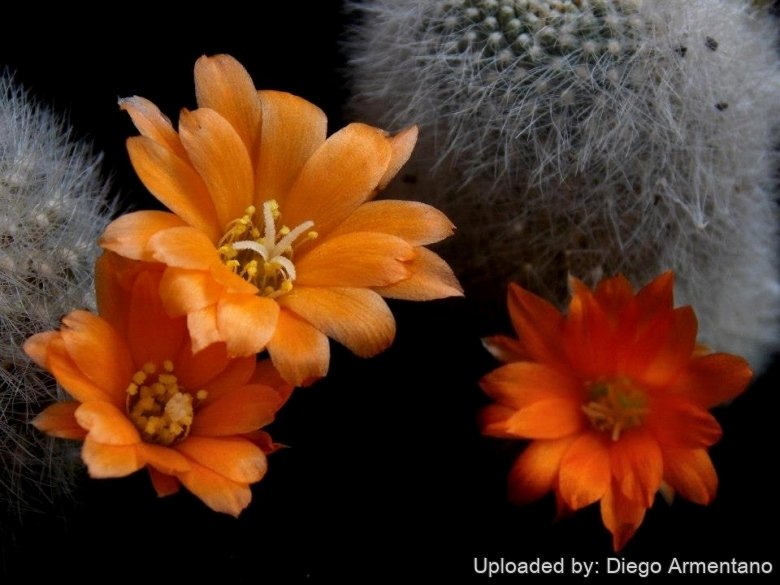
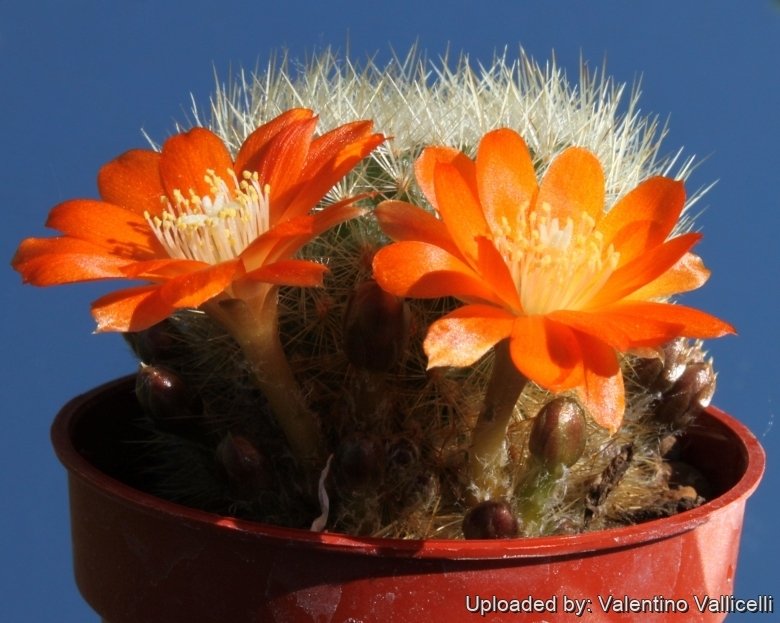
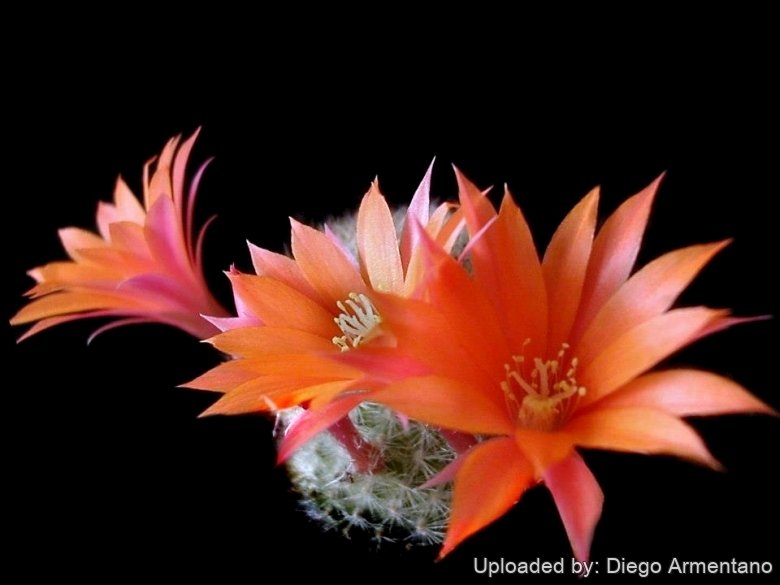
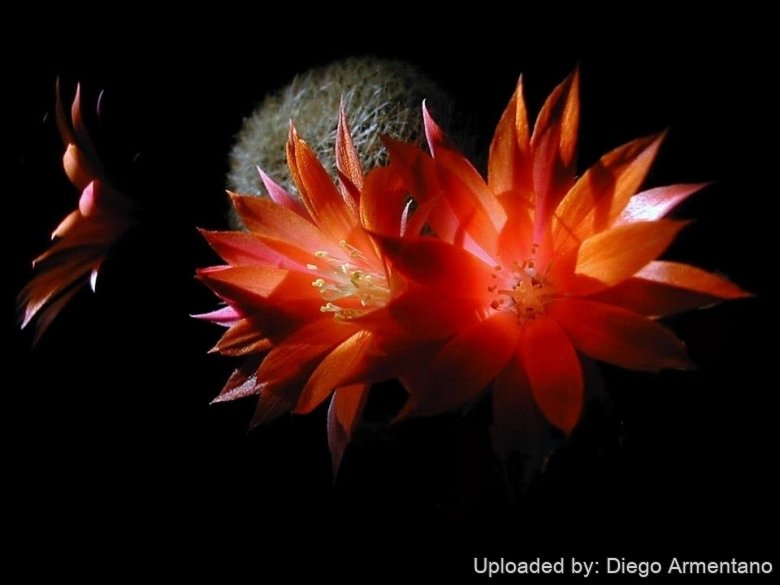
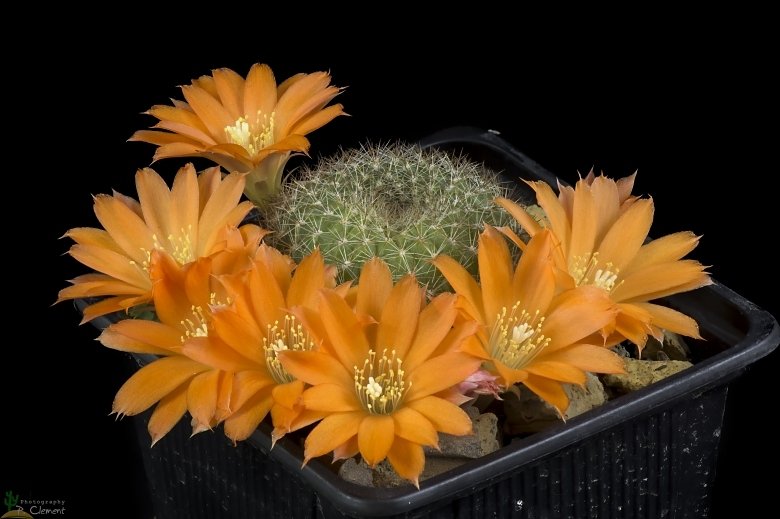
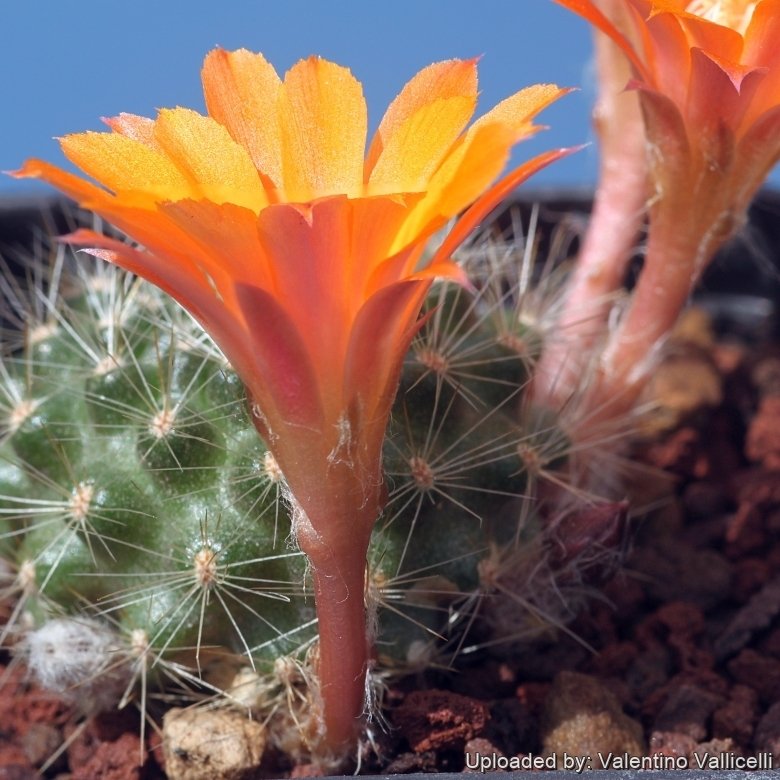
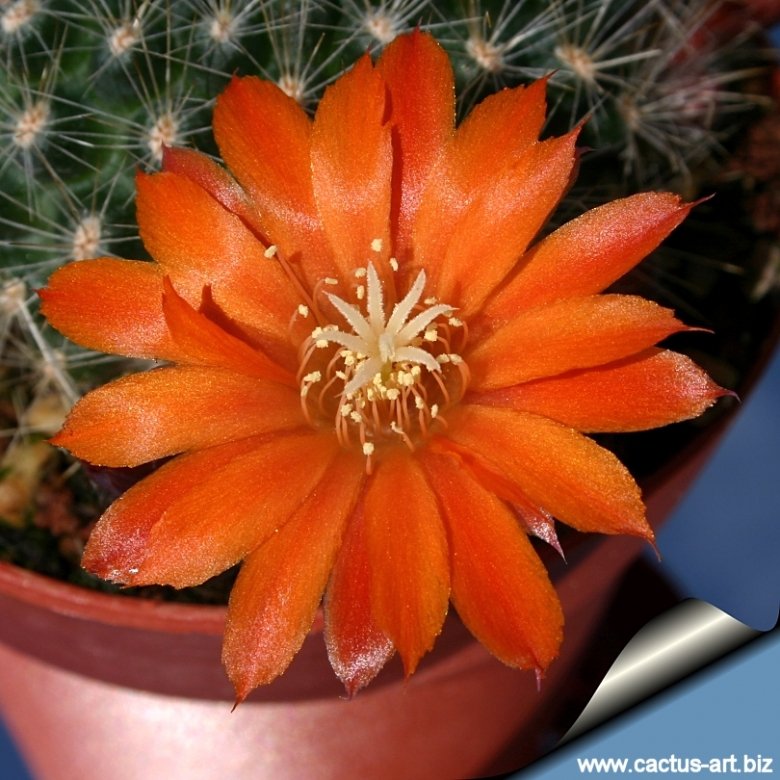
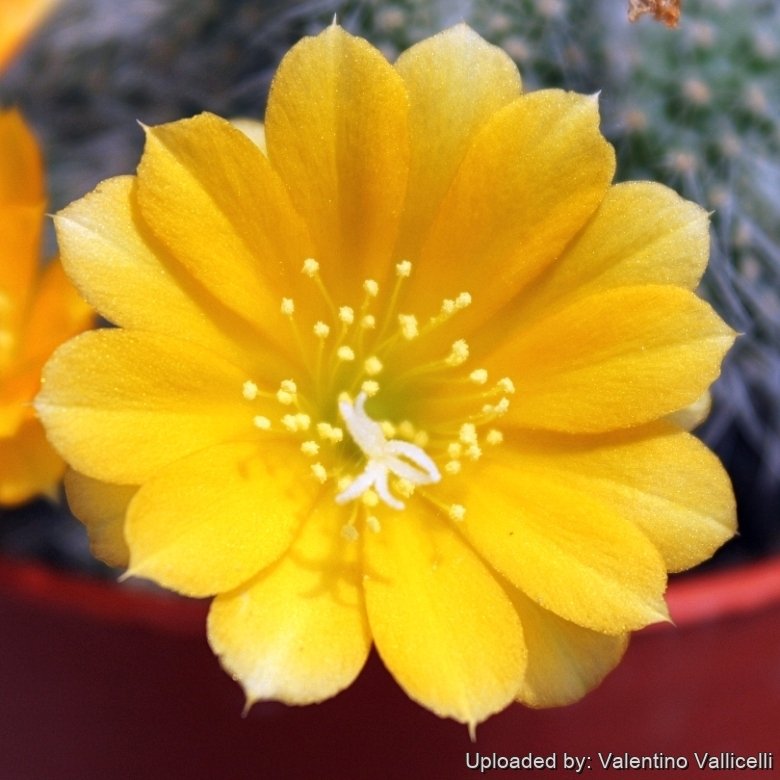
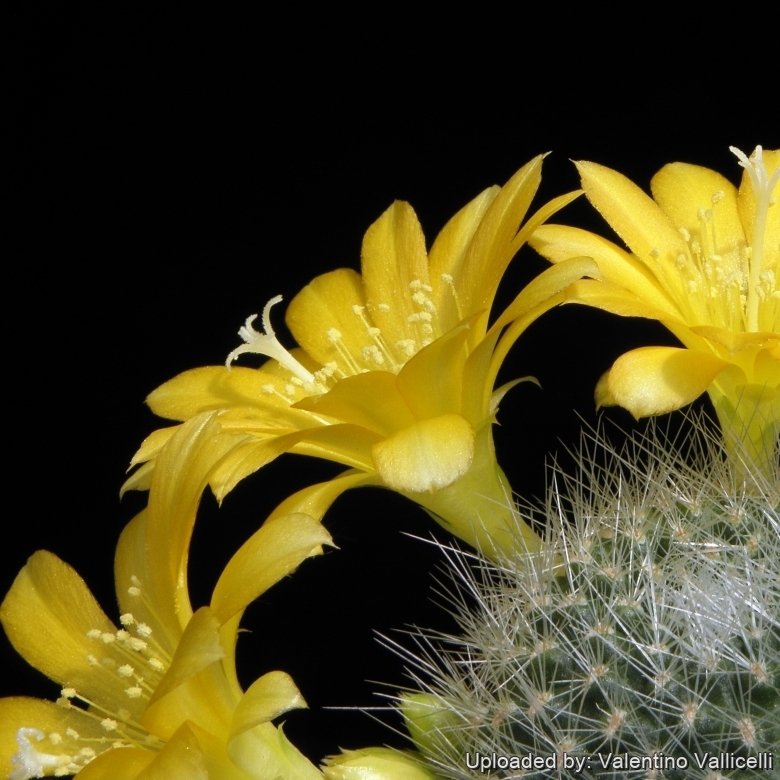
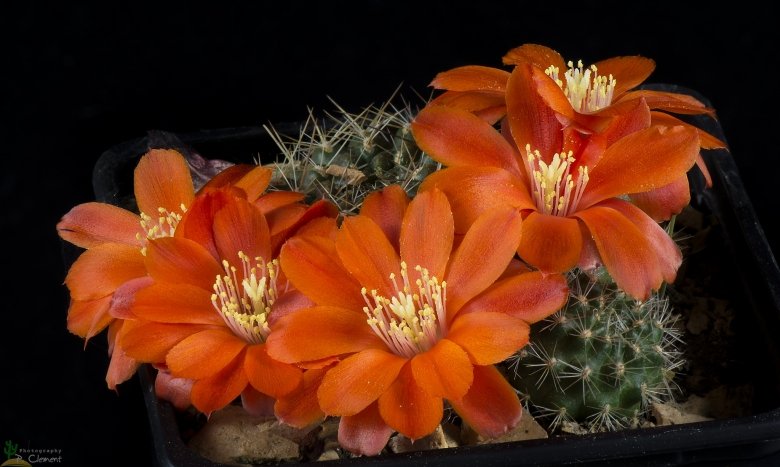
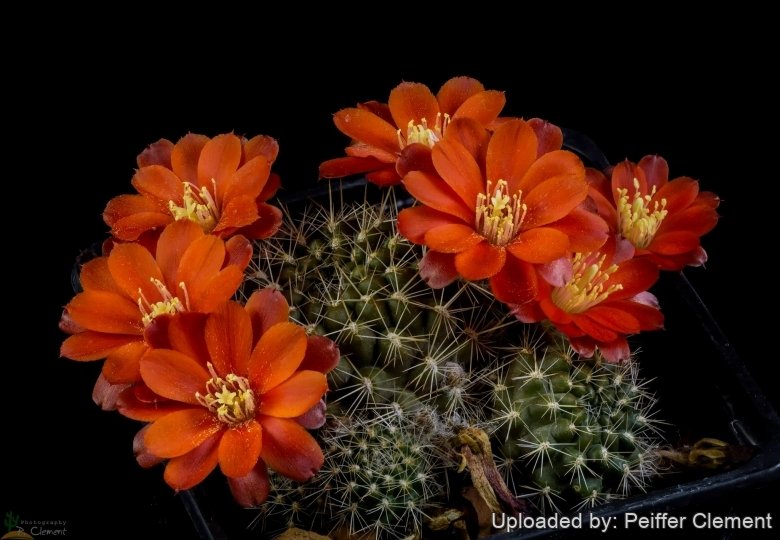
Flowers: Flowers produced halfway up the stems, curving upward, yellow, bright orange or vermilion red, funnel-shaped, 25-45 mm long, 4 cm diameter. Tube narrow 10-18 mm long, outside pale greenish to reddish, inside pale. Ovary spherical, about 4 mm wide, with small triangular scales with few white wool few white bristly hairs. Tepals vermilion red, rather rounded, often slightly serrated, 14-16 mm long, 4-6 mm wide. Filaments white, anthers golden yellow. Pistil white, with 5-6 white stigma lobes 2-3 mm long, slightly protruding the anthers.
Blooming season: Flowers all tend to come in one late Spring rush, rather than spread over the Summer, and remain open for up to six days.
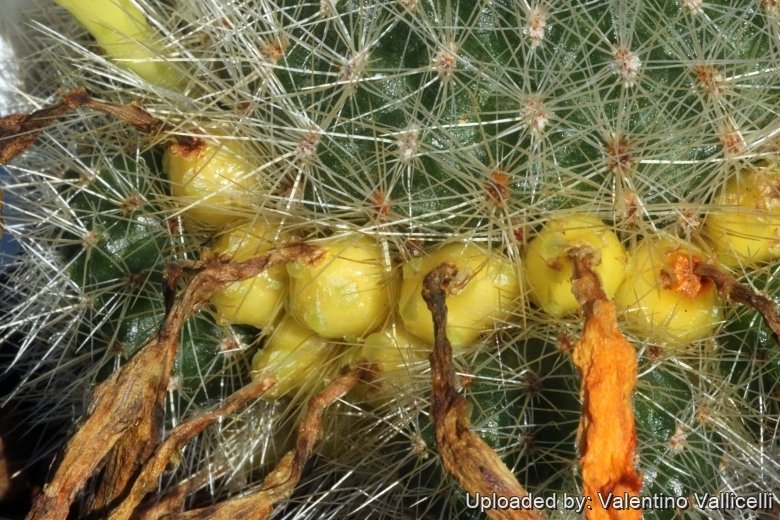
Fruit: Tiny, spherical, berrylike, about 5 mm wide, greenish-brown to purplish, with white wool and bristly, hidden among the spines, bursting when ripe.
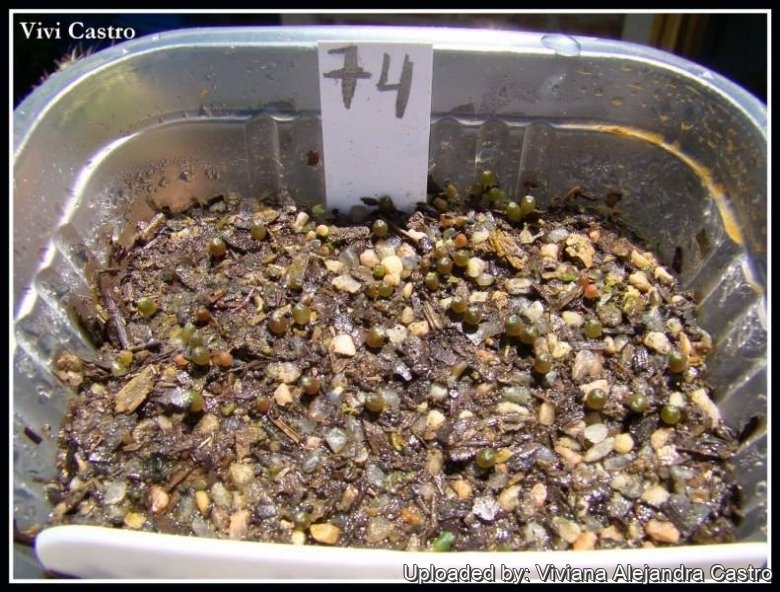
Seeds: Brown-black, about 1 mm long and 0.6 mm wide, with brownish oval hilum.
Origin and Habitat
Bolivia (Chuquisaca, Tarija, Cochabamba, Salta, Jujuy, Potosí, Santa Cruz)
Altitude: 2100-4000 metres above sea level.
Habitat: This cactus can be found in prepuna shrublands, in high, dry, rocky grasslands in valleys and rocky slopes of the Andes in fully exposed sites and in cliffs near rivers and riverbeds. Inhabitants must be very rugged in order to tolerate such extremes in exposure. Rebutia fiebrigii is such a robust individual. Rebutia fiebrigii is an abundant species. The population is stable because it is not exposed to any major threat.
Cultivation and Propagation
Rebutia narvaecensis comes from mountainous areas, so like bright light, and cool and dry conditions in the winter. It has delightful flowers and the plants remain compact, and clumps can easily be managed by division. It is easy to cultivate and recommended for beginners.
Growth rate: It is a slow growing but easily flowering species that will make clumps given the best conditions.
Soils: This species is easy to cultivate in a very open mineral mix with at least 50% sand or pumice grit and a pH slightly on the acidic side.
Repotting: They are small container size plants and prefer deep pots and good drainage to accommodate their tap roots, but they rot prone, because of the sensitivity to excess of watering, not easy to get to any large size on their own roots (it’s really a challenge to grow them into a large clump). They will occupy a small pot comfortably, and eventually remain a manageable sized house plant. It is better that they are repotted regularly. Repotting will increase the number and size of stems, and will increase the number of flowers produced. Repot yearly until they reach about 100 mm in size, then every two or three years will suffice. Repotting is best done at the end of winter, but can be done at other times, too. Do not water for a couple of weeks after repotting, to reduce risk of root rot via broken roots. A layer of ‘pea’ gravel at the bottom of the pot improves drainage. A layer of decorative gravel as a top dressing helps prevent the caking of the potting mix, which decreases the rate of water absorption. It also keeps the perlite and pumice from blowing everywhere, and looks nice.
Watering: It requires full sun or light shade and careful watering to keep plant compact, and maintain strong and dense spines and allow the pot to dry out between waterings. Keep dry in winter at a minimum temperature of 0°C. It tends to rot if too wet. The plants can be placed outdoors in April, but protected from rain and direct sunlight. Water them thoroughly when placed out, and again in two weeks, and again in one week. After one month the plants are ready to be placed out in full sun and full rain for the summer. During dry spells the collection is watered once a week, during hot dry spells, twice a week.
Fertilization: Feed with a high potassium fertilizer in summer.
Hardiness: It is reputedly resistant to frost if kept on the dry side prior to, and during, cold weather and requires a winter rest period (hardy to -7° C, or less for short periods). Rebutias grow in nature at high altitudes, and do not thrive well at high temperatures in cultivation. They will often go dormant in mid-summer, and resume growth again when the weather cools in late August. They can tolerate amazingly low temperatures for long periods of time. All species can take a frost, even when not bone dry. It is generally accepted that plants kept at too high a temperature, or watered too much during the winter rest period, will not bloom the following year. They will be perfectly happy in pots outdoors from April to September if protected from torrential rain and hail.
Exposition: The plant tolerates extremely bright situations but enjoys filtered sunlight or afternoon shade, inside it needs bright light, and some direct sun. Tends to bronze in strong light, which encourages flowering and heavy spine production, but is likely to suffer from sun scorch or stunted growth if over exposed to direct sunlight during the hottest part of the day in summer.
Uses: It is a fine plant for a rock garden or container, contrasts well with agaves, yuccas, and low-growing flowering plants. This variety is also likely to flower as a house plant, but results will depend on a variety of growing conditions.
Pests & diseases: All, especially the young, are susceptible to red spider mites.
Rot: It is especially prone to root rot, therefore, underpot in a smaller container filled with very porous compost. However rot it is only a minor problem with rebutias if the plants are watered and “aired” correctly. If they are not, fungicides won’t help all that much.
Propagation: Offsets, seeds. Seeds germinate in 7-14 days at 21-27° C in spring or summer remove gradually the glass cover as soon the plants will be well rooted (ca 1-2 weeks) and keep ventilated, no full sun for young plants! The seedlings should not be disturbed until they are well rooted, after which they can be planted separately in small pots. To make a cutting twist off a branch and permit it to dry out a couple of weeks, lay it on the soil and insert the stem end partially into the soil. Try to keep the cutting somewhat upright so that the roots are able to grow downward.
Note: It would appear that in cultivation they grow larger and cluster more vigorously than in habitat.
Bibliography
Major references and further lectures
-
Edward Anderson “The Cactus family” Timber Press, Incorporated, 2001
-
James Cullen, Sabina G. Knees, H. Suzanne Cubey “The European Garden Flora Flowering Plants: A Manual for the Identification of Plants Cultivated in Europe, Both Out-of-Doors and Under Glass” Cambridge University Press, 11/Aug/2011
-
David R Hunt; Nigel P Taylor; Graham Charles; International Cactaceae Systematics Group. “The New Cactus Lexicon” dh books, 2006
-
N. L. Britton, J. N. Rose “The Cactaceae. Descriptions and Illustrations of Plants of the Cactus Family.” Volume 4, The Carnegie Institution of Washington, Washington 1923
-
Curt Backeberg “Die Cactaceae: Handbuch der Kakteenkunde” Gustav Fischer Verlag, Stuttgart New York 1982–1985
-
Backeberg, Curt “Das Kakteenlexikon” p. 70, 1966
-
Pilbeam, John “Rebutia” p. 40, 1997
-
Ritter, Friedrich; “Kakteen in Südamerika” 2: 618, 1980
-
Šída, Otakar; “Rod Rebutia”, p. 56, 1997
-
Barbara Segall”Botanica: the illustrated A-Z of over 10,000 garden plants and how to cultivate them” Mynah, 1997
-
Lowry, M. 2013. Rebutia fiebrigii. The IUCN Red List of Threatened Species. Version 2014.3. <www.iucnredlist.org>. Downloaded on 28 April 2015.
From llifle page Aylostera albipilosa
Description
Rebutia albipilosa is a plant from northern Argentina. It’s a white-furrowed cactus with dense, long, white bristles and a large main body, with several offsets that bloom sparely but regularly.
Stem: Flattish, 3-8 cm wide, 4-6 cm tall. It would appear that in cultivation they grow larger and cluster more vigorously than in habitat.
Spines: White or cream-white, fine, long and soft, that cover the plant body.
Flower: Deep orange, funnel-shaped, 2 cm in diameter, from the base of the stems.
Fruit: Tiny, berrylike, hidden among the spines, bursting when ripe.
Origin and Habitat
Northern Argentina (Jujuy to Salta to Catamarca) and Bolivia (Tarija)
Altitude: From 3600-3700 metres a.s.l.
Habitat: It is found in high, dry, rocky grasslands in rocky slopes of the Andes in fully exposed sites. The dense covering of spines reduces the interception of solar radiation by the stem surface lowering the risks of overheating the apex during a summer day and of freezing during a winter night.
Cultivation and Propagation
Rebutia albipilosa is a summer grower species that is easy to cultivate and recommended for beginners. The whole Rebutia fiebrigii complex has delightful flowers and the plants remain compact, and clumps can easily be managed by division. Another advantage is that the plants are cold hardy in winter if kept dry.
Growth rate: It is a slow growing but easily flowering species that will make clumps given the best conditions.
Soils: This species is easy to cultivate in a very open mineral mix with at least 50% sand or pumice grit and a pH slightly on the acidic side.
Repotting: It is better that they are repotted regularly. Pots should be only slightly larger than the plant and root system. Repotting will increase the number and size of stems, and will increase the number of flowers produced. Repot yearly until they reach about 100 mm in size, then every two or three years will suffice. Repotting is best done at the end of winter, but can be done at other times, too. Do not water for a couple of weeks after repotting, to reduce risk of root rot via broken roots. A layer of ‘pea’ gravel at the bottom of the pot improves drainage. A layer of decorative gravel as a top dressing helps prevent the caking of the potting mix, which decreases the rate of water absorption. It also keeps the perlite and pumice from blowing everywhere, and looks nice.
Watering: It requires full sun or light shade and careful watering to keep plant compact, and maintain strong and dense spines and allow the pot to dry out between waterings. Keep dry in winter at a minimum temperature of 0°C. Rebutia albipilosa tends to rot if too wet. The plants can be placed outdoors in April, but protected from rain and direct sunlight. Water them thoroughly when placed out, and again in two weeks, and again in one week. After one month the plants are ready to be placed out in full sun and full rain for the summer. During dry spells the collection is watered once a week, during hot dry spells, twice a week.
Fertilization: Feed with a high potassium fertilizer in summer.
Hardiness: It is reputedly resistant to frost if kept on the dry side prior to, and during, cold weather and requires a winter rest period (hardy to -7° C, or less for short periods). Rebutias grow in nature at high altitudes, and do not thrive well at high temperatures in cultivation. They will often go dormant in mid-summer, and resume growth again when the weather cools in late August. They can tolerate amazingly low temperatures for long periods of time. All species can take a frost, even when not bone dry. It is generally accepted that plants kept at too high a temperature, or watered too much during the winter rest period, will not bloom the following year. They will be perfectly happy in pots outdoors from April to September if protected from torrential rain and hail.
Exposition: The plant tolerates extremely bright situations but enjoys filtered sunlight or afternoon shade, inside it needs bright light, and some direct sun. Tends to bronze in strong light, which encourages flowering and heavy spine production, but is likely to suffer from sun scorch or stunted growth if over exposed to direct sunlight during the hottest part of the day in summer.
Uses: It is an excellent plant for container growing. It always looks good and stays small. It look fine in a cold greenhouse and frame or outdoor in a rockery.
Pests & diseases: All, especially the young, are susceptible to red spider mites.
Rot: This species is particularly easy and accommodating, seldom suffer of cryptogamic diseases. Rot it is only a minor problem with rebutias if the plants are watered and “aired” correctly. If they are not, fungicides won’t help all that much.
Propagation: Offsets, seeds. Seeds germinate in 7-14 days at 21-27° C in spring, remove gradually the glass cover as soon the plants will be well rooted (ca 1-2 weeks) and keep ventilated, no full sun for young plants! To make a cutting twist off a branch and permit it to dry out a couple of weeks, lay it on the soil and insert the stem end partially into the soil. Try to keep the cutting somewhat upright so that the roots are able to grow downward.
Note: It would appear that in cultivation they grow larger and cluster more vigorously than in habitat.
Bibliography
Major references and further lectures
-
Edward Anderson “The Cactus family” Timber Press, Incorporated, 2001
-
James Cullen, Sabina G. Knees, H. Suzanne Cubey “The European Garden Flora Flowering Plants: A Manual for the Identification of Plants Cultivated in Europe, Both Out-of-Doors and Under Glass” Cambridge University Press, 11/Aug/2011
-
David R Hunt; Nigel P Taylor; Graham Charles; International Cactaceae Systematics Group. “The New Cactus Lexicon” dh books, 2006
-
N. L. Britton, J. N. Rose “The Cactaceae. Descriptions and Illustrations of Plants of the Cactus Family.” Volume 4, The Carnegie Institution of Washington, Washington 1923
-
Curt Backeberg “Die Cactaceae: Handbuch der Kakteenkunde” Gustav Fischer Verlag, Stuttgart New York 1982–1985
-
Backeberg, Curt “Das Kakteenlexikon” p. 70, 1966
-
Pilbeam, John “Rebutia” (ISBN 0-9528302-2-1)
Source: Aylostera albipilosa, LLIFLE - Encyclopedia of living forms, CC-BY-SA, retrieved 2026-10-25.
From llifle page Aylostera azurduyensis
Description
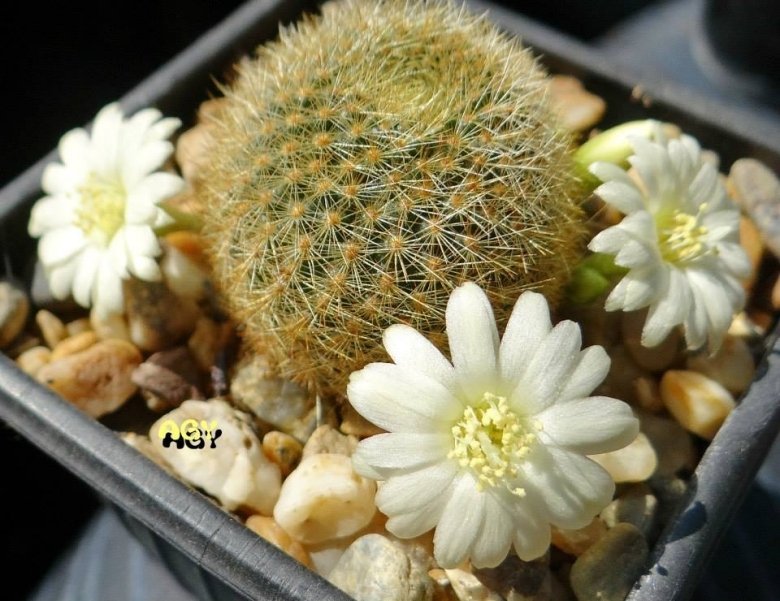
Aylostera azurduyensis is a local or morphological form of the widespread and very variable Rebutia fiebrigii. It is a small mound-forming cactus with yellowish to brownish, silky, short spines and peculiar white blooms. However the distinguishing characteristics of Aylostera azurduyensis, appear to fall within the natural variation of Aylostera azurduyensis and it should be synonymized with the latter.
Origin and Habitat
Azurduy to La Angostura, Bolivia.
Altitude range: Around 2350-2450 metres above sea level.
Cultivation and Propagation
Rebutia fiebrigii comes from mountainous areas, so like bright light, and cool and dry conditions in the winter. The whole Rebutia fiebrigii complex has delightful flowers and the plants remain compact, and clumps can easily be managed by division. It is easy to cultivate and recommended for beginners.
Growth rate: It is a slow growing but easily flowering species that will make clumps given the best conditions.
Soils: This species is easy to cultivate in a very open mineral mix with at least 50% sand or pumice grit and a pH slightly on the acidic side.
Repotting: They are small container size plants and prefer deep pots and good drainage to accommodate their tap roots, but they rot prone, because of the sensitivity to excess of watering, not easy to get to any large size on their own roots (it’s really a challenge to grow them into a large clump). They will occupy a small pot comfortably, and eventually remain a manageable sized house plant. It is better that they are repotted regularly. Repotting will increase the number and size of stems, and will increase the number of flowers produced. Repot yearly until they reach about 100 mm in size, then every two or three years will suffice. Repotting is best done at the end of winter, but can be done at other times, too. Do not water for a couple of weeks after repotting, to reduce risk of root rot via broken roots. A layer of ‘pea’ gravel at the bottom of the pot improves drainage. A layer of decorative gravel as a top dressing helps prevent the caking of the potting mix, which decreases the rate of water absorption. It also keeps the perlite and pumice from blowing everywhere, and looks nice.
Watering: It requires full sun or light shade and careful watering to keep plant compact, and maintain strong and dense spines and allow the pot to dry out between waterings. Keep dry in winter at a minimum temperature of 0°C. It tends to rot if too wet. The plants can be placed outdoors in April, but protected from rain and direct sunlight. Water them thoroughly when placed out, and again in two weeks, and again in one week. After one month the plants are ready to be placed out in full sun and full rain for the summer. During dry spells the collection is watered once a week, during hot dry spells, twice a week.
Fertilization: Feed with a high potassium fertilizer in summer.
Hardiness: It is reputedly resistant to frost if kept on the dry side prior to, and during, cold weather and requires a winter rest period (hardy to -7° C, or less for short periods). Rebutias grow in nature at high altitudes, and do not thrive well at high temperatures in cultivation. They will often go dormant in mid-summer, and resume growth again when the weather cools in late August. They can tolerate amazingly low temperatures for long periods of time. All species can take a frost, even when not bone dry. It is generally accepted that plants kept at too high a temperature, or watered too much during the winter rest period, will not bloom the following year. They will be perfectly happy in pots outdoors from April to September if protected from torrential rain and hail.
Exposition: The plant tolerates extremely bright situations but enjoys filtered sunlight or afternoon shade, inside it needs bright light, and some direct sun. Tends to bronze in strong light, which encourages flowering and heavy spine production, but is likely to suffer from sun scorch or stunted growth if over exposed to direct sunlight during the hottest part of the day in summer.
Uses: It is a fine plant for a rock garden or container, contrasts well with agaves, yuccas, and low-growing flowering plants. This variety is also likely to flower as a house plant, but results will depend on a variety of growing conditions.
Pests & diseases: All, especially the young, are susceptible to red spider mites.
Rot: It is especially prone to root rot, therefore, underpot in a smaller container filled with very porous compost. However rot it is only a minor problem with rebutias if the plants are watered and “aired” correctly. If they are not, fungicides won’t help all that much.
Propagation: Offsets, seeds. Seeds germinate in 7-14 days at 21-27° C in spring or summer remove gradually the glass cover as soon the plants will be well rooted (ca 1-2 weeks) and keep ventilated, no full sun for young plants! The seedlings should not be disturbed until they are well rooted, after which they can be planted separately in small pots. To make a cutting twist off a branch and permit it to dry out a couple of weeks, lay it on the soil and insert the stem end partially into the soil. Try to keep the cutting somewhat upright so that the roots are able to grow downward.
Note: It would appear that in cultivation they grow larger and cluster more vigorously than in habitat.
Source: Aylostera azurduyensis, LLIFLE - Encyclopedia of living forms, CC-BY-SA, retrieved 2026-10-25.
From llifle page Aylostera cajasensis
Description
Small clumping cactus with fine silvery spines arranged on globes so that it looks like orbs covered with small, white spiders. It readily forms a clustering mound.
The variety “Cajasensis” specifically describes the population from the Desfiladero de Cajas (altitude 2500 m) with orange-red or red flowers, larger heads with silvery pectinated spines. Some books state that Rebutia heliosa v. cajasensis looks pretty much like many of the forms of Rebutia heliosa v. condorensis but lighter spined. Indeed, some books make both these varieties synonymous, whereas.
Root: Tap root.
Stem: Grey green, 2-3(-4) cm wide, rarely higher than 4 cm.
Ribs: Spiraling with very tiny tubercles.
Areoles: Small, with brown felt and elongated.
Spines: only radials 2-4(-5) mm long, silvery white, pectinated, spider-like, covering almost completely the small stems in a spiral pattern.
Flower: Large dark-orange to red, funnel-shaped, long -necked, 4 cm in diameter, 5 cm long.
Blossoming time: Profusely flowering in spring. (Rebutias are self-fertilizing but aylosteras are not, and the latter can be fooled by introducing foreign pollen and then re-pollinating with its own pollen.)
Origin and Habitat
Cajas, Alto Cajas and Yesera, Mendez, Tarija, Bolivia.
Habitat: It grows in mountainous areas at an altitude around 2500 m 2800 m over sea level
Cultivation and Propagation
These plants come from mountainous areas, so like bright light, cool and dry conditions in the winter; this is important for the flowers as well as for their health. Without this cool winter period (0-10° C) they normally won’t get many buds. They have a thick taproot and are of difficult cultivation and rot prone because of a great sensitivity to the excess of watering, not easy to get to any large size on their own roots really a challenge to grow into a large clump. They are commonly grafted to avoid root problems and to make easier to grow. Sun Exposure: Suited for sunny-brightly exposure; can tolerate light shade.
Cultural Practices: Suited for airy exposures. Needs deep pot and good drainage to accommodate its tap root. It is very cold resistant as low as to -10° C or less for short periods of time. It is a fine plant for a rock garden or container, contrasts well with agaves, yuccas, and low-growing flowering plants.
Pests & diseases: R. heliosa is especially prone to root rot, therefore, underpot in a smaller container filled with very porous compost.
Propagation: Cutting as it branches freely from the base; Also can be grown from seeds or graft. Seeds can be sown in the spring or summer. The seedlings should not be disturbed until they are well rooted, after which they can be planted separately in small pots.
Source: Aylostera cajasensis, LLIFLE - Encyclopedia of living forms, CC-BY-SA, retrieved 2026-10-25.
From llifle page Aylostera muscula
Description
Rebutia muscula is one of the many geographical forms of the extremely variable Rebutia fiebrigii. The Rebutia muscula forms form low cushion covered by dense furry white spines and produces vibrant orange-red flower. The dense spines would protect it from the extremes of cold and sunshine.
Habit: It is a small solitary or mound-forming cactus spreading out to 15 cm. It grows quite close to the ground and offsets only with age. It would appear that in cultivation they grow larger and cluster more vigorously than in habitat.
Roots: Fibrous.
Stem: Hemispherical, later elongated, somewhat depressed at apex, pale green, 3-4 cm wide, 4 cm tall. The stems of this cactus grow usually taller than they are broad. It would appear that in cultivation they grow larger and cluster more vigorously than in habitat.
Ribs: 25-40, with almost square tubercles, about 2 mm high.
Areoles: Short oval, 1-1,5 mm long, on the tops of tubecles, white tomentose, about 3 mm apart.
Spines: About 50 (in cultivation often less, to about 30), bright white, 2-4 mm long, spreading in all directions, fine and soft tightly enveloping the plant body. Central spines hardly distinguishable, somewhat shorter.
Flower: Deep orange, funnel-shaped, up to 3,5 cm long, 2-3 cm in diameter from the base of the stems. Ovary green, with small scales, with with white woolly flakes and about 10 whitish hairy bristles in the axils; Floral tube funnel-shaped about 15 mm long, 3,5 mm wide at the base, above about 5 mm wide, outside light olive green, glossy, green-scaled, with hair and several soft white thin bristle. Tepals, pale reddish orange, about 20 mm long and 5 mm wide, inner ones darker and serrated at the tips, outers more pointed, all widely spread. Filaments whitish, 7-8 mm long, mounted in two series, on the the bottom and the edge of the tube. Anthers yellow. Pistil whitish, with 4-5 yellowish stigma lobes, about 4 mm long, protruding above the highest anthers. There is also a white flowering form.
Blooming Season: Flowers profusely throughout spring into summer with spurts of flowering into autumn.
Fruit: Tiny, berrylike, about 5 mm large, spherical, green-brown, with flowers remnants hidden among the spines, bursting when ripe.
Seeds: Black, about 1,2 mm long, 0,8 x 0,7 mm wide, elongate oval, with a more curved dorsal side, testa with small, tubercles, hilum basal brownish.
Remarks: Rebutia muscula is quite variable. The differences usually concern only the spination, along with the more common pure white forms, there are also plants with yellow spines. However the colouring of spines is greatly influenced by the conditions of culture, at lower light levels the spines are less numerous, delicate and white, while with strong solar radiation the spines are stronger with a yellowish tint. Minor differences can also be found in the colour of flowers sometime with a more yellow tint.
Origin and Habitat
Tarija, Bolivia.
Altitude: 1800-3000 metres above sea level.
Habitat: It is found in high, dry, rocky grasslands in rocky slopes of the Andes in fully exposed sites. The dense covering of spines reduces the interception of solar radiation by the stem surface lowering the risks of overheating the apex during a summer day and of freezing during a winter night.
Cultivation and Propagation
Rebutia muscula is a summer grower species that is easy to cultivate and recommended for beginners. The whole Rebutia fiebrigii complex has delightful flowers and the plants remain compact, and clumps can easily be managed by division. Another advantage is that the plants are cold hardy in winter if kept dry.
Growth rate: It is a slow growing but easily flowering species that will make clumps given the best conditions.
Soils: This species is easy to cultivate in a very open mineral mix with at least 50% sand or pumice grit and a pH slightly on the acidic side.
Repotting: It is better that they are repotted regularly. Pots should be only slightly larger than the plant and root system. Repotting will increase the number and size of stems, and will increase the number of flowers produced. Repot yearly until they reach about 100 mm in size, then every two or three years will suffice. Repotting is best done at the end of winter, but can be done at other times, too. Do not water for a couple of weeks after repotting, to reduce risk of root rot via broken roots. A layer of ‘pea’ gravel at the bottom of the pot improves drainage. A layer of decorative gravel as a top dressing helps prevent the caking of the potting mix, which decreases the rate of water absorption. It also keeps the perlite and pumice from blowing everywhere, and looks nice.
Watering: It requires full sun or light shade and careful watering to keep plant compact, and maintain strong and dense spines and allow the pot to dry out between waterings. Keep dry in winter at a minimum temperature of 0°C. Rebutia albipilosa tends to rot if too wet. The plants can be placed outdoors in April, but protected from rain and direct sunlight. Water them thoroughly when placed out, and again in two weeks, and again in one week. After one month the plants are ready to be placed out in full sun and full rain for the summer. During dry spells the collection is watered once a week, during hot dry spells, twice a week.
Fertilization: Feed with a high potassium fertilizer in summer.
Hardiness: It is reputedly resistant to frost if kept on the dry side prior to, and during, cold weather and requires a winter rest period (hardy to -7° C, or less for short periods). Rebutias grow in nature at high altitudes, and do not thrive well at high temperatures in cultivation. They will often go dormant in mid-summer, and resume growth again when the weather cools in late August. They can tolerate amazingly low temperatures for long periods of time. All species can take a frost, even when not bone dry. It is generally accepted that plants kept at too high a temperature, or watered too much during the winter rest period, will not bloom the following year. They will be perfectly happy in pots outdoors from April to September if protected from torrential rain and hail.
Exposition: The plant tolerates extremely bright situations but enjoys filtered sunlight or afternoon shade, inside it needs bright light, and some direct sun. Tends to bronze in strong light, which encourages flowering and heavy spine production, but is likely to suffer from sun scorch or stunted growth if over exposed to direct sunlight during the hottest part of the day in summer.
Uses: It is an excellent plant for container growing. It always looks good and stays small. It look fine in a cold greenhouse and frame or outdoor in a rockery.
Pests & diseases: All, especially the young, are susceptible to red spider mites.
Rot: This species is particularly easy and accommodating, seldom suffer of cryptogamic diseases. Rot it is only a minor problem with rebutias if the plants are watered and “aired” correctly. If they are not, fungicides won’t help all that much.
Propagation: Offsets, seeds. Seeds germinate in 7-14 days at 21-27° C in spring, remove gradually the glass cover as soon the plants will be well rooted (ca 1-2 weeks) and keep ventilated, no full sun for young plants! To make a cutting twist off a branch and permit it to dry out a couple of weeks, lay it on the soil and insert the stem end partially into the soil. Try to keep the cutting somewhat upright so that the roots are able to grow downward.
Note: It would appear that in cultivation they grow larger and cluster more vigorously than in habitat.
Bibliography
Major references and further lectures
-
Edward Anderson “The Cactus family” Timber Press, Incorporated, 2001
-
James Cullen, Sabina G. Knees, H. Suzanne Cubey “The European Garden Flora Flowering Plants: A Manual for the Identification of Plants Cultivated in Europe, Both Out-of-Doors and Under Glass” Cambridge University Press, 11/Aug/2011
-
David R Hunt; Nigel P Taylor; Graham Charles; International Cactaceae Systematics Group. “The New Cactus Lexicon” dh books, 2006
-
Curt Backeberg “Die Cactaceae: Handbuch der Kakteenkunde” Gustav Fischer Verlag, Stuttgart New York 1982–1985
-
Backeberg, Curt; “Descriptio Cactacearum Novarum”, 3: 5, 1963
-
Backeberg, Curt; “Das Kakteenlexikon” p. 70, 1966
-
Donald, John Donald; “Cactus & Succulent Journal of GB”, 27: 78, 1965
-
Donald, John Donald; “Ashingtonia”, 2:181, 1975
-
Haage, Walter; “Kakteen von A bis Z”, p. 44, 1981
-
Pilbeam, John; “Rebutia” (ISBN 0-9528302-2-1), p. 76, 1997
-
Ritter, Friedrich; “Kakteen in Südamerika”, 2: 618, 1980
-
Šída, Otakar; “Rod Rebutia” (ISBN 80-901383-5-7), p. 60, 1997
-
Veverka, Miroslav; “Atlas kaktusů”, tab. 41, 1995
-
Lowry, M. 2013. Rebutia fiebrigii. The IUCN Red List of Threatened Species. Version 2014.3. <www.iucnredlist.org>. Downloaded on 28 April 2015.
-
N. L. Britton, J. N. Rose “The Cactaceae. Descriptions and Illustrations of Plants of the Cactus Family.” Volume 4, The Carnegie Institution of Washington, Washington 1923
Source: Aylostera muscula, LLIFLE - Encyclopedia of living forms, CC-BY-SA, retrieved 2026-10-25.
From llifle page Rebutia pulchella
Description
Rebutia pulchella is probably one of the many geographical forms of the extremely variable Rebutia fiebrigii. It is a small mound-forming cactus spreading out to 15 cm, with clumping, heads 2.5 cm wide, 4 cm tall with light green tubercles thickly covering the body. The spines are glassy-white, silky, short. It produces vibrant orange-red flower.
Habit: Mound-forming plant with bristly white spines. It grows quite close to the ground and offsets only with age. It would appear that in cultivation they grow larger and cluster more vigorously than in habitat.
Stem: 2.5(-3) cm wide, up to 4 cm tall, dark, flat, covered by distinctive tubercles similar to a Mammillaria, that are easy to see through the small spines.
Spines: White, fine and soft.
Flowers: Startling bright orange, funnel-shaped, 4,5 cm. long, 4 cm diameter from the base of the stems. Stigma lobes white.
Blooming season: Flowers are produced profusely in spring, and remain open for up to six days.
Fruit: Tiny, berrylike, hidden among the spines, bursting when ripe.
Remarks: Nowadays, under the name of Rebutia fiebrigii, botanists include several different forms, that were previously regarded as independent species.
Origin and Habitat
Bolivia (Sucre, Chuquisaca, and Tarija).
Altitude range: It grows at around 2200 metres above sea level.
Habitat: It is found in high, dry, rocky grasslands in rocky slopes of the Andes in fully exposed sites. The dense covering of spines reduces the interception of solar radiation by the stem surface lowering the risks of overheating the apex during a summer day and of freezing during a winter night.
Cultivation and Propagation
Rebutia pulchella is a summer grower species that is easy to cultivate and recommended for beginners. The whole Rebutia fiebrigii complex has delightful flowers and the plants remain compact, and clumps can easily be managed by division. Another advantage is that the plants are cold hardy in winter if kept dry.
Growth rate: It is a slow growing but easily flowering species that will make clumps given the best conditions.
Soils: This species is easy to cultivate in a very open mineral mix with at least 50% sand or pumice grit and a pH slightly on the acidic side.
Repotting: It is better that they are repotted regularly. Pots should be only slightly larger than the plant and root system. Repotting will increase the number and size of stems, and will increase the number of flowers produced. Repot yearly until they reach about 100 mm in size, then every two or three years will suffice. Repotting is best done at the end of winter, but can be done at other times, too. Do not water for a couple of weeks after repotting, to reduce risk of root rot via broken roots. A layer of ‘pea’ gravel at the bottom of the pot improves drainage. A layer of decorative gravel as a top dressing helps prevent the caking of the potting mix, which decreases the rate of water absorption. It also keeps the perlite and pumice from blowing everywhere, and looks nice.
Watering: It requires full sun or light shade and careful watering to keep plant compact, and maintain strong and dense spines and allow the pot to dry out between waterings. Keep dry in winter at a minimum temperature of 0°C. Rebutia albipilosa tends to rot if too wet. The plants can be placed outdoors in April, but protected from rain and direct sunlight. Water them thoroughly when placed out, and again in two weeks, and again in one week. After one month the plants are ready to be placed out in full sun and full rain for the summer. During dry spells the collection is watered once a week, during hot dry spells, twice a week.
Fertilization: Feed with a high potassium fertilizer in summer.
Hardiness: It is reputedly resistant to frost if kept on the dry side prior to, and during, cold weather and requires a winter rest period (hardy to -7° C, or less for short periods). Rebutias grow in nature at high altitudes, and do not thrive well at high temperatures in cultivation. They will often go dormant in mid-summer, and resume growth again when the weather cools in late August. They can tolerate amazingly low temperatures for long periods of time. All species can take a frost, even when not bone dry. It is generally accepted that plants kept at too high a temperature, or watered too much during the winter rest period, will not bloom the following year. They will be perfectly happy in pots outdoors from April to September if protected from torrential rain and hail.
Exposition: The plant tolerates extremely bright situations but enjoys filtered sunlight or afternoon shade, inside it needs bright light, and some direct sun. Tends to bronze in strong light, which encourages flowering and heavy spine production, but is likely to suffer from sun scorch or stunted growth if over exposed to direct sunlight during the hottest part of the day in summer.
Uses: It is an excellent plant for container growing. It always looks good and stays small. It look fine in a cold greenhouse and frame or outdoor in a rockery.
Pests & diseases: All, especially the young, are susceptible to red spider mites.
Rot: This species is particularly easy and accommodating, seldom suffer of cryptogamic diseases. Rot it is only a minor problem with rebutias if the plants are watered and “aired” correctly. If they are not, fungicides won’t help all that much.
Propagation: Offsets, seeds. Seeds germinate in 7-14 days at 21-27° C in spring, remove gradually the glass cover as soon the plants will be well rooted (ca 1-2 weeks) and keep ventilated, no full sun for young plants! To make a cutting twist off a branch and permit it to dry out a couple of weeks, lay it on the soil and insert the stem end partially into the soil. Try to keep the cutting somewhat upright so that the roots are able to grow downward.
Note: It would appear that in cultivation they grow larger and cluster more vigorously than in habitat.
Bibliography
Major references and further lectures
-
Edward Anderson “The Cactus family” Timber Press, Incorporated, 2001
-
James Cullen, Sabina G. Knees, H. Suzanne Cubey “The European Garden Flora Flowering Plants: A Manual for the Identification of Plants Cultivated in Europe, Both Out-of-Doors and Under Glass” Cambridge University Press, 11/Aug/2011
-
David R Hunt; Nigel P Taylor; Graham Charles; International Cactaceae Systematics Group. “The New Cactus Lexicon” dh books, 2006
-
N. L. Britton, J. N. Rose “The Cactaceae. Descriptions and Illustrations of Plants of the Cactus Family.” Volume 4, The Carnegie Institution of Washington, Washington 1923
-
Curt Backeberg “Die Cactaceae: Handbuch der Kakteenkunde” Gustav Fischer Verlag, Stuttgart New York 1982–1985
-
Backeberg, Curt “Das Kakteenlexikon” p. 70, 1966
-
Pilbeam, John “Rebutia”
Source: Rebutia pulchella, LLIFLE - Encyclopedia of living forms, CC-BY-SA, retrieved 2026-10-25.
From llifle page Rebutia vallegrandensis
Description
Rebutia vallegrandensis is one of the many geographical forms of the extremely variable Rebutia fiebrigii. It produces vibrant orange-red flower. Aylostera pumila nom. nud. (field number L351) should also be referred here.
Habit: Mound-forming plant with short bristly spines. It grows quite close to the ground and offsets only with age. It would appear that in cultivation they grow larger and cluster more vigorously than in habitat.
Stem: 3 cm wide, 4 cm tall, dark, flat, covered by distinctive tubercles similar to a Mammillaria, that are easy to see through the small spines.
Spines: White to brownish, fine and soft.
Flowers: Startling bright orange, funnel-shaped, 3-4,5 cm long, 4 cm diameter from the base of the stems. Stigma lobes white.
Blooming season: Flowers are produced profusely in spring, and remain open for up to six days.
Fruit: Tiny, berrylike, hidden among the spines, bursting when ripe.
Remarks: Nowadays, under the name of Rebutia fiebrigii, botanists include several different forms, that were previously regarded as independent species.
Origin and Habitat
Vallegrande, Santa Cruz, Bolivia
Altitude: 2000-2900 metres above sea level.
Habitat: It is found in high, dry, rocky valleys and rocky slopes of the Andes in fully exposed sites along with a rich succulent flora comprising Rebutia ithyacantha, Echinopsis obrepanda, Gymnocalycium pflanzii, Sulcorebutia vargasii, Sulcorebutia langeri, Cleistocactus candelilla, Cleistocactus vallegrandensis, Echinopsis huotii, Pfeiffera ianthothele, Roseocereus tetracanthus, Echinopsis vallegrandensis, Echinopsis arachnacantha v. vallegrandensis, Opuntia cochabambensis, Echinopsis ancistrophora and Lobivia draxleriana. Inhabitants must be very rugged in order to tolerate such extremes in exposure. Rebutia vallegrandensis is such a robust individual.
Cultivation and Propagation
Rebutia vallegrandensis comes from mountainous areas, so like bright light, and cool and dry conditions in the winter. The whole Rebutia fiebrigii complex has delightful flowers and the plants remain compact, and clumps can easily be managed by division. It is easy to cultivate and recommended for beginners.
Growth rate: It is a slow growing but easily flowering species that will make clumps given the best conditions.
Soils: This species is easy to cultivate in a very open mineral mix with at least 50% sand or pumice grit and a pH slightly on the acidic side.
Repotting: They are small container size plants and prefer deep pots and good drainage to accommodate their tap roots, but they rot prone, because of the sensitivity to excess of watering, not easy to get to any large size on their own roots (it’s really a challenge to grow them into a large clump). They will occupy a small pot comfortably, and eventually remain a manageable sized house plant. It is better that they are repotted regularly. Repotting will increase the number and size of stems, and will increase the number of flowers produced. Repot yearly until they reach about 100 mm in size, then every two or three years will suffice. Repotting is best done at the end of winter, but can be done at other times, too. Do not water for a couple of weeks after repotting, to reduce risk of root rot via broken roots. A layer of ‘pea’ gravel at the bottom of the pot improves drainage. A layer of decorative gravel as a top dressing helps prevent the caking of the potting mix, which decreases the rate of water absorption. It also keeps the perlite and pumice from blowing everywhere, and looks nice.
Watering: It requires full sun or light shade and careful watering to keep plant compact, and maintain strong and dense spines and allow the pot to dry out between waterings. Keep dry in winter at a minimum temperature of 0°C. It tends to rot if too wet. The plants can be placed outdoors in April, but protected from rain and direct sunlight. Water them thoroughly when placed out, and again in two weeks, and again in one week. After one month the plants are ready to be placed out in full sun and full rain for the summer. During dry spells the collection is watered once a week, during hot dry spells, twice a week.
Fertilization: Feed with a high potassium fertilizer in summer.
Hardiness: It is reputedly resistant to frost if kept on the dry side prior to, and during, cold weather and requires a winter rest period (hardy to -7° C, or less for short periods). Rebutias grow in nature at high altitudes, and do not thrive well at high temperatures in cultivation. They will often go dormant in mid-summer, and resume growth again when the weather cools in late August. They can tolerate amazingly low temperatures for long periods of time. All species can take a frost, even when not bone dry. It is generally accepted that plants kept at too high a temperature, or watered too much during the winter rest period, will not bloom the following year. They will be perfectly happy in pots outdoors from April to September if protected from torrential rain and hail.
Exposition: The plant tolerates extremely bright situations but enjoys filtered sunlight or afternoon shade, inside it needs bright light, and some direct sun. Tends to bronze in strong light, which encourages flowering and heavy spine production, but is likely to suffer from sun scorch or stunted growth if over exposed to direct sunlight during the hottest part of the day in summer.
Uses: It is a fine plant for a rock garden or container, contrasts well with agaves, yuccas, and low-growing flowering plants. This variety is also likely to flower as a house plant, but results will depend on a variety of growing conditions.
Pests & diseases: All, especially the young, are susceptible to red spider mites.
Rot: It is especially prone to root rot, therefore, underpot in a smaller container filled with very porous compost. However rot it is only a minor problem with rebutias if the plants are watered and “aired” correctly. If they are not, fungicides won’t help all that much.
Propagation: Offsets, seeds. Seeds germinate in 7-14 days at 21-27° C in spring or summer remove gradually the glass cover as soon the plants will be well rooted (ca 1-2 weeks) and keep ventilated, no full sun for young plants! The seedlings should not be disturbed until they are well rooted, after which they can be planted separately in small pots. To make a cutting twist off a branch and permit it to dry out a couple of weeks, lay it on the soil and insert the stem end partially into the soil. Try to keep the cutting somewhat upright so that the roots are able to grow downward.
Note: It would appear that in cultivation they grow larger and cluster more vigorously than in habitat.
Source: Rebutia vallegrandensis, LLIFLE - Encyclopedia of living forms, CC-BY-SA, retrieved 2026-10-25.
From llifle page Rebutia archibuiningiana
Description
Rebutia archibuiningiana is probably one of the many geographical forms of the extremely variable Rebutia fiebrigii with glassy-white to yellowish, silky, short spines and light green tubercles thickly covering the body. The body is made invisible by the spines. It produces vibrant orange-red flowers. The dense spines would protect it from the extremes of cold and sunshine.
Habit: It is a small solitary or mound-forming cactus spreading out to 15 cm. It grows quite close to the ground and offsets only with age. It would appear that in cultivation they grow larger and cluster more vigorously than in habitat.
Stem: Roundish to slightly elongated, depressed at the top, 50-60 mm wide and tall, dark green, flat, covered by distinctive tubercles similar to a Mammillaria, that are not easy to see through the dense small spines.
Ribs: About 18, straight to spirally arranged tuberculate
Tubercles: About 5 mm high conical.
Areoles: Elliptical, white-tomentose.
Spines: 30-40, all more or less similar, bristly, glassy-white, creamy-yellow or pale brownish, bristle-like, fine and soft.
Radial spines: Less than 10 mm long, white.
Central spines: 2 to 5 somewhat longer, to 20 mm long creamy white.
Flowers: Flowers produced basally or halfway up the stems, curving upward, bright orange or vermilion red, funnel-shaped, 25-45 mm long, 4 cm diameter. Tube narrow 10-18 mm long, outside reddish, inside pale. Ovary spherical, about 4 mm wide, with small triangular scales with few white wool and few white bristly hairs. Tepals vermilion red, rather rounded, often slightly serrated, 14-16 mm long, 4-6 mm wide. Filaments white, anthers golden yellow. Pistil white, with 5-6 white stigma lobes 2-3 mm long, slightly protruding the anthers.
Blooming season: Flowers all tend to come in one late Spring rush, rather than spread over the Summer, and remain open for up to six days.
Fruit: Tiny, spherical, berrylike, about 5 mm wide, greenish or reddish, with few white wool and bristly, hidden among the spines, bursting when ripe.
Origin and Habitat
Tarija, Bolivia.
Altitude: 2200-3800 metres above sea level.
Habitat: It is found in high, dry, rocky grasslands in rocky slopes of the Andes in fully exposed sites. The dense covering of spines reduces the interception of solar radiation by the stem surface lowering the risks of overheating the apex during a summer day and of freezing during a winter night.
Cultivation and Propagation
Rebutia archibuiningiana is a summer grower species that is easy to cultivate and recommended for beginners. The whole Rebutia fiebrigii complex has delightful flowers and the plants remain compact, and clumps can easily be managed by division. Another advantage is that the plants are cold hardy in winter if kept dry.
Growth rate: It is a slow growing but easily flowering species that will make clumps given the best conditions.
Soils: This species is easy to cultivate in a very open mineral mix with at least 50% sand or pumice grit and a pH slightly on the acidic side.
Repotting: It is better that they are repotted regularly. Pots should be only slightly larger than the plant and root system. Repotting will increase the number and size of stems, and will increase the number of flowers produced. Repot yearly until they reach about 100 mm in size, then every two or three years will suffice. Repotting is best done at the end of winter, but can be done at other times, too. Do not water for a couple of weeks after repotting, to reduce risk of root rot via broken roots. A layer of ‘pea’ gravel at the bottom of the pot improves drainage. A layer of decorative gravel as a top dressing helps prevent the caking of the potting mix, which decreases the rate of water absorption. It also keeps the perlite and pumice from blowing everywhere, and looks nice.
Watering: It requires full sun or light shade and careful watering to keep plant compact, and maintain strong and dense spines and allow the pot to dry out between waterings. Keep dry in winter at a minimum temperature of 0°C. It tends to rot if too wet. The plants can be placed outdoors in April, but protected from rain and direct sunlight. Water them thoroughly when placed out, and again in two weeks, and again in one week. After one month the plants are ready to be placed out in full sun and full rain for the summer. During dry spells the collection is watered once a week, during hot dry spells, twice a week.
Fertilization: Feed with a high potassium fertilizer in summer.
Hardiness: It is reputedly resistant to frost if kept on the dry side prior to, and during, cold weather and requires a winter rest period (hardy to -7° C, or less for short periods). Rebutias grow in nature at high altitudes, and do not thrive well at high temperatures in cultivation. They will often go dormant in mid-summer, and resume growth again when the weather cools in late August. They can tolerate amazingly low temperatures for long periods of time. All species can take a frost, even when not bone dry. It is generally accepted that plants kept at too high a temperature, or watered too much during the winter rest period, will not bloom the following year. They will be perfectly happy in pots outdoors from April to September if protected from torrential rain and hail.
Exposition: The plant tolerates extremely bright situations but enjoys filtered sunlight or afternoon shade, inside it needs bright light, and some direct sun. Tends to bronze in strong light, which encourages flowering and heavy spine production, but is likely to suffer from sun scorch or stunted growth if over exposed to direct sunlight during the hottest part of the day in summer.
Uses: It is an excellent plant for container growing. It always looks good and stays small. It look fine in a cold greenhouse and frame or outdoor in a rockery.
Pests & diseases: All, especially the young, are susceptible to red spider mites.
Rot: This species is particularly easy and accommodating, seldom suffer of cryptogamic diseases. Rot it is only a minor problem with rebutias if the plants are watered and “aired” correctly. If they are not, fungicides won’t help all that much.
Propagation: Offsets, seeds. Seeds germinate in 7-14 days at 21-27° C in spring, remove gradually the glass cover as soon the plants will be well rooted (ca 1-2 weeks) and keep ventilated, no full sun for young plants! To make a cutting twist off a branch and permit it to dry out a couple of weeks, lay it on the soil and insert the stem end partially into the soil. Try to keep the cutting somewhat upright so that the roots are able to grow downward.
Note: It would appear that in cultivation they grow larger and cluster more vigorously than in habitat.
Source: Rebutia archibuiningiana, LLIFLE - Encyclopedia of living forms, CC-BY-SA, retrieved 2026-10-25.
From llifle page Rebutia hoffmannii
Description
Rebutia hoffmannii (Aylostera hoffmannii), is generally included within (as a synonym of) Rebutia spinosissima, suggesting that there is not really a fundamental difference between the two. At the same time Rebutia spinosissima is now considered one of the morphological form of the widespread and variable e Rebutia spinosissima, that together with other closely related taxa form a special group within R. fiebrigii differentiated by spination and smaller, flatter, strongly tuberculate stem that makes them easy to recognize. Spines are dense, fine, bristle-like, numerous, hardly distinguishable as central and radial. Rebutia hoffmannii is not exactly identical to Rebutia spinosissima, but distinguish from the latter by denser, very fine, tight, white spines, usually with brownish tips, that add more colour to the plant and outer petals often with purple-reddish shades. The flowers are also small for the genus.
Stems: Solitary later forming cushions, the individual stems rather flat to spherical, up to 40 mm wide, light green, crown somewhat depressed, filled with spines.
Ribs: About 25, low, divided in small conical tubercles.
Areole: Closely set, round, about 1.5 mm wide, whitish to brownish tomentose.
Spines: Numerous, fine, bristle-like, hardly distinguishable as radial and central, whitish. Central spines 5-6 somewhat stronger and longer, with brownish tip. Radial spines fine whitish to 10 mm long.
Flowers: Light brick-red, darker inside, funnel-shaped, about 30 mm long and 25-30 mm wide. Ovary c. 3 mm wide, pale olive green, covered with white triangular scales, with 3 mm long, thin, flexible, twisted, white bristles and hair in their axils. Floral tube slender cylindrical, about 10 mm long and 3 mm wide, pale greenish, covered with 1-2 mm long scales. Outer perianth segments, lanceolate with sharply pointed tip, 5-15 mm long and 1-4 mm wide, the smallest (lowermost) pale greenish, the larger with orange median stripe and purple-reddish tips. Inner perianth segments c.10 mm long and 5 mm wide, brick red with vermilion red middle stripe. Filaments white, thin, 6-10 mm long, anthers small, spherical, yellow. Pistil white, thread-like, fused with the base of the tube for about 5 mm, with 5-6 stigma lobes about 3 mm long.
Fruit: Small, spherical, 3-4 mm wide, covered in scales, hair and bristles.
Seeds: Elongated, about 1 mm long.
Origin and Habitat
Northern Argentina (province of Salta) and Bolivia (Department of Tarija)
Altitude range: 2300-2500 metes above sea level.
Cultivation and Propagation
Rebutia hoffmannii is a summer grower species that is easy to cultivate and recommended for beginners. The whole Rebutia fiebrigii complex has delightful flowers and the plants remain compact, and clumps can easily be managed by division. Another advantage is that the plants are cold hardy in winter if kept dry.
Growth rate: It is a slow growing but easily flowering species that will make clumps given the best conditions.
Soils: This species is easy to cultivate in a very open mineral mix with at least 50% sand or pumice grit and a pH slightly on the acidic side.
Repotting: It is better that they are repotted regularly. Pots should be only slightly larger than the plant and root system. Repotting will increase the number and size of stems, and will increase the number of flowers produced. Repot yearly until they reach about 100 mm in size, then every two or three years will suffice. Repotting is best done at the end of winter, but can be done at other times, too. Do not water for a couple of weeks after repotting, to reduce risk of root rot via broken roots. A layer of ‘pea’ gravel at the bottom of the pot improves drainage. A layer of decorative gravel as a top dressing helps prevent the caking of the potting mix, which decreases the rate of water absorption. It also keeps the perlite and pumice from blowing everywhere, and looks nice.
Watering: It requires full sun or light shade and careful watering to keep plant compact, and maintain strong and dense spines and allow the pot to dry out between waterings. Keep dry in winter at a minimum temperature of 0°C. Rebutia albipilosa tends to rot if too wet. The plants can be placed outdoors in April, but protected from rain and direct sunlight. Water them thoroughly when placed out, and again in two weeks, and again in one week. After one month the plants are ready to be placed out in full sun and full rain for the summer. During dry spells the collection is watered once a week, during hot dry spells, twice a week.
Fertilization: Feed with a high potassium fertilizer in summer.
Hardiness: It is reputedly resistant to frost if kept on the dry side prior to, and during, cold weather and requires a winter rest period (hardy to -7° C, or less for short periods). Rebutias grow in nature at high altitudes, and do not thrive well at high temperatures in cultivation. They will often go dormant in mid-summer, and resume growth again when the weather cools in late August. They can tolerate amazingly low temperatures for long periods of time. All species can take a frost, even when not bone dry. It is generally accepted that plants kept at too high a temperature, or watered too much during the winter rest period, will not bloom the following year. They will be perfectly happy in pots outdoors from April to September if protected from torrential rain and hail.
Exposition: The plant tolerates extremely bright situations but enjoys filtered sunlight or afternoon shade, inside it needs bright light, and some direct sun. Tends to bronze in strong light, which encourages flowering and heavy spine production, but is likely to suffer from sun scorch or stunted growth if over exposed to direct sunlight during the hottest part of the day in summer.
Uses: It is an excellent plant for container growing. It always looks good and stays small. It look fine in a cold greenhouse and frame or outdoor in a rockery.
Pests & diseases: All, especially the young, are susceptible to red spider mites.
Rot: This species is particularly easy and accommodating, seldom suffer of cryptogamic diseases. Rot it is only a minor problem with rebutias if the plants are watered and “aired” correctly. If they are not, fungicides won’t help all that much.
Propagation: Offsets, seeds. Seeds germinate in 7-14 days at 21-27° C in spring, remove gradually the glass cover as soon the plants will be well rooted (ca 1-2 weeks) and keep ventilated, no full sun for young plants! To make a cutting twist off a branch and permit it to dry out a couple of weeks, lay it on the soil and insert the stem end partially into the soil. Try to keep the cutting somewhat upright so that the roots are able to grow downward.
Note: It would appear that in cultivation they grow larger and cluster more vigorously than in habitat.
Bibliography
Major references and further lectures
-
Edward Anderson “The Cactus family” Timber Press, Incorporated, 2001
-
David Hunt “Cites Cactaceae Checklist” Third edition 2016
-
Backeberg, Curt; Knuth, Frederic Marcus; “Kaktus-ABC”, p. 275, 1935
-
Backeberg, Curt; “Die Cactaceae”, 3: 1531, 1959
-
Backeberg, Curt; “Das Kakteenlexikon”, p, 71, 1966
-
Donald, John Donald; “The Classification of the Rebutias”; Ashingtonia, 2, 1977
-
Krainz, Hans; “Die Kakteen”, 15: CVc, 1960
-
Pilbeam, John; “Rebutia”, p. 93, 1997
-
Šída, Otakar; “Atlas kaktusů”, tab. 42, 1995
10)Šída, Otakar; “Rod Rebutia”, p. 59, 1997
Source: Rebutia hoffmannii, LLIFLE - Encyclopedia of living forms, CC-BY-SA, retrieved 2026-10-25.
From llifle page Aylostera pulchella var. prolifera
Description
Rebutia pulchella var. prolifera is probably one of the many geographical forms of the extremely variable Rebutia fiebrigii. It is a small mound-forming cactus spreading out to 15 cm, with glassy-white, silky, short spines and light green tubercles thickly covering the body. It produces vibrant orange-red flower.
Habit: Mound-forming plant with bristly white spines. It grows quite close to the ground and offsets only with age. It would appear that in cultivation they grow larger and cluster more vigorously than in habitat.
Stem: 3 cm wide, 4 cm tall, dark, flat, covered by distinctive tubercles similar to a Mammillaria, that are easy to see through the small spines.
Spines: White, fine and soft.
Flowers: Startling bright orange, funnel-shaped, 4,5 cm. long, 4 cm diameter from the base of the stems. Stigma lobes white.
Blooming season: Flowers are produced profusely in spring, and remain open for up to six days.
Fruit: Tiny, berrylike, hidden among the spines, bursting when ripe.
Remarks: Nowadays, under the name of Rebutia fiebrigii, botanists include several different forms, that were previously regarded as independent species.
Origin and Habitat
Sucre, Chuquisaca, Bolivia.
Habitat: It is found in high, dry, rocky grasslands in rocky slopes of the Andes in fully exposed sites. The dense covering of spines reduces the interception of solar radiation by the stem surface lowering the risks of overheating the apex during a summer day and of freezing during a winter night.
Cultivation and Propagation
Rebutia pulchella var. prolifera is a summer grower species that is easy to cultivate and recommended for beginners. The whole Rebutia fiebrigii complex has delightful flowers and the plants remain compact, and clumps can easily be managed by division. Another advantage is that the plants are cold hardy in winter if kept dry.
Growth rate: It is a slow growing but easily flowering species that will make clumps given the best conditions.
Soils: This species is easy to cultivate in a very open mineral mix with at least 50% sand or pumice grit and a pH slightly on the acidic side.
Repotting: It is better that they are repotted regularly. Pots should be only slightly larger than the plant and root system. Repotting will increase the number and size of stems, and will increase the number of flowers produced. Repot yearly until they reach about 100 mm in size, then every two or three years will suffice. Repotting is best done at the end of winter, but can be done at other times, too. Do not water for a couple of weeks after repotting, to reduce risk of root rot via broken roots. A layer of ‘pea’ gravel at the bottom of the pot improves drainage. A layer of decorative gravel as a top dressing helps prevent the caking of the potting mix, which decreases the rate of water absorption. It also keeps the perlite and pumice from blowing everywhere, and looks nice.
Watering: It requires full sun or light shade and careful watering to keep plant compact, and maintain strong and dense spines and allow the pot to dry out between waterings. Keep dry in winter at a minimum temperature of 0°C. Rebutia albipilosa tends to rot if too wet. The plants can be placed outdoors in April, but protected from rain and direct sunlight. Water them thoroughly when placed out, and again in two weeks, and again in one week. After one month the plants are ready to be placed out in full sun and full rain for the summer. During dry spells the collection is watered once a week, during hot dry spells, twice a week.
Fertilization: Feed with a high potassium fertilizer in summer.
Hardiness: It is reputedly resistant to frost if kept on the dry side prior to, and during, cold weather and requires a winter rest period (hardy to -7° C, or less for short periods). Rebutias grow in nature at high altitudes, and do not thrive well at high temperatures in cultivation. They will often go dormant in mid-summer, and resume growth again when the weather cools in late August. They can tolerate amazingly low temperatures for long periods of time. All species can take a frost, even when not bone dry. It is generally accepted that plants kept at too high a temperature, or watered too much during the winter rest period, will not bloom the following year. They will be perfectly happy in pots outdoors from April to September if protected from torrential rain and hail.
Exposition: The plant tolerates extremely bright situations but enjoys filtered sunlight or afternoon shade, inside it needs bright light, and some direct sun. Tends to bronze in strong light, which encourages flowering and heavy spine production, but is likely to suffer from sun scorch or stunted growth if over exposed to direct sunlight during the hottest part of the day in summer.
Uses: It is an excellent plant for container growing. It always looks good and stays small. It look fine in a cold greenhouse and frame or outdoor in a rockery.
Pests & diseases: All, especially the young, are susceptible to red spider mites.
Rot: This species is particularly easy and accommodating, seldom suffer of cryptogamic diseases. Rot it is only a minor problem with rebutias if the plants are watered and “aired” correctly. If they are not, fungicides won’t help all that much.
Propagation: Offsets, seeds. Seeds germinate in 7-14 days at 21-27° C in spring, remove gradually the glass cover as soon the plants will be well rooted (ca 1-2 weeks) and keep ventilated, no full sun for young plants! To make a cutting twist off a branch and permit it to dry out a couple of weeks, lay it on the soil and insert the stem end partially into the soil. Try to keep the cutting somewhat upright so that the roots are able to grow downward.
Note: It would appear that in cultivation they grow larger and cluster more vigorously than in habitat.
Source: Aylostera pulchella var. prolifera, LLIFLE - Encyclopedia of living forms, CC-BY-SA, retrieved 2026-10-25.
From llifle page Rebutia flavistyla
Description
Rebutia flavistila is one of the many geographical forms of the extremely variable Rebutia fiebrigii with glassy-white, silky, short spines and light green tubercles thickly covering the body. It produces vibrant orange-red flowers with distinctive yellow (Latin = flavus) filaments and pistil (hence the name).
Habit: Single or mound-forming plant with bristly white spines. It grows quite close to the ground and offsets only with age. It would appear that in cultivation they grow larger and cluster more vigorously than in habitat.
Root: Short white taproot.
Stem: Spherical, flat, green, 4-5 cm wide, 4 cm tall.
Ribs: 15-27, curling, covered by distinctive tubercles similar to a Mammillaria, that are easy to see through the small spines. Tubercles 4-6 mm high, 4-5 mm wide at the base.
Areoles: Oblong, 1,5-3 mm long, yellowish, later white tomentose, 5-8 mm apart.
Spines: Yellowish, later white, fine, soft, almost straight.
Radial spines: 15-22, somewhat pectinate, 6-10 mm long.
Central spines: Similar to radials slightly protruding.
Flowers: Produced at the base of the bodies, 30-40 mm long, startling bright orange, funnel-shaped, 4.5 cm. long, 4 cm diameter from the base of the stems. Ovary ball-shaped 4 mm wide, with few scales approx. 1 mm long, axil with white wool and a few white hairs. Flower tube campanulate, about 20 mm long, above about 6 mm wide, pale inside, outside, orange yellow, covered with scales. Tepals about 15 mm long, 4-5 mm wide, orange, outside reddish.
Filaments and anthers pale yellow 5-7 mm long, . Style sulphur yellow. Stigma lobes lemon yellow.
Blooming season: Flowers are produced profusely in spring, and remain open for up to six days.
Fruit: Tiny, berrylike, globose, 5-7 mm wide, pale green, hidden among the spines, bursting when ripe.
Seeds: Brown, about 1,2 mm long, 0,7 mm wide, slightly tuberculate.
Origin and Habitat
Mendez, Tarija, Bolivia
Habitat: It is found in high, dry, rocky grasslands in rocky slopes of the Andes in fully exposed sites. The dense covering of spines reduces the interception of solar radiation by the stem surface lowering the risks of overheating the apex during a summer day and of freezing during a winter night.
Cultivation and Propagation
Rebutia flavistyla is a summer grower species that is easy to cultivate and recommended for beginners. The whole Rebutia fiebrigii complex has delightful flowers and the plants remain compact, and clumps can easily be managed by division. Another advantage is that the plants are cold hardy in winter if kept dry.
Growth rate: It is a slow growing but easily flowering species that will make clumps given the best conditions.
Soils: This species is easy to cultivate in a very open mineral mix with at least 50% sand or pumice grit and a pH slightly on the acidic side.
Repotting: It is better that they are repotted regularly. Pots should be only slightly larger than the plant and root system. Repotting will increase the number and size of stems, and will increase the number of flowers produced. Repot yearly until they reach about 100 mm in size, then every two or three years will suffice. Repotting is best done at the end of winter, but can be done at other times, too. Do not water for a couple of weeks after repotting, to reduce risk of root rot via broken roots. A layer of ‘pea’ gravel at the bottom of the pot improves drainage. A layer of decorative gravel as a top dressing helps prevent the caking of the potting mix, which decreases the rate of water absorption. It also keeps the perlite and pumice from blowing everywhere, and looks nice.
Watering: It requires full sun or light shade and careful watering to keep plant compact, and maintain strong and dense spines and allow the pot to dry out between waterings. Keep dry in winter at a minimum temperature of 0°C. It tends to rot if too wet. The plants can be placed outdoors in April, but protected from rain and direct sunlight. Water them thoroughly when placed out, and again in two weeks, and again in one week. After one month the plants are ready to be placed out in full sun and full rain for the summer. During dry spells the collection is watered once a week, during hot dry spells, twice a week.
Fertilization: Feed with a high potassium fertilizer in summer.
Hardiness: It is reputedly resistant to frost if kept on the dry side prior to, and during, cold weather and requires a winter rest period (hardy to -7° C, or less for short periods). Rebutias grow in nature at high altitudes, and do not thrive well at high temperatures in cultivation. They will often go dormant in mid-summer, and resume growth again when the weather cools in late August. They can tolerate amazingly low temperatures for long periods of time. All species can take a frost, even when not bone dry. It is generally accepted that plants kept at too high a temperature, or watered too much during the winter rest period, will not bloom the following year. They will be perfectly happy in pots outdoors from April to September if protected from torrential rain and hail.
Exposition: The plant tolerates extremely bright situations but enjoys filtered sunlight or afternoon shade, inside it needs bright light, and some direct sun. Tends to bronze in strong light, which encourages flowering and heavy spine production, but is likely to suffer from sun scorch or stunted growth if over exposed to direct sunlight during the hottest part of the day in summer.
Uses: It is an excellent plant for container growing. It always looks good and stays small. It look fine in a cold greenhouse and frame or outdoor in a rockery.
Pests & diseases: All, especially the young, are susceptible to red spider mites.
Rot: This species is particularly easy and accommodating, seldom suffer of cryptogamic diseases. Rot it is only a minor problem with rebutias if the plants are watered and “aired” correctly. If they are not, fungicides won’t help all that much.
Propagation: Offsets, seeds. Seeds germinate in 7-14 days at 21-27° C in spring, remove gradually the glass cover as soon the plants will be well rooted (ca 1-2 weeks) and keep ventilated, no full sun for young plants! To make a cutting twist off a branch and permit it to dry out a couple of weeks, lay it on the soil and insert the stem end partially into the soil. Try to keep the cutting somewhat upright so that the roots are able to grow downward.
Note: It would appear that in cultivation they grow larger and cluster more vigorously than in habitat.
Bibliography
Major references and further lectures
-
Edward Anderson “The Cactus family” Timber Press, Incorporated, 2001
-
James Cullen, Sabina G. Knees, H. Suzanne Cubey “The European Garden Flora Flowering Plants: A Manual for the Identification of Plants Cultivated in Europe, Both Out-of-Doors and Under Glass” Cambridge University Press, 11/Aug/2011
-
David R Hunt; Nigel P Taylor; Graham Charles; International Cactaceae Systematics Group. “The New Cactus Lexicon” dh books, 2006
-
N. L. Britton, J. N. Rose “The Cactaceae. Descriptions and Illustrations of Plants of the Cactus Family.” Volume 4, The Carnegie Institution of Washington, Washington 1923
-
Curt Backeberg “Die Cactaceae: Handbuch der Kakteenkunde” Gustav Fischer Verlag, Stuttgart New York 1982–1985
-
Pilbeam, John; “Rebutia”, p. 42, 1997
-
Ritter, Friedrich; “Kakteen in Südamerika”, 2: 615, 1980
-
Šída, Otakar; “Rod Rebutia”, p. 54, 1997
Source: Rebutia flavistyla, LLIFLE - Encyclopedia of living forms, CC-BY-SA, retrieved 2026-10-25.
From llifle page Rebutia simoniana
Description
Rebutia simoniana is one of the many geographical forms of the extremely variable Rebutia fiebrigii. The Rebutia simoniana forms form low cushion covered by dense furry white spines and produces vibrant orange flower. The dense spines would protect it from the extremes of cold and sunshine.
Habit: It is a small solitary or mound-forming cactus spreading out to 15 cm. It grows quite close to the ground and offsets only with age. It would appear that in cultivation they grow larger and cluster more vigorously than in habitat.
Stems: Individual heads, short, cylindrical, 3-6 cm wide, 4 cm tall. The colour of the epidermis varies from grey-green to olive-green.
Spines: Short whitish radials with few pale brownish centrals.
Flowers: 4-4,5 cm in diameter, bright orange-red.
Roots: Fibrous root, eventually slightly enlarged and juicy.
Origin and Habitat
Bolivia.
Cultivation and Propagation
Rebutia simoniana comes from mountainous areas, so like bright light, and cool and dry conditions in the winter. The whole Rebutia fiebrigii complex has delightful flowers and the plants remain compact, and clumps can easily be managed by division. It is easy to cultivate and recommended for beginners.
Growth rate: It is a slow growing but easily flowering species that will make clumps given the best conditions.
Soils: This species is easy to cultivate in a very open mineral mix with at least 50% sand or pumice grit and a pH slightly on the acidic side.
Repotting: They are small container size plants and prefer deep pots and good drainage to accommodate their tap roots, but they rot prone, because of the sensitivity to excess of watering, not easy to get to any large size on their own roots (it’s really a challenge to grow them into a large clump). They will occupy a small pot comfortably, and eventually remain a manageable sized house plant. It is better that they are repotted regularly. Repotting will increase the number and size of stems, and will increase the number of flowers produced. Repot yearly until they reach about 100 mm in size, then every two or three years will suffice. Repotting is best done at the end of winter, but can be done at other times, too. Do not water for a couple of weeks after repotting, to reduce risk of root rot via broken roots. A layer of ‘pea’ gravel at the bottom of the pot improves drainage. A layer of decorative gravel as a top dressing helps prevent the caking of the potting mix, which decreases the rate of water absorption. It also keeps the perlite and pumice from blowing everywhere, and looks nice.
Watering: It requires full sun or light shade and careful watering to keep plant compact, and maintain strong and dense spines and allow the pot to dry out between waterings. Keep dry in winter at a minimum temperature of 0°C. It tends to rot if too wet. The plants can be placed outdoors in April, but protected from rain and direct sunlight. Water them thoroughly when placed out, and again in two weeks, and again in one week. After one month the plants are ready to be placed out in full sun and full rain for the summer. During dry spells the collection is watered once a week, during hot dry spells, twice a week.
Fertilization: Feed with a high potassium fertilizer in summer.
Hardiness: It is reputedly resistant to frost if kept on the dry side prior to, and during, cold weather and requires a winter rest period (hardy to -7° C, or less for short periods). Rebutias grow in nature at high altitudes, and do not thrive well at high temperatures in cultivation. They will often go dormant in mid-summer, and resume growth again when the weather cools in late August. They can tolerate amazingly low temperatures for long periods of time. All species can take a frost, even when not bone dry. It is generally accepted that plants kept at too high a temperature, or watered too much during the winter rest period, will not bloom the following year. They will be perfectly happy in pots outdoors from April to September if protected from torrential rain and hail.
Exposition: The plant tolerates extremely bright situations but enjoys filtered sunlight or afternoon shade, inside it needs bright light, and some direct sun. Tends to bronze in strong light, which encourages flowering and heavy spine production, but is likely to suffer from sun scorch or stunted growth if over exposed to direct sunlight during the hottest part of the day in summer.
Uses: It is a fine plant for a rock garden or container, contrasts well with agaves, yuccas, and low-growing flowering plants. This variety is also likely to flower as a house plant, but results will depend on a variety of growing conditions.
Pests & diseases: All, especially the young, are susceptible to red spider mites.
Rot: It is especially prone to root rot, therefore, underpot in a smaller container filled with very porous compost. However rot it is only a minor problem with rebutias if the plants are watered and “aired” correctly. If they are not, fungicides won’t help all that much.
Propagation: Offsets, seeds. Seeds germinate in 7-14 days at 21-27° C in spring or summer remove gradually the glass cover as soon the plants will be well rooted (ca 1-2 weeks) and keep ventilated, no full sun for young plants! The seedlings should not be disturbed until they are well rooted, after which they can be planted separately in small pots. To make a cutting twist off a branch and permit it to dry out a couple of weeks, lay it on the soil and insert the stem end partially into the soil. Try to keep the cutting somewhat upright so that the roots are able to grow downward.
Note: It would appear that in cultivation they grow larger and cluster more vigorously than in habitat.
Source: Rebutia simoniana, LLIFLE - Encyclopedia of living forms, CC-BY-SA, retrieved 2026-10-25.
From llifle page Rebutia sp. Huari Huari
Description
Rebutia sp. Huari Huari is probably one of the many geographical forms of the extremely variable Rebutia fiebrigii. It is a small solitary or mound-forming cactus spreading out to 15 cm with glassy-white, silky, short spines and light green tubercles thickly covering the body. It is a free-flowering species with distinctive bright lemon-yellow blooms (orange red in Rebutia fiebrigii). The dense spines would protect it from the extremes of cold and sunshine. The spines can become so dense on mature specimens that the plant’s body becomes obscured from view.
Stem: Roundish to slightly elongated, depressed at the top, 50-60 mm wide and tall, glossy fresh green, flat, covered by distinctive tubercles similar to a Mammillaria, that are easy to see through the small spines. It grows quite close to the ground and offsets only with age. It would appear that in cultivation they grow larger and cluster more vigorously than in habitat.
Ribs: About 18, straight to spirally arranged tuberculate
Tubercles: Up to 5 mm high conical.
Areoles: Elliptical, white-tomentose.
Spines: 30-40, all more or less similar, the central ones slightly larger, variously bristly, glassy-white, bristle-like, fine and soft.
Radial spines: Less than 10 mm long, white.
Central spines: 2 to 5 somewhat longer, to 20 mm long white.
Flowers: Flowers produced basally or halfway up the stems, curving upward, lemon-yellow (never orange or red), funnel-shaped, 25-45 mm long, 4 cm diameter. Tube narrow 10-18 mm long, outside pale greenish, inside greenish-yellow. Ovary spherical, about 4 mm wide, with small triangular scales with few white wool few white bristly hairs. Tepals lemon yellow, rather rounded, often slightly toothed, 14-16 mm long, 4-6 mm wide. Filaments yellowish, anthers yellow. Pistil white, with 5-6 white stigma lobes 2-3 mm long, slightly protruding the anthers.
Blooming season: Flowers all tend to come in one late Spring rush, rather than spread over the Summer, and remain open for up to six days.
Fruit: Tiny, spherical, berrylike, about 5 mm wide, greenish with few white wool and bristly, hidden among the spines, bursting when ripe.
Origin and Habitat
Huari-Huari, Potosí, Bolivia
Altitude: From 3600-3700 metres a.s.l.
Habitat: It is found in high, dry, rocky grasslands in rocky slopes of the Andes in fully exposed sites. The dense covering of spines reduces the interception of solar radiation by the stem surface lowering the risks of overheating the apex during a summer day and of freezing during a winter night.
Cultivation and Propagation
Rebutia sp. Huari-Huari comes from mountainous areas, so like bright light, and cool and dry conditions in the winter. The whole Rebutia fiebrigii complex has delightful flowers and the plants remain compact, and clumps can easily be managed by division. It is easy to cultivate and recommended for beginners.
Growth rate: It is a slow growing but easily flowering species that will make clumps given the best conditions.
Soils: This species is easy to cultivate in a very open mineral mix with at least 50% sand or pumice grit and a pH slightly on the acidic side.
Repotting: They are small container size plants and prefer deep pots and good drainage to accommodate their tap roots, but they rot prone, because of the sensitivity to excess of watering, not easy to get to any large size on their own roots (it’s really a challenge to grow them into a large clump). They will occupy a small pot comfortably, and eventually remain a manageable sized house plant. It is better that they are repotted regularly. Repotting will increase the number and size of stems, and will increase the number of flowers produced. Repot yearly until they reach about 100 mm in size, then every two or three years will suffice. Repotting is best done at the end of winter, but can be done at other times, too. Do not water for a couple of weeks after repotting, to reduce risk of root rot via broken roots. A layer of ‘pea’ gravel at the bottom of the pot improves drainage. A layer of decorative gravel as a top dressing helps prevent the caking of the potting mix, which decreases the rate of water absorption. It also keeps the perlite and pumice from blowing everywhere, and looks nice.
Watering: It requires full sun or light shade and careful watering to keep plant compact, and maintain strong and dense spines and allow the pot to dry out between waterings. Keep dry in winter at a minimum temperature of 0°C. It tends to rot if too wet. The plants can be placed outdoors in April, but protected from rain and direct sunlight. Water them thoroughly when placed out, and again in two weeks, and again in one week. After one month the plants are ready to be placed out in full sun and full rain for the summer. During dry spells the collection is watered once a week, during hot dry spells, twice a week.
Fertilization: Feed with a high potassium fertilizer in summer.
Hardiness: It is reputedly resistant to frost if kept on the dry side prior to, and during, cold weather and requires a winter rest period (hardy to -7° C, or less for short periods). Rebutias grow in nature at high altitudes, and do not thrive well at high temperatures in cultivation. They will often go dormant in mid-summer, and resume growth again when the weather cools in late August. They can tolerate amazingly low temperatures for long periods of time. All species can take a frost, even when not bone dry. It is generally accepted that plants kept at too high a temperature, or watered too much during the winter rest period, will not bloom the following year. They will be perfectly happy in pots outdoors from April to September if protected from torrential rain and hail.
Exposition: The plant tolerates extremely bright situations but enjoys filtered sunlight or afternoon shade, inside it needs bright light, and some direct sun. Tends to bronze in strong light, which encourages flowering and heavy spine production, but is likely to suffer from sun scorch or stunted growth if over exposed to direct sunlight during the hottest part of the day in summer.
Uses: It is a fine plant for a rock garden or container, contrasts well with agaves, yuccas, and low-growing flowering plants. This variety is also likely to flower as a house plant, but results will depend on a variety of growing conditions.
Pests & diseases: All, especially the young, are susceptible to red spider mites.
Rot: It is especially prone to root rot, therefore, underpot in a smaller container filled with very porous compost. However rot it is only a minor problem with rebutias if the plants are watered and “aired” correctly. If they are not, fungicides won’t help all that much.
Propagation: Offsets, seeds. Seeds germinate in 7-14 days at 21-27° C in spring or summer remove gradually the glass cover as soon the plants will be well rooted (ca 1-2 weeks) and keep ventilated, no full sun for young plants! The seedlings should not be disturbed until they are well rooted, after which they can be planted separately in small pots. To make a cutting twist off a branch and permit it to dry out a couple of weeks, lay it on the soil and insert the stem end partially into the soil. Try to keep the cutting somewhat upright so that the roots are able to grow downward.
Note: It would appear that in cultivation they grow larger and cluster more vigorously than in habitat.
Source: Rebutia sp. Huari Huari, LLIFLE - Encyclopedia of living forms, CC-BY-SA, retrieved 2026-10-25.
From llifle page Aylostera lateritia
Description
Rebutia lateritia (Aylostera lateritia) is a nomen nudum (n.n.), a taxonomic proposal of a name that is not valid because it is only a name given in the catalogue of Karel Knize, KK 1519, without sufficient descriptive data. For John Pilbeam these plants are related to Rebutia fiebrigii, although in its flowers they remember something to some cacti of the group of Rebutia deminuta ssp. kupperiana. More likely it is an intermediate form between the two. Therefore, with some reservations, we can include it in Rebutia fiebrigii in the broad sense because Rebutia lateritia falls into the variability of this species.
Derivation of specific name: Latin lateritia, lateritium “Brick-red” “terracotta” for the brick red colour of its flowers.
Stem: Same as R. fiebrigii.
Spines: Slightly stronger than in standard R. fiebrigii.
Flowers: Orange-red.
Origin and Habitat
Potosi to Ballestro, Bolivia at around 3800 metres of altitude (Field number KK1519).
Cultivation and Propagation
Rebutia lateritia is a summer grower species that is easy to cultivate.
Growth rate: It is a relatively rapidly growing and easily flowering species that will make clumps given the best conditions.
Soils: It likes very porous standard cactus mix soil. Prefer a neutral or low pH compost, avoid substrata rich in limestone.
Repotting: It is better that they are repotted regularly. Repotting will increase the number and size of stems and will increase the number of flowers produced. Repot yearly until reaching about 100mm in size, then every two or three years will suffice. Repotting is best done at the end of winter but can be done at other times. Do not water for a couple of weeks after repotting to reduce risk of root rot via broken roots. Use pot with good drainage.
Watering: Needs moderate to copious waterings in summer, but do not overwater (Rot prone), keep dry in winter at a minimum temperature of 0°C.
Fertilization: Feed with a high potassium fertilizer in summer.
Hardiness: Reputedly resistant to frost if kept on the dry side prior to, and during, cold weather (hardy to -4 C ° C, or less for short periods).
Exposition: The plant tolerates bright situations but enjoys filtered sunlight or afternoon shade, inside it needs bright light, and some direct sun. Tends to bronze in strong light, which encourages flowering and heavy spine production, but is likely to suffer from sun scorch or stunted growth if over exposed to direct sunlight during the hottest part of the day in summer.
Uses: It is an excellent plant for container growing. It always looks good and stays small. It look fine in a cold greenhouse and frame or outdoor in a rockery.
Pests & diseases: It may be attractive to a variety of insects, but plants in good condition should be nearly pest-free, particularly if they are grown in a mineral potting-mix, with good exposure and ventilation. Nonetheless, there are several pests to watch for:
- Red spiders: Red spiders may be effectively rubbed up by watering the plants from above.
- Mealy bugs: Mealy bugs occasionally develop aerial into the new growth among the wool with disfiguring results, but the worst types develop underground on the roots and are invisible except by their effects.
- Scales: Scales are rarely a problem.
- Rot: This species is particularly easy and accommodating, seldom suffer of cryptogamic diseases. Rot it is only a minor problem with rebutias if the plants are watered and “aired” correctly. If they are not, fungicides won’t help all that much.
Propagation: Division, direct sow after last frost. Seeds germinate in 7-14 days at 21-27° C in spring, remove gradually the glass cover as soon the plants will be well rooted (ca 1-2 weeks) and keep ventilated, no full sun for young plants! Seed Collecting: Permit fruit to ripen. Fruit must be significantly overripe before harvesting seed; clean and dry seeds. To make a cutting twist off a branch and permit it to dry out a couple of weeks, lay it on the soil and insert the stem end partially into the soil. Try to keep the cutting somewhat upright so that the roots are able to grow downward.
Source: Aylostera lateritia, LLIFLE - Encyclopedia of living forms, CC-BY-SA, retrieved 2026-10-25.
Cultivars and forms (3)
Forms (1)
Gallery