Publication: Bradleya 5: 93. 1987
Description
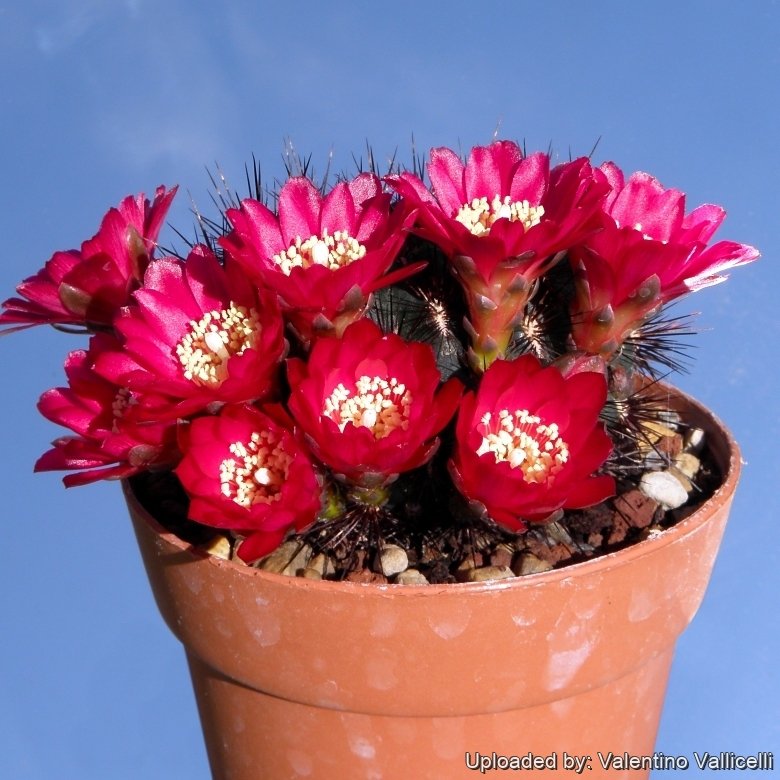
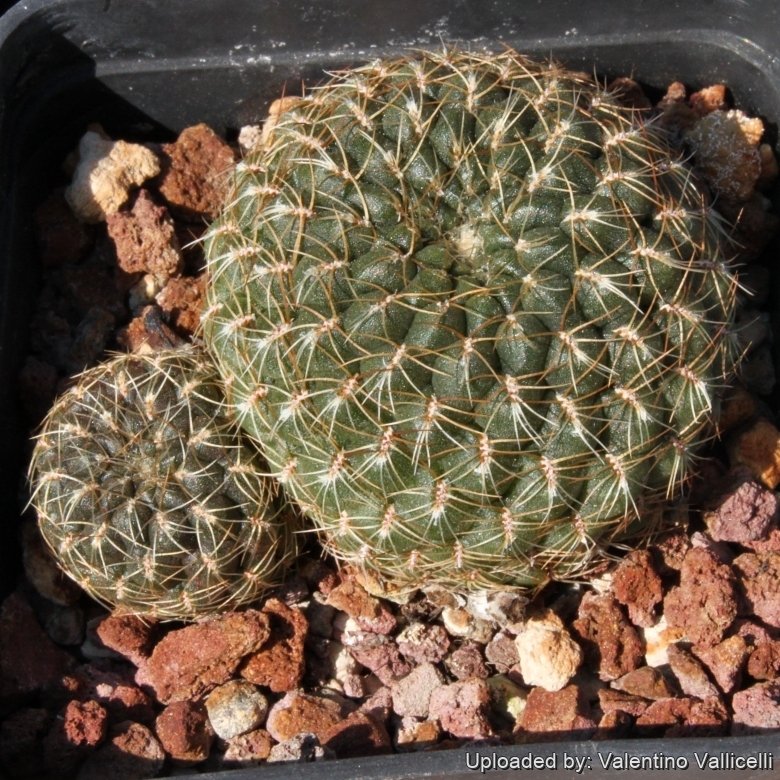
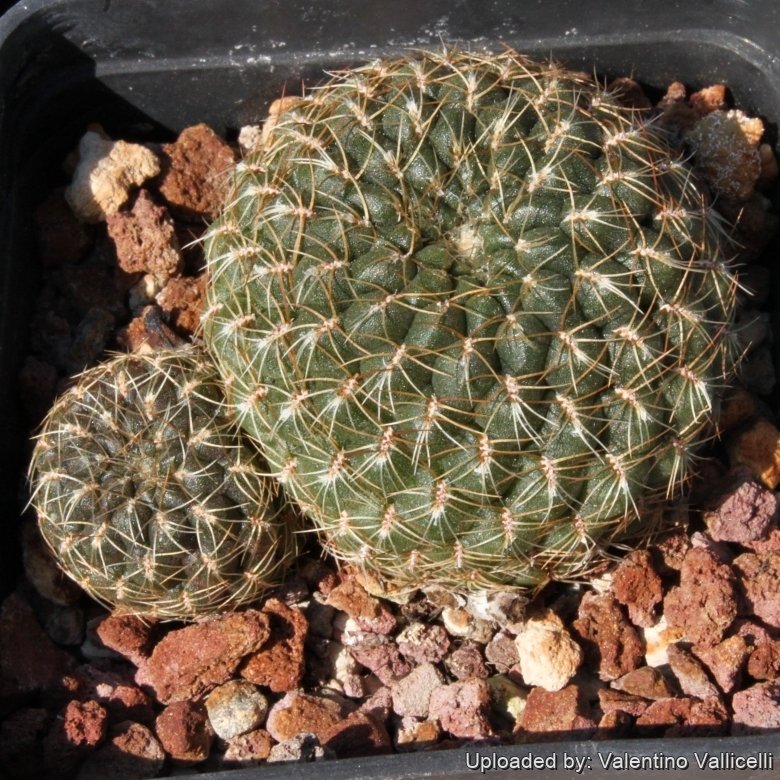
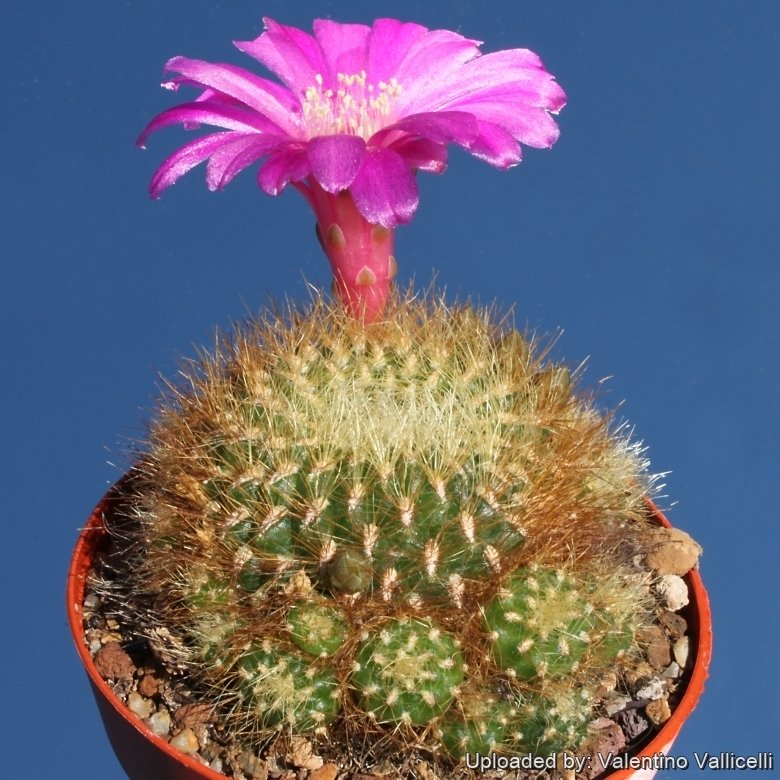
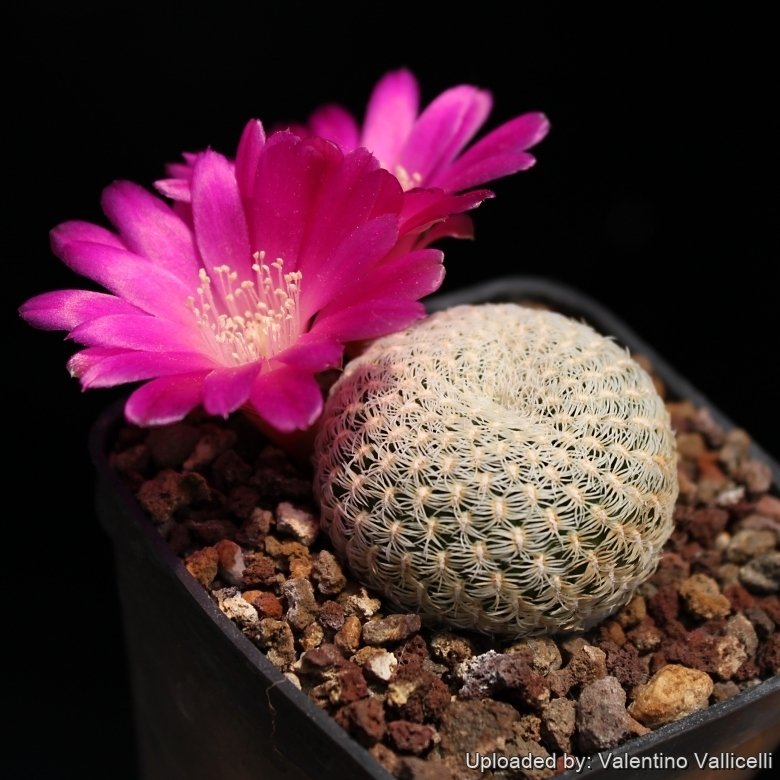
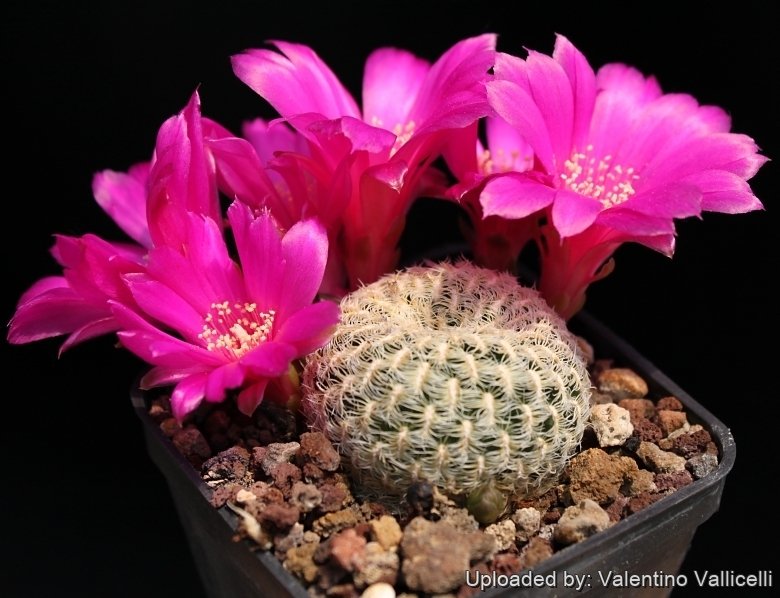
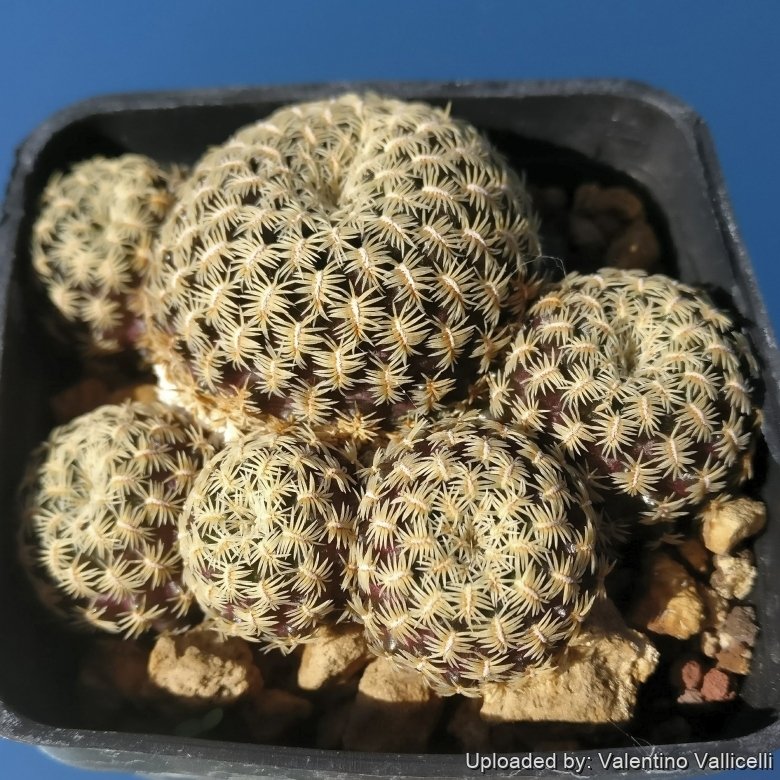
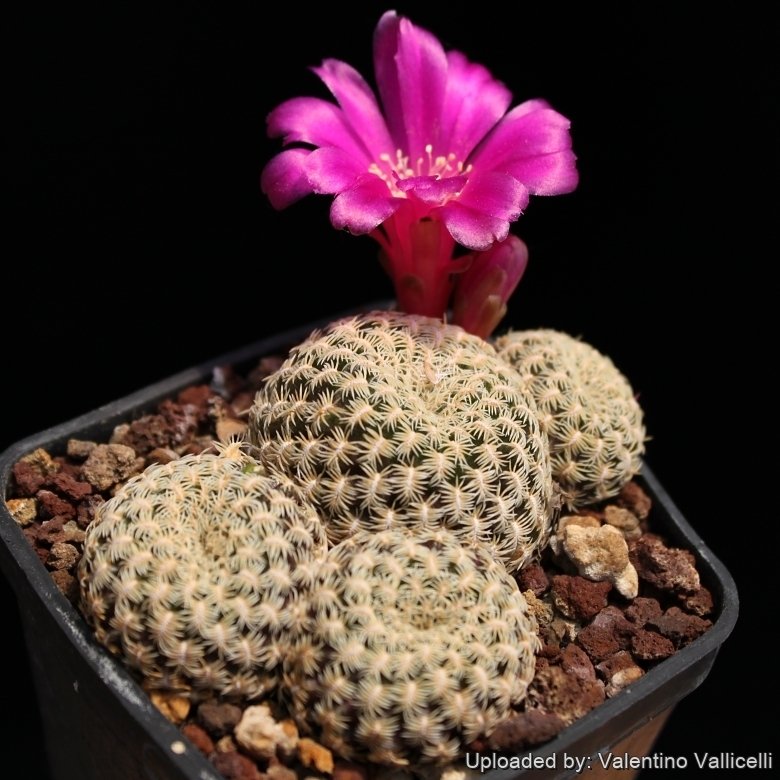
This is one of the larger headed species, solitary or clustering when the main head is about 5-7 cm in diameter and producing a nice patch over time. It distinguish for for the tubercles with chinned bases.
Remarks: This Taxon has lots of synonyms ( like many other cacti) whit several controversial varieties and subspecies and comprises a multitude of different forms, but where each form is linked to others by populations of plants with intermediate characteristics
Roots: It has long tap roots.
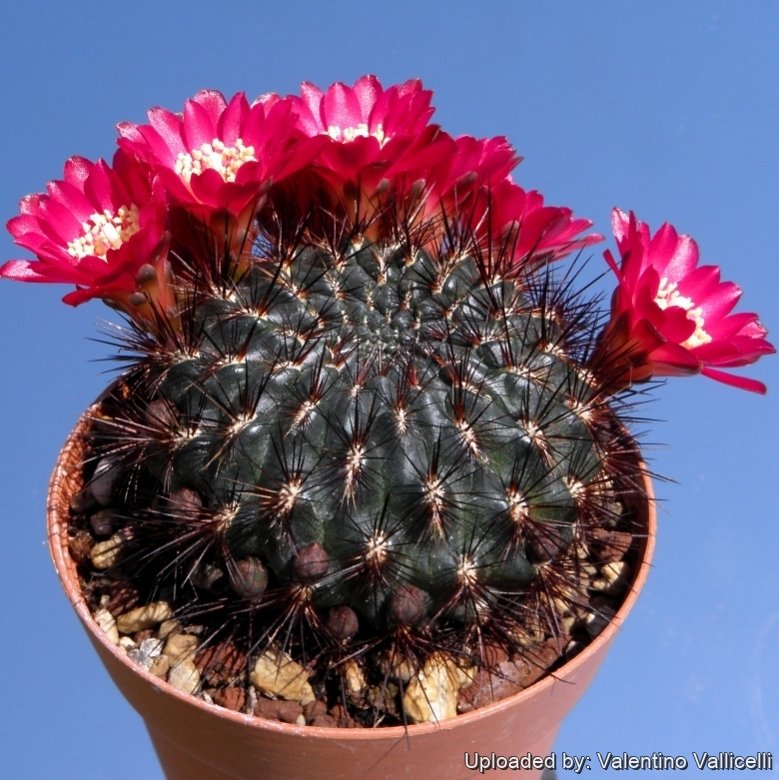
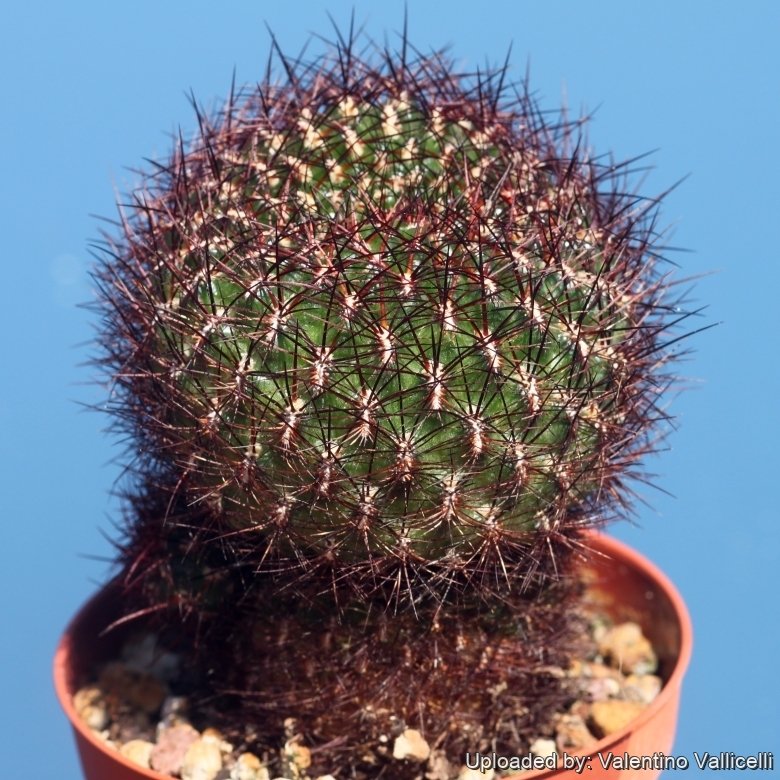
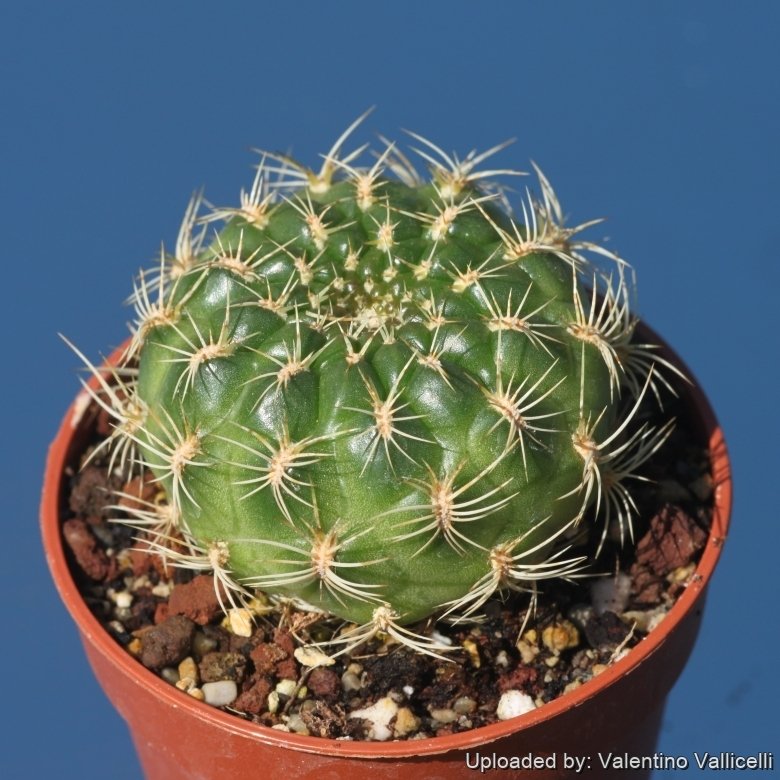
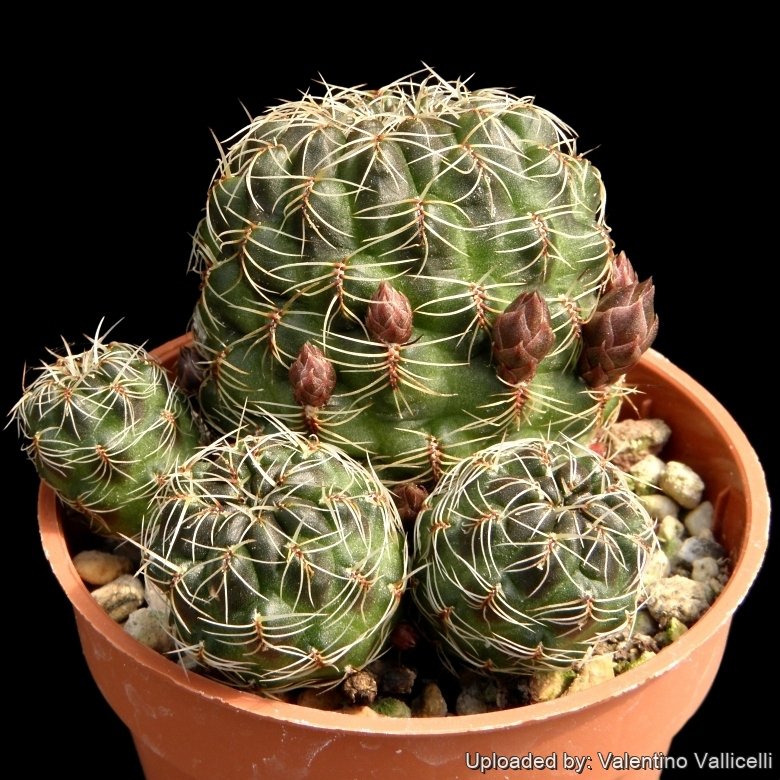
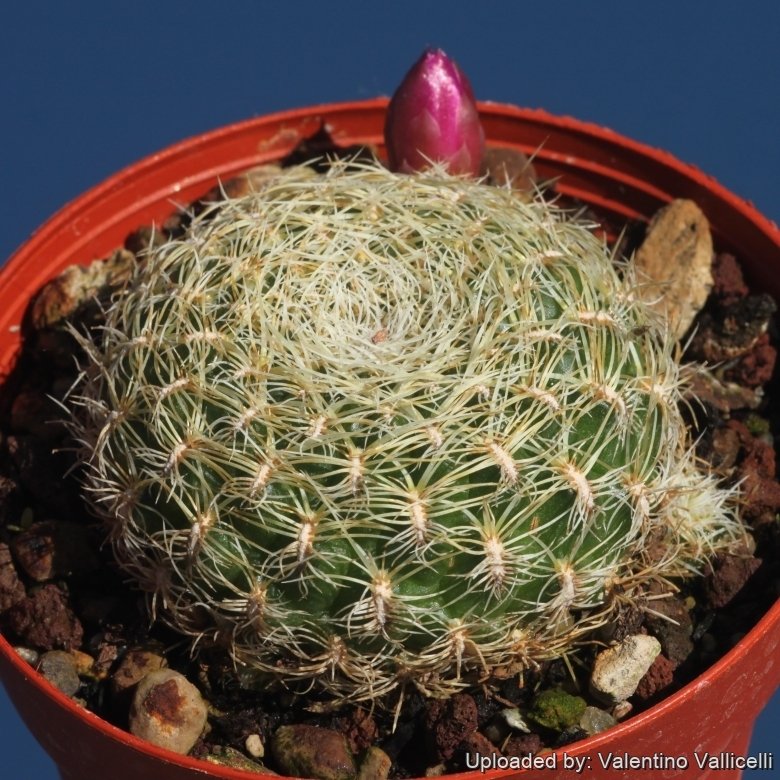
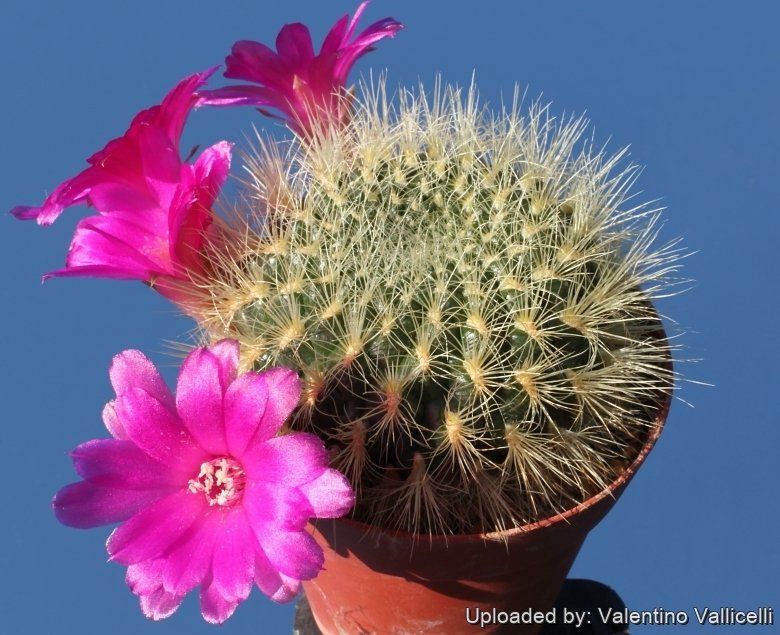
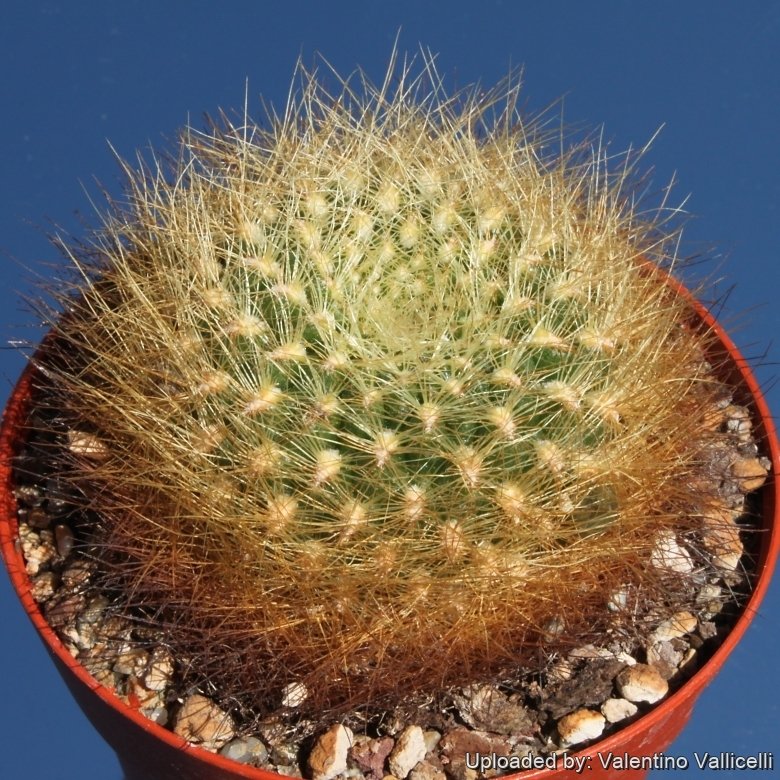
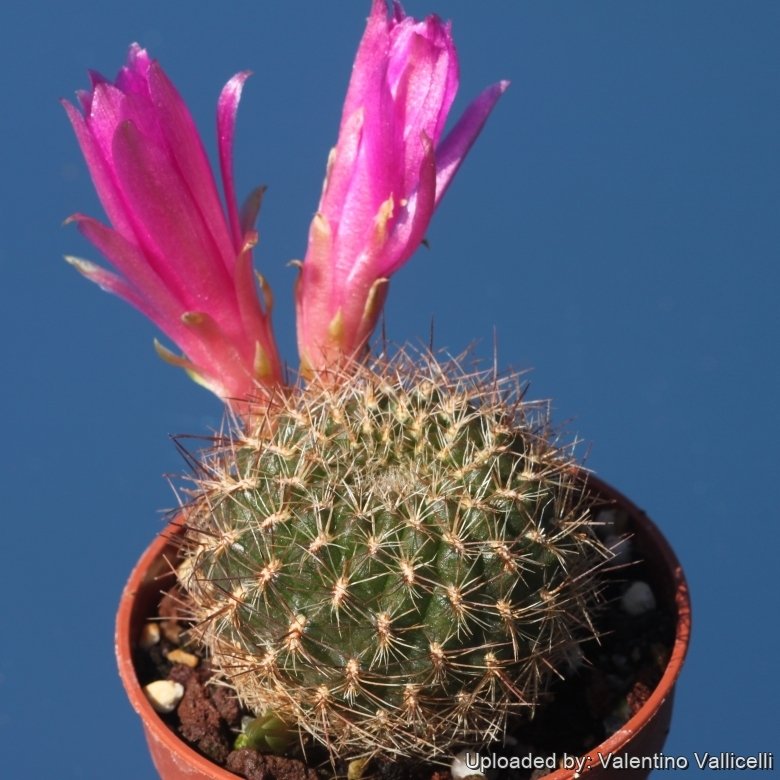
Stem: Fresh green in colour, flattened globular, hemispherical or shortly cylindrical, depressed at apex, 9-10 cm tall 6-7 cm in diameter. This species pups at the base.
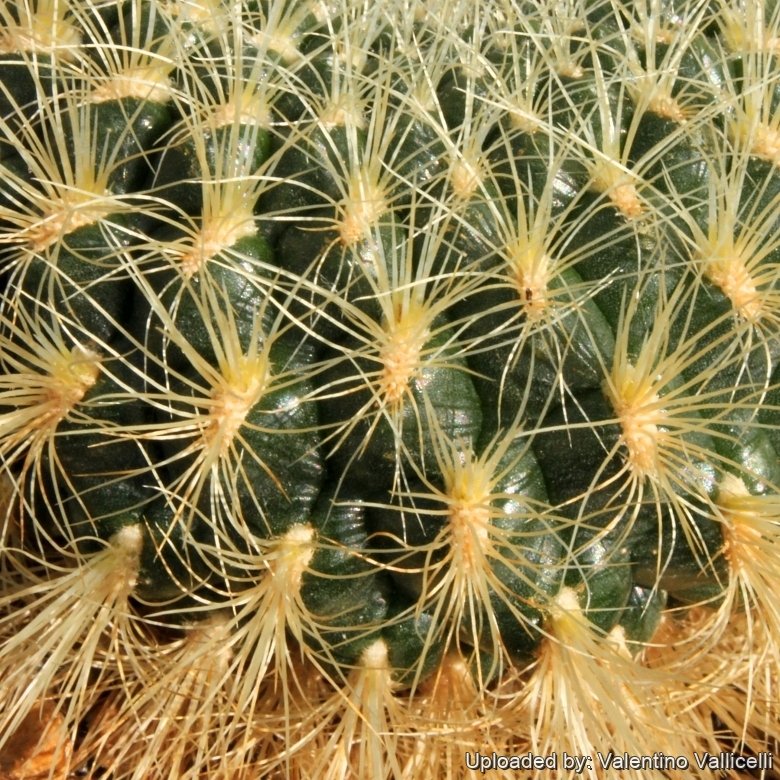
Ribs: About 20, tuberculate, spiralling; tubercles with chinned protrusions.
Areoles: Elongate, 5-7 mm.
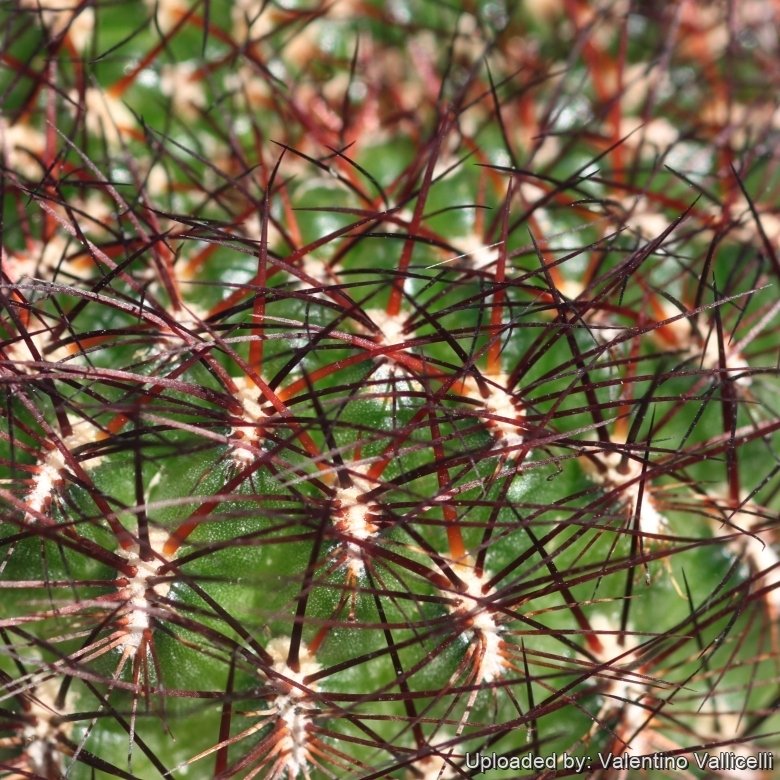
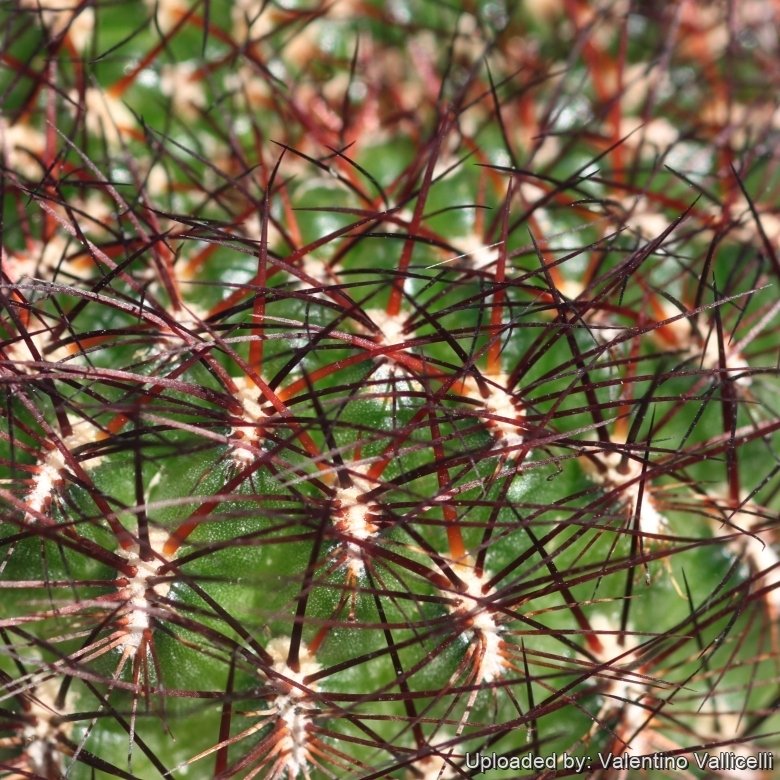
Central spines: 2-4 or more. 5-35 mm long.
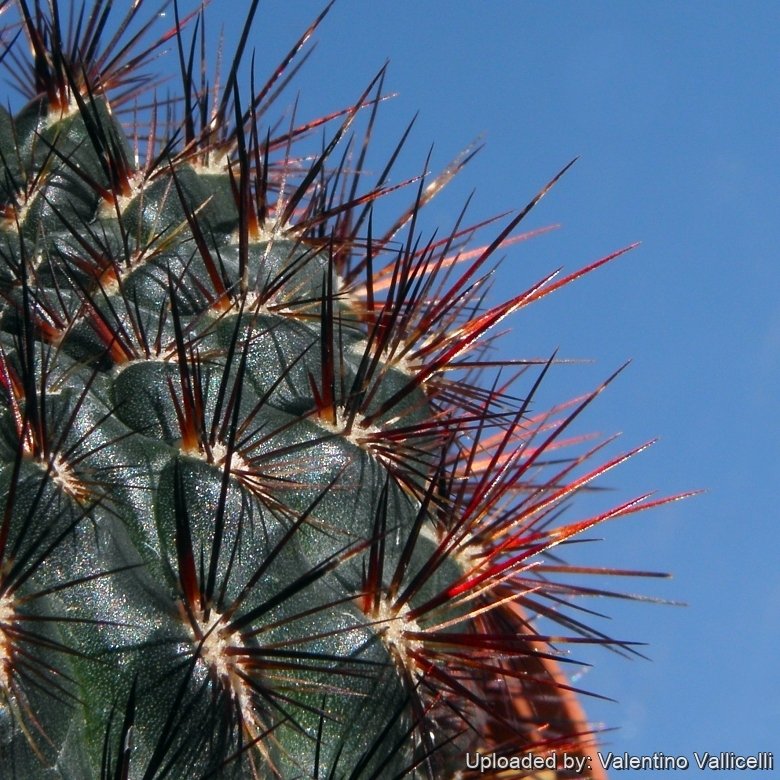
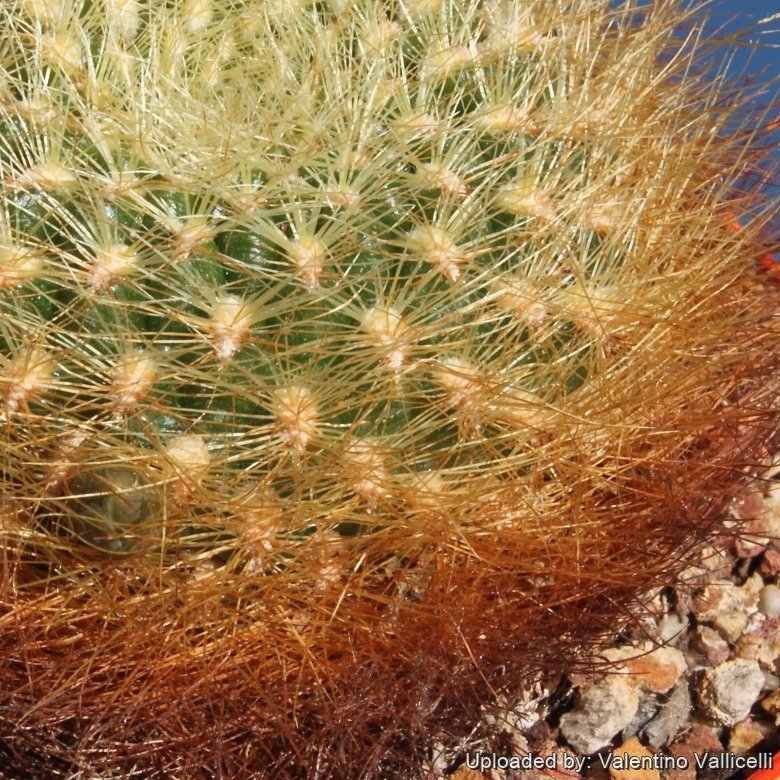
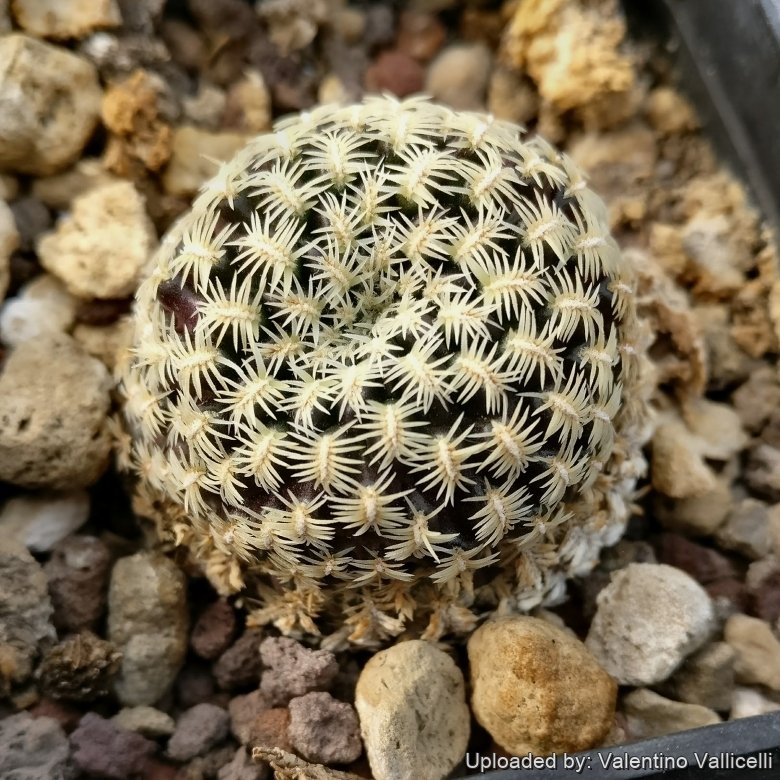
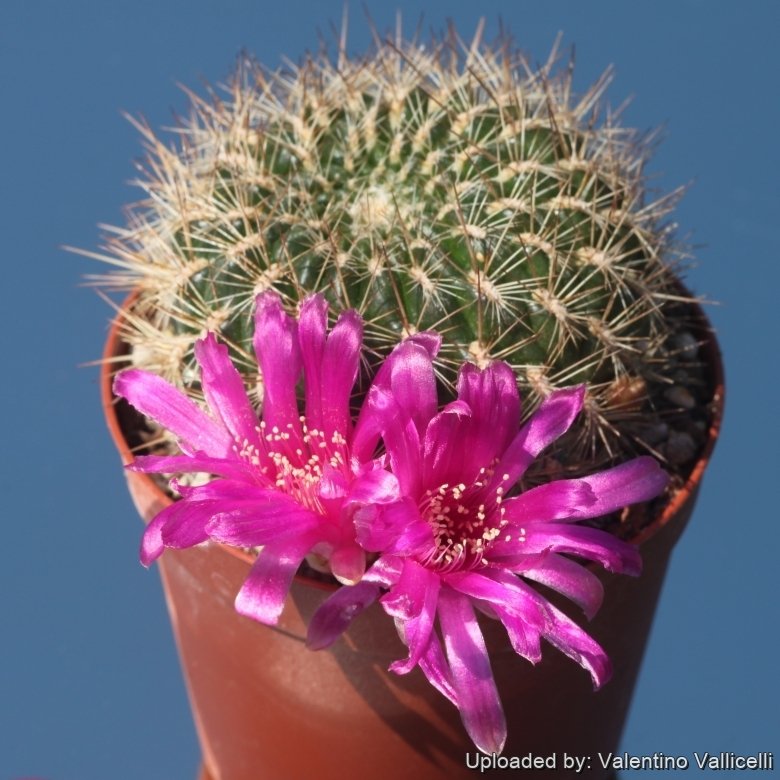
Radial spines: 14-18, 5-25 mm long, comb-like and ascending, yellow, reddish, dark brown or black (mostly mahogany red-brown o black spines in subsp. mentosa).
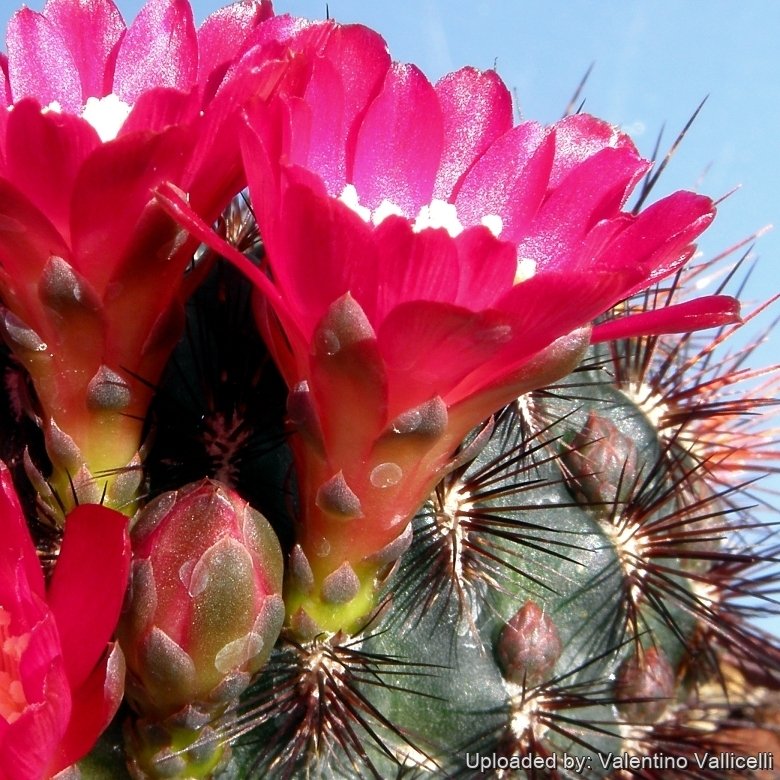
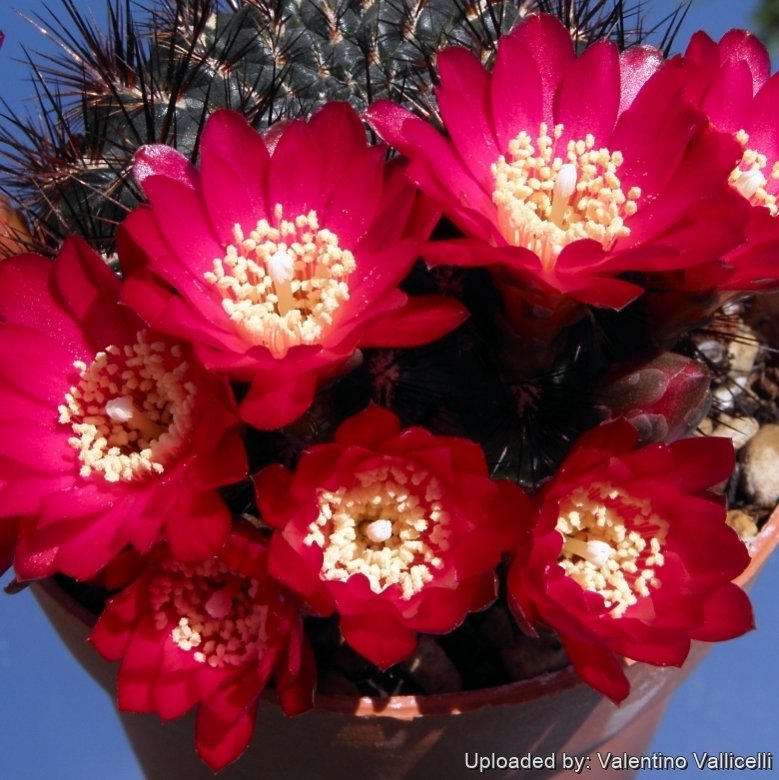
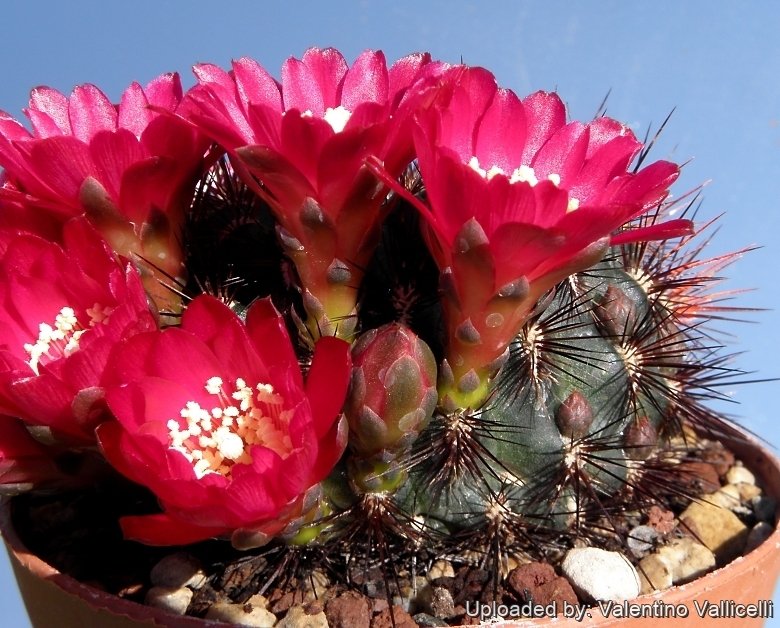
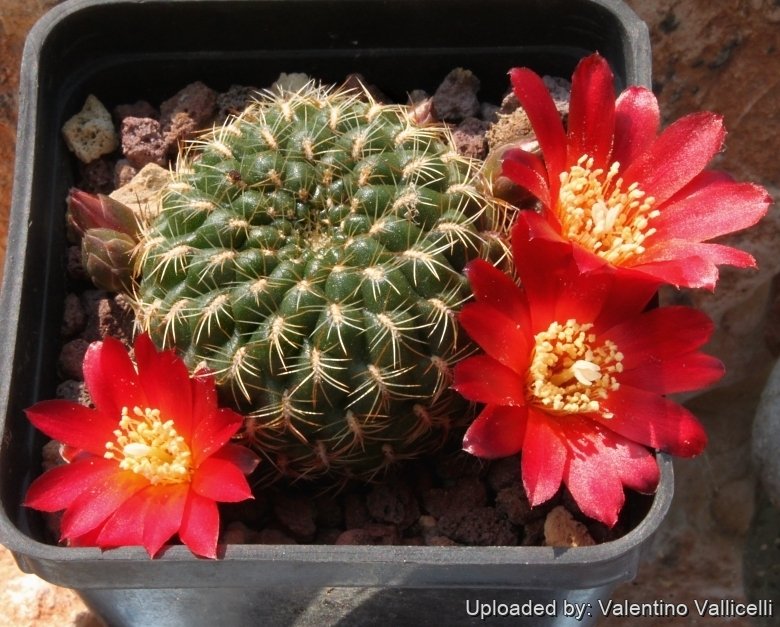
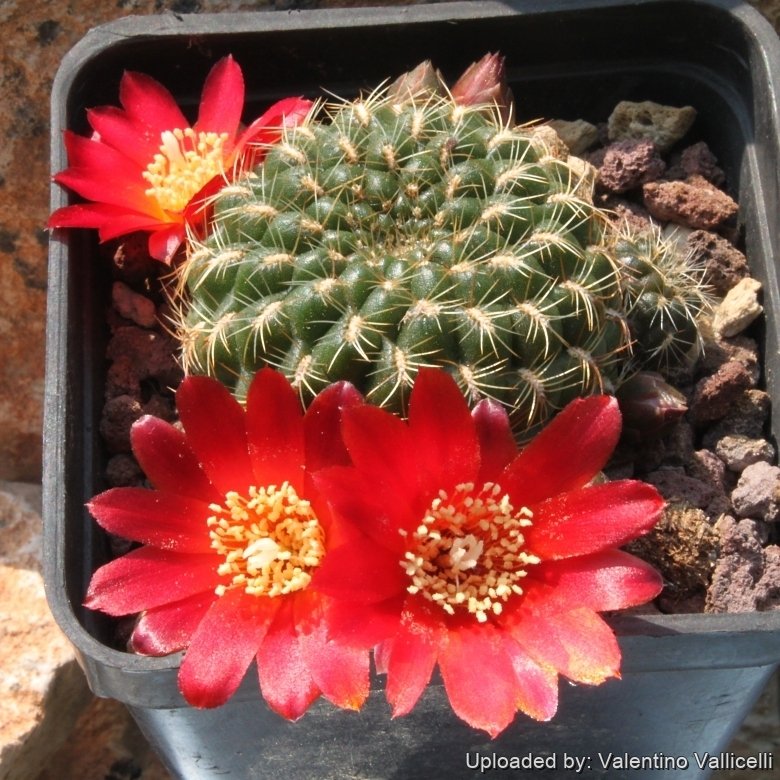
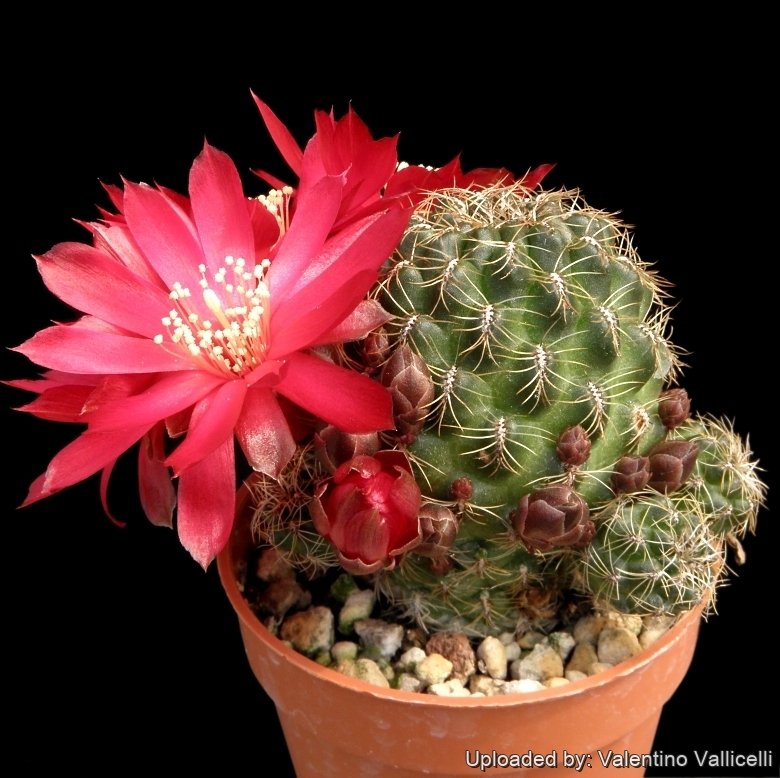
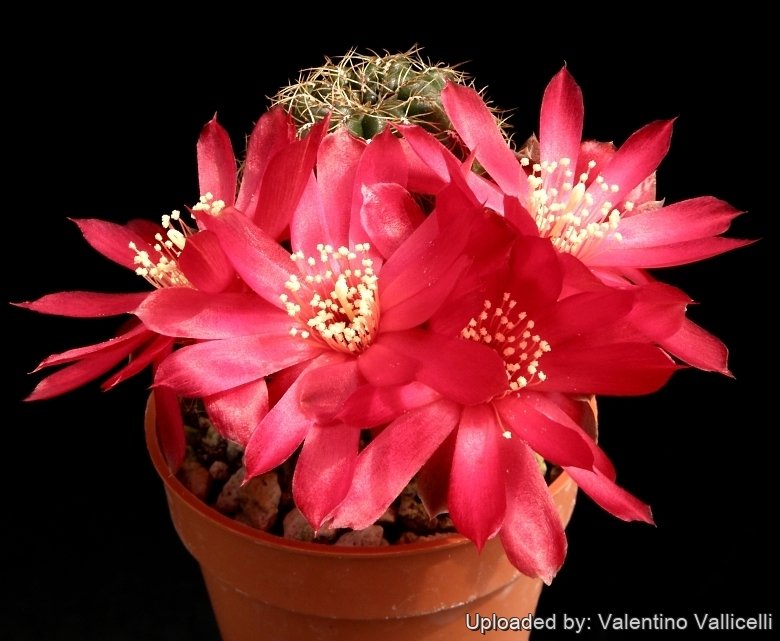
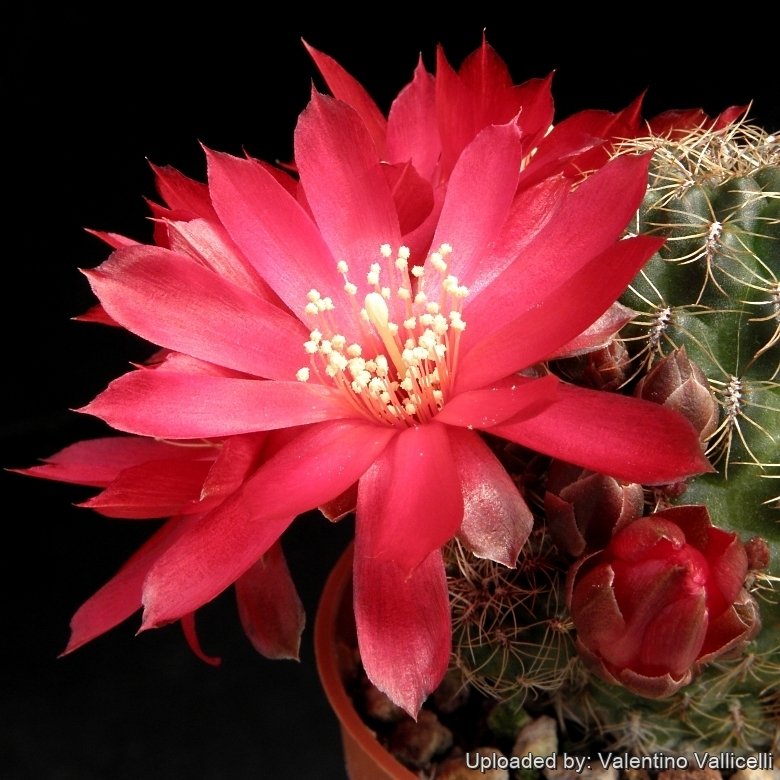
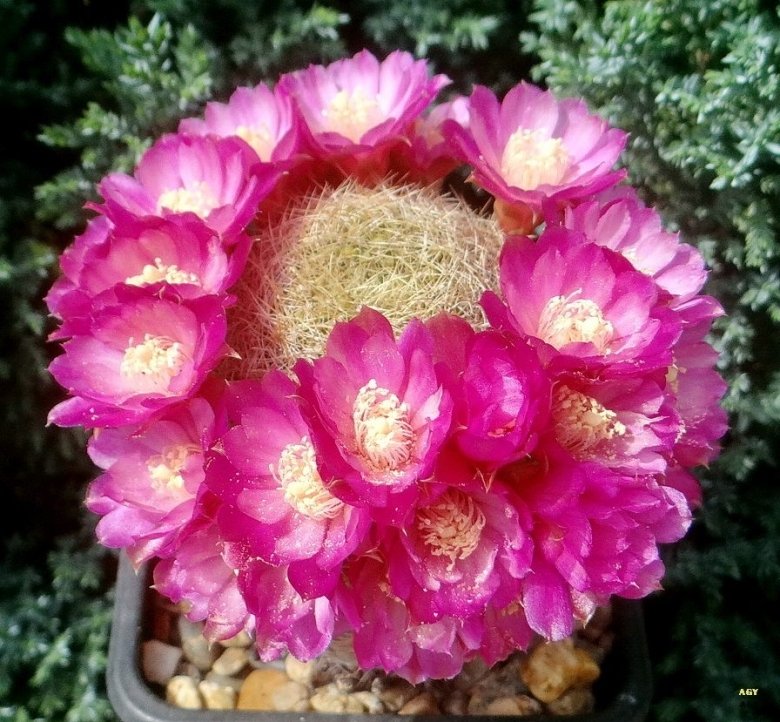
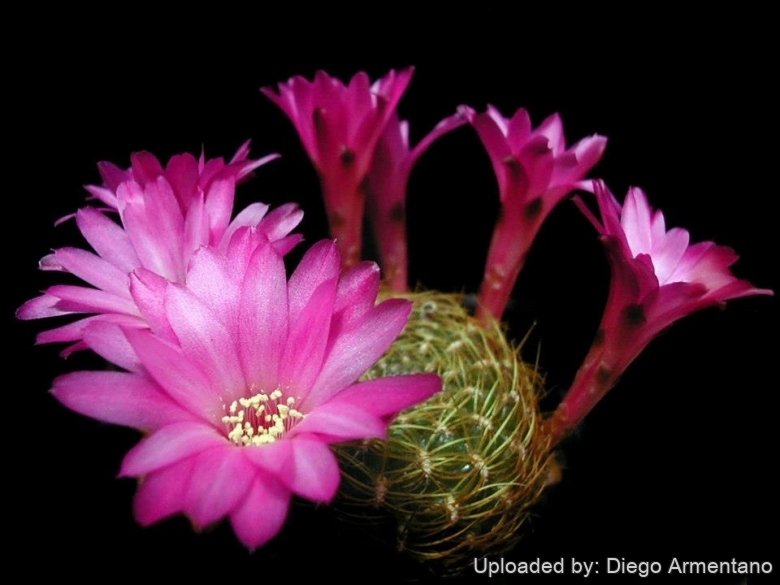
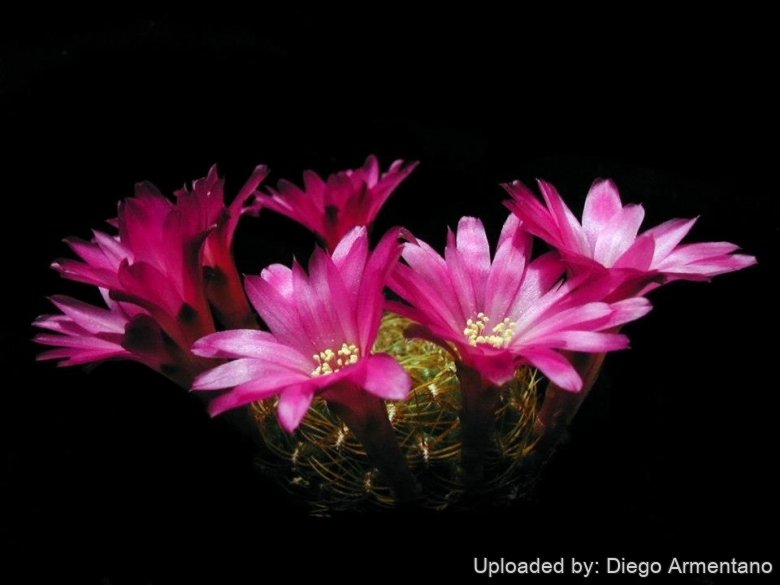
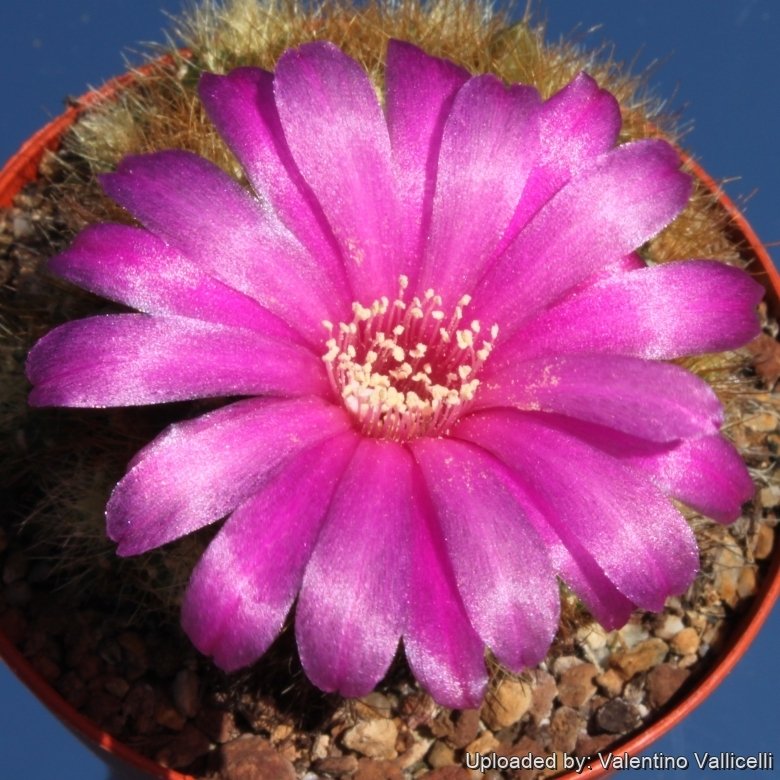
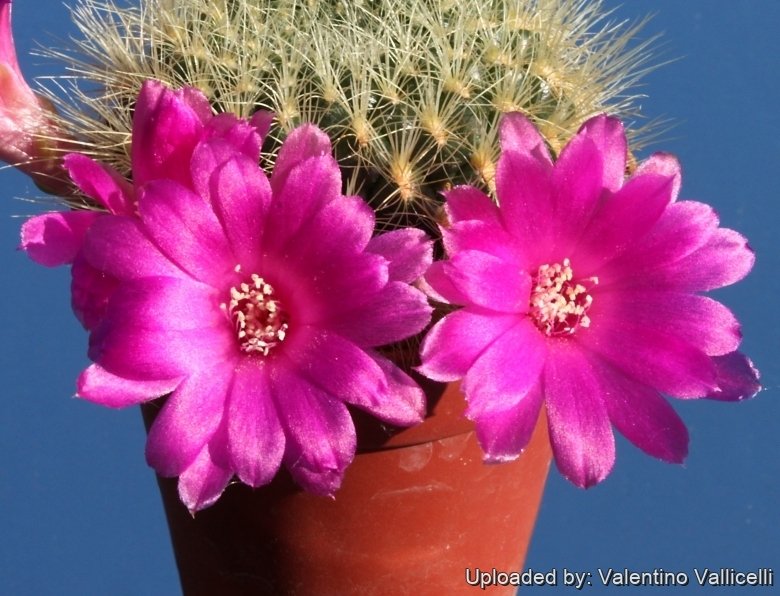
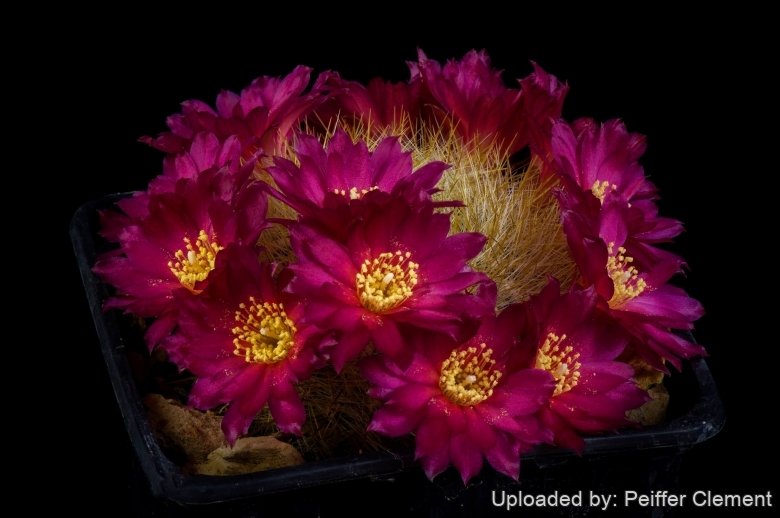
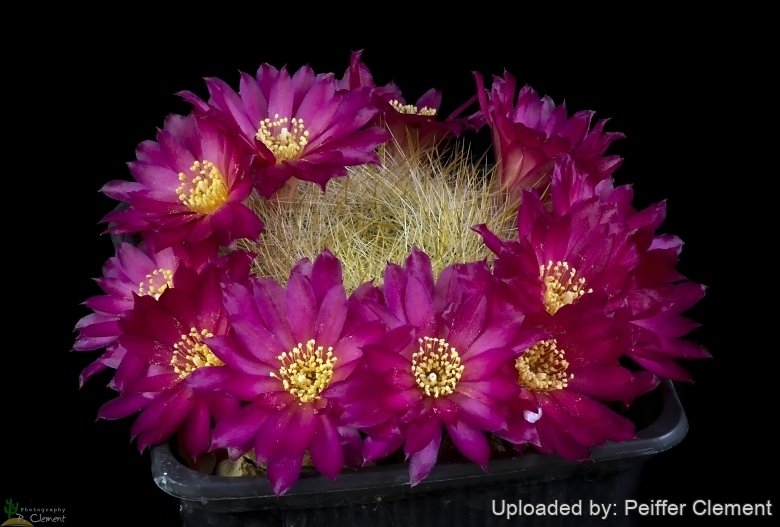
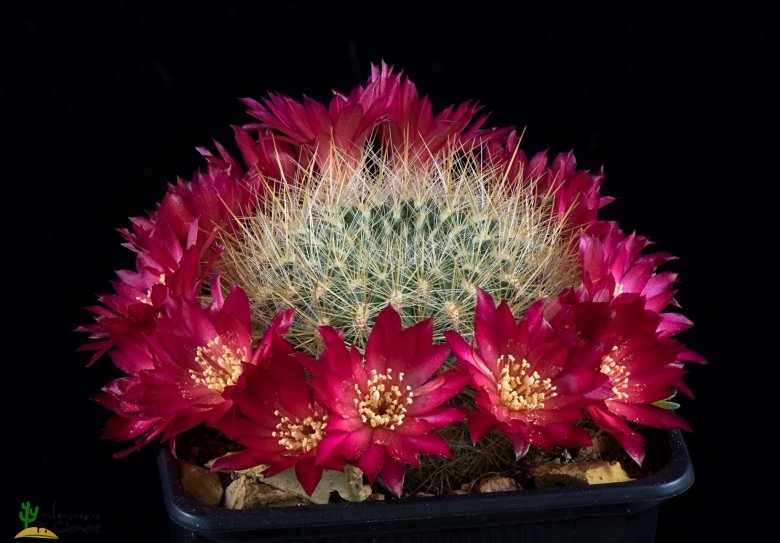
Flowers: Showy that cluster around the lower stem, funnel-shaped with short necks, about 3 cm tall, 3,5 cm in diameter, deep purple or magenta.
Blooming season: Spring.
Fruit: Dark reddish-brown with pale green scales.
Origin and Habitat
Bolivia, Cochabomba, Campero province (Questa de Santiago, Aiquile)
Cultivation and Propagation
Sulcorebutias are summer grower species easy to cultivate, more cold tolerant than most. These mountainous plants have thick taproots and are susceptible to overwatering. They requires also an appropriate air circulation and are sometime grafted to avoid root problems.
Growth rate: It is a relatively rapidly growing and easily flowering species. It’s a heavy clumper and produces a nice patch over time.
Soils: It likes very coarse mineral cactus mix soil, but can become too elongated if compost is too rich.
Repotting: Use pot with good drainage.
Watering: Water regularly from Spring to Autumn, but do not overwater(Rot prone), it must be strictly kept dry throughout the winter quiescent period since it is very sensitive to any moisture excesseskeep dry in winter.
Fertilization: Feed with a high potassium fertilizer in summer.
Hardiness: They need to be kept in a cool place during winter rest and are somewhat resistant to frost if kept on the dry side prior to, and during, cold weather (due to the altitude they are hardy to -7 C ° C, or less for short periods). The cold is important for the flowers, as well as for their health. Without this cool winter period, they normally won’t get any buds.
Exposition: Requires full sun or light shade and careful watering to keep plant compact with strong coloured spines. Tends to bronze in strong light, which encourages flowering and heavy spine production. Light shadow my be useful in the hottest summer days.
Uses: It is an excellent plant for container growing. It always looks good and stays small. It look fine in a cold greenhouse and frame or outdoor in a rockery.
Pests & diseases: It may be attractive to a variety of insects, but plants in good condition should be nearly pest-free, particularly if they are grown in a mineral potting-mix, with good exposure and ventilation. Nonetheless, there are several pests to watch for:
- Red spiders: Red sopiders may be effectively rubbed up by watering the infested plants from above.
- Mealy bugs: Mealy bugs occasionally develop aerial into the new growth among the wool with disfiguring results, but the worst types develop underground on the roots and are invisible except by their effects.
- Sciara Flies: Sciara flies are one of the major problems for seedlings. It is a good practice to mulch your seedlings with a layer of grit, which will strongly discourage the flies.
- Scales: Scales are rarely a problem.
It is wise to treat your whole collection with a systemic insecticide twice a year in spring and autumn.
- Rot: Rot is only a minor problem with cacti if the plants are watered and “aired” correctly. If they are not, fungicides won’t help all that much. To prevent rottenness it is also advisable to surround its root neck by very rough sand or grit, this help a fast water drainage.
Propagation: Seed, cutting, grafting. Seeds germinate in 7-14 days at 21-27° C in spring, remove gradually the glass cover as soon the plants will be well rooted (ca 1-2 weeks) and keep ventilated, no full sun for young plants!
Bibliography
Major references and further lectures
-
James Cullen, Sabina G. Knees, H. Suzanne Cubey “The European Garden Flora Flowering Plants: A Manual for the Identification of Plants Cultivated in Europe, Both Out-of-Doors and Under Glass” Cambridge University Press, 11/Aug./2011
-
David Hunt, Nigel Taylor “The New Cactus Lexicon” DH Books, 2006 ISBN 0953813444, 9780953813445
-
Edward F. Anderson “The Cactus Family” Timber Press, 2001
-
John Pilbeam “Sulcorebutia and Weingartia: A Collector’s Guide” Timber Press, 1985
-
Cyril Marsden, Herbert Spencer Jackson “Rebutia, Including Aylostera and Sulcorebutia” Macmillan, 1968
-
Terry Hewitt “Cacti” Lorenz Books, 01/Apr/1998
From llifle page Cinnabarinea torotorensis
Description
The Sulcorebutia torotorensis is one of the larger headed species, solitary or clustering when the main head is about 5-7 cm in diameter and producing a nice patch over time. It distinguish for the tubercles with chinned bases. This plant is very similar and referable (if not the same) to Rebutia mentosa subs. purpurea.
Remarks: This Taxon has lots of synonyms (like many other cacti) whit several controversial varieties and subspecies and comprises a multitude of different forms, but where each form is linked to others by populations of plants with intermediate characteristics
Roots: It has long Dahlia like tuberous roots.
Stem: Greysh-green to purplish, flattened globular, hemispherical or shortly cylindrical, depressed at apex, 9-10 cm tall 6-7 cm in diameter.
Ribs: About 18, tuberculate, spiralling; tubercles about 4 x 5 cm with chinned protrusions.
Areoles: 4-6 mm long, elongate and felted, up to 1 cm apart.
Central spines: 2-5 speading, 8-11 mm long.
Radial spines: 10-17, 4-8 mm long, spreading to comb-like and ascending, yellow or brownish.
Flowers: Showy that cluster around the lower stem about 3 cm tall, 3,5 cm in diameter, funnel-shaped with short necks (about 5 mm), purple or magenta clove-shented.
Fruit: Dark reddish-brown with pale green scales.
Origin and Habitat
Torotoro, Potosi, Bolivia
Habitat: Slopes and ridges above the Mizque River
Cultivation and Propagation
Sulcorebutias are summer grower species easy to cultivate, more cold tolerant than most. These mountainous plants have thick taproots and are susceptible to overwatering. They requires also an appropriate air circulation and are sometime grafted to avoid root problems.
Growth rate: It is a relatively rapidly growing and easily flowering species that will make clumps given the best conditions.
Soils: It likes very coarse mineral cactus mix soil, but can become too elongated if compost is too rich.
Repotting: Use pot with good drainage.
Watering: Water regularly from Spring to Autumn, but do not overwater(Rot prone), it must be strictly kept dry throughout the winter quiescent period since it is very sensitive to any moisture excesseskeep dry in winter.
Fertilization: Feed with a high potassium fertilizer in summer.
Hardiness: They need to be kept in a cool place during winter rest and are somewhat resistant to frost if kept on the dry side prior to, and during, cold weather (due to the altitude they are hardy to -7 C ° C, or less for short periods). The cold is important for the flowers, as well as for their health. Without this cool winter period, they normally won’t get any buds.
Exposition: Requires full sun or light shade and careful watering to keep plant compact with strong coloured spines. Tends to bronze in strong light, which encourages flowering and heavy spine production. Light shadow my be useful in the hottest summer days.
Uses: It is an excellent plant for container growing. It always looks good and stays small. It look fine in a cold greenhouse and frame or outdoor in a rockery.
Pests & diseases: It may be attractive to a variety of insects, but plants in good condition should be nearly pest-free, particularly if they are grown in a mineral potting-mix, with good exposure and ventilation. Nonetheless, there are several pests to watch for:
- Red spiders: Red sopiders may be effectively rubbed up by watering the infested plants from above.
- Mealy bugs: Mealy bugs occasionally develop aerial into the new growth among the wool with disfiguring results, but the worst types develop underground on the roots and are invisible except by their effects.
- Sciara Flies: Sciara flies are one of the major problems for seedlings. It is a good practice to mulch your seedlings with a layer of grit, which will strongly discourage the flies.
- Scales: Scales are rarely a problem.
It is wise to treat your whole collection with a systemic insecticide twice a year in spring and autumn.
- Rot: Rot is only a minor problem with cacti if the plants are watered and “aired” correctly. If they are not, fungicides won’t help all that much. To prevent rottenness it is also advisable to surround its root neck by very rough sand or grit, this help a fast water drainage.
Propagation: Seed, cutting, grafting. Seeds germinate in 7-14 days at 21-27° C in spring, remove gradually the glass cover as soon the plants will be well rooted (ca 1-2 weeks) and keep ventilated, no full sun for young plants!
Source: Cinnabarinea torotorensis, LLIFLE - Encyclopedia of living forms, CC-BY-SA, retrieved 2026-10-25.
From llifle page Sulcorebutia mentosa subs. santiaginiensis
Description
Sulcorebutia santiaginiensis is one of the innumerable local form of the very variable Rebutia mentosa, it is very similar (if not the same) as Rebutia mentosa subs. purpurea but (?) with somewhat weaker spines.
Habit: is one of the larger headed species, solitary or sometime clustering in cultivation when the main head is about 5-7 cm in diameter .
Remarks: This Taxon has lots of synonyms (like many other cacti) whit several controversial varieties and subspecies and comprises a multitude of different forms, but where each form is linked to others by populations of plants with intermediate characteristics
Roots: It has long Dahlia like tuberous roots.
Stem: Grass-green, flattened globular, hemispherical or shortly cylindrical, depressed at apex, 4-9 cm tall 3-4 cm in diameter.
Ribs: About 18, completely divided into tubercles and unrecognisable; tubercles, spiralling about 4 x 5 cm with chinned protrusions.
Areoles: 4-6 mm long, elongate and felted, up to 1 cm apart.
Spines: Sand coloured, light-brown to reddish brown or whitish strong, comb-like, spreading out and bent down to the body.
Central spines: 4-6 speading, 12-18 mm long.
Radial spines: 8-10, 10-14 mm long.
Flowers: Showy that cluster around the lower stem about 2-3 cm tall, 3,5-4,5 cm in diameter, funnel-shaped with short necks (about 5 mm), purple to violet-red or dark red clove-shented.
Fruit: Dark reddish-brown with pale green scales 7-10 mm in diameter.
Origin and Habitat
Aiquile to Santiago, Cochabamba. Bolivia
Altitude: 2400-2900 above sea level.
Bibliography
Major references and further lectures
-
James Cullen, Sabina G. Knees, H. Suzanne Cubey “The European Garden Flora Flowering Plants: A Manual for the Identification of Plants Cultivated in Europe, Both Out-of-Doors and Under Glass” Cambridge University Press, 11/Aug./2011
-
David Hunt, Nigel Taylor “The New Cactus Lexicon” DH Books, 2006 ISBN 0953813444, 9780953813445
-
Edward F. Anderson “The Cactus Family” Timber Press, 2001
-
John Pilbeam “Sulcorebutia and Weingartia: A Collector’s Guide” Timber Press, 1985
-
Cyril Marsden, Herbert Spencer Jackson “Rebutia, Including Aylostera and Sulcorebutia” Macmillan, 1968
-
Terry Hewitt “Cacti” Lorenz Books, 01/Apr/1998
-
Gertel, W., de Vries J. (2008b): “A revision of the Sulcorebutias of the central distribution area – Part I” – Cactus & Co. 12 (4): 237 – 265
-
Gertel, W., de Vries J. (2006): “A revision of the Sulcorebutias of the northern distribution area – Part II” – Cactus & Co. 10 (1): 26 - 42
-
Gertel, W., de Vries J. (2007): “A revision of the Sulcorebutias of the northern distribution area – Part III” – Cactus & Co. 11 (3): 133 - 159
Source: Sulcorebutia mentosa subs. santiaginiensis, LLIFLE - Encyclopedia of living forms, CC-BY-SA, retrieved 2026-10-25.
From llifle page Sulcorebutia albissima
Description
Sulcorebutia albissima (a.k.a. S. albata or S. albida) is one of the innumerable local form of the very variable Rebutia mentosa with squat clustering stems and outstanding purple blooms. Others forms are similar and plants from other localities look more like it.
Habit: It was originally described as solitary, but often clusters in cultivation producing a nice patch over time.
Stems: Globular, flattened, or somewhat elongated-cylindrical in cultivation, up to 6 cm in diameter.
Radial spines: Off-white, greyish, to light brown, pectinately arranged, lying against the surface and interlacing, stiff, needle-like, slightly curved, and the spination of well-grown specimens is pleasing.
Central spines: Usually absent.
Flowers: Several from the base, large intensely coloured glossy dark pink to purple-red.
Blooming season: Flowers are freely produced in spring (like all sulcorebutias) in this species
Origin and Habitat
Bolivia (Cochabamba at elevations between 2100-2900 m)
Habitat: It grows in rocky slopes and crevices.
Cultivation and Propagation
Sulcorebutias are summer grower species easy to cultivate, more cold tolerant than most. These mountainous plants have thick taproots and are susceptible to overwatering. They requires also an appropriate air circulation and are sometime grafted to avoid root problems.
Growth rate: It is a relatively rapidly growing and easily flowering species that will make clumps given the best conditions.
Soils: It likes very coarse mineral cactus mix soil, but can become too elongated if compost is too rich.
Repotting: Use pot with good drainage.
Watering: Water moderately from Spring to Autumn, but do not overwater (Rot prone), it must be strictly kept dry throughout the winter quiescent period since it is very sensitive to any moisture excesses keep dry in winter.
Fertilization: Feed with a high potassium fertilizer in summer.
Hardiness: They need to be kept in a cool place during winter rest and are somewhat resistant to frost if kept on the dry side prior to, and during, cold weather (due to the altitude they are hardy to -7 C ° C, or less for short periods). The cold is important for the flowers, as well as for their health. Without this cool winter period, they normally won’t get any buds.
Exposition: Requires full sun or light shade and careful watering to keep plant compact with strong coloured spines. Tends to bronze in strong light, which encourages flowering and heavy spine production. Light shadow my be useful in the hottest summer days.
Uses: It is an excellent plant for container growing. It always looks good and stays small. It look fine in a cold greenhouse and frame or outdoor in a rockery.
Pests & diseases: It may be attractive to a variety of insects, but plants in good condition should be nearly pest-free, particularly if they are grown in a mineral potting-mix, with good exposure and ventilation. Nonetheless, there are several pests to watch for:
- Red spiders: Red spiders may be effectively rubbed up by watering the infested plants from above.
- Mealy bugs: Mealy bugs occasionally develop aerial into the new growth among the wool with disfiguring results, but the worst types develop underground on the roots and are invisible except by their effects.
- Sciara Flies: Sciara flies are one of the major problems for seedlings. It is a good practice to mulch your seedlings with a layer of grit, which will strongly discourage the flies.
- Scales: Scales are rarely a problem.
It is wise to treat your whole collection with a systemic insecticide twice a year in spring and autumn.
- Rot: Rot is only a minor problem with cacti if the plants are watered and “aired” correctly. If they are not, fungicides won’t help all that much. To prevent rottenness it is also advisable to surround its root neck by very rough sand or grit, this help a fast water drainage.
Propagation: Seed, cutting, grafting. Seeds germinate in 7-14 days at 21-27° C in spring, remove gradually the glass cover as soon the plants will be well rooted (ca 1-2 weeks) and keep ventilated, no full sun for young plants!
Source: Sulcorebutia albissima, LLIFLE - Encyclopedia of living forms, CC-BY-SA, retrieved 2026-10-25.
From llifle page Sulcorebutia x erinacea
Description
Hybrid Parentage: (Sulcorebutia mentosa F.Ritter × Sulcorebutia albissima (F.H.Brandt) Pilbeam)
Source: Sulcorebutia x erinacea, LLIFLE - Encyclopedia of living forms, CC-BY-SA, retrieved 2026-10-25.
From llifle page Sulcorebutia flavida
Description
Sulcorebutia flavissima is generally included within (as a synonym of) Rebutia mentosa, suggesting that there is not really a fundamental difference between the two. The name “flavissima”, meaning “most yellow”, refers to the yellow colour of spines. The overall yellow appearance helps distinguish this plant from other morphological forms of Rebutia mentosa. It is a clear form of Rebutia mentosa. Plants of Rebutia mentosa may show different colours of spines, as well as flowers. Often plants with lighter spines tend to have a lighter skin colouration and sometimes lighter flowers too.
Stem: Single, flat hemispherical 25 mm tall and 60 mm wide, in cultivation occasionally reaching 60-70 mm in width and forming a tuft. Epidermis bright green. Ribs up to 18, spiralling.
Areole: Elongate about 8 mm long with a creamy white wool.
Radial spines: About 24, up to 20 mm long, bent radially towards the apex, bright yellow.
Central spines: 2-5, about 20 mm long, thicker than the radials, protruding at the top of the areoles, bright yellow.
Flowers: 35 mm long, 40-50 mm wide. Perianth segments, often with a fine tip, dark to pale violet-red, with lighter medium strips, sometimes almost wholly white. Ovary and tube pink with darker scales. Throat, stamens, style and stigma white.
Fruit: Sherical, 7-10 mm wide, reddish brown with lighter scales.
Seed: About 1.2 mm long and 0.8 mm wide, testa matt black, hilum rounded, dark.
Origin and Habitat
Sulcorebutia flavissima occours at the Orkho Abuelo foot and in the adjacent areas, between Aiquile and Mizque, Cochabamba department, Bolivia
Altitude range: 2400-2800(3250?) metres above sea level.
Habitat and ecology: Yellow spined specimens (S. flavissima) occurs along with dark spined individuals (S. mentosa) in the whole area around Aiquile. Nowhere homogeneous stands of Sulcorebutia flavissima had been found, but yellow and dark plants grow intermingled close one to each other, and are part of the same polymorphic population.
Bibliography
Major references and further lectures
-
Otakar Šída “Sulcorebutia mentosa Ritter var. flavissima (Rausch) Šída comb. et stat. Nov.” Atlasu kaktus? 2004 Retrieved 08 April 2016 from <http://www.cact.cz/noviny/2004/05/Sulcorebutia\_mentosa\_var\_flavissima.htm\>
-
Augustin K., Gertel W., Hentzchel G., “Sulcorebutia, Kakteenzwerge der bolivianischen Anden”, p. 110, 2000
-
Backeberg C. et Haage W., “Das Kakteenlexikon”, p. 506, 1977
-
Brinkmann K.-H., “Die Gattung Sulcorebutia”, p. 31, 1976
-
Hájek F., “Sulcorebutia mentosa Ritter”, Atlas kaktus? 1986, t.41, 1987
-
Klikar J., “Sulcorebutia flavissima Rausch”, Kaktusy 24:4, 1988
-
Lindner P., “P?ehled rodu Sulcorebutia Backeberg emend. Brederoo et Donald”, Aztekia (mimo?ádné ?íslo), p. 77, 1982
-
Odehnal J., Slaba R., “Rod Sulcorebutia – poznámky pod ?arou”, Kaktusy 37 / speciál 2, 2001
-
Pilbeam J., “Sulcorebutia and Weingartia, A Collector’s Guide”, p. 49, 1985
Source: Sulcorebutia flavida, LLIFLE - Encyclopedia of living forms, CC-BY-SA, retrieved 2026-10-25.
From llifle page Sulcorebutia flavissima
Bibliography
Major references and further lectures
-
Otakar Šída “Sulcorebutia mentosa Ritter var. flavissima (Rausch) Šída comb. et stat. Nov.” Atlasu kaktusů 2004 Retrieved 08 April 2016 from <http://www.cact.cz/noviny/2004/05/Sulcorebutia\_mentosa\_var\_flavissima.htm\>
-
Augustin K., Gertel W., Hentzchel G., “Sulcorebutia, Kakteenzwerge der bolivianischen Anden”, p. 110, 2000
-
Backeberg C. et Haage W., “Das Kakteenlexikon”, p. 506, 1977
-
Brinkmann K.-H., “Die Gattung Sulcorebutia”, p. 31, 1976
-
Hájek F., “Sulcorebutia mentosa Ritter”, Atlas kaktusů 1986, t.41, 1987
-
Klikar J., “Sulcorebutia flavissima Rausch”, Kaktusy 24:4, 1988
-
Lindner P., “Přehled rodu Sulcorebutia Backeberg emend. Brederoo et Donald”, Aztekia (mimořádné číslo), p. 77, 1982
-
Odehnal J., Slaba R., “Rod Sulcorebutia – poznámky pod čarou”, Kaktusy 37 / speciál 2, 2001
-
Pilbeam J., “Sulcorebutia and Weingartia, A Collector’s Guide”, p. 49, 1985
Source: Sulcorebutia flavissima, LLIFLE - Encyclopedia of living forms, CC-BY-SA, retrieved 2026-10-25.
From llifle page Sulcorebutia swobodae
Description
Sulcorebutia swobodae is one of the innumerable local form of the very variable Rebutia mentosa with long predominantly yellow flexible spines not hurting to the touch and pink-violet blooms. However in habitat Rebutia mentosa var. swobodae is very variable in colour even within the same population with spines ranging from yellow to brown to almost black. The standard Rebutia mentosa shows the same variably coloured spination but distinguishes in the number, texture and shape of the spines. Rebutia mentosa has always more or less powerful, stinging spines variously spreading or somewhat addpressed – By the other hand Rebutia mentosa var. swobodae has only soft, protruding “Bristles or hairs”. Moreover the stems of Rebutia mentosa var. swobodae is almost concealed by the dense cover of spines that are significantly higher in number than the species.
Habit: This is one of the larger headed species, solitary or clustering when the main head is about 5-7 cm in diameter and producing a nice patch over time. This species pups at the base.
Roots: It has long tap roots.
Stem: Flattened globular or hemispherical, often shortly cylindrical in cultivation, depressed at apex, 4-7 cm tall and in diameter, typically light-green in yellow spined specimens, but in darker spined forms often brown-green, brown-violet or sometimes almost black..
Ribs: About 20, tuberculate, spiralling; tubercles with chinned protrusions.
Areoles: Elongate, white or brown woolly 5-7 mm long.
Spines: 20-25 or more per areola, not clearly differentiated as centrals and radials, about 14 mm long, comb-like, protruding and ascending, bristly, soft, fexible not hurting to the touch usually yellow, but also white, brown or black..
Flowers: Showy that cluster around the lower stem, funnel-shaped with short necks, about 3 cm tall, 3,5 cm in diameter, pink-violet to purple.
Blooming season: Spring.
Fruit: Dark yellowish-brown with pale green scales.
Origin and Habitat
Between Aiquile and Mizque, Department Cochabamba, Bolivia
Altitude: 2300-2600 metres above sea level.
Bibliography
Major references and further lectures
-
James Cullen, Sabina G. Knees, H. Suzanne Cubey “The European Garden Flora Flowering Plants: A Manual for the Identification of Plants Cultivated in Europe, Both Out-of-Doors and Under Glass” Cambridge University Press, 11/Aug./2011
-
David Hunt, Nigel Taylor “The New Cactus Lexicon” DH Books, 2006 ISBN 0953813444, 9780953813445
-
Edward F. Anderson “The Cactus Family” Timber Press, 2001
-
John Pilbeam “Sulcorebutia and Weingartia: A Collector’s Guide” Timber Press, 1985
-
Cyril Marsden, Herbert Spencer Jackson “Rebutia, Including Aylostera and Sulcorebutia” Macmillan, 1968
-
Terry Hewitt “Cacti” Lorenz Books, 01/Apr/1998
-
Augustin Karl (1984): Sulcorebutia swobodae - eine Neuentdeckung aus Bolivien. Kakt. And. Sukk., 35 (6): 120-122
-
Augustin Karl, Gertel Willi, Hentzschel Günter (2000): Sulcorebutia. Verlag Eugen Ulmer, Stuttgart, pag.110
Source: Sulcorebutia swobodae, LLIFLE - Encyclopedia of living forms, CC-BY-SA, retrieved 2026-10-25.
From llifle page Sulcorebutia albissima f. pectinifera
Description
Sulcorebutia albissima f. pectinifera is an unnecessary catalog name used to indicate one of the innumerable local form of the very variable Rebutia mentosa with squat clustering stems and outstanding purple blooms. The var “pectinifera” has very tight white pectinate spines, and the spination of well-grown specimens is pleasing.
Habit: It was originally described as solitary, but often clusters in cultivation producing a nice patch over time.
Stems: Globular, flattened, or somewhat elongated-cylindrical in cultivation, up to 6 cm in diameter.
Radial spines: White to creamy, pectinately arranged, lying against the surface and interlacing, short needle-like.
Central spines: Usually absent.
Flowers: Several from the base, large intensely coloured glossy dark pink to purple-red.
Blooming season: Flowers are freely produced in spring (like all sulcorebutias) in this species.
Origin and Habitat
Bolivia (Cochabamba) North West Aiquile 7 km to Mizque and adjacent areas.
Altitude: 2380 metres above sea level.
Cultivation and Propagation
Sulcorebutias are summer grower species easy to cultivate, more cold tolerant than most. These mountainous plants have thick taproots and are susceptible to overwatering. They requires also an appropriate air circulation and are sometime grafted to avoid root problems.
Growth rate: It is a relatively rapidly growing and easily flowering species that will make clumps given the best conditions.
Soils: It likes very coarse mineral cactus mix soil, but can become too elongated if compost is too rich.
Repotting: Use pot with good drainage.
Watering: Water regularly from Spring to Autumn, but do not overwater(Rot prone), it must be strictly kept dry throughout the winter quiescent period since it is very sensitive to any moisture excesses keep dry in winter.
Fertilization: Feed with a high potassium fertilizer in summer.
Hardiness: They need to be kept in a cool place during winter rest and are somewhat resistant to frost if kept on the dry side prior to, and during, cold weather (due to the altitude they are hardy to -7 C ° C, or less for short periods). The cold is important for the flowers, as well as for their health. Without this cool winter period, they normally won’t get any buds.
Exposition: Requires full sun or light shade and careful watering to keep plant compact with strong coloured spines. Tends to bronze in strong light, which encourages flowering and heavy spine production. Light shadow my be useful in the hottest summer days.
Uses: It is an excellent plant for container growing. It always looks good and stays small. It look fine in a cold greenhouse and frame or outdoor in a rockery.
Pests & diseases: It may be attractive to a variety of insects, but plants in good condition should be nearly pest-free, particularly if they are grown in a mineral potting-mix, with good exposure and ventilation. Nonetheless, there are several pests to watch for:
- Red spiders: Red spiders may be effectively rubbed up by watering the infested plants from above.
- Mealy bugs: Mealy bugs occasionally develop aerial into the new growth among the wool with disfiguring results, but the worst types develop underground on the roots and are invisible except by their effects.
- Sciara Flies: Sciara flies are one of the major problems for seedlings. It is a good practice to mulch your seedlings with a layer of grit, which will strongly discourage the flies.
- Scales: Scales are rarely a problem.
It is wise to treat your whole collection with a systemic insecticide twice a year in spring and autumn.
- Rot: Rot is only a minor problem with cacti if the plants are watered and “aired” correctly. If they are not, fungicides won’t help all that much. To prevent rottenness it is also advisable to surround its root neck by very rough sand or grit, this help a fast water drainage.
Propagation: Seed, cutting, grafting. Seeds germinate in 7-14 days at 21-27° C in spring, remove gradually the glass cover as soon the plants will be well rooted (ca 1-2 weeks) and keep ventilated, no full sun for young plants!
Source: Sulcorebutia albissima f. pectinifera, LLIFLE - Encyclopedia of living forms, CC-BY-SA, retrieved 2026-10-25.
From llifle page Sulcorebutia mairanana
Description
Sulcorebutia mairanana is a nomen nudum (undescribed name) used in Karel Kníže catalogue - (field number KK1811) to indicate a plant from Mairana in Bolivia. This controversial plant probably correspond to Sulcorebutia albissima (a white spined form of Rebutia mentosa).
Origin and Habitat
Mairana to Valle Grande, Bolivia
Altitude range: 2000 metres above sea level.
Source: Sulcorebutia mairanana, LLIFLE - Encyclopedia of living forms, CC-BY-SA, retrieved 2026-10-25.
From llifle page Sulcorebutia cupreata
Description
Sulcorebutia cupreata is an undescribed name (nomen nudum - Abbreviation n. n. A title lacking valid description). It was first named by the Czech cactus trader Karel Knize, resident in Lima, Peru. It has been said that Knize gave most of the plants he collected/sold new names to increase sales. Knize never properly described his plants, he just gave them names and sold them. He deliberately hunted down unusual looking things so it can be difficult to characterise them in terms of the existing described species. This “species” is somewhat similar to Sulcorebutia flavissima (Rebutia mentosa), but Rod and Ken Preston-Mafham, in their “Cacti: The Illustrated Dictionary” lists Sulcorebutia flavissima Rausch as an alternative name for Weingartia flavida F.H.Brandt, Sulcorebutia flavida (F.H.Brandt) Pilbeam and Sulcorebutia cupreata n.n. (Kníže ), but then who can say what it should really look like since Knize never described it.
Derivation of specific name. Latin “Cupreatus,-a,-um” - copper coloured, possibly for the body colour?
Stem: Green.
Areoles: White to brownish, oval.
Radial spines: Protruding white to yellowish.
Flowers: Red-purple flower.
Central spines: Long straight yellowish to yellowish-brown.
Origin and Habitat
Aiquile, Cochabamba, Bolivia (Field number KK1800).
Altitude range: 3000 metres above sea level.
Bibliography
Major references and further lectures
- Rod a Ken Preston-Mafham “Cacti: The Illustrated Dictionary”, 1997
Source: Sulcorebutia cupreata, LLIFLE - Encyclopedia of living forms, CC-BY-SA, retrieved 2026-10-25.
Cultivars and forms (1)
Subspecies (1)
Gallery