Publication: Ashingtonia 2: 43, 1976
Description
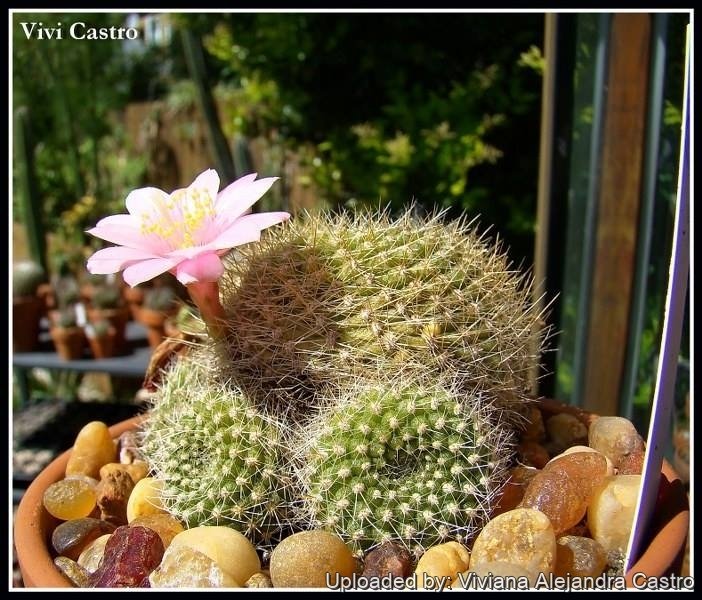
Rebutia minuscula f. kariusiana| (Rebutia kariusiana) is one of the many forms of the extremely variable Rebutia minuscula, and shows transitional characters between Rebutia minuscula subs. violaciflora| and Rebutia wessneriana subs. beryllioides. It has pink-violet flowers and plants in cultivation shows minimal variability. The hue of the flowers is very uniform and characteristic. Slight differences in colour shade are probably just the result of differences in culture or age of the plants. R. kariusiana grows and blooms well and its uniformity is probably due to controlled pollination. It has comparatively larger stems than other “minuscula” and tends to stay solitary or produce few shoots only with age. It is autosterile (needs cross-pollination).
Roots: Fibrous.
Stems: Flattened globose to globose, apex depressed and spiny, bright green, bout 50 mm in diameter.
Ribs: 16-21 with low, vertical or spiralled with distinct tubercles.
Tubercles: Low, flat conical.
Areoles: Small on top of tubercles, circular to slightly elliptical, 1,5 mm long, about 5 mm apart. Slightly covered with short greyish felt, soon bare
Radial spines: About 8 to 10, fine 3-6 mm long, white to light brown, at first lighter.
Central spines: 3 to 4, up to 6 mm long, dark brown, darker at base.
Flowers: Slender funnel-form, 45 mm long, 40 mm wide, both inside and outside pale pink to bright violet pink . Self fertile. Buds pointed, light green. Flowers grow in profusion from the older areoles on the bottom half of the stem, often at the stem bases. Pericarpell, pale to olive green almost spherical, pale red, naked, covered with several darker red scales. Floral tube funnel-form, about 12 mm long, with pale green scales without hair bristles, which gradually change in the outer tepals. Outer perianth segments (tepals) acute-lanceolate, with a marked brownish mid strip on the outside. Inner perianth segment slightly wider, usually bright pink. Filaments yellow, anthers yellowish. Style free to base, pink, stigma with 4-5 white lobes only slightly protruding the anthers.
Fruits: Globose, yellow-green, to 6 mm in diameter, drying and cracking irregularly.
Seeds: Oblong, glossy black about 1 mm long and 0,7 mm wide, hilum basal, somewhat oblique, white.
Remarks: Rebutia minuscula is quite variable. The differences concern the spination and flowers colour, however the size and number of spines is greatly influenced by the conditions of culture, at lower light levels the spines are less numerous, delicate and white, while with strong solar radiation the spines are stronger with a yellowish tint. In some cases differences are referable to separate population, but often occurred over a long period of cultivation due to autogamy. Many such variants have been described as species in the past.
Origin and Habitat
Rebutia kariusiana is a cultivated form presumably endemic to Northern Argentina, in the province of Salta, near the areal of Rebutia violaciflora a Rebutia beryllioide. According to other information, the first original Rebutia kariusiana was found in a batch of Rebutia marsoneri and should come from an area in the province of Jujuy.
Cultivation and Propagation
Rebutia kariusiana (Rebutia minuscula f. kariusiana|) comes from mountainous areas, so like bright light, and cool and dry conditions in the winter. The whole Rebutia minuscula complex has delightful flowers and the plants remain compact, and clumps can easily be managed by division. It is easy to cultivate and recommended for beginners.
Growth rate: It is a slow growing but easily flowering species that will make clumps given the best conditions.
Soils: This species is easy to cultivate in a very open mineral mix with at least 50% sand or pumice grit and a pH slightly on the acidic side.
Repotting: They are small container size plants and prefer deep pots and good drainage to accommodate their tap roots, but they rot prone, because of the sensitivity to excess of watering, not easy to get to any large size on their own roots (it’s really a challenge to grow them into a large clump). They will occupy a small pot comfortably, and eventually remain a manageable sized house plant. It is better that they are repotted regularly. Repotting will increase the number and size of stems, and will increase the number of flowers produced. Repot yearly until they reach about 100 mm in size, then every two or three years will suffice. Repotting is best done at the end of winter, but can be done at other times, too. Do not water for a couple of weeks after repotting, to reduce risk of root rot via broken roots. A layer of ‘pea’ gravel at the bottom of the pot improves drainage. A layer of decorative gravel as a top dressing helps prevent the caking of the potting mix, which decreases the rate of water absorption. It also keeps the perlite and pumice from blowing everywhere, and looks nice.
Watering: It requires full sun or light shade and careful watering to keep plant compact, and maintain strong and dense spines and allow the pot to dry out between waterings. Keep dry in winter at a minimum temperature of 0°C. It tends to rot if too wet. The plants can be placed outdoors in April, but protected from rain and direct sunlight. Water them thoroughly when placed out, and again in two weeks, and again in one week. After one month the plants are ready to be placed out in full sun and full rain for the summer. During dry spells the collection is watered once a week, during hot dry spells, twice a week.
Fertilization: Feed with a high potassium fertilizer in summer.
Hardiness: It is reputedly resistant to frost if kept on the dry side prior to, and during, cold weather and requires a winter rest period (hardy to -7° C, or less for short periods). Rebutias grow in nature at high altitudes, and do not thrive well at high temperatures in cultivation. They will often go dormant in mid-summer, and resume growth again when the weather cools in late August. They can tolerate amazingly low temperatures for long periods of time. All species can take a frost, even when not bone dry. It is generally accepted that plants kept at too high a temperature, or watered too much during the winter rest period, will not bloom the following year. They will be perfectly happy in pots outdoors from April to September if protected from torrential rain and hail.
Exposition: The plant tolerates extremely bright situations but enjoys filtered sunlight or afternoon shade, inside it needs bright light, and some direct sun. Tends to bronze in strong light, which encourages flowering and heavy spine production, but is likely to suffer from sun scorch or stunted growth if over exposed to direct sunlight during the hottest part of the day in summer.
Uses: It is a fine plant for a rock garden or container, contrasts well with agaves, yuccas, and low-growing flowering plants. This variety is also likely to flower as a house plant, but results will depend on a variety of growing conditions.
Pests & diseases: All, especially the young, are susceptible to red spider mites.
Rot: It is especially prone to root rot, therefore, underpot in a smaller container filled with very porous compost. However rot it is only a minor problem with rebutias if the plants are watered and “aired” correctly. If they are not, fungicides won’t help all that much.
Propagation: Offsets, seeds. Seeds germinate in 7-14 days at 21-27° C in spring or summer remove gradually the glass cover as soon the plants will be well rooted (ca 1-2 weeks) and keep ventilated, no full sun for young plants! The seedlings should not be disturbed until they are well rooted, after which they can be planted separately in small pots. To make a cutting twist off a branch and permit it to dry out a couple of weeks, lay it on the soil and insert the stem end partially into the soil. Try to keep the cutting somewhat upright so that the roots are able to grow downward.
Note: It would appear that in cultivation they grow larger and cluster more vigorously than in habitat.
Bibliography
Major references and further lectures
-
Přispěvatelé Wikipedie, ‘Rebutia kariusiana’, Wikipedie: Otevřená encyklopedie, 16. 09. 2014, 01:43 UTC, <http://cs.wikipedia.org/w/index.php?title=Rebutia\_kariusiana&oldid=11860796\> [získáno 2. 11. 2014]
-
Backeberg, Curt; “Das Kakteenlexikon”, p. 384, 385, 1966
-
Donald, John Donald; Ashingtonia, 2: 51, 1975
-
Pilbeam, John; “Rebutia”, p. 50, 1997
-
Šída, Otakar; “Atlas kaktusů,” tab. 67, 1988
-
Šída, Otakar; “Rod Rebutia”, p. 34, 1997
-
Edward Anderson “The Cactus family” Timber Press, Incorporated, 2001
-
James Cullen, Sabina G. Knees, H. Suzanne Cubey “The European Garden Flora Flowering Plants: A Manual for the Identification of Plants Cultivated in Europe, Both Out-of-Doors and Under Glass” Cambridge University Press, 11/Aug/2011
-
David R Hunt; Nigel P Taylor; Graham Charles; International Cactaceae Systematics Group. “The New Cactus Lexicon” dh books, 2006
-
N. L. Britton, J. N. Rose “The Cactaceae. Descriptions and Illustrations of Plants of the Cactus Family.” Volume 4, The Carnegie Institution of Washington, Washington 1923
Gallery