Publication: Bradleya 5: 94. 1987
Description
Rebutia neumanniana best known as Weingartia neumanniana is the smaller and slower growing “Weingartia”, sometimes considered as a difficult to grow plant, but relatively easy and doesn’t mind a cold winter.
Habit. Plants solitary or sprouting from the roots with age. The small juvenile shoots that sprout around the mother plant from the roots are hidden most of the year by dust or leaves that cover them, and they do not have spines.
Root: It ha a swollen, often branched, tap-root.
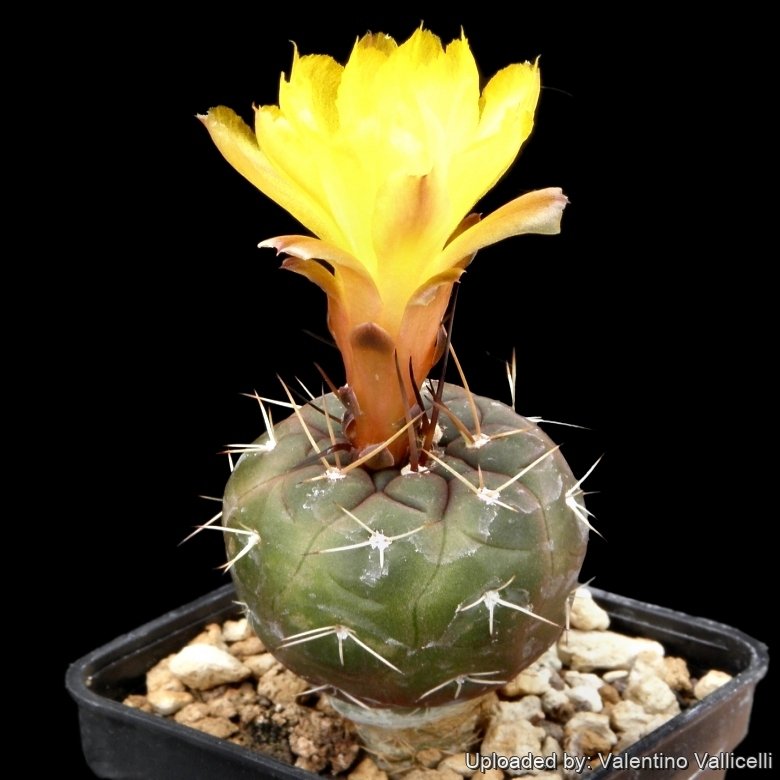
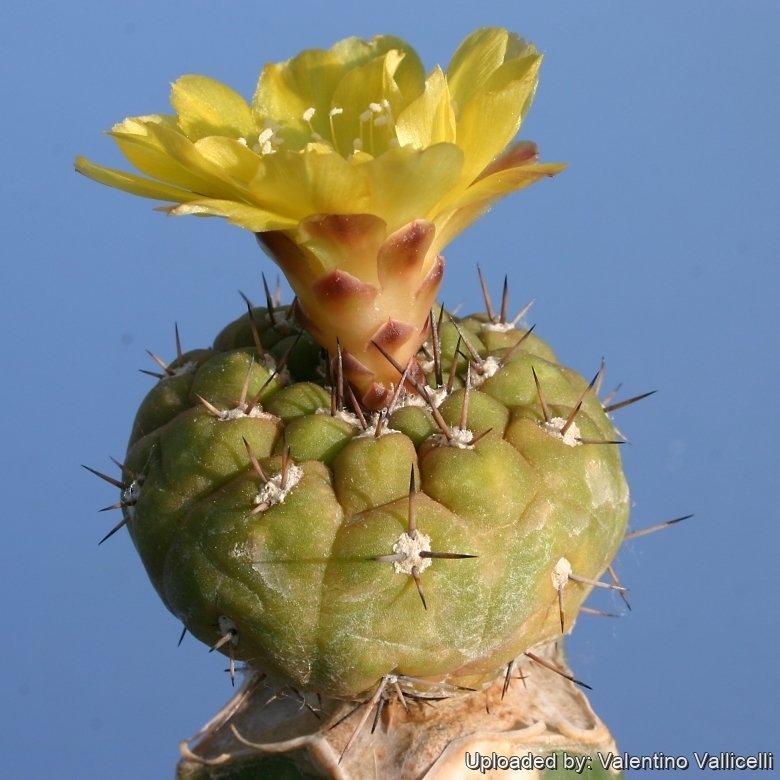
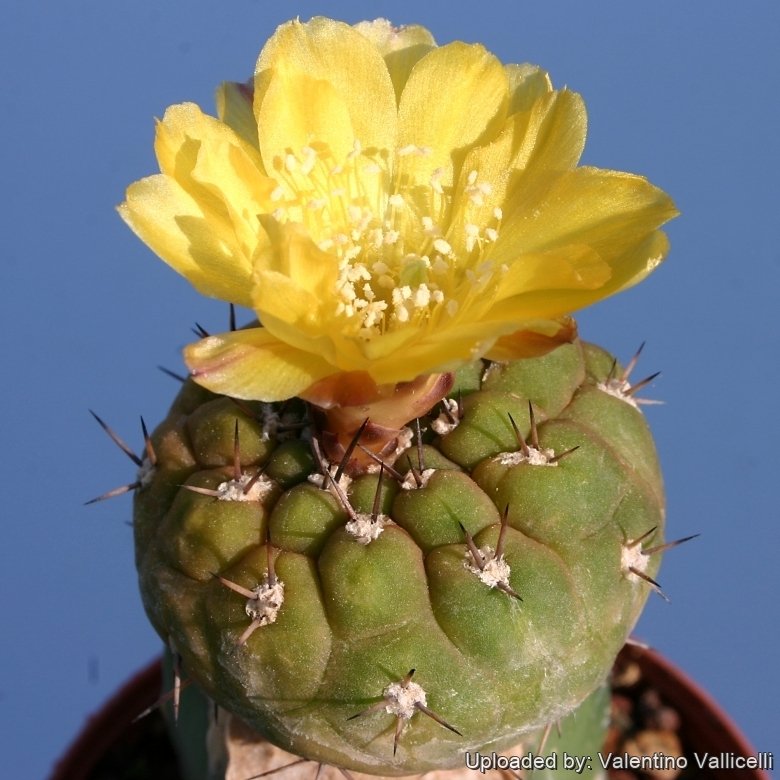
Stems: Almost spherical, grey-green with velvety appearance, green in culture, constricted at at neck, 3-7 cm high and 1-5 cm in diameter.
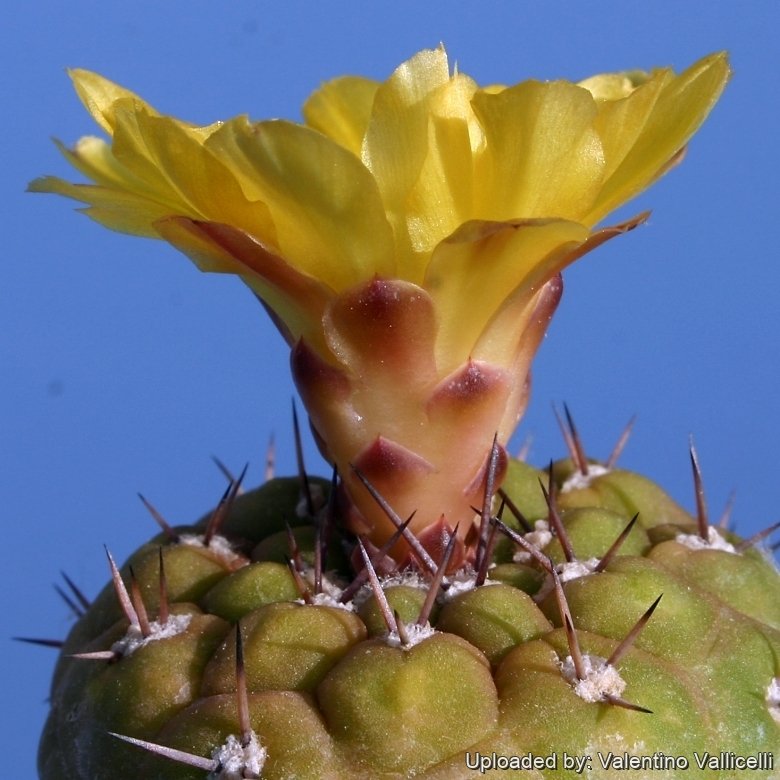
Ribs: 6 to 10 (or up to 14 in culture), clearly divided into low, round-topped, indistinctly six-sided tubercles.
Areoles: Round, white about 1 cm apart.
Spines: Rigid, as long as the diameter of the plants, needle-like, yellowish, brownish or reddish black , often becoming black. Small stems spineless. Pericarpel and tube with scales but no hair or bristles (Like in the genus Gymnocalycium).
Central spine: 1(-3), straight, pointing upward, to 3 cm long.
Radial spines: 6-8, somewhat shorter, stiff, spreading, to 2 cm long. Staminal throat-circle present.
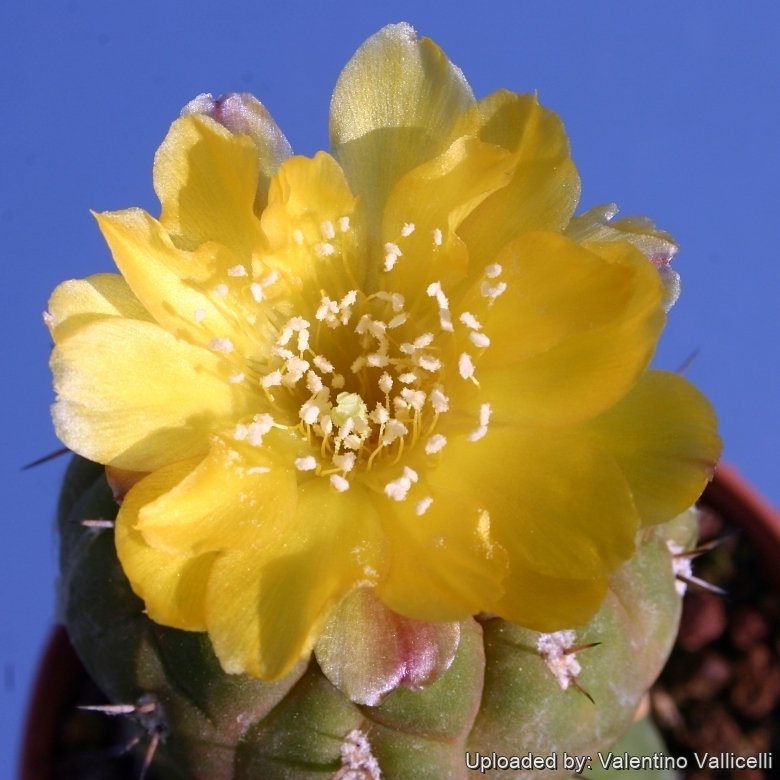
Flowers: Yellow to reddish orange, often with caramel streaks, bell-shaped, apical, almost central, up to 2,5 cm long and in diameter.
Fruits: Globose to ovoid, brownish.
Seeds: 1,5 x 1 mm dark brown to black.
Origin and Habitat
Rebutia neumanniana is known from a few localities in Northern Argentina (High above the town of Humahuaca to Iturbe, Salta) and southern Bolivia (Villazon to Berque, Potosi) whether the three known subpopulations are indeed isolated and/or whether there may be additional subpopulations between them. Furthermore, not much is known about the population size due to its cryptic appearance. . Rebutia neumanniana is the most southern species of the “Weingartia”, the only one that grows in Argentina, the bulk of the genus being in Bolivia.
Altitude: 3300-4000 metres above sea level.
Habitat: It grows in the altiplano crammed in the rock gaps on flat hill tops and gentle slopes on outcrops of rock with vertical strata. This cactus is locally abundant, but it is quite cryptic.
Cultivation and Propagation
These plants come from mountainous areas, so like bright light, cool and dry conditions in the winter; this is important for the flowers as well as for their health. Without this cool winter period (0-10° C) they normally won’t get many buds. They have a thick taproot and are of difficult cultivation and rot prone because of a great sensitivity to the excess of watering, not easy to get to any large size on their own roots really a challenge to grow into a large clump. They are commonly grafted to avoid root problems and to make easier to grow.
Sun Exposure: Suited for sunny-brightly exposure; can tolerate light shade.
Cultural Practices: Suited for airy exposures. Needs deep pot and good drainage to accommodate its tap root.
It is very cold resistant as low as to -10° C or less for short periods of time.
Pests & diseases: It is especially prone to root rot, therefore, underpot in a smaller container filled with very porous compost. On a graft the plants are easier to grow, but the body splits if over-watered (especially in spring).
Propagation: Seeds, also can be grown from cutting or graft. Seeds can be sown in the spring or summer. The seedlings should not be disturbed until they are well rooted, after which they can be planted separately in small pots.
Notes
The plants belonging to the Rebutia neumanniana group are characterized by a strong thickened rootstock with a narrowing (neck) in the zone that connects to the stem, and sometime new shoots are formed on the root-branches that emerge from the soil. This species was considered closely related to Gymnocalycium and Rebutia but neither of these placements is supported by DNA studies so it should still be called Weingartia neumanniana.
Bibliography
Major references and further lectures
-
Edward Anderson “The Cactus family” Timber Press, Incorporated, 2001
-
James Cullen, Sabina G. Knees, H. Suzanne Cubey “The European Garden Flora Flowering Plants: A Manual for the Identification of Plants Cultivated in Europe, Both Out-of-Doors and Under Glass” Cambridge University Press, 11/Aug/2011
-
David R Hunt; Nigel P Taylor; Graham Charles; International Cactaceae Systematics Group. “The New Cactus Lexicon” dh books, 2006
-
Ritter Fr.: “Kakteen in Südamerika” Spangenberg, 1980
-
John Pilbeam “Sulcorebutia and Weingartia: A Collector’s Guide” Timber Press, 1985
-
E Haustein “Der Kosmos Kakteenfuehrer (the Kosmos Cactus Guide)” Balogh Scientific Books 01 December 1998
-
Cullmann W., Götz E., Gröner G.”Kakteen: Kultur, Vermehrung und Pflege - Lexikon der Gattungen und Arten” Ulmer, Stuttgart, 1984
-
Curt Backeberg “Die Cactaceae: Handbuch der Kakteenkunde” Volume 3 G. Fischer, 1959
-
Werdermann, E. “Weingartia Werd.” Kakteenkunde(2):20-21 1937
From llifle page Weingartia kargliana
Description
Rebutia neumanniana var. kargliana (best known as Weingartia kargliana), is a local or morphological form of Rebutia neumanniana. It very similar to the standard species, but came from an isolated population in Bolivia (Potosi). The differences with Rebutia neumanniana are very minimal and most botanist agree on the fact that both should all be included in the Rebutia neumanniana, and the two plants are not readily distinguishable, if not for the geographical provenance.
Habit. Plants solitary or sprouting from the roots with age. The small juvenile shoots that sprout around the mother plant from the roots are hidden most of the year by dust or leaves that cover them, and they do not have spines.
Root: It ha a swollen, often branched, tap-root.
Stems: Almost spherical, grey-green with velvety appearance, green in culture, constricted at at neck, 3-7 cm high and 1-5 cm in diameter.
Ribs: 6 to 10 (or up to 14 in culture), clearly divided into low, round-topped, indistinctly six-sided tubercles.
Areoles: Round, white about 1 cm apart.
Spines: Rigid, as long as the diameter of the plants, needle-like, yellowish, brownish or reddish black , often becoming black. Small stems spineless. Pericarpel and tube with scales but no hair or bristles (Like in the genus Gymnocalycium).
Central spine: 1(-3), straight, pointing upward, to 3 cm long.
Radial spines: 6-8, somewhat shorter, stiff, spreading, to 2 cm long. Staminal throat-circle present.
Flowers: Yellow to reddish orange, often with caramel streaks, bell-shaped, apical, almost central, up to 2,5 cm long and in diameter.
Fruits: Globose to ovoid, brownish.
Seeds: 1,5 x 1 mm dark brown to black.
Origin and Habitat
(Tupiza, Pampa Mochara, Iscayachi, Cieneguillas, Rio Blanco to El Puente) Sud Chichas, Potosi, Bolivia
Altitude: 3000-3500 metres above sea level.
Habitat and ecology: This cactus grows amongst rocks in the altiplano. Furthermore, not much is known about the population size due to its cryptic appearance.
Bibliography
Major references and further lectures
-
Edward Anderson “The Cactus family” Timber Press, Incorporated, 2001
-
James Cullen, Sabina G. Knees, H. Suzanne Cubey “The European Garden Flora Flowering Plants: A Manual for the Identification of Plants Cultivated in Europe, Both Out-of-Doors and Under Glass” Cambridge University Press, 11/Aug/2011
-
David R Hunt; Nigel P Taylor; Graham Charles; International Cactaceae Systematics Group. “The New Cactus Lexicon” dh books, 2006
-
Ritter Fr.: “Kakteen in Südamerika” Spangenberg, 1980
-
John Pilbeam “Sulcorebutia and Weingartia: A Collector’s Guide” Timber Press, 1985
-
E Haustein “Der Kosmos Kakteenfuehrer (the Kosmos Cactus Guide)” Balogh Scientific Books 01 December 1998
-
Cullmann W., Götz E., Gröner G.”Kakteen: Kultur, Vermehrung und Pflege - Lexikon der Gattungen und Arten” Ulmer, Stuttgart, 1984
-
Curt Backeberg “Die Cactaceae: Handbuch der Kakteenkunde” Volume 3 G. Fischer, 1959
-
Werdermann, E. “Weingartia Werd.” Kakteenkunde(2):20-21 1937
11)Lowry, M. 2013. Rebutia neumanniana. The IUCN Red List of Threatened Species. Version 2014.3. <www.iucnredlist.org>. Downloaded on 18 April 2015.
Source: Weingartia kargliana, LLIFLE - Encyclopedia of living forms, CC-BY-SA, retrieved 2026-10-25.
Cultivars and forms (1)
Varieties (1)
Gallery