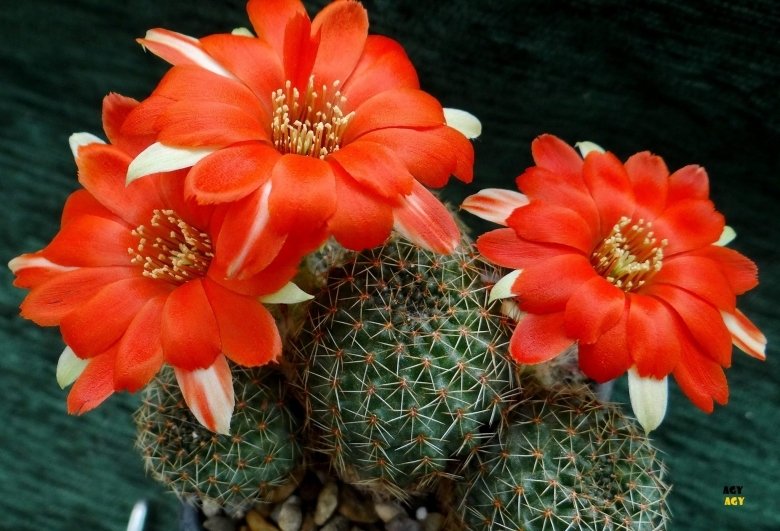
Publication: Cactaceae (Britton & Rose) 3: 47, fig. 60. 1922
Description
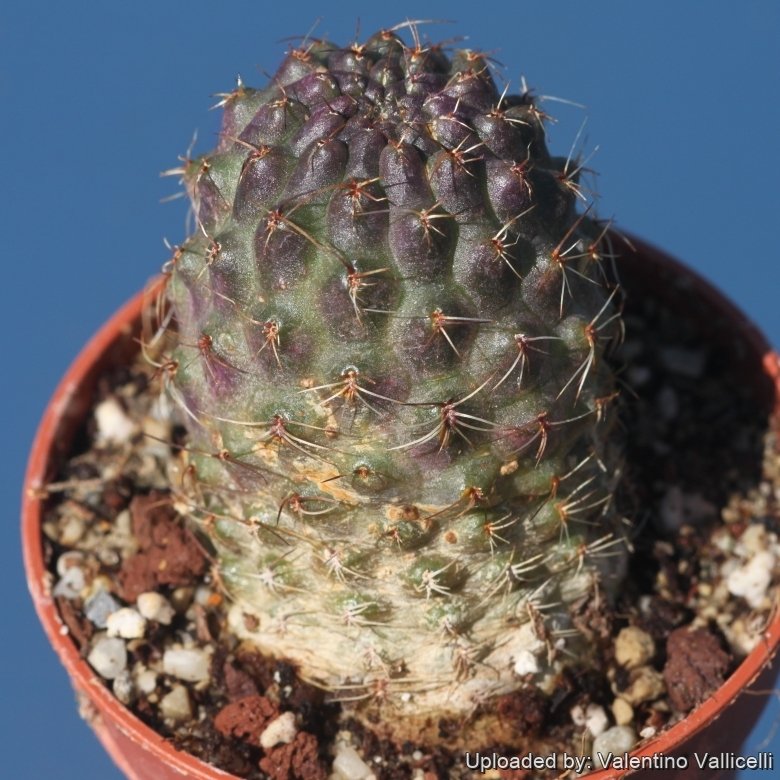
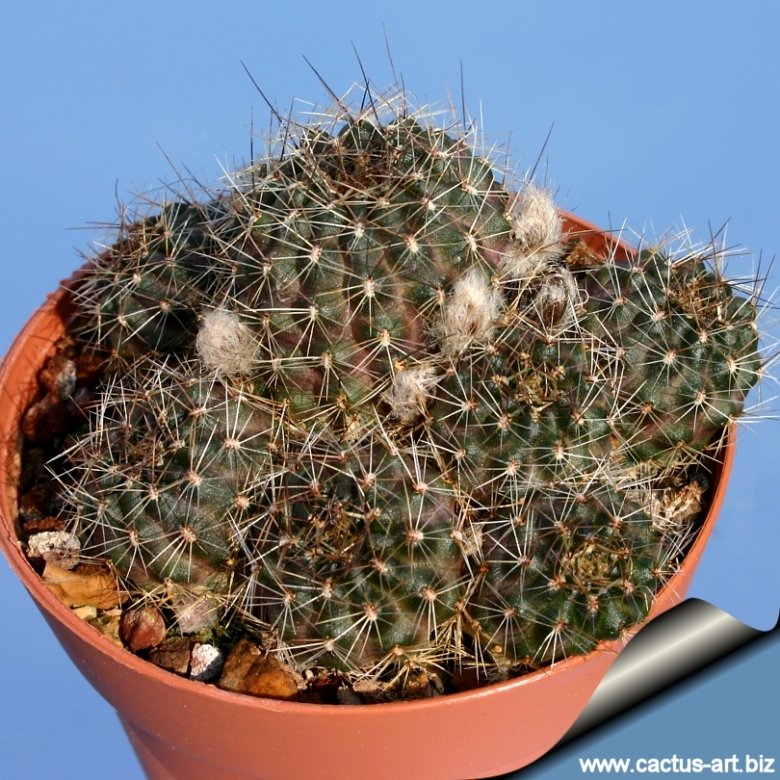
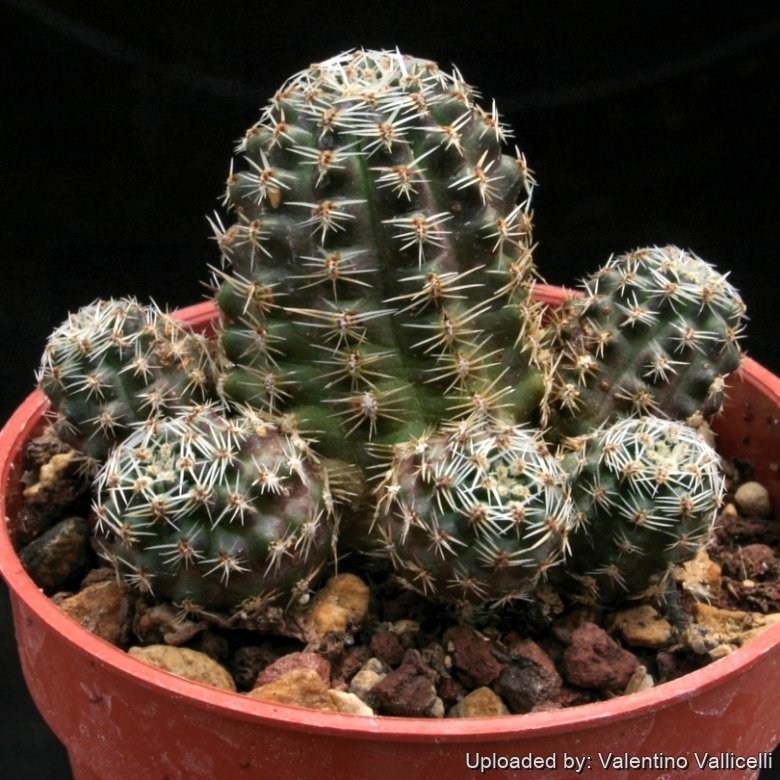
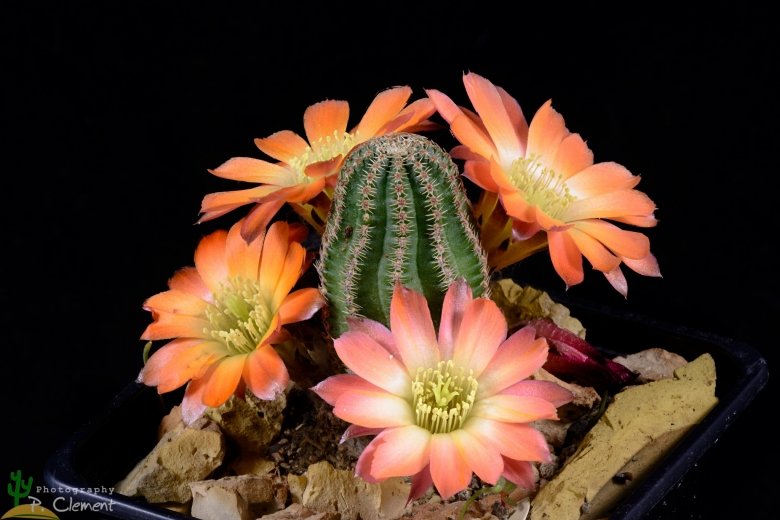
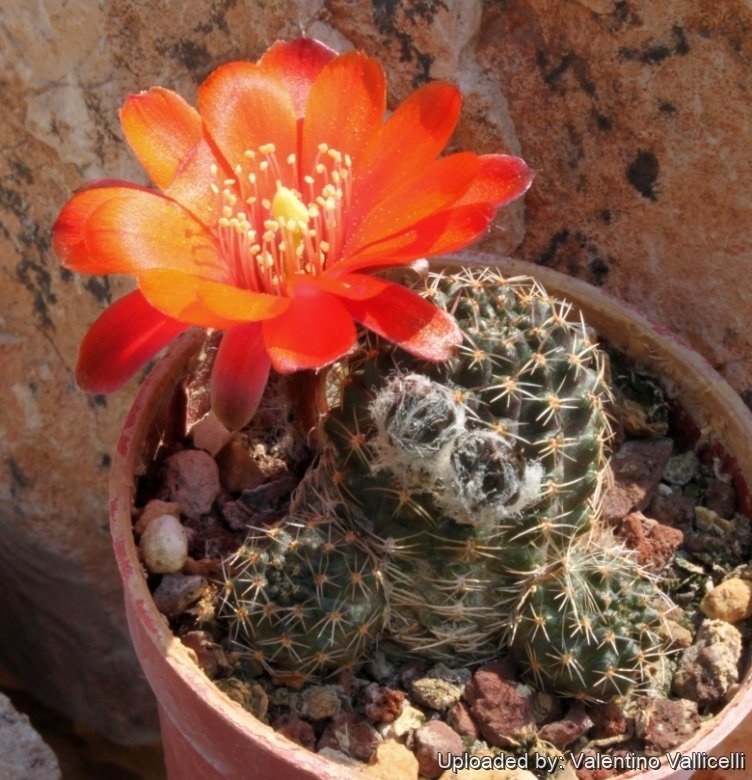
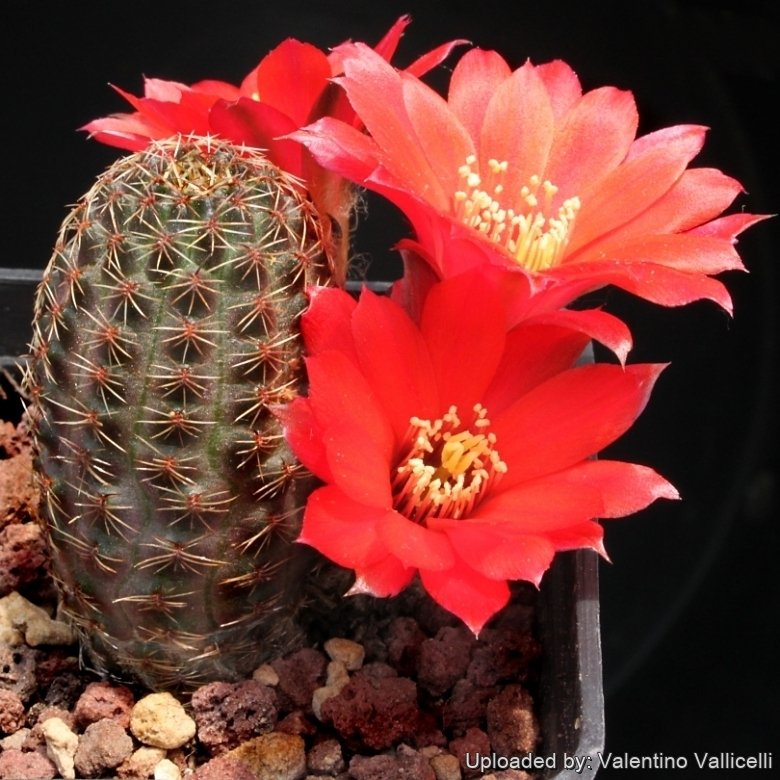
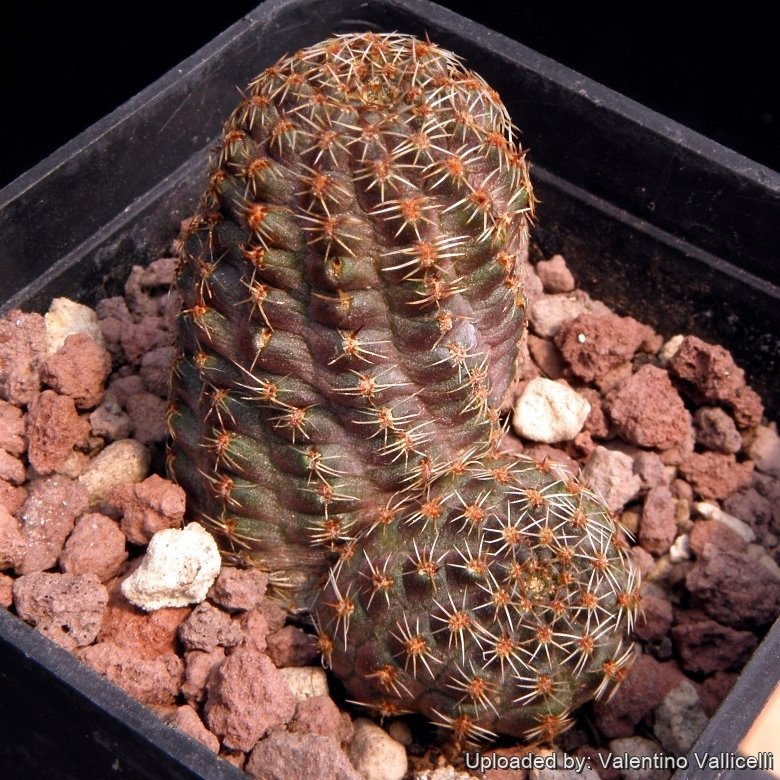
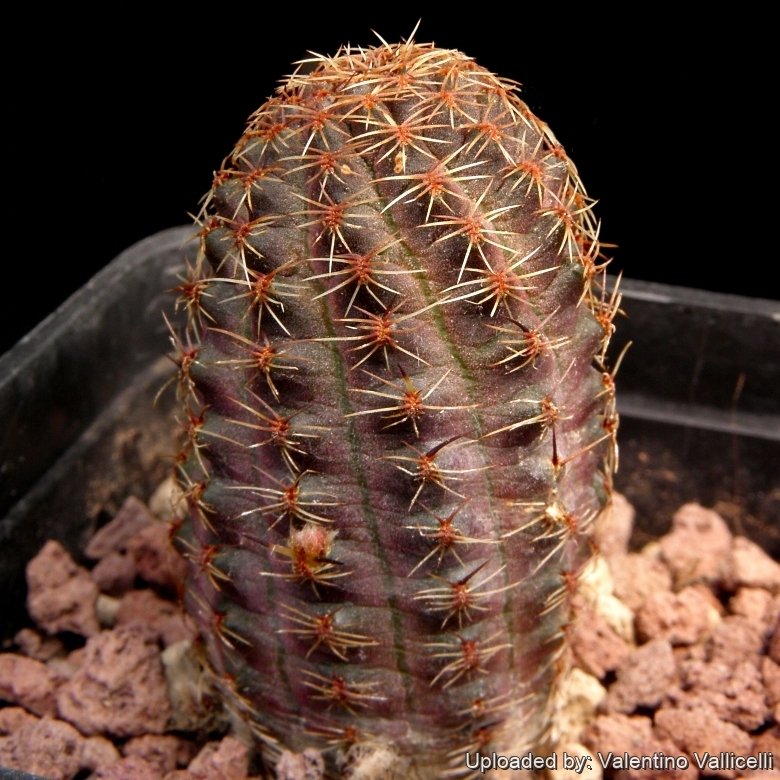
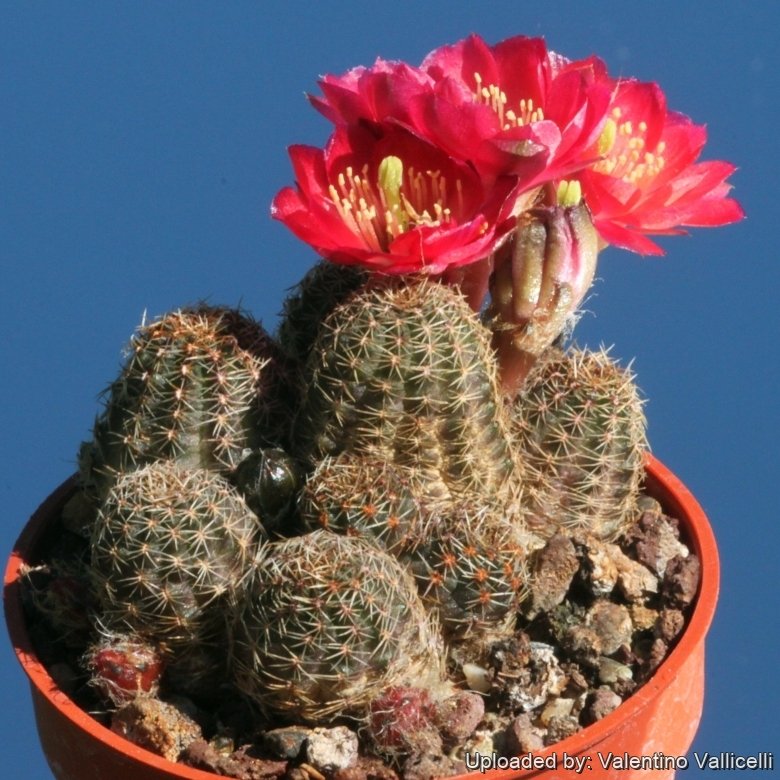
Rebutia pygmaea is a very small clumping species, widespread and extremely variable that has received numerous unnecessary names. Some of its variable forms don’t really look like the same species.
Habit: It is a small geophyte cactus solitary or clustering and barely rising above ground level.
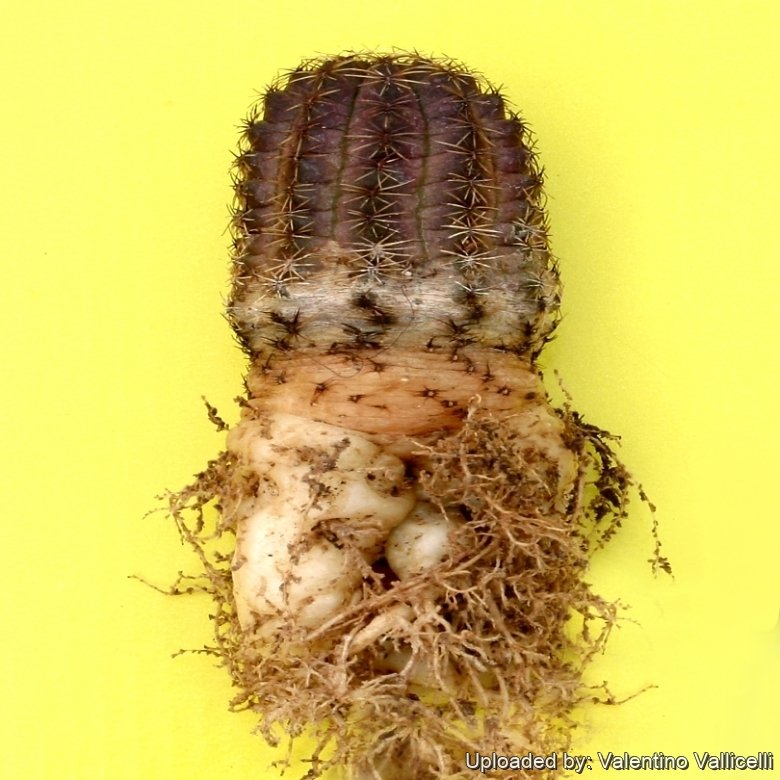
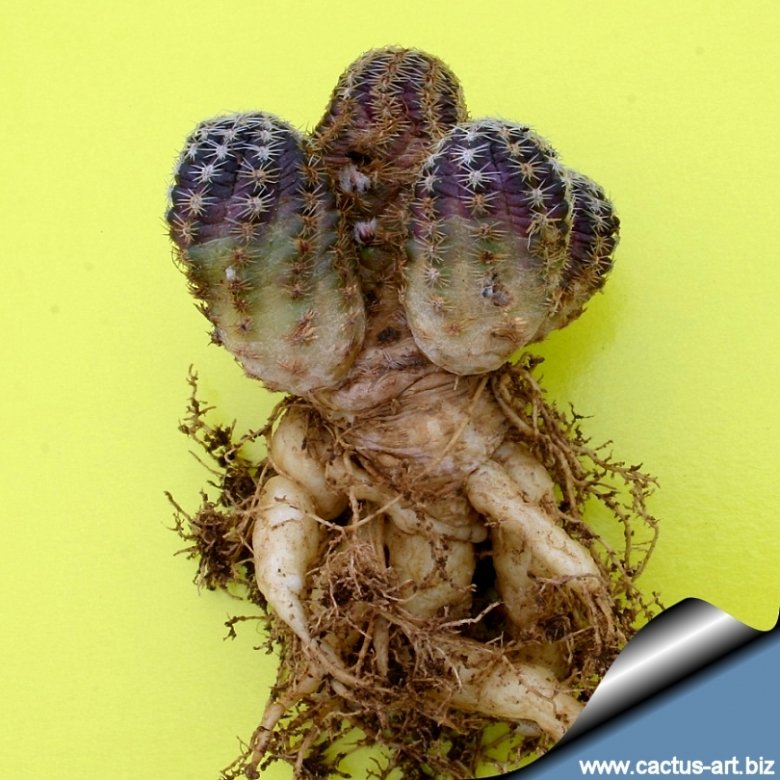
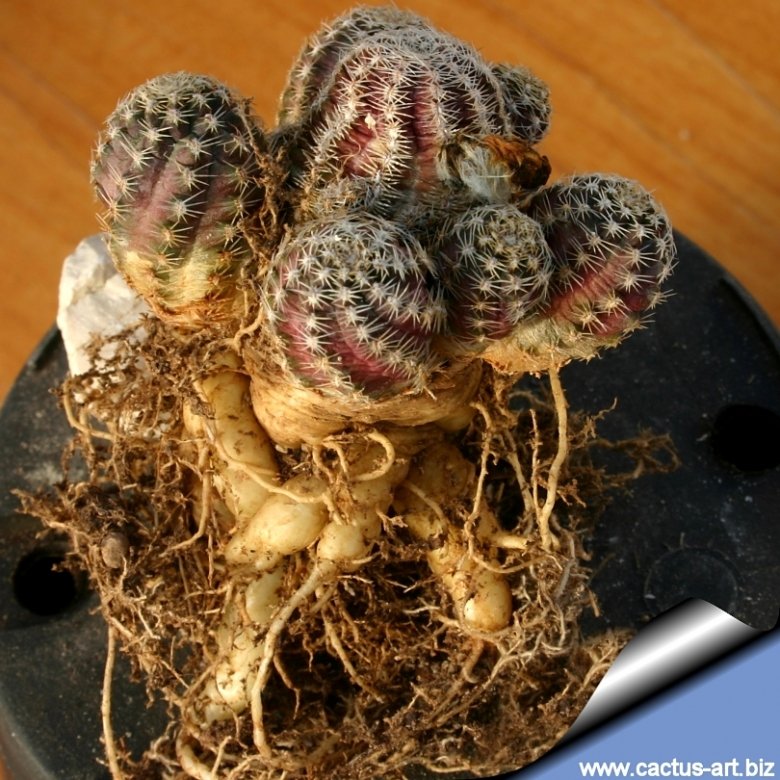
Roots: It has a heavy tap root that may exceed the size of the plant above soil level. Tap root more or less branched whitish.
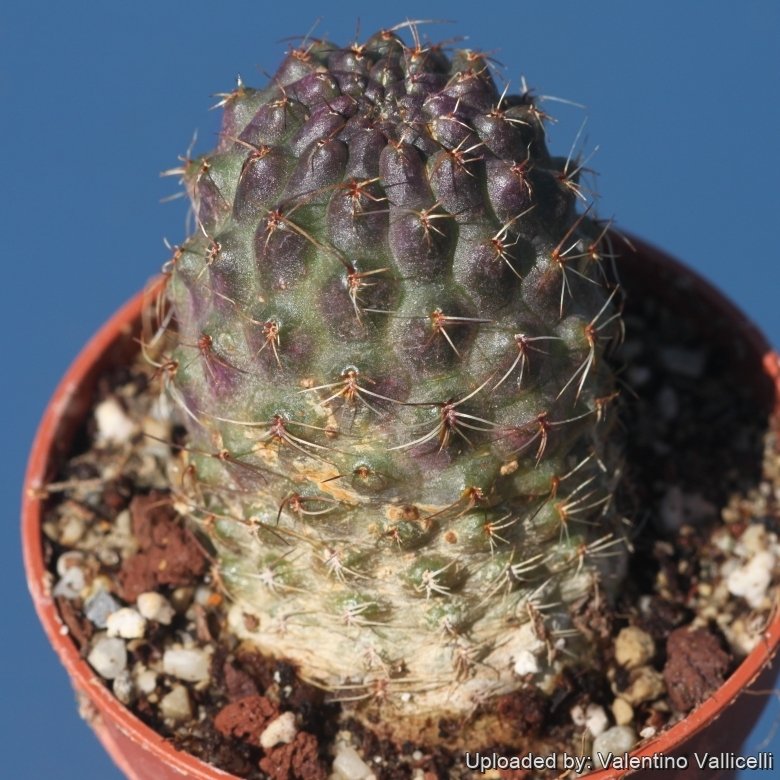
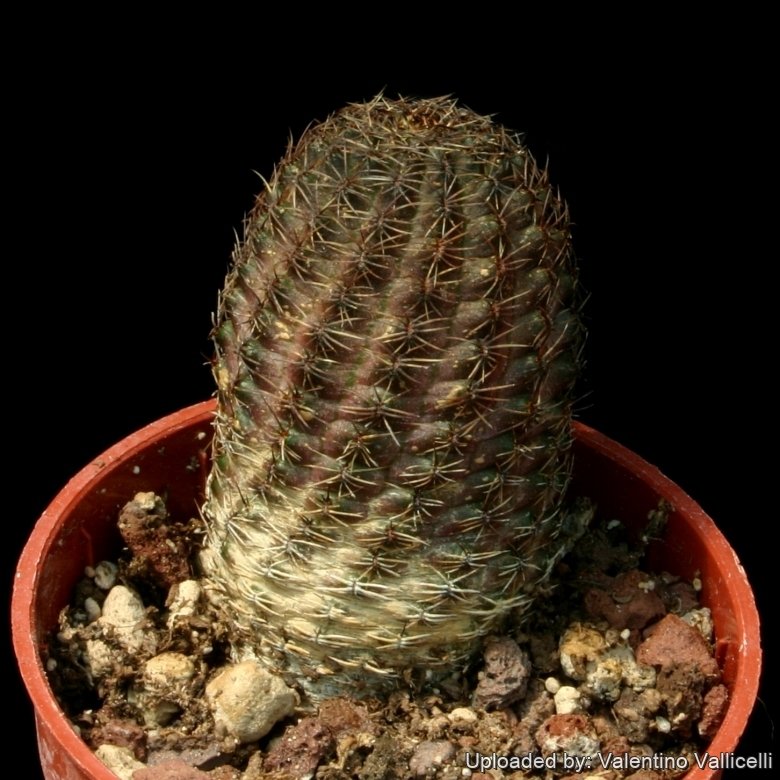
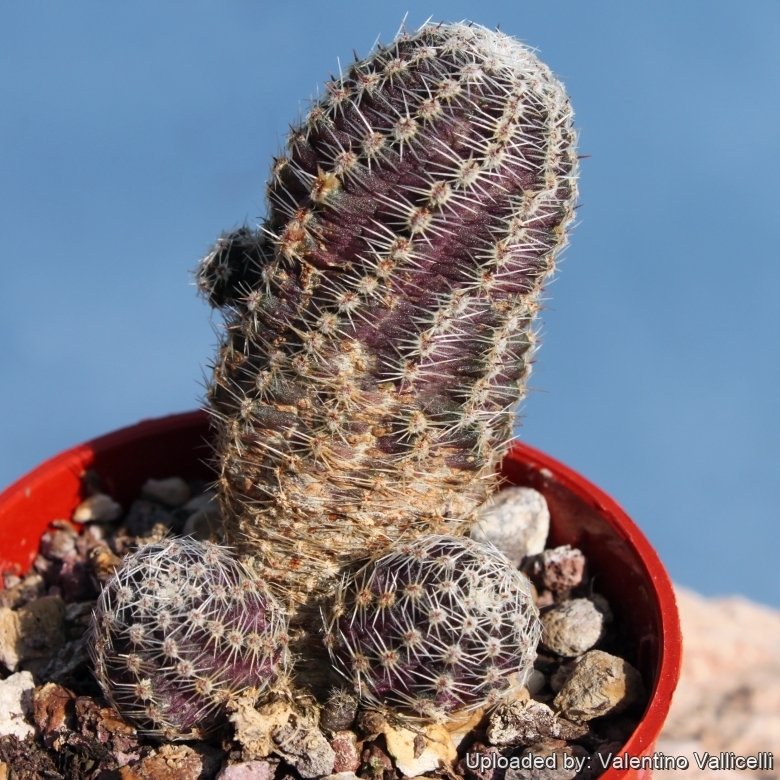
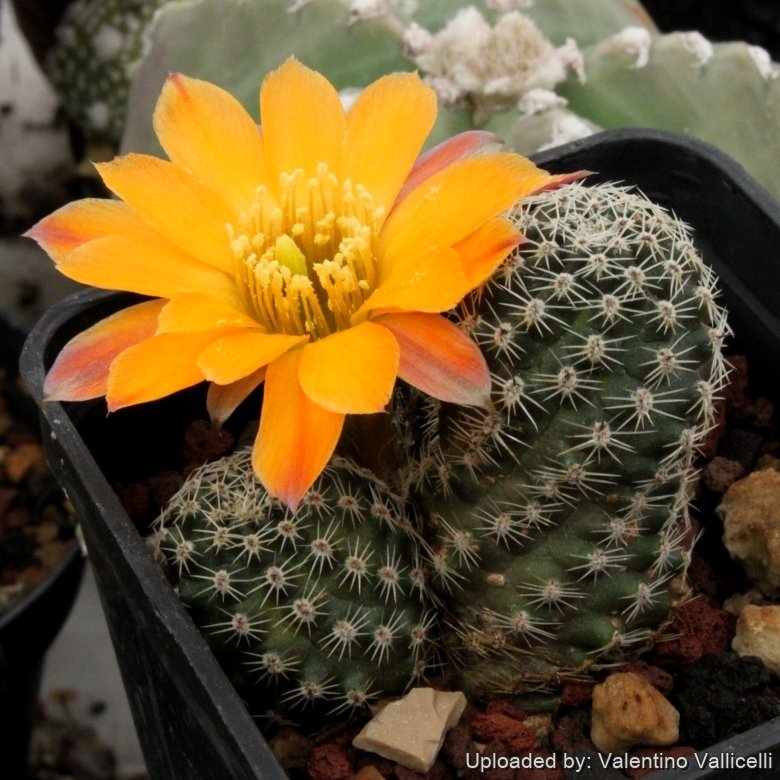
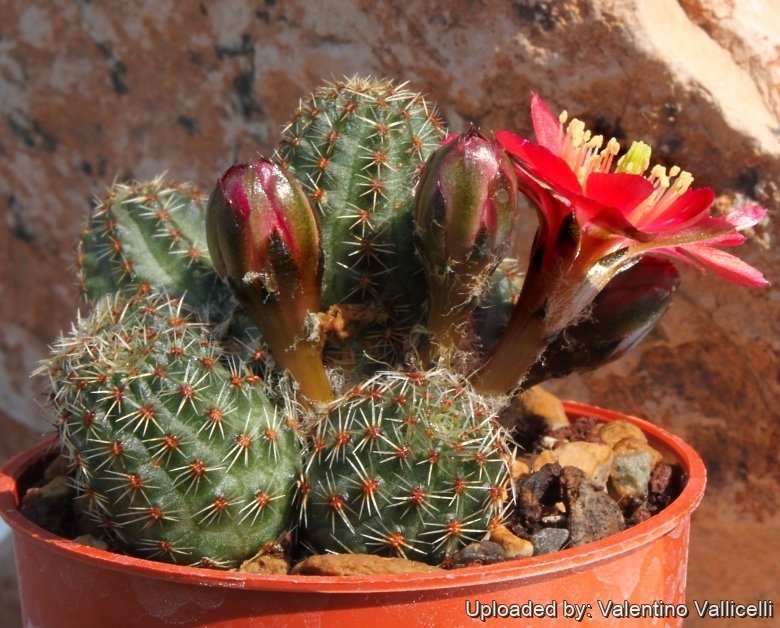
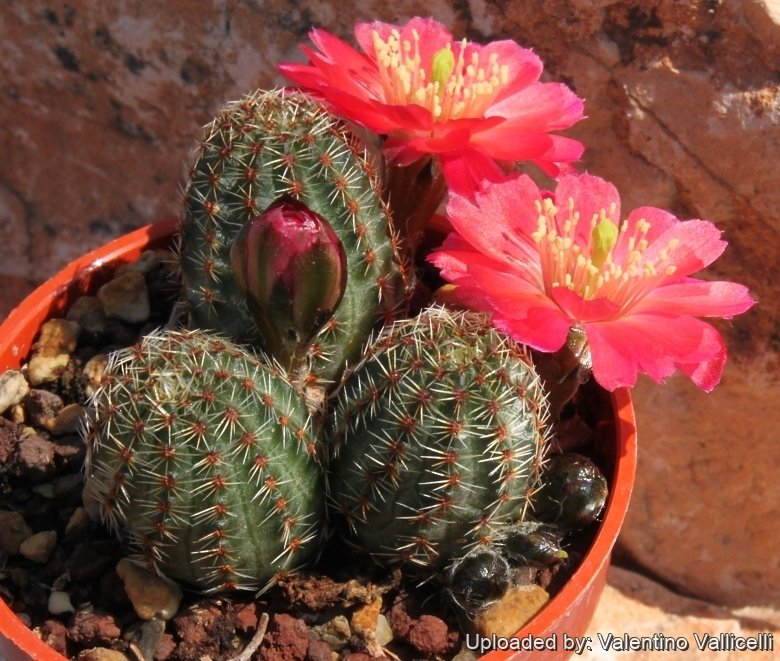
Stem: 10-30(-40) mm tall, 12-20 mm wide, spherical to slightly oblong, becoming short-cylindrical in cultivation. The colour of the epidermis vary from grey-green or olive-green to dark purple-green with violet tints.
Ribs: About 10 more or less spiralling, slightly tuberculate.
Tubercles: About 2-4 mm wide and 1,5 mm high.
Areoles: Oval, 1-1,5 mm long, about 0,5 mm wide, slightly brownish or whitish tomentose, 2 mm long, with abundant white or light brown felt, a little far apart.
Radial spines: 8-11, thin, bristly, pectinate, short, brown to glassy white with a darker base, 2-3 mm long.
Central spines: usually absent, or rarely 1 yellowish, 1-2 mm long.
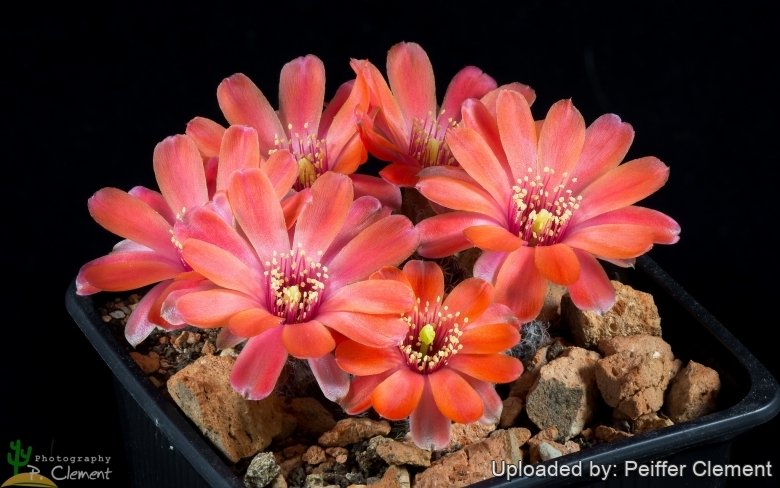
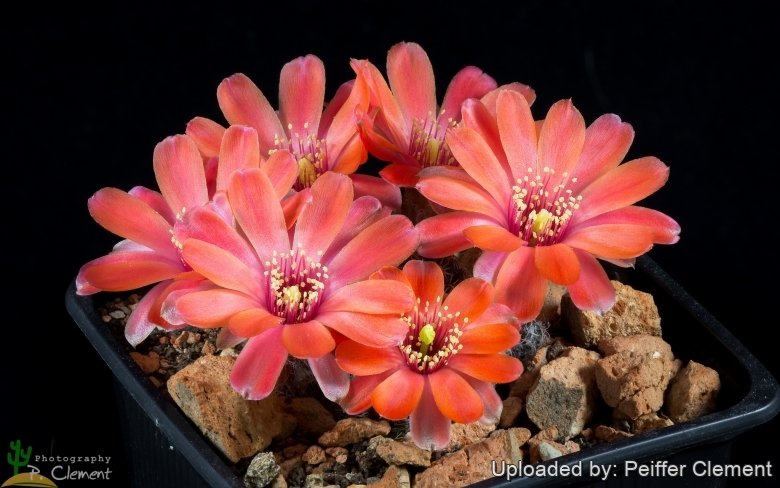
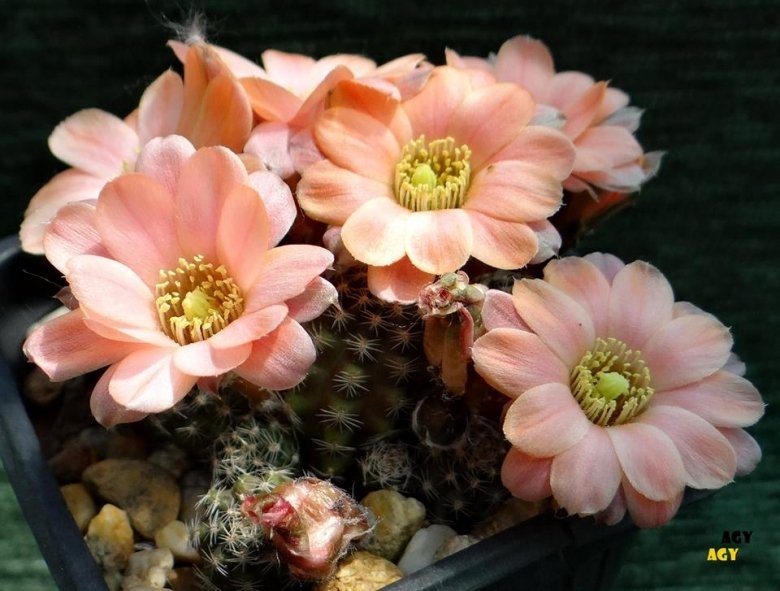
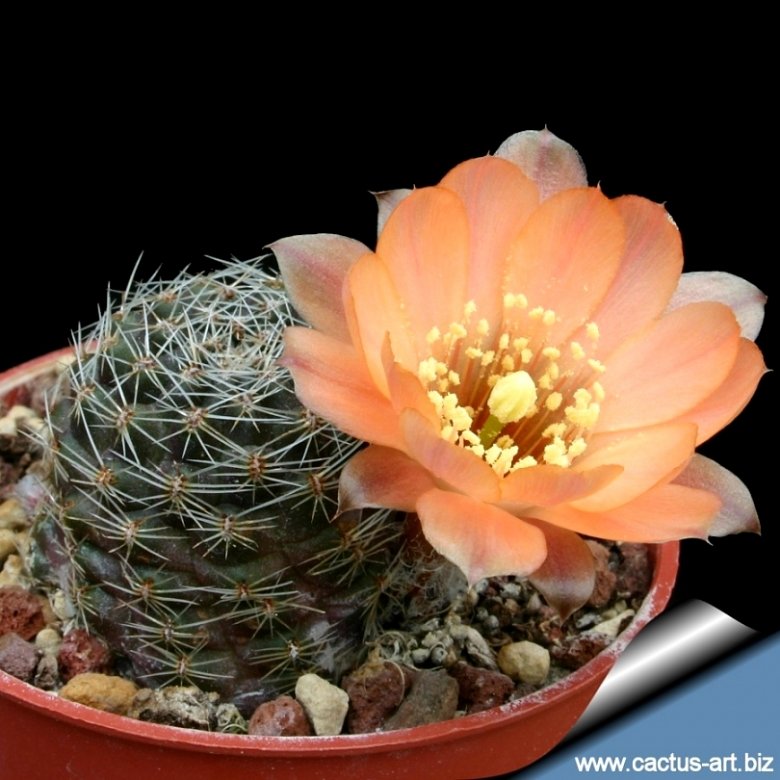
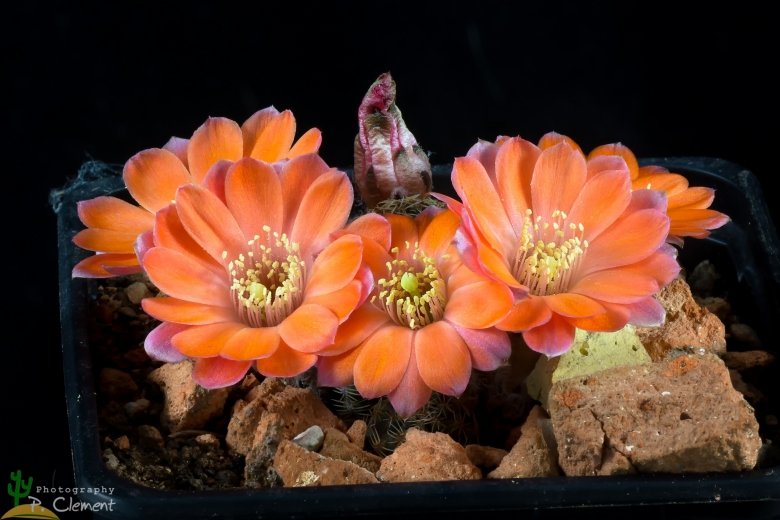
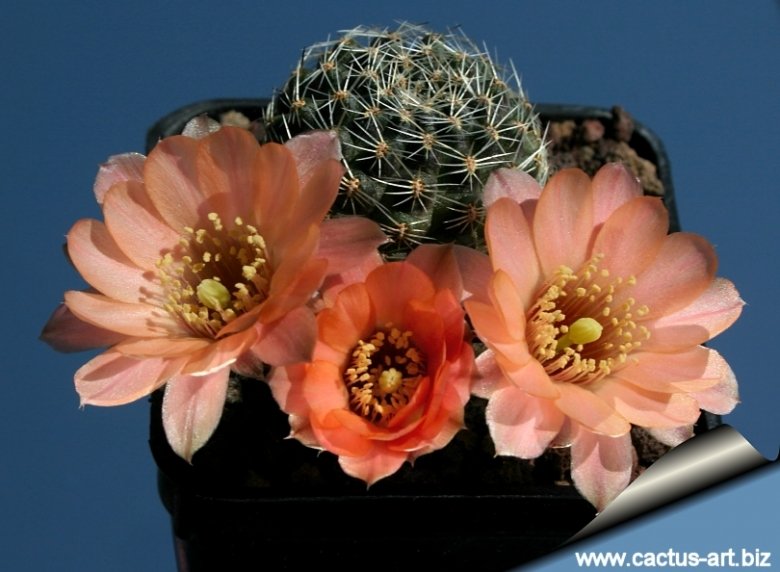
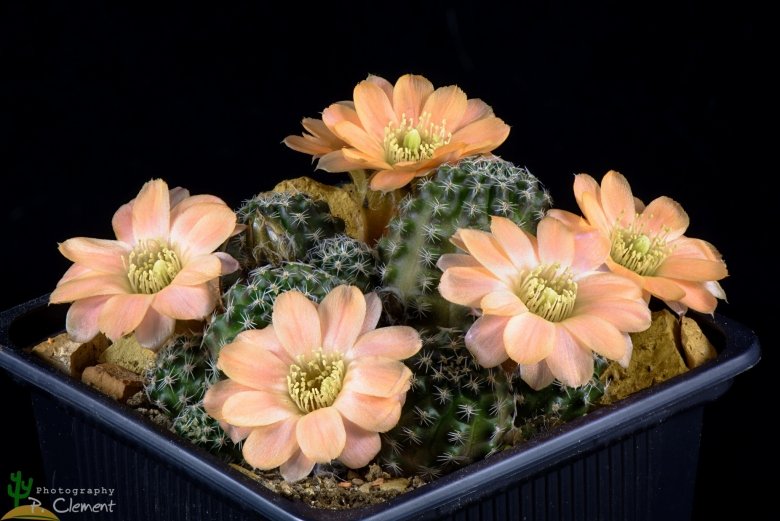
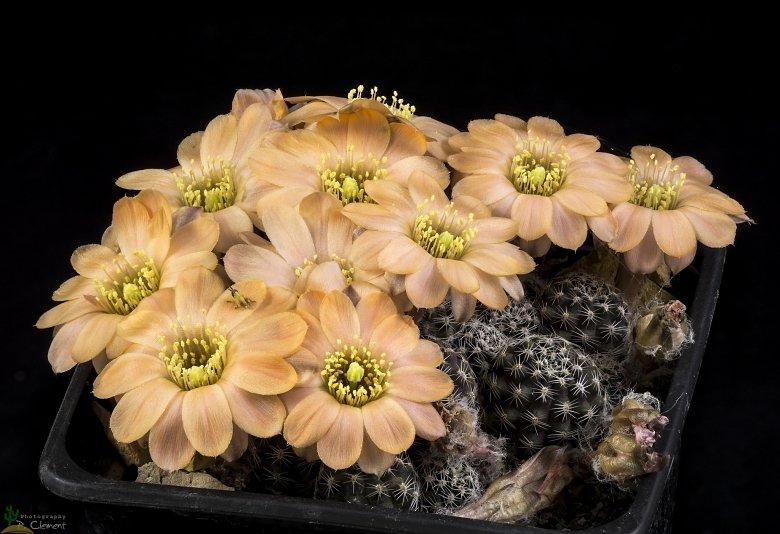
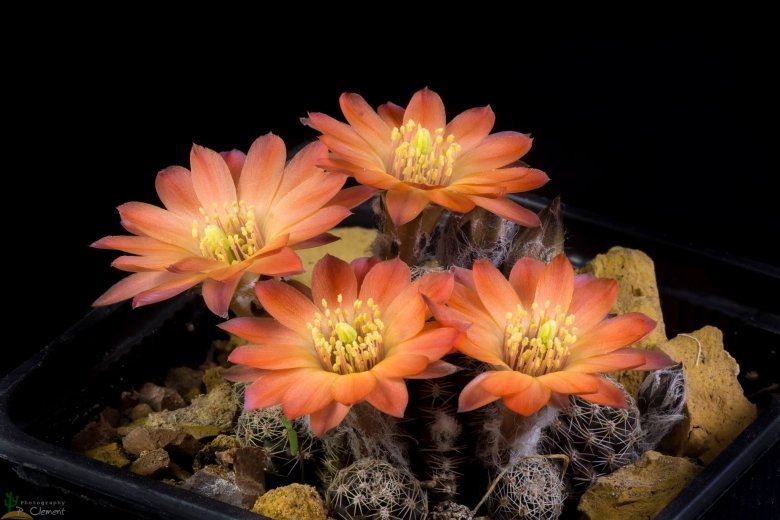
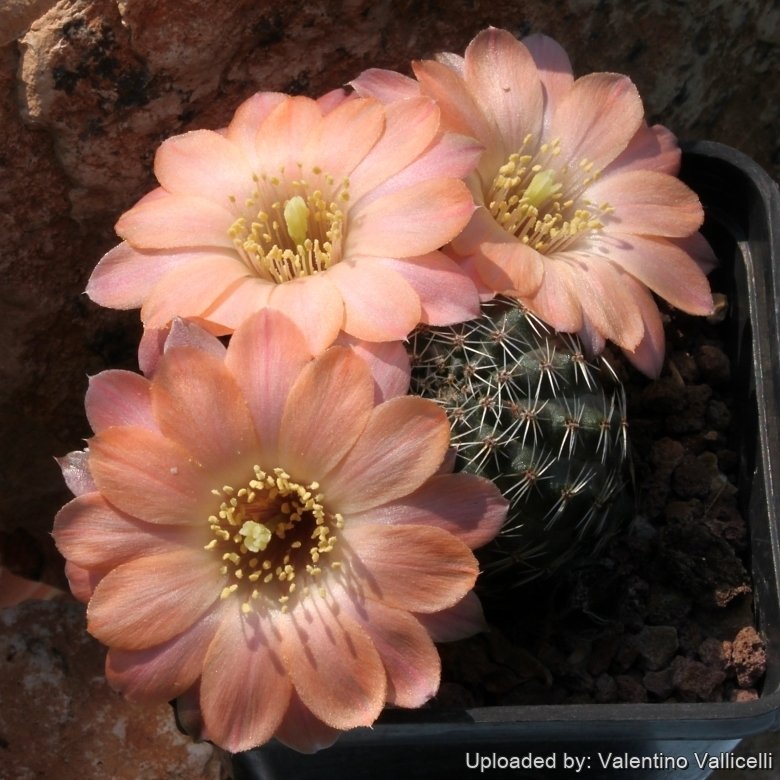
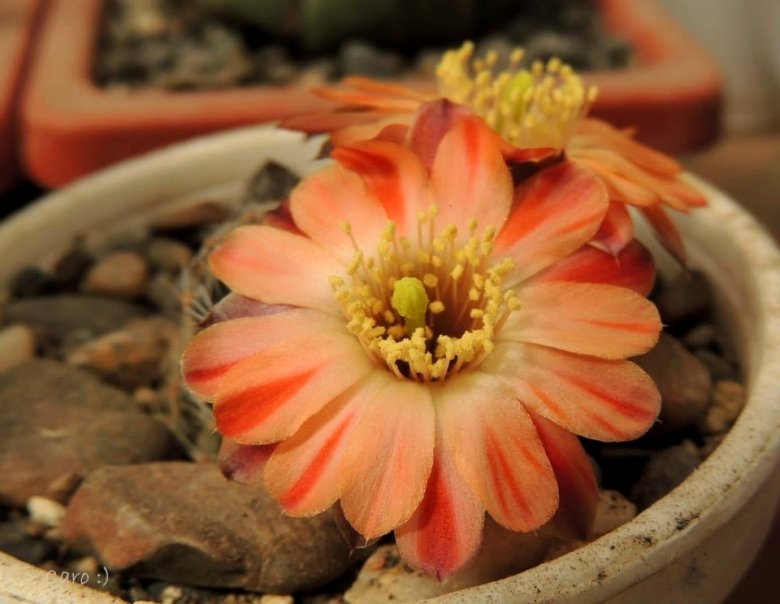
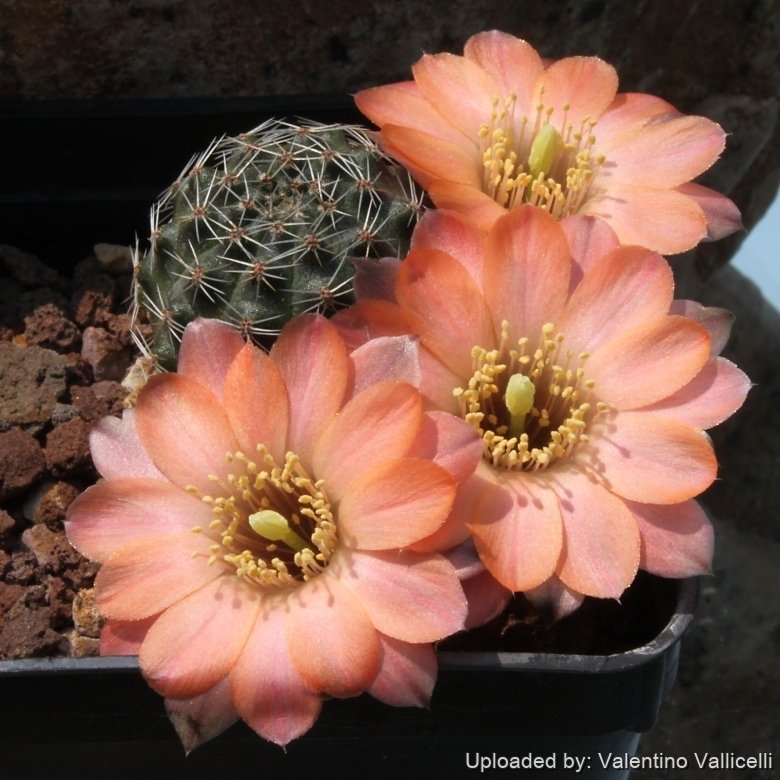
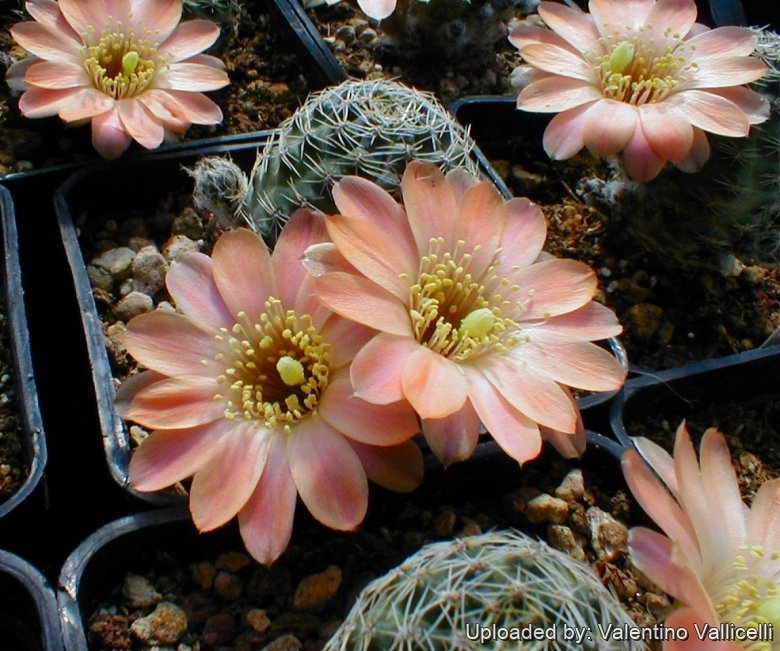
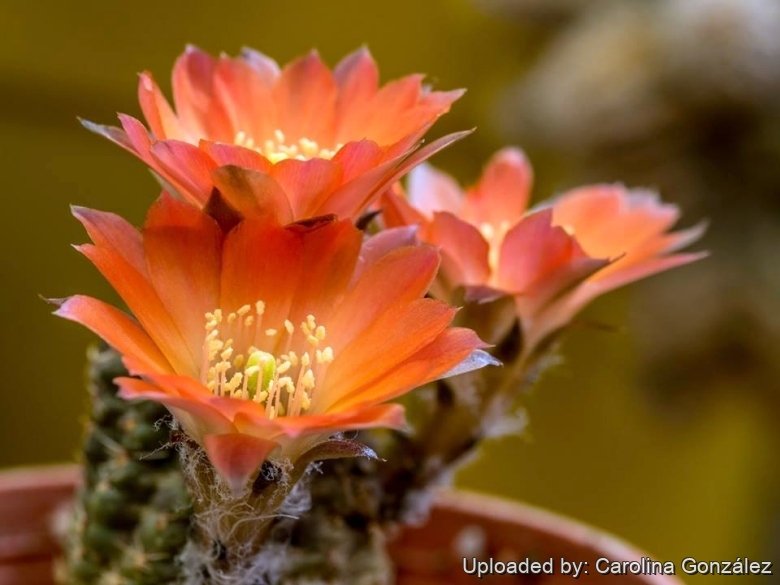
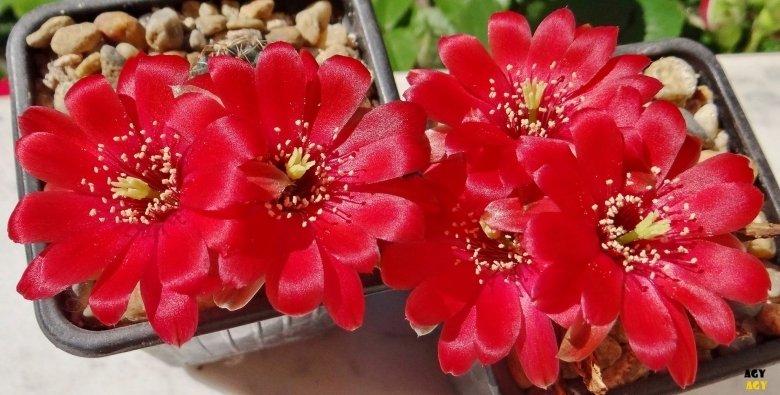
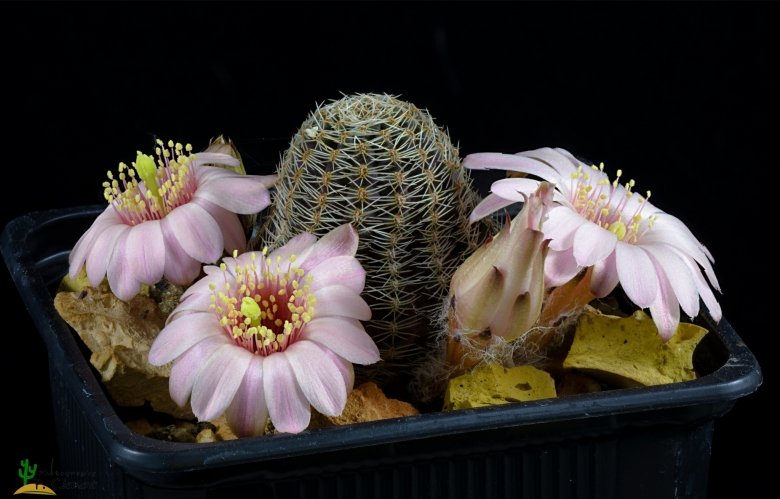
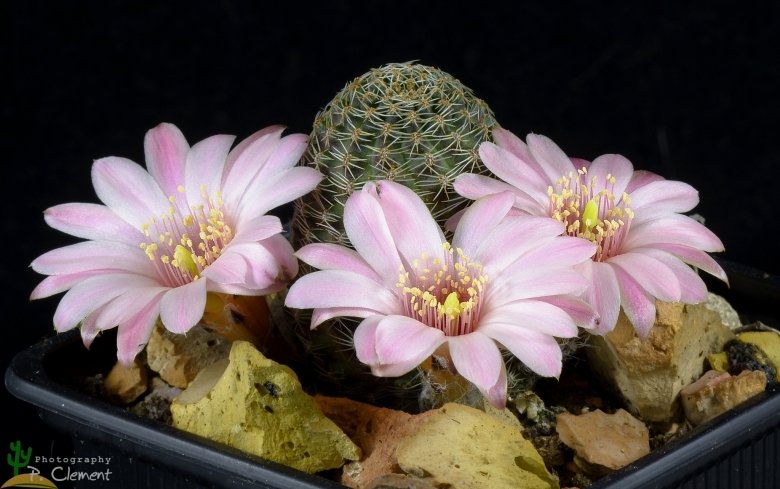
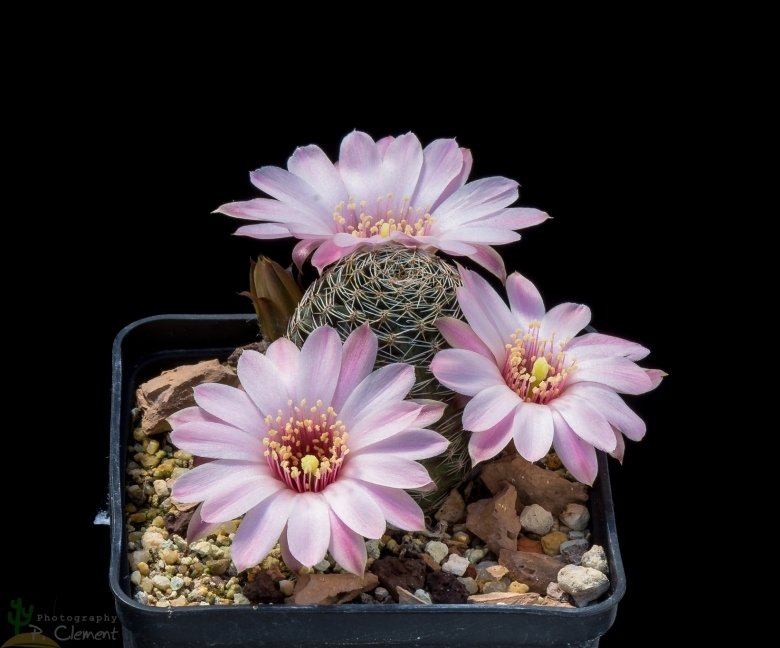
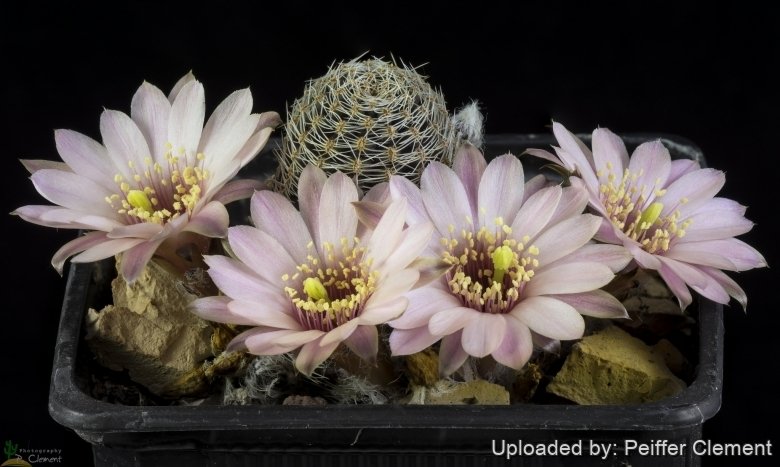
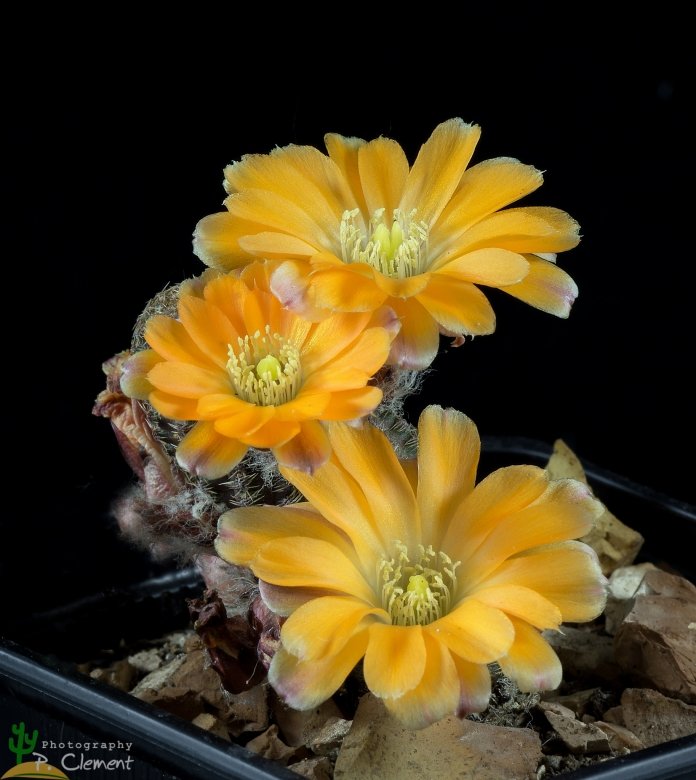
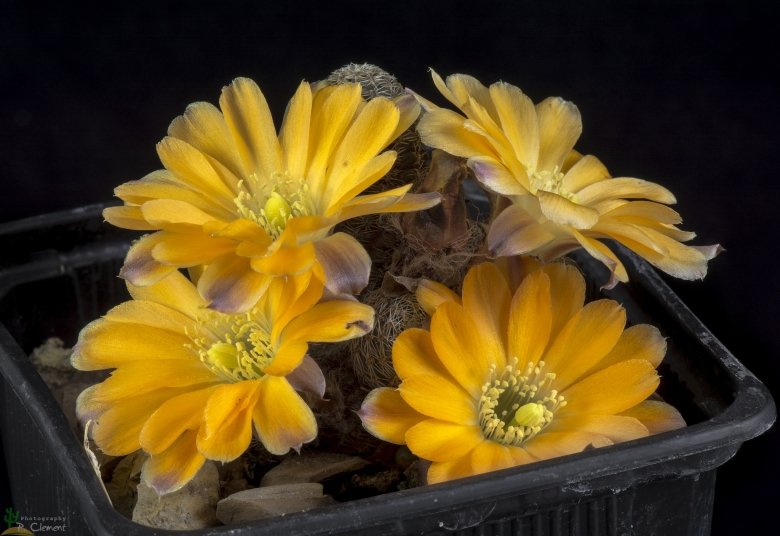
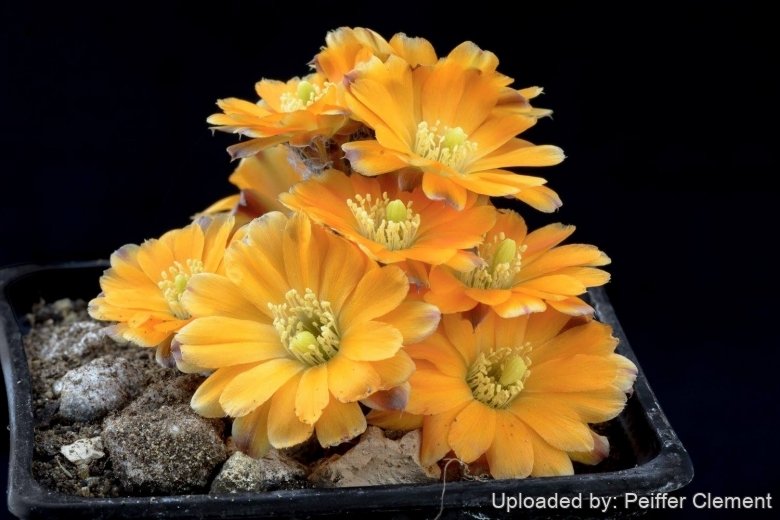
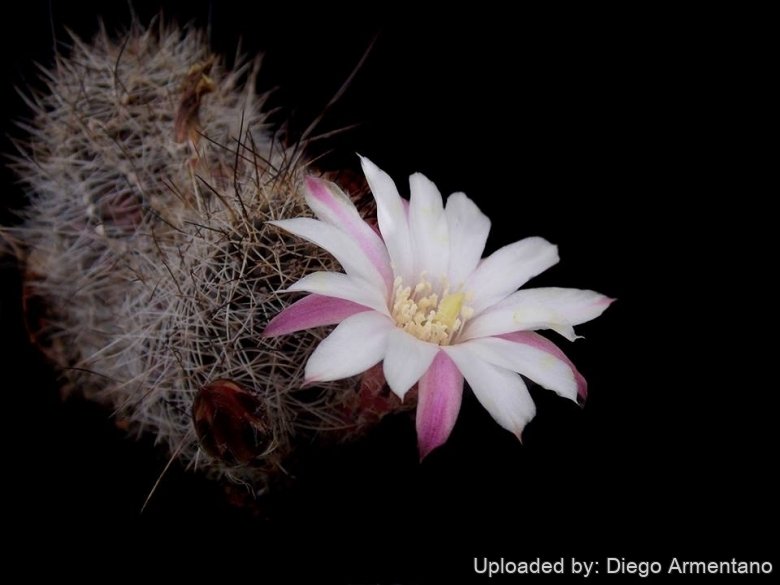
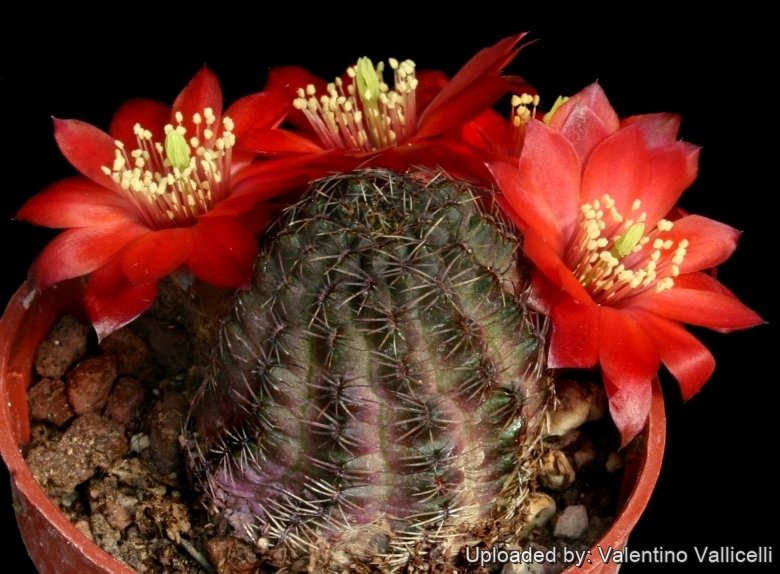
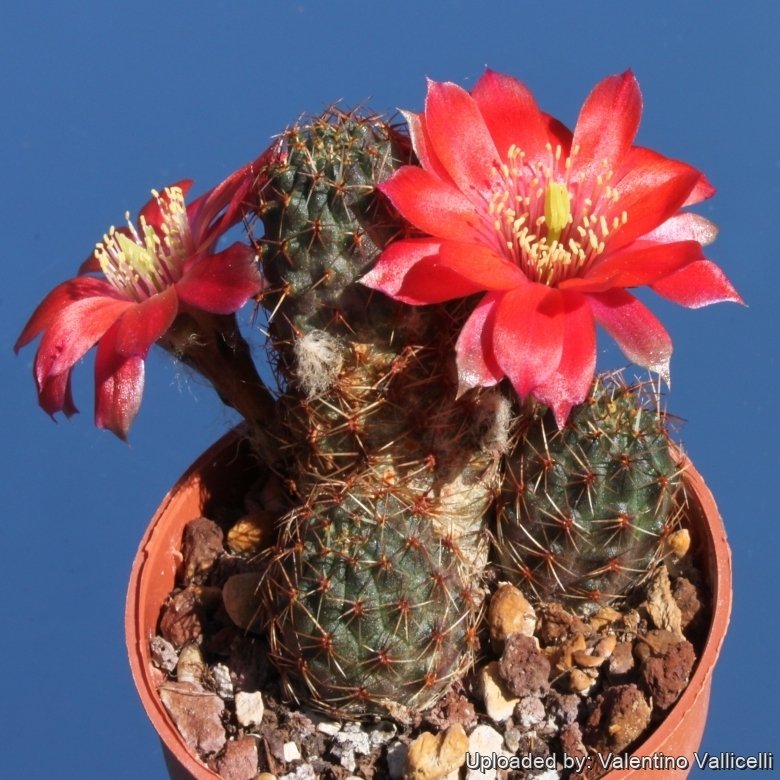
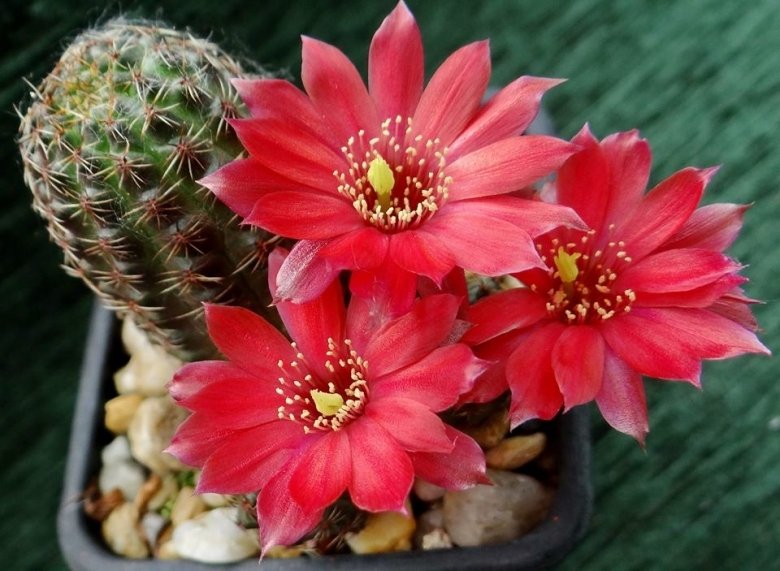
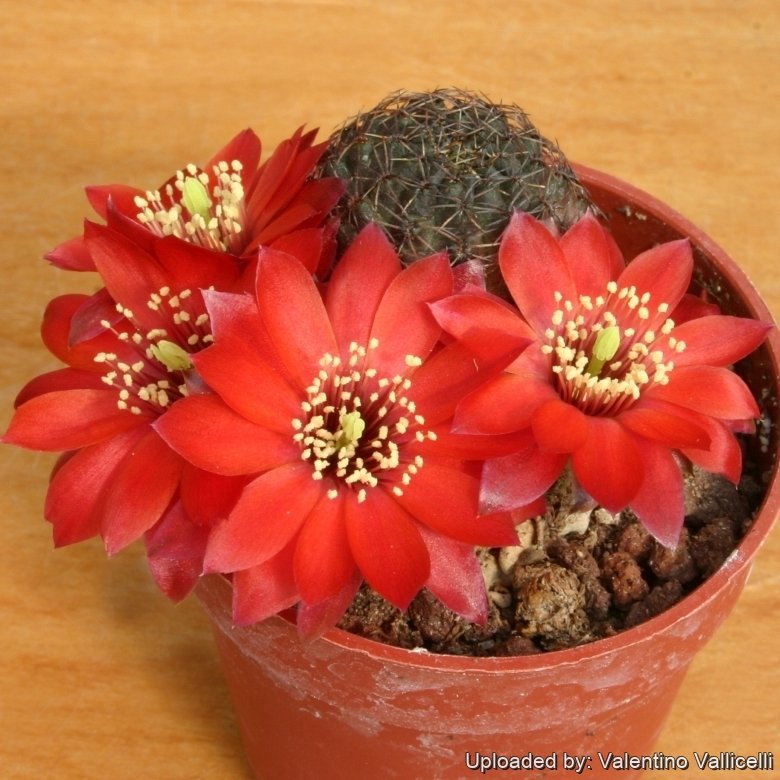
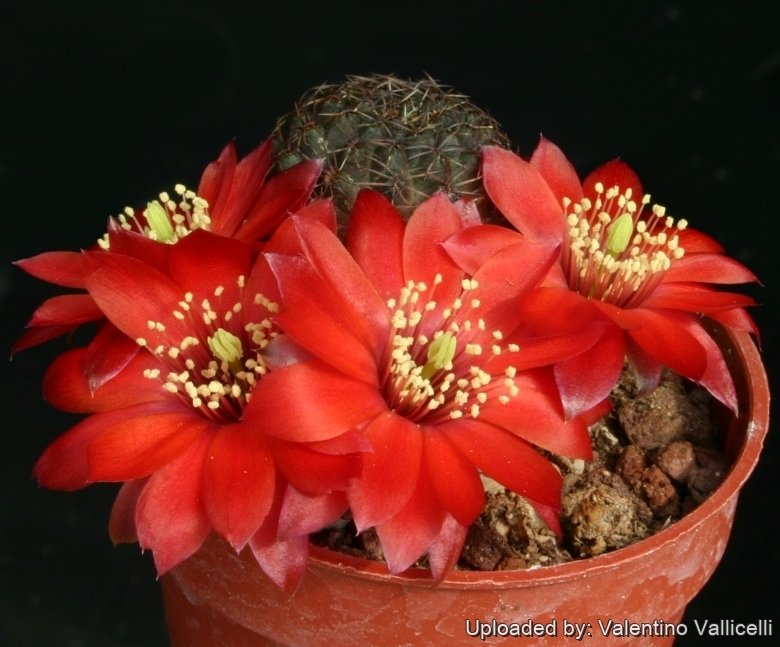
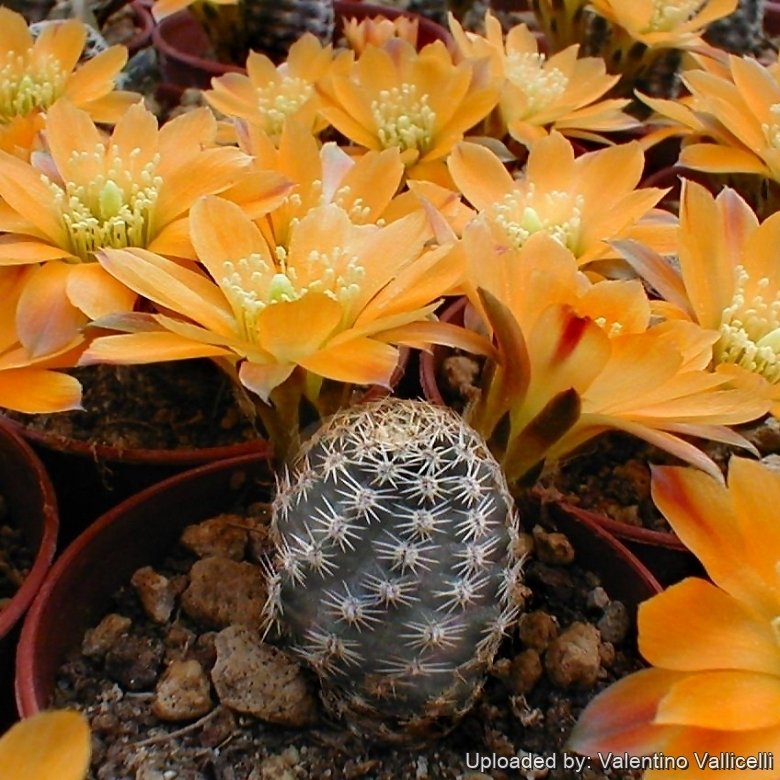
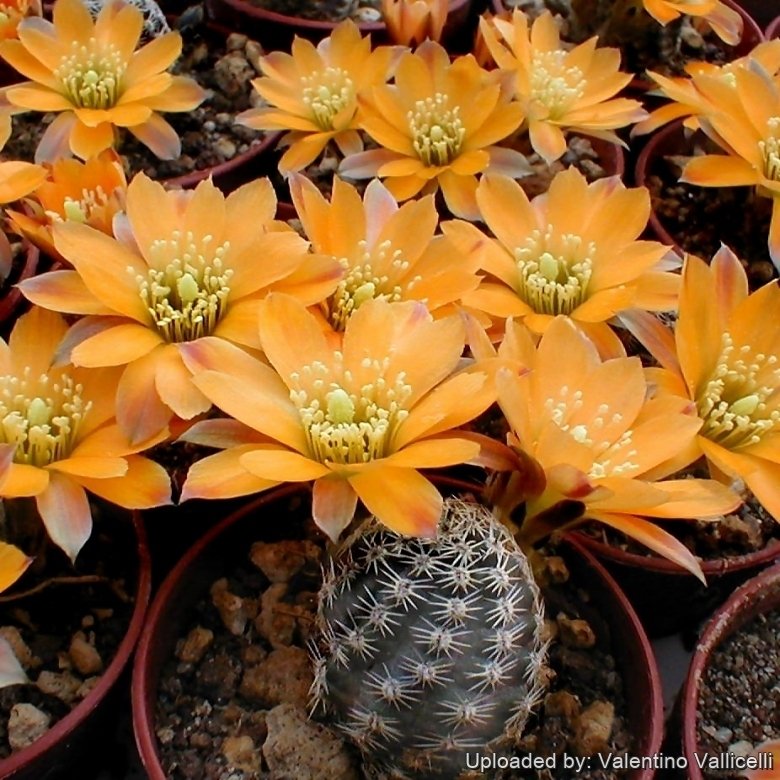
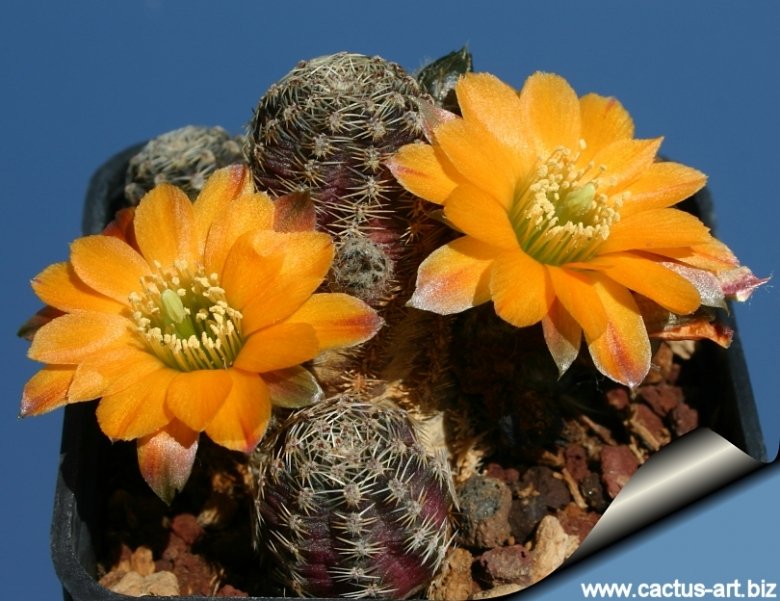
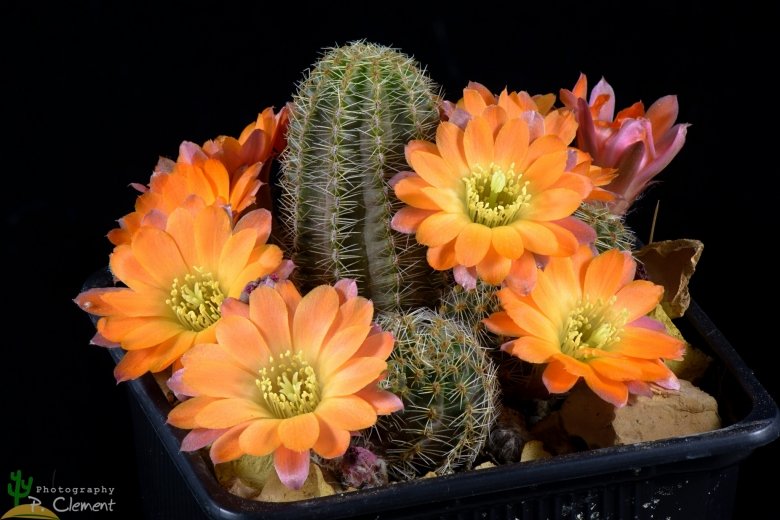
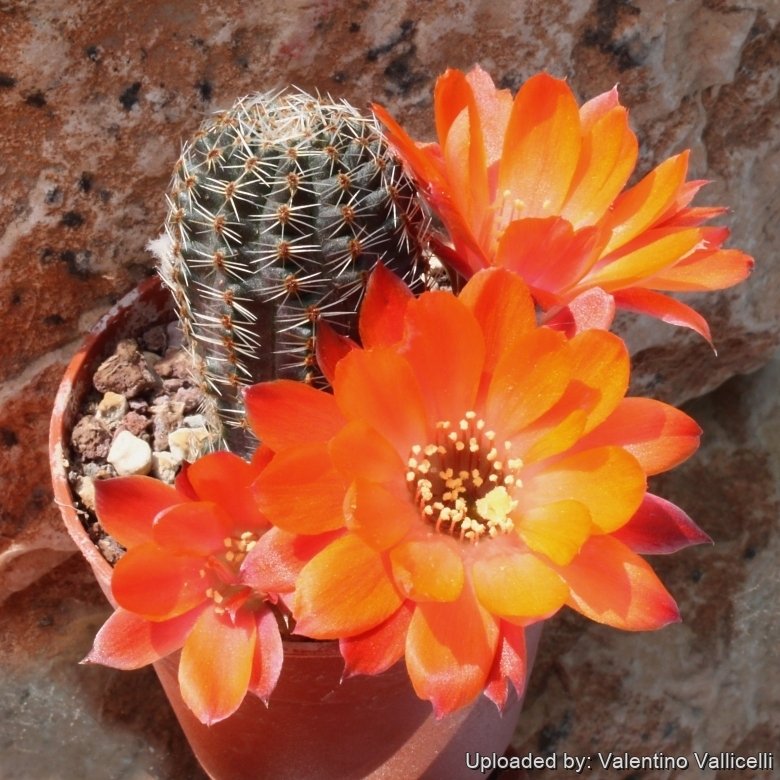
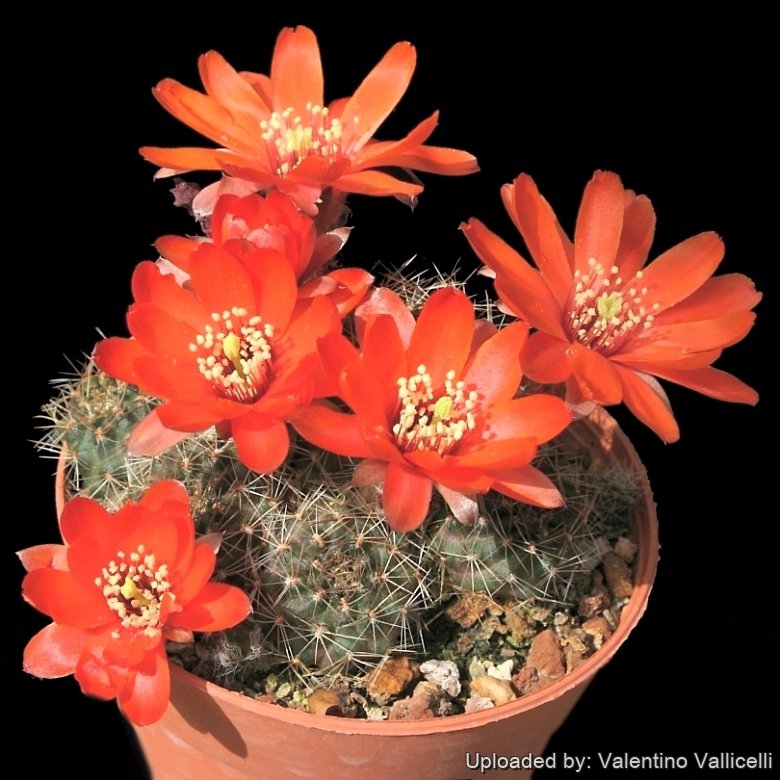
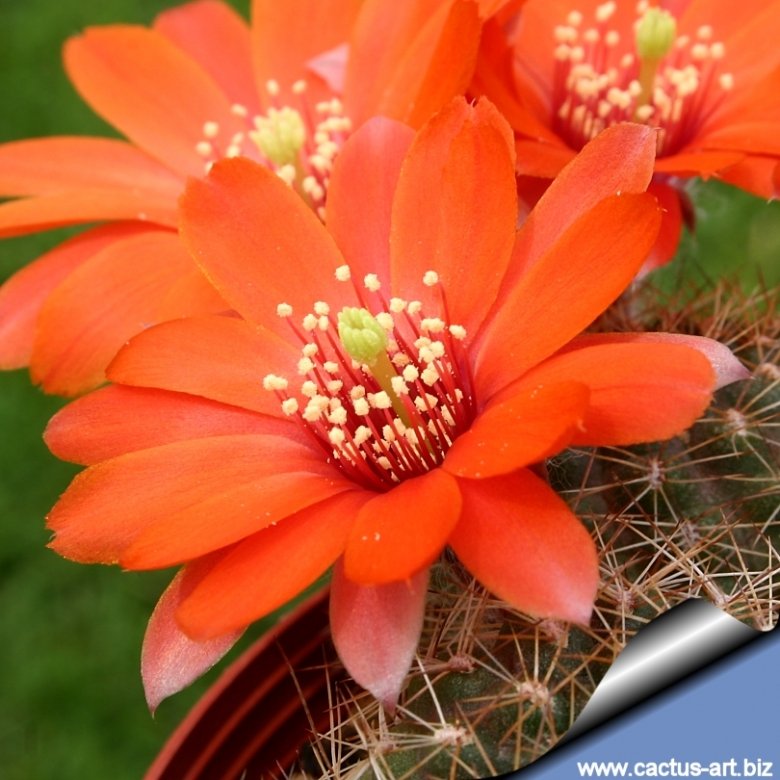
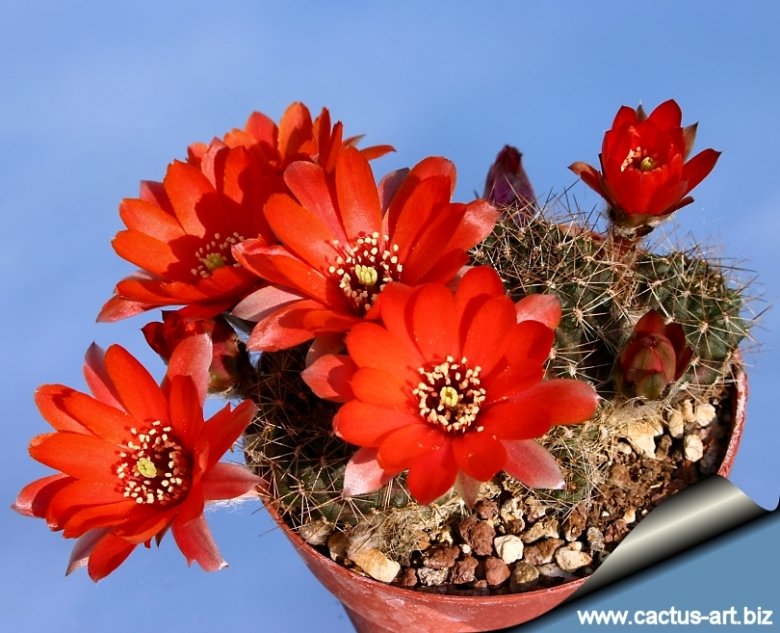
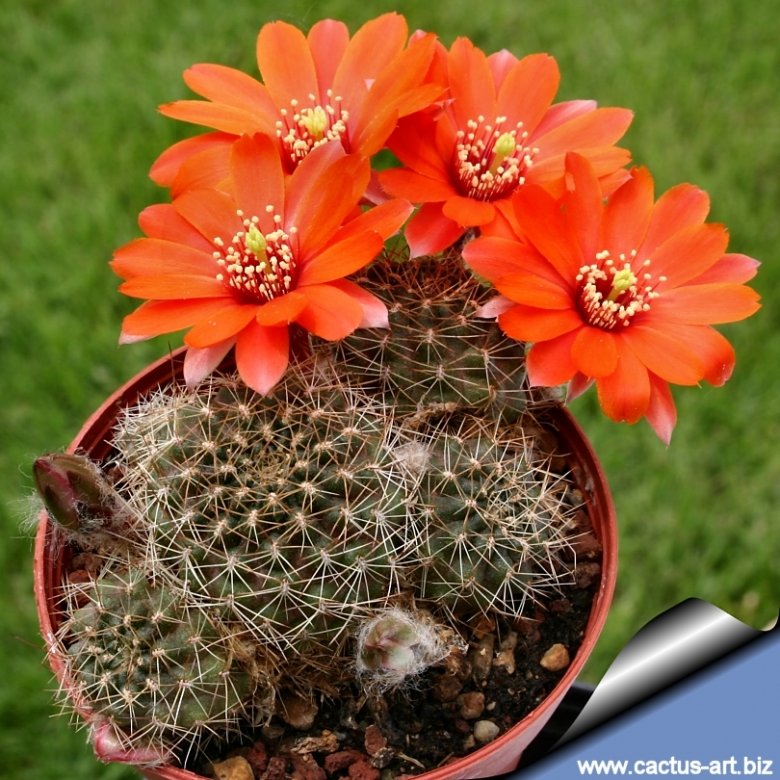
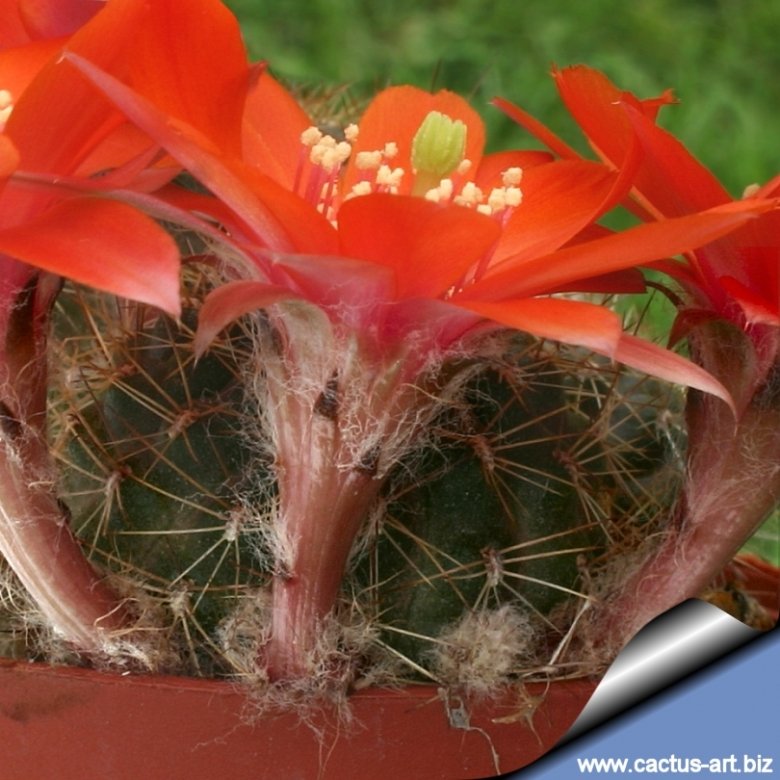
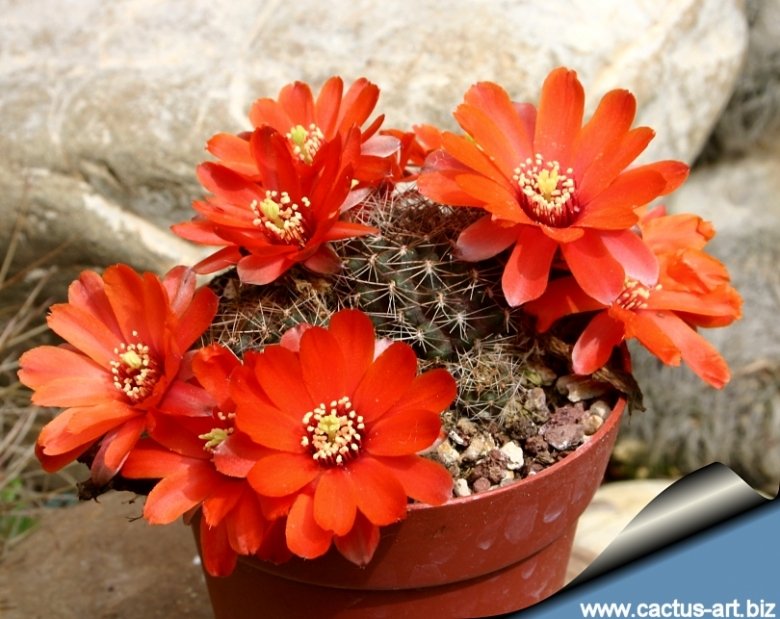
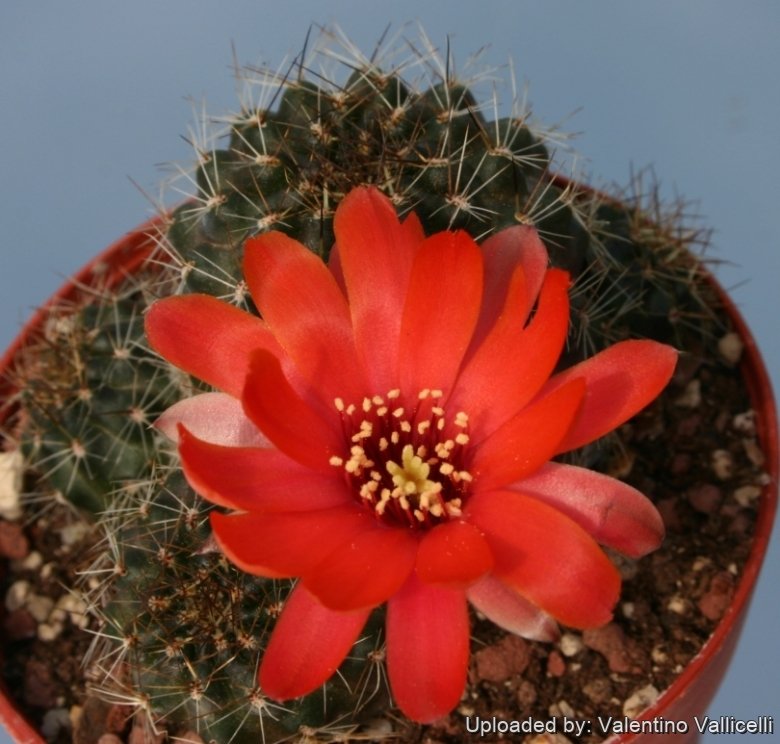
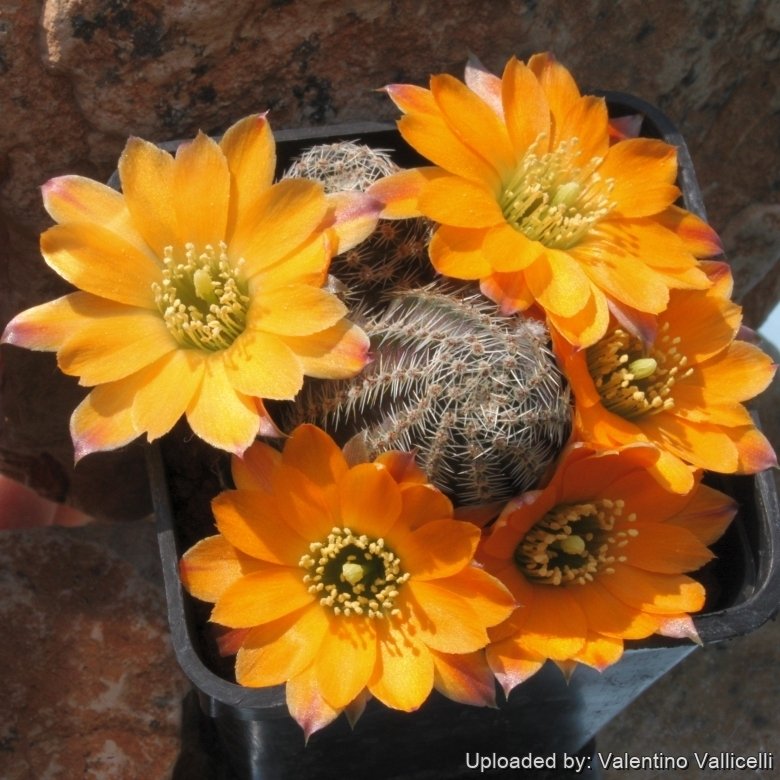
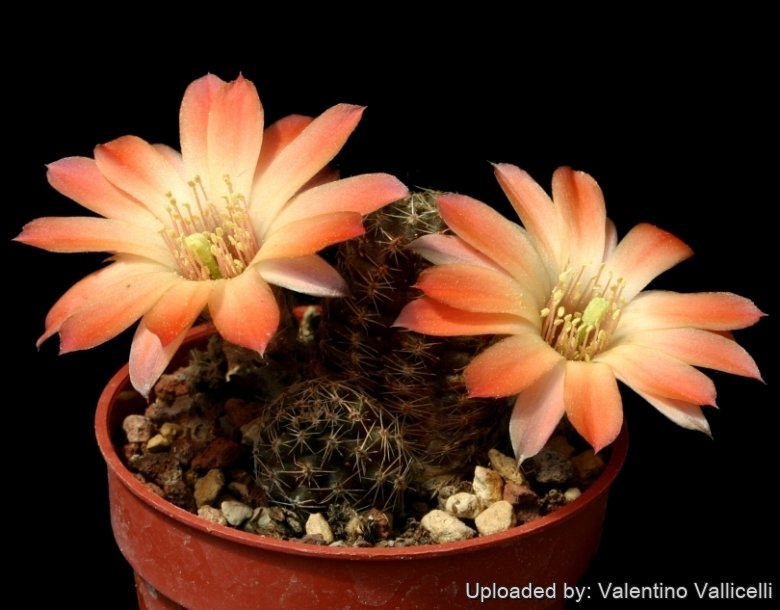
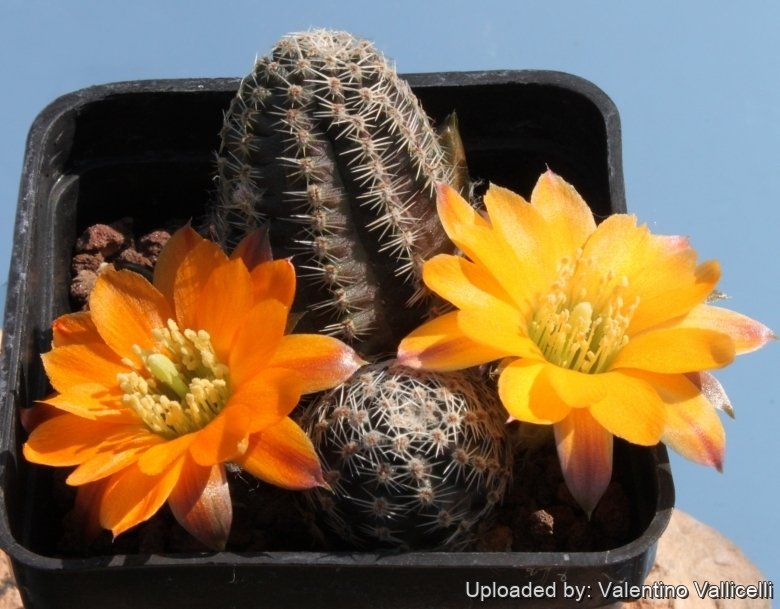
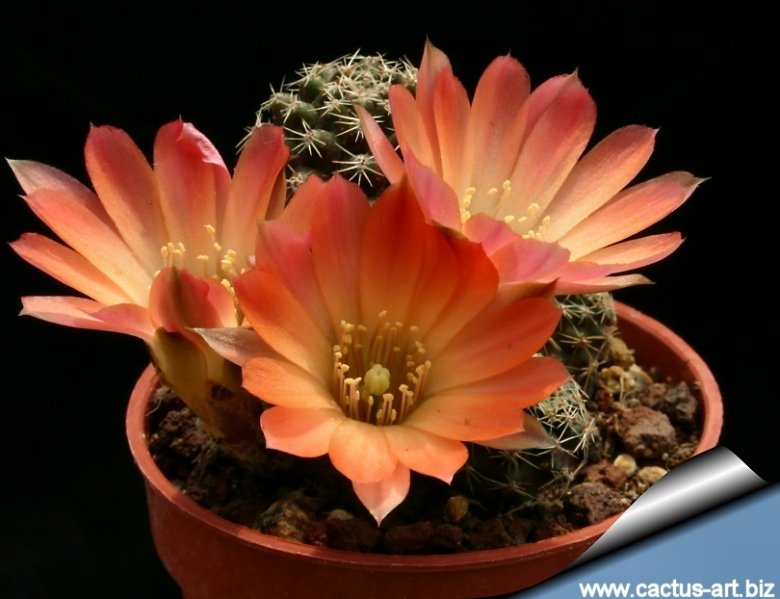
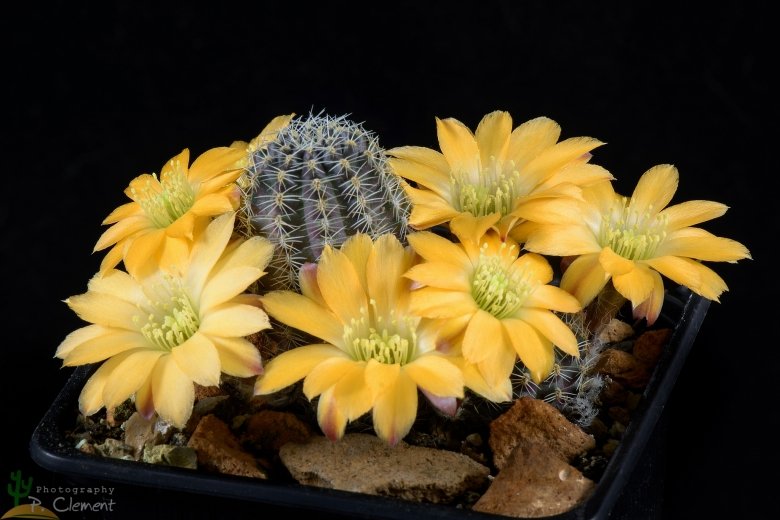
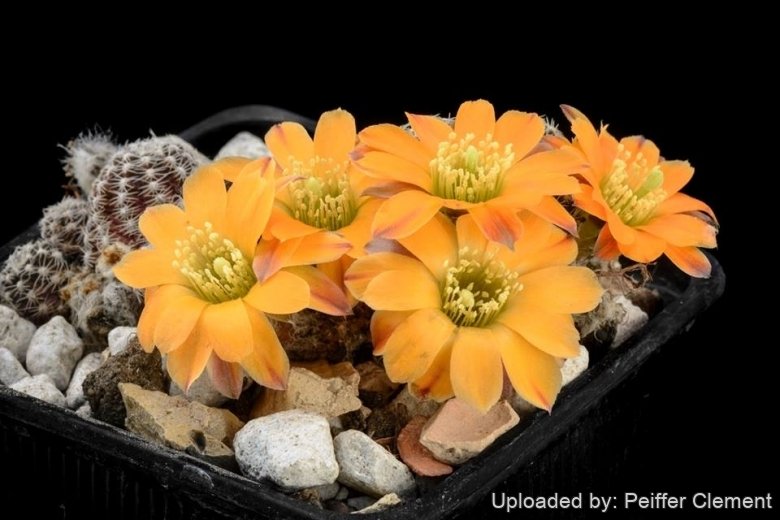
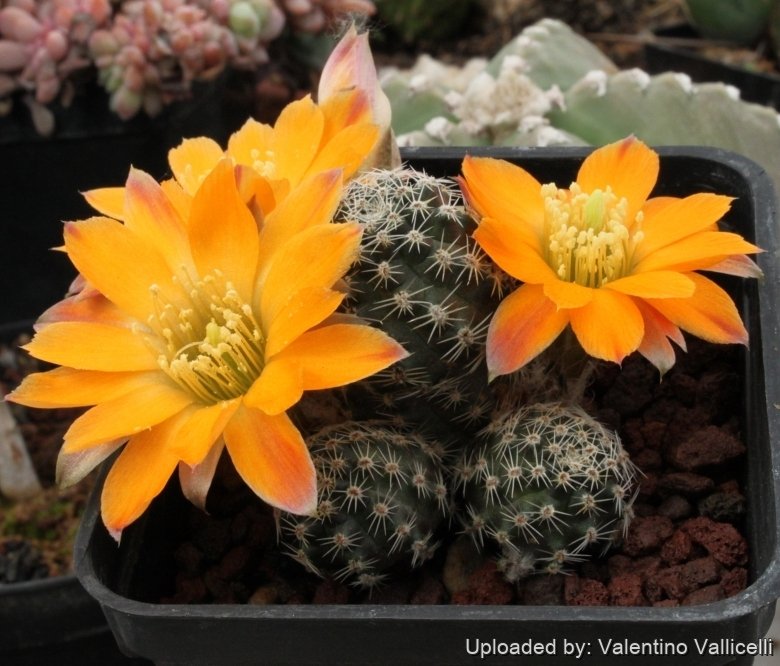
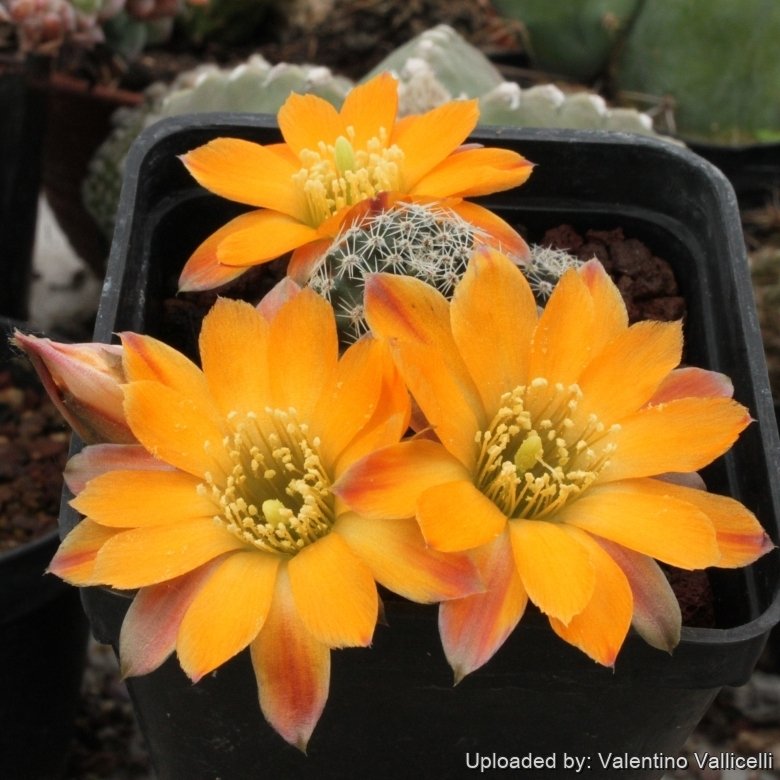
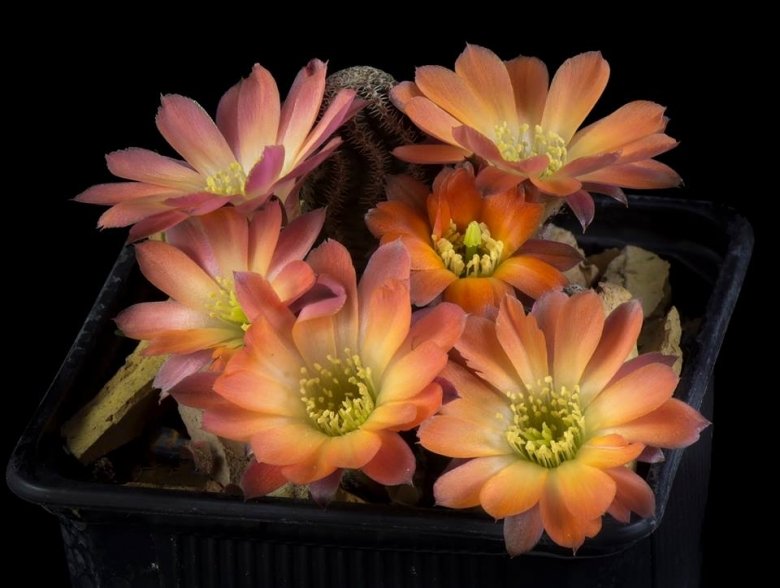
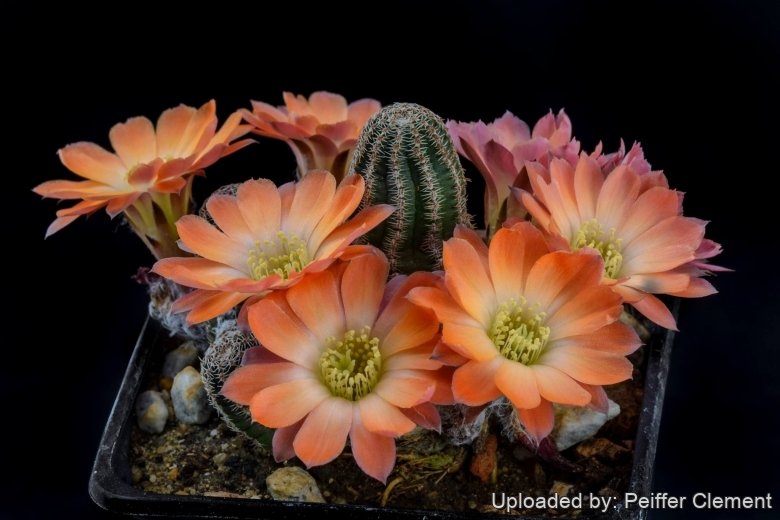
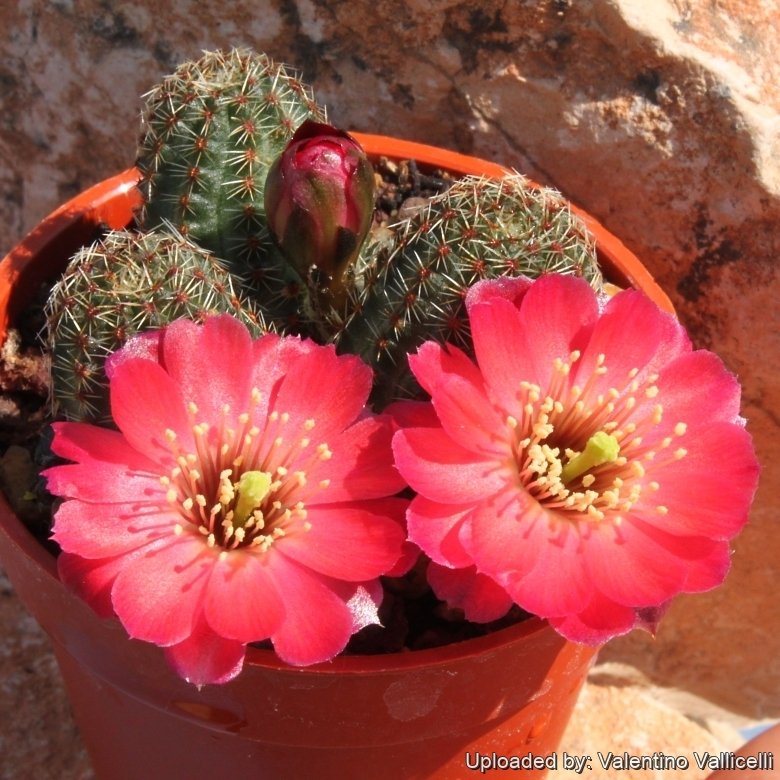
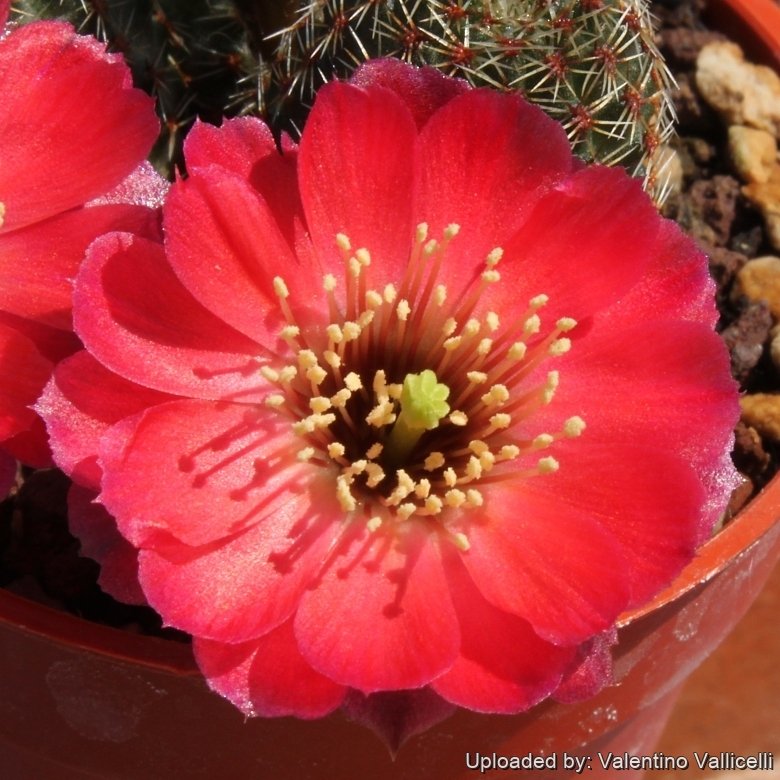
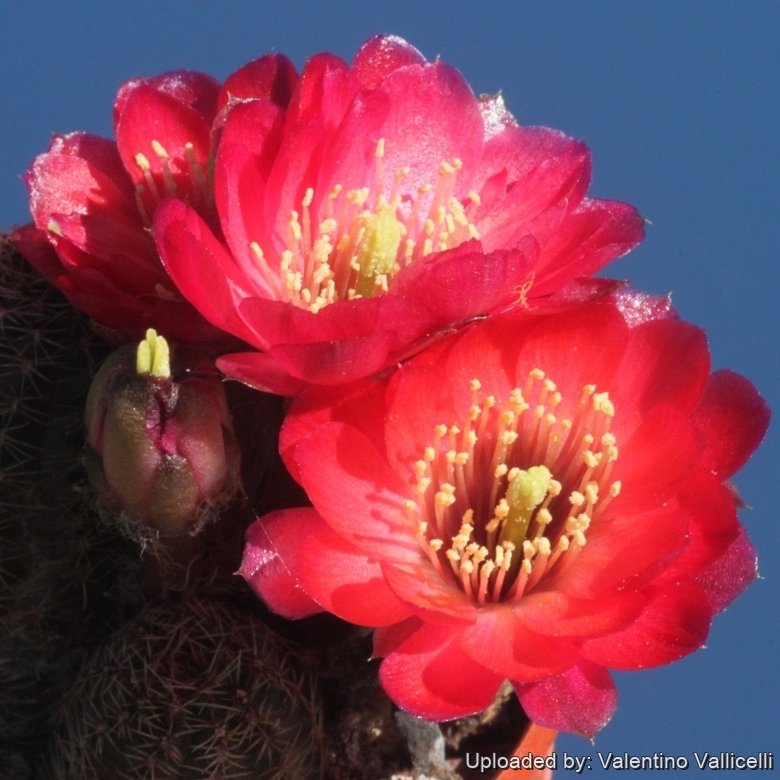
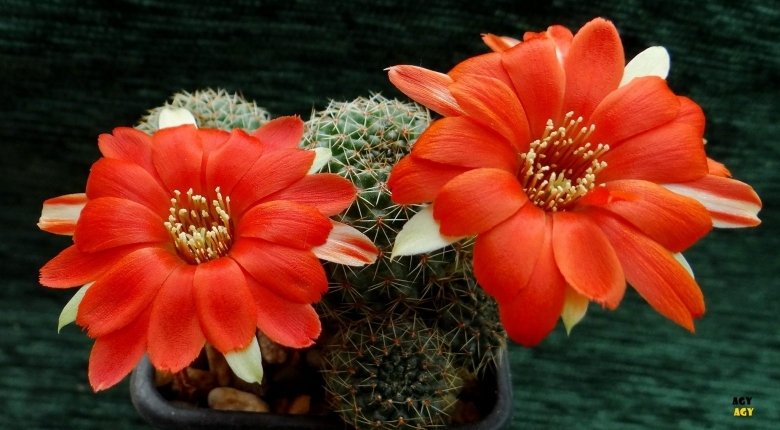
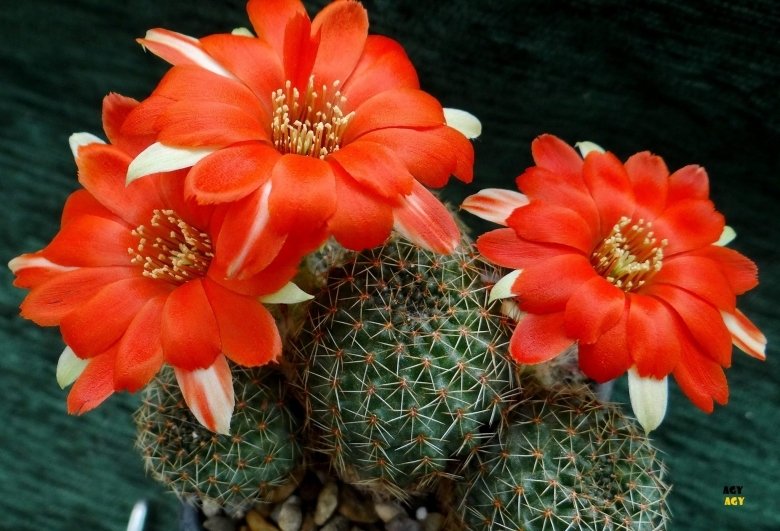
Flowers: From the basal parts of the stem, widely funnel-shaped about 20-30 mm long and 25-35 mm wide usually salmon pink, however the flowers of this species and its varieties (forms?) vary a lot and range from from white to pink, red, salmon and orange. Buds with few black scales with woolly axils and with 1-3 white bristles, 2-3 mm long. Tube funnel-shaped, 7-12 mm long, the top 6-9 mm wide, pale pink inside, outside with few scales and white hairs. Tepals pale red to dark purple (but also white, yellow orange) 10-15 mm long, 4-5 mm wide, rounded up with a small tapered tip. filaments magenta about 12 mm long. Anthers lemon yellow. Pistil light green, about 15 mm long, with 6 yellow-green stigma lobes, 2-4 mm long.
Fruit: Spherical, greenish, with thin skin, drying at maturity, about 6 mm large.
Seeds: Spherical to bell-shaped, rough, covered with remnants of the membrane with a large, straight, rarely slightly oblique hilum.
Blooming season: Flowers all tend to come in one late Spring rush, rather than spread over the Summer.
Reutia pygmaea var. pygmea: (Typical form) has 9 to 11, short, appressed radial spines, 2 to 3 mm long, acicular, somewhat swollen at base. Its flowers appears on the lower part of the plant, and are somewhat curved at base, becoming nearly erect, 18 to 25 mm. long, rose-purple; scales on ovary and flower-tube small, hairy in their axils.
Origin and Habitat
This species grows in Jujuy and Salta, Argentina, and in Chuquisaca, Oruro, Potosí and Tarija, Bolivia.
Altititude range: It can be found at altitudes from 2,950 to 4,300 metres above sea level.
Habitat: The species occurs on rocky outcrops in the puna grasslands often on steeply sloping ground where water rarely stands for any length of time. Rebutia pygmaea is not exposed to any major threat due to its wide range, stable population and its presence in a protected area.
Cultivation and Propagation
Rebutia pygmaea is a summer grower species that is easy to cultivate and recommended for beginners. The whole Rebutia pygmaea complex has delightful flowers and the plants remain compact, and clumps can easily be managed by division. Another advantage is that the plants are very cold hardy in Winter if kept dry.
Growth rate: It is a slow growing but easily flowering species that will make clumps given the best conditions.
Soils: It likes very porous standard cactus mix soil with a pH slightly on the acidic side.
Repotting: This species will occupy a small flower pot comfortably and remain a manageable sized house plant, repotting should be done every other year or when the it has outgrown its pot. Use pot with good drainage.
Watering: Needs moderate to copious waterings in summer, but do not overwater (the root system is rot prone) and allow the pot to dry out between waterings. Keep dry in winter at a minimum temperature of 0°C.
Fertilization: Feed with a high potassium fertilizer in summer.
Hardiness: It is reputedly resistant to frost if kept on the dry side prior to, and during, cold weather and requires a winter rest period (hardy to -12 C ° C, or less for short periods), but for safe cultivation it is best to avoid freezing temperatures. It does not like high temperatures in summer, and will be perfectly happy in pots outdoors from April to September if protected from torrential rain and hail
Exposition: The plant tolerates extremely bright situations but enjoys filtered sunlight or afternoon shade, inside it needs bright light, and some direct sun. Tends to bronze in strong light, which encourages flowering and heavy spine production, but is likely to suffer from sun scorch or stunted growth if over exposed to direct sunlight during the hottest part of the day in summer.
Uses: It is an excellent plant for container growing. It always looks good and stays small. It look fine in a cold greenhouse and frame or outdoor in a rockery.
Pests & diseases: It may be attractive to and liable to damage by spider mites and thrips but plants in good condition should be nearly pest-free, particularly if they are grown in a mineral potting-mix, with good exposure and ventilation.
Rot: This species is particularly easy and accommodating, seldom suffer of cryptogamic diseases. Rot it is only a minor problem with rebutias if the plants are watered and “aired” correctly. If they are not, fungicides won’t help all that much.
Propagation: Division, direct sow after last frost. Seeds germinate in 7-14 days at 21-27° C in spring, remove gradually the glass cover as soon the plants will be well rooted (ca 1-2 weeks) and keep ventilated, no full sun for young plants! To make a cutting twist off a branch and permit it to dry out a couple of weeks, lay it on the soil and insert the stem end partially into the soil. Try to keep the cutting somewhat upright so that the roots are able to grow downward.
Note: It would appear that in cultivation they grow larger and cluster more vigorously than in habitat.
Bibliography
Major references and further lectures
-
Edward Anderson “The Cactus family” Timber Press, Incorporated, 2001
-
James Cullen, Sabina G. Knees, H. Suzanne Cubey “The European Garden Flora Flowering Plants: A Manual for the Identification of Plants Cultivated in Europe, Both Out-of-Doors and Under Glass” Cambridge University Press, 11/Aug/2011
-
David R Hunt; Nigel P Taylor; Graham Charles; International Cactaceae Systematics Group. “The New Cactus Lexicon” dh books, 2006
-
N. L. Britton, J. N. Rose “The Cactaceae. Descriptions and Illustrations of Plants of the Cactus Family.” Volume 4, The Carnegie Institution of Washington, Washington 1923
-
Curt Backeberg “Die Cactaceae: Handbuch der Kakteenkunde” Gustav Fischer Verlag, Stuttgart New York 1982–1985
-
Backeberg, Curt, “Das Kakteenlexikon” p. 271, 1966
-
Mosti, Stefano; “Digitorebutia” Buining & Donald (2), Cactus & Co., 4: 87, 2000
-
Pilbeam, John; “Rebutia” p. 73, 1997
-
Rausch Walter, “Lobivia ‘95”, p. 109, 1986
-
Ritter, Friedrich; “Kakteen in Südamerika”, 2: 616, 1980
-
Šída Otakar, “Rod Rebutia”, p. 85, 1997
-
Šída, Otakar; “Atlas kaktus?”, tab. 29, 2002
-
Lowry, M. 2013. Rebutia pygmaea. The IUCN Red List of Threatened Species. Version 2014.3. <www.iucnredlist.org>. Downloaded on 20 April 2015.
From llifle page Acantholobivia haagei
Description
Very small clumping plants.
Stems: Individual heads short-cylindrical 2-4 cm wide, 4 cm tall, The colour of the epidermis vary from olive-green to dark purple-green with violet tints.
Spines: Short glass-white.
Flowers: Up to 3 cm in diameter and salmon pink.
Roots: tap root.
Origin and Habitat
Bolivia, Argentina.
Habitat: Rebutia haagei grows on steeply sloping ground where water rarely stands for any length of time.
Cultivation and Propagation
Rebutia haagei is a summer grower species that is easy to cultivate and recommended for beginners. The whole Rebutia pygmaea complex has delightful flowers and the plants remain compact, and clumps can easily be managed by division. Another advantage is that the plants are very cold hardy in Winter if kept dry.
Growth rate: It is a slow growing but easily flowering species that will make clumps given the best conditions.
Soils: It likes very porous standard cactus mix soil with a pH slightly on the acidic side.
Repotting: This species will occupy a small flower pot comfortably and remain a manageable sized house plant, repotting should be done every other year or when the it has outgrown its pot. Use pot with good drainage.
Watering: Needs moderate to copious waterings in summer, but do not overwater (the root system is rot prone) and allow the pot to dry out between waterings. Keep dry in winter at a minimum temperature of 0°C.
Fertilization: Feed with a high potassium fertilizer in summer.
Hardiness: It is reputedly resistant to frost if kept on the dry side prior to, and during, cold weather and requires a winter rest period (hardy to -12 C ° C, or less for short periods), but for safe cultivation it is best to avoid freezing temperatures. It does not like high temperatures in summer, and will be perfectly happy in pots outdoors from April to September if protected from torrential rain and hail
Exposition: The plant tolerates extremely bright situations but enjoys filtered sunlight or afternoon shade, inside it needs bright light, and some direct sun. Tends to bronze in strong light, which encourages flowering and heavy spine production, but is likely to suffer from sun scorch or stunted growth if over exposed to direct sunlight during the hottest part of the day in summer.
Uses: It is an excellent plant for container growing. It always looks good and stays small. It look fine in a cold greenhouse and frame or outdoor in a rockery.
Pests & diseases: It may be attractive to and liable to damage by spider mites and thrips
but plants in good condition should be nearly pest-free, particularly if they are grown in a mineral potting-mix, with good exposure and ventilation.
Rot: This species is particularly easy and accommodating, seldom suffer of cryptogamic diseases. Rot it is only a minor problem with rebutias if the plants are watered and “aired” correctly. If they are not, fungicides won’t help all that much.
Propagation: Division, direct sow after last frost. Seeds germinate in 7-14 days at 21-27° C in spring, remove gradually the glass cover as soon the plants will be well rooted (ca 1-2 weeks) and keep ventilated, no full sun for young plants! To make a cutting twist off a branch and permit it to dry out a couple of weeks, lay it on the soil and insert the stem end partially into the soil. Try to keep the cutting somewhat upright so that the roots are able to grow downward.
Note: It would appear that in cultivation they grow larger and cluster more vigorously than in habitat.
Bibliography
Major references and further lectures
-
Edward Anderson “The Cactus family” Timber Press, Incorporated, 2001
-
James Cullen, Sabina G. Knees, H. Suzanne Cubey “The European Garden Flora Flowering Plants: A Manual for the Identification of Plants Cultivated in Europe, Both Out-of-Doors and Under Glass” Cambridge University Press, 11/Aug/2011
-
David R Hunt; Nigel P Taylor; Graham Charles; International Cactaceae Systematics Group. “The New Cactus Lexicon” dh books, 2006
-
N. L. Britton, J. N. Rose “The Cactaceae. Descriptions and Illustrations of Plants of the Cactus Family.” Volume 4, The Carnegie Institution of Washington, Washington 1923
-
Curt Backeberg “Die Cactaceae: Handbuch der Kakteenkunde” Gustav Fischer Verlag, Stuttgart New York 1982–1985
Source: Acantholobivia haagei, LLIFLE - Encyclopedia of living forms, CC-BY-SA, retrieved 2026-10-25.
From llifle page Digitorebutia atrovirens
Description
Rebutia atrovirens (firstly described as Lobivia atrovirens by Backeberg in 1936) is a local or morphological form of the widespread and variable Rebutia pygmaea. It has a shining, dark green, tuberculate body with a dull violet shimmer and very dark red flowers. However the distinguishing characteristics of Rebutia atrovirens, appear to fall within the natural variation of Rebutia pygmaea and it should be synonymized with the latter.
Origin and Habitat
Bolivia (Tarija, Potosí, Chuquisaca) and Argentina (Salta, Jujuy).
Altitude range: 3000-4000 metres above sea level.
Habitat and ecology: Rebutia atrovirens occurs on rocky outcrops among grass with very low bushes often on steeply sloping ground where water rarely stands for any length of time.
Cultivation and Propagation
Rebutia atrovirens is a summer growing species that is easy to cultivate and recommended for beginners. The whole Rebutia pygmaea complex has delightful flowers and the plants remain compact, and clumps can easily be managed by division. Another advantage is that the plants are very cold hardy in Winter if kept dry.
Growth rate: It is a slow growing but easily flowering species that will make clumps given the best conditions.
Soils: It likes very porous standard cactus mix soil with a pH slightly on the acidic side.
Repotting: This species will occupy a small flower pot comfortably and remain a manageable sized house plant, repotting should be done every other year or when the it has outgrown its pot. Use pot with good drainage.
Watering: Needs moderate to copious waterings in summer, but do not overwater (the root system is rot prone) and allow the pot to dry out between waterings. Keep dry in winter at a minimum temperature of 0°C.
Fertilization: Feed with a high potassium fertilizer in summer.
Hardiness: It is reputedly resistant to frost if kept on the dry side prior to, and during, cold weather and requires a winter rest period (hardy to -12 C ° C, or less for short periods), but for safe cultivation it is best to avoid freezing temperatures. It does not like high temperatures in summer, and will be perfectly happy in pots outdoors from April to September if protected from torrential rain and hail
Exposition: The plant tolerates extremely bright situations but enjoys filtered sunlight or afternoon shade, inside it needs bright light, and some direct sun. Tends to bronze in strong light, which encourages flowering and heavy spine production, but is likely to suffer from sun scorch or stunted growth if over exposed to direct sunlight during the hottest part of the day in summer.
Uses: It is an excellent plant for container growing. It always looks good and stays small. It look fine in a cold greenhouse and frame or outdoor in a rockery.
Pests & diseases: It may be attractive to and liable to damage by spider mites and thrips but plants in good condition should be nearly pest-free, particularly if they are grown in a mineral potting-mix, with good exposure and ventilation.
Rot: This species is particularly easy and accommodating, seldom suffer of cryptogamic diseases. Rot it is only a minor problem with rebutias if the plants are watered and “aired” correctly. If they are not, fungicides won’t help all that much.
Propagation: Division, direct sow after last frost. Seeds germinate in 7-14 days at 21-27° C in spring, remove gradually the glass cover as soon the plants will be well rooted (ca 1-2 weeks) and keep ventilated, no full sun for young plants! To make a cutting twist off a branch and permit it to dry out a couple of weeks, lay it on the soil and insert the stem end partially into the soil. Try to keep the cutting somewhat upright so that the roots are able to grow downward.
Note: It would appear that in cultivation they grow larger and cluster more vigorously than in habitat.
Bibliography
Major references and further lectures
- Walther Haage “Cacti as House Plants” Studio Vista, 1965
Source: Digitorebutia atrovirens, LLIFLE - Encyclopedia of living forms, CC-BY-SA, retrieved 2026-10-25.
From llifle page Digitorebutia canacruzensis
Description
Rebutia canacruzensis is one of the morphological or geographical form of the very variable Rebutia pygmaea, distinguished by its pale shell-pink flower with deeper pink throat. It stay solitary or forms small groups. The original description included the following information:
Stem: Barely rising above ground level, less than 4 cm tall and 2.5 cm thick, greyish-green with purple tints.
Ribs: 10-11.
Areoles: Oval, approx 1 mm long, with white and brown wool.
Radial spines: About 11, short, to mm long, bristle-like, not overlapping, glassy white, brown at base.
Central spines: Absent.
Flowers: 3.5cm long, 2.5 cm wide, pale shell-pink with a deeper pink throat fading to almost white on sunny days. Petals with an obscure, darker, narrow midstripe.
Origin and Habitat
Bolivia, Chuquisaca, Norrth of Cinti, near Cana Cruz.
Altitude range: Around 3,700 metres altitude.
Cultivation and Propagation
Rebutia canacruzensis (Rebutia pygmaea) is a summer grower species that is easy to cultivate and recommended for beginners. It has has delightful flowers and the plants remain compact, and clumps can easily be managed by division. Another advantage is that the plants are very cold hardy in Winter if kept dry.
Growth rate: It is a slow growing but easily flowering species that will make clumps given the best conditions.
Soils: It likes very porous standard cactus mix soil with a pH slightly on the acidic side.
Repotting: This species will occupy a small flower pot comfortably and remain a manageable sized house plant, repotting should be done every other year or when the it has outgrown its pot. Use pot with good drainage.
Watering: Needs moderate to copious waterings in summer, but do not overwater (the root system is rot prone) and allow the pot to dry out between waterings. Keep dry in winter at a minimum temperature of 0°C.
Fertilization: Feed with a high potassium fertilizer in summer.
Hardiness: It is reputedly resistant to frost if kept on the dry side prior to, and during, cold weather and requires a winter rest period (hardy to -12 C ° C, or less for short periods), but for safe cultivation it is best to avoid freezing temperatures. It does not like high temperatures in summer, and will be perfectly happy in pots outdoors from April to September if protected from torrential rain and hail
Exposition: The plant tolerates extremely bright situations but enjoys filtered sunlight or afternoon shade, inside it needs bright light, and some direct sun. Tends to bronze in strong light, which encourages flowering and heavy spine production, but is likely to suffer from sun scorch or stunted growth if over exposed to direct sunlight during the hottest part of the day in summer.
Uses: It is an excellent plant for container growing. It always looks good and stays small. It look fine in a cold greenhouse and frame or outdoor in a rockery.
Pests & diseases: It may be attractive to and liable to damage by spider mites and thrips but plants in good condition should be nearly pest-free, particularly if they are grown in a mineral potting-mix, with good exposure and ventilation.
Rot: This species is particularly easy and accommodating, seldom suffer of cryptogamic diseases. Rot it is only a minor problem with rebutias if the plants are watered and “aired” correctly. If they are not, fungicides won’t help all that much.
Propagation: Division, direct sow after last frost. Seeds germinate in 7-14 days at 21-27° C in spring, remove gradually the glass cover as soon the plants will be well rooted (ca 1-2 weeks) and keep ventilated, no full sun for young plants! To make a cutting twist off a branch and permit it to dry out a couple of weeks, lay it on the soil and insert the stem end partially into the soil. Try to keep the cutting somewhat upright so that the roots are able to grow downward.
Note: It would appear that in cultivation they grow larger and cluster more vigorously than in habitat.
Bibliography
Major references and further lectures
-
John Pilbeam “Rebutia” Cirio Pub. Services, p. 60, 01 May 1997
-
Rebutia canacruzensis Rausch, in Kakt. And. Sukk. 27(3): 49-50. 1976.
Source: Digitorebutia canacruzensis, LLIFLE - Encyclopedia of living forms, CC-BY-SA, retrieved 2026-10-25.
From llifle page Digitorebutia diersiana var. minor
Description
Rebutia minor (Rausch) Mosti, better known as Rebutia diersiana var. minor Rausch, is one of the many geographical or morphological form of Rebutia pygmaea. Many variant of Rebutia pygmaea was early classified as different independent species, but nowadays all this plants are considered part of a multiform species, where each form is linked to others by populations of plants with intermediate characteristics. Rebutia minor is the smallest known form, distinguished by very dark coloured stems, with dark areoles, and contrasted with the yellow to orange yellow flowers.
Derivation of specifis name: “minor” Latin, smaller, lesser. In reference to the very small body size of the this plant.
Stems: Less than 2 cm tall, and to 1.3 cm wide (a little taller in cultivation), sparingly clustering, greyish-green to purple-brown. R. minor has the smallest stem in the whole R. pygmaea group.
Ribs: 10.
Areoles: Elongate with short dark brown wool.
Spines: 9-11 all radial, dark violet-brown, later grey, lying flat to the stem.
Flowers: Pale yellow to orange yellow sometimes reddish in the outside.
Origin and Habitat
Bolivia, Chuquisaca, Sud Cinti at Yuquina near Culpina.
Altitude range: 3,600 metres above sea level.
Cultivation and Propagation
Rebutia minima is a summer grower species that is easy to cultivate and recommended for beginners. The whole Rebutia pygmaea complex has delightful flowers and the plants remain compact, and clumps can easily be managed by division. Another advantage is that the plants are very cold hardy in Winter if kept dry.
Growth rate: It is a slow growing but easily flowering species that will make clumps given the best conditions.
Soils: It likes very porous standard cactus mix soil with a pH slightly on the acidic side.
Repotting: This species will occupy a small flower pot comfortably and remain a manageable sized house plant, repotting should be done every other year or when the it has outgrown its pot. Use pot with good drainage.
Watering: Needs moderate to copious waterings in summer, but do not overwater (the root system is rot prone) and allow the pot to dry out between waterings. Keep dry in winter at a minimum temperature of 0°C.
Fertilization: Feed with a high potassium fertilizer in summer.
Hardiness: It is reputedly resistant to frost if kept on the dry side prior to, and during, cold weather and requires a winter rest period (hardy to -12 C ° C, or less for short periods), but for safe cultivation it is best to avoid freezing temperatures. It does not like high temperatures in summer, and will be perfectly happy in pots outdoors from April to September if protected from torrential rain and hail
Exposition: The plant tolerates extremely bright situations but enjoys filtered sunlight or afternoon shade, inside it needs bright light, and some direct sun. Tends to bronze in strong light, which encourages flowering and heavy spine production, but is likely to suffer from sun scorch or stunted growth if over exposed to direct sunlight during the hottest part of the day in summer.
Uses: It is an excellent plant for container growing. It always looks good and stays small. It look fine in a cold greenhouse and frame or outdoor in a rockery.
Pests & diseases: It may be attractive to and liable to damage by spider mites and thrips
but plants in good condition should be nearly pest-free, particularly if they are grown in a mineral potting-mix, with good exposure and ventilation.
Rot: This species is particularly easy and accommodating, seldom suffer of cryptogamic diseases. Rot it is only a minor problem with rebutias if the plants are watered and “aired” correctly. If they are not, fungicides won’t help all that much.
Propagation: Division, direct sow after last frost. Seeds germinate in 7-14 days at 21-27° C in spring, remove gradually the glass cover as soon the plants will be well rooted (ca 1-2 weeks) and keep ventilated, no full sun for young plants! To make a cutting twist off a branch and permit it to dry out a couple of weeks, lay it on the soil and insert the stem end partially into the soil. Try to keep the cutting somewhat upright so that the roots are able to grow downward.
Note: It would appear that in cultivation they grow larger and cluster more vigorously than in habitat.
Bibliography
Major references and further lectures
-
John Pilbeam “Rebutia” Cirio Pub. Services, 01 May 1997
-
Urs Eggli, Leonard E. Newton “Etymological Dictionary of Succulent Plant Names” Springer Science & Business Media, 29 June 2013
-
W. Rausch, Succulent, 58: 257, 1979 / Succulenta, 58 (11): 258, 1979
-
Rod a Ken Preston-Mafham “Cacti: The Illustrated Dictionary”, 1997
Source: Digitorebutia diersiana var. minor, LLIFLE - Encyclopedia of living forms, CC-BY-SA, retrieved 2026-10-25.
From llifle page Digitorebutia eos
Description
Rebutia eos is one of the varieties of Rebutia pygmaea which is a very variable taxon with several collected extreme forms that were early published as full species or as varieties, but these were too weak botanically to stand, so they are all combined in Rebutia pygmaea.
Habit: Rebutia eos is a miniature cactus with greyish-green body, brownish spines, darker central spine and flowers varying in colour from pure white, over white with pinkish centre to the beautiful pink flowered form also known as Rebutia eos var. roseiflora Rausch n. prov., ( field number R 333a), however pure white to pink flowers may occur in the same plant. In cold weather on the first day the flowers are often bright pink, but turn white on the second day. In hot weather the blossoms tend to be pure white from the first day.
Stem: Solitary, or rarely branched, short columnar, 30 mm tall and 20 mm wide, brownish-green.
Root: Tap root.
Ribs: 12-13 straight or slightly twisted barely noticeable, broken into blunt tubercles about 4 mm long.
Areoles: Oval, 2 mm long, with brown wool.
Radial spines: 6-10, up to 6 mm long, bristle-like with a brown base.
Central spine: One (sometimes missing), up to 55 mm long, stronger, brown to black, pointing upward.
Flowers: About 40 mm long and 30-40 mm wide; perikarpel spherical, reddish-brown, with dark brown scales. Receptacle pink, hairless below; above dark green, with lanceolate scales bearing white hairs in the axils. Outer perianth segments white, with brownish central stripe. Inner perianth segments, white or pinkish. Pistil and stigma pale green; stigma-lobes pale green or creamy-pink.
Fruit: Brown with dark scales, covered with white wool.
Seeds: Bell-shaped, testa brown, matte.
Taxonomyc notes: Rausch described this plant in1970, and in 1972 he called it Rebutia eos and in 1987 Lobivia haagei var. eos. In 1992 the CITES list regarded it as a synonymous of Lobivia atrovirens and in “The New Cactus Lexicon” (2006) David R Hunt; Nigel P Taylor & Graham Charles integrated this taxon into Rebutia pygmaea.
Origin and Habitat
Tafna, Jujuy, in the Argentina/Bolivia border.
Altitude range: 3600-3700 metres above sea level.
Cultivation and Propagation
Rebutia eos is a summer grower species that is easy to cultivate and recommended for beginners. It has delightful flowers and the plants remain compact, and clumps can easily be managed by division. Another advantage is that the plants are very cold hardy in Winter if kept dry.
Growth rate: It is a slow growing but easily flowering species that will make clumps given the best conditions.
Soils: It likes very porous standard cactus mix soil with a pH slightly on the acidic side.
Repotting: This species will occupy a small flower pot comfortably and remain a manageable sized house plant, repotting should be done every other year or when the it has outgrown its pot. Use pot with good drainage.
Watering: Needs moderate to copious waterings in summer, but do not overwater (the root system is rot prone) and allow the pot to dry out between waterings. Keep dry in winter at a minimum temperature of 0°C.
Fertilization: Feed with a high potassium fertilizer in summer.
Hardiness: It is reputedly resistant to frost if kept on the dry side prior to, and during, cold weather and requires a winter rest period (hardy to -12 C ° C, or less for short periods), but for safe cultivation it is best to avoid freezing temperatures. It does not like high temperatures in summer, and will be perfectly happy in pots outdoors from April to September if protected from torrential rain and hail
Exposition: The plant tolerates extremely bright situations but enjoys filtered sunlight or afternoon shade, inside it needs bright light, and some direct sun. Tends to bronze in strong light, which encourages flowering and heavy spine production, but is likely to suffer from sun scorch or stunted growth if over exposed to direct sunlight during the hottest part of the day in summer.
Uses: It is an excellent plant for container growing. It always looks good and stays small. It look fine in a cold greenhouse and frame or outdoor in a rockery.
Pests & diseases: It may be attractive to and liable to damage by spider mites and thrips but plants in good condition should be nearly pest-free, particularly if they are grown in a mineral potting-mix, with good exposure and ventilation.
Rot: This species is particularly easy and accommodating, seldom suffer of cryptogamic diseases. Rot it is only a minor problem with rebutias if the plants are watered and “aired” correctly. If they are not, fungicides won’t help all that much.
Propagation: Division, direct sow after last frost. Seeds germinate in 7-14 days at 21-27° C in spring, remove gradually the glass cover as soon the plants will be well rooted (ca 1-2 weeks) and keep ventilated, no full sun for young plants! To make a cutting twist off a branch and permit it to dry out a couple of weeks, lay it on the soil and insert the stem end partially into the soil. Try to keep the cutting somewhat upright so that the roots are able to grow downward.
Note: It would appear that in cultivation they grow larger and cluster more vigorously than in habitat.
Bibliography
Major references and further lectures
-
Rausch, W. “Rebutia (Digitorebutia) eos Rausch spec. nov.” - Succulent 51: 2-3; 1972.
-
Excerpta botanica: Taxonomica et Chorologica, Volume 21 G. Fischer Verlag., 1972
-
Backeberg C., “Das Kakteenlexikon”, 3. ed., p. 487, 801, 1976
-
Donald J.D., “The Rebutias from Lau Expeditions”, Ashingtonia, 1 : 77, 88, 1974
-
Gröner G., “Rebutia eos Rausch”, Kakt. und and. Sukk., 34 : 144-145, 1983
-
Haage W., “Kakteen von A bis Z”, p. 446, 1981
-
Köhler U., “Die Schönheit aus Humahuaca”, Kakt. und and. Sukk., 21 : 9, 1970
-
Simon W., “Rebutia eos; Hinweise auf Erstbeschreibung von W.Rausch”, Stachelpost, 8 : 33, 1972
-
Miroslav Veverka. “Rebutia eos Rausch” retrieved 07 March 2016 from <http://www.cact.cz/galerie\_test/detail.php?id=522\>
Source: Digitorebutia eos, LLIFLE - Encyclopedia of living forms, CC-BY-SA, retrieved 2026-10-25.
From llifle page Lobivia pygmaea var. colorea
Description
Rebutia colorea is one of the many geographical forms of the extremely variable Rebutia pygmaea. It has tiny dark olive-green to brownish-violet stems. Flowers are bright, electric carmine to purple.
Habit: It is a small geophyte cactus, with a heavy tap root that may exceed the size of the plant above soil level. Solitary or clustering and barely rising above ground level.
Roots: Tap root more or less branched whitish.
Stem: 10-30(-40) mm tall, 12-20 mm wide, spherical to slightly oblong, becoming short-cylindrical in cultivation. The colour of the epidermis vary from grey-green or olive-green to dark purple-green with violet tints.
Ribs: About 10 more or less spiralling, slightly tuberculate.
Tubercles: About 2-4 mm wide and 1,5- mm high.
Areoles: Oval, 1-1,5 mm long, about 0,5 mm wide, slightly brownish or whitish tomentose, 2 mm long, with abundant white or light brown felt, a little far apart.
Radial spines: 8-11, thin, bristly, pectinate, short, brown to glassy white with a darker base, 2-3 mm long.
Central spines: usually absent, or rarely 1 yellowish, 1-2 mm long.
Flowers:Bright, electric carmine to purple. From the basal parts of the stem, widely funnel-shaped about 25-35 mm long and 25-35 mm wide usually salmon pink, however the flowers of this species and its varieties (forms?) vary a lot and range from from white to pink, red, salmon and orange. Buds spherical with few whitish to dark scales with woolly axils and with white bristles. Tube funnel-shaped, 8-14 mm long, pale pink inside, outside with few scales and white hairs. Tepals somewhat pointed, intense purple with crimson to ruby tips. Filaments purple about 10 mm long. Anthers yellow. Pistil light green, about 15 mm long, with 4-7 green stigma lobes.
Fruit: Spherical, reddish, with thin skin, drying at maturity, about 10 mm large.
Seeds: Brown-black , 1,0x1,8 mm broad, nearly smooth.
Blooming season: Flowers all tend to come in one late Spring rush, rather than spread over the Summer.
Origin and Habitat
Bolivia, Dept. Tarija, Mendez, San Antonio and Abra de Same, near Iscayachi, at 3500 m and Yunchara, 3700 m
Habitat: They grow on steeply sloping ground where water rarely stands for any length of time
Cultivation and Propagation
Rebutia colorea is a summer grower species that is easy to cultivate and recommended for beginners. The whole Rebutia pygmaea complex has delightful flowers and the plants remain compact, and clumps can easily be managed by division. Another advantage is that the plants are very cold hardy in Winter if kept dry.
Growth rate: It is a slow growing but easily flowering species that will make clumps given the best conditions.
Soils: It likes very porous standard cactus mix soil with a pH slightly on the acidic side.
Repotting: This species will occupy a small flower pot comfortably and remain a manageable sized house plant, repotting should be done every other year or when the it has outgrown its pot. Use pot with good drainage.
Watering: Needs moderate to copious waterings in summer, but do not overwater (the root system is rot prone) and allow the pot to dry out between waterings. Keep dry in winter at a minimum temperature of 0°C.
Fertilization: Feed with a high potassium fertilizer in summer.
Hardiness: It is reputedly resistant to frost if kept on the dry side prior to, and during, cold weather and requires a winter rest period (hardy to -12 C ° C, or less for short periods), but for safe cultivation it is best to avoid freezing temperatures. It does not like high temperatures in summer, and will be perfectly happy in pots outdoors from April to September if protected from torrential rain and hail
Exposition: The plant tolerates extremely bright situations but enjoys filtered sunlight or afternoon shade, inside it needs bright light, and some direct sun. Tends to bronze in strong light, which encourages flowering and heavy spine production, but is likely to suffer from sun scorch or stunted growth if over exposed to direct sunlight during the hottest part of the day in summer.
Uses: It is an excellent plant for container growing. It always looks good and stays small. It look fine in a cold greenhouse and frame or outdoor in a rockery.
Pests & diseases: It may be attractive to and liable to damage by spider mites and thrips
but plants in good condition should be nearly pest-free, particularly if they are grown in a mineral potting-mix, with good exposure and ventilation.
Rot: This species is particularly easy and accommodating, seldom suffer of cryptogamic diseases. Rot it is only a minor problem with rebutias if the plants are watered and “aired” correctly. If they are not, fungicides won’t help all that much.
Propagation: Division, direct sow after last frost. Seeds germinate in 7-14 days at 21-27° C in spring, remove gradually the glass cover as soon the plants will be well rooted (ca 1-2 weeks) and keep ventilated, no full sun for young plants! To make a cutting twist off a branch and permit it to dry out a couple of weeks, lay it on the soil and insert the stem end partially into the soil. Try to keep the cutting somewhat upright so that the roots are able to grow downward.
Note: It would appear that in cultivation they grow larger and cluster more vigorously than in habitat.
Bibliography
Major references and further lectures
-
Edward Anderson “The Cactus family” Timber Press, Incorporated, 2001
-
James Cullen, Sabina G. Knees, H. Suzanne Cubey “The European Garden Flora Flowering Plants: A Manual for the Identification of Plants Cultivated in Europe, Both Out-of-Doors and Under Glass” Cambridge University Press, 11/Aug/2011
-
David R Hunt; Nigel P Taylor; Graham Charles; International Cactaceae Systematics Group. “The New Cactus Lexicon” dh books, 2006
-
N. L. Britton, J. N. Rose “The Cactaceae. Descriptions and Illustrations of Plants of the Cactus Family.” Volume 4, The Carnegie Institution of Washington, Washington 1923
-
Curt Backeberg “Die Cactaceae: Handbuch der Kakteenkunde” Gustav Fischer Verlag, Stuttgart New York 1982–1985
-
Mosti, Stefano; “Digitorebutia” Buining & Donald (2), Cactus & Co., 3: 202, 1999
-
Pilbeam, John; “Rebutia” (ISBN 0-9528302-2-1), p. 75, 1997
-
Ritter, Friedrich; “Kakteen in Südamerika” 2: 605, 1980
-
Šída, Otakar; “Atlas kaktus?” tab. 28, 2002
Source: Lobivia pygmaea var. colorea, LLIFLE - Encyclopedia of living forms, CC-BY-SA, retrieved 2026-10-25.
From llifle page Lobivia pygmaea var. diersiana
Description
Rebutia diersiana is one of the many geographical forms of the extremely variable Rebutia pygmaea. It has a distinctive yellow or orangish-yellow flowers.
Habit: It is a small geophyte cactus, with a heavy tap root that may exceed the size of the plant above soil level. Solitary or often clustering in cultivation.
Stem: 1 to 2 cm wide, spherical to slightly oblong, becoming short-cylindrical in cultivation. Epidermis light green , often with a purple-brown tinge.
Ribs: About 10 slightly tuberculate.
Tubercles: About 2,5 mm high.
Areoles: Oval, slightly whitish tomentose, 2 mm long, with abundant white or light brown felt, a little far apart.
Radial spines: 1-12, thin, bristly, pectinate, glassy white, 1-2 mm long.
Central spines: usually absent, or rarely 1 yellowish, 1-2 mm long.
Flowers: From the basal parts of the stem, widely funnel-shaped about 30 mm long and wide. Ovary greenish with a few dark green scales with white wool and bristles. Floral tube, pink with few, narrow, dark green scales with white wool and bristles. Outer perianth segments lanceolate, pinkish-yellow with darker purple tip and with purple central ribs. Inner perianth segments lanceolate, pale yellow to golden yellow. Throat white. Filaments white. Pistil greenish-white, stigma with 5-6 greenish segments.
Fruit: Spherical, greenish, about 6 mm large.
Seeds: Oblong spherical, about 1-1,2 mm long and 0,8-1 mm wide, brown-black, testa quite distinct, oblong, slightly convex.
Blooming season: Flowers all tend to come in one late Spring rush, rather than spread over the Summer.
Roots: Tap root .
Origin and Habitat
Potosí and Chuquisaca, Bolivia
Altitude: about 300-3700 metres above sea level.
Habitat: They grow on steeply sloping ground where water rarely stands for any length of time.
Cultivation and Propagation
Rebutia diersiana is a summer grower species that is easy to cultivate and recommended for beginners. The whole Rebutia pygmaea complex has delightful flowers and the plants remain compact, and clumps can easily be managed by division. Another advantage is that the plants are very cold hardy in Winter if kept dry.
Growth rate: It is a slow growing but easily flowering species that will make clumps given the best conditions.
Soils: It likes very porous standard cactus mix soil with a pH slightly on the acidic side.
Repotting: This species will occupy a small flower pot comfortably and remain a manageable sized house plant, repotting should be done every other year or when the it has outgrown its pot. Use pot with good drainage.
Watering: Needs moderate to copious waterings in summer, but do not overwater (the root system is rot prone) and allow the pot to dry out between waterings. Keep dry in winter at a minimum temperature of 0°C.
Fertilization: Feed with a high potassium fertilizer in summer.
Hardiness: It is reputedly resistant to frost if kept on the dry side prior to, and during, cold weather and requires a winter rest period (hardy to -12 C ° C, or less for short periods), but for safe cultivation it is best to avoid freezing temperatures. It does not like high temperatures in summer, and will be perfectly happy in pots outdoors from April to September if protected from torrential rain and hail
Exposition: The plant tolerates extremely bright situations but enjoys filtered sunlight or afternoon shade, inside it needs bright light, and some direct sun. Tends to bronze in strong light, which encourages flowering and heavy spine production, but is likely to suffer from sun scorch or stunted growth if over exposed to direct sunlight during the hottest part of the day in summer.
Uses: It is an excellent plant for container growing. It always looks good and stays small. It look fine in a cold greenhouse and frame or outdoor in a rockery.
Pests & diseases: It may be attractive to and liable to damage by spider mites and thrips
but plants in good condition should be nearly pest-free, particularly if they are grown in a mineral potting-mix, with good exposure and ventilation.
Rot: This species is particularly easy and accommodating, seldom suffer of cryptogamic diseases. Rot it is only a minor problem with rebutias if the plants are watered and “aired” correctly. If they are not, fungicides won’t help all that much.
Propagation: Division, direct sow after last frost. Seeds germinate in 7-14 days at 21-27° C in spring, remove gradually the glass cover as soon the plants will be well rooted (ca 1-2 weeks) and keep ventilated, no full sun for young plants! To make a cutting twist off a branch and permit it to dry out a couple of weeks, lay it on the soil and insert the stem end partially into the soil. Try to keep the cutting somewhat upright so that the roots are able to grow downward.
Note: It would appear that in cultivation they grow larger and cluster more vigorously than in habitat.
Bibliography
Major references and further lectures
-
Edward Anderson “The Cactus family” Timber Press, Incorporated, 2001
-
James Cullen, Sabina G. Knees, H. Suzanne Cubey “The European Garden Flora Flowering Plants: A Manual for the Identification of Plants Cultivated in Europe, Both Out-of-Doors and Under Glass” Cambridge University Press, 11/Aug/2011
-
David R Hunt; Nigel P Taylor; Graham Charles; International Cactaceae Systematics Group. “The New Cactus Lexicon” dh books, 2006
-
N. L. Britton, J. N. Rose “The Cactaceae. Descriptions and Illustrations of Plants of the Cactus Family.” Volume 4, The Carnegie Institution of Washington, Washington 1923
-
Curt Backeberg “Die Cactaceae: Handbuch der Kakteenkunde” Gustav Fischer Verlag, Stuttgart New York 1982–1985
-
Mosti, Stefano; “Digitorebutia” Buining & Donald (2), Cactus & Co., 3: 199, 2000
-
Pilbeam, John; “Rebutia” (ISBN 0-9528302-2-1), p. 28, 1997
-
Rausch, Walter; “Lobivia” ´85, p.116, 1986
-
?íha, Jan; “Atlas kaktus?” tab. 47, 1990
-
Šída, Otakar; “Rod Rebutia” (ISBN 80-901383-5-7), p. 87, 1997
Source: Lobivia pygmaea var. diersiana, LLIFLE - Encyclopedia of living forms, CC-BY-SA, retrieved 2026-10-25.
From llifle page Lobivia pygmaea var. tafnaensis
Description
Rebutia pygmaea is one of the many geographical forms of the extremely variable Rebutia pygmaea. It has bright orange-red flowers.
Habit: It is a small geophyte cactus, with a heavy tap root that may exceed the size of the plant above soil level. Solitary or clustering and barely rising above ground level.
Roots: Tap root more or less branched whitish.
Stem: about 10-30( mm tall, 12-20 mm wide, spherical to slightly oblong, becoming short-cylindrical in cultivation.
Areoles: Oval, 2 mm long, with abundant white or light brown felt, a little far apart.
Radial spines: about 8-11, thin, bristly, pectinate, short, whitish with a darker base, 2-3 (pr more) mm long.
Central spines: Usually absent
Flowers: From the basal parts of the stem, widely funnel-shaped usually orange-red.
Blooming season: Flowers all tend to come in one late Spring rush, rather than spread over the Summer.
Origin and Habitat
La Quiaca, Jujuy, Argentina.
Altitude: Around 3700 metres above sea level.
Habitat: It is found in high, dry, rocky grasslands in valleys and rocky slopes of the Andes in fully exposed sites. Inhabitants must be very rugged in order to tolerate such extremes in exposure. Rebutia tafnaensis is such a robust individual.
Source: Lobivia pygmaea var. tafnaensis, LLIFLE - Encyclopedia of living forms, CC-BY-SA, retrieved 2026-10-25.
From llifle page Mediolobivia atrovirens var. haefneriana
Description
Rebutia haefneriana is one of the many geographical forms of the extremely variable Rebutia pygmaea. It has tiny dark greyish-greem to olive-green stems. Flowers are dusky pink to dark orange or red.
Habit: It is a small geophyte cactus, with a heavy tap root that may exceed the size of the plant above soil level. Solitary or clustering and barely rising above ground level.
Stems: Individual heads, globose to flattened globose (sometime short-cylindrical in cultivation), 2-4 cm wide and tall. The colour of the epidermis is dark grey-green or olive-green, with violet tints.
Spines: Short glass-white with darker tips, bristly, awl-shaped to needle-like, radials all straight (or sometimes with one central one).
Flowers: Diurnal, borne on the stems’ side, 2,5 to 3 cm in diameter, and dusky pink to dark orange or red. Stigma lobes are greenish, anthers are cream coloured.
Origin and Habitat
Oruro,4000m, Bolivia
Habitat: They grow on steeply sloping ground, where water rarely stands for any length of time
Cultivation and Propagation
Rebutia haefneriana is a summer grower species that is easy to cultivate and recommended for beginners. The whole Rebutia pygmaea complex has delightful flowers and the plants remain compact, and clumps can easily be managed by division. Another advantage is that the plants are very cold hardy in Winter if kept dry.
Growth rate: It is a slow growing but easily flowering species that will make clumps given the best conditions.
Soils: It likes very porous standard cactus mix soil with a pH slightly on the acidic side.
Repotting: This species will occupy a small flower pot comfortably and remain a manageable sized house plant, repotting should be done every other year or when the it has outgrown its pot. Use pot with good drainage.
Watering: Needs moderate to copious waterings in summer, but do not overwater (the root system is rot prone) and allow the pot to dry out between waterings. Keep dry in winter at a minimum temperature of 0°C.
Fertilization: Feed with a high potassium fertilizer in summer.
Hardiness: It is reputedly resistant to frost if kept on the dry side prior to, and during, cold weather and requires a winter rest period (hardy to -12 C ° C, or less for short periods), but for safe cultivation it is best to avoid freezing temperatures. It does not like high temperatures in summer, and will be perfectly happy in pots outdoors from April to September if protected from torrential rain and hail
Exposition: The plant tolerates extremely bright situations but enjoys filtered sunlight or afternoon shade, inside it needs bright light, and some direct sun. Tends to bronze in strong light, which encourages flowering and heavy spine production, but is likely to suffer from sun scorch or stunted growth if over exposed to direct sunlight during the hottest part of the day in summer.
Uses: It is an excellent plant for container growing. It always looks good and stays small. It look fine in a cold greenhouse and frame or outdoor in a rockery.
Pests & diseases: It may be attractive to and liable to damage by spider mites and thrips
but plants in good condition should be nearly pest-free, particularly if they are grown in a mineral potting-mix, with good exposure and ventilation.
Rot: This species is particularly easy and accommodating, seldom suffer of cryptogamic diseases. Rot it is only a minor problem with rebutias if the plants are watered and “aired” correctly. If they are not, fungicides won’t help all that much.
Propagation: Division, direct sow after last frost. Seeds germinate in 7-14 days at 21-27° C in spring, remove gradually the glass cover as soon the plants will be well rooted (ca 1-2 weeks) and keep ventilated, no full sun for young plants! To make a cutting twist off a branch and permit it to dry out a couple of weeks, lay it on the soil and insert the stem end partially into the soil. Try to keep the cutting somewhat upright so that the roots are able to grow downward.
Note: It would appear that in cultivation they grow larger and cluster more vigorously than in habitat.
Source: Mediolobivia atrovirens var. haefneriana, LLIFLE - Encyclopedia of living forms, CC-BY-SA, retrieved 2026-10-25.
From llifle page Rebutia gracilispina
Description
The following description of this species is based on Rebutia gracilispina F.Ritter 1977 sensu stricto (Collector’s number referred here is FR 1118). But plants in circulation under this name do not match up exactly with Ritter’s description, most noticeably in their clearly defined ribs, unlike the much less defined ribs required by Ritter, and plants matching up to Ritter’s description have not appeared in cultivation.
But if we consider the numerous synonyms, form and variety of this very variable taxon (Rebutia pygmaea), all the value of size, colour, flower and spines characteristic can change considerably.
Habit: Very small clumping geophytical cactus.
Stem: Individual heads globose, later columnar, with green body colour
Ribs: Loosely defined.
Areoles: Small, to 0.7mm long, with white wool.
Radial spines: Very thin, numbering 7 to 10, pectinate, about 2mm long, white, red-brown at the base;
Central spines: Absent or occasionally one similar to radials.
Flowers: Intense vermilion to scarlet, stigma yellowish-white.
Roots: tap root:
Origin and Habitat
Reported from Bolivia, Potosi, Sud Chicas, Mai Paso, at 4000 m altitude, where it is scarce.
Cultivation and Propagation
Rebutia gracilispina is a summer grower species that is easy to cultivate and recommended for beginners. The whole Rebutia pygmaea complex has delightful flowers and the plants remain compact, and clumps can easily be managed by division. Another advantage is that the plants are very cold hardy in Winter if kept dry.
Growth rate: It is a slow growing but easily flowering species that will make clumps given the best conditions.
Soils: It likes very porous standard cactus mix soil with a pH slightly on the acidic side.
Repotting: This species will occupy a small flower pot comfortably and remain a manageable sized house plant, repotting should be done every other year or when the it has outgrown its pot. Use pot with good drainage.
Watering: Needs moderate to copious waterings in summer, but do not overwater (the root system is rot prone) and allow the pot to dry out between waterings. Keep dry in winter at a minimum temperature of 0°C.
Fertilization: Feed with a high potassium fertilizer in summer.
Hardiness: It is reputedly resistant to frost if kept on the dry side prior to, and during, cold weather and requires a winter rest period (hardy to -12 C ° C, or less for short periods), but for safe cultivation it is best to avoid freezing temperatures. It does not like high temperatures in summer, and will be perfectly happy in pots outdoors from April to September if protected from torrential rain and hail
Exposition: The plant tolerates extremely bright situations but enjoys filtered sunlight or afternoon shade, inside it needs bright light, and some direct sun. Tends to bronze in strong light, which encourages flowering and heavy spine production, but is likely to suffer from sun scorch or stunted growth if over exposed to direct sunlight during the hottest part of the day in summer.
Uses: It is an excellent plant for container growing. It always looks good and stays small. It look fine in a cold greenhouse and frame or outdoor in a rockery.
Pests & diseases: It may be attractive to and liable to damage by spider mites and thrips
but plants in good condition should be nearly pest-free, particularly if they are grown in a mineral potting-mix, with good exposure and ventilation.
Rot: This species is particularly easy and accommodating, seldom suffer of cryptogamic diseases. Rot it is only a minor problem with rebutias if the plants are watered and “aired” correctly. If they are not, fungicides won’t help all that much.
Propagation: Division, direct sow after last frost. Seeds germinate in 7-14 days at 21-27° C in spring, remove gradually the glass cover as soon the plants will be well rooted (ca 1-2 weeks) and keep ventilated, no full sun for young plants! To make a cutting twist off a branch and permit it to dry out a couple of weeks, lay it on the soil and insert the stem end partially into the soil. Try to keep the cutting somewhat upright so that the roots are able to grow downward.
Note: It would appear that in cultivation they grow larger and cluster more vigorously than in habitat.
Source: Rebutia gracilispina, LLIFLE - Encyclopedia of living forms, CC-BY-SA, retrieved 2026-10-25.
From llifle page Rebutia knizei
Description
Rebutia pygmaea var. knizei (Rebutia knizei) is one of the morphological or local forms of the very variable Rebutia pygmaea characterized by yellow or orange-yellow flowers with green stigma lobes. Although R. knizei is very similar to Rebutia diersiana they come from quite faraway sites. The former grows at higher altitudes (3800 m) and also in collections is much rarer. Moreover it has sharper petals and the spines are more dense, otherwise the number of ribs and radial spines is the same, the colour of the flower as well. The stems is dark-green and take a violet tinge on in the sun.
Origin and Habitat
Uyuni to Tupiza, Potosi, Bolivia
Cultivation and Propagation
Rebutia pygmaea var. knizei (Rebutia knizei) is a summer grower species that is easy to cultivate and recommended for beginners. It has has delightful flowers and the plants remain compact, and clumps can easily be managed by division. Another advantage is that the plants are very cold hardy in Winter if kept dry.
Growth rate: It is a slow growing but easily flowering species that will make clumps given the best conditions.
Soils: It likes very porous standard cactus mix soil with a pH slightly on the acidic side.
Repotting: This species will occupy a small flower pot comfortably and remain a manageable sized house plant, repotting should be done every other year or when the it has outgrown its pot. Use pot with good drainage.
Watering: Needs moderate to copious waterings in summer, but do not overwater (the root system is rot prone) and allow the pot to dry out between waterings. Keep dry in winter at a minimum temperature of 0°C.
Fertilization: Feed with a high potassium fertilizer in summer.
Hardiness: It is reputedly resistant to frost if kept on the dry side prior to, and during, cold weather and requires a winter rest period (hardy to -12 C ° C, or less for short periods), but for safe cultivation it is best to avoid freezing temperatures. It does not like high temperatures in summer, and will be perfectly happy in pots outdoors from April to September if protected from torrential rain and hail
Exposition: The plant tolerates extremely bright situations but enjoys filtered sunlight or afternoon shade, inside it needs bright light, and some direct sun. Tends to bronze in strong light, which encourages flowering and heavy spine production, but is likely to suffer from sun scorch or stunted growth if over exposed to direct sunlight during the hottest part of the day in summer.
Uses: It is an excellent plant for container growing. It always looks good and stays small. It look fine in a cold greenhouse and frame or outdoor in a rockery.
Pests & diseases: It may be attractive to and liable to damage by spider mites and thrips but plants in good condition should be nearly pest-free, particularly if they are grown in a mineral potting-mix, with good exposure and ventilation.
Rot: This species is particularly easy and accommodating, seldom suffer of cryptogamic diseases. Rot it is only a minor problem with rebutias if the plants are watered and “aired” correctly. If they are not, fungicides won’t help all that much.
Propagation: Division, direct sow after last frost. Seeds germinate in 7-14 days at 21-27° C in spring, remove gradually the glass cover as soon the plants will be well rooted (ca 1-2 weeks) and keep ventilated, no full sun for young plants! To make a cutting twist off a branch and permit it to dry out a couple of weeks, lay it on the soil and insert the stem end partially into the soil. Try to keep the cutting somewhat upright so that the roots are able to grow downward.
Note: It would appear that in cultivation they grow larger and cluster more vigorously than in habitat.
Source: Rebutia knizei, LLIFLE - Encyclopedia of living forms, CC-BY-SA, retrieved 2026-10-25.
From llifle page Rebutia mixticolor
Description
It is a very small clumping species, widespread and extremely variable that has received numerous unnecessary names. Some of its variable forms don’t really look like the same species.
Stems: Individual heads short-cylindrical 2-4 cm wide, 4 cm tall, The colour of the epidermis vary from grey-green or olive-green to dark purple-green with violet tints.
Spines: Short glass-white.
Flowers: Up to 3cm in diameter and usually salmon pink However the flowers of this species and its varieties (forms?) vary a lot and range from from white to pink, red, salmon and orange.
Roots: tap root:
Origin and Habitat
Bolivia, Argentina
Habitat: They grow on steeply sloping ground where water rarely stands for any length of time
Cultivation and Propagation
It is easy to grow and recommended for beginners. Prefer gritty, porous mix with a pH slightly on the acidic side. Full sun to light shade, Water regularly in summer but do not overwater (the root system is rot prone) and allow the pot to dry out between waterings. Keep dry in winter Hardy to -4°C it will take low temperatures when dry and do require a winter rest period. This species will occupy a small flower pot comfortably and remain a manageable sized house plant.
Pest and disease: This plants are subject to mealy-bug attack and to fungus and rot problems brought about by overwatering and high humidity.
Note: It would appear that in cultivation they grow larger and cluster more vigorously than in habitat.
Source: Rebutia mixticolor, LLIFLE - Encyclopedia of living forms, CC-BY-SA, retrieved 2026-10-25.
From llifle page Rebutia rutiliflora
Description
Rebutia rutiliflora is one of the many geographical forms of the extremely variable Rebutia pygmaea. It has bright orange flowers.
Habit: It is a small geophyte cactus, with a heavy tap root that may exceed the size of the plant above soil level. Solitary or clustering and barely rising above ground level.
Roots: Tap root more or less branched whitish.
Stem: about 10-30( mm tall, 12-20 mm wide, spherical to slightly oblong, becoming short-cylindrical in cultivation.
Areoles: Oval, 2 mm long, with abundant white or light brown felt, a little far apart.
Radial spines: about 8-11, thin, bristly, pectinate, short, whitish with a darker base, 2-3 (pr more) mm long.
Central spines: Usually absent
Flowers: From the basal parts of the stem, widely funnel-shaped usually orange.
Blooming season: Flowers all tend to come in one late Spring rush, rather than spread over the Summer.
Origin and Habitat
Mal Paso, Potosí, Bolivia.
Altitude: Around 3600-4000 metres above sea level.
Habitat: It is found in high, dry, rocky grasslands in valleys and rocky slopes of the Andes in fully exposed sites. Inhabitants must be very rugged in order to tolerate such extremes in exposure. Rebutia rutiliflora is such a robust individual.
Cultivation and Propagation
Rebutia rutiliflora is a summer grower species that is easy to cultivate and recommended for beginners. The whole Rebutia pygmaea complex has delightful flowers and the plants remain compact, and clumps can easily be managed by division. Another advantage is that the plants are very cold hardy in Winter if kept dry.
Growth rate: It is a slow growing but easily flowering species that will make clumps given the best conditions.
Soils: It likes very porous standard cactus mix soil with a pH slightly on the acidic side.
Repotting: This species will occupy a small flower pot comfortably and remain a manageable sized house plant, repotting should be done every other year or when the it has outgrown its pot. Use pot with good drainage.
Watering: Needs moderate to copious waterings in summer, but do not overwater (the root system is rot prone) and allow the pot to dry out between waterings. Keep dry in winter at a minimum temperature of 0°C.
Fertilization: Feed with a high potassium fertilizer in summer.
Hardiness: It is reputedly resistant to frost if kept on the dry side prior to, and during, cold weather and requires a winter rest period (hardy to -12 C ° C, or less for short periods), but for safe cultivation it is best to avoid freezing temperatures. It does not like high temperatures in summer, and will be perfectly happy in pots outdoors from April to September if protected from torrential rain and hail
Exposition: The plant tolerates extremely bright situations but enjoys filtered sunlight or afternoon shade, inside it needs bright light, and some direct sun. Tends to bronze in strong light, which encourages flowering and heavy spine production, but is likely to suffer from sun scorch or stunted growth if over exposed to direct sunlight during the hottest part of the day in summer.
Uses: It is an excellent plant for container growing. It always looks good and stays small. It look fine in a cold greenhouse and frame or outdoor in a rockery.
Pests & diseases: It may be attractive to and liable to damage by spider mites and thrips
but plants in good condition should be nearly pest-free, particularly if they are grown in a mineral potting-mix, with good exposure and ventilation.
Rot: This species is particularly easy and accommodating, seldom suffer of cryptogamic diseases. Rot it is only a minor problem with rebutias if the plants are watered and “aired” correctly. If they are not, fungicides won’t help all that much.
Propagation: Division, direct sow after last frost. Seeds germinate in 7-14 days at 21-27° C in spring, remove gradually the glass cover as soon the plants will be well rooted (ca 1-2 weeks) and keep ventilated, no full sun for young plants! To make a cutting twist off a branch and permit it to dry out a couple of weeks, lay it on the soil and insert the stem end partially into the soil. Try to keep the cutting somewhat upright so that the roots are able to grow downward.
Note: It would appear that in cultivation they grow larger and cluster more vigorously than in habitat.
Source: Rebutia rutiliflora, LLIFLE - Encyclopedia of living forms, CC-BY-SA, retrieved 2026-10-25.
From llifle page Rebutia torquata
Description
Rebutia torquata (Aylostera torquata) is a local or morphological form of the widespread and variable Rebutia pygmaea. It has bicoloured flowers, red with a creamy-yellow throats and snaky ribs with areoles touching each other to form a striking continuous areoles strip. Plants are generally very uniform in size and colour of the flowers and in particular in the shape of the wavy ribs, that form an almost uninterrupted line of closely set areoles and spines.
Derivation of specific name: Latin “torquatus, torquata, torquatum” ringed or collared, having a necklace or collar. Referring to the closely set areoles (less than 3 mm apart), that form an almost continuous line down the ribs’ sides.
Stem: Long columnar, 20-30 mm thick, green.
Root: Large tap root that may exceed the size of the plant above soil level.
Ribs: 8-10, straight to snaky about 3mm high, separated by shallow, broad furrows. The ribs are composed of very densely packaged tubercles, often touching each other to form a continuous areoles line.
Areoles: 1 mm long, white.
Spines: Only radial, 6-10, pointing sideward (pectinate), only about 1 mm long (sometimes 2 mm), white with reddish-brown base.
Flowers: From the basal parts of the stem, about 30 mm long and 40-50 mm wide, red with a yellow throat. Bud dark green with small black scales, white woolly hairs, and (rarely) single hair bristles. Flower tube about 15 mm long, of which 3-4 mm thick, inside pale yellow, outside covered with hairs and larger black scales. Inner perianth segments about 12 mm long, 5 mm wide, spathulate, obtuse, apically red gradually turning pale yellow toward the base, outer perianth segments with shorter tip, equally coloured, almost black at the end. Filaments 6-7 mm long, green becoming yellowish at tips, developing all over the tube length. Anthers yellow. Style light-green, with 8 green stigma lobes, protruding about 4 mm above the level of the highest anthers.
Fruit: Spherical, reddish, about 4 mm wide, covered with 1-2 mm long, narrowly triangular, dark scales and white wavy hair.
Seeds: 1.2 mm long, 0.7 mm wide, black-brown.
Origin and Habitat
Tupiza to Impora, Mal Paso, Potosí department, Bolivia.
Altitude range: 3670-3970 metres above sea level.
Cultivation and Propagation
Rebutia torquata is a summer grower species that is easy to cultivate and recommended for beginners. The whole Rebutia pygmaea complex has delightful flowers and the plants remain compact, and clumps can easily be managed by division. Another advantage is that the plants are very cold hardy in Winter if kept dry.
Growth rate: It is a slow growing but easily flowering species that will make clumps given the best conditions.
Soils: It likes very porous standard cactus mix soil with a pH slightly on the acidic side.
Repotting: This species will occupy a small flower pot comfortably and remain a manageable sized house plant, repotting should be done every other year or when the it has outgrown its pot. Use pot with good drainage.
Watering: Needs moderate to copious waterings in summer, but do not overwater (the root system is rot prone) and allow the pot to dry out between waterings. Keep dry in winter at a minimum temperature of 0°C.
Fertilization: Feed with a high potassium fertilizer in summer.
Hardiness: It is reputedly resistant to frost if kept on the dry side prior to, and during, cold weather and requires a winter rest period (hardy to -12 C ° C, or less for short periods), but for safe cultivation it is best to avoid freezing temperatures. It does not like high temperatures in summer, and will be perfectly happy in pots outdoors from April to September if protected from torrential rain and hail
Exposition: The plant tolerates extremely bright situations but enjoys filtered sunlight or afternoon shade, inside it needs bright light, and some direct sun. Tends to bronze in strong light, which encourages flowering and heavy spine production, but is likely to suffer from sun scorch or stunted growth if over exposed to direct sunlight during the hottest part of the day in summer.
Uses: It is an excellent plant for container growing. It always looks good and stays small. It look fine in a cold greenhouse and frame or outdoor in a rockery.
Pests & diseases: It may be attractive to and liable to damage by spider mites and thrips but plants in good condition should be nearly pest-free, particularly if they are grown in a mineral potting-mix, with good exposure and ventilation.
Rot: This species is particularly easy and accommodating, seldom suffer of cryptogamic diseases. Rot it is only a minor problem with rebutias if the plants are watered and “aired” correctly. If they are not, fungicides won’t help all that much.
Propagation: Division, direct sow after last frost. Seeds germinate in 7-14 days at 21-27° C in spring, remove gradually the glass cover as soon the plants will be well rooted (ca 1-2 weeks) and keep ventilated, no full sun for young plants! To make a cutting twist off a branch and permit it to dry out a couple of weeks, lay it on the soil and insert the stem end partially into the soil. Try to keep the cutting somewhat upright so that the roots are able to grow downward.
Note: It would appear that in cultivation they grow larger and cluster more vigorously than in habitat.
Bibliography
Major references and further lectures
-
Mosti, Stefano “Digitorebutia Buining & Donald (2)”, Cactus & Co., 4: 95, 2000.
-
Pilbeam, John “Rebutia”, p. 106, 1997.
-
Ritter, Friedrich “Kakteen in Südamerika”, 2: 597, 1980.
-
Šída, Otakar “Rod Rebutia”, p. 88, 1997.
-
Wikipedie: Otevřená encyklopedie: Rebutia torquata [online]. c2015 [citováno 10. 05. 2017]. Dostupný z WWW: <https://cs.wikipedia.org/w/index.php?title=Rebutia\_torquata&oldid=13073419\>
Source: Rebutia torquata, LLIFLE - Encyclopedia of living forms, CC-BY-SA, retrieved 2026-10-25.
From llifle page Rebutia tropaeolipicta
Description
Rebutia tropaeolipicta is one of the many geographical variety (forms?) of the extremely variable Rebutia pygmaea. It has bright orange-red flowers.
Habit: It is a small geophyte cactus, with a heavy tap root that may exceed the size of the plant above soil level. Solitary or clustering and barely rising above ground level.
Roots: Tap root more or less branched whitish.
Stem: about 10-30( mm tall, 12-20 mm wide, spherical to slightly oblong, becoming short-cylindrical in cultivation.
Areoles: Oval, with abundant white or light brown felt, a little far apart.
Radial spines: about 8-11, thin, bristly, pectinate, short, whitish with a darker base, 2-3 (pr more) mm long.
Central spines: Usually absent
Flowers: From the basal parts of the stem, widely funnel-shaped usually orange-red.
Blooming season: Flowers all tend to come in one late Spring rush, rather than spread over the Summer.
Origin and Habitat
Tupiza to Impora, Mal Paso, Potosí, Bolivia
Altitude: Around 3600 metres above sea level.
Habitat: It is found in high, dry, rocky grasslands in valleys and rocky slopes of the Andes in fully exposed sites. Inhabitants must be very rugged in order to tolerate such extremes in exposure. Rebutia tafnaensis is such a robust individual.
Cultivation and Propagation
Rebutia tropaeolipicta is a summer grower species that is easy to cultivate and recommended for beginners. The whole Rebutia pygmaea complex has delightful flowers and the plants remain compact, and clumps can easily be managed by division. Another advantage is that the plants are very cold hardy in Winter if kept dry.
Growth rate: It is a slow growing but easily flowering species that will make clumps given the best conditions.
Soils: It likes very porous standard cactus mix soil with a pH slightly on the acidic side.
Repotting: This species will occupy a small flower pot comfortably and remain a manageable sized house plant, repotting should be done every other year or when the it has outgrown its pot. Use pot with good drainage.
Watering: Needs moderate to copious waterings in summer, but do not overwater (the root system is rot prone) and allow the pot to dry out between waterings. Keep dry in winter at a minimum temperature of 0°C.
Fertilization: Feed with a high potassium fertilizer in summer.
Hardiness: It is reputedly resistant to frost if kept on the dry side prior to, and during, cold weather and requires a winter rest period (hardy to -12 C ° C, or less for short periods), but for safe cultivation it is best to avoid freezing temperatures. It does not like high temperatures in summer, and will be perfectly happy in pots outdoors from April to September if protected from torrential rain and hail
Exposition: The plant tolerates extremely bright situations but enjoys filtered sunlight or afternoon shade, inside it needs bright light, and some direct sun. Tends to bronze in strong light, which encourages flowering and heavy spine production, but is likely to suffer from sun scorch or stunted growth if over exposed to direct sunlight during the hottest part of the day in summer.
Uses: It is an excellent plant for container growing. It always looks good and stays small. It look fine in a cold greenhouse and frame or outdoor in a rockery.
Pests & diseases: It may be attractive to and liable to damage by spider mites and thrips
but plants in good condition should be nearly pest-free, particularly if they are grown in a mineral potting-mix, with good exposure and ventilation.
Rot: This species is particularly easy and accommodating, seldom suffer of cryptogamic diseases. Rot it is only a minor problem with rebutias if the plants are watered and “aired” correctly. If they are not, fungicides won’t help all that much.
Propagation: Division, direct sow after last frost. Seeds germinate in 7-14 days at 21-27° C in spring, remove gradually the glass cover as soon the plants will be well rooted (ca 1-2 weeks) and keep ventilated, no full sun for young plants! To make a cutting twist off a branch and permit it to dry out a couple of weeks, lay it on the soil and insert the stem end partially into the soil. Try to keep the cutting somewhat upright so that the roots are able to grow downward.
Note: It would appear that in cultivation they grow larger and cluster more vigorously than in habitat.
Source: Rebutia tropaeolipicta, LLIFLE - Encyclopedia of living forms, CC-BY-SA, retrieved 2026-10-25.
From llifle page Rebutia brunneoradicata
Description
Rebutia brunneoradicata is one of the many geographical forms of the extremely variable Rebutia pygmaea. It has a distinctive brow tap root, hence the species epithet “brunneoradicata” (brown rooted).
Habit: It is a small geophyte cactus, with a heavy tap root that may exceed the size of the plant above soil level. Solitary or often clustering in cultivation.
Stem: 1 to 2 cm wide, spherical to slightly oblong, becoming short-cylindrical. Epidermis dull dark green, rarely with a slight purple tinge.
Ribs: 9 to 12 ribs heavily tuberculate.
Tubercles: 2-3 mm high.
Areoles: Oval, slightly whitish tomentose, 1-1,5 mm long, 2,5-5 mm apart.
Spines: All radial, 8-12, thin, bristly, pectinate, 2-3 mm long, black to brown, becoming grey with time.
Flowers: From the basal parts of the stem, widely funnel-shaped 25-30 mm wide whitish to red, floral tube 9-12 mm long; scales very narrow, whitish to green 1-2 mm long, axils with white wool, and sometimes one white bristle; outer perianth segments pale purple 15-18 mm long , 5-7 m wide, rounded at the top; Inner perienth segments numerous, scarlet red to crimson purple. Filaments pale purple, 6-10 mm long, anthers light yellow; pistil light green with 5-6 greenish yellow stigma lobes, 1,5 -2 mm long at the height of the highest anthers.
Fruit:Spherical, about 5 mm high.
Seeds: Oblong spherical, about 1 mm long and 0,8 mm wide, brown-black, finely ridged.
Blooming season: Flowers all tend to come in one late Spring rush, rather than spread over the Summer.
Roots: Tap root brown.
Origin and Habitat
Bolivia, San Antonio (Department Tarija province Mendez.
Altitude: up to 4000 metres above sea level.
Habitat: It is found in high, dry, rocky grasslands in valleys and rocky slopes of the Andes in fully exposed sites along with a succulent flora comprising Rebutia pauciareolata and Rebutia atrovirens. Inhabitants must be very rugged in order to tolerate such extremes in exposure. Rebutia brunneoradicata is such a robust individual.
Cultivation and Propagation
Rebutia brunneoradicata is a summer grower species that is easy to cultivate and recommended for beginners. The whole Rebutia pygmaea complex has delightful flowers and the plants remain compact, and clumps can easily be managed by division. Another advantage is that the plants are very cold hardy in Winter if kept dry.
Growth rate: It is a slow growing but easily flowering species that will make clumps given the best conditions.
Soils: It likes very porous standard cactus mix soil with a pH slightly on the acidic side.
Repotting: This species will occupy a small flower pot comfortably and remain a manageable sized house plant, repotting should be done every other year or when the it has outgrown its pot. Use pot with good drainage.
Watering: Needs moderate to copious waterings in summer, but do not overwater (the root system is rot prone) and allow the pot to dry out between waterings. Keep dry in winter at a minimum temperature of 0°C.
Fertilization: Feed with a high potassium fertilizer in summer.
Hardiness: It is reputedly resistant to frost if kept on the dry side prior to, and during, cold weather and requires a winter rest period (hardy to -12 C ° C, or less for short periods), but for safe cultivation it is best to avoid freezing temperatures. It does not like high temperatures in summer, and will be perfectly happy in pots outdoors from April to September if protected from torrential rain and hail
Exposition: The plant tolerates extremely bright situations but enjoys filtered sunlight or afternoon shade, inside it needs bright light, and some direct sun. Tends to bronze in strong light, which encourages flowering and heavy spine production, but is likely to suffer from sun scorch or stunted growth if over exposed to direct sunlight during the hottest part of the day in summer.
Uses: It is an excellent plant for container growing. It always looks good and stays small. It look fine in a cold greenhouse and frame or outdoor in a rockery.
Pests & diseases: It may be attractive to and liable to damage by spider mites and thrips
but plants in good condition should be nearly pest-free, particularly if they are grown in a mineral potting-mix, with good exposure and ventilation.
Rot: This species is particularly easy and accommodating, seldom suffer of cryptogamic diseases. Rot it is only a minor problem with rebutias if the plants are watered and “aired” correctly. If they are not, fungicides won’t help all that much.
Propagation: Division, direct sow after last frost. Seeds germinate in 7-14 days at 21-27° C in spring, remove gradually the glass cover as soon the plants will be well rooted (ca 1-2 weeks) and keep ventilated, no full sun for young plants! To make a cutting twist off a branch and permit it to dry out a couple of weeks, lay it on the soil and insert the stem end partially into the soil. Try to keep the cutting somewhat upright so that the roots are able to grow downward.
Note: It would appear that in cultivation they grow larger and cluster more vigorously than in habitat.
Bibliography
Major references and further lectures
-
Edward Anderson “The Cactus family” Timber Press, Incorporated, 2001
-
James Cullen, Sabina G. Knees, H. Suzanne Cubey “The European Garden Flora Flowering Plants: A Manual for the Identification of Plants Cultivated in Europe, Both Out-of-Doors and Under Glass” Cambridge University Press, 11/Aug/2011
-
David R Hunt; Nigel P Taylor; Graham Charles; International Cactaceae Systematics Group. “The New Cactus Lexicon” dh books, 2006
-
N. L. Britton, J. N. Rose “The Cactaceae. Descriptions and Illustrations of Plants of the Cactus Family.” Volume 4, The Carnegie Institution of Washington, Washington 1923
-
Curt Backeberg “Die Cactaceae: Handbuch der Kakteenkunde” Gustav Fischer Verlag, Stuttgart New York 1982–1985
-
Mosti, Stefano; Digitorebutia Buining & Donald (2), Cactus & Co., 3: 199, 2000
-
Pilbeam, John; Rebutia (ISBN 0-9528302-2-1), p. 28, 1997
-
Ritter, Friedrich; Kakteen in Südamerika, 2: 604, 1980
Source: Rebutia brunneoradicata, LLIFLE - Encyclopedia of living forms, CC-BY-SA, retrieved 2026-10-25.
From llifle page Mediolobivia pygmaea var. gavazzii
Description
Rebutia gavazzii is one of the many geographical forms of the extremely variable Rebutia pygmaea. It is one of the smallest “pygmaea” with tiny free clustering stems, so this species is a good choice for growers with a limited amount of space. It has short, neat spines and rather attractive and distinctive flowers, reminiscent of a pale form of Rebutia pygmaea var. colorea
Habit: It is a small geophyte cactus, with a heavy tap root that may exceed the size of the plant above soil level.
Stem: This pygmaea form has dark olive-green to brownish-violet body stems 1 to 2 cm wide, becoming short-cylindrical.
Ribs: 9 to 11 ribs
Spines: All radial, 6 to 8, pectinate.
Flowers: Bright, electric carmine to purple with a paler pinkish-white throat.
Blooming season: Flowers all tend to come in one late Spring rush, rather than spread over the Summer.
Roots: Tap root.
Origin and Habitat
Cuesta de Sama, Mendez, Tarija, Tarija, Bolivia
Cultivation and Propagation
Rebutia gavazzii is a summer grower species that is easy to cultivate and recommended for beginners. The whole Rebutia pygmaea complex has delightful flowers and the plants remain compact, and clumps can easily be managed by division. Another advantage is that the plants are very cold hardy in Winter if kept dry.
Growth rate: It is a slow growing but easily flowering species that will make clumps given the best conditions.
Soils: It likes very porous standard cactus mix soil with a pH slightly on the acidic side.
Repotting: This species will occupy a small flower pot comfortably and remain a manageable sized house plant, repotting should be done every other year or when the it has outgrown its pot. Use pot with good drainage.
Watering: Needs moderate to copious waterings in summer, but do not overwater (the root system is rot prone) and allow the pot to dry out between waterings. Keep dry in winter at a minimum temperature of 0°C.
Fertilization: Feed with a high potassium fertilizer in summer.
Hardiness: It is reputedly resistant to frost if kept on the dry side prior to, and during, cold weather and requires a winter rest period (hardy to -12 C ° C, or less for short periods), but for safe cultivation it is best to avoid freezing temperatures. It does not like high temperatures in summer, and will be perfectly happy in pots outdoors from April to September if protected from torrential rain and hail
Exposition: The plant tolerates extremely bright situations but enjoys filtered sunlight or afternoon shade, inside it needs bright light, and some direct sun. Tends to bronze in strong light, which encourages flowering and heavy spine production, but is likely to suffer from sun scorch or stunted growth if over exposed to direct sunlight during the hottest part of the day in summer.
Uses: It is an excellent plant for container growing. It always looks good and stays small. It look fine in a cold greenhouse and frame or outdoor in a rockery.
Pests & diseases: It may be attractive to and liable to damage by spider mites and thrips
but plants in good condition should be nearly pest-free, particularly if they are grown in a mineral potting-mix, with good exposure and ventilation.
Rot: This species is particularly easy and accommodating, seldom suffer of cryptogamic diseases. Rot it is only a minor problem with rebutias if the plants are watered and “aired” correctly. If they are not, fungicides won’t help all that much.
Propagation: Division, direct sow after last frost. Seeds germinate in 7-14 days at 21-27° C in spring, remove gradually the glass cover as soon the plants will be well rooted (ca 1-2 weeks) and keep ventilated, no full sun for young plants! To make a cutting twist off a branch and permit it to dry out a couple of weeks, lay it on the soil and insert the stem end partially into the soil. Try to keep the cutting somewhat upright so that the roots are able to grow downward.
Note: It would appear that in cultivation they grow larger and cluster more vigorously than in habitat.
Source: Mediolobivia pygmaea var. gavazzii, LLIFLE - Encyclopedia of living forms, CC-BY-SA, retrieved 2026-10-25.
From llifle page Aylostera huasiensis
Description
Rebutia huasiensis is one of the innumerable local form of the variable Rebutia pygmaea with dark green stems and lots of orange-red blooms. Peculiar of this plant is the colouration of the external rows of petals that are often white (or greenish) or stripped in white.
Remarks: Rebutia pygmaea is a very small clumping species, widespread and extremely variable. Some of its variable forms don’t really look like the same species. The vast amount of phenotypic variation in the species has led to the erection of several variants and has received numerous unnecessary names of controversial botanical value: Rebutia huasiensis is one of them, but it still has a value for a collector because they identify plants with particular characters.
Habitus: Often solitary in nature it may form groups in cultivation.
Stem: Spherical to short cylindrical, up to 30 mm in diameter (or more in cultivation). Epidermis dark bluish-green.
Ribs: Rib divided in small tubercles forming spirals. Tubercles round, about 4 mm long, 2-3 mm high with a 6-polygonal base.
Areoles: 2 mm long, brown tomentose.
Root: It has a juicy succulent taproot.
Radial spines: 7-9, symmetrically arranged, addpressed or protruding, thin, short, 3-5(-8) mm long, at first brown with darker tip, later greysh.
Central spins: Absent.
Flower: Vibrant carmine-red, about 4 cm across. Inner segments orange-red with a slightly purple-red mid-strip and a paler margin. Outer segments white or greenish on the edge. Throat often paler and filaments, pink or whitish. Style greenish, half the length of tube. Stigma green, 6-8 humerus.
Origin and Habitat
Inca Huasi and adjacent areas (North of Pucara to Huankanki), Chuquisaca, Bolivia
Altitude range: 2800-3400 metres above sea level.
Cultivation and Propagation
Rebutia huasiensis is a summer growing species that is easy to cultivate and recommended for beginners. The whole Rebutia pygmaea complex has delightful flowers and the plants remain compact, and clumps can easily be managed by division. Another advantage is that the plants are very cold hardy in Winter if kept dry.
Growth rate: It is a slow growing but easily flowering species that will make clumps given the best conditions.
Soils: It likes very porous standard cactus mix soil with a pH slightly on the acidic side.
Repotting: This species will occupy a small flower pot comfortably and remain a manageable sized house plant, repotting should be done every other year or when the it has outgrown its pot. Use pot with good drainage.
Watering: Needs moderate to copious waterings in summer, but do not overwater (the root system is rot prone) and allow the pot to dry out between waterings. Keep dry in winter at a minimum temperature of 0°C.
Fertilization: Feed with a high potassium fertilizer in summer.
Hardiness: It is reputedly resistant to frost if kept on the dry side prior to, and during, cold weather and requires a winter rest period (hardy to -12 C ° C, or less for short periods), but for safe cultivation it is best to avoid freezing temperatures. It does not like high temperatures in summer, and will be perfectly happy in pots outdoors from April to September if protected from torrential rain and hail
Exposition: The plant tolerates extremely bright situations but enjoys filtered sunlight or afternoon shade, inside it needs bright light, and some direct sun. Tends to bronze in strong light, which encourages flowering and heavy spine production, but is likely to suffer from sun scorch or stunted growth if over exposed to direct sunlight during the hottest part of the day in summer.
Uses: It is an excellent plant for container growing. It always looks good and stays small. It look fine in a cold greenhouse and frame or outdoor in a rockery.
Pests & diseases: It may be attractive to and liable to damage by spider mites and thrips but plants in good condition should be nearly pest-free, particularly if they are grown in a mineral potting-mix, with good exposure and ventilation.
Rot: This species is particularly easy and accommodating, seldom suffer of cryptogamic diseases. Rot it is only a minor problem with rebutias if the plants are watered and “aired” correctly. If they are not, fungicides won’t help all that much.
Propagation: Division, direct sow after last frost. Seeds germinate in 7-14 days at 21-27° C in spring, remove gradually the glass cover as soon the plants will be well rooted (ca 1-2 weeks) and keep ventilated, no full sun for young plants! To make a cutting twist off a branch and permit it to dry out a couple of weeks, lay it on the soil and insert the stem end partially into the soil. Try to keep the cutting somewhat upright so that the roots are able to grow downward.
Note: It would appear that in cultivation they grow larger and cluster more vigorously than in habitat.
Bibliography
Major references and further lectures
-
O. Šída, “Atlas kaktusů” XX: 29, 2005
-
John Pilbeam “Rebutia” Cirio Pub. Services, 01/May/1997
Source: Aylostera huasiensis, LLIFLE - Encyclopedia of living forms, CC-BY-SA, retrieved 2026-10-25.
From llifle page Aylostera odehnalii
Origin and Habitat
Bolivia (Western South America, Southern America)
Source: Aylostera odehnalii, LLIFLE - Encyclopedia of living forms, CC-BY-SA, retrieved 2026-10-25.
From llifle page Aylostera raffaellii
Origin and Habitat
Jujuy (Argentina Northwest, Southern South America, Southern America)
Type Locality: near Tafna.
Source: Aylostera raffaellii, LLIFLE - Encyclopedia of living forms, CC-BY-SA, retrieved 2026-10-25.
From llifle page Mediolobivia pectinata var. neosteinmannii
Description
Rebutia pygmaea is a very small clumping species, widespread and extremely variable that has received numerous unnecessary names. Some of its variable forms don’t really look like the same species.
Habit: It is a small geophyte cactus solitary or clustering and barely rising above ground level.
Roots: It has a heavy tap root that may exceed the size of the plant above soil level. Tap root more or less branched whitish.
Stem: 10-30(-40) mm tall, 12-20 mm wide, spherical to slightly oblong, becoming short-cylindrical in cultivation. The colour of the epidermis vary from grey-green or olive-green to dark purple-green with violet tints.
Ribs: About 10 more or less spiralling, slightly tuberculate.
Tubercles: About 2-4 mm wide and 1,5 mm high.
Areoles: Oval, 1-1,5 mm long, about 0,5 mm wide, slightly brownish or whitish tomentose, 2 mm long, with abundant white or light brown felt, a little far apart.
Radial spines: 8-11, thin, bristly, pectinate, short, brown to glassy white with a darker base, 2-3 mm long.
Central spines: usually absent, or rarely 1 yellowish, 1-2 mm long.
Flowers: From the basal parts of the stem, widely funnel-shaped about 20-30 mm long and 25-35 mm wide usually salmon pink, however the flowers of this species and its varieties (forms?) vary a lot and range from from white to pink, red, salmon and orange. Buds with few black scales with woolly axils and with 1-3 white bristles, 2-3 mm long. Tube funnel-shaped, 7-12 mm long, the top 6-9 mm wide, pale pink inside, outside with few scales and white hairs. Tepals pale red to dark purple (but also white, yellow orange) 10-15 mm long, 4-5 mm wide, rounded up with a small tapered tip. filaments magenta about 12 mm long. Anthers lemon yellow. Pistil light green, about 15 mm long, with 6 yellow-green stigma lobes, 2-4 mm long.
Fruit: Spherical, greenish, with thin skin, drying at maturity, about 6 mm large.
Seeds: Spherical to bell-shaped, rough, covered with remnants of the membrane with a large, straight, rarely slightly oblique hilum.
Blooming season: Flowers all tend to come in one late Spring rush, rather than spread over the Summer.
Bibliography
Major references and further lectures
-
Edward Anderson “The Cactus family” Timber Press, Incorporated, 2001
-
James Cullen, Sabina G. Knees, H. Suzanne Cubey “The European Garden Flora Flowering Plants: A Manual for the Identification of Plants Cultivated in Europe, Both Out-of-Doors and Under Glass” Cambridge University Press, 11/Aug/2011
-
David R Hunt; Nigel P Taylor; Graham Charles; International Cactaceae Systematics Group. “The New Cactus Lexicon” dh books, 2006
-
N. L. Britton, J. N. Rose “The Cactaceae. Descriptions and Illustrations of Plants of the Cactus Family.” Volume 4, The Carnegie Institution of Washington, Washington 1923
-
Curt Backeberg “Die Cactaceae: Handbuch der Kakteenkunde” Gustav Fischer Verlag, Stuttgart New York 1982–1985
-
Backeberg, Curt, “Das Kakteenlexikon” p. 271, 1966
-
Mosti, Stefano; “Digitorebutia” Buining & Donald (2), Cactus & Co., 4: 87, 2000
-
Pilbeam, John; “Rebutia” (ISBN 0-9528302-2-1), p. 73, 1997
-
Rausch Walter, “Lobivia ‘95”, p. 109, 1986
-
Ritter, Friedrich; “Kakteen in Südamerika”, 2: 616, 1980
-
Šída Otakar, “Rod Rebutia” (ISBN 80-901383-5-7), p. 85, 1997
-
Šída, Otakar; “Atlas kaktus?”, tab. 29, 2002
Source: Mediolobivia pectinata var. neosteinmannii, LLIFLE - Encyclopedia of living forms, CC-BY-SA, retrieved 2026-10-25.
Cultivars and forms (10)
Varieties (7)
Cultivars (1)
Gallery