Publication: Kakteen-Freunde ii. No. 1, (1933); Backeb. Blatter Kakteenforsch. 1934, Pr. 2,[p. 8].
From llifle page Rebutia fusca
Description
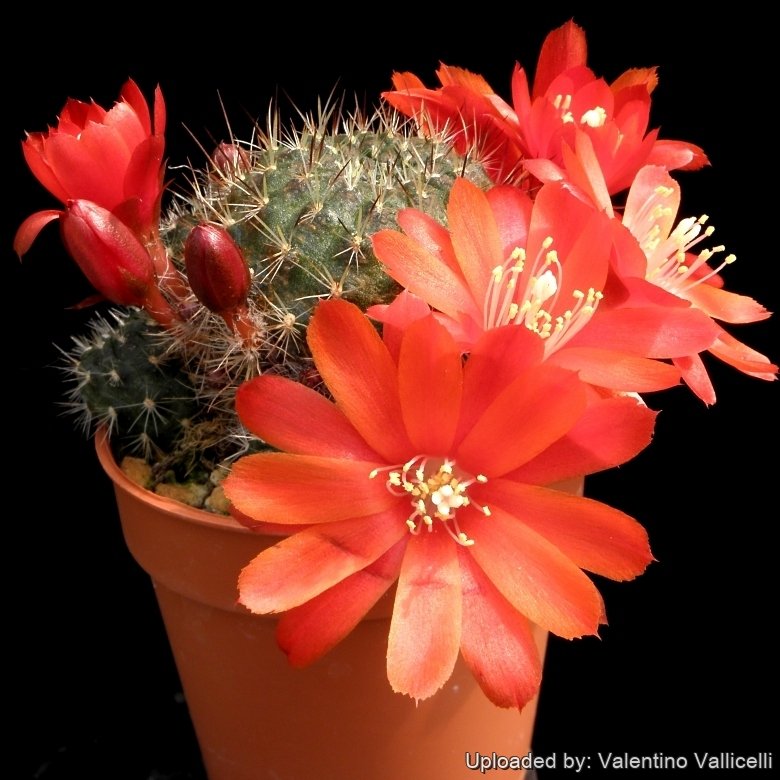
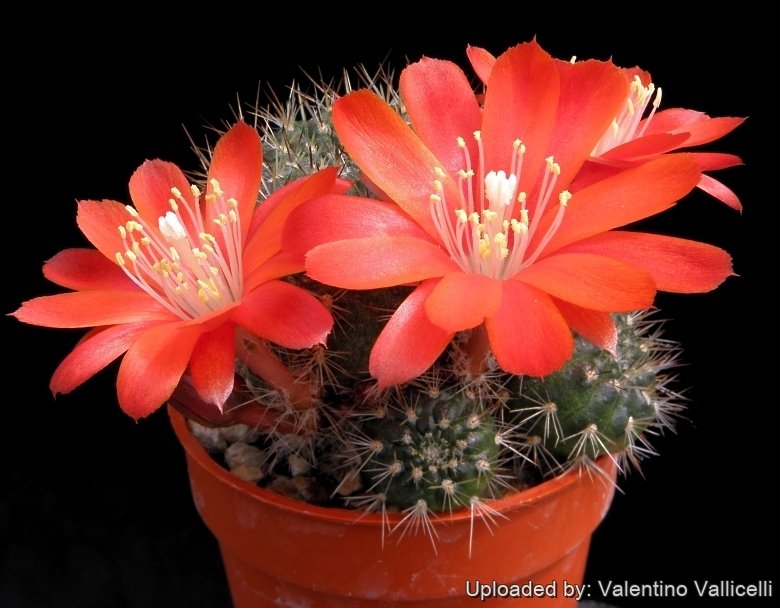
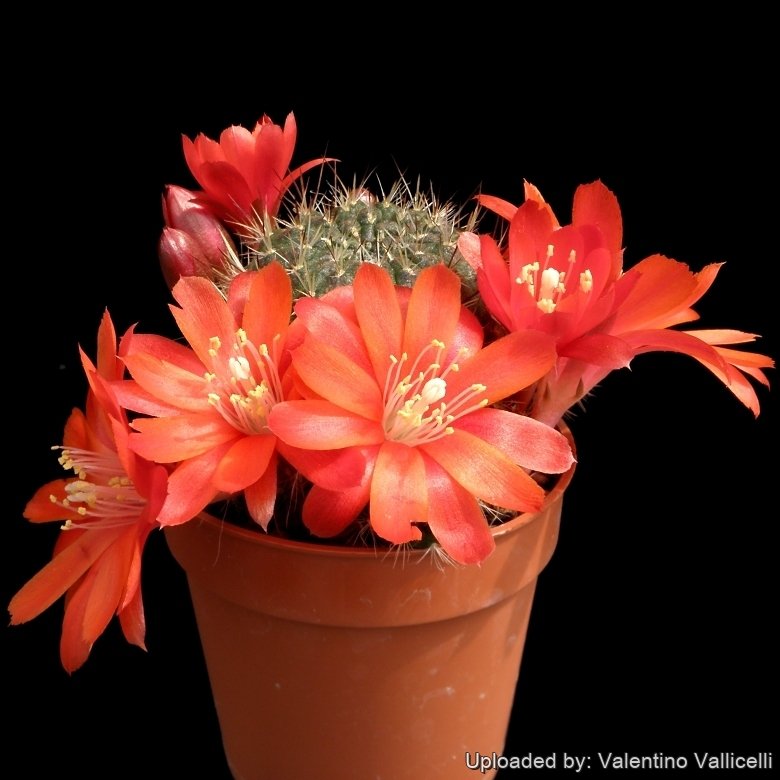
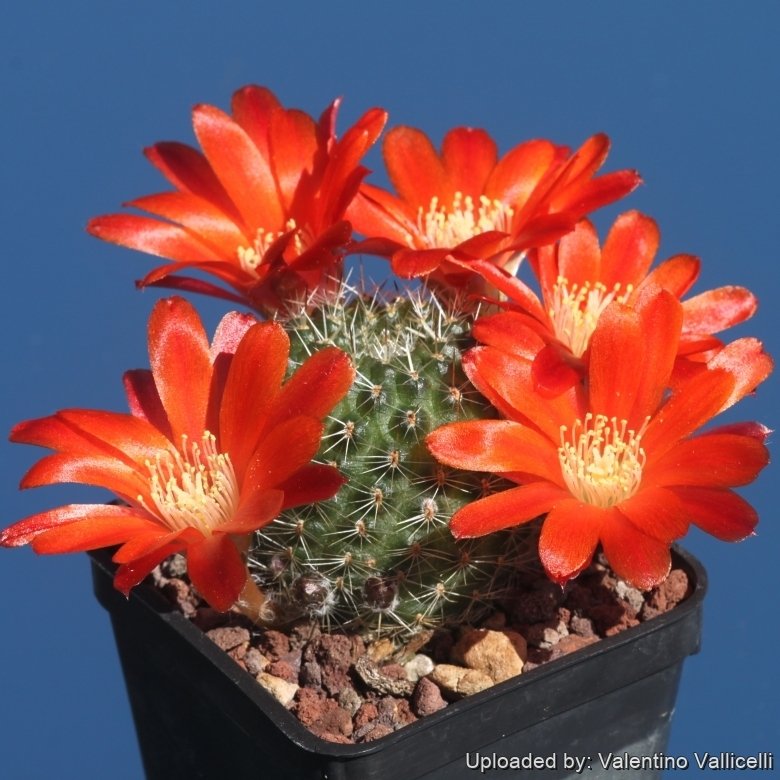
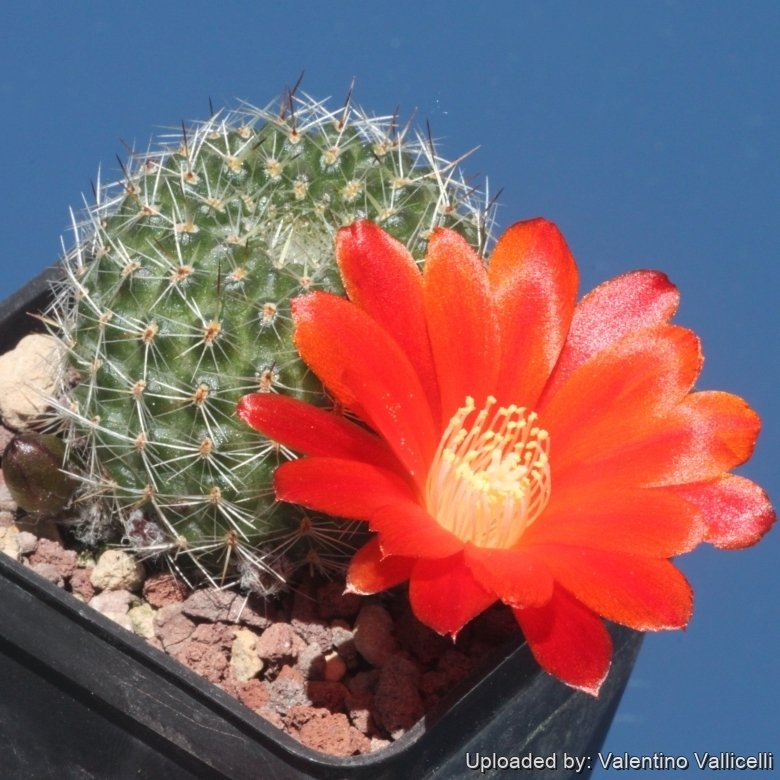
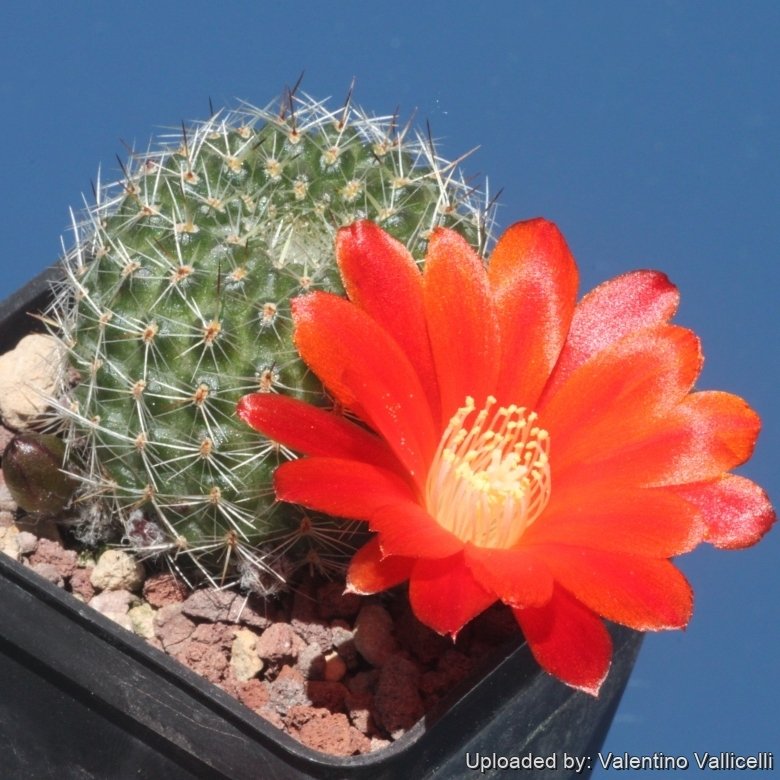
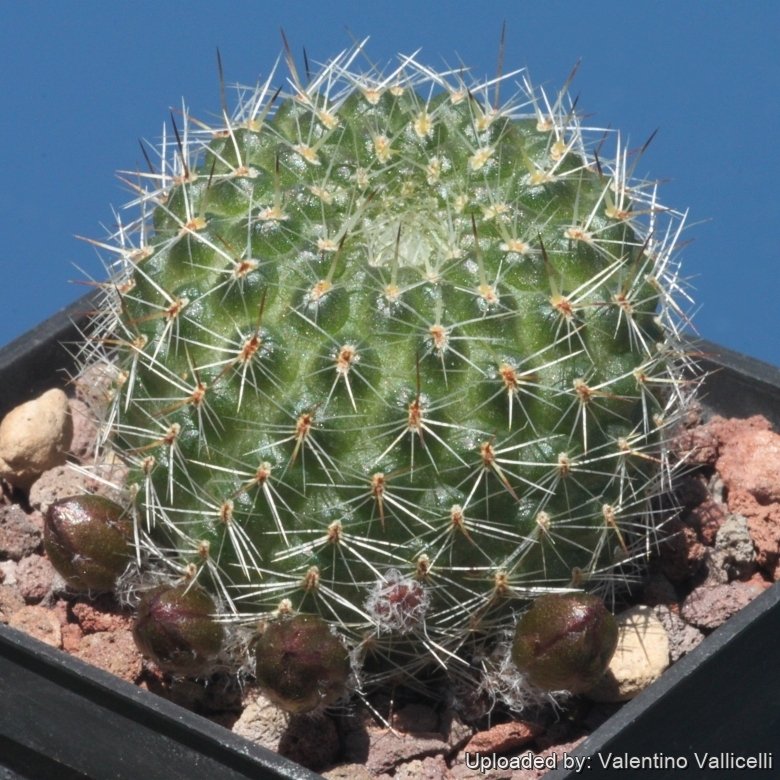
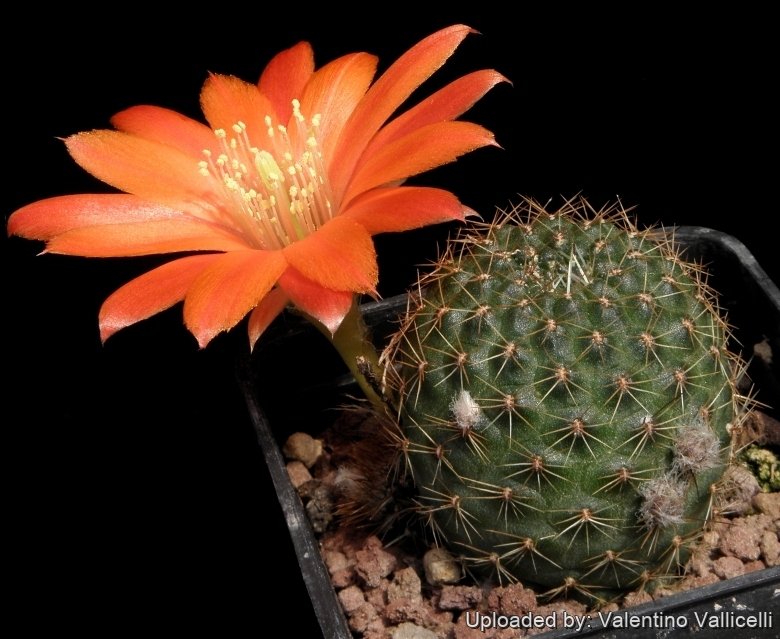
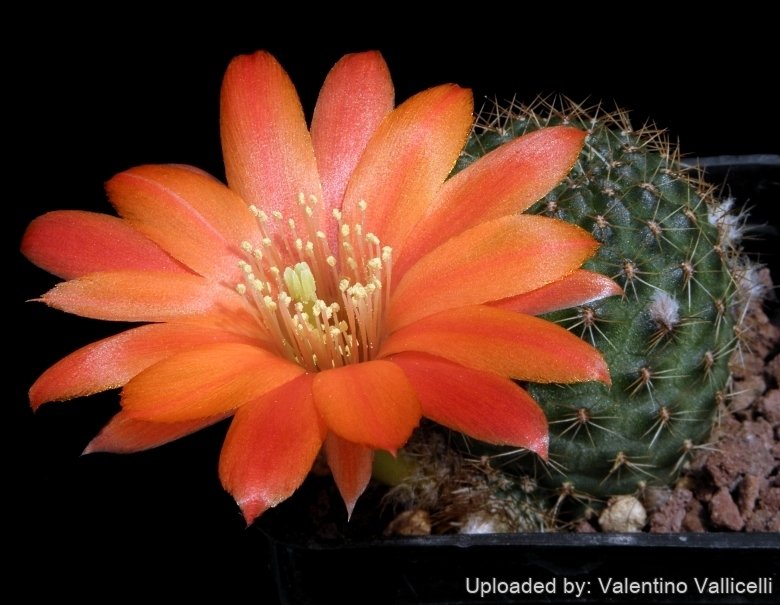
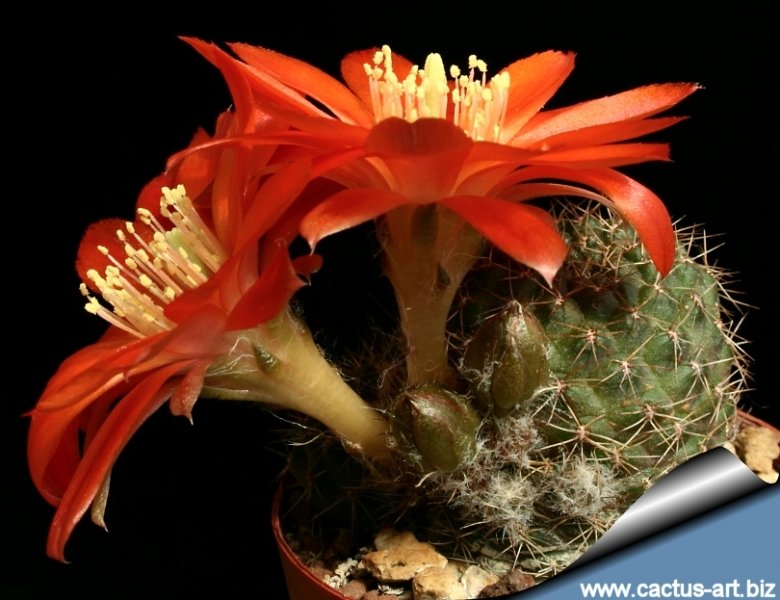
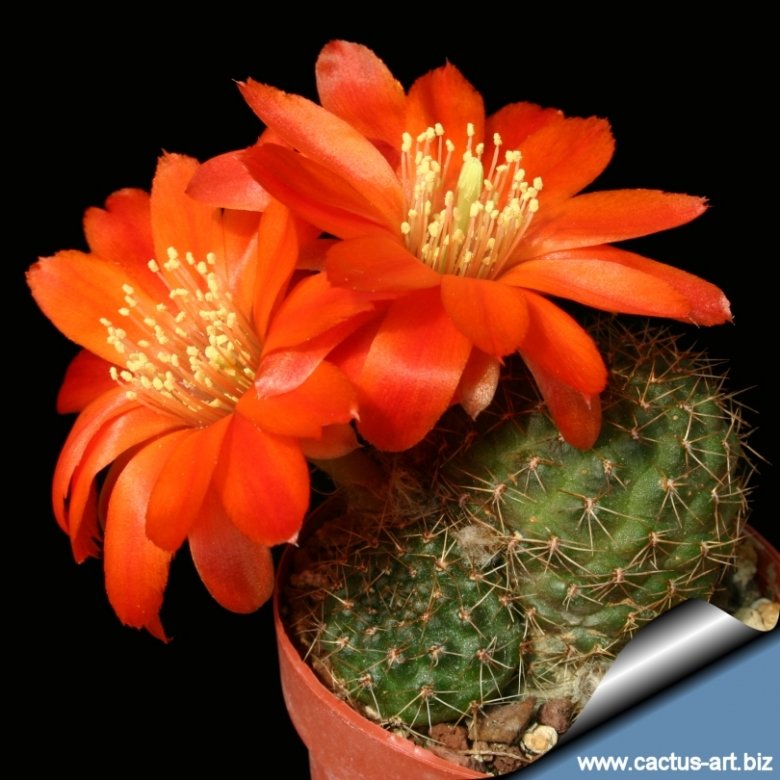
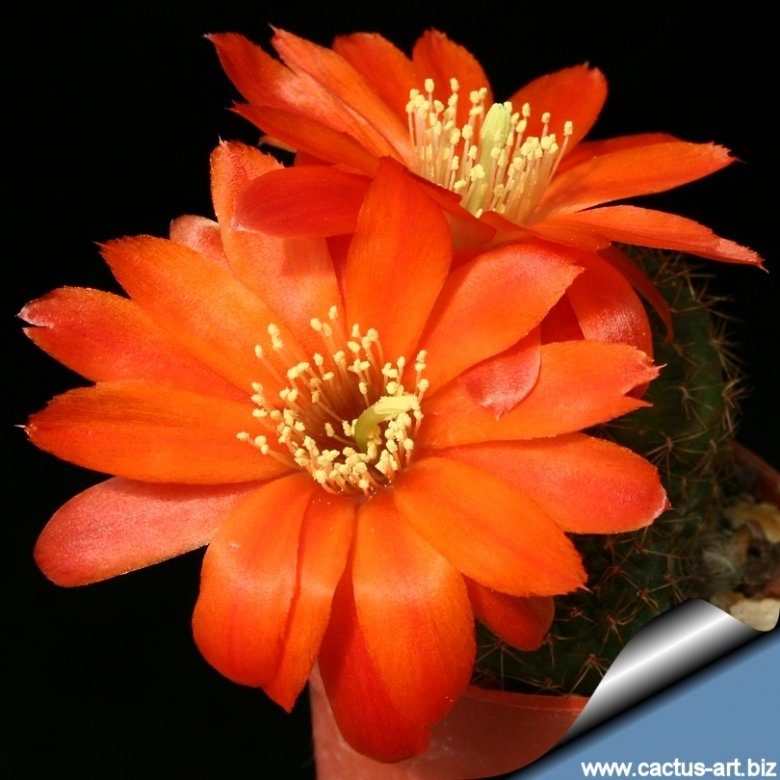
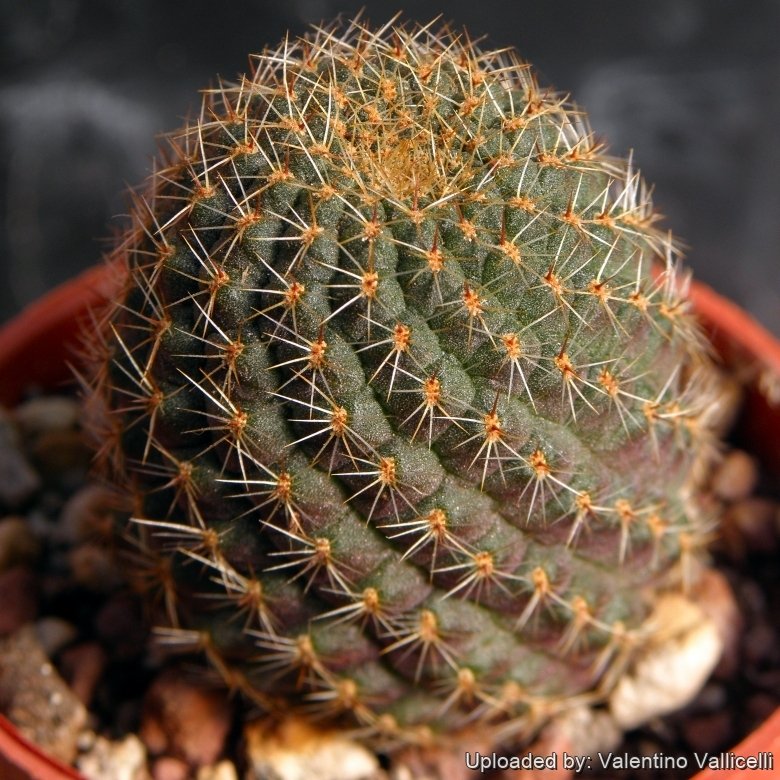
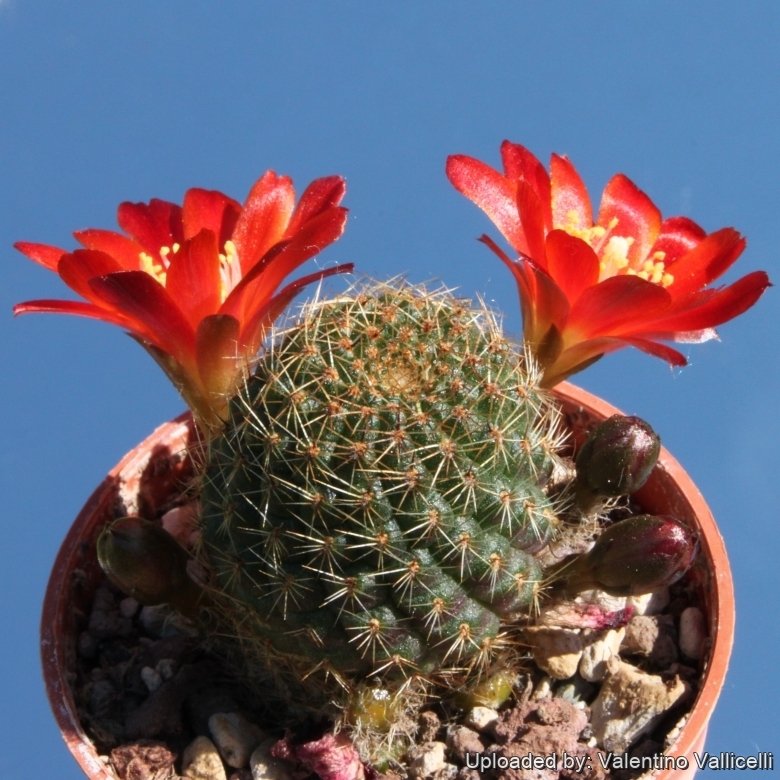
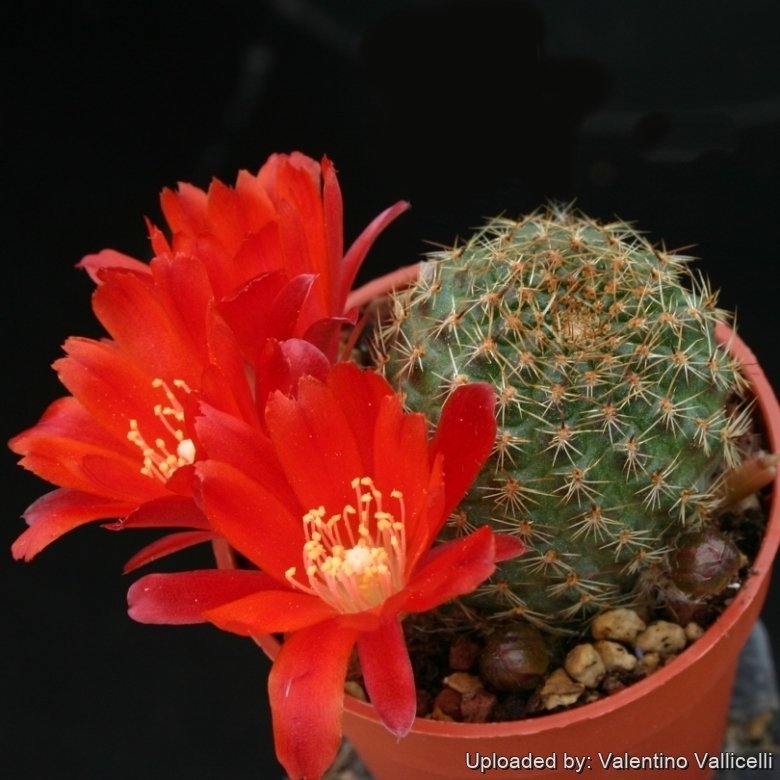
Rebutia fusca is a very distinctive species with an overall brown aspect, and with very short spines lying close to the stem that barely reach 2-3 mm long and give the impression that the plant could be grasped with impunity. It is the “Bolivian form” of Rebutia spegazziniana, but it has a very different habit from that species, growing tallish stems and solitary or clustering randomly. This slow growing cactus is highly priced for its vibrant orange red blooms.
Stem: Solitary, slowly and sparsely clustering in cultivation, 2-4 cm wide, and up to 8 cm tall or more.
Ribs: 13-17 scarcely discernible.
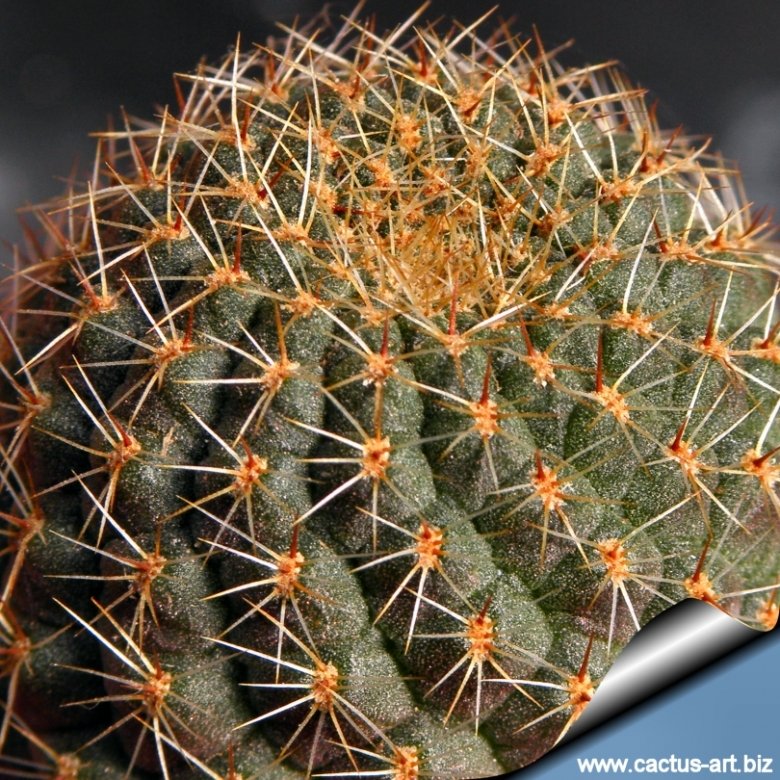
Areoles: With brown wool.
Radial spines: 8-14, pectinate, 1.5-3 mm long, lying flat to to the body, red, sometimes yellow, with red at the base.
Central spines: 1 or 2, thicker, red to nearly black, 2-3 mm long.
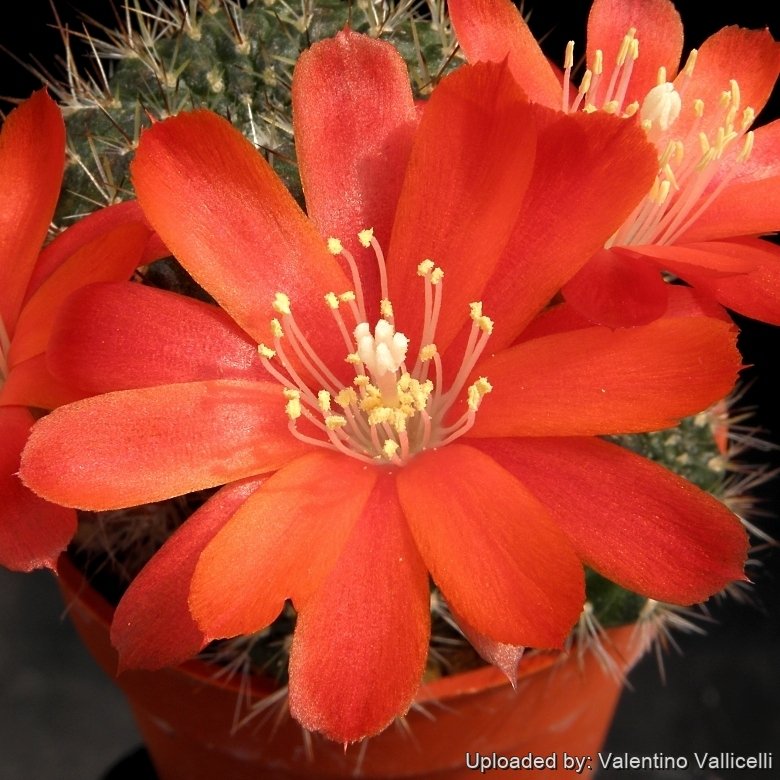
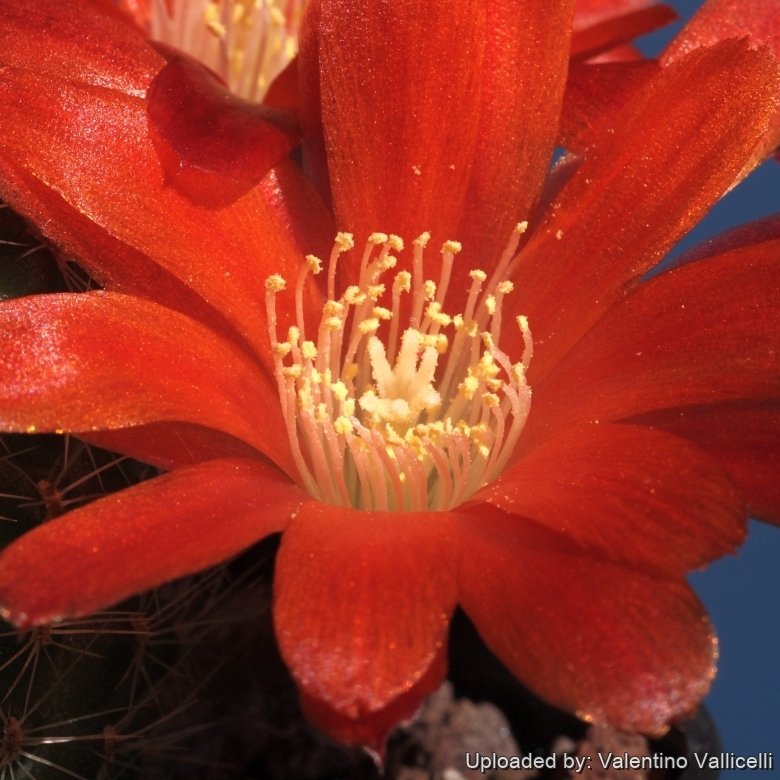
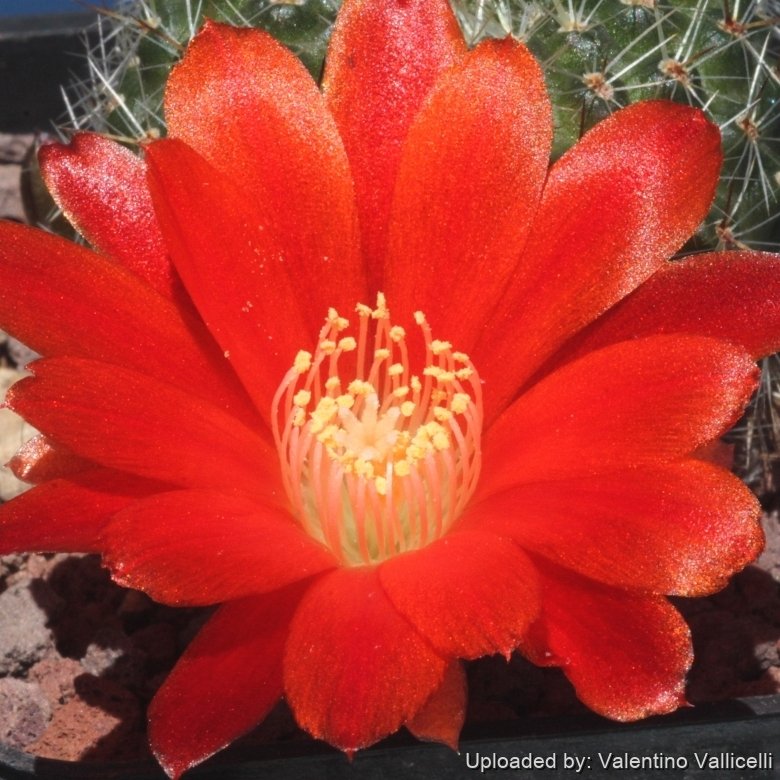
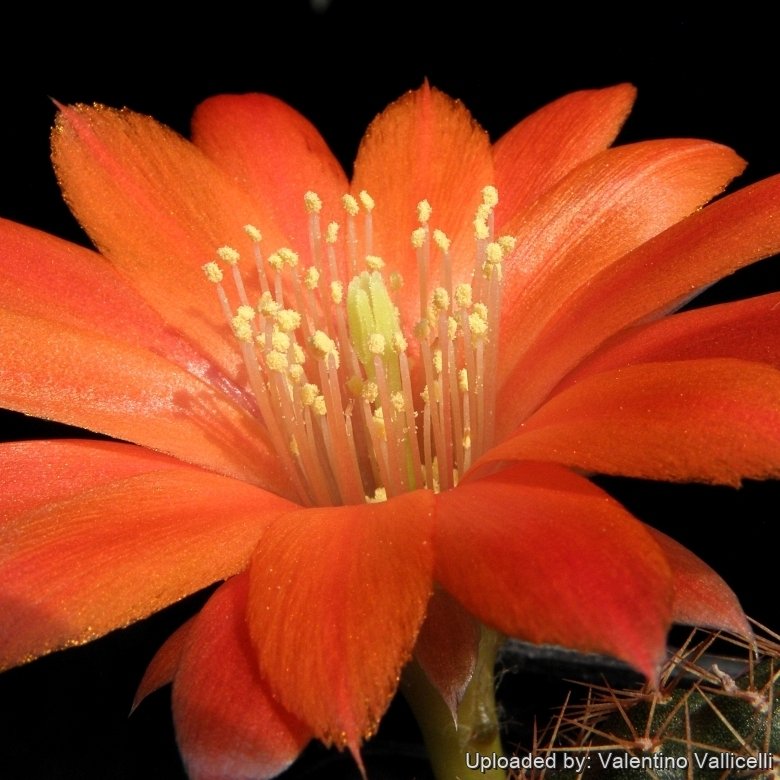
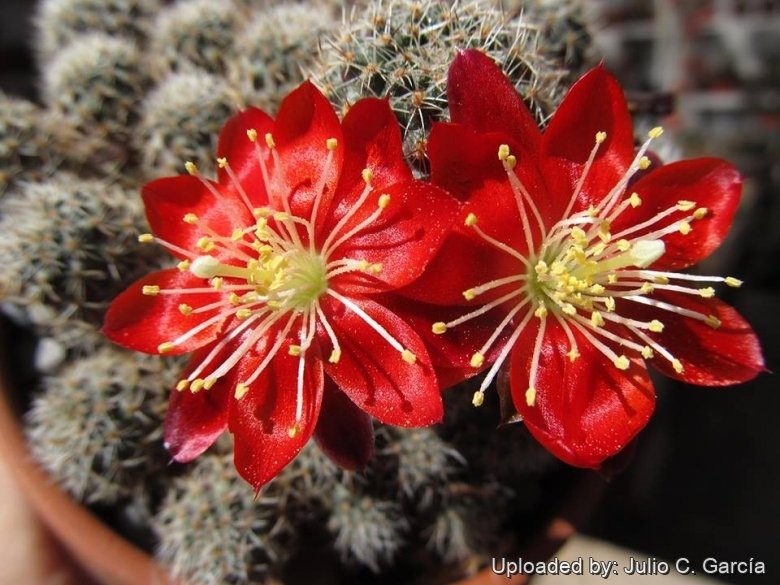
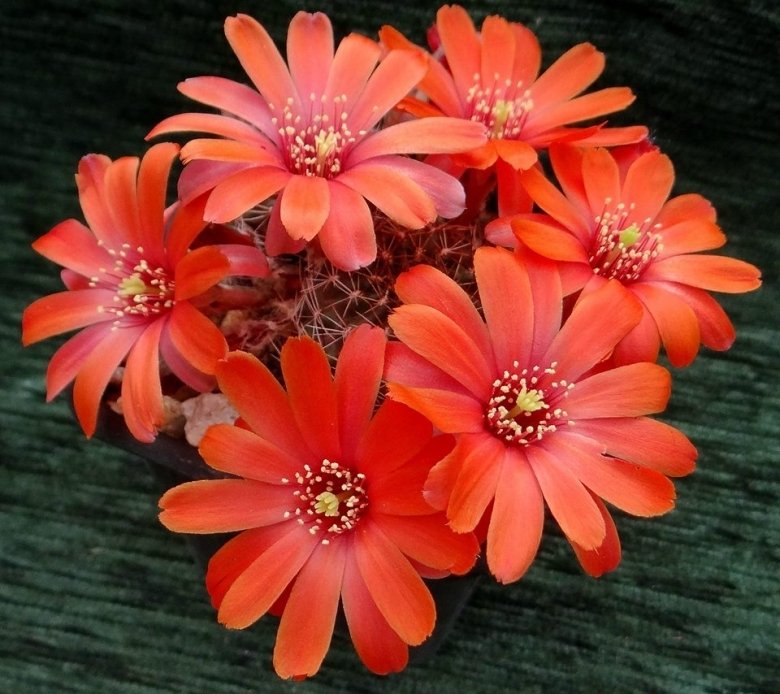
Flowers: Orange-red to scarlet, 2-3 cm long and wide. The stigma lobes are very pale and the anthers are cream coloured.
Spines: Rebutia fusca is one of the shortest spined species in the genus.
Note: It is sometimes seen misnamed Rebutia vulpina, an altogether more bristly and more globular species.
Origin and Habitat
Questa de Sama and adjacent areas, Tarija, Bolivia
Altitude range: 3100-3900
Habitat and ecology: Rebutia fusca grows on rock outcrops in grassy slopes.
Cultivation and Propagation
It is easy to grow and recommended for beginners. Prefer gritty, porous mix with a pH slightly on the acidic side. Full sun to light shade, Water regularly in summer but do not overwater (the root system is rot prone) and allow the pot to dry out between waterings. Keep dry in winter Hardy to -4°C it will take low temperatures when dry and do require a winter rest period. This species will occupy a small flower pot comfortably and remain a manageable sized house plant.
Pest and disease: This plants are subject to mealy-bug attack and to fungus and rot problems brought about by overwatering and high humidity.
Propagation: Seed or offsets.
Bibliography
Major references and further lectures
-
John Pilbeam “Rebutia” Cirio Pub. Services, 01 May 1997
-
“British Cactus & Succulent Journal” Cactus & Succulent Society, 2001
Source: Rebutia fusca, LLIFLE - Encyclopedia of living forms, CC-BY-SA, retrieved 2026-10-25.
From llifle page Rebutia mamillosa
Origin and Habitat
S. Cinti Province, west of Camargo, Chuquisaca Dept., Bolivia.
Source: Rebutia mamillosa, LLIFLE - Encyclopedia of living forms, CC-BY-SA, retrieved 2026-10-25.
From llifle page Rebutia patericalyx
Description
Rebutia patericalyx Ritter (1977) is one of the controversial forms of the widespread and variable Rebutia spegazziniana. It is noted for the smallish solitary to sparingly clustering stems. The spines are 3 to 6mm long, pointing sideways, pale yellow to white and covered by minuscule hairs visible only under lens. The flowers are scarlet. However the distinguishing characteristics of Rebutia patericalyx, appear to fall within the natural variation of Rebutia spegazziniana and most authors synonymize it with the latter, but it still has a value for a collector because they identify plants with particular characters. Regrettably most plants in cultivation under this name seldom match up to the original description, being usually raised from commercial seed which has often been wrongly identified, and this is sadly often the case with Ritter plants.
Derivation of specific name: ‘patericalyx’, from Latin ‘patera’, bowl, and Latin ‘calyx’, calyx, cup, a bowl-shaped cup, and refers to the shape of the flower.
Stems: Single-stemmed to sparsely clustering, green, 1.3 to 3 cm wide.
Ribs: 13 to 16 ill-defined.
Areoles: 1-2 mm long, with white wool.
Spines: 12-15, pale yellow to white, pointing sideways, 3 to 6mm long, sometimes with one similar central spine. All with tiny pubescent hairs visible only with a magnifying glass,
Flowers: Scarlet , 3.5 cm or more cm long and wide. Pericarpel with white wool and bristles.
Note: Rod and Ken Preston-Mafham (1997) proposed a different classification and placed Rebutia patericalyx as a synonym of Rebutia deminuta (Web.) Br.& R.
Origin and Habitat
Rebutia patericalyx has been reported from La Cueva, Chuquisaca, Bolivia.
Bibliography
Major references and further lectures
-
John Pilbeam “Rebutia” Cirio Pub. Services, 01 May 1997
-
Rod and Ken Preston-Mafham “Cacti: The Illustrated Dictionary” 1997
Source: Rebutia patericalyx, LLIFLE - Encyclopedia of living forms, CC-BY-SA, retrieved 2026-10-25.
From llifle page Rebutia tarvitaensis
Description
Very small clumping plants.
Stems: Individual heads short-cylindrical 3-6 cm wide, 4 cm tall, The colour of the epidermis vary from grey-green to olive-green with violet tints.
Spines: Short .
Flowers: 4-4,5 cm in diameter bright orange-red.
Roots: Tap root.
Origin and Habitat
Tarvita , Azurdua Co. , dpt. Chuquisaca , Bolivia.
Altitude: Around 2700 metres above sea level.
Notes
It would appear that in cultivation they grow larger and cluster more vigorously than in habitat.
Bibliography
Major referneces and further lectures
-
Walther Haage “Cacti and succulents: a practical handbook” Dutton, 1963
-
Edward Anderson “The Cactus family” Timber Press, Incorporated, 2001
-
James Cullen, Sabina G. Knees, H. Suzanne Cubey “The European Garden Flora Flowering Plants: A Manual for the Identification of Plants Cultivated in Europe, Both Out-of-Doors and Under Glass” Cambridge University Press, 11/Aug/2011
-
David R Hunt; Nigel P Taylor; Graham Charles; International Cactaceae Systematics Group. “The New Cactus Lexicon” dh books, 2006
-
N. L. Britton, J. N. Rose “The Cactaceae. Descriptions and Illustrations of Plants of the Cactus Family.” Volume 4, The Carnegie Institution of Washington, Washington 1923,
-
Curt Backeberg: “Die Cactaceae: Handbuch der Kakteenkunde” Volume V, Gustav Fischer Verlag, Stuttgart New York 1982–1985
Source: Rebutia tarvitaensis, LLIFLE - Encyclopedia of living forms, CC-BY-SA, retrieved 2026-10-25.
From llifle page Rebutia vulpina
Description
Often misidentified in cultivation, this is a clustering, globular species, with stems 3 to 5cm wide, with about 20 ribs. Areoles have white wool.
Radial spines: 10 to 14, thin, white, standing out, roughened, 3 to 15mm long.
Central spines: 1 to 7, red-brown.
Flowers: Bright red, petals tipped scarlet, stigma white.
Origin and Habitat
Bolivia (Chuquisaca,Tarija) and argentina (Jujuy, Salta, Catamarca)
Altitude: 3400-3900
Cultivation and Propagation
Rebutia vulpina is easy to grow and free flowering. Nevertheless, it is appropriate to provide adequate growing conditions in order to obtain abundant blooms.
Growth rate: It is a relatively rapidly growing species that will make large clumps given the best conditions.
Soils: As most Rebutia cultivated for their blossom, it needs a soil mixture a little richer than the average cactus with still an excellent drainage. Prefer a low pH compost, avoid substrata too rich in limestone.
Repotting: This plant needs plenty of space for its roots, repotting should be done every other year or when the it has outgrown its pot. It is rot prone and should be planted in a shallow pot. Use pot with good drainage.
Watering: Needs moderate to copious waterings in summer (it is more demanding than other cactus), but do not overwater, keep dry in winter at a minimum temperature of 0°C.
Fertilization: Feed with a high potassium fertilizer in summer.
Hardiness: It is quite frost resistant if kept dry and hardy to -5° C to -18° C for short periods (depending on varieties and growing conditions). However warmth throughout the year will increase the grower’s success (minimum 5° C during rest season).
Exposition: The plant tolerates bright situations which encourages flowering and heavy spine production, but is likely to suffer from sun scorch or stunted growth if over exposed to direct sunlight during the hottest part of the day in summer. It grows well with filtered sunlight or afternoon shade.
Uses: It is an excellent plant for container growing. It look fine in a cold greenhouse and frame or outdoor in a rockery. It is also used as a rootstock for grafting delicate and slow growing cactus species.
Pests & diseases: It may be attractive to a variety of insects, but plants in good condition should be nearly pest-free, particularly if they are grown in a mineral potting-mix, with good exposure and ventilation. Nonetheless, there are several pests to watch for:
- Red spiders: Red spiders may be effectively rubbed up by watering the plants from above.
- Mealy bugs: Mealy bugs occasionally develop aerial into the new growth among the wool with disfiguring results, but the worst types develop underground on the roots and are invisible except by their effects.
- Scales: Scales are rarely a problem.
- Rot: This species is particularly easy and accommodating, seldom suffer of cryptogamic diseases. Rot it is only a minor problem with cacti if the plants are watered and “aired” correctly.
Propagation: Direct sow after last frost, offsets (if available) . Seeds germinate in 7-14 days at 21-27° C in spring, remove gradually the glass cover as soon the plants will be well rooted (ca 1-2 weeks) and keep ventilated, no full sun for young plants! To make a cutting twist off a branch and permit it to dry out a couple of weeks, lay it on the soil and insert the stem end partially into the soil. Try to keep the cutting somewhat upright so that the roots are able to grow downward.
Notes
Rebutia spegazziniana is a widespread and quite variable species that has received an undue number of names.
Source: Rebutia vulpina, LLIFLE - Encyclopedia of living forms, CC-BY-SA, retrieved 2026-10-25.
From llifle page Rebutia mamillosa var. australis
Description
Rebutia mamillosa v. australis is a small cactus species with prominent ribs, tiny bristly spines and vibrant red flower which is distinguished from var. mamillosa by larger body and flowers to 45 mm long with white filaments. It is one of the many geographical or morphological form of the widespread and variable Rebutia spegazziniana.
Habit: It is a solitary or clustered stem succulent, branching at ground level to form low dense groups or mounds up to 15 cm wide. It grows quite close to the ground and offsets only with age. It would appear that in cultivation it grows larger and clusters more vigorously than in habitat.
Stems: Individual heads 20-30 mm wide, globose to flattened globose (sometime short-cylindrical in cultivation). The colour of the epidermis is very dark greenish brown becoming deeply bronzed purple in full sunlight.
Root: Taproot smaller than in var. mamillosa.
Ribs: 10-15, forming prominent tubercles.
Areoles: Small, brown, 1-1.5 mm.
Spines: Short glass-white with darker tips, bristly, awl-shaped to needle-like.
Radial spines: 12-20 all straight, 3-6mm long, white or yellowish.
Central spines: 0-4, equal in length.
Flowers: Diurnal, borne on the stems’ side near ground level, 26-46 cm long and in diameter, bright red, with white filaments, 3-4 pale yellow stigma lobes.
Fruits: Globose, reddish green.
Seeds: Black.
Similar species: Rebutia mamillosa (comprising v. australis Ritt. FR 1138 and v. orientalis Ritt. FR341a ) is similar to Rebutia fulviseta Rausch and Rebutia leucanthema Rausch. Both them have somewhat smaller flowers, smaller bodies, and generally rather longer, thinner spines than shown by Rebutia spegazziniana. All this species are individually isolated from each other yet they are morphologically very similar and difficult to distinguish when not in flower, especially R. mamillosa and R. leucanthema.
Origin and Habitat
San Antonio, Tarija, Bolivia
Altitude range: Around 3650 metres above sea level. Field number FR 341 a.
Cultivation and Propagation
Rebutia mamillosa var. australis is easy to grow and recommended for beginners. Prefer gritty, porous mix with a pH slightly on the acidic side. Full sun to light shade, Water regularly in summer but do not overwater (the root system is rot prone) and allow the pot to dry out between waterings. Keep dry in winter Hardy to -4°C it will take low temperatures when dry and do require a winter rest period. This species will occupy a small flower pot comfortably and remain a manageable sized house plant.
Pest and disease: This plants are subject to mealy-bug attack and to fungus and rot problems brought about by overwatering and high humidity.
Propagation: Seed or offsets.
Bibliography
Major references and further lectures
-
Edward Anderson “The Cactus family” Timber Press, Incorporated, 2001
-
James Cullen, Sabina G. Knees, H. Suzanne Cubey “The European Garden Flora Flowering Plants: A Manual for the Identification of Plants Cultivated in Europe, Both Out-of-Doors and Under Glass”} Cambridge University Press, 11/Aug/2011
-
David R Hunt; Nigel P Taylor; Graham Charles; International Cactaceae Systematics Group. “The New Cactus Lexicon” dh books, 2006
-
Donald, John Donald “The Classification of the Rebutias” Ashingtonia, vol. 2 1975
-
Ashingtonia 3(1): 29-30, January/February 1978
-
John Pilbeam “Rebutia” Cirio Pub. Services, 01/mag/1997
Source: Rebutia mamillosa var. australis, LLIFLE - Encyclopedia of living forms, CC-BY-SA, retrieved 2026-10-25.
From llifle page Rebutia mamillosa var. orientalis
Description
It differs from var. mamillosa by by the areoles abundantly filled with white wool; with 0-4 radial spines, 5-7 mm long, darker at base.
Origin and Habitat
Tarija towards the south, Bolivia. Field number FR 1138.
Bibliography
Major references and further lectures
- Ashingtonia 3(1): 29-30, January/February 1978
Source: Rebutia mamillosa var. orientalis, LLIFLE - Encyclopedia of living forms, CC-BY-SA, retrieved 2026-10-25.
From llifle page Rebutia boliviensis
Description
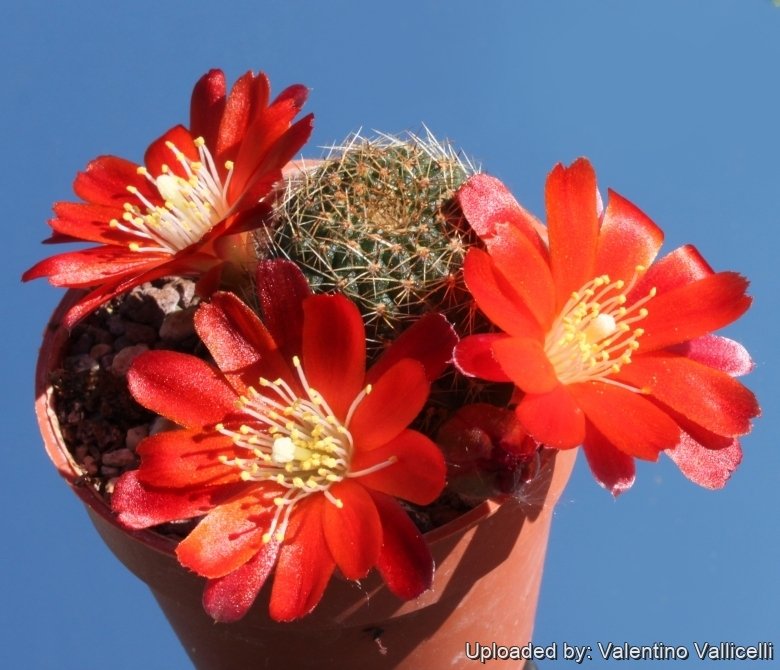
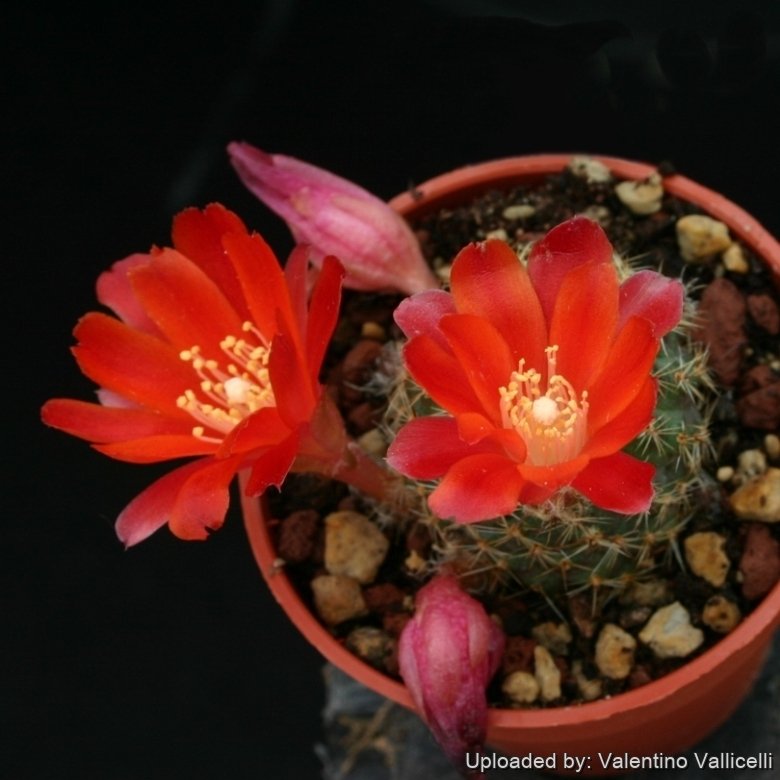
Rebutia spegazziniana var. boliviensis is an undescribed name (n.n.) firstly published in Köhres seed catalog in 1974, and used to indicate one of the innumerable local form of the variable Rebutia spegazziniana with bright carmine-red flowers, but others forms are similar and plants from other localities look more like it. Rebutia spegazziniana var. boliviensis is variable and has also at times been referred to a form of Rebutia deminuta. Anyway (whatever the scientific name is) this easy to grow cactus is highly priced for its vibrant red blooms.
Remarks: Rebutia spegazziniana is a widespread and variable species that has received an undue number of names. The differences usually concern only the spination, however the colouring, size and density of spines is greatly influenced by the conditions of culture, at lower light levels the spines are less numerous, delicate and white, while with strong solar radiation the spines are stronger with a darker tint. Minor differences can also be found in the colour of flowers sometime with a more pink or orange tint.
Origin and Habitat
Rio Bermejo, Tarija, Bolivia (field numbers: WR 922 and VJ 76)
Cultivation and Propagation
Rebutia spegazziniana var. boliviensis is easy to grow and recommended for beginners. Prefer gritty, porous mix with a pH slightly on the acidic side. Full sun to light shade, Water regularly in summer but do not overwater (the root system is rot prone) and allow the pot to dry out between waterings. Keep dry in winter Hardy to -4°C it will take low temperatures when dry and do require a winter rest period. This species will occupy a small flower pot comfortably and remain a manageable sized house plant.
Pest and disease: This plants are subject to mealy-bug attack and to fungus and rot problems brought about by overwatering and high humidity.
Propagation: Seed or offsets.
Source: Rebutia boliviensis, LLIFLE - Encyclopedia of living forms, CC-BY-SA, retrieved 2026-10-25.
Cultivars and forms (2)
Gallery