Publication: Cact. Journ. Brit. vii. 107 (1939)
Description
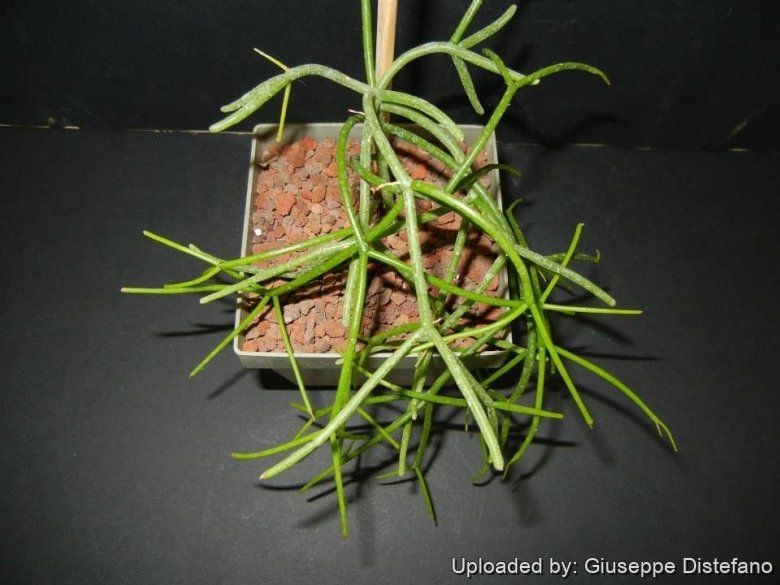
Rhipsalis baccifera (also known as Mistletoe cactus or Spaghetti cactus) is a graceful epiphyte succulent with long thread-like stems and numerous creamy-white flowers followed by mistletoe-like fruits. It forms large hanging clusters, 1 to 4 metres long (occasionally up to 9 meters). Like most cacti it has succulent stems, however in R. baccifera these are weak, slender, narrow and pendent. It shows considerable polymorphism as a result of the existence of lots of geographically isolated populations and can be divided into numerous subspecies: the nominate subspecies, subsp. cleistogama M.Kessler, Ibisch & Barthlott, subsp. erythrocarpa (K.Schum.) Barthlott, subsp. hileiabaiana N.P.Taylor & Barthlott, subsp. horrida Baker) Barthlott, subsp. mauritiana (DC.) Barthlott; and subsp. shaferi (Britton & Rose) Bartlott & N.P.Taylor. Additional subspecies have been described in Africa and Madagascar. Rhipsalis baccifera is the species most frequently grown.
Stems: Articulated, of indeterminate growth, very much branched dichotomously, or spirally, growing from tips of other branches, generally in pairs but sometimes in whorls of 6 or 8. The stems are weak and pendent 1-4 (or more) metres long; branches when young cylindrical, slender, not dimorphic, terete, sometimes producing aerial roots, 3-6 mm in diameter, light green, joints 10 to 20 cm. long, rarely up to 50 cm.
Areoles: Few dispersed, composite, with only 1-2 (or more) white tiny bristles to 1 m long. These bristly spines tend to disappear as the plant gets older.
Flowers: Borne laterally in winter or spring, solitary, small (5-10 mm in diameter), greenish in bud, sometimes subtended by a single bristle; petals 2 mm. long, cream-coloured; stamens borne on disk; ovary exserted.
Fruit: Naked, spheric, translucent, mistletoe-like, white or flesh-coloured (sometimes red), maturing a few days after flowering, globose, 5-8 mm. in diameter. The fruits are also edible, with a soft sweet taste.
Origin and Habitat
Rhipsalis baccifera is an extremely widespread species widely distributed in tropical America and the Caribbean. It can be found in Anguilla; Antigua and Barbuda; Argentina; Aruba; Barbados; Belize; Bolivia, Plurinational States of; Brazil (Bahia, Ceará, Maranhão, Paraíba, Pernambuco, São Paulo); Colombia; Costa Rica; Cuba; Dominica; Dominican Republic; Ecuador; El Salvador; French Guiana; Grenada; Guadeloupe; Guatemala; Guyana; Haiti; Honduras; Jamaica; Madagascar; Martinique; Mexico (Campeche, Chiapas, Hidalgo, Jalisco, Oaxaca, Puebla, Querétaro, Quintana Roo, San Luis Potosí, Tabasco, Tamaulipas, Veracruz, Yucatán); Montserrat; Netherlands Antilles; Nicaragua; Panama; Paraguay; Peru; Puerto Rico; Saint Kitts and Nevis; Saint Lucia; Saint Vincent and the Grenadines. United States (Florida – Native). The species also occurs in tropical Africa from the Ivory Coast to Ethiopia and as far south as South Africa, Seychelles, Mauritius, Reunion and Madagascar. It is also reported from Sri Lanka.
Altitude: It is found at elevations between sea level and 1,700 metres.
Habitat and Ecology: Rhipsalis baccifera is an epiphytic or saxicolous cactus, usualty growing on trunk or branches of large trees, hanging in large clusters in a wide variety of habitats comprising low and medium elevation forests, rain forest, riverine forests and mangrove tidal swamp. It also grows in humus on shady rocks. This is the only cactus species naturally occurring outside the New World. One theory is that it was introduced to the Old World by migratory birds, long enough ago for the Old World populations to be regarded as distinct subspecies. The alternative theory is that the species initially crossed the Atlantic on European ships trading between South America and Africa, after which birds may have spread it more widely. Rhipsalis baccifera is usually abundant where it occurs. The fruits atract birds, that spread the seeds, so the species can reproduce easy and fast, taking over trees in a large area. Given the huge range of this species, it is likely to be affected by a number of minor threats. However, none of these threats is significant enough to warrant any concern.
Cultivation and Propagation
Rhipsalis baccifera is among the easiest to cultivate epiphytic cacti and tolerates neglect. These forest cacti tend to be long lived.
Exposure: This plant (as with all Rhipsalis) prefers partial shade.
Watering: It requires ample summer water (more than other cacti), but allow soil to dry slightly between waterings.
Soil: These cacti won’t want a normal cactus soil but will prefer to be in a soil largely composed of organic material, such as peat or sphagnum moss, This type of soil would normally be used for orchids, bromeliads or other epiphytic plants.
These forest cacti tend to be long lived.
Hardiness: Frost tender. It needs night-time temperatures no cooler than 5° C, especially in the winter.
Special requirements: These plants bloom profusely if grown in an even, high temperature, but significantly less if the temperature fluctuates between 4°C and 18°C. They drop their buds easily if they are moved. Once flower buds have formed, do not move the plant, as slight changes in environment may cause the buds to drop.
Propagation: Stem cuttings.
Notes
R. baccifera, the only species of cactus to occur naturally outside the Western Hemisphere, is diploid in South America but tetraploid (2n = 4x = 44) in Central America, the Caribbean, SriLanka, and throughout Africa, and octoploid (2n = 8x - 88) in Madagascar.
Bibliography
Major references and further lectures
-
N. L. Britton, J. N. Rose: “The Cactaceae. Descriptions and Illustrations of Plants of the Cactus Family.” Volume 4, The Carnegie Institution of Washington, Washington 4: 7. 1923 [24 Dec 1923]
-
Edward Anderson “The Cactus family” Timber Press, Incorporated, 2001
-
James Cullen, Sabina G. Knees, H. Suzanne Cubey “The European Garden Flora Flowering Plants: A Manual for the Identification of Plants Cultivated in Europe, Both Out-of-Doors and Under Glass” Cambridge University Press, 11/Aug/2011
-
David R Hunt; Nigel P Taylor; Graham Charles; International Cactaceae Systematics Group. “The New Cactus Lexicon” dh books, 2006
-
Urs Eggli, Leonard E. Newton: “Etymological Dictionary of Succulent Plant Names” Springer, Berlin/Heidelberg 2010
-
Clive Innes “Complete Handbook of Cacti and Succulents” Van Nostrand Reinhold Company, 01/dic/1981
-
John Borg “Cacti: a gardener’s handbook for their identification and cultivation” Blandford P., 1970
-
Brian Lamb “Letts guide to cacti of the world” Letts, 17/ott/1991
-
Sara Oldfield “Cactus and Succulent Plants: Status Survey and Conservation Action Plan” IUCN, 01/gen/1997
-
Arreola, H., Hammel, B., Hilton-Taylor, C., Ishiki, M., Loaiza, C., Nassar, J., Oakley, L., Pin, A., Taylor, N.P., Terrazas, T. & Zappi, D. 2013. Rhipsalis baccifera. In: IUCN 2013. “IUCN Red List of Threatened Species.” Version 2013.2. <www.iucnredlist.org>. Downloaded on 02 May 2014.
-
Innes C, Wall B. “Cacti, Succulents and Bromeliads.” Cassell & The Royal Horticultural Society. 1995
-
“Rhipsalis baccifera (J.S. Mueller) Stearn” in Cact. J. (Croydon) 7: 107 (1939). Rhipsalis, Lepismium, Hatiora, Schlumbergera. [Consulta: 2006-09-26].
-
Maxwell, Phil. “The Rhipsalis Riddle - or the day the cacti came down from the trees: Part 3”. in: New Zealand Cactus and Succulent Journal, May 1999.
-
J. H. Cota-Sánchez, M. Bomfim-Patricio “Seed morphology, ploidy and the evolutionary history of the epiphytic cactus Rhipsalis baccifera (Cactaceae).” In: Polibotánica. volume 29, 2010
-
Bandoni de Oliveiera et al. “Paleogeography of the South Atlantic: a route for primates and rodents into the New World?” 2009
-
Maxwell, P “The Rhipsalis Riddle.” 1999
-
Nobel, P.S. ed. “Cacti: Biology and Uses.” 1992
-
Cota-Sánchez, J.H & Bomfim-Patrício, M.C. “Seed morphology, polyploidy and the evolutionary history of the epiphytic cactus Rhipsalis baccifera (Cactaceae).” PoliBotanica. 2010
-
Barthlott W., Taylor N. P.“Notes towards a monograph of Rhipsalideae (Cactaceae). Bradleya” 13: 43–79. 1995
Cultivars and forms (1)
Subspecies (1)
Gallery