Publication: Sp. Pl. 2: 1035. 1753 [1 May 1753]
Description
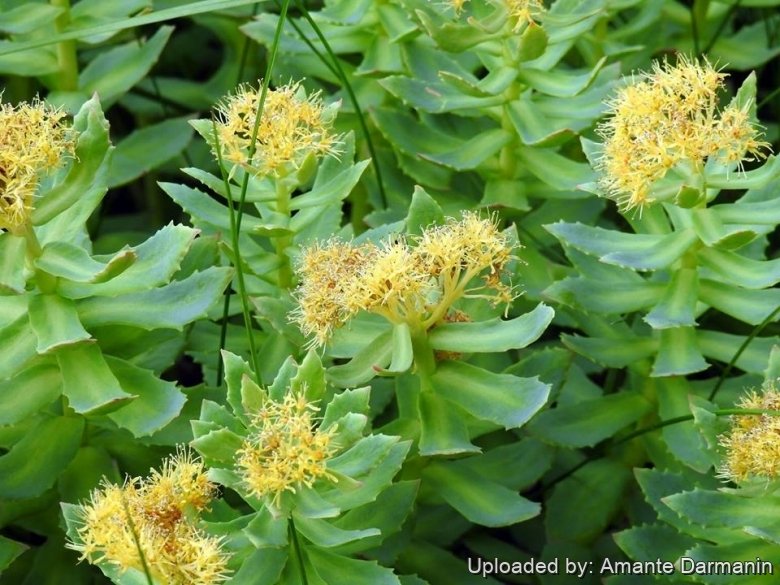
Rhodiola rosea is a glabrous perennial succulent herb growing from 5 to 40 cm tall, and has several stems growing from a short, scaly rootstock. Flowers have 4 sepals and 4 petals, yellow to greenish yellow in colour sometimes tipped with red, about 1 to 3.5 millimetres long, and blooming in summer. Plants are mostly dioecious (individual flowers are either male or female, but only one sex is to be found on any one plant so both male and female plants must be grown if seed is required).
Rootstock: Erect or spreading, 5-25 mm in diameter. The root exhales the odour of the rose
Stems: Floral stems branched at the base, or simple, erect or ascending, glabrous and somewhat glaucous, deciduous growing from the same thick root may reach 5 to 40 cm in height and 2-6 mm in diameter.
Leaves: Sessile. Blades pale green, usually glaucous, ovate to or slightly obovate or oblong, margins toothed or sometimes almost entire, apex acute to obtuse, narrowed or rounded at the base, 10-50 mm long 4-15 mm wide, the lower ones smaller.
Inflorescences : Terminal. The numerous flowers (up to 150) are nearly sessile, crowded in a dense corymbose cyme, to 6.5 cm in diameter. Pedicels ca. 3 mm long.
Flowers: Yellowish-green or purplish. Mostly unisexual (dioecious), buy occasional plants may have both staminate and pistillate flowers in the same cyme. Flowers are 4(-5)-merous. Sepals linear-oblong or lanceolate, narrower and shorter than the petals, unequal, 1-2.5 mm long. Petals pale yellow to greenish yellow, sometimes red at tips, oblong, 1-3.5 mm long, shorter than stamens, in staminate flowers spreading, hooded, 0.7-1.1 mm wide, in pistillate erect. Staminate flowers with 8 (rarely 10) stamens, the pistillate ones with 4 (rarely 5) carpels. The plant is not self-fertile.
Fruits (follicles): 4-9 mm long; beaks spreading.
Seeds: Reddish brown to purple, winged at both ends, pyriform, 1.7-2.2 mm long and 0.5-0.7 mm wide. The seeds form capsules during the second half of the summer. Under natural conditions, the ripened seeds fall in August and September.
Chromosome number: 2n = 22.
Remarks: Linnaeus used the epithet “Rosea” as a feminine noun (does not decline with the gender of the genus).
Origin and Habitat
Northern, central and southern Europe, including Britain and much of the Arctic, (West-wards to the Pyrenees, east-wards to southern Bulgaria), Russia (Ural, Siberia), Asia (Mongolia, northern China, Korea, Japan, Sakhalin, Kuriles), Northern America (northern USA and Canada), Greenland.
Altitude range: 0-1900 metres above sea level.
Habitat and ecology: Crevices of mountain rocks, moist, rocky ledges and talus of coastal cliffs, further south on mountains. It is in flower from May to August, and the seeds ripen from Jul to August. The flowers are pollinated by Bees and flies.
Cultivation and Propagation
Rhodiola rosea is for both light (sandy), medium (loamy) and heavy (clay) soils and prefers well-drained soil. It is suitable for acid, neutral and basic (alkaline) soils.
It cannot grow in the shade. It is partially drought tolerant, salt tolerant, and wind tolerant.
Food uses. The leaves and shoots are eaten raw, having a bitter flavour, or cooked like spinach, and are sometimes added to salads.
Traditional medicine: Historically, people in northern regions have used rhodiola for anxiety, fatigue, anemia, impotence, infections, headache, and depression related to stress. People also have used it to increase physical endurance, work performance, longevity, and improve resistance to high-altitude sickness. Through 2012, human studies evaluating R. rosea did not have sufficient quality to determine whether it has properties affecting fatigue or any other condition.
Bibliography
Major references and further lectures
-
Reid V. Moran (2009), “Rhodiola rosea Linnaeus, Sp. Pl. 2: 1035. 1753”, “Flora of North America online”, 8 <http://www.efloras.org/florataxon.aspx?flora\_id=1&taxon\_id=200009865\>
-
“Rhodiola rosea L.”. “Plants for a Future”. 2012. Retrieved 03 October 2017.
-
Saratikov A.S. (1974). “Golden Root (Rhodiola Rosea)” (2nd ed.). Publishing House of Tomsk University.
-
Ishaque, S; Shamseer, L; Bukutu, C; Vohra, S (2012). “Rhodiola rosea for physical and mental fatigue: A systematic review”. BMC Complementary and Alternative Medicine. 12: 70. <https://www.ncbi.nlm.nih.gov/pmc/articles/PMC3541197/\>
-
“Rhodiola”. National Center for Complementary and Integrative Health, US National Institutes of Health. September 2016. Retrieved 03 October 2017. <https://nccih.nih.gov/health/rhodiola\>
-
Wikipedia contributors. “Rhodiola rosea.” Wikipedia, The Free Encyclopedia. Wikipedia, The Free Encyclopedia, 4 Sep. 2017. Web. 2 Oct. 2017
-
Robert Theodore Clausen “Sedum of North America North of the Mexican Plateau” Cornell University Press, 01 January 1975
-
Alain Cuerrier, Kwesi Ampong-Nyarko, Rhodiola rosea, CRC Press, 02 December 2014
-
N.N. Tzvelev, “Flora of Russia - Volume 10A: The European Part and Bordering Regions”, Oxford & IBH Publishing Company Pvt. Limited, 31 March 2007
-
John Torrey, Asa Gray, “A Flora of North America: Containing Abridged Descriptions of All the Known Indigenous and Naturalized Plants Growing North of Mexico; Arranged According to the Natural System”, Volume 1, Wiley & Putnam, 1838
-
Nathaniel Lord Britton, Addison Brown {{
From llifle page Rhodiola hideoi
Origin and Habitat
Japan. (Hondo)
Source: Rhodiola hideoi, LLIFLE - Encyclopedia of living forms, CC-BY-SA, retrieved 2026-10-26.
From llifle page Rhodiola integrifolia subs. neomexicana
Origin and Habitat
New Mexico (South-Central U.S.A., Northern America)
Source: Rhodiola integrifolia subs. neomexicana, LLIFLE - Encyclopedia of living forms, CC-BY-SA, retrieved 2026-10-26.
From llifle page Rhodiola iremelica
Origin and Habitat
Ural mountains.
Source: Rhodiola iremelica, LLIFLE - Encyclopedia of living forms, CC-BY-SA, retrieved 2026-10-26.
From llifle page Rhodiola krivochizhinii
Origin and Habitat
U.S.S.R. (Soviet Far East).
Source: Rhodiola krivochizhinii, LLIFLE - Encyclopedia of living forms, CC-BY-SA, retrieved 2026-10-26.
From llifle page Rhodiola maxima
Origin and Habitat
Kuril, Islands.
Source: Rhodiola maxima, LLIFLE - Encyclopedia of living forms, CC-BY-SA, retrieved 2026-10-26.
From llifle page Rhodiola roanensis
Origin and Habitat
North Carolina (Southeastern U.S.A., Northern America)
Source: Rhodiola roanensis, LLIFLE - Encyclopedia of living forms, CC-BY-SA, retrieved 2026-10-26.
From llifle page Sedum rhodiola var. oblongum
Origin and Habitat
Bei Ajan (= Ayan in Khabarovsk Krai) and Ochotsk, Russia.
Source: Sedum rhodiola var. oblongum, LLIFLE - Encyclopedia of living forms, CC-BY-SA, retrieved 2026-10-26.
From llifle page Sedum rhodiola var. viride
Origin and Habitat
Siberia, Russia.
Source: Sedum rhodiola var. viride, LLIFLE - Encyclopedia of living forms, CC-BY-SA, retrieved 2026-10-26.
From llifle page Sedum rhodiola var. vulgare
Origin and Habitat
Ajan, Lapland (= Ayan in Khabarovsk Krai) and from the not Russian Europe.
Source: Sedum rhodiola var. vulgare, LLIFLE - Encyclopedia of living forms, CC-BY-SA, retrieved 2026-10-26.
Cultivars and forms (5)
Gallery