Publication: Cact. Succ. J. (Los Angeles) 38: 53. 1966
Description
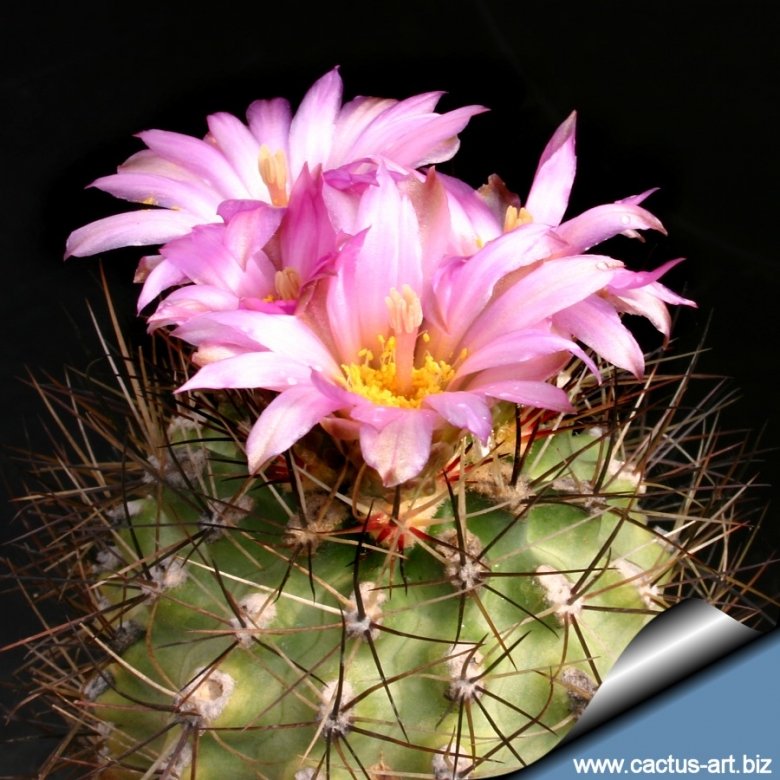
Sclerocactus glaucus (Colorado hookless cactus) is a ball cactus, spines not obscuring the stems.
Habit: Single or clumping, in groups of up to 9 heads.
Root: Taproots much branched.
Stem: Squat, globular, ovoid or somewhat cylindrical, (3-)4-12(-30) cm tall, 4 to 9 cm in diameter green or powdery blue, like the scientific name.
Ribs: (8-)12-13(-15) well defined sometime tuberculous. Tubercles protruding 6-9 mm above the ribs.
Areoles: With conspicuous nectar glands located above each areole.
Central spines: (0 or) 1 to 3 , terete or elliptic in cross section, pointing in various directions the lower ones brown, the upper ones white1-3 cm long. Generally characteristic unhooked, but some specimens lack central spines or have central spines which are hooked. Often young spines somewhat pubescent.
Radial spines: 6-8 (sometime less), needle like, whitish, 5-17 mm long, similar to the centrals.
Flowers: Beautiful purple or pink, fragrant, wide funnelform or bell-shaped , 4-5 cm in diameter, 3-4(-6) cm long. Stigma pinkish, erect. Stamens with white or green filaments and yellow anthers.
Fruits: Barrel shaped, 9-128-30) mm long, 8-12 mm across.
Seeds: 1,5 x 2,5 mm, black.
Blooming season: Summer.
Origin and Habitat
Sclerocactus glaucus has a very narrow range in southwestern Colorado (United States, Northern America). Its extent of occurrence is approximately 2500 square kilometres.
Altitude: Elevation ranges from 1300 to 2600 meters above sea level.
Habitat and Ecology: It is found in the Navajoan Desert scattered in a series of locally abundant subpopulations on gravely or rocky soils on hills, riverside and mesas of varying exposures on Salt-Desert/Grassland sites, occasionally on clayey plains mostly in desert scrub dominated by Atriplex. It is more abundant on south-facing exposures, and on slopes to about 5-30 percent grade. During the dry season it may shrink so much it disappears beneath the soil surface. Other succulent plants in the habitat include Echinocereus triglochidiatus var. melanacanthus, Pediocactus simpsonii, Escobaria missouriensis, Echinocereus triglochidiatus f. inermis, Opuntia polyacantha, and Yucca harrimaniae. The threats to this species are illegal collection, oil and gas exploration and urbanization. This species is threatened by hybridization with Sclerocactus parvifloris, particularly in the southern extent of its range.
Cultivation and Propagation
This plant is very rare in cultivation, it is difficult to grow on its own roots and to propagate. Mature individuals easily rot and die especially after planting. The seeds germinate with extreme difficulty and a low rate of success, seedlings do not do well either, and more die each year. Sclerocactus glaucus is extremely xerophytic and adapted to very dry soils, but plants grafted on hardy stock (Opuntia humifusa, Echinocereus triglochidiatus etc…) are relatively easy to grow and no special skill is required, they can stay in a non heated green house. (min tem -20°C) … This interesting cactus, continues to be a particular prize among specialist collectors.
Propagation: Seeds are extremely difficult to germinate (only 2-3 percent of seeds germinate). The germination is really difficult and if some seedling finally sprout, as they start to grows they disappear one by one. Grafting is often used to speed growth rate and to create a back-up for plants in collection.
Bibliography
Major references and further lectures
-
Edward Anderson “The Cactus family” Timber Press, Incorporated, 2001
-
James Cullen, Sabina G. Knees, H. Suzanne Cubey “The European Garden Flora Flowering Plants: A Manual for the Identification of Plants Cultivated in Europe, Both Out-of-Doors and Under Glass” Cambridge University Press, 11/Aug/2011
-
David R Hunt; Nigel P Taylor; Graham Charles; International Cactaceae Systematics Group. “The New Cactus Lexicon” dh books, 2006
-
Urs Eggli, Leonard E. Newton: “Etymological Dictionary of Succulent Plant Names.” Birkhäuser 2004
-
Lyman David Benson “The Cacti of the United States and Canada” Stanford University Press, 1982
-
Butterworth, C. & Porter, J.M. 2013. Sclerocactus glaucus. In: IUCN 2013. “IUCN Red List of Threatened Species.” Version 2013.2. <www.iucnredlist.org>. Downloaded on 04 December 2013.
From llifle page Sclerocactus franklinii
Description
Sclerocactus franklinii is a morphological or local form of the variable Sclerocactus glaucus. It was described by Evans (1939) from close by the type locality of Sclerocactus glaucus. More recent observations of the extent of variation in Sclerocactus glaucus populations has led many authors to conclude that Sclerocactus franklinii was a synonym of the bluegreen Sclerocactus glaucus because it is not sufficiently distinct to deserve its own formal status.
Origin and Habitat
Mesa County and Delta County, Colorado (Northwestern U.S.A., Northern America)
Type locality: South rim of Gunnison Valley, one or two miles east of Delta, Delta County, Colorado.
Altitude: Around 1400 metres above sea level.
Cultivation and Propagation
This plant is very rare in cultivation, it is difficult to grow on its own roots and to propagate. Mature individuals easily rot and die especially after planting. The seeds germinate with extreme difficulty and a low rate of success, seedlings do not do well either, and more die each year. Sclerocactus franklinii is extremely xerophytic and adapted to very dry soils, but plants grafted on hardy stock (Opuntia humifusa, Echinocereus triglochidiatus etc…) are relatively easy to grow and no special skill is required, they can stay in a non heated green house. (min tem -20°C) … This interesting cactus, continues to be a particular prize among specialist collectors.
Propagation: Seeds are extremely difficult to germinate (only 2-3 percent of seeds germinate). The germination is really difficult and if some seedling finally sprout, as they start to grows they disappear one by one. Grafting is often used to speed growth rate and to create a back-up for plants in collection.
Source: Sclerocactus franklinii, LLIFLE - Encyclopedia of living forms, CC-BY-SA, retrieved 2026-10-25.
Cultivars and forms (2)
Forms (1)
Cultivars (1)
Gallery