Description
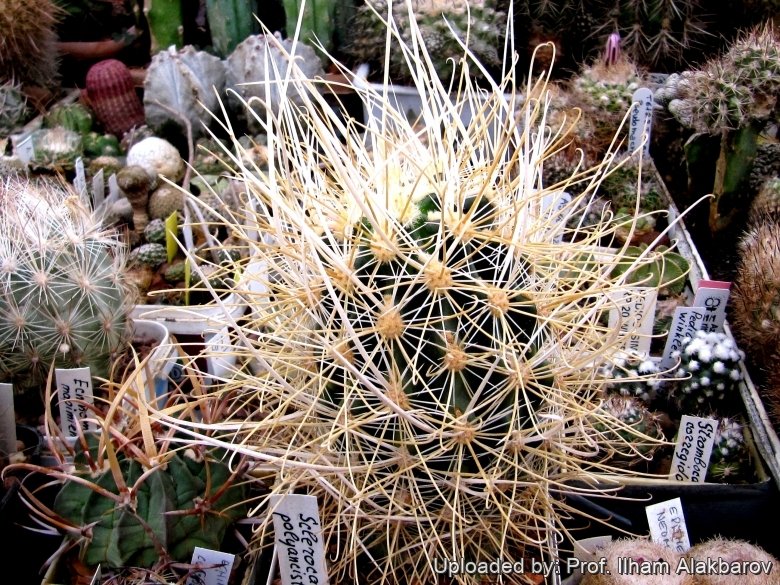
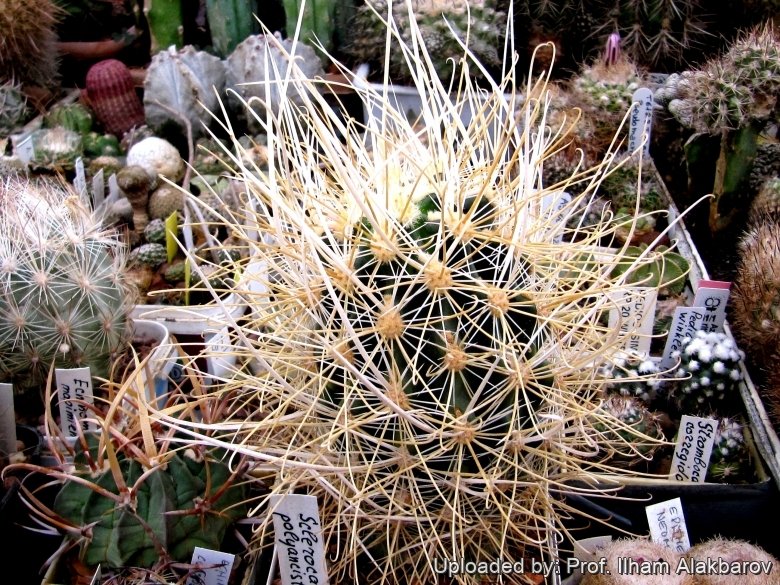
Sclerocactus polyancistrus is easily recognized by its big stem size (the giant of the genus), by numerous hooked, dense, central spines (five to nine) clothing and obscuring stems in a colourful assortment of red and white spines and large flowers with spicy, pungent odour.
White spined form: The white spined form (Sclerocactus polyancistrus f. albispinus) is easily recognizable from the standard species for its pure white central spines. White spined plants are somewhat rare, however some white specimens occurs naturally throughout its range, and can be encountered in many populations. The whiter forms are often very pretty and appreciated by collectors.
Stem: Single or in clusters, cylindric or more or less elongate, 10-40 long, 5-9 cm across.
Ribs: 13-17.
Spines: Dense, obscuring stems.
Radial spines: 10-18 per areole, white, straight, flat, 20-50 mm long.
Central spines: 9-12 per areole, 5-8 hooked, white, some hooked, 30-100 mm long. Adaxial central spines usually 3 per areole, white, usually curved or twisted, flat, usually 35-130 mm long.
Flower: With spicy pungent odour, funnelform, 5-10 cm in diameter outer perianth segments with greenish purple midstripes, inner segments rose-purple to magenta (rarely white).
Blooming season: April to June.
Fruit: Green, tan, or red, barrel-shaped, 2,2-5 cm, dry at maturity;
Remarks: S. polyancistrus is the only component of the genus that lacks papillae on the style, and its style possesses grooves, somewhat reminiscent of Ferocactus.
Origin and Habitat
Sclerocactus polyancistrus f. albispinus (white spined form) is reported from Searles, Kern Co., California, USA. White spined plants are somewhat rare however some white specimens occurs naturally throughout its range, and can be encountered in many populations.
Cultivation and Propagation
This is one of the most beautiful cacti but also one of the more difficult to be cultivated.
Very easily rot! Only few people have tried for long time to cultivate it, usually after a few months the plant inexorably dies.
It’s thought that’s better to watch this species in photo or in the natural habitat rather than to try to cultivate it.
For this reasons the plant is usually grafted on a frost hardy stock.
This plant need full sun and a very good ventilation, especially in winter.
Propagation: Seeds are extremely difficult to germinate (only 2-3 percent of seeds germinate) The germination is really difficult and if some seedling finally sprout, as they start to grows they disappear one by one. Grafting is often used to speed growth rate and to create a back-up for plants in collection.
Bibliography
Major references and further lectures
-
Butterworth, C. & Porter, J.M. 2013. Sclerocactus polyancistrus. In: IUCN 2013. “IUCN Red List of Threatened Species”. Version 2013.2. <www.iucnredlist.org>. Downloaded on 06 April 2014.
-
Edward Anderson “The Cactus family” Timber Press, Incorporated, 2001
-
James Cullen, Sabina G. Knees, H. Suzanne Cubey “The European Garden Flora Flowering Plants: A Manual for the Identification of Plants Cultivated in Europe, Both Out-of-Doors and Under Glass” Cambridge University Press, 11/Aug/2011
-
David R Hunt; Nigel P Taylor; Graham Charles; International Cactaceae Systematics Group. “The New Cactus Lexicon” dh books, 2006
-
Lyman David Benson “The Cacti of the United States and Canada” Stanford University Press, 1982
-
Fritz Hochstätter “An den Standorten von Pediocactus und Sclerocactus” Selbstverlag, 1989.
-
Fritz Hochstätter “The Genus Sclerocactus”. Selbstverlag, 2005
Gallery