Publication: Succulenta (Netherlands) 68: 123, figs. 1989
Description
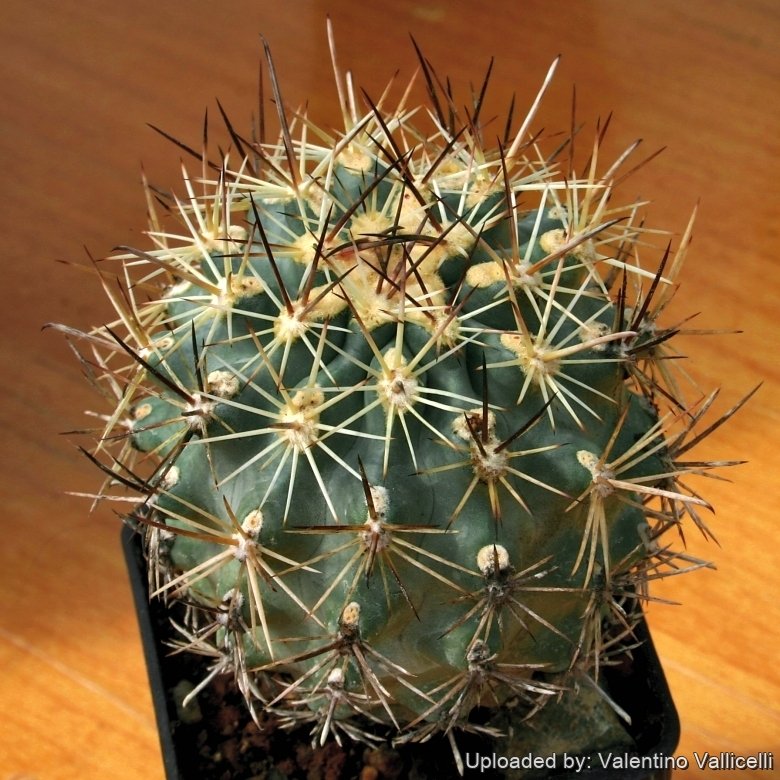
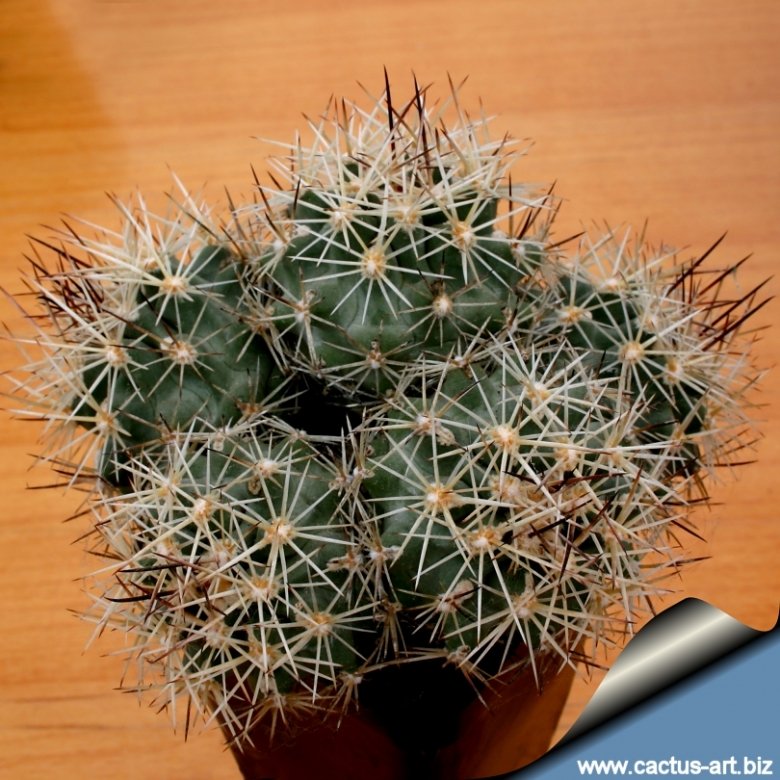
Sclerocactus wetlandicus is a rare north American cactus with central spines not greatly different from radial spines. Some plants lack central spines, or have central spines which are hooked. It is quite variable.
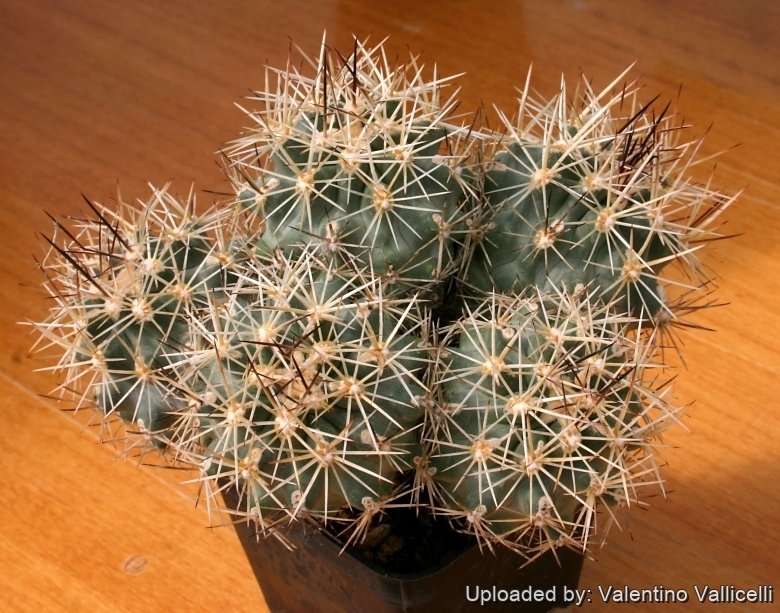
Habit: Usually solitary or occasionally clumping, in groups of up to 9 stems.
Stem: Green to bluish green (glaucous) squat, spheric, cylindric, or elongate-cylindric, 3-8,5(-15)tall and 4-10(-12) cm on diameter.
Ribs: 12-14(-15) tubercles evident on ribs.
Areoles: 3 mm in diameter, 9-10 mm apart. Red nectar glands are found above each areole.
Spines: Slightly or not obscuring stems.
Radial spines: 6-10(or more) per areole, white, creas, pale tan, brown, reddish brown (rarely black), 6-20 mm, central spines 3-5 per areole, sometimes not greatly different from radial spines; straight and unhooked or curved (rarely hooked), 12-26 mm long.
Central spines: 3-4(-5) per areole, sometimes not greatly different from radial spines, usually white (rarely light brown), 15-29 mm long. Some specimens lack central spines, or have central spines which are hooked.
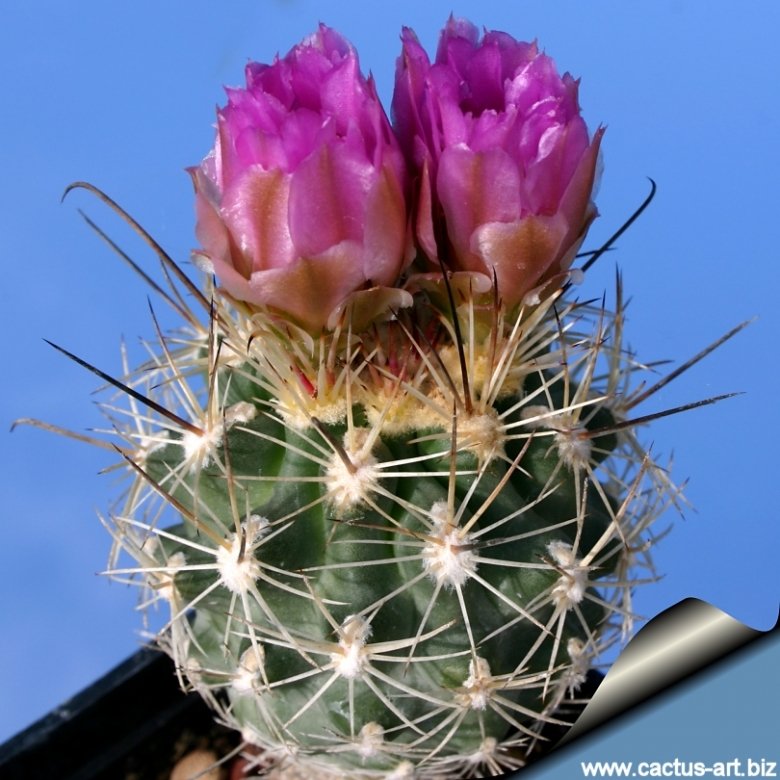
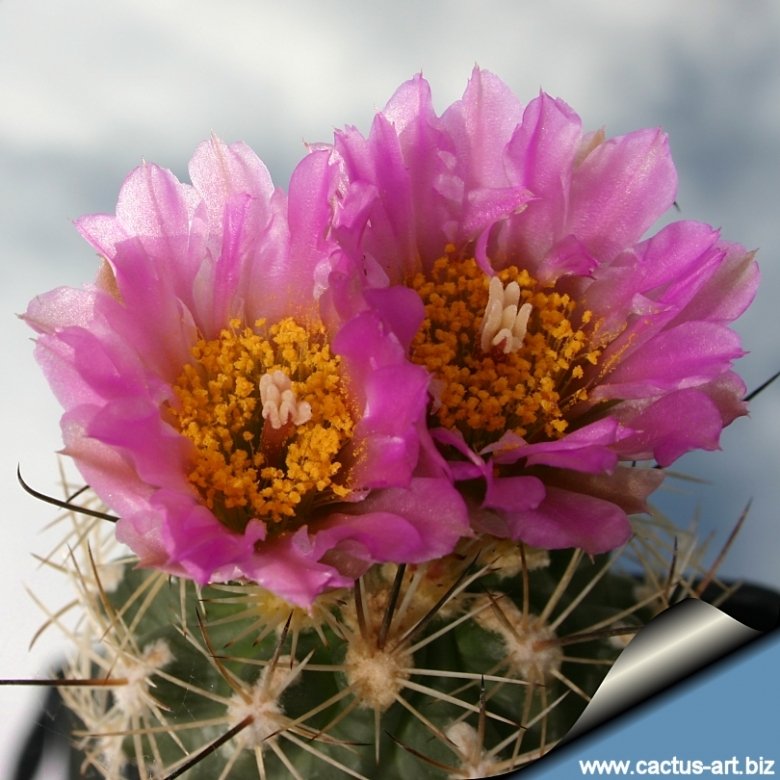
Flowers: Purple or pink flowers fragrant, funnel-form, 2,5-5 cm wide and tall; outer tepals with brownish lavender midstripes and pink to violet margins, filaments green to white; anthers yellow.
Fruits: Ovoid, barrel-shaped, 9-30 long, 7-12 mm across, with a few membranous scales, mostly near apex.
Seeds: Black, 1,5 long, 2,5 mm broad; cells convex but flattened apically.
Blooming season: Spring (In habitat from late April to May).
Origin and Habitat
Duchesne and Uintah counties, Utah. (Southwestern U.S.A., Northern America)
Altitude: 1250-1950 metres above sea level.
Habitat: Gravel-covered clay hills, desert grasslands, saltbush, rabbit brush flats; of conservation concern.
Cultivation and Propagation
This plant is very rare in cultivation; it does not do well. It is very difficult to grow its own roots. Mature individuals easily rot and die, especially after planting.
It is extremely xerophytic and adapted to very dry soils, but plant grafted an hardy Opuntia compressa stock are very easy to grow and no special skill is required, they can stay in a non heated green house or outdoors in raised beds, terraces, window sills etc..
This cactus continues to be, a particular prize among collectors.
Propagation: Seeds are extremely difficult to germinate (only 2-3 percent of seeds germinate) The germination is really difficult and if some seedling finally sprout, as they start to grows they disappear one by one. Grafting is often used to speed growth rate and to create a back-up for plants in collection.
Notes
Sclerocactus wetlandicus is morphologically very similar to Sclerocactus glaucus and has been frequently treated within Sclerocactus glaucus, but the two populations are geographically separated and Phylogenetic analyses of chloroplast DNA are ambiguous regarding the closest relative of Sclerocactus wetlandicus. However, this species is related to Sclerocactus brevispinus, Sclerocactus glaucus, Sclerocactus wrightiae, Sclerocactus whipplei, and Sclerocactus parviflorus. We refer to this species as the Sclerocactus glaucus complex.
Bibliography
Major references and further lectures
-
James Cullen, Sabina G. Knees, H. Suzanne Cubey “The European Garden Flora Flowering Plants: A Manual for the Identification of Plants Cultivated in Europe, Both Out-of-Doors and Under Glass” Cambridge University Press, 11/Aug./2011
-
David Hunt, Nigel Taylor “The New Cactus Lexicon” DH Books, 2006
-
Edward F. Anderson “The Cactus Family” Timber Press, 2001
-
Sclerocactus wetlandicus in: “Flora of North America North of Mexico, vol. 4: Magnoliophyta: Caryophyllidae, part. 1” Oxford University Press New York, New York, USA
-
Sclerocactus wetlandicus in: http://www.efloras.org/florataxon.aspx?flora\_id=1&taxon\_id=242415287 downloades on 20/08/2013
Cultivars and forms (1)
Forms (1)
Gallery