Publication: Engl. Bot. 26: t. 1802 1807.
Description
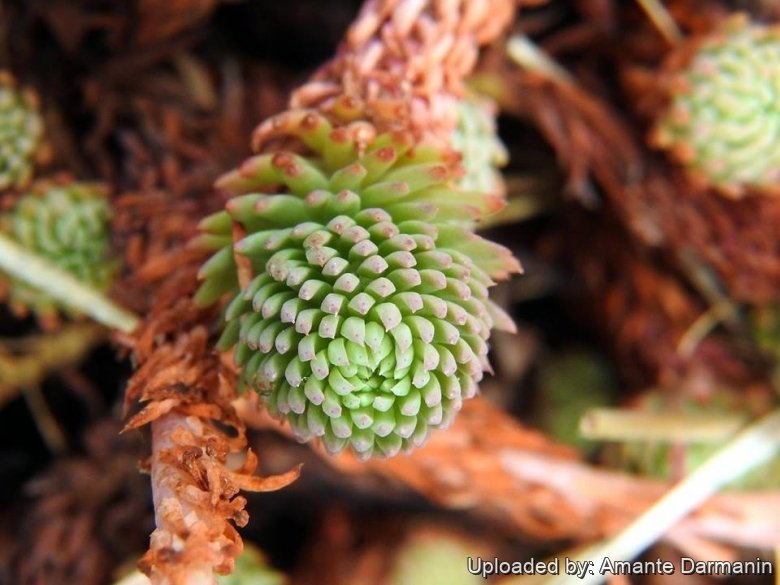
Sedum forsterianum is a glabrous perennial succulent herb. It forms a low mound with blue-green leaves aggregated into a tight, cone-like, terminal rosette and persistent brown, shrunken, dead leaves towards the base. The erect flowering stem about 20 cm long sustains a terminal corymb with 3-7 branches which is characteristically drooping in bud. The flowers are bright yellow, starry and appear in summer. It can he confused with Sedum rupestre but less robust, with stems erect in bud.
Stems: Sterile non-flowering shoots very variable in size, creeping and rooting, glabrous.
Roots: Very fine, abundant, born from the annual shoots.
Leaves: Alternate, fleshy, densely imbricate and held erect, especially towards tip of stems, green, green-grey, glaucous, dark purplish green, or rusty red, linear, (4-)8-12 (-20) mm long, c. 1mm wide and semi-circular in cross section (strongly flattened above), acuminate, with a truncate basal spur. Dead leaves persistent, brown.
Flowering branches: Ascending, 10-40 cm tall.
Inflorescences: Terminal, compact hemispherical or round topped and drooping in bud before anthesis, corymbs with 3-7 branches strongly recurved outwards. Bracts absent. Pedicels 1,5-4 mm long.
Flowers: (5- to) 6- to 7-(to 9-) merous, shortly pedicellate. Sepals basally fused to the receptacle, equal, triangular or triangular-ovate, glabrous, 2-3 mm long, acute or more or less blunt flat or with the sides sometimes slightly reflexed and like the flower stalks glaucous. Petals free, oblong strap-shaped, spreading, four times as long as sepals lanceolate bluntish keeled (4-)6-7(-8) mm long, bright yellow, with the middle nerve more dark. Filaments 10-14 (twice as petals), as long as the petals, subulate somewhat flattened below, glabrous, without papillae, yellow. Anthers yellow lanceolate tapering. Stigmas indistinct. Nectaries transversely oblong, slightly notched flattened broader at the base, yellowish-green.
Fruits (Follicles): Erect, brown c. 5 mm long, style 1.5-2 mm long, persistent.
Seeds: Oblong, pale brown, ribbed, apex acute .
Chromosome number: 2n = 24, 36, 48, 60, 66, 72, 84, 96.
Origin and Habitat
Sedum forsterianum grows in NW and SW Europe (Belgium, Netherlands, Great Britain, Ireland, France, Germany, Luxembourg, Spain, Portugal incl. Azores), NW Africa (Morocco). This species is grown in rockeries and on graves, and has become naturalised in many areas outside its native range.
Altitude ranges: 0-1500 metres above sea level.
Habitat and ecology: Sedum forsterianum usually grows in rather mesic habitats, on cliffs, rocky outcrops, screes and sand, generally on poor soils, both in dry open places and in wet woodlands; also naturalised in churchyards, and on walls, hedgebanks, waste ground and railway land.
Bibliography
Major references and further lecture
-
Urs Eggli “Illustrated Handbook of Succulent Plants: Crassulaceae” Springer Science & Business Media, 06 December 2012
-
Henk ‘t Hart, Urs Eggli, “Sedums of Europe - Stonecrops and Wallpeppers”, CRC Press, 01 June 2003
-
Simon Harrap, “Harrap’s Wild Flowers”, Bloomsbury Publishing, 25 September 2014
-
William Jackson Hooker, “Botanical Miscellany”, Volume 3, Murray, 1833
-
Aedo, C. 1997. Sedum L. in Castroviejo, S., Aedo, C., La
Gallery