Publication: Prodr. [A. P. de Candolle] 6: 405. 1838 [1837 publ. early Jan 1838]
Description
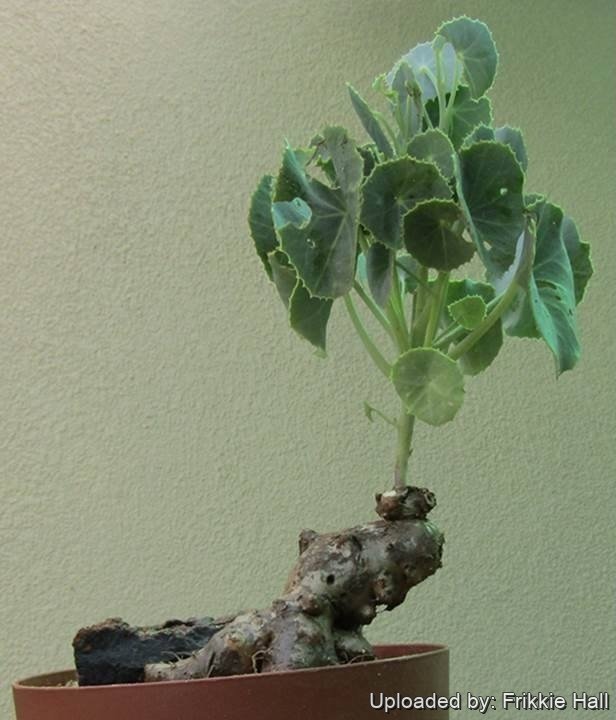
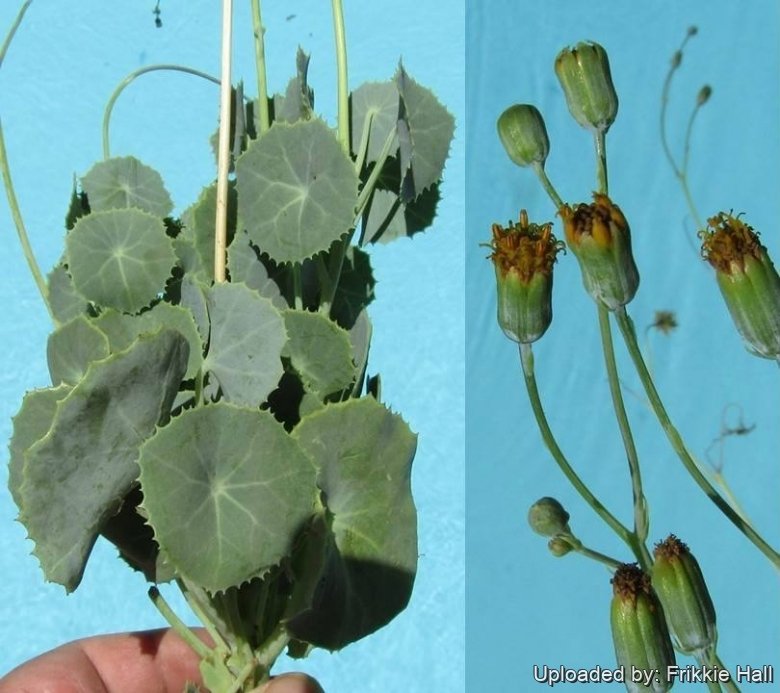
Senecio oxyriifolius is a glabrous deciduous perennial herb 40–110 cm high with creeping, horizontal, fleshy or woody tuberous rootstock producing a single and erect flowering stems. The leaves are fleshy, hairless, almost round, with a slender stalk up to 150 mm long. The blade is often attached to the stalk by the lower surface (instead of the margin), the margin is variable but usually more or less coarsely toothed. The Flowers (capitula) are few to many, discoid, in panicles, on long, smooth stalks. Has disc florets only (rarely 1 or 2 ray florets) and are bright yellow. The leaves of this species are extremely variable.
Derivation of specific name: oxyriifolius (Latin), with leaves like Oxyria digyna, a European species with broadly rounded leaves arising from the base.
Tuberous rootstock: Gnarled, creeping, horizontal, fleshy or woody, underground (often raised in cultivation).
Annual stems: Glabrous, succulent or rather succulent to 60 cm, thin and wiry, erect but soon becoming prostrate.
Leaves: Scattered, fleshy, lower ones small, soon disappearing, median 4–8, with a slender petiole functional, 2.5-7.5 cm long attached marginally or centrally (peltate ) to a circular to triangular variously notched green blade 2.5–6 cm long, 3.8–9.5 cm wide, pale green or glaucous, margins variable closely sinuate-dentate. Upper leaves few, distant, small, lanceolate, scale-like. Petiole 2.5–8 cm long.
Inflorescence: Terminal, spreading or lax, simple to corymbose, 30-40 cm long. Stalks of the individual capitula slender, often glaucous.
Capitula (flowers): Several, small, discoid, pendulous to erect. Involucre cylindrical, pale green or glaucous, 6.5–8.5 mm long, 2–3 mm in diameter. Phyllaries (5-)8-9(-13), pale green or glaucous. Ray florets 0-2, with a small yellow recurved ray. Disc florets 12 - 20, pale to golden yellow.
Blooming season: Spring to summer (in habitat September-January).
Seeds (achenes): 2.5–3.2 mm long, ribbed, shortly hairy; pappus 4.7–7 mm long.
Chromosome number: 2n = 60.
Origin and Habitat
Congo (Kinshasa), Angola, Tanzania (Ufipa and Rungwe Districts), Zambia, Malawi, Mozambique, Zimbabwe, South Africa (Eastern Cape, Gauteng, KwaZulu-Natal, Limpopo, Mpumalanga, North West).
Type locality: South Africa, Cape Province, Fish River.
Altitude range: 950–2800 metres above sea level.
Habitat and ecology: Occurs in high-altitude grassland among rocks and in crevices of rock sheets
Cultivation and Propagation
Senecio oxyriifolius is a well known plant in cultivation. It grows easily from root or stem cuttings. The roots grow slowly when potted, eventually taking the shape of the pot, and often breaking it. In the ground it spreads quicldy, being useful as a ground cover in warmer climates. Can survive outdoors in Europe if the tubers are buried 15 cm in the soil.
Bibliography
Major references and further lectures
-
Urs Eggli “Illustrated Handbook of Succulent Plants: Dicotyledons” Springer Science & Business Media, 2002
-
Gerrit Germishuizen “Transvaal Wild Flowers” Macmillan South Africa (Publishers), 1982
-
Pooley, E. “Mountain flowers: a field guide to the flora of the Drakensberg and Lesotho.” Natal Flora Publications Trust, Durban. 2003
-
Foden, W. & Potter, L. 2005. Senecio oxyriifolius DC. subsp. oxyriifolius. National Assessment: Red List of South African Plants version 2015.1. Accessed on 2016/04/28
-
H. Beentje, C. Jeffrey & D.J.N. Hind “Flora of Tropical East Africa”, Part Part 3, 2005
-
Olive Mary Hilliard, B. L. Burtt “The botany of the southern Natal Drakensberg” National Botanic Gardens, 1987
-
Braam Van Wyk, Sasa Malan, Timothy Kemper Lowrey, Anne Pienaar “Field Guide to the Wild Flowers of the Witwatersrand & Pretoria Region: Including the Magaliesberg & Suikerbosrand” Struik, 1988
-
Cactus and Succulent Journal, Volume 78, 2006
-
Beentje, H.J. & Ghazanfar, S.A. (eds.). “Compositae (Part 3) Flora of Tropical East Africa” Page 646. 2005
-
Da Silva, M.C., Izidine, S. & Amude, A.B. “A preliminary checklist of the vascular plants of Mozambique.” Southern African Botanical Diversity Network Report No. 30 Sabonet, Pretoria Page 34. 2004.
-
Fabian, A. & Germishuizen, G. “Wild Flowers of Northern South Africa.” Fernwood Press, Vlaeburg. Pages 430 - 431. (Includes a picture). 1997.
-
Mapaura, A. & Timberlake, J. (eds) “A checklist of Zimbabwean vascular plants” Southern African Botanical Diversity Network Report No. 33 Sabonet, Pretoria and Harare Page 28. 2004.
-
Phiri, P.S.M. “A Checklist of Zambian Vascular Plants” Southern African Botanical Diversity Network Report No. 32 Page 28. 2005.
-
Pooley, E. “A Field Guide to the Wild Flowers of KwaZulu-Natal and the Eastern Region.” Natal Flora Publications Trust. Durban. Pages 328 - 329. (Includes a picture). 1998.
-
Setshogo, M.P. “Preliminary checklist of the plants of Botswana.” Sabonet Report no. 37. Sabonet, Pretoria and Gaborone Page 38. 2005.
-
Van Wyk, B. & Malan, S. “Field Guide to the Wild Flowers of the Witwatersrand and Pretoria Region” Struik, Cape Town Pages 116 - 117. (Includes a picture). 1988.
-
Hyde, M.A., Wursten, B.T., Ballings, P. & Coates Palgrave, M. (2016). “Flora of Zimbabwe: Species information: Senecio oxyriifolius”. http://www.zimbabweflora.co.zw/speciesdata/species.php?species\_id=161280, retrieved 28 April 2016