Publication: Prodr. [A. P. de Candolle] 6: 403 (1837 [1838])
Description
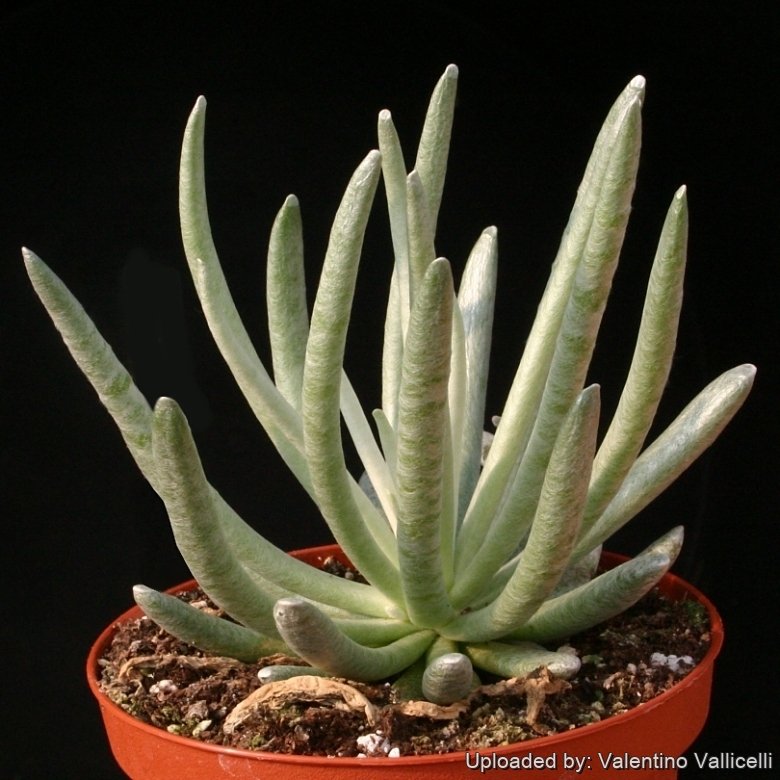
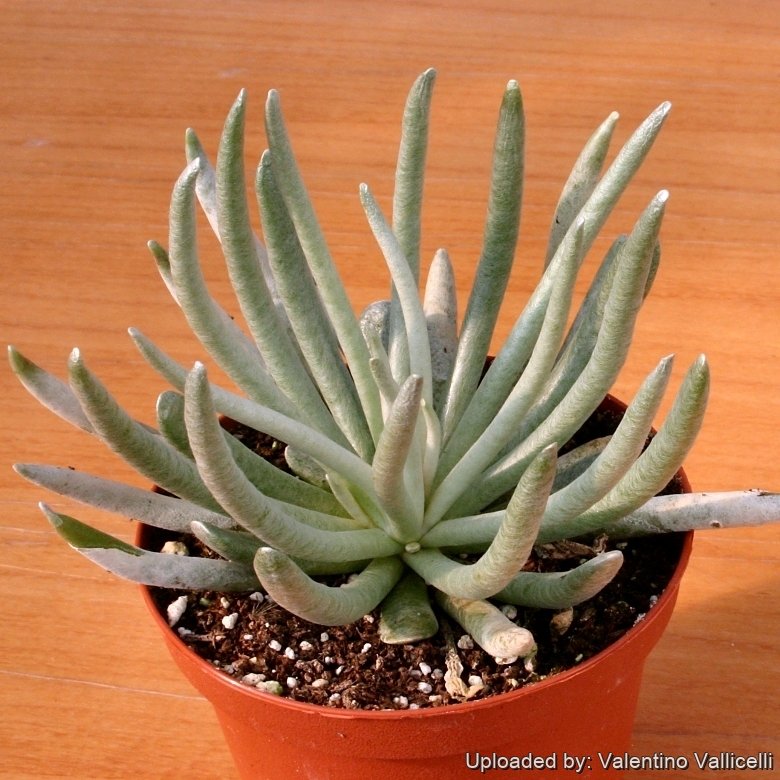
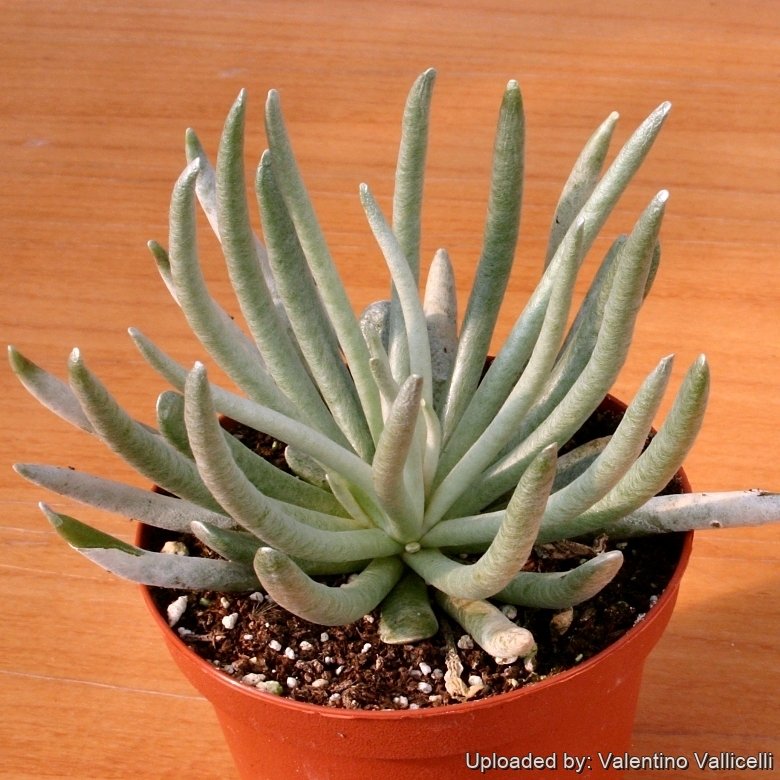
Senecio scaposus is a stemless or nearly stemless small perennial succulent, Height and width up to 30 cm. Groundcover, cespitose in habit or surculose-spreading, forming large mats
Stems: Very numerous, simple, very short (often elongatin in cultivation) from a multiple caudex.
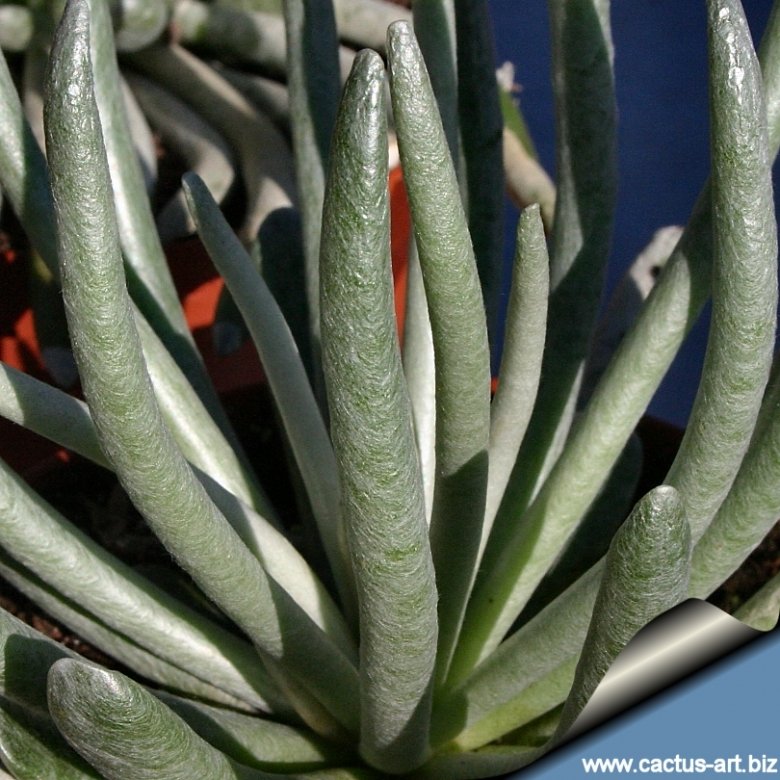
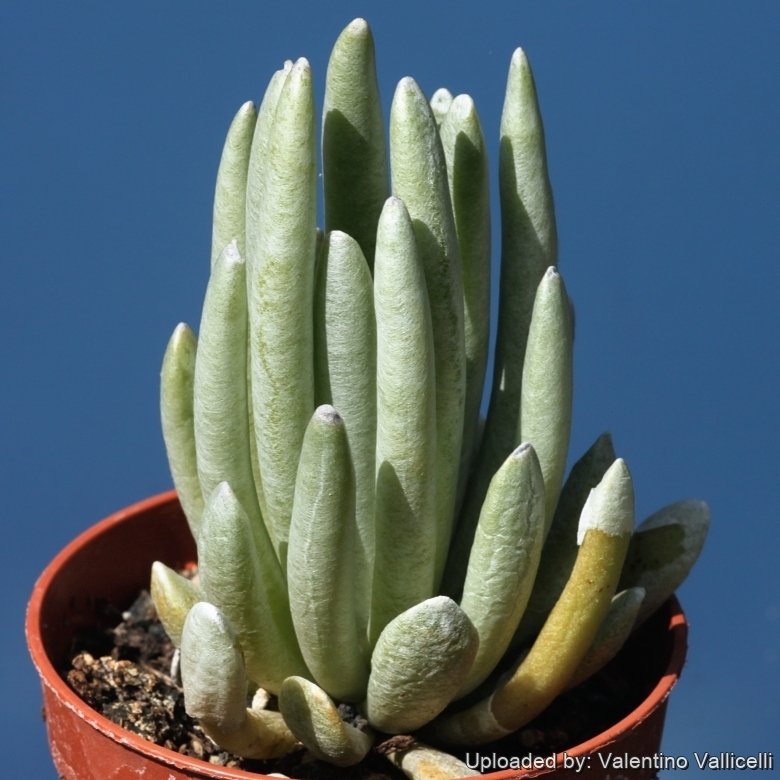
Leaves: Crowded, long, cylindrical, straight to banana-shaped, inwardly curving (3-)5-10(-13) cm long, 4-7(-10) mm in diameter, that angle upward in tufts and grow in a tight rosette. Tip acute or somewhat spatulate. The young leaves have a bright silver coating (a sort of felt) at least when young, with patterned patches of a waxy light blue on a light green background .They can actually be pealed off revealing the green, succulent leaf below and become a smooth green when they get older.
Inflorescence: (1-)3-5(-6) starry silvery-yellow flowers (capitula) grow atop a 30-45 cm long stalk, simple or (rarely) branching. Flowers are showy, approx 3.5 cm accross, and resemble daisies. Each has about phyllaries 10-13, and 7-13 ray florets, with limbs to 15 mm long, yellow. Disc flowers numerous yellow. Pappus 6 mm long.
Blooming season: Summer.
Chromosome number: 2n = 20.
Origin and Habitat
Little Karoo in the Western Cape to the Kei River in the Eastern Cape, South Africa.
Habitat and ecology: This species grows on ledges of sandstone cliffs, on steep slopes of rocky hills, and along dry river valleys in Albany Thicket and Eastern Valley Bushveld biomes, in sandy, mineral poor and acidic soil. The young leaves have a white to silvery felted coating which may be shed as they get older. This felted covering is an adaptation to the dry conditions under which the plant grows and serves to reflect the sunlight, preventing over-heating or burning.
Cultivation and Propagation
S. scaposus is an easy to grow hardy succulent from high altitude. It is a great little low growing container plant. As they grow, they produce side branches. Generally, give them full sun (coastal) to light shade in well-drained soil. It enjoy more water than others but do not over-water, drench and let dry between waterings . Keep dry as possible in winter It may be grown outside in mild climates, however plants growing in small pots with well drained soil can tolerate winter rains. Hardy to at least -7°C.
Senecio is a huge genus of asters with over 1500 species worldwide. Most of the succulent species are found in South Africa.
Bibliography
Major references and further lectures.
-
Urs Eggli “Illustrated Handbook of Succulent Plants: Dicotyledons” Springer Science & Business Media, 2002
-
Sharon Asakawa, John Bagnasco, Shaun Buchanan “Planting Designs for Cactus & Succulents: Indoor and Outdoor Projects for Unique, Easy-Care Plants—in All Climates” Cool Springs Press, 15 January 2014
-
Foden, W. & Potter, L. 2005. Senecio scaposus DC. var. scaposus. National Assessment: Red List of South African Plants version 2014.1. Accessed on 2015/08/01
-
Senecio scaposus kumbulanursery.co.za 2009 - 2014 <http://kumbulanursery.co.za\>