Publication: Cact. Succ. J. (Los Angeles) 62(6): 283. 1990
Description
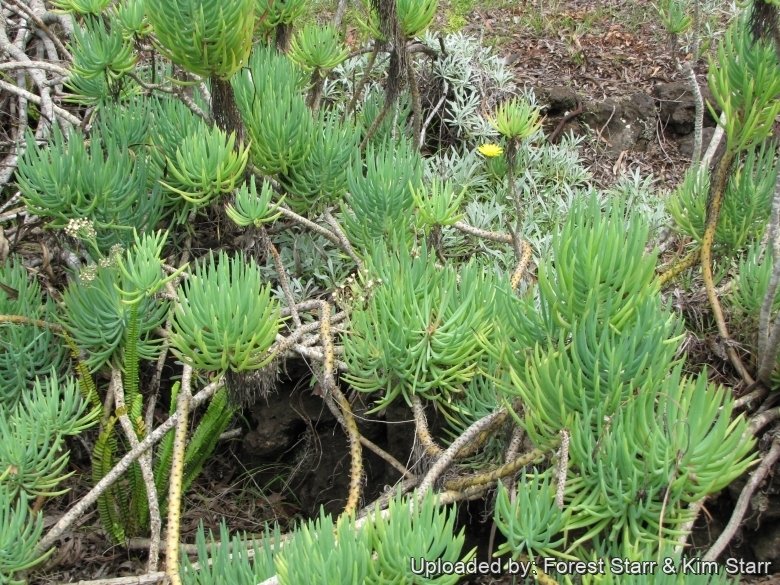
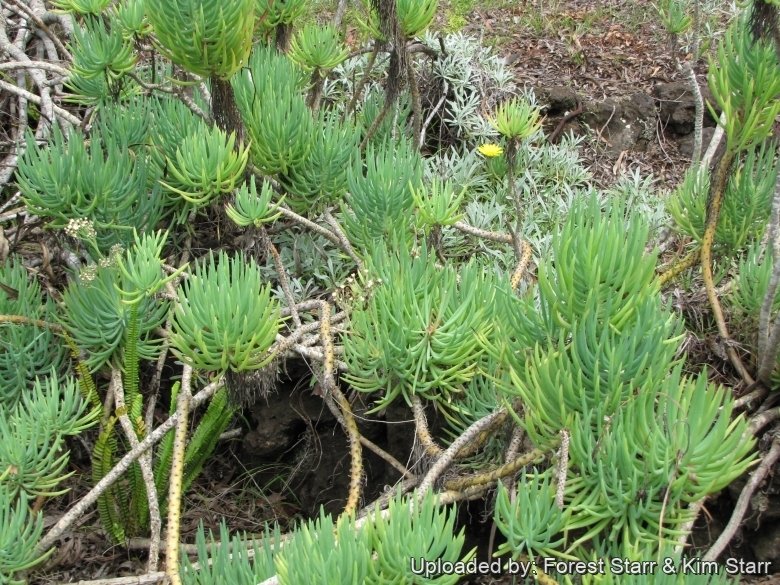
The Narrow-Leaf Chalksticks, Senecio talinoides subs. cylindricus, is a low growing, glabrous, pruinose, evergreen succulent shrub 45- to 60 cm tall and spreading to 90 to 150 cm wide. It has semi-prostrate stems that turn upright and is distinguished from the standard Senecio talinoides by its leaves that are grey-green 7-15 cm long, tubular, slender, slightly upcurved and crowded at the stems tips. The small rayless dull cream coloured flowers appear in corymbs in late spring to early summer. This plant is commonly listed as Senecio cylindricus but acknowledge that it is correctly considered to be a subspecies of Senecio talinoides, together with the more ground-hugging and lower growing but similar Senecio mandraliscae. It is also found under the name Senecio vitalis.
Stem: Sparingly branched, long, tubular and stout. Fleshy, becoming woody as they ages, erect becoming procumbent and often rooting at the nodes and brittle, 5-10 mm in diameter, usually short but much more long in cultivation.
Leaves: Encircling the trailing stems or reduced to tufts at the stem tips, all cylindrical-terete, tappered at both ends, erect or arching, fleshy, with a long mucro, 7-15 cm long, 8-13 mm in diameter, glaucous-grey with darker stripes, but can rub off the pruine and it’s a blue-green beneath. The pruine is a waxy white coating that protects it from hot, sunny, and dry conditions.
Inflorescence: Corymbose or paniculate with 10-15 small ray-less capitula (flower heads) held above the foliage. The outside of the capitulum is blue-green, and the small flowers within are white or off-white and not showy. Capitula 5-9 mm in diameter. Involucre 9-12 mm, with 2-5 supplementary bracts. Phyllaries 6 – 8. Disc florets 7-20.
Blooming season: The small flowers appear in late spring to early summer.
Fruits: The fruits called achenes (or cypselas) are long and thin and have a conspicuous feathery pappus attached that functions as a “parachute” which enables the seed to be dispersed by the wind.
Origin and Habitat
Eastern Cape of South Africa from along the coast from Alexandria to East London.
Habitat and ecology: Senecio talinoides subs. cylindricus grow in an area that is transitional between the winter rainfall Cape Province where the dry season is long and hot but tempered by the moist, marine influence to the west and summer rainfall received at East London and further to the northeast. This plant seems to grow mainly in summer, but it thrive opportunistically whenever water is available, it does well if water is withheld bat also tolerates winter rainfall if soil drains tolerably well.
Cultivation and Propagation
Senecio talinoides subs. cylindricus makes a great medium height ground cover with fine texture and makes a very ornamental pale blue colouring in full sun in warm climates. It contrasts well with broader succulent foliage like Aloe barberae and Aloe plicatilis. It is drought tolerant, but will accept irrigation. Similar in appearance but not as common is Senecio serpens, which is a better choice, if you can find it, for small beds and containers.
Soil: It requires a very free draining enriched soil, mildly acidic to mildly alkaline but is very tolerant of poor soils.
Watering: This plant seems to thrive with summer irrigation but does well if withheld and tolerates winter rainfall if soil drains tolerably well. It adapts to different growing conditions from extreme heat and drought, to high moisture as it has a low rot potential.
Exposition: They seem to do well in part shade such as at the base of trees, but thrives also in hot sunny positions and will tolerate coastal conditions.
Frost Tolerance: It is cultivated in open air in the tropical and warm Mediterranean climate, with temperatures which it is good to keep over the 5°C, best 10-12°C, but can withstand light frost for short periods if very dry (hardy down to -2 to -10º C, even if with damage to the foliage) in these situations it will better resist if sheltered by the winter rains, seen that the humidity and low temperatures render it more sensitive to rottenness. Plants in containers however, suffered major leaf loss. USDA Zone 9b to 12.
Wind and salt tolerance: Tolerates well high wind and second line salt wind.
Maintenance: The flower stems need to be removed to keep a tidy appearance. These species do tend to get sort of leggy, which is particularly a problem if grown as a potted plant, and yearly trimming back is often necessary. Cut back in late summer. Because old leaves fall off and new ones grow at the ends of the stems, Senecio mandraliscae becomes lanky unless made to branch. The flowers are not very showy and may be cut off to preserve the beauty of the foliage.
Propagation: It is easy to propagate by cuttings in late spring to summer, just take a cutting of the plant let it dry for 1 or 2 weeks and stuff it in the ground (preferably dry, loose, extremely well draining soil). Once established this pant provides a source of cuttings to give away or to fill gaps in the garden.
Bibliography
Major references and further lectures
-
Forest & Kim Starr “Senecio mandraliscae (Blue finger)”. Plants of Hawaii. <http://www.starrenvironmental.com\>. Web. 27 Sep. 2014.
-
Gideon Smith, Neil R. Crouch “Guide to Succulents of Southern Africa” Struik Nature, 01/Nov/2009
-
Debra Lee Baldwin “Succulent Container Gardens: Design Eye-Catching Displays with 350 Easy-Care Plants” Timber Press, 20/Jan/2010
-
Urs Eggli “Illustrated Handbook of Succulent Plants: Dicotyledons” Springer Science & Business Media, 2002
-
Gordon D. Rowley “Flowering succulents” Living Colour Publications, 1959
-
Gordon D. Rowley “Succulent Compositae: A Grower’s Guide to the Succulent Species of Senecio und Otbonna” Strawberry Press, 1994
-
Hermann Jacobsen “A Handbook of Succulent Plants: Ficus to Zygophyllum” Blandford Press, 1960
-
Jacobsen “Lexicon of succulent plants” Littlehampton Book Services Ltd. 1974
-
Werner Rauh “The Wonderful World of Succulents: Cultivation and Description of Selected Succulent Plants Other Than Cacti” Smithsonian Institution Press, 1984
-
San Marcos Growers contributors “Senecio cylindricus (Narrow-Leaf Chalksticks)”. San Marcos Growers <http://www.smgrowers.com\>. Web. 27 Sep. 2014.
-
“The Succulent Senecios of South Africa”. The Guide to Life, The Universe and Everything. 2003
-
James Cullen, Sabina G. Knees, H. Suzanne Cubey “The European Garden Flora Flowering Plants: A Manual for the Identification of Plants Cultivated in Europe, Both Out-of-Doors and Under Glass” Cambridge University Press, 11/Aug/2011
Gallery