Publication: Stapel. Nov. 13. t. 11. 1797 [Mar 1797]
Description
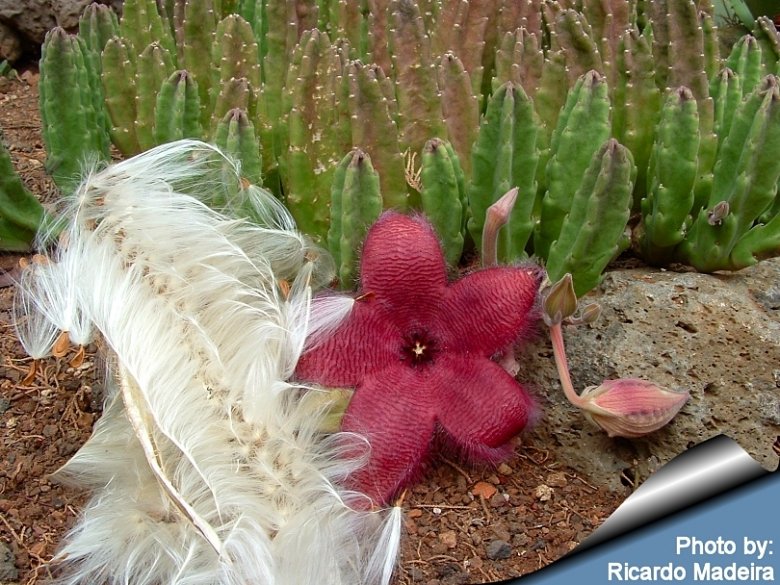
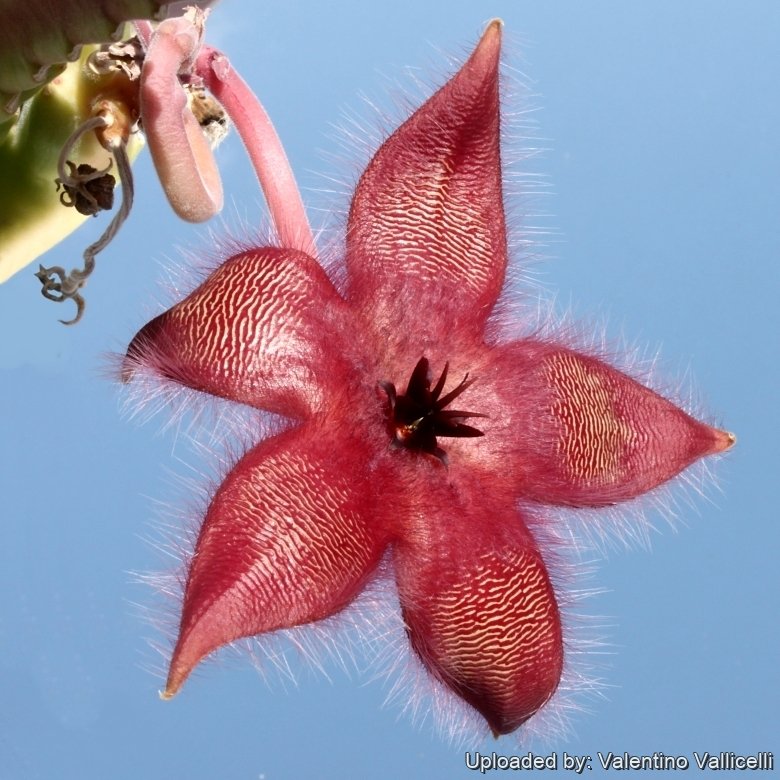
Stapelia grandiflora is a tufted cactus-like plant with large and showy star-fish shaped flowers. Stapelia grandiflora is a very variable species with many hybrids both in the wild and in cultivation. This specie meets and intergrade with Stapelia hirsuta in the little Karoo and the two (quite similar) species can be separated by its thicker pedicel.
Habit: It is a relatively large, perennial, stem succulent that can form large compact clusters up to 50 cm in diameter (or more).
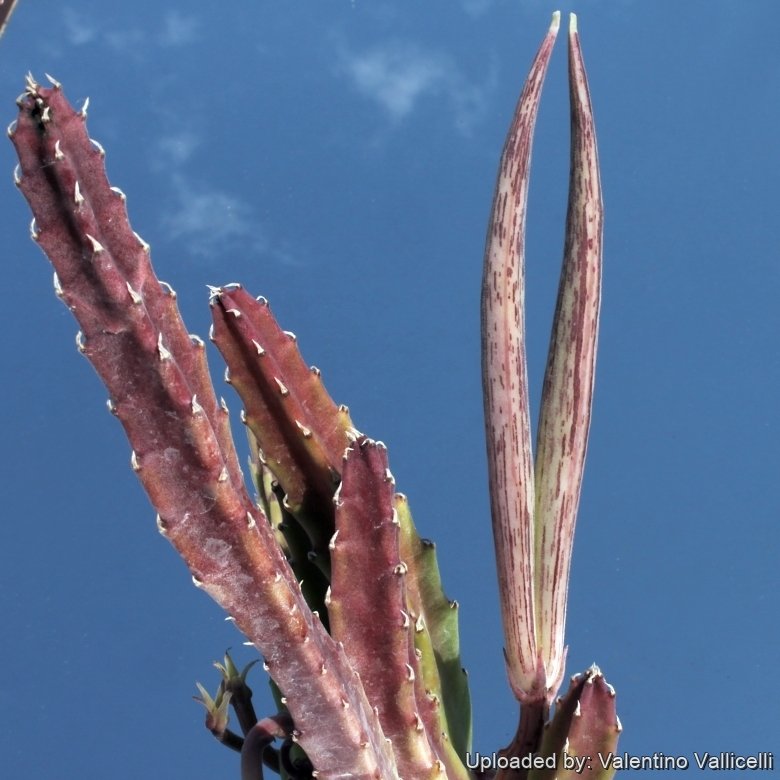
Stems: Erect or ascending 9-10(-30) cm long up to 3 cm in diameter (usually less than 2 cm). Soft, velvety, pale green or reddish and slightly furrowed with upright hooked tubercles along the ridges. Stems are clavate and quadrangular lengthwise, a factor which allows expansion and contraction to compensate without harm for any excess or shortness of fluids inside; hence they may appear flat- or sunken-sided according to the availability of water. This is the “succulence” and a storehouse for nutrients, which are crucial to their survival in harsh, xeric habitats.
Leaves: Short lived, rudimentary.
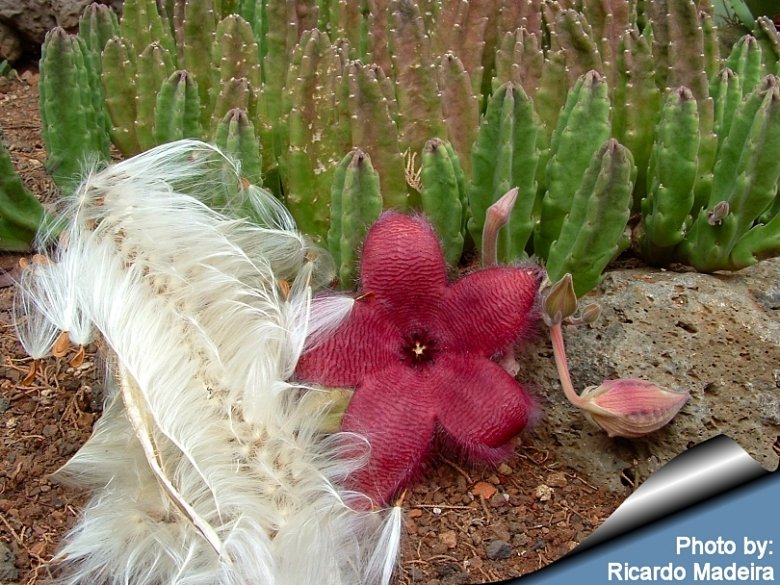
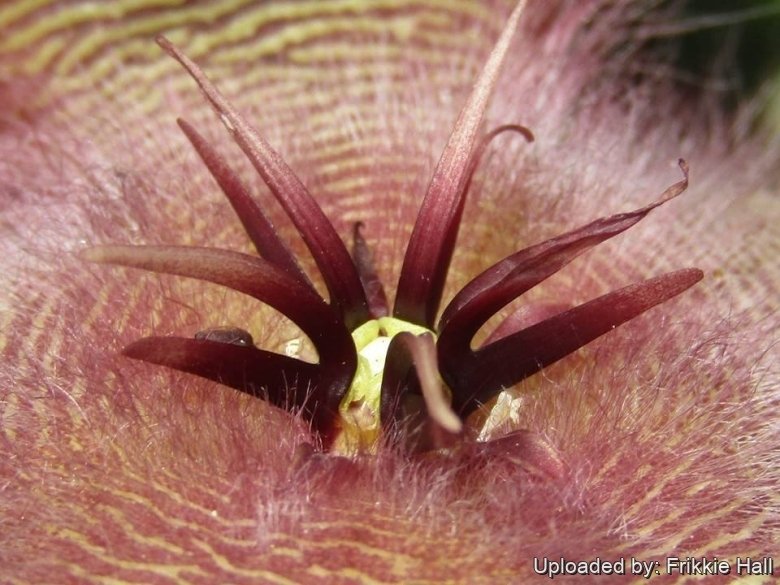
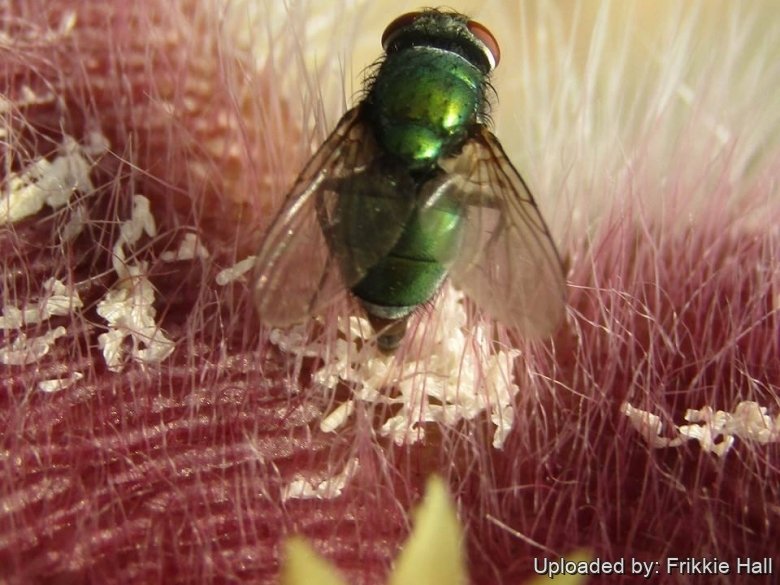
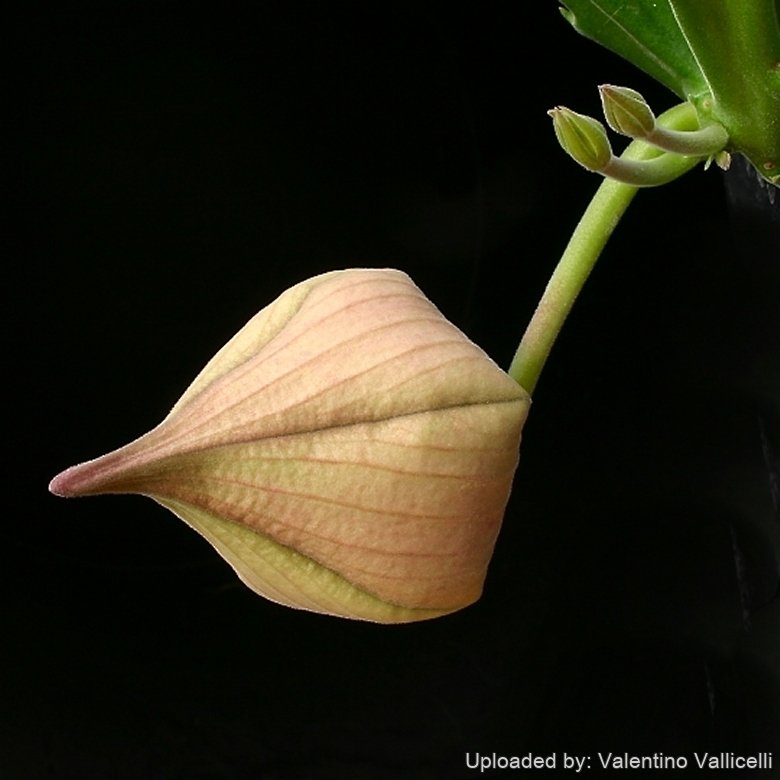
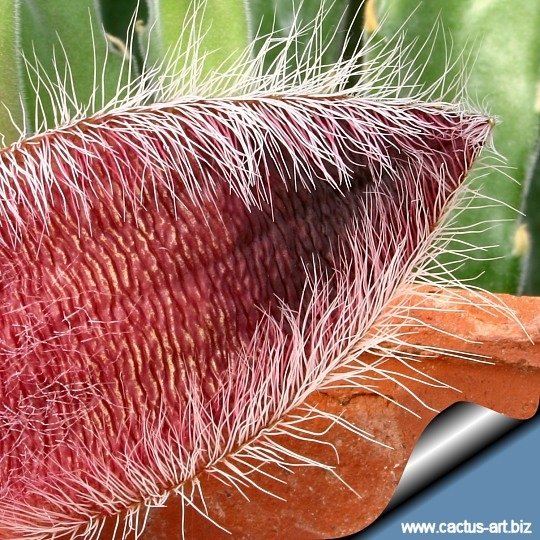
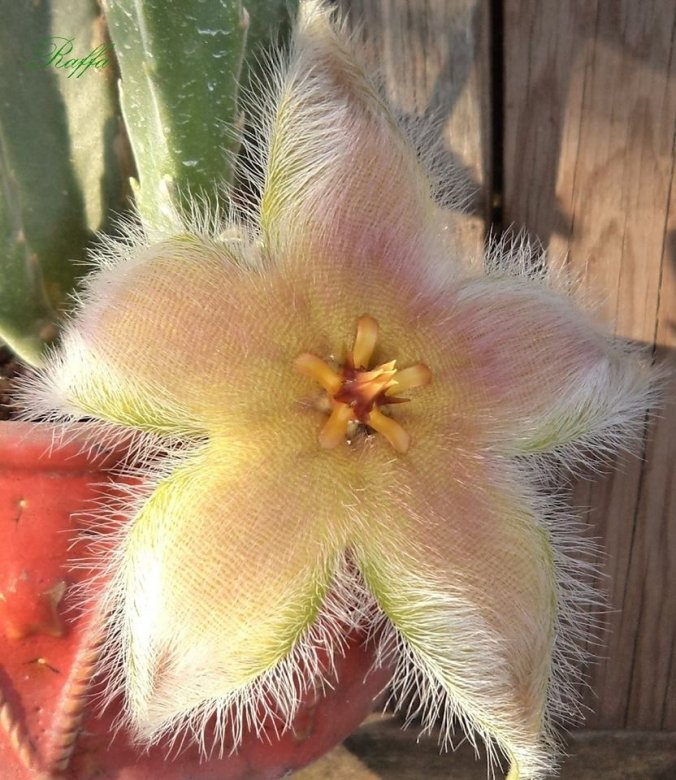
Flower: Blooms are produced from the base on younger shoots they are large, flat, star fish-shaped, orange, dark-red, deep brown-purple to chocolate, with transverse brow to whitish corrugation and densely covered by long purplish hairs at the centre that remember the fur of a dead animal. Pedicels 3-7 cm long, 4-5 mm in diameter, thickened at the base shorter than the corolla. Undersides red to greenish. Corolla width very variable, from 5-22 cm (usually 10/12 cm) across and very deeply lobed. Corolla segments ovate lanceolate acute. Buds plump peaked that resemble the domes of a Russian Orthodox church. Flowers smell like rotting meat and are very attractive to the flies that pollinate them. Sometimes flies lay eggs on the flower. Larvae that have hatched from the eggs can be seen on the flower. Flowers are smaller than those of Stapelia gigantea.
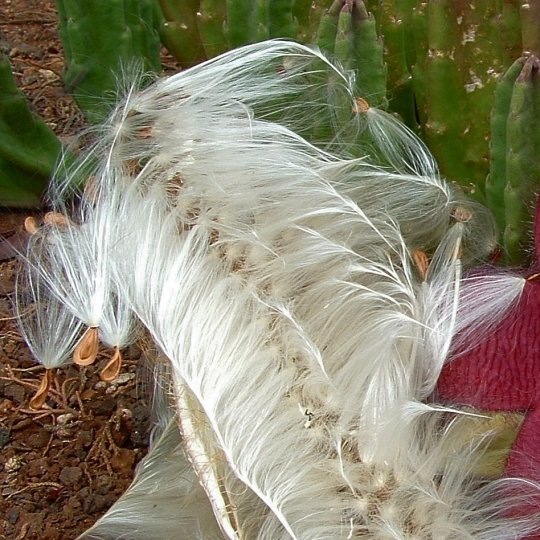
Fruit: Flies pollinate the flowers resulting in the typical twin seed horns (follicles), which are decorative in themselves and often don’t appear until a year later.
Blooming season: Flowers are intermittently produced throughout the late summer and autumn.
Origin and Habitat
Southern Africa (Northern cape, Eastern Cape and Free State). It is also a very popular houseplant grown worldwide for its eye catching and large flowers.
Cultivation and Propagation
Together with Stapelia gigantea and Orbea variegata, probably the most widely cultivated of stapeliads. It is an easy obliging blooming plant when mature, which is happy in any average succulent house.
Soil: Since roots are quite shallow, use a cactus mix or add extra perlite or pumice to regular soil potting soil. A gritty, very free-draining compost is suitable, and clay pots help the plants to dry out between watering.
Watering: Stapelia require moderately watering through the growing season but enjoy plenty of water and some fertiliser in hot weather, this helps them to flower freely. Water more sparingly in winter according to temperatures. But, as with most asclepiads, it is unwise to leave them wet in cold weather.
Hardiness: Winter care presents no problems at 5°C with plenty of light.
Sun Exposure: Partial sun or light shade.
Pest and diseases: Stapelia species vary in their susceptibility to rotting, but are generally fairly easy to grow, especially if kept pest-free. They are very susceptible to stem and root mealy bugs, and damage from these may well initiate fungal attack. If you do have problems with a stem or with basal rotting, you can reliably isolate the healthy parts, dry them off, and re-root them in moist compost.
Cultural Practices: Re-pot every 2 years.
Propagation: Easiest with stem cuttings. Allow cuttings to dry a day before planting. Stems must be laid (Not buried) on gritty compost and will then root from the underside of the stems. It can also be increased from seeds sowing in spring in moist, sandy peat moss. Barely cover seeds. Seeds germinate
Bibliography
Major references and further lectures
-
George Don “A General System of Gardening and Botany” Rivington, 1838
-
White & Sloane. “The Stapelieae” edn 2. Abbey San Encino Press, 1937
-
“Encyclopaedia Londinensis, or, Universal dictionary of arts, sciences, and literature” Volume 23 1828
-
James Cullen, Sabina G. Knees, H. Suzanne Cubey “The European Garden Flora Flowering Plants: A Manual for the Identification of Plants Cultivated in Europe, Both Out-of-Doors and Under Glass” Cambridge University Press, 11/Aug/2011
-
Carl August Lückhoff “The stapelieae of Southern Africa” A. A. Balkema, 1952
-
Doreen Court “Succulent Flora of Southern Africa” A.A. Balkema, 2000
-
Hermann Jacobsen “A handbook of succulent plants: descriptions, synonyms, and cultural details for succulents other than Cactaceae”, Volume 1 Blandford Press, 1960
-
Alison Heath, Roger Heath “Field guide to the plants of northern Botswana, including the Okavango Delta: useful in countries and geographical areas adjacent to northern Botswana in the Zambesi Basin” Royal Botanic Gardens, Kew, 15/Jun/2010
-
Bruyns, P.V. “Stapeliads of Southern Africa and Madagascar” Volume I Umdaus Press, Hatfield, South Africa Pages 257 - 259 2005
-
Golding, J.S. “Southern African Plant Red Data Lists.” Southern African Botanical Diversity Network Report No. 14. SABONET. Pretoria. Page 162. (ed.) 2002
-
Mapaura, A & Timberlake, J. “A checklist of Zimbabwean vascular plants” Southern African Botanical Diversity Network Report No. 33 Sabonet, Pretoria and Harare Page 21. (eds) 2004
-
Focke Albers und Ulli Meve (Hrsg.): “Sukkulenten-Lexikon” Volume 3 Asclepiadaceae” Ulmer, Stuttgart 2002
-
George Don “A General System of Gardening and Botany” Rivington, 1838
-
Leach, L. C. “A revision of Stapelia” L. Excelsa Taxon. Ser. 3: 1–157 1985
From llifle page Gonostemon grandiflorus var. desmetianus
Description
Stapelia desmetiana is a leafless, finely hairy succulent with robust, erect, 4-angled stems, 20 30 mm diameter, forming large clumps, 10-30 cm tall. It is a free-growing, large-flowered plant that differs from Stapelia grandiflora Masson in the corolla being hairy to the tips of the lobes. Dr. N. E. Brown gives an excellent figure of the species in Hooker’s Icones Plantarum (PL 1916) and remarks on the extreme variability in the shape of the inner corona-lobes.
Stems: Green, or reddish-green, conspicuously velvety-pubescent, branched, 15-30 cm high, 2-3 cm in diameter, densely velvety pubescent; angles much compressed and the teeth with erect rudimentary leaves to 2 mm long, or whitish leaf-scars. Sap clear.
Flowers: Star-shaped, usually 3?10 successively developed from a short stout peduncle on the lower portion of the young stems, opening one at a time. Pedicel 1-5 cm long, 4 mm thick, velvety. Calyx-lobes (sepals ) 7-14 mm long, 4 mm broad, ovate-lanceolate, acute, velvety. Corolla ovate, acuminate in bud, when expanded 11-14(-17) cm in diameter, very pale purple-yellow to dark flesh-red, with numerous transverse yellowish (rarely olive-coloured) lines on the disk and on the basal 1/3? 2/3 of the inner face of the lobes, pubescent beneath, rugose and densely hairy above with straight simple purple and white hairs 2-5 mm long, all pointing towards the apex of the lobes, but are not adpressed. Lobes 5-7 cm long, 2.5-3 cm broad, flat, ovate-lanceolate, acuminate, ciliate with long simple white or pale purple hairs, half of them directed inwards. Outer corona-lobes pale yellow with a broad purple mark down the inner face, ascending-spreading, recurved at the tips, 6-10 mm long, ovate-oblong, channelled down the face, sub- crenate on the upper half. Inner-lobes dark purple-brown, often paler (or perhaps yellowish) towards the tips, 2-horned, connivent-erect; inner horn 3-4 mm long, subulate, recurving. Outer horn 6-10 mm long, varying from slightly longer to twice as long as the dorsal wing, oblong, sub-crenate, joined to the inner horn at the base
Origin and Habitat
Stapelia desmetiana has a very similar distribution to that of S. grandiflora
Cultivation and Propagation
It is an easy obliging blooming plant when mature, which is happy in any average succulent house.
Soil: Since roots are quite shallow, use a cactus mix or add extra perlite or pumice to regular soil potting soil. A gritty, very free-draining compost is suitable, and clay pots help the plants to dry out between watering.
Watering: Stapelia require moderately watering through the growing season but enjoy plenty of water and some fertiliser in hot weather, this helps them to flower freely. Water more sparingly in winter according to temperatures. But, as with most asclepiads, it is unwise to leave them wet in cold weather.
Hardiness: Winter care presents no problems at 5
Bibliography
Major references and further factures
-
N. E. Brown, “Flora Capensis”, Vol 4, 1909
-
Stapelia desmetiana in: “The Flowering Plants of Africa”, Volume 12, Botanical Research Institute, Department of Agricultural Technical Services, Republic of South Africa., 1932
Source: Gonostemon grandiflorus var. desmetianus, LLIFLE - Encyclopedia of living forms, CC-BY-SA, retrieved 2026-10-25.
Gallery