Publication: Kakteen (Berger) 346. 1929
Description
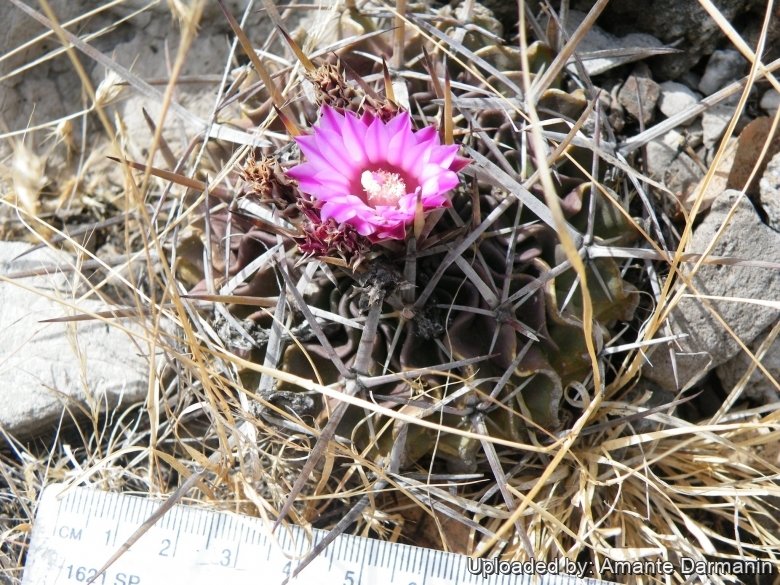
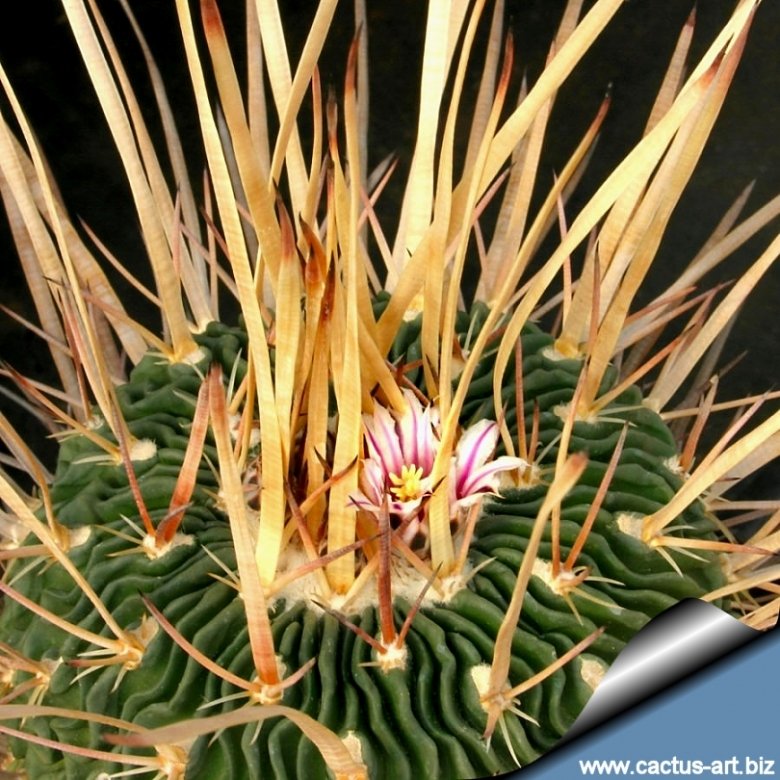
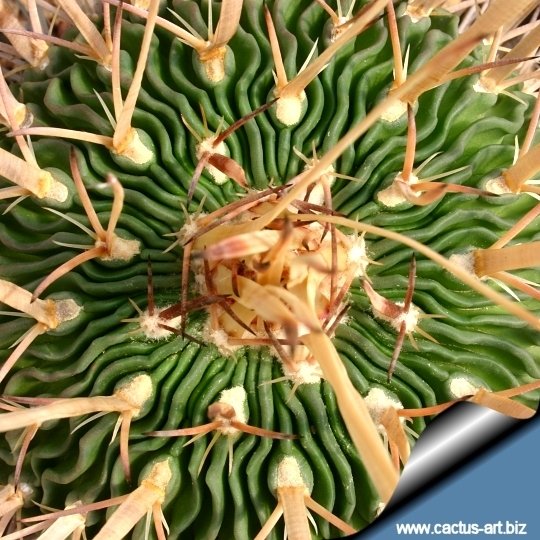
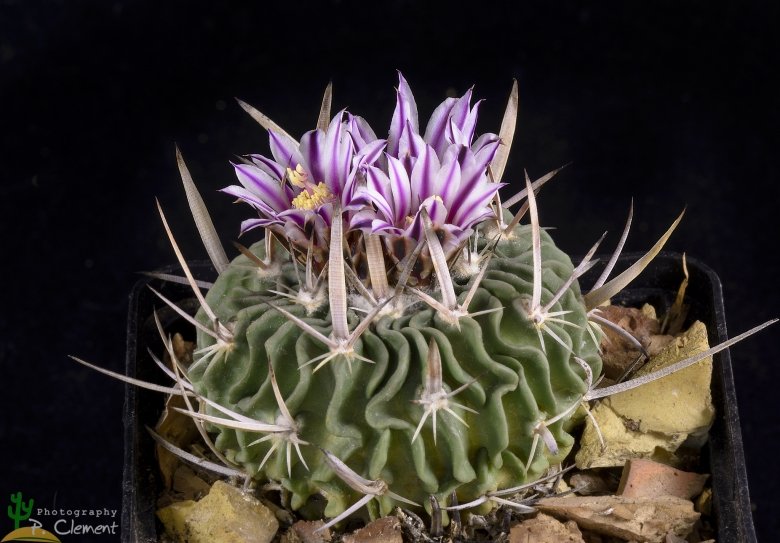
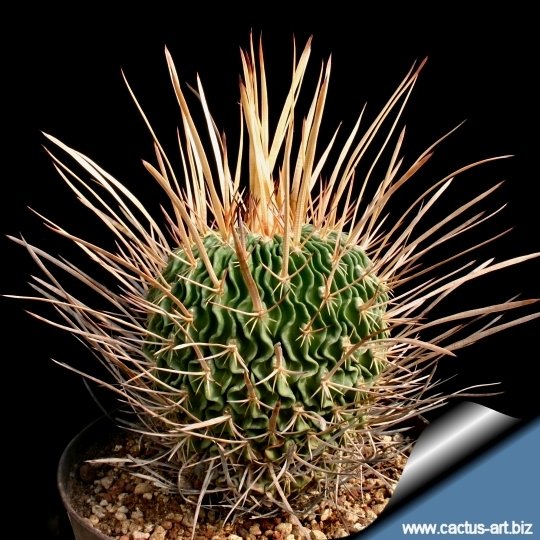
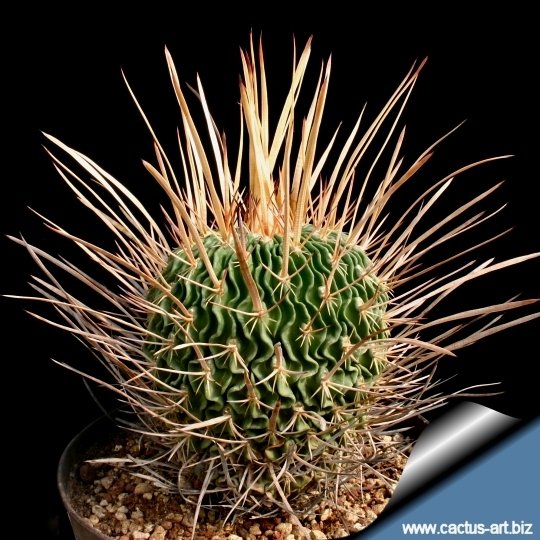
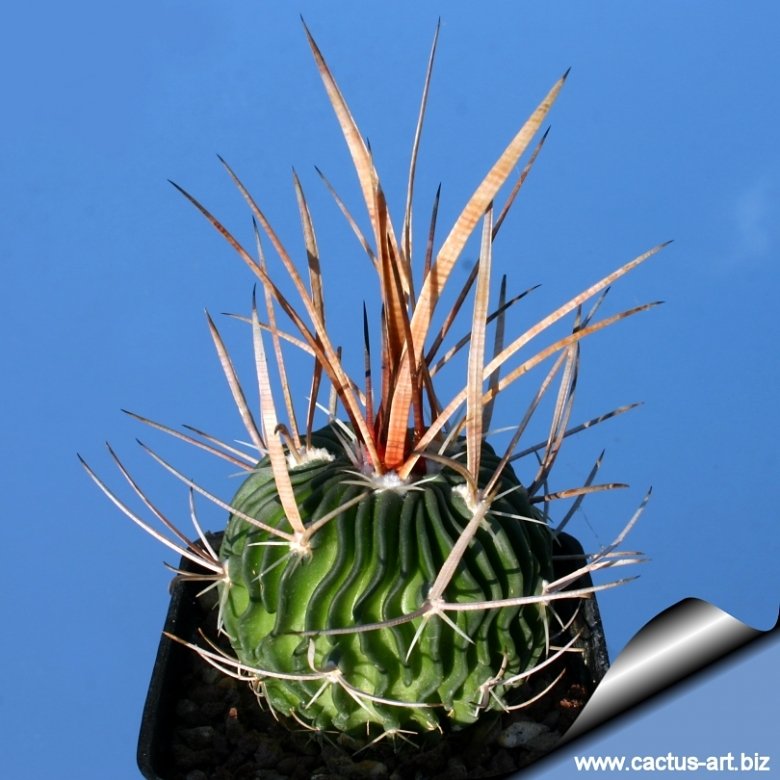
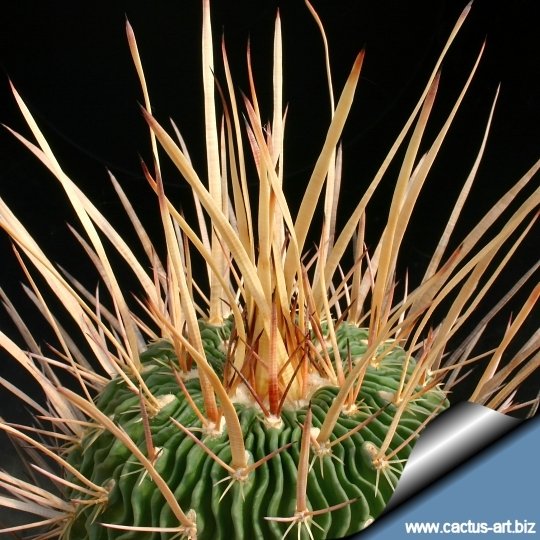
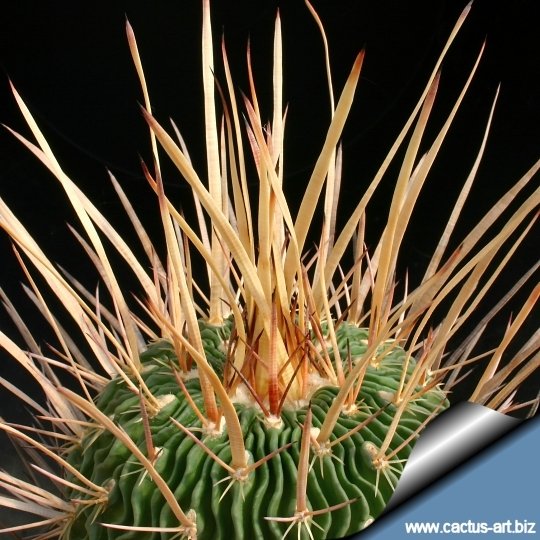
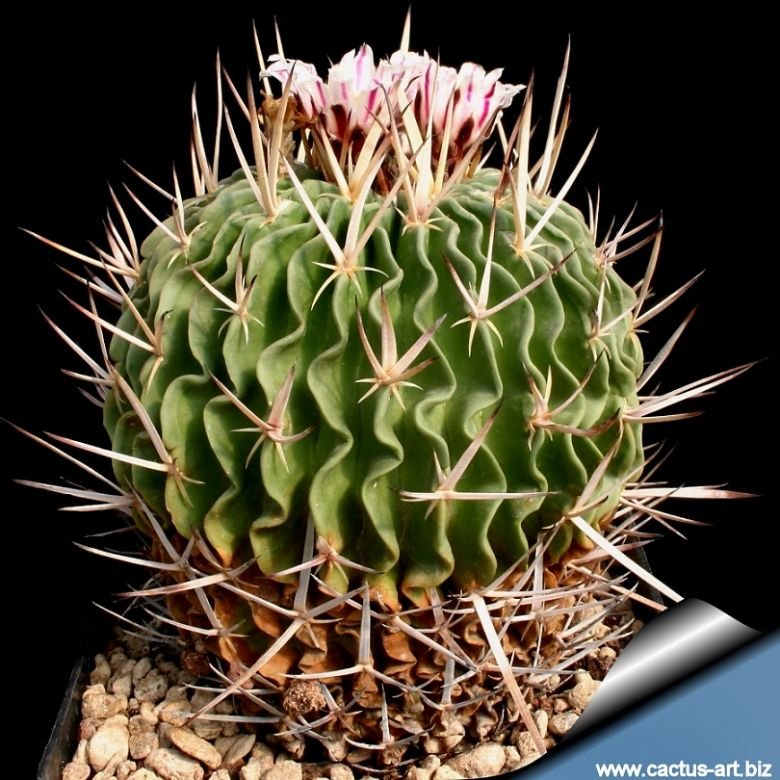
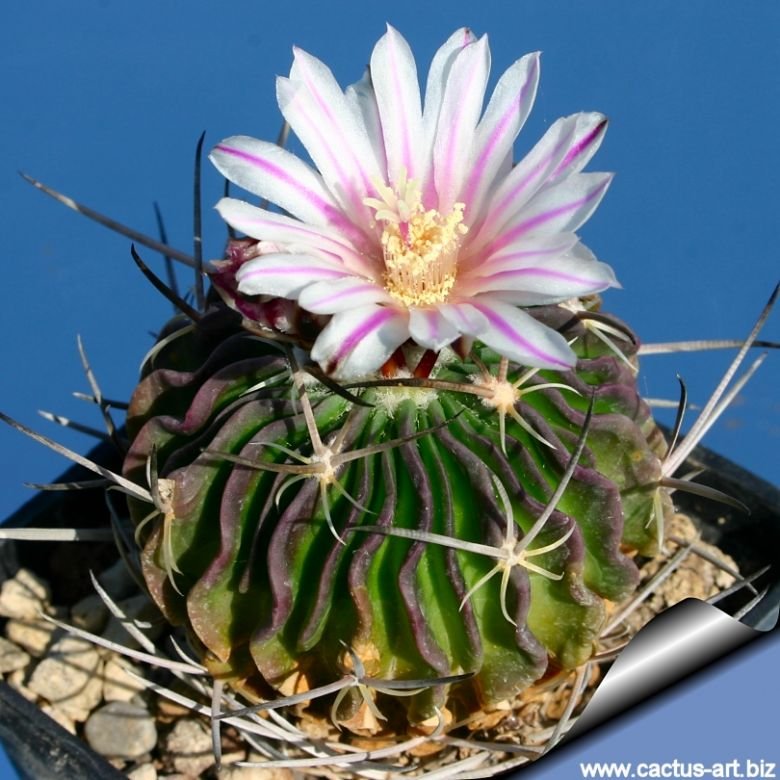
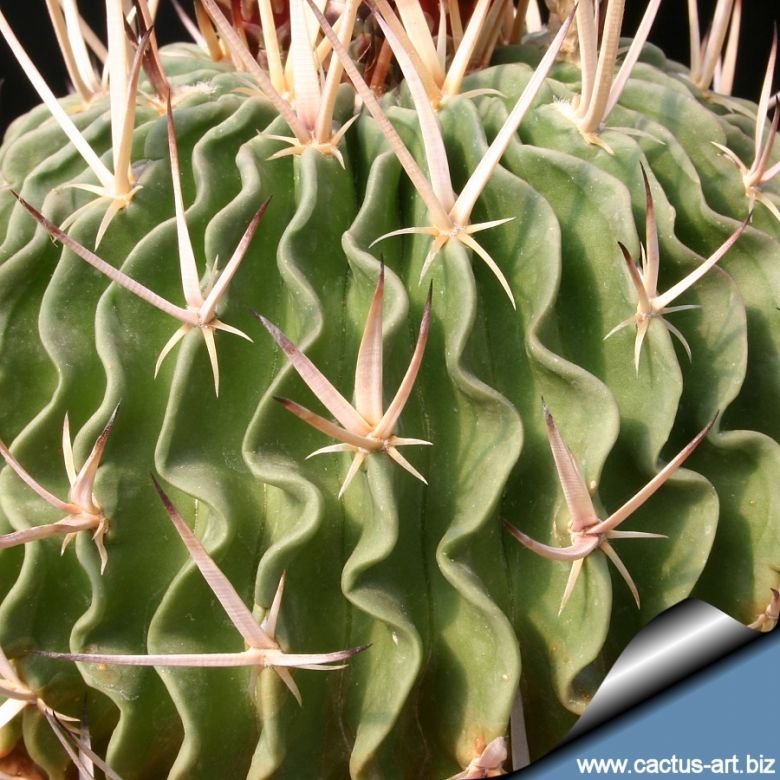
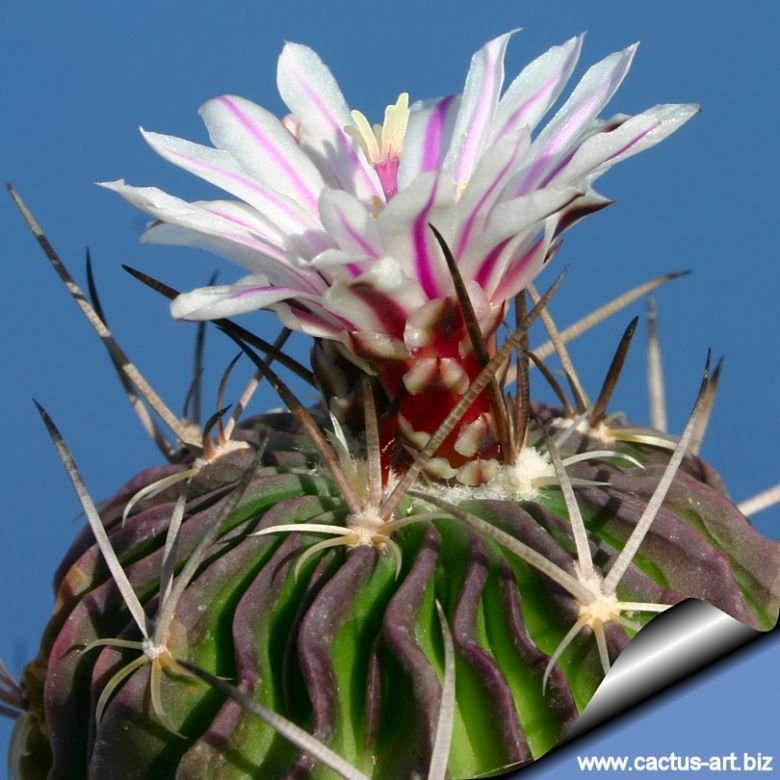
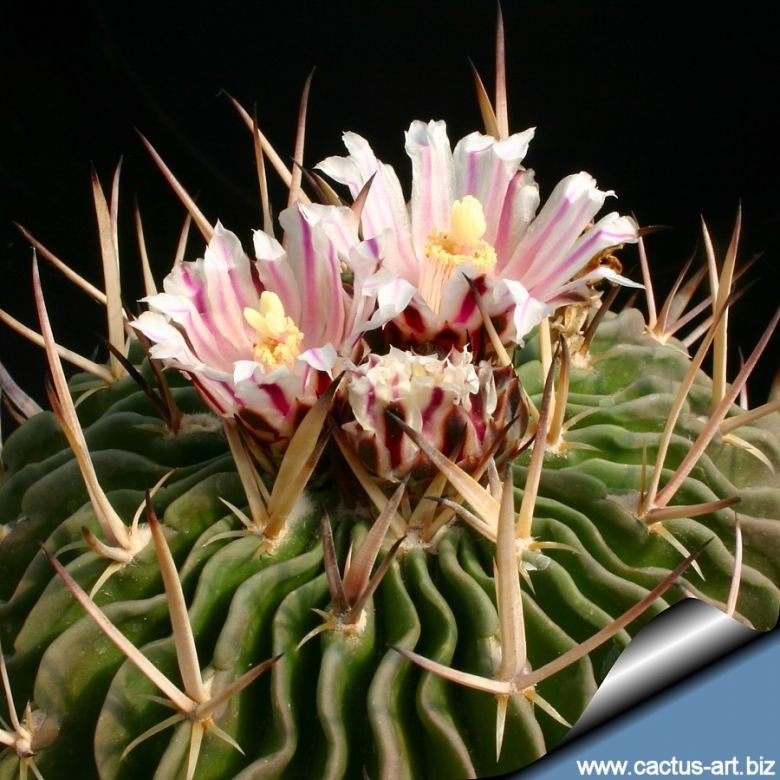
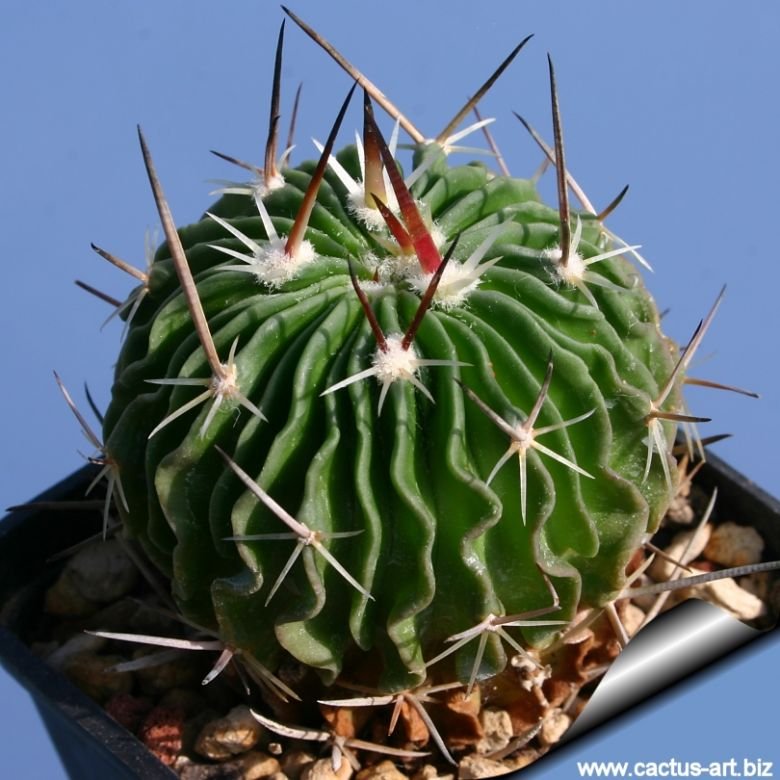
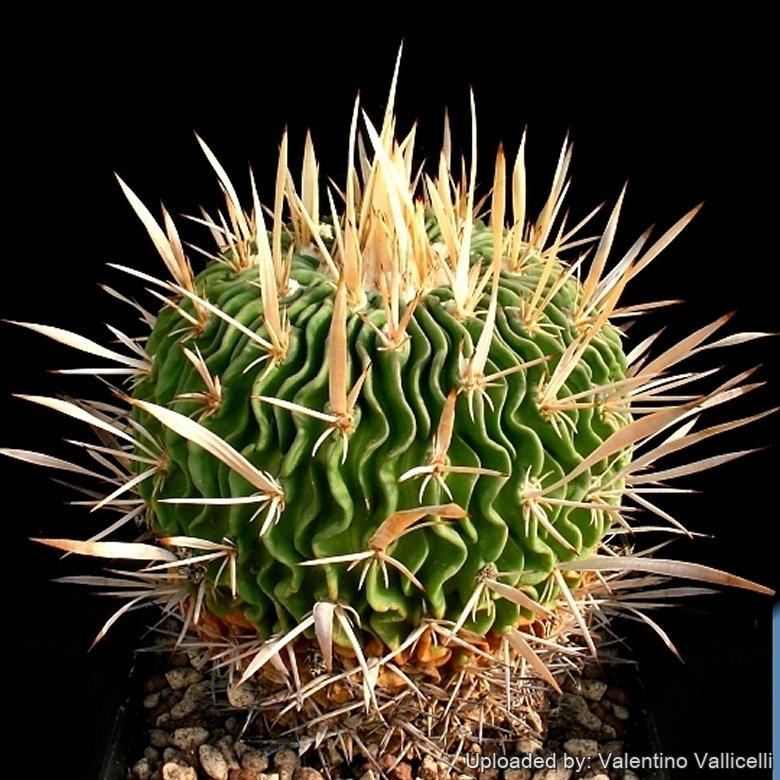
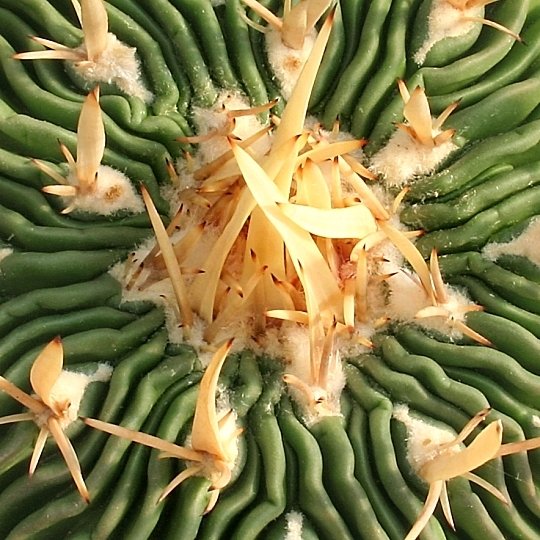
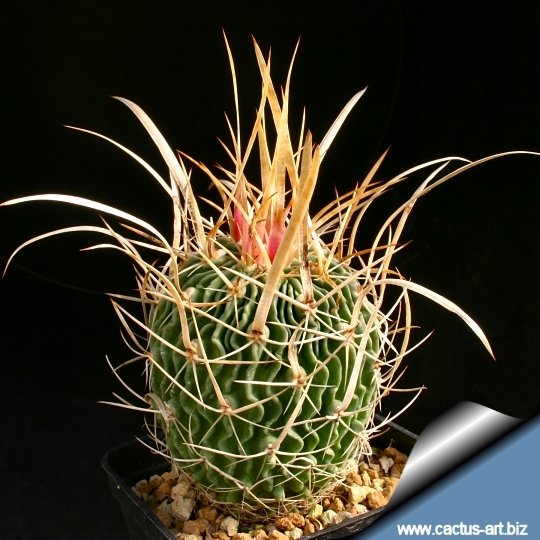
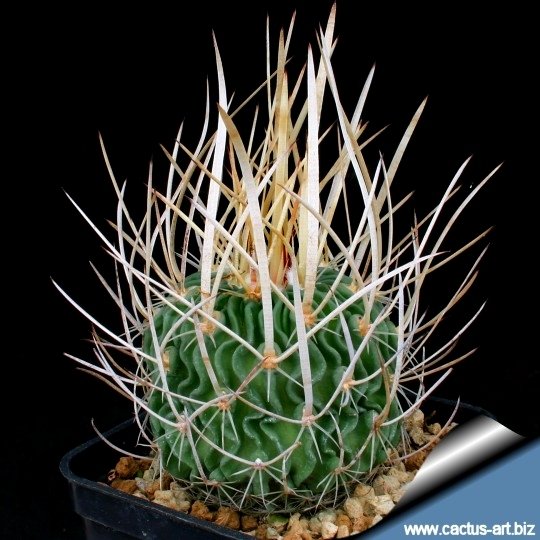
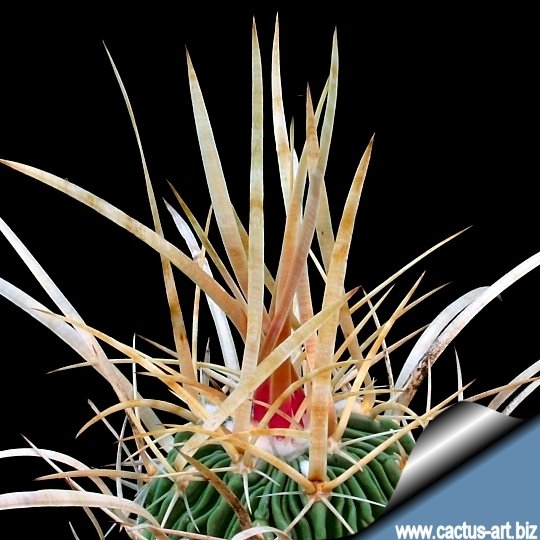
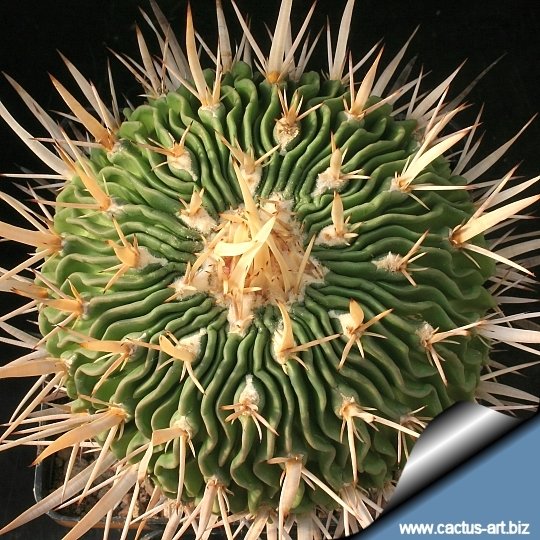
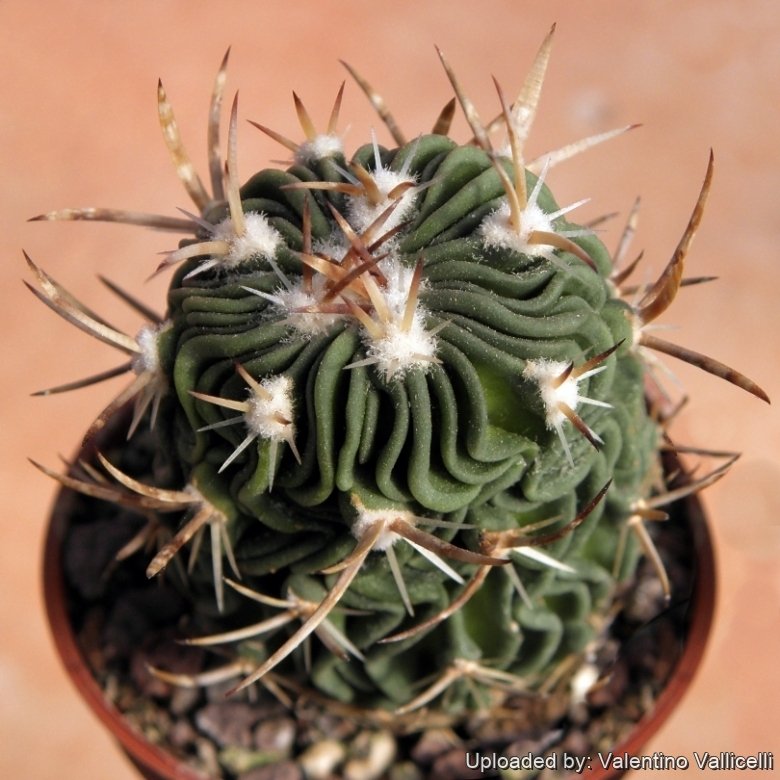
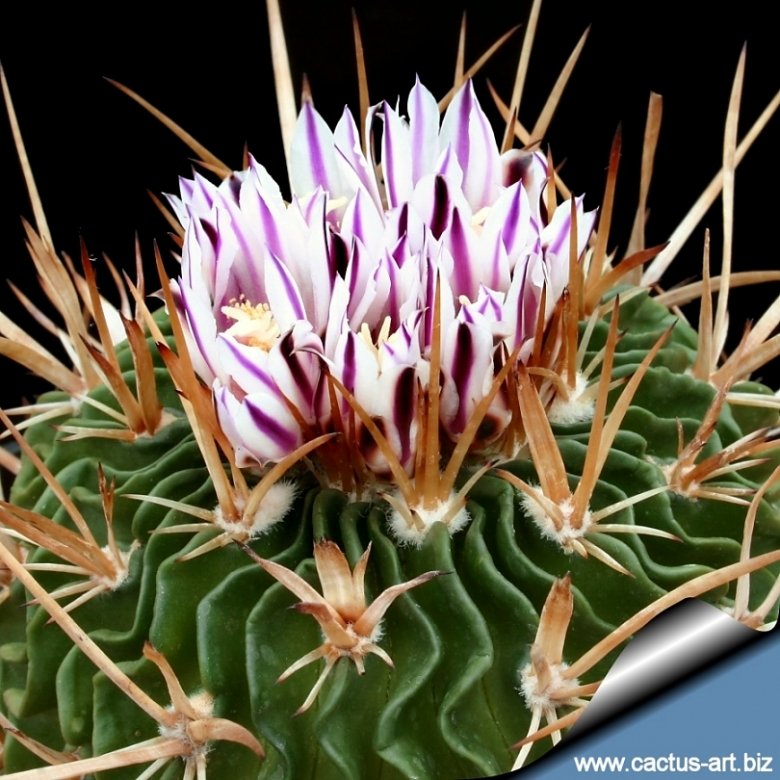
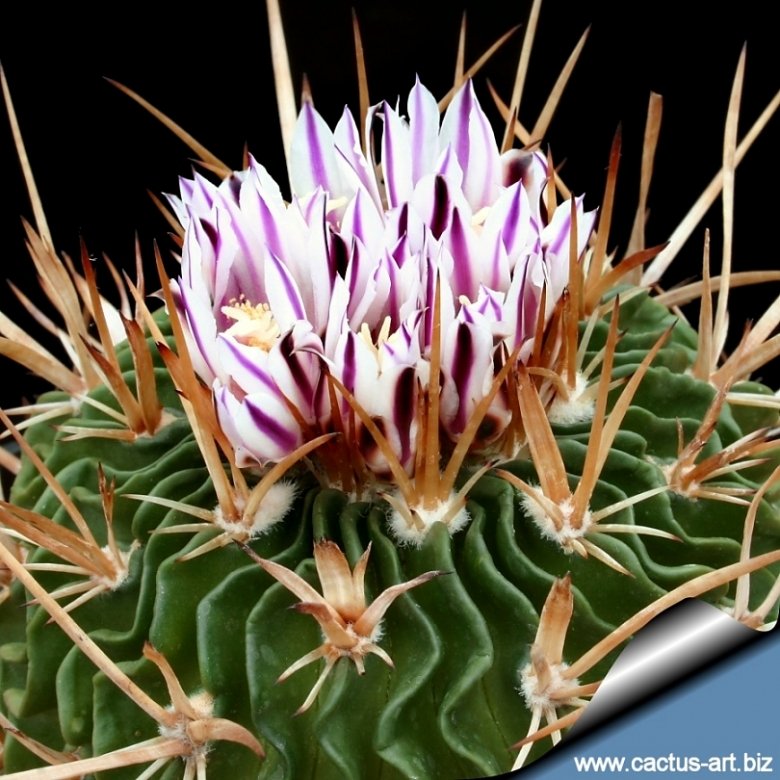
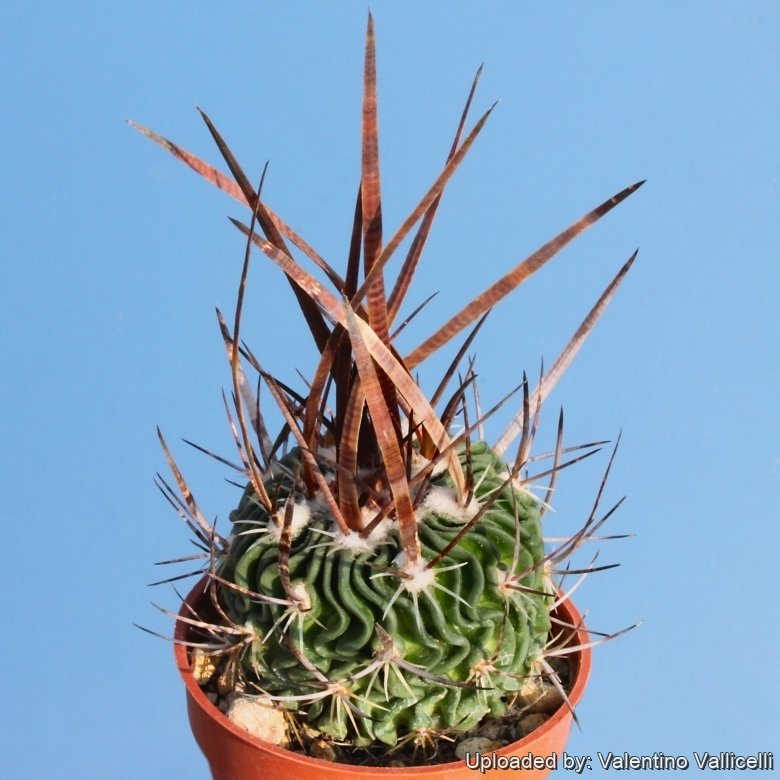
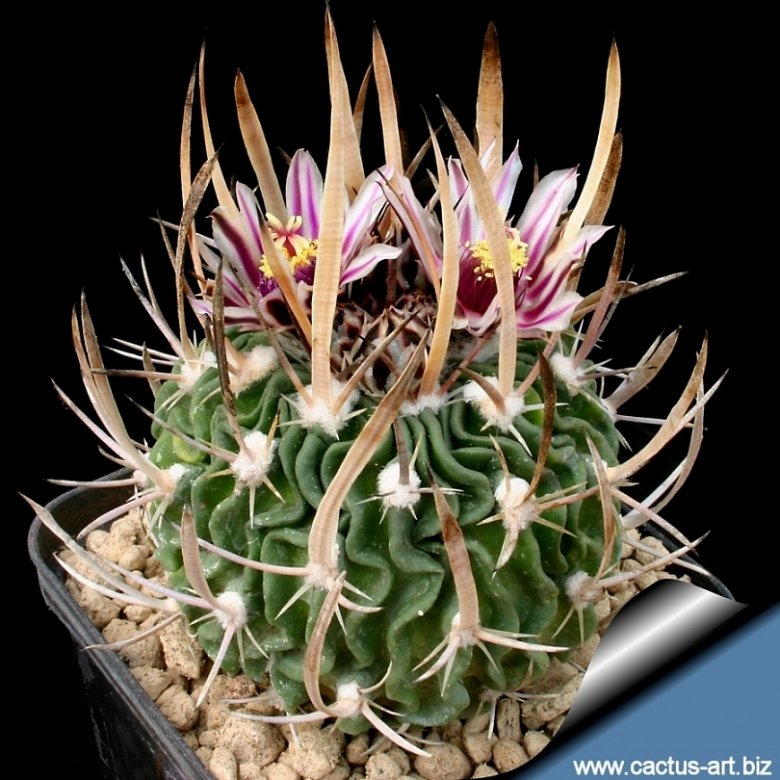
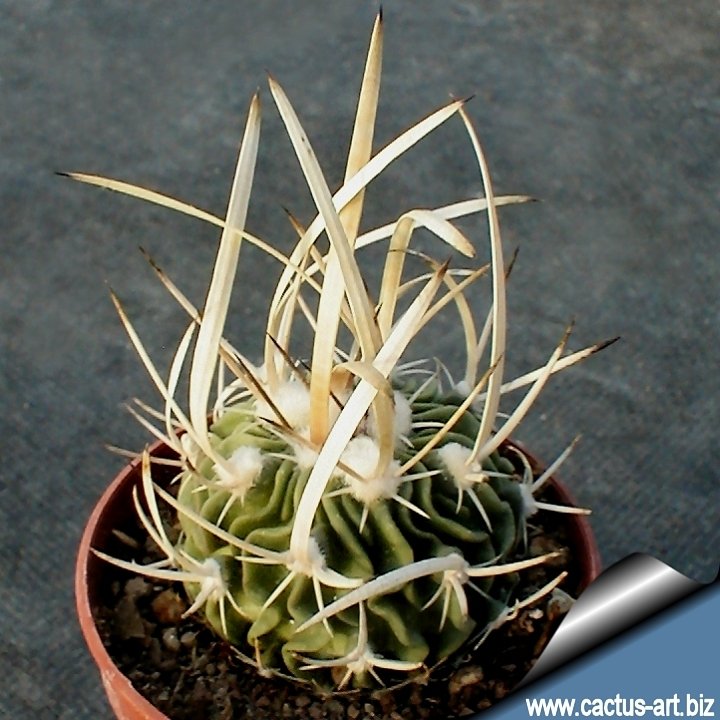
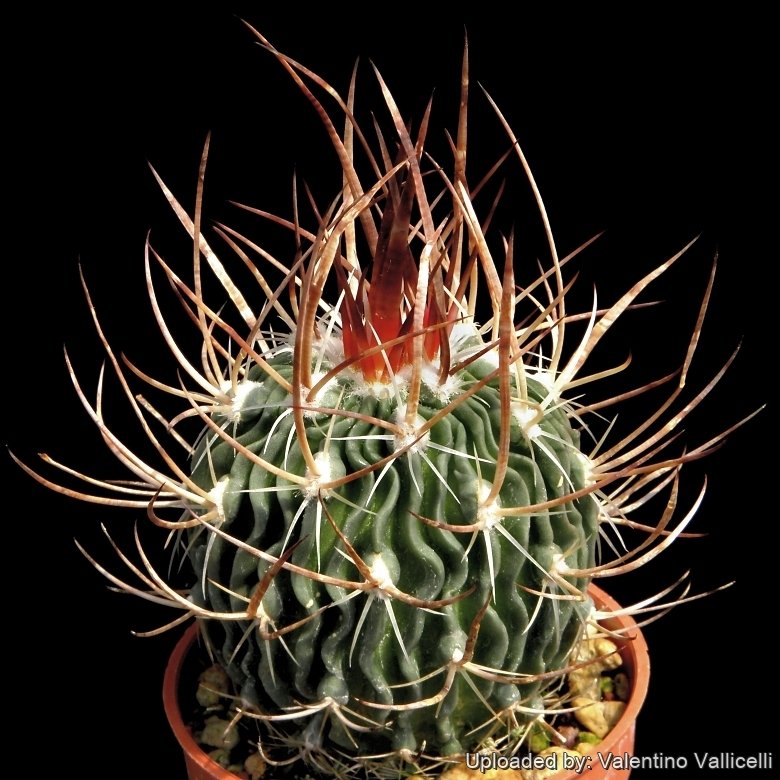
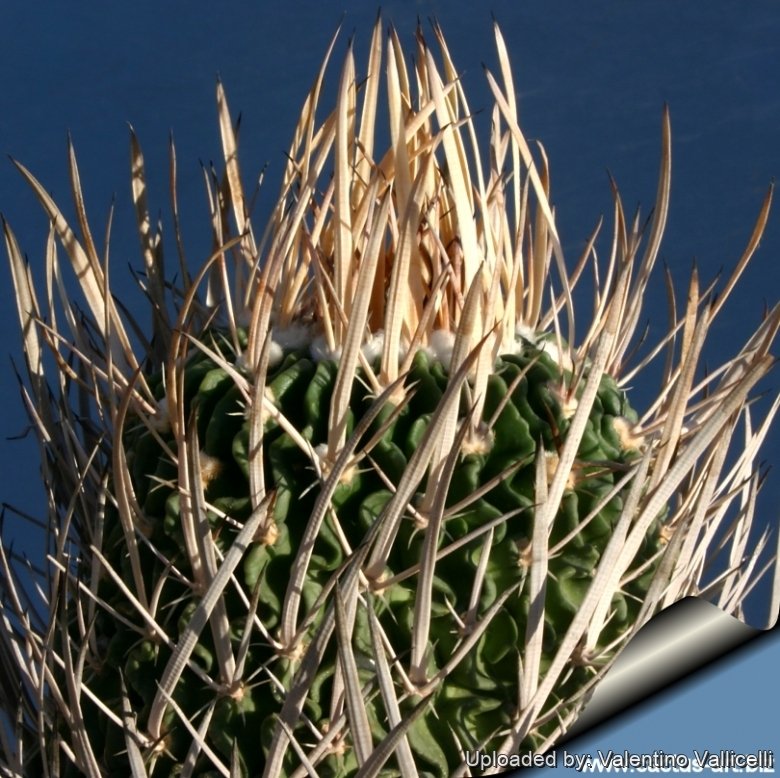
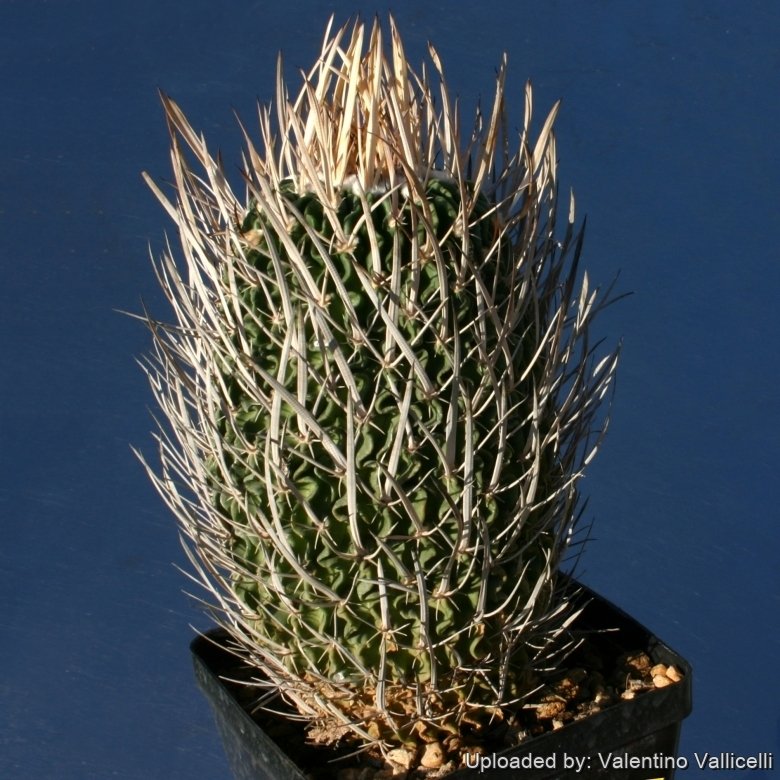
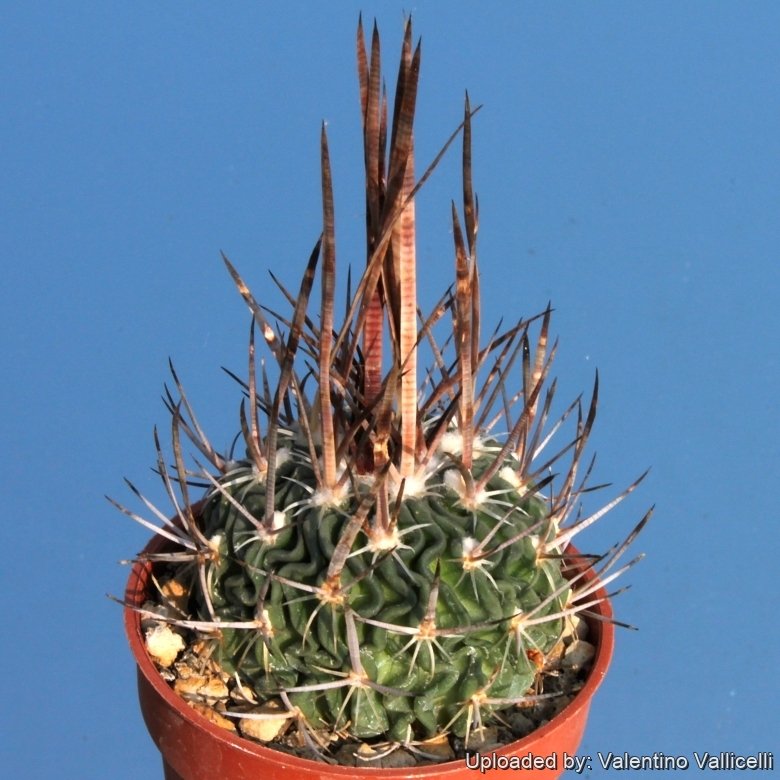
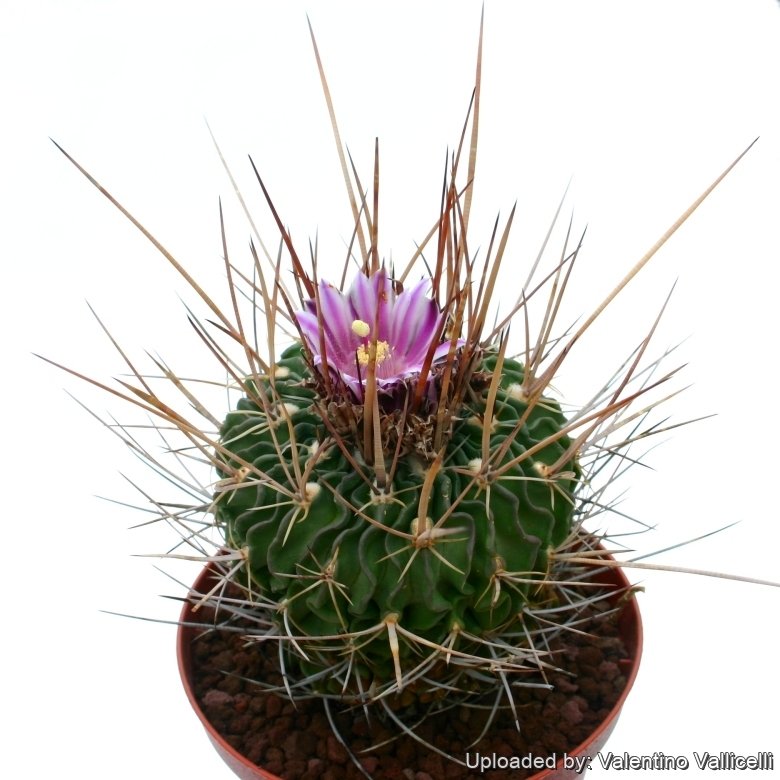
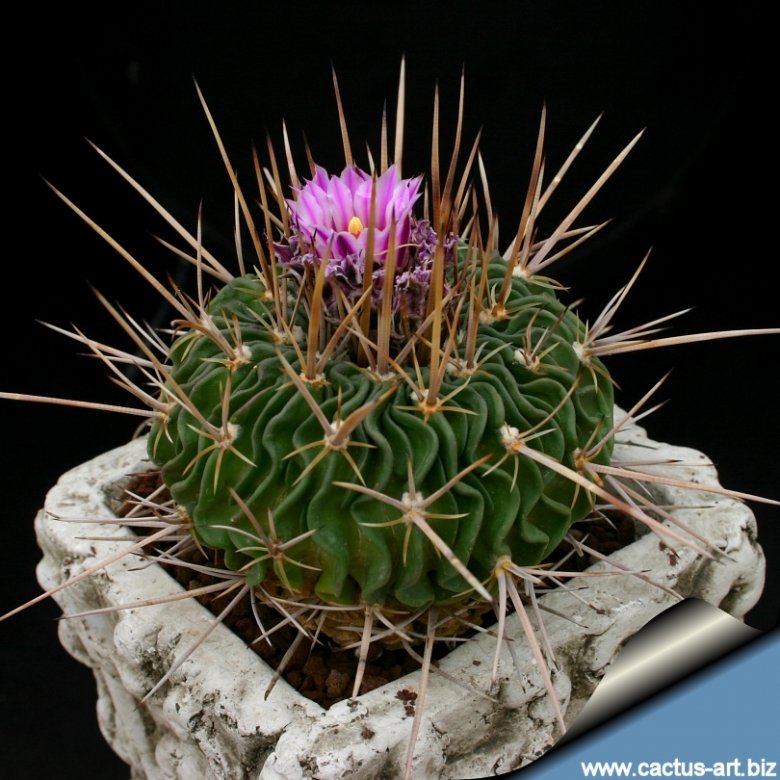
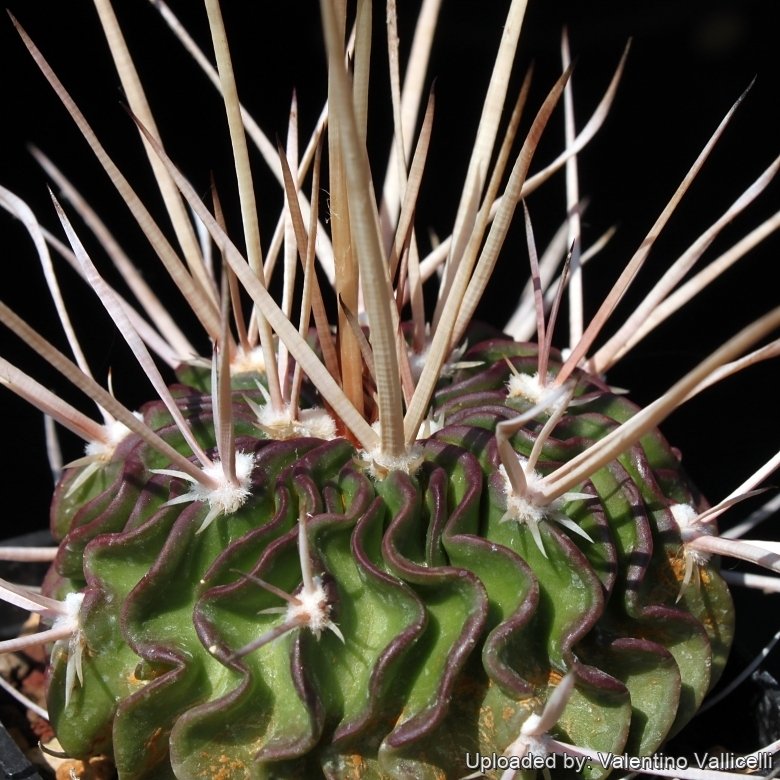
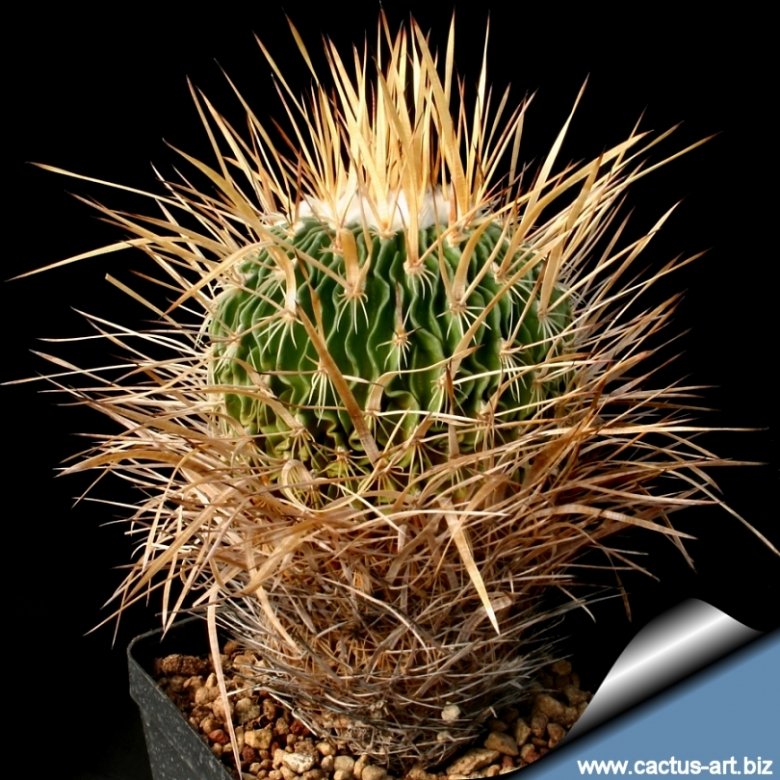
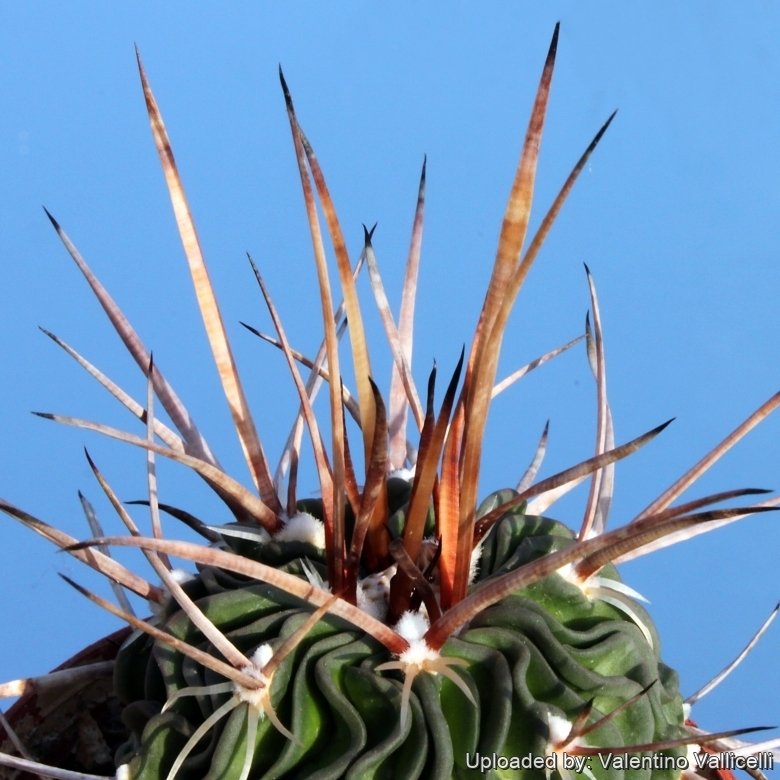
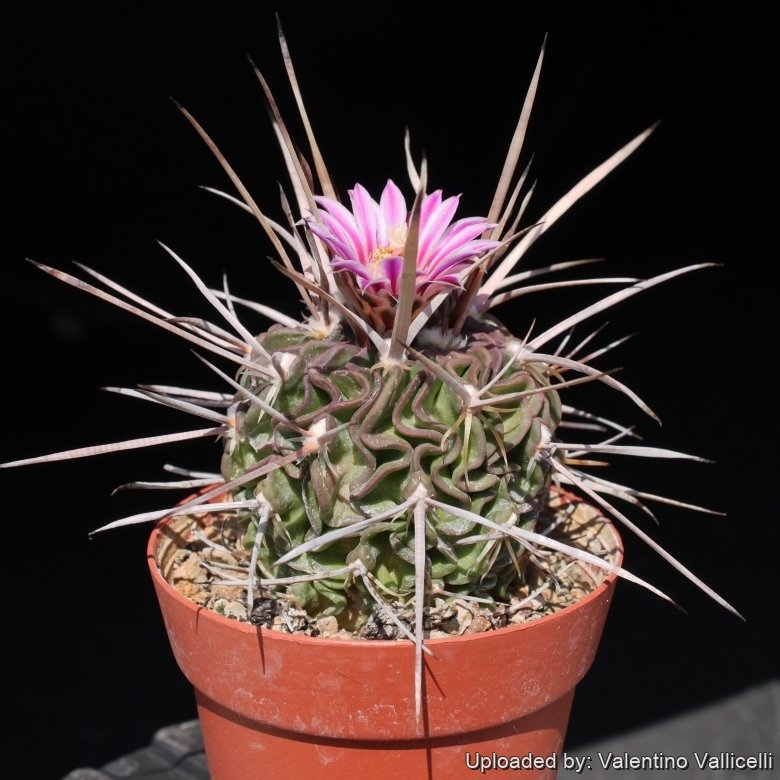
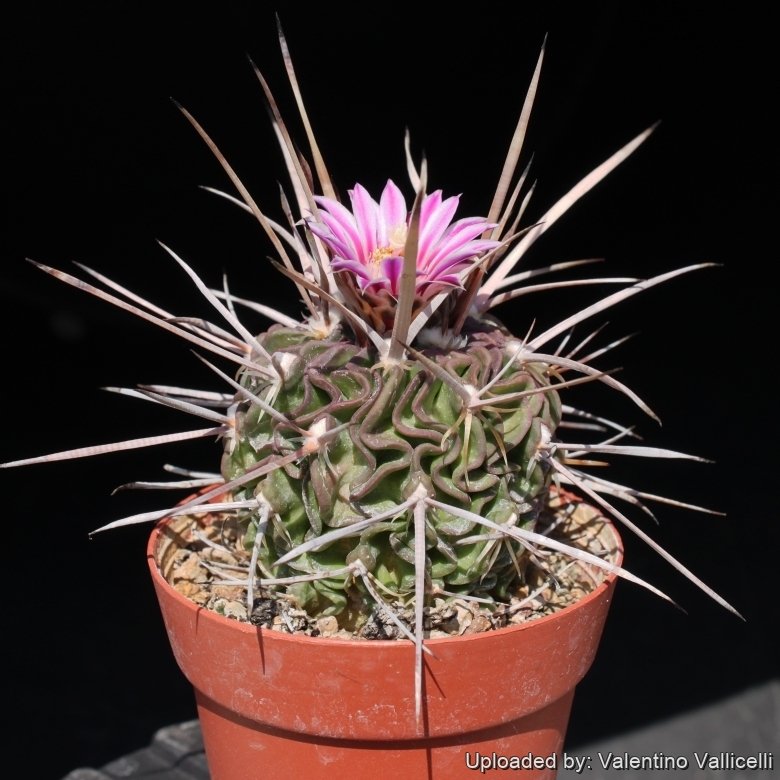
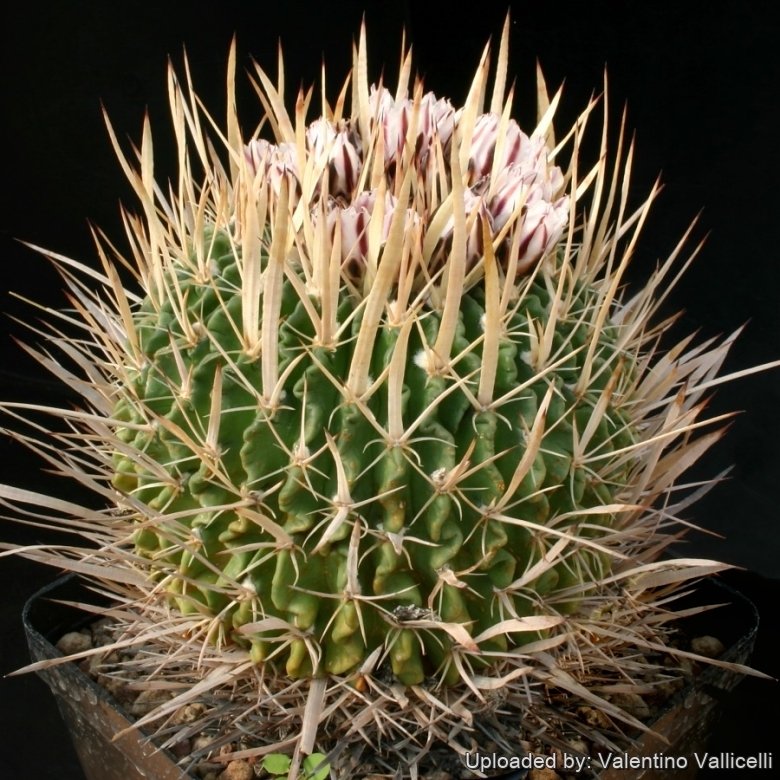
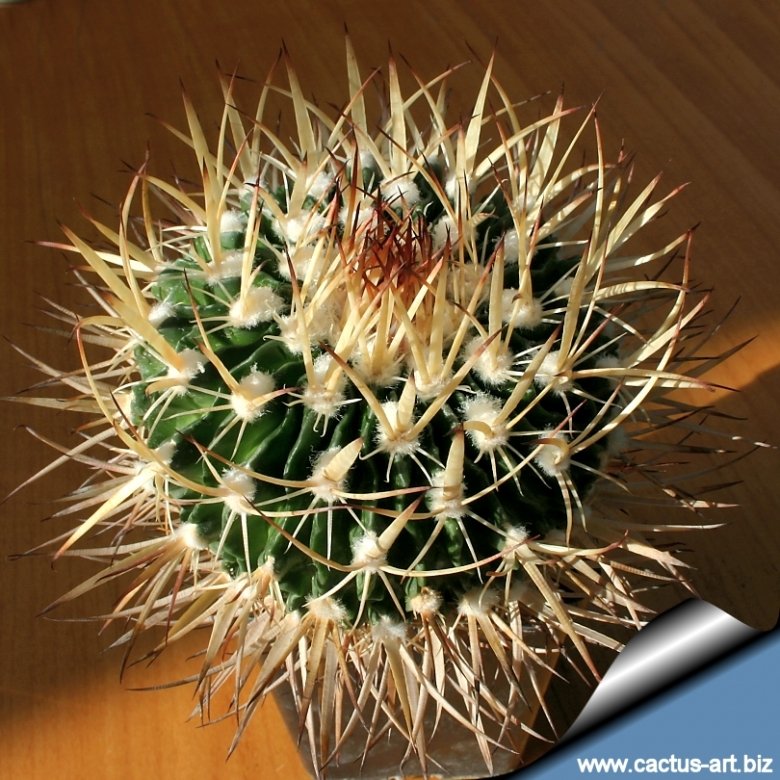
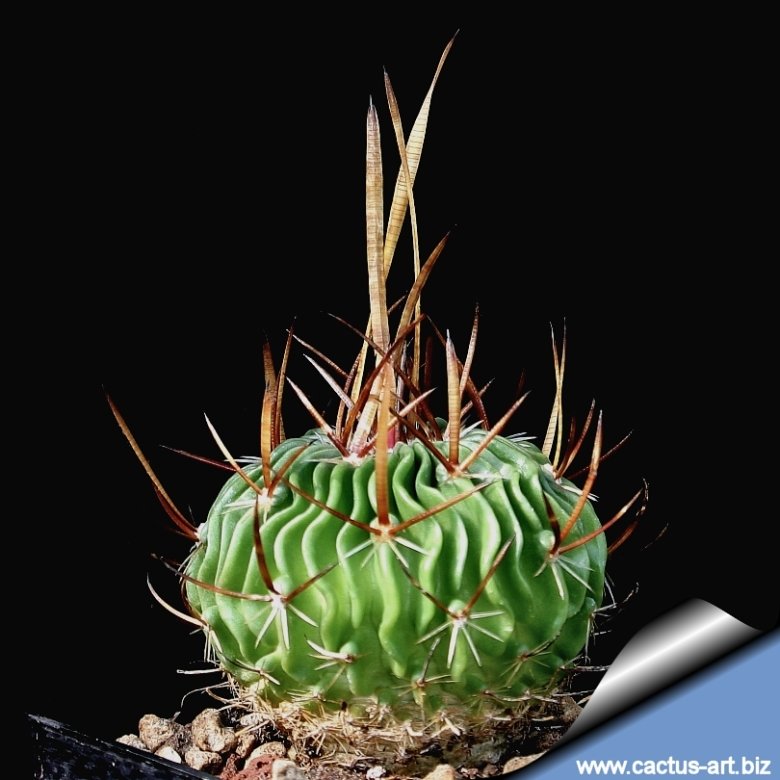
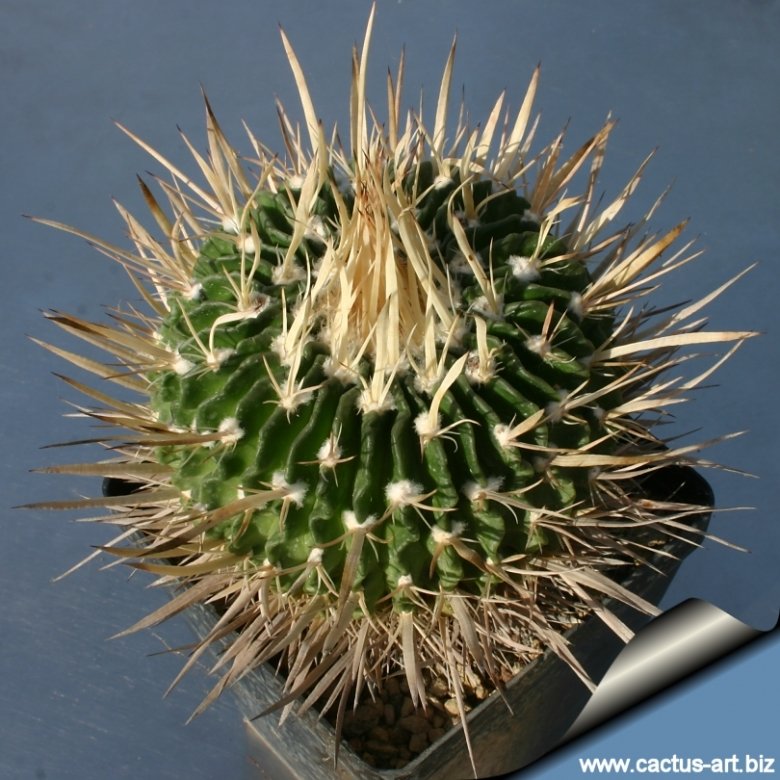
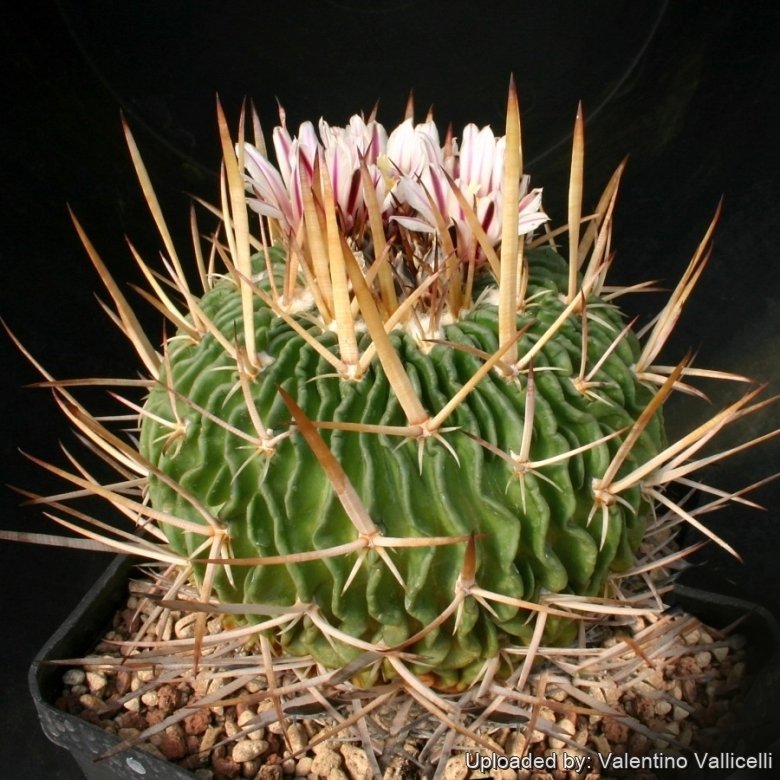
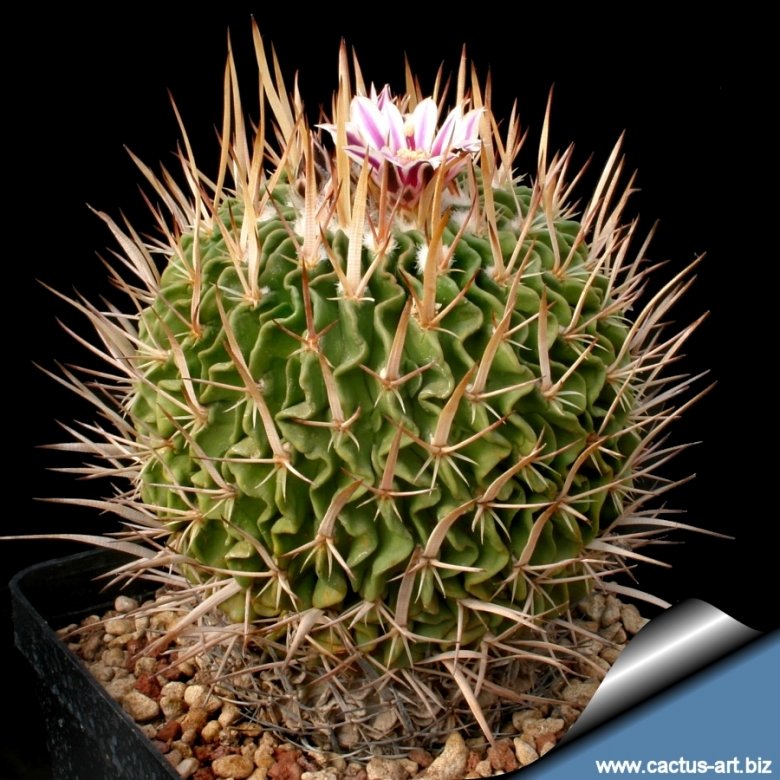
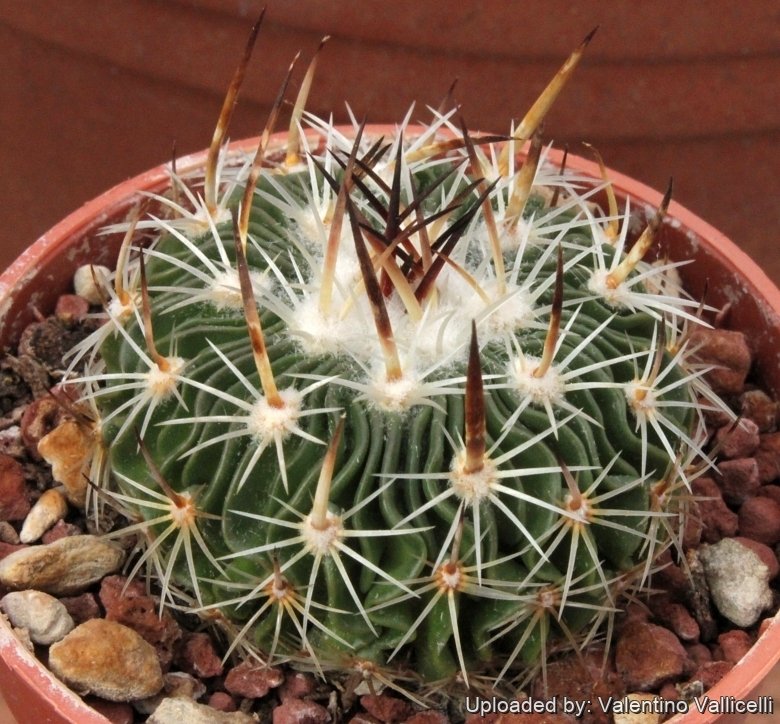
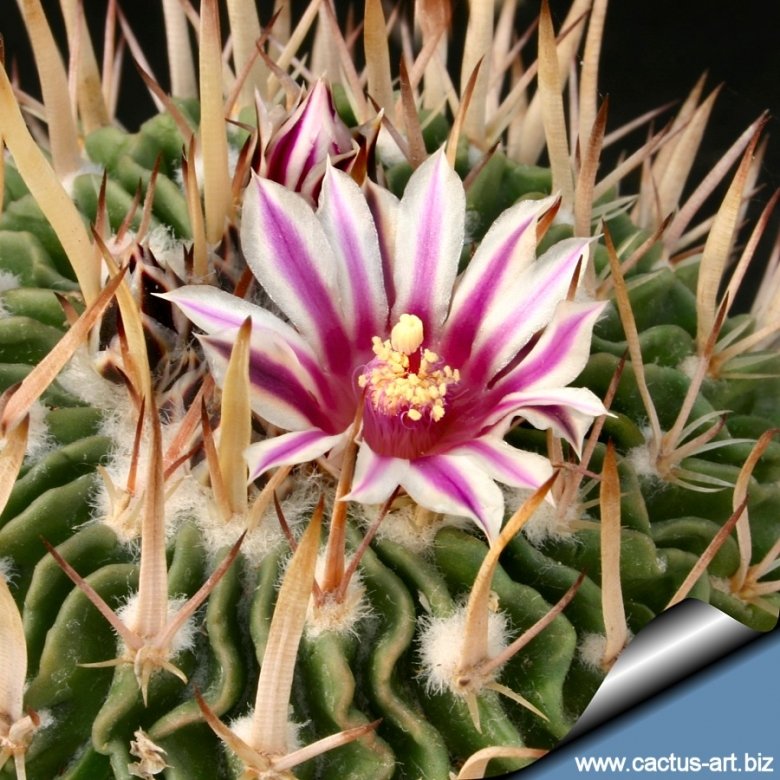
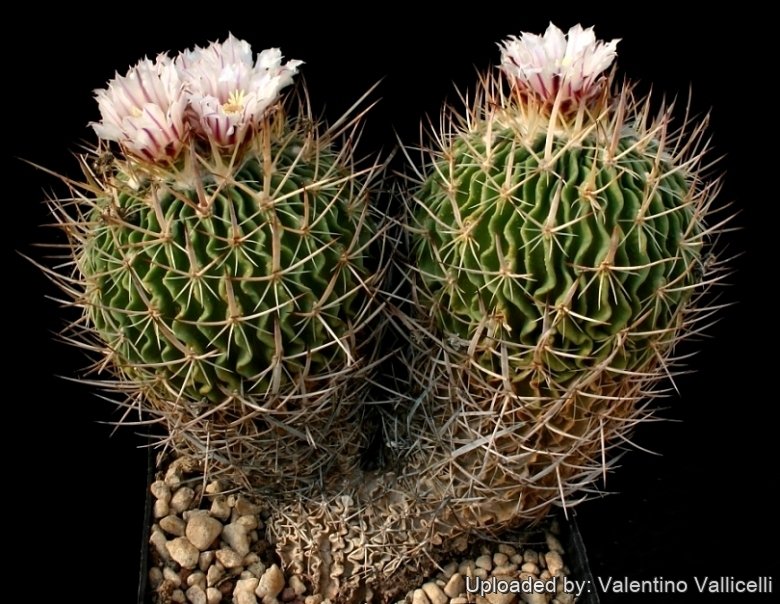
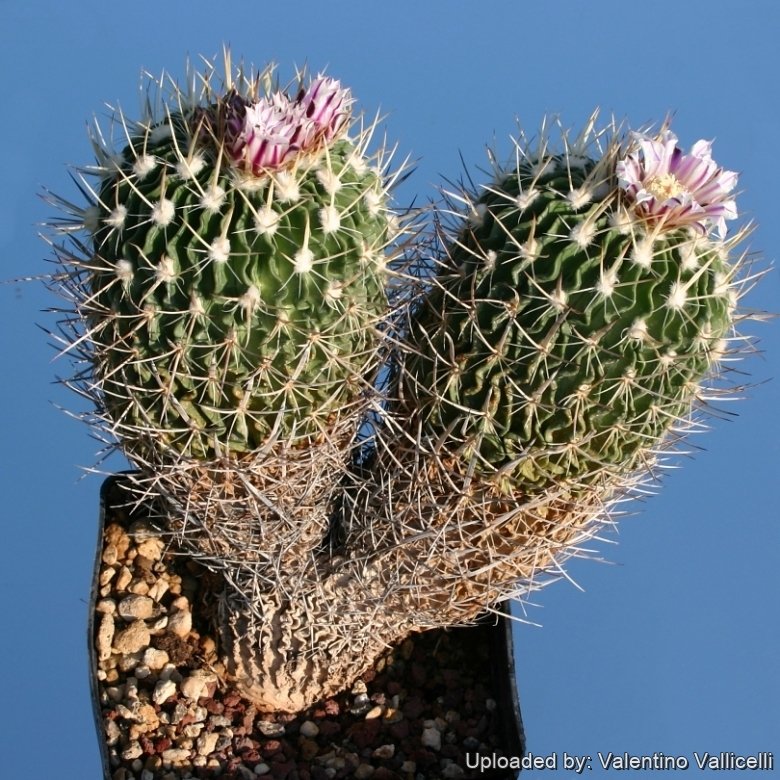
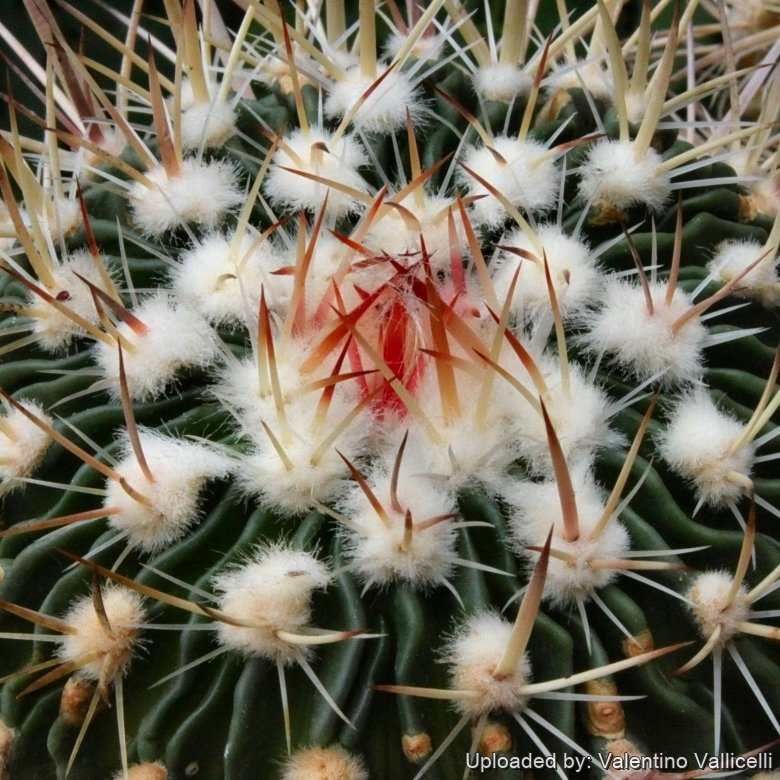
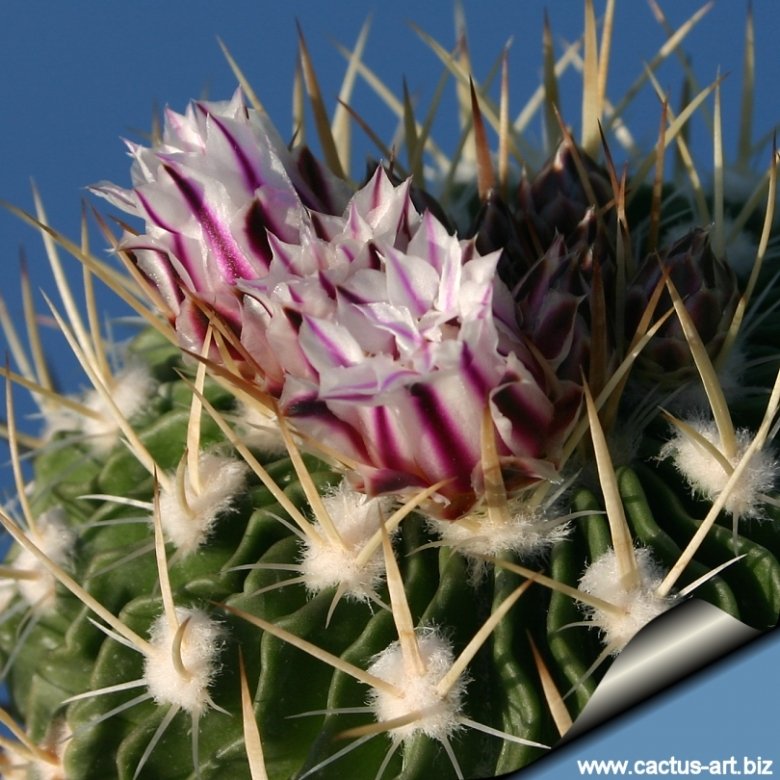
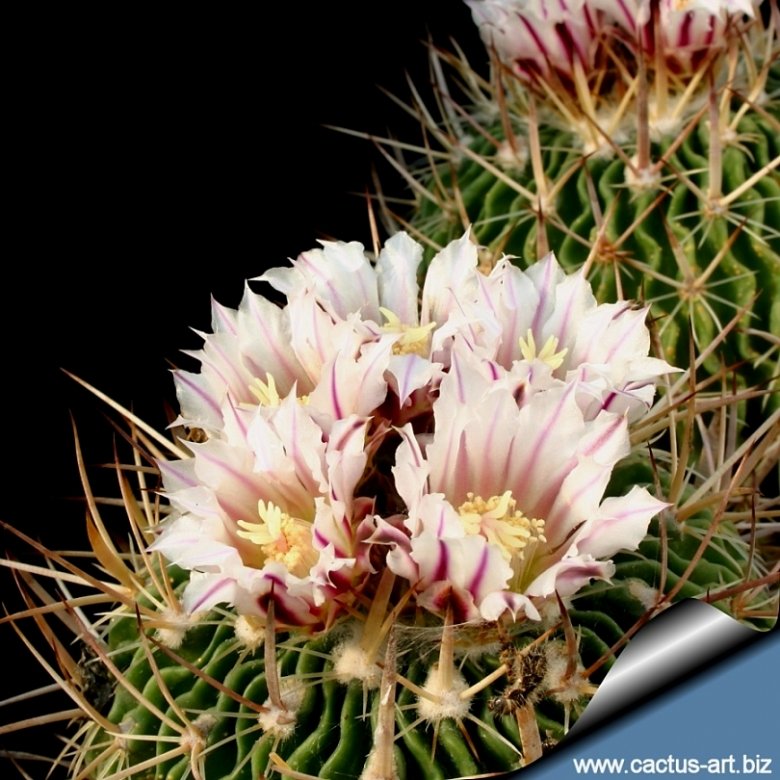
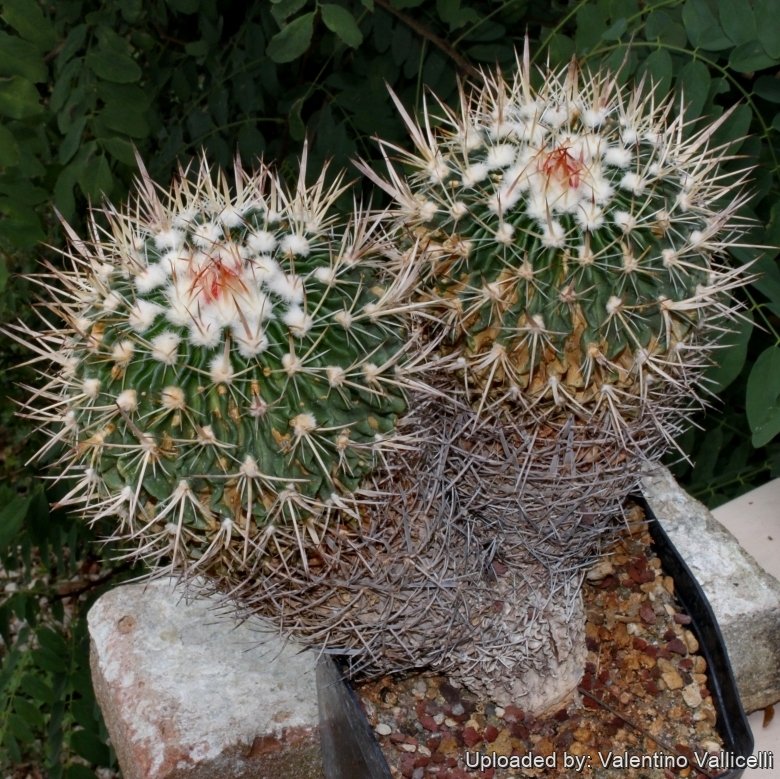
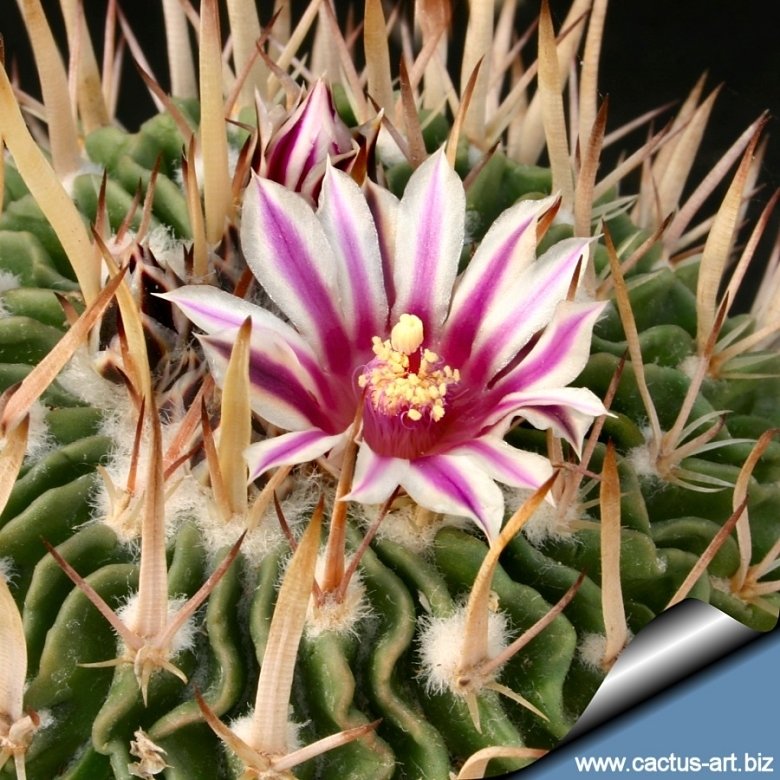
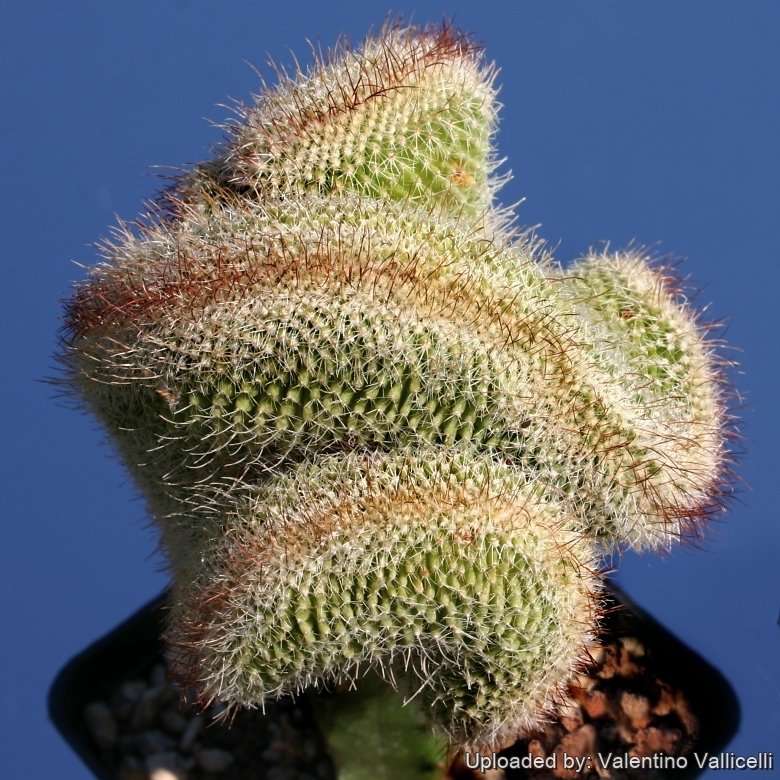
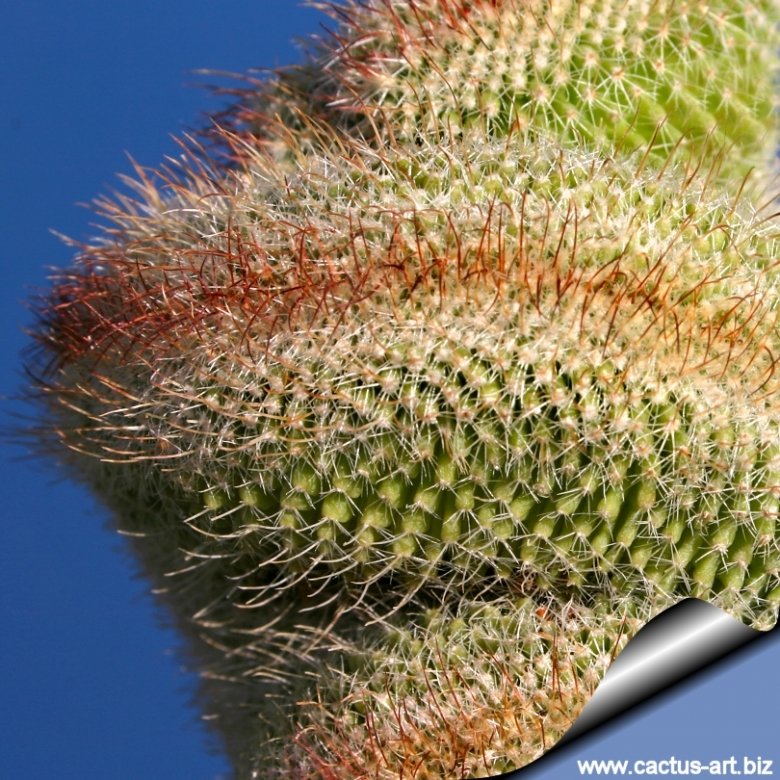
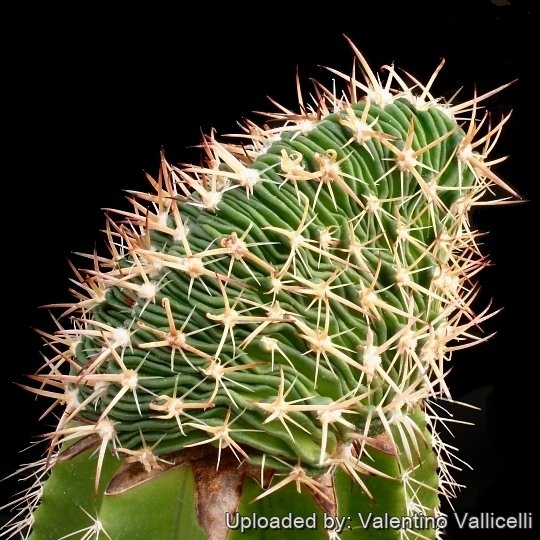
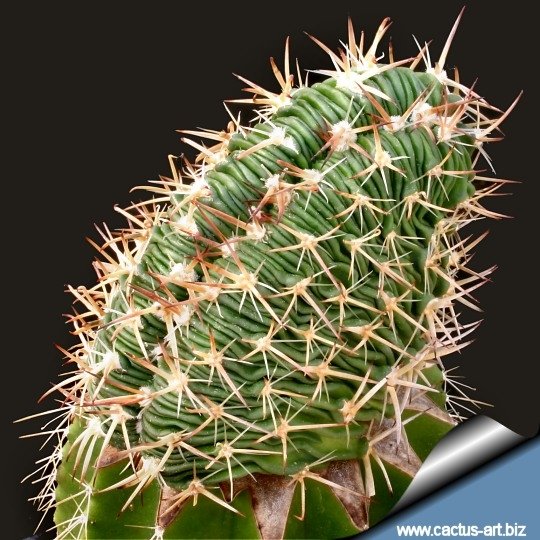
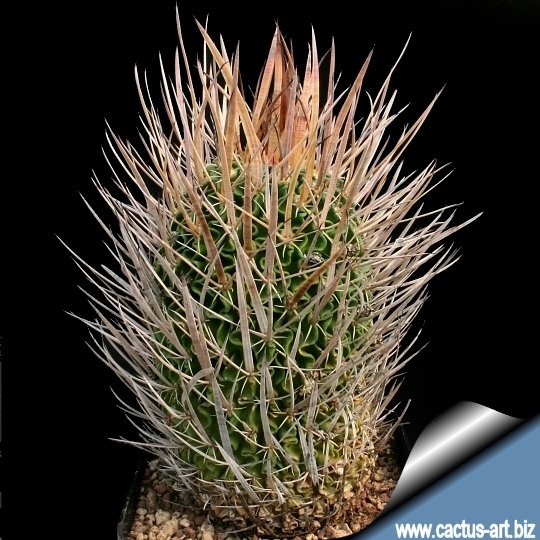
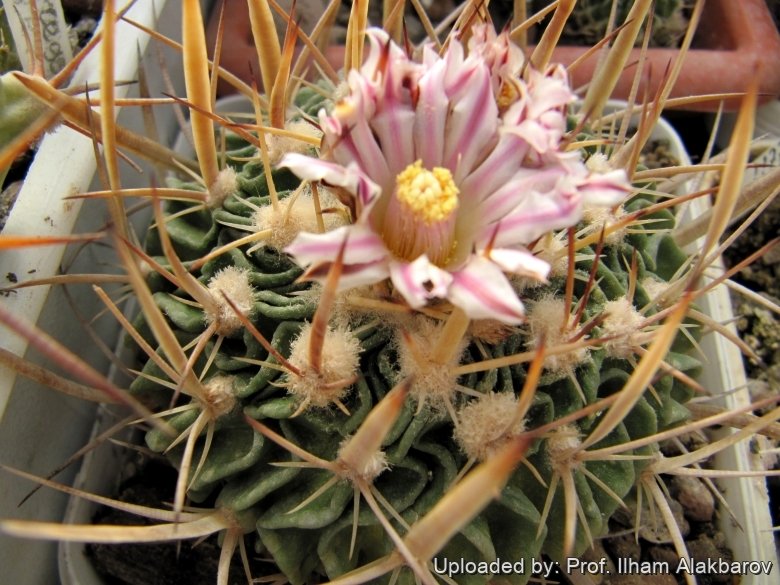
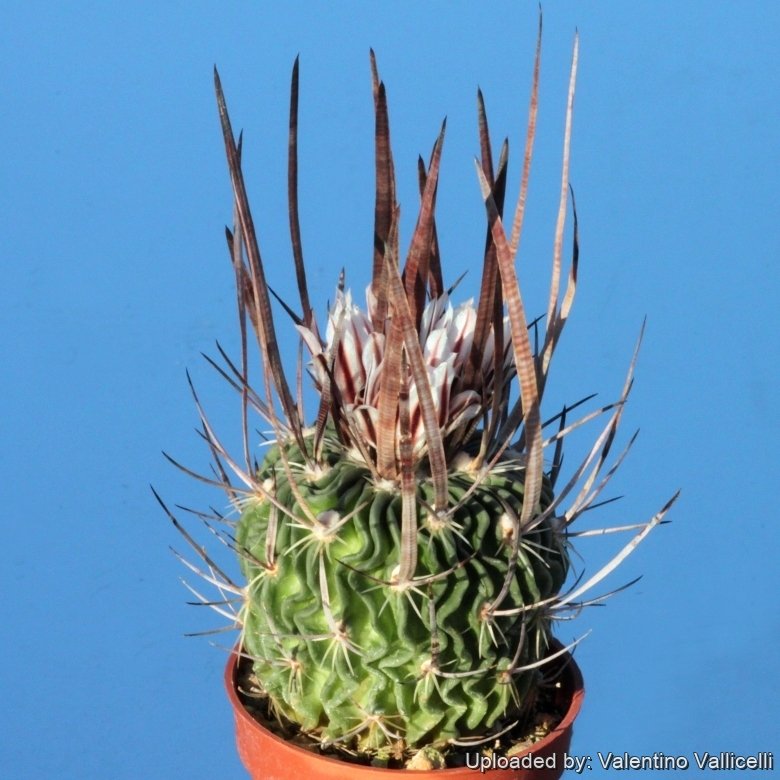
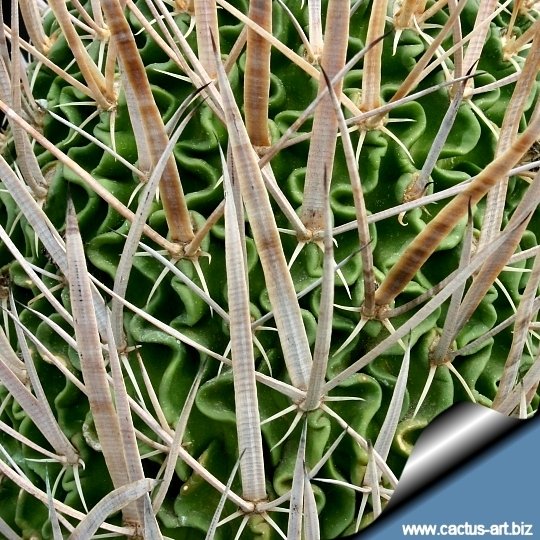
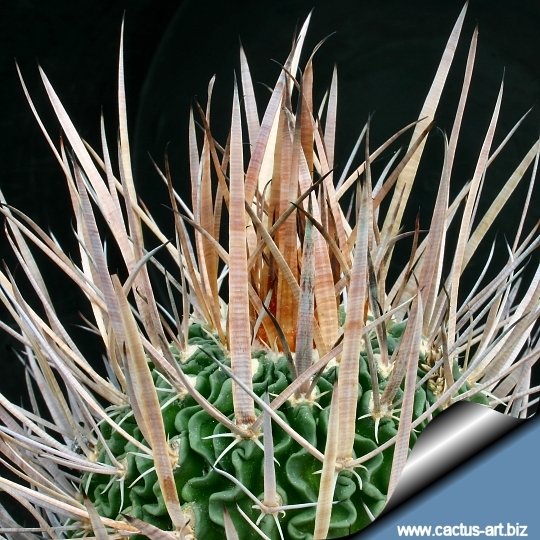
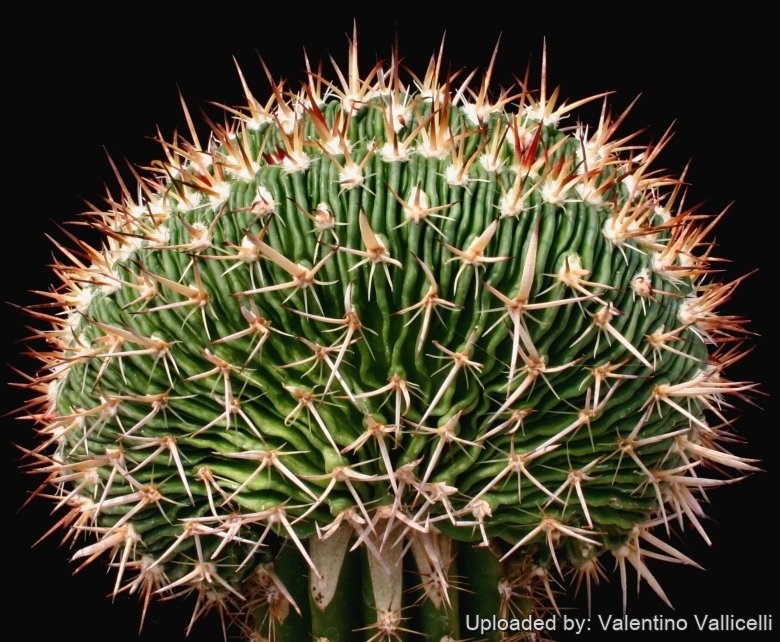
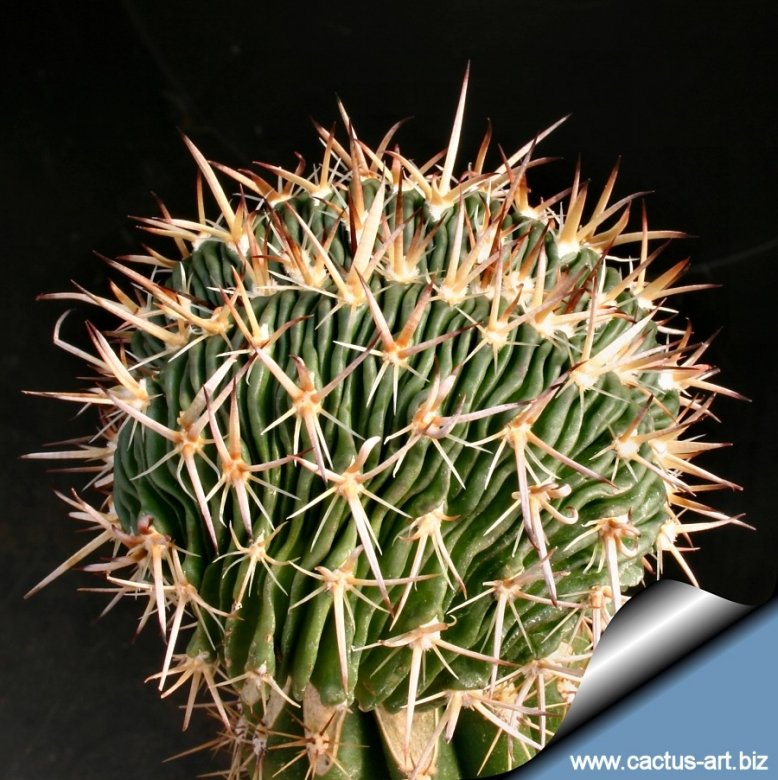
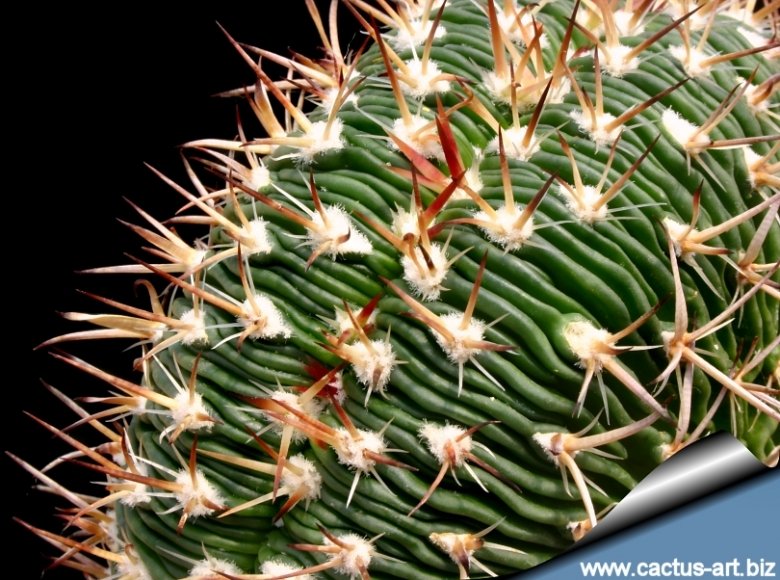
Stenocactus crispatus (Formerly known as Echinofossulocactus crispatus) is one of the more popular and prettiest cactus species. It is closely covered with very long flattened spines and wavy dark matt green ribs contrasting vividly with the pale wool of the new areoles. It is a very variable species that now includes many form (previously considered independent species) with one form intergrading into another, creating a taxonomic nightmare. It is similar to Stenocactus multicostatus and equally variable, but has often a darker stem with less numerous ribs.
Habit: It is a solitary plant (or rarely branching) .
Stem: Up to 20 cm tall, 10 cm wide, globose, obovoid or short-cylindric, somewhat depressed at apex, bluish-green, dark matt green or dark olive-green.
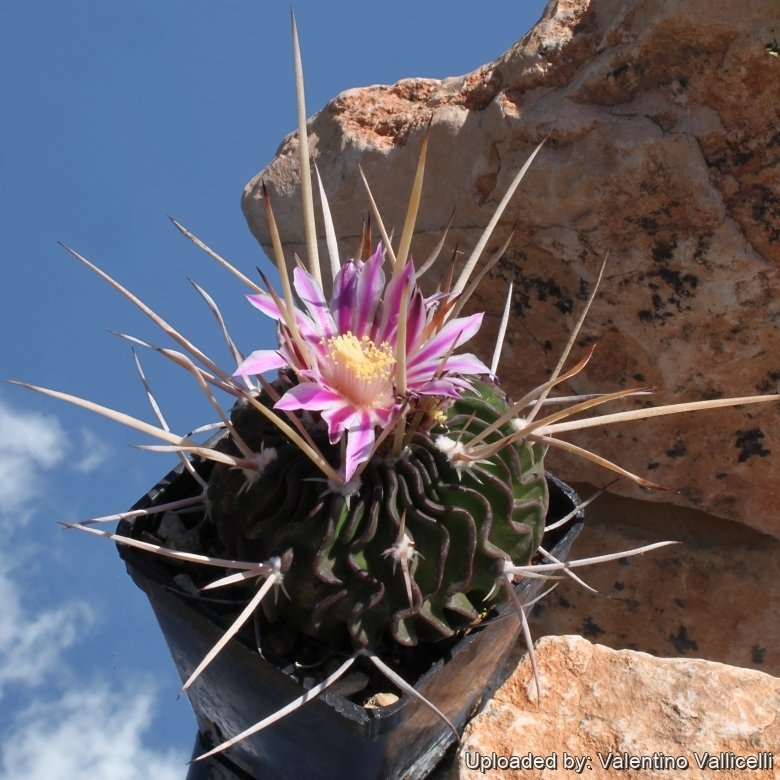
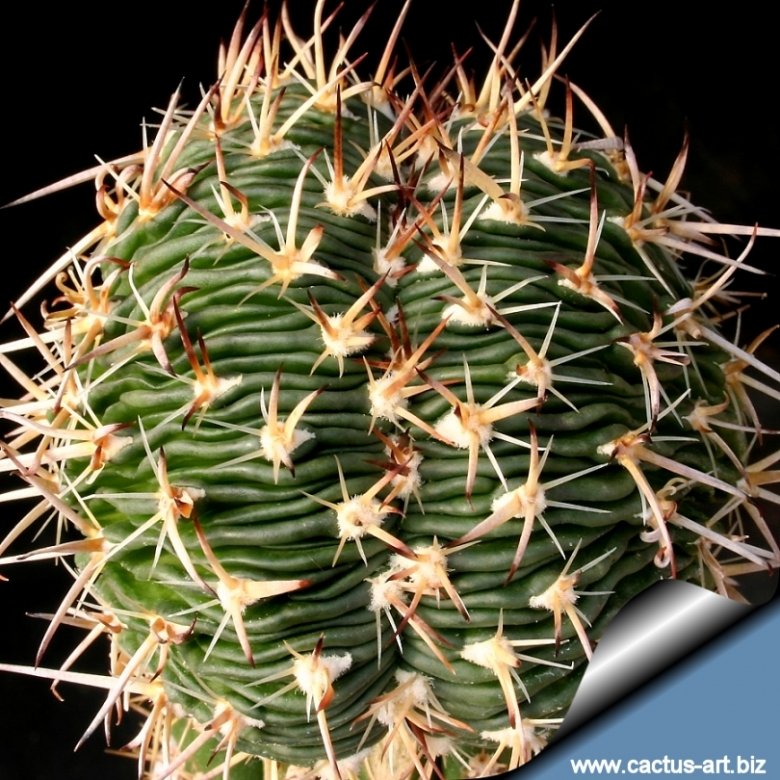
Ribs: (25-)30-60(-80) thin, more or less folded, very regularly and attractively waived and depressed in the region of areoles. The flattened, wavy or curled ridges of this species are characteristic of other kinds of Echinofossulocactus.
Areoles: 1 to 3 in each ribs, woolly in youth, later naked.
Radial spines: Usually 4 to 6 flattened, whitish to brownish, 0,5 to 1 cm long and about 0,6-1 mm wide at the base.
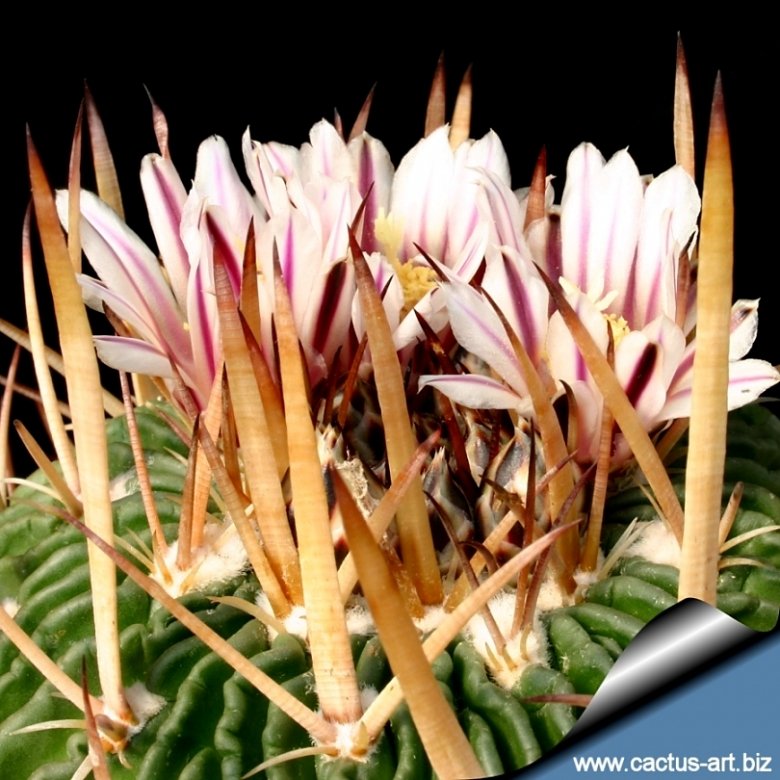
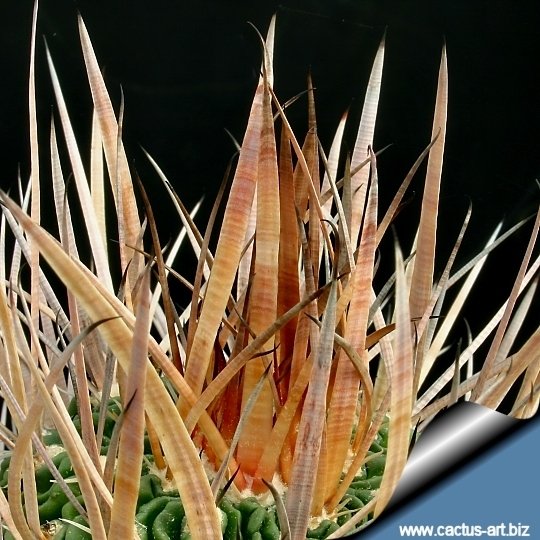
Central spine: 3-4 very flattened, whitish, yellowish, brownish to almost black, often darker at the tip, directed upwards ± rigid, ferocious-looking, straight or curved, unequal with one very long (from 1 to 10 cm long) and 1-5 mm wide at the base
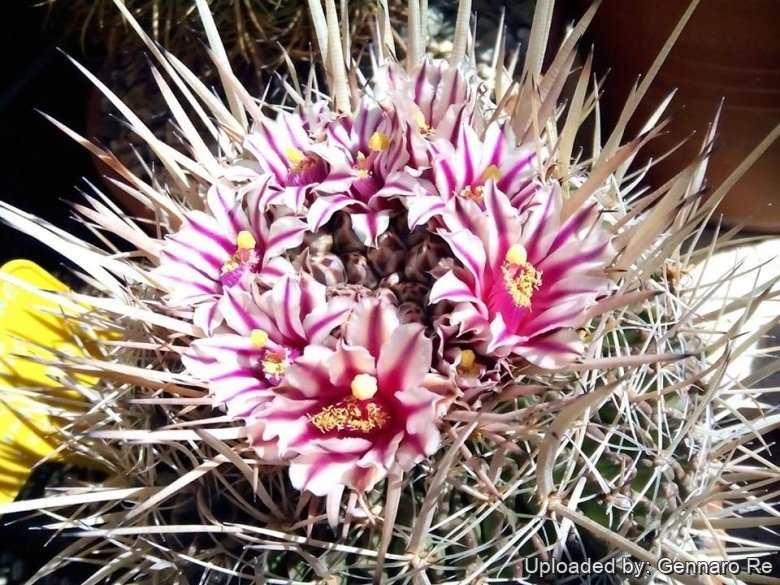
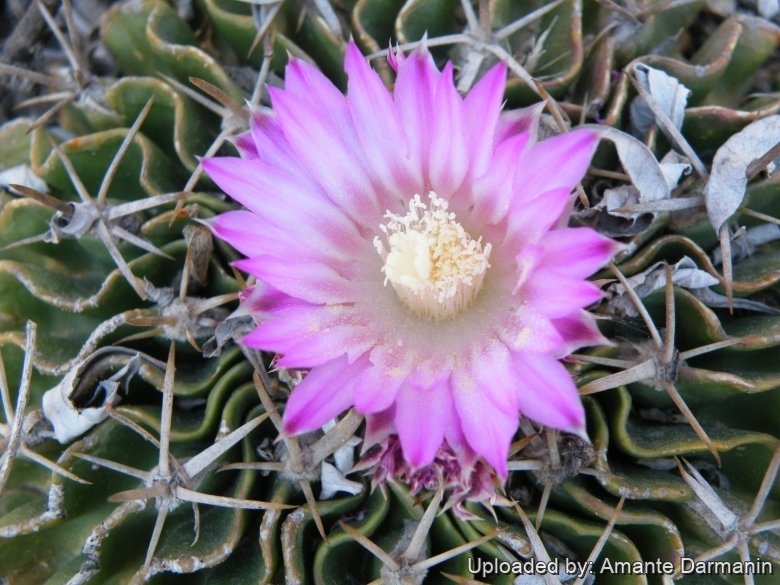
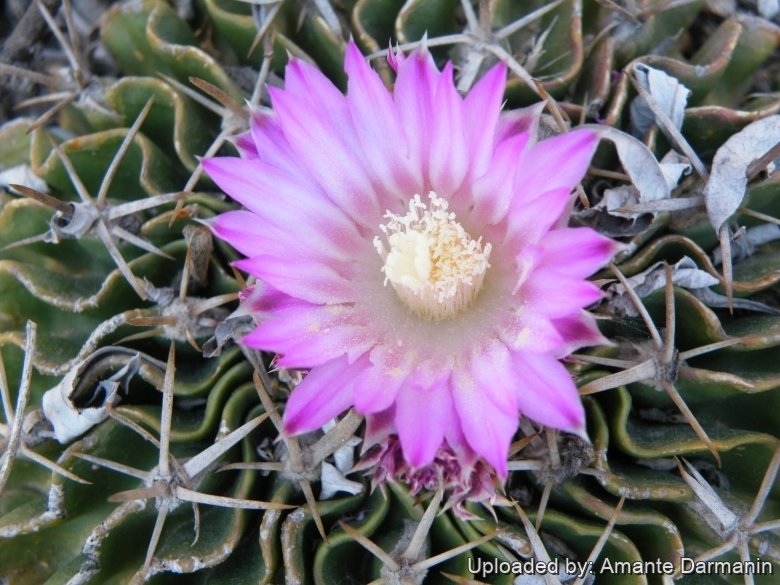
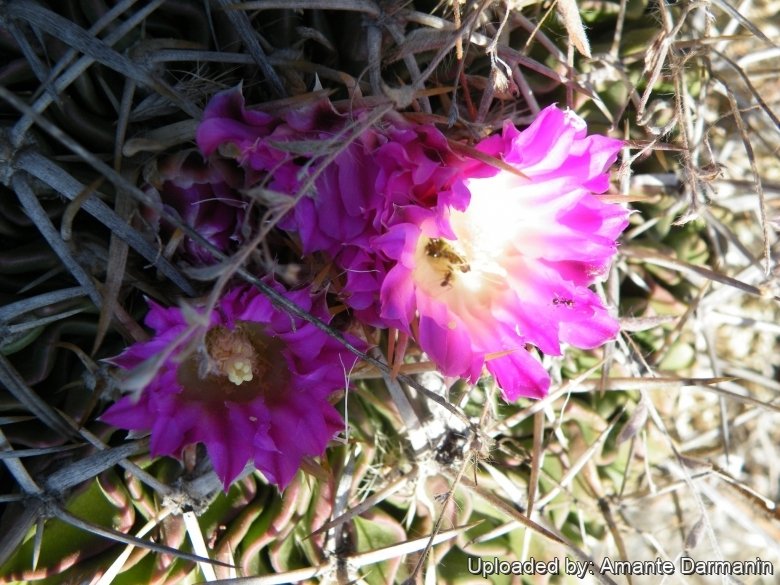
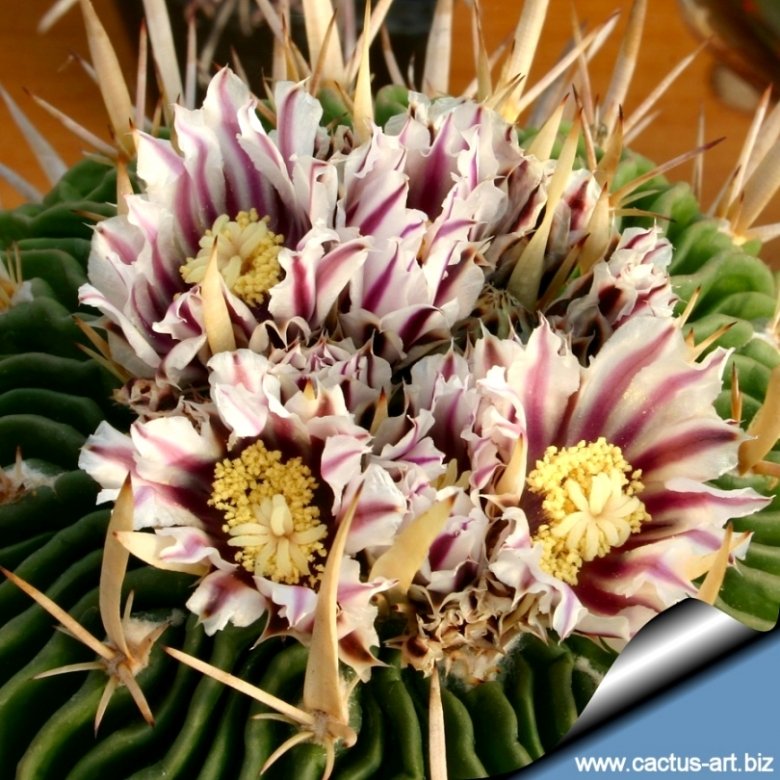
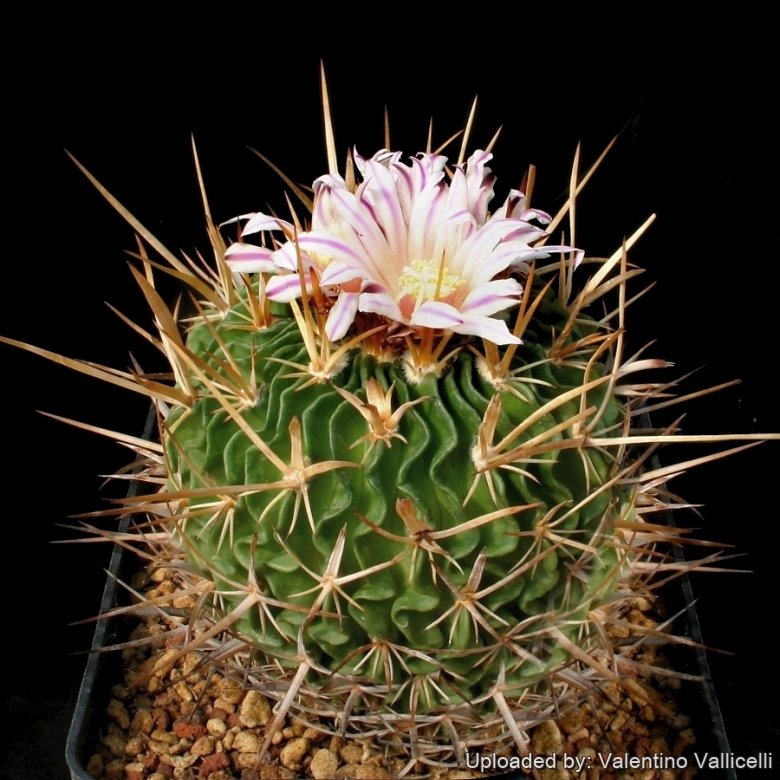
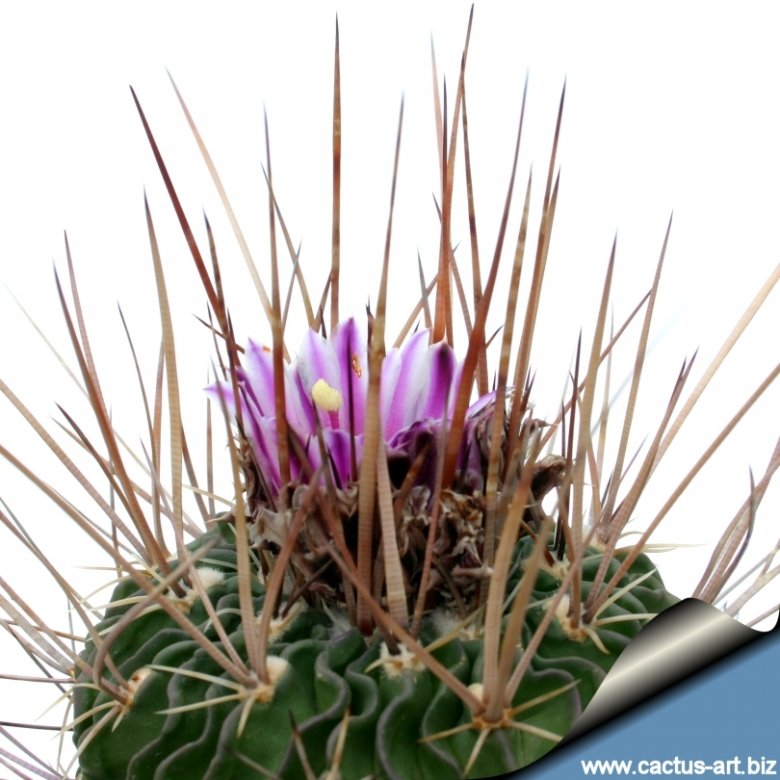
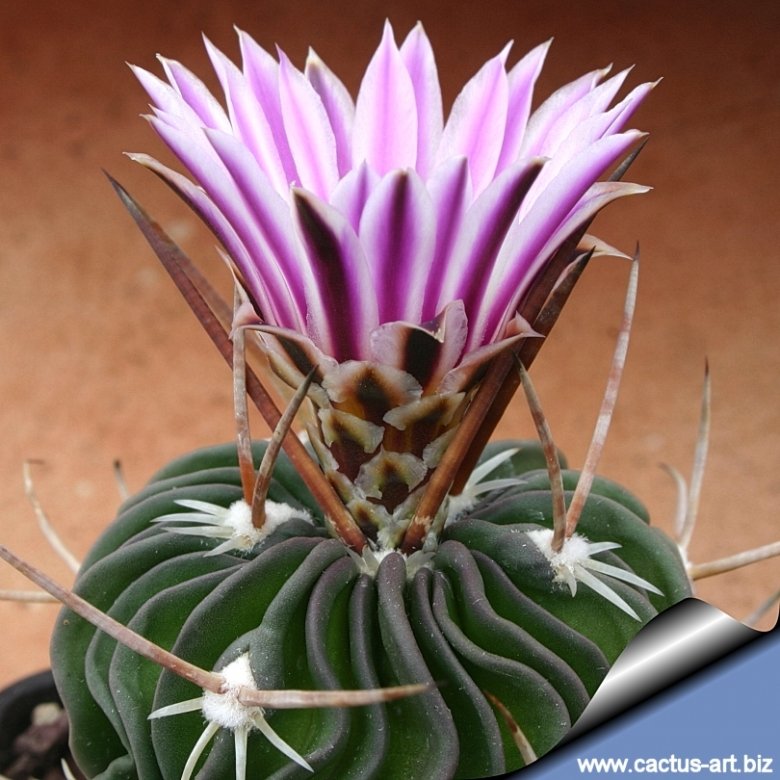
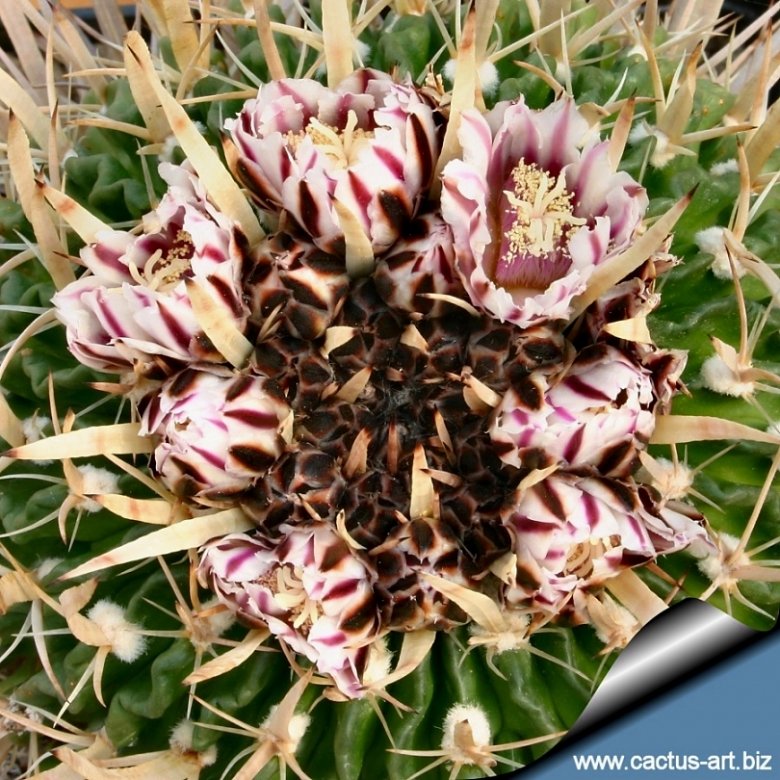
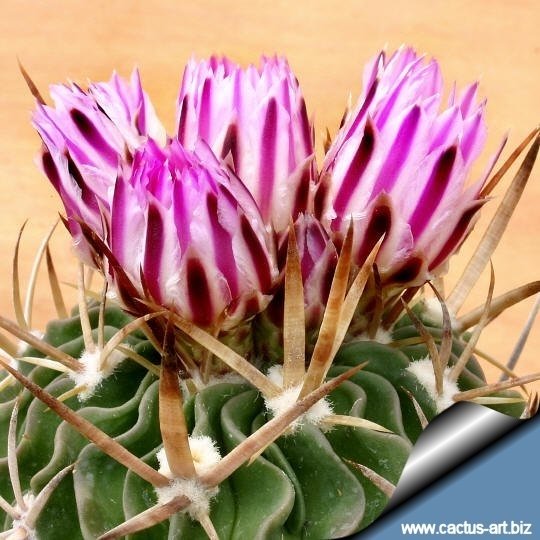
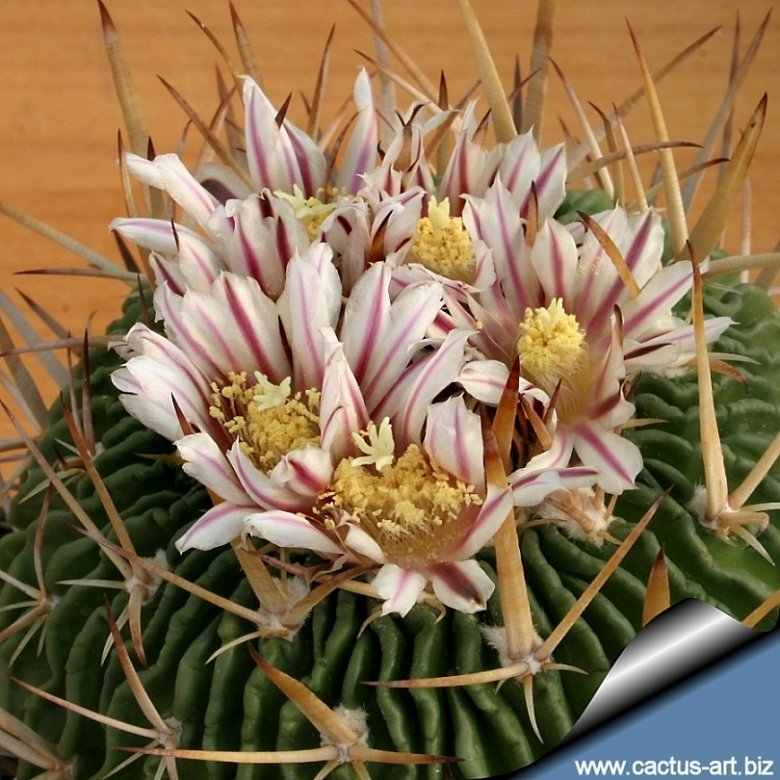
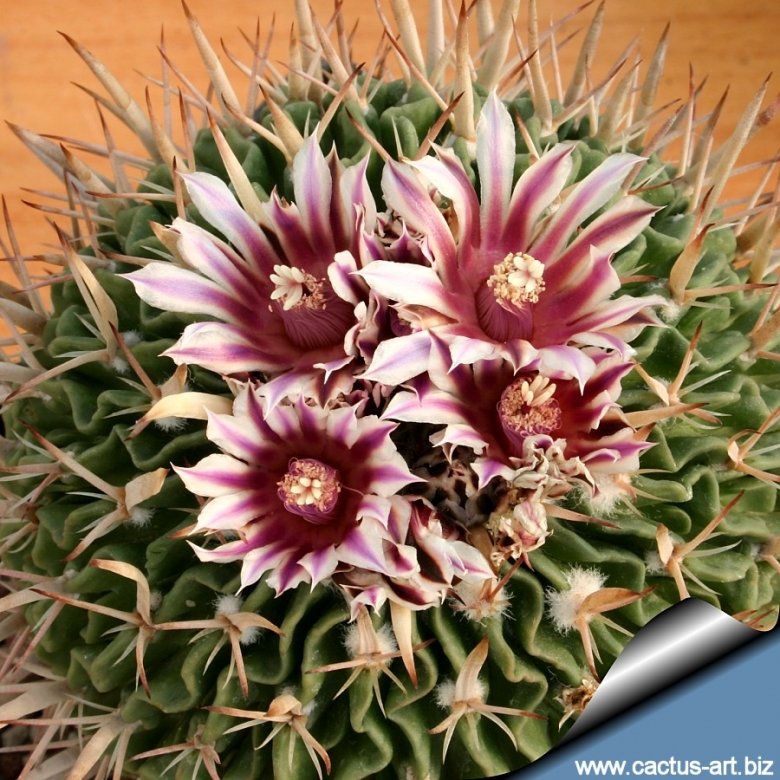
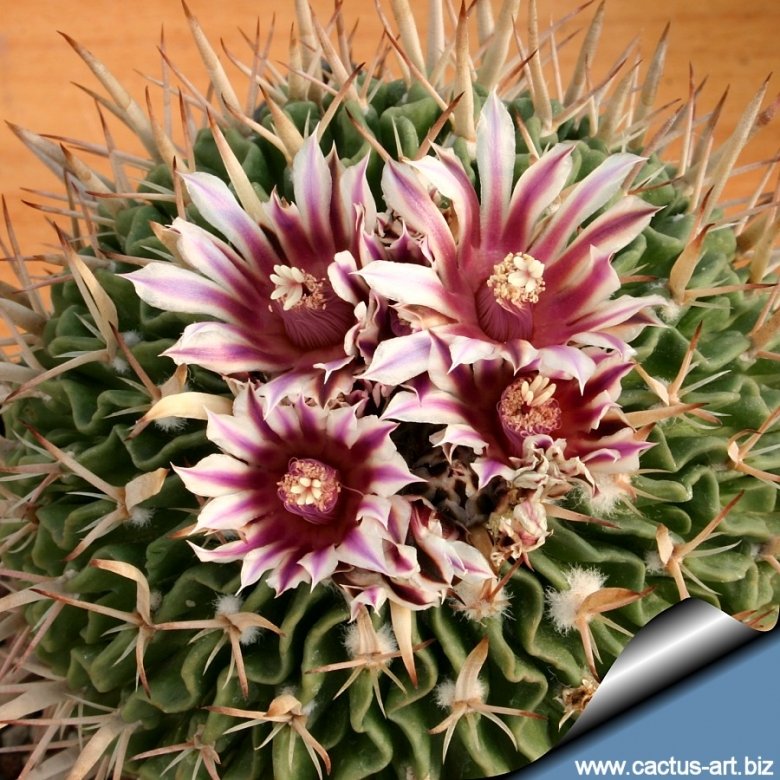
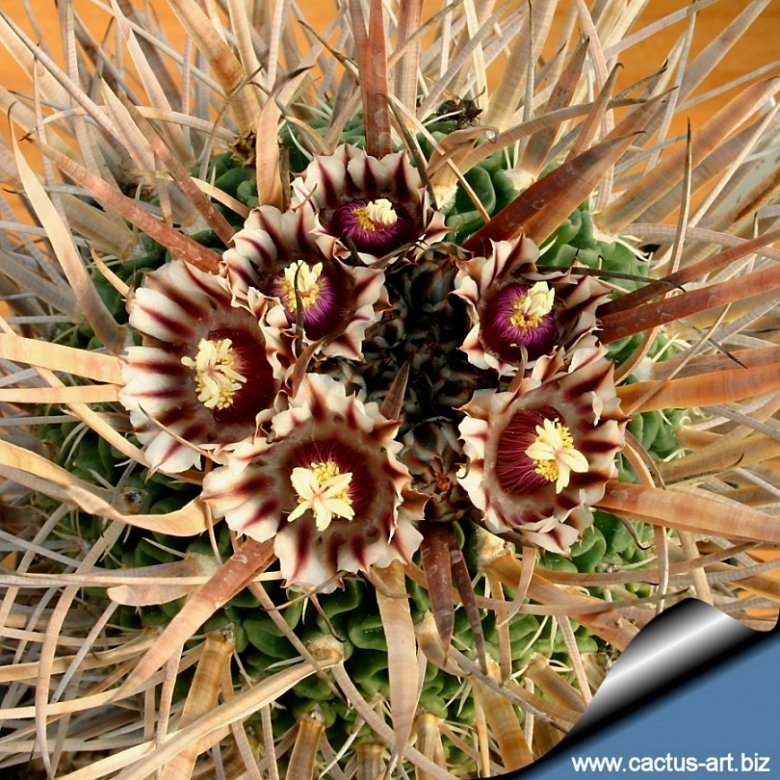
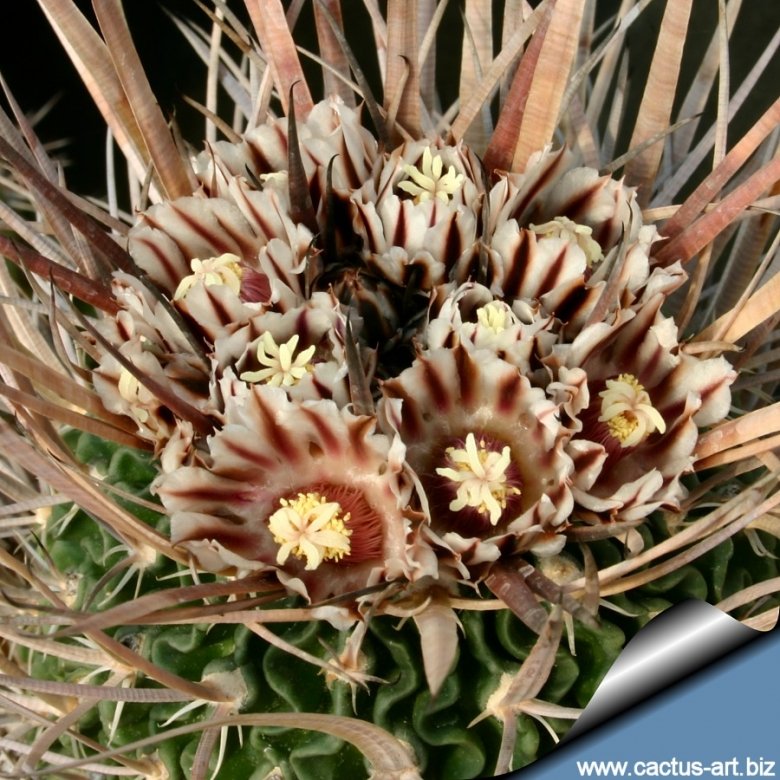
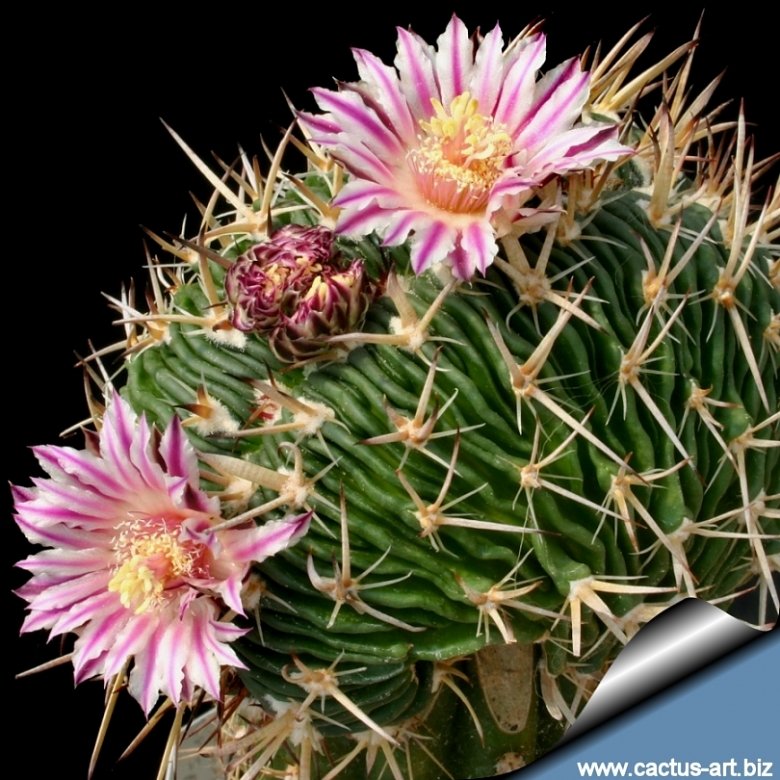
Flowers: Central, rather small, up to 4 cm long, funnel-shaped. Perianth segments in two series, pale pink with a purplish midrib, oblong-linear, acute. Flower tube well developed, covered with imbricating scales.
Blooming season: Late spring to summer.
Fruits: 8-12 mm long, 4-6 mm wide, obovoid reddish to greysh, dry at maturity.
Seeds: 1 mm long x 0,9 mm wide, pyriform to reniform, black. Head with celled and wavy wall.
Origin and Habitat
Hidalgo, Queretaro, Veracruzm, Mexico, Oaxaca and puebla, north and central Mexico.
Altitude: 1500-2600 metres above sea level.
Habitat: Mattoral xerophilo, pastizal and open juniper-pinion forests.
Cultivation and Propagation
Stenocactus crispatus is easy to to care cactus, recommended for any collection that needs lots of light with ample airflow.
Growth rate: It is small growing and easy to to care and very willing to flower. Because of it’s small size makes a great potted plant specimen, great for beginning collectors.
Soils: It needs regular cacti soil with little organic matter (peat, humus). Good drainage is essential along with good moisture retention properties and adequate nutrients availability.
Repotting: Repotting every other year. As it is especially prone to rot under-pot in a smaller container filled with very porous compost. Use pot with good drainage.
Watering: No absolute schedule can be given for watering as various factors (Soil mixture, containers, drainage, temperature, size of plant) influence water use, so - as a general rule - the soil should be thoroughly wetted at each watering during the active growing season (spring and summer), water when the top 1,5- 2 cm of soil feels dry to the finger. Do not soak the soil during the dormant period. Be careful, excessive watering can make root and/or stem to rots. Make sure there is good air circulation between plants. Care must be taken with watering as they tends to become swollen and untidy in growth habit if given too much water and shade.
Fertilization: During the growing season enrich the soil using a fertilizer rich in potassium and phosphorous, but poor in nitrogen, because this chemical element doesn’t help the development of succulent plants, making them too soft and full of water.
Hardiness: Reputedly sensitive to frost , but less so if kept on the dry side prior to, and during, cold weather (hardy to -5° C for short periods). However some warmth throughout the year will increase the grower’s success (minimum 5° C during rest season). These cool temperatures develop sturdier plants and encourage the formation of flower buds.
Exposition: Outside bright sun it likes strong sunshine, but is tolerant and do well with light shade during the hot Summer months, inside it needs bright light, and some direct sun. Subject to sunburn if exposed to direct sun for too long. Tends to bronze in strong light, which encourages flowering and heavy wool and spine production.
Uses: It is an excellent plant for container growing. It always looks good and stays small. It look fine in a cold greenhouse and frame.
Pests & diseases: It may be attractive to a variety of insects, but plants in good condition should be nearly pest-free, particularly if they are grown in a mineral potting-mix, with good exposure and ventilation. Nonetheless, there are several pests to watch for:
- Red spiders: Sensitive to red spider mite. Overhead watering is helpful in controlling mites.
- Mealy bugs: Occasionally mealy bugs they develop aerial into the new growth among the wool with disfiguring results, but the worst types develop underground on the roots and are invisible except by their effects.
- Scales: Scales are rarely a problem.
- Rot: Rot it is only a minor problem with cacti if the plants are watered and “aired” correctly. If they are not, fungicides won’t help all that much.
Propagation: Seeds (usually) or by the shoots of adult plants (if available). Seeds germinate in 7-14 days at 21-27° C in spring, remove the glass cover gradually as the plants develops and keep ventilated, no full sun for young plants! The seedlings should not be disturbed until they are well rooted, after which they can be planted separately in small pots. Cuttings of healthy shoots can be taken in the spring and summer. Cut the stem with a sharp, sterile knife, leave the cutting in a warm, dry place for a week or weeks (depending on how thick the cutting is). This permits the cut surface to heal, or callus. The callus helps prevent rotting when the cutting is placed in the rooting material. Once the callus forms, the cutting may be inserted in a container filled with firmed cactus potting mix topped with a surface layer of coarse grit. They should be placed in the coarse grit only; this prevents the cut end from becoming too wet and allows the roots to penetrate the rich compost underneath. The cuttings should root in 2 to 6 weeks.
Notes
Stenocacti are commonly called wave or brain cacti because of their crinkly appearance. Because the undulating ribs on this small, spherical cactus are so numerous and so closely spaced that most of what you see is the wavy brain-like surface of the plant.
Bibliography
Major references and further lectures
-
Friedrich Ritter “Kakteen in Südamerika Ergebnisse meiner 20jährigen Feldforschungen: Volume 4: Peru” 1981
-
Edward Anderson “The Cactus family” Timber Press, Incorporated, 2001
-
James Cullen, Sabina G. Knees, H. Suzanne Cubey “The European Garden Flora Flowering Plants: A Manual for the Identification of Plants Cultivated in Europe, Both Out-of-Doors and Under Glass” Cambridge University Press, 11/Aug/2011
-
David R Hunt; Nigel P Taylor; Graham Charles; International Cactaceae Systematics Group. “The New Cactus Lexicon” dh books, 2006
-
Hans Hecht “Cacti & succulents” Sterling Pub. Co., 1997
-
Walther Haage “Kakteen von A bis Z” , Quelle & Meyer Verlag: Heidelberg, 1986
-
Urs Eggli “Das große Kakteen-Lexikon” Ulmer, Stuttgart 2005
-
David Hunt “CITES Cactaceae Checklist” Second Edition. 1999
-
Nigel Paul Taylor “A commentary on the genus Echinofossulocactus Lawr.” In: Cactus and Succulent Journal of Great Britain. Volume 41, page 35–42 1979
From llifle page Brittonrosea anfractuosa
Description
Echinofossulocactus (Stenocactus) anfractuosus is a synonym of Stenocactus crispatus. The plant found in cultivation are quite variable, and the dissimilarity among seedlings spination may be considerable.
Habit: It is a perennial stem succulent growing solitary (or rarely branching from the base).
Stem: Vimple, somewhat longer than broad, 12.5 cm long, 6 cm in diameter, dull green.
Ribs: Approximately 30, thin, compressed, wavy, each bearing only a few areoles.
Spines. Somewhat curved, straw-colored with brown tips.
Radial spines: 7, the lowermost 4 weaker and smaller, the uppermost 3 (or 2) to 3 cm long, much larger, round or (the central) flattened.
Central spines: Solitary, about 2,5 cm long, light brown.
Flowers: The perianth-segments purple with white margins.
Remarks: Identifying the species of an Echinofossulocactus is as difficult as identifying the genus is easy. For the most part, they tend to look alike, and there are far more names than there are species.
Origin and Habitat
Mexico (Hidalgo). Between Pachuca and Ixmiquilpan and adjacent areas.
Cultivation and Propagation
Stenocactus kellerianus is easy to to care cactus, recommended for any collection that needs lots of light with ample airflow.
Growth rate: It is small growing and easy to to care and very willing to flower. Because of it’s small size makes a great potted plant specimen, great for beginning collectors.
Soils: It needs regular cacti soil with little organic matter (peat, humus). Good drainage is essential along with good moisture retention properties and adequate nutrients availability.
Repotting: Repotting every other year. As it is especially prone to rot under-pot in a smaller container filled with very porous compost. Use pot with good drainage.
Watering: No absolute schedule can be given for watering as various factors (Soil mixture, containers, drainage, temperature, size of plant) influence water use, so - as a general rule - the soil should be thoroughly wetted at each watering during the active growing season (spring and summer), water when the top 1,5- 2 cm of soil feels dry to the finger. Do not soak the soil during the dormant period. Be careful, excessive watering can make root and/or stem to rots. Make sure there is good air circulation between plants. Care must be taken with watering as they tends to become swollen and untidy in growth habit if given too much water and shade.
Fertilization: During the growing season enrich the soil using a fertilizer rich in potassium and phosphorous, but poor in nitrogen, because this chemical element doesn’t help the development of succulent plants, making them too soft and full of water.
Hardiness: Reputedly sensitive to frost , but less so if kept on the dry side prior to, and during, cold weather (hardy to -5° C for short periods). However some warmth throughout the year will increase the grower’s success (minimum 5° C during rest season). These cool temperatures develop sturdier plants and encourage the formation of flower buds.
Exposition: Outside bright sun it likes strong sunshine, but is tolerant and do well with light shade during the hot Summer months, inside it needs bright light, and some direct sun. Subject to sunburn if exposed to direct sun for too long. Tends to bronze in strong light, which encourages flowering and heavy wool and spine production.
Uses: It is an excellent plant for container growing. It always looks good and stays small. It look fine in a cold greenhouse and frame.
Pests & diseases: It may be attractive to a variety of insects, but plants in good condition should be nearly pest-free, particularly if they are grown in a mineral potting-mix, with good exposure and ventilation. Nonetheless, there are several pests to watch for:
- Red spiders: Sensitive to red spider mite. Overhead watering is helpful in controlling mites.
- Mealy bugs: Occasionally mealy bugs they develop aerial into the new growth among the wool with disfiguring results, but the worst types develop underground on the roots and are invisible except by their effects.
- Scales: Scales are rarely a problem.
- Rot: Rot it is only a minor problem with cacti if the plants are watered and “aired” correctly. If they are not, fungicides won’t help all that much.
Propagation: Seeds (usually) or by the shoots of adult plants (if available). Seeds germinate in 7-14 days at 21-27° C in spring, remove the glass cover gradually as the plants develops and keep ventilated, no full sun for young plants! The seedlings should not be disturbed until they are well rooted, after which they can be planted separately in small pots. Cuttings of healthy shoots can be taken in the spring and summer. Cut the stem with a sharp, sterile knife, leave the cutting in a warm, dry place for a week or weeks (depending on how thick the cutting is). This permits the cut surface to heal, or callus. The callus helps prevent rotting when the cutting is placed in the rooting material. Once the callus forms, the cutting may be inserted in a container filled with firmed cactus potting mix topped with a surface layer of coarse grit. They should be placed in the coarse grit only; this prevents the cut end from becoming too wet and allows the roots to penetrate the rich compost underneath. The cuttings should root in 2 to 6 weeks.
Bibliography
Major references and further lectures
-
Nathaniel Lord Britton, Joseph Nelson Rose “The Cactaceae: Descriptions and Illustrations of Plants of the Cactus Family” Volume 3, 1922
-
Edward Anderson “The Cactus family” Timber Press, Incorporated, 2001
-
James Cullen, Sabina G. Knees, H. Suzanne Cubey “The European Garden Flora Flowering Plants: A Manual for the Identification of Plants Cultivated in Europe, Both Out-of-Doors and Under Glass” Cambridge University Press, 11/Aug/2011
-
David R Hunt; Nigel P Taylor; Graham Charles; International Cactaceae Systematics Group. “The New Cactus Lexicon” dh books, 2006
-
Hans Hecht “Cacti & succulents” Sterling Pub. Co., 1997
-
Walther Haage “Kakteen von A bis Z” , Quelle & Meyer Verlag: Heidelberg, 1986
-
Urs Eggli “Das große Kakteen-Lexikon” Ulmer, Stuttgart 2005
-
David Hunt “CITES Cactaceae Checklist” Second Edition. 1999
-
Nigel Paul Taylor “A commentary on the genus Echinofossulocactus Lawr.” In: Cactus and Succulent Journal of Great Britain. Volume 41, page 35–42 1979
-
Friedrich Ritter “Kakteen in Südamerika Ergebnisse meiner 20jährigen Feldforschungen: Volume 4: Peru” 1981
Source: Brittonrosea anfractuosa, LLIFLE - Encyclopedia of living forms, CC-BY-SA, retrieved 2026-10-25.
From llifle page Brittonrosea arrigens
Description
Stenocactus arrigensis (Formerly known as Echinofossulocactus arrigensis) is one of the species with the prettiest spination, spine are flattened, ferocious-looking with one very long central spine (up to 7-9 cm long) directed upwards. The ribs are thin with very undulated or curled ridges. Stenocactus arrigensis is to all intents and purposes a synonym of Stenocactus crispatus. The plant still found in cultivation under the name of Stenocactus arrigensis are quite variable and the dissimilarity among seedlings spination may be considerable.
Habit: It is a perennial stem succulent growing solitary (or rarely branching from the base).
Stem: Up to 20 cm tall, 10 cm wide, globose, obovoid or short-cylindric, somewhat depressed at apex, bluish-green, dark matt green or dark olive-green.
Ribs: (25-)30-60(-80) thin, more or less folded, with very regularly and attractively waived, depressed in the region of areoles. The flattened, wavy or curled ridges of this species are characteristic of other kinds of Echinofossulocactus.
Areoles: 1 to 3 in each ribs, woolly in youth, later naked.
Radial spines: Usually 4 to 6 flattened, whitish to brownish, 0,5 to 1 cm long and about 0,6-1 mm wide at the base.
Central spine: 3-4 very flattened, whitish, yellowish, brownish to almost black, often darker at the tip, directed upwards ± rigid, ferocious-looking, straight or curved, unequal with one very long (from 1 to 10 cm long) and 1-5 mm wide at the base
Flowers: Central, rather small, up to 4 cm long, funnel-shaped. Perianth segments in two series, pale pink with a purplish midrib, oblong-linear, acute. Flower tube well developed, covered with imbricating scales.
Blooming season: Late spring to summer.
Fruits: 8-12 mm long, 4-6 mm wide, obovoid reddish to greysh, dry at maturity.
Seeds: 1 mm long x 0,9 mm wide, pyriform to reniform, black. Head with celled and wavy wall.
Remarks: Identifying the species of an Echinofossulocactus is as difficult as identifying the genus is easy. For the most part, they tend to look alike, and there are far more names than there are species.
Cultivation and Propagation
Stenocactus arrigens is easy to to care cactus, recommended for any collection that needs lots of light with ample airflow.
Growth rate: It is a small growing, but easily flowering species.
Soils: It needs regular cacti soil with little organic matter (peat, humus).
Repotting: Repotting every other year. As it is especially prone to rot under-pot in a smaller container filled with very porous compost. Use pot with good drainage.
Watering: Water regularly in summer, but do not overwater (very wet-sensitively, especially in light of its succulent root system), allow to dry between watering. Its roots are easily lost in pots that stay damp for any length of time. It should not be watered at all in winter. In the rest period no high atmospheric humidity!! Care must be taken with watering as they tends to become swollen and untidy in growth habit if given too much water and shade.
Fertilization: During the growing season enrich the soil using a fertilizer rich in potassium and phosphorous, but poor in nitrogen, because this chemical element doesn’t help the development of succulent plants, making them too soft and full of water.
Hardiness: Reputedly sensitive to frost , but less so if kept on the dry side prior to, and during, cold weather (hardy to -5° C for short periods). However some warmth throughout the year will increase the grower’s success (minimum 5° to 8°C during rest season).
Exposition: Outside bright sun it likes strong sunshine, but is tolerant and do well with light shade during the hot Summer months, inside it needs bright light, and some direct sun. Subject to sunburn if exposed to direct sun for too long. Tends to bronze in strong light, which encourages flowering and heavy wool and spine production.
Uses: It is an excellent plant for container growing. It always looks good and stays small. It look fine in a cold greenhouse and frame.
Pests & diseases: It may be attractive to a variety of insects, but plants in good condition should be nearly pest-free, particularly if they are grown in a mineral potting-mix, with good exposure and ventilation. Nonetheless, there are several pests to watch for:
- Red spiders: Sensitive to red spider mite. Overhead watering is helpful in controlling mites.
- Mealy bugs: Occasionally mealy bugs they develop aerial into the new growth among the wool with disfiguring results, but the worst types develop underground on the roots and are invisible except by their effects.
- Scales: Scales are rarely a problem.
- Rot: Rot it is only a minor problem with cacti if the plants are watered and “aired” correctly. If they are not, fungicides won’t help all that much.
Propagation: Seeds (usually). Seeds germinate in 7-14 days at 21-27° C in spring, remove the glass cover gradually as the plants develops and keep ventilated, no full sun for young plants! The seedlings should not be disturbed until they are well rooted, after which they can be planted separately in small pots.
Source: Brittonrosea arrigens, LLIFLE - Encyclopedia of living forms, CC-BY-SA, retrieved 2026-10-25.
From llifle page Brittonrosea dichroacantha
Description
Stenocactus dichroacanthus is one of the many geographical form of the widespread and morphologically very variable Stenocactus crispatus. Many of its morphological and geographical variant was early classified as different independent species, but nowadays all this plant are considered part of a multiform species, where each form is linked to others by populations of plants with intermediate characteristics. Stenocactus dichroacanthus typically has 3 strong flattened central spines and 4-6 glassy-white radial spines.
Habit: It is a solitary plant (or rarely branching).
Stem: Obovoid up to 15 cm tall, 10 cm wide, somewhat umbilicated at apex, yellowish green, bluish-green, dark matt green or dark olive-green.
Ribs: (25-)30-60(-80) thin, acute, very regularly and attractively waived and depressed in the region of areoles. The flattened, wavy or curled ridges of this species are characteristic of other kinds of Echinofossulocactus.
Areoles: Only a few in each ribs, white tomentose in youth, later naked.
Radial spines: Usually 4 to 6 flattened, whitish to brownish, 0,5 to 1 cm long and about 0,6-1 mm wide at the base.
Central spine: 2-3 very flattened, purplish, directed upwards, ferocious-looking, straight or curved, unequal with one very long.
Radial spines: 4 to 6 glassy-white.
Flowers: Several at a time at plants apex, rather small, 2-4 cm long, funnel-shaped. Perianth segments in two series, pale pink with a purplish midrib, oblong-linear, acute. Flower tube well developed, covered with imbricating scales.
Blooming season: Late spring to summer.
Fruits: 8-12 mm long, 4-6 mm wide, obovoid reddish to greysh, dry at maturity.
Origin and Habitat
Hidalgo, San Luis Potosí, Querétaro, Mexico
Altitude: 1500-2500
Habitat: It grows in the Mattoral xerophilo, pastizal and open juniper-pinion forests. These areas support succulents and xerophytes plants such as Opuntia robusta, Opuntia streptacantha, Opuntia tunicata, Opuntia scheeri, Ferocactus histrix, Ferocactus latispinus, Thelocactus bicolor, Echinocereus cinerascens, Parkinsonia aculeata, Myrtillocactus geometrizans, Coryphantha erecta, Coryphantha radians, Acacia farinosa, Ipomoea arborescens, Echinocactus platyacanthus, Echinocactus horizonthalonius, Larrea tridentata, Echeveria secunda and Dasylirion acrotichum.
Cultivation and Propagation
Stenocactus dochroacanthus is easy to to care cactus, recommended for any collection that needs lots of light with ample airflow.
Growth rate: It is small growing and easy to to care and very willing to flower. Because of it’s small size makes a great potted plant specimen, great for beginning collectors.
Soils: It needs regular cacti soil with little organic matter (peat, humus). Good drainage is essential along with good moisture retention properties and adequate nutrients availability.
Repotting: Repotting every other year. As it is especially prone to rot under-pot in a smaller container filled with very porous compost. Use pot with good drainage.
Watering: No absolute schedule can be given for watering as various factors (Soil mixture, containers, drainage, temperature, size of plant) influence water use, so - as a general rule - the soil should be thoroughly wetted at each watering during the active growing season (spring and summer), water when the top 1,5- 2 cm of soil feels dry to the finger. Do not soak the soil during the dormant period. Be careful, excessive watering can make root and/or stem to rots. Make sure there is good air circulation between plants. Care must be taken with watering as they tends to become swollen and untidy in growth habit if given too much water and shade.
Fertilization: During the growing season enrich the soil using a fertilizer rich in potassium and phosphorous, but poor in nitrogen, because this chemical element doesn’t help the development of succulent plants, making them too soft and full of water.
Hardiness: Reputedly sensitive to frost , but less so if kept on the dry side prior to, and during, cold weather (hardy to -5° C for short periods). However some warmth throughout the year will increase the grower’s success (minimum 5° C during rest season). These cool temperatures develop sturdier plants and encourage the formation of flower buds.
Exposition: Outside bright sun it likes strong sunshine, but is tolerant and do well with light shade during the hot Summer months, inside it needs bright light, and some direct sun. Subject to sunburn if exposed to direct sun for too long. Tends to bronze in strong light, which encourages flowering and heavy wool and spine production.
Uses: It is an excellent plant for container growing. It always looks good and stays small. It look fine in a cold greenhouse and frame.
Pests & diseases: It may be attractive to a variety of insects, but plants in good condition should be nearly pest-free, particularly if they are grown in a mineral potting-mix, with good exposure and ventilation. Nonetheless, there are several pests to watch for:
- Red spiders: Sensitive to red spider mite. Overhead watering is helpful in controlling mites.
- Mealy bugs: Occasionally mealy bugs they develop aerial into the new growth among the wool with disfiguring results, but the worst types develop underground on the roots and are invisible except by their effects.
- Scales: Scales are rarely a problem.
- Rot: Rot it is only a minor problem with cacti if the plants are watered and “aired” correctly. If they are not, fungicides won’t help all that much.
Propagation: Seeds (usually) or by the shoots of adult plants (if available). Seeds germinate in 7-14 days at 21-27° C in spring, remove the glass cover gradually as the plants develops and keep ventilated, no full sun for young plants! The seedlings should not be disturbed until they are well rooted, after which they can be planted separately in small pots. Cuttings of healthy shoots can be taken in the spring and summer. Cut the stem with a sharp, sterile knife, leave the cutting in a warm, dry place for a week or weeks (depending on how thick the cutting is). This permits the cut surface to heal, or callus. The callus helps prevent rotting when the cutting is placed in the rooting material. Once the callus forms, the cutting may be inserted in a container filled with firmed cactus potting mix topped with a surface layer of coarse grit. They should be placed in the coarse grit only; this prevents the cut end from becoming too wet and allows the roots to penetrate the rich compost underneath. The cuttings should root in 2 to 6 weeks.
Notes
Identifying the species of a Stenocactus (Echinofossulocactus) is as difficult as identifying the genus is easy. For the most part, they tend to look alike, and there are far more names than there are species.
Bibliography
Major references and further lectures
-
Nigel Paul Taylor “A commentary on the genus Echinofossulocactus Lawr.” In: Cactus and Succulent Journal of Great Britain. Volume 41, page 35–42 1979
-
Edward Anderson “The Cactus family” Timber Press, Incorporated, 2001
-
James Cullen, Sabina G. Knees, H. Suzanne Cubey “The European Garden Flora Flowering Plants: A Manual for the Identification of Plants Cultivated in Europe, Both Out-of-Doors and Under Glass” Cambridge University Press, 11/Aug/2011
-
David R Hunt; Nigel P Taylor; Graham Charles; International Cactaceae Systematics Group. “The New Cactus Lexicon” dh books, 2006
-
Hans Hecht “Cacti & succulents” Sterling Pub. Co., 1997
-
Walther Haage “Kakteen von A bis Z” , Quelle & Meyer Verlag: Heidelberg, 1986
-
Urs Eggli “Das große Kakteen-Lexikon” Ulmer, Stuttgart 2005
-
David Hunt “CITES Cactaceae Checklist” Second Edition. 1999
-
Innes C, Wall B. “Cacti, Succulents and Bromeliads” Cassell & The Royal Horticultural Society. 1995
-
Backeberg C. “Die Cactaceae” Volume-6, Jena 1963
-
Backeberg C. “Das Kakteenlexikon” Jena 1966
-
Rauh W. ” Kakteen an ihren Standorten”, Berlin-Hamburg, 1979
Source: Brittonrosea dichroacantha, LLIFLE - Encyclopedia of living forms, CC-BY-SA, retrieved 2026-10-25.
From llifle page Brittonrosea gladiata
Description
Stenocactus gladiatus (Formerly known as Echinofossulocactus gladiatus) is one of the many geographical form of the widespread and morphologically variable Stenocactus fasciculatus. Many of its morphological and geographical variant was early classified as different independent species, but nowadays all this plant are considered part of a multiform species, where each form is linked to others by populations of plants with intermediate characteristics. The name Stenocactus gladiatus is used to indicate plants characterized by large, wide and flat central spines directed upwards, but similar plants with wide and flat central spines are commonly found in other populations and to all intents and purposes it is a synonym of Stenocactus crispatus. The wavy dark matt green ribs contrasting vividly with the pale wool of the new areoles. The plant still found in cultivation under the name of Stenocactus gladiatus are quite variable and the dissimilarity among seedlings spination may be considerable.
Stem: Ovoid to oblong ca. 12 cm tall, 10 cm in diameter, brightly bluish-green.
Ribs: 14-22 (or more: to 30).
Radial spines: 4-6 on the lower par of the areole, straight, glassy, 8-12 mm long, and 3 reddish-grey in the upper part of areole of which the central one is flat-pressed directed upward up to 3 cm long the lateral are shorter.
Central spines: 1 Horn coloured right-angled, with dark tip, longer and more rigid, directed upward up to 4 cm long.
Flowers: White with carmine- red central strip (or yellowish?), about 2 cm long and wide.
Origin and Habitat
Hidalgo, Mexico
Cultivation and Propagation
Stenocactus gladiatus is easy to to care cactus, recommended for any collection that needs lots of light with ample airflow.
Growth rate: It is small growing and easy to to care and very willing to flower. Because of it’s small size makes a great potted plant specimen, great for beginning collectors.
Soils: It needs regular cacti soil with little organic matter (peat, humus). Good drainage is essential along with good moisture retention properties and adequate nutrients availability.
Repotting: Repotting every other year. As it is especially prone to rot under-pot in a smaller container filled with very porous compost. Use pot with good drainage.
Watering: No absolute schedule can be given for watering as various factors (Soil mixture, containers, drainage, temperature, size of plant) influence water use, so - as a general rule - the soil should be thoroughly wetted at each watering during the active growing season (spring and summer), water when the top 1,5- 2 cm of soil feels dry to the finger. Do not soak the soil during the dormant period. Be careful, excessive watering can make root and/or stem to rots. Make sure there is good air circulation between plants. Care must be taken with watering as they tends to become swollen and untidy in growth habit if given too much water and shade.
Fertilization: During the growing season enrich the soil using a fertilizer rich in potassium and phosphorous, but poor in nitrogen, because this chemical element doesn’t help the development of succulent plants, making them too soft and full of water.
Hardiness: Reputedly sensitive to frost , but less so if kept on the dry side prior to, and during, cold weather (hardy to -5° C for short periods). However some warmth throughout the year will increase the grower’s success (minimum 5° C during rest season). These cool temperatures develop sturdier plants and encourage the formation of flower buds.
Exposition: Outside bright sun it likes strong sunshine, but is tolerant and do well with light shade during the hot Summer months, inside it needs bright light, and some direct sun. Subject to sunburn if exposed to direct sun for too long. Tends to bronze in strong light, which encourages flowering and heavy wool and spine production.
Uses: It is an excellent plant for container growing. It always looks good and stays small. It look fine in a cold greenhouse and frame.
Pests & diseases: It may be attractive to a variety of insects, but plants in good condition should be nearly pest-free, particularly if they are grown in a mineral potting-mix, with good exposure and ventilation. Nonetheless, there are several pests to watch for:
- Red spiders: Sensitive to red spider mite. Overhead watering is helpful in controlling mites.
- Mealy bugs: Occasionally mealy bugs they develop aerial into the new growth among the wool with disfiguring results, but the worst types develop underground on the roots and are invisible except by their effects.
- Scales: Scales are rarely a problem.
- Rot: Rot it is only a minor problem with cacti if the plants are watered and “aired” correctly. If they are not, fungicides won’t help all that much.
Propagation: Seeds (usually) or by the shoots of adult plants (if available). Seeds germinate in 7-14 days at 21-27° C in spring, remove the glass cover gradually as the plants develops and keep ventilated, no full sun for young plants! The seedlings should not be disturbed until they are well rooted, after which they can be planted separately in small pots. Cuttings of healthy shoots can be taken in the spring and summer. Cut the stem with a sharp, sterile knife, leave the cutting in a warm, dry place for a week or weeks (depending on how thick the cutting is). This permits the cut surface to heal, or callus. The callus helps prevent rotting when the cutting is placed in the rooting material. Once the callus forms, the cutting may be inserted in a container filled with firmed cactus potting mix topped with a surface layer of coarse grit. They should be placed in the coarse grit only; this prevents the cut end from becoming too wet and allows the roots to penetrate the rich compost underneath. The cuttings should root in 2 to 6 weeks.
Notes
Plant with wide flat central spines labelled (Echinofossulocactus) Stenocactus gladiatus are frequently seen in cultivation and in nurseries catalogues, but the descriptions of this species by individual authors are so different, that it is doubtful, if this name is correct. S. gladiatus is in fact very similar (if not the same) to Stenocactus crispatus and particularly to Stenocactus violaciflorus, but this description fit also for Stenocactus lamellosus. By the other hand other authors say that this name probably does not apply to a member of this genus.
.Identifying the species of an Echinofossulocactus is as difficult as identifying the genus is easy. For the most part, they tend to look alike, and there are far more names than there are species.
Source: Brittonrosea gladiata, LLIFLE - Encyclopedia of living forms, CC-BY-SA, retrieved 2026-10-25.
From llifle page Brittonrosea grandicornis
Description
The so called “grandicornis” is a solitary (or rarely branching) plant, considered by many only one of the many forms of Stenocactus crispatus. It is characterized by particularly long central spines and wavy ribs. The plant found in cultivation are quite variable, and the dissimilarity among seedlings spination may be considerable.
Stem: Up to 20 cm tall, 10 cm wide, globose, short-cylindric or obovoid, somewhat depressed at apex, light green to olive-green.
Ribs: 30-60, thin with very regularly and attractively waived, depressed in the region of areoles. The flattened, wavy or curled ridged of this species are characteristic of other kinds of Echinofossulocactus.
Areoles: 1 to 3 in each ribs, woolly in youth, later naked.
Radial spines: Usually 4 to 6 flattened, whitish to brownish, 0,5 to 1 cm long and about 0,6-1 mm wide at the base.
Central spine: 3-4 very flattened, whitish, yellowish, brownish to almost black, often darker at the tip, directed upwards ± rigid, ferocious-looking, straight or curved, unequal with one very long up to 10 cm long and 1-5 mm wide at the base.
Flowers: Central, funnel-shaped rather small, perianth segments in two series, pale pink with a purplish midrib, oblong-linear, acute. Flower tube covered with imbricated scales.
Blooming season: Late spring to summer.
Fruits: 8-12 mm long, 4-6 mm wide, obovoid reddish to greysh, dry at maturity.
Seeds: 1 mm long x 0,9 mm wide, pyriform to reniform, black. Head with celled and wavy wall.
Origin and Habitat
San Luis Potosi, Mexico.
Cultivation and Propagation
Stenocactus grandicornis is easy to to care cactus, recommended for any collection that needs lots of light with ample airflow.
Growth rate: It is small growing and easy to to care and very willing to flower. Because of it’s small size makes a great potted plant specimen, great for beginning collectors.
Soils: It needs regular cacti soil with little organic matter (peat, humus). Good drainage is essential along with good moisture retention properties and adequate nutrients availability.
Repotting: Repotting every other year. As it is especially prone to rot under-pot in a smaller container filled with very porous compost. Use pot with good drainage.
Watering: No absolute schedule can be given for watering as various factors (Soil mixture, containers, drainage, temperature, size of plant) influence water use, so - as a general rule - the soil should be thoroughly wetted at each watering during the active growing season (spring and summer), water when the top 1,5- 2 cm of soil feels dry to the finger. Do not soak the soil during the dormant period. Be careful, excessive watering can make root and/or stem to rots. Make sure there is good air circulation between plants. Care must be taken with watering as they tends to become swollen and untidy in growth habit if given too much water and shade.
Fertilization: During the growing season enrich the soil using a fertilizer rich in potassium and phosphorous, but poor in nitrogen, because this chemical element doesn’t help the development of succulent plants, making them too soft and full of water.
Hardiness: Reputedly sensitive to frost , but less so if kept on the dry side prior to, and during, cold weather (hardy to -5° C for short periods). However some warmth throughout the year will increase the grower’s success (minimum 5° C during rest season). These cool temperatures develop sturdier plants and encourage the formation of flower buds.
Exposition: Outside bright sun it likes strong sunshine, but is tolerant and do well with light shade during the hot Summer months, inside it needs bright light, and some direct sun. Subject to sunburn if exposed to direct sun for too long. Tends to bronze in strong light, which encourages flowering and heavy wool and spine production.
Uses: It is an excellent plant for container growing. It always looks good and stays small. It look fine in a cold greenhouse and frame.
Pests & diseases: It may be attractive to a variety of insects, but plants in good condition should be nearly pest-free, particularly if they are grown in a mineral potting-mix, with good exposure and ventilation. Nonetheless, there are several pests to watch for:
- Red spiders: Sensitive to red spider mite. Overhead watering is helpful in controlling mites.
- Mealy bugs: Occasionally mealy bugs they develop aerial into the new growth among the wool with disfiguring results, but the worst types develop underground on the roots and are invisible except by their effects.
- Scales: Scales are rarely a problem.
- Rot: Rot it is only a minor problem with cacti if the plants are watered and “aired” correctly. If they are not, fungicides won’t help all that much.
Propagation: Seeds (usually) or by the shoots of adult plants (if available). Seeds germinate in 7-14 days at 21-27° C in spring, remove the glass cover gradually as the plants develops and keep ventilated, no full sun for young plants! The seedlings should not be disturbed until they are well rooted, after which they can be planted separately in small pots. Cuttings of healthy shoots can be taken in the spring and summer. Cut the stem with a sharp, sterile knife, leave the cutting in a warm, dry place for a week or weeks (depending on how thick the cutting is). This permits the cut surface to heal, or callus. The callus helps prevent rotting when the cutting is placed in the rooting material. Once the callus forms, the cutting may be inserted in a container filled with firmed cactus potting mix topped with a surface layer of coarse grit. They should be placed in the coarse grit only; this prevents the cut end from becoming too wet and allows the roots to penetrate the rich compost underneath. The cuttings should root in 2 to 6 weeks.
Bibliography
Major references and further lectures
-
Friedrich Ritter “Kakteen in Südamerika Ergebnisse meiner 20jährigen Feldforschungen: Volume 4: Peru” 1981
-
Edward Anderson “The Cactus family” Timber Press, Incorporated, 2001
-
James Cullen, Sabina G. Knees, H. Suzanne Cubey “The European Garden Flora Flowering Plants: A Manual for the Identification of Plants Cultivated in Europe, Both Out-of-Doors and Under Glass” Cambridge University Press, 11/Aug/2011
-
David R Hunt; Nigel P Taylor; Graham Charles; International Cactaceae Systematics Group. “The New Cactus Lexicon” dh books, 2006
-
Hans Hecht “Cacti & succulents” Sterling Pub. Co., 1997
-
Walther Haage “Kakteen von A bis Z”, Quelle & Meyer Verlag: Heidelberg, 1986
-
Urs Eggli “Das große Kakteen-Lexikon” Ulmer, Stuttgart 2005
-
David Hunt “CITES Cactaceae Checklist” Second Edition. 1999
-
Nigel Paul Taylor “A commentary on the genus Echinofossulocactus Lawr.” In: Cactus and Succulent Journal of Great Britain. Volume 41, page 35–42 1979
Source: Brittonrosea grandicornis, LLIFLE - Encyclopedia of living forms, CC-BY-SA, retrieved 2026-10-25.
From llifle page Brittonrosea hastata
Description
Stenocactus hastatus (Formerly known as Echinofossulocactus hastatus) is one of the many geographical form of the widespread and morphologically variable Stenocactus crispatus. Many of its morphological and geographical variant was early classified as different independent species, but nowadays all this plant are considered part of a multiform species, where each form is linked to others by populations of plants with intermediate characteristics. The name Stenocactus hastatus is used to indicate plants characterized by long rigid and sharp spines, but similar plants are commonly found in other populations and to all intents and purposes it is a synonym of Stenocactus crispatus. The wavy dark matt green ribs contrasting vividly with the pale wool of the new areoles. The plant still found in cultivation under the name of Stenocactus hastatus are quite variable and the dissimilarity among seedlings spination may be considerable.
Solitary cactus with long sharp spines. The plants in cultivation are quite variable.
Stem: Flattened depressed-globose to short cylindrical, light green, 10-12 cm in diameter and tall.
Ribs: Up to 35, wavy with a triangular section, somewhat crenate;
Areoles: With white felt;
Central spines: 1 per areole, solitary, white or pale with brown tips, 4 to 8 cm long, more or less flattened, porrect, rigid and very sharp.
Radial spines: 5 or 6 short yellowish spines, the upper ones longer, up to 3 cm long.
Flowers: Large white or pink (the largest of the genus).
Fruits: becoming dry.
Seeds: Obovate, 1,5 mm long, brownish-grey, shining, finely punctate.
Origin and Habitat
Mexico, Hidalgo (North of Puchuca)
Cultivation and Propagation
Stenocactus hastatus is easy to to care cactus, recommended for any collection that needs lots of light with ample airflow.
Growth rate: It is small growing and easy to to care and very willing to flower. Because of it’s small size makes a great potted plant specimen, great for beginning collectors.
Soils: It needs regular cacti soil with little organic matter (peat, humus). Good drainage is essential along with good moisture retention properties and adequate nutrients availability.
Repotting: Repotting every other year. As it is especially prone to rot under-pot in a smaller container filled with very porous compost. Use pot with good drainage.
Watering: No absolute schedule can be given for watering as various factors (Soil mixture, containers, drainage, temperature, size of plant) influence water use, so - as a general rule - the soil should be thoroughly wetted at each watering during the active growing season (spring and summer), water when the top 1,5- 2 cm of soil feels dry to the finger. Do not soak the soil during the dormant period. Be careful, excessive watering can make root and/or stem to rots. Make sure there is good air circulation between plants. Care must be taken with watering as they tends to become swollen and untidy in growth habit if given too much water and shade.
Fertilization: During the growing season enrich the soil using a fertilizer rich in potassium and phosphorous, but poor in nitrogen, because this chemical element doesn’t help the development of succulent plants, making them too soft and full of water.
Hardiness: Reputedly sensitive to frost , but less so if kept on the dry side prior to, and during, cold weather (hardy to -5° C for short periods). However some warmth throughout the year will increase the grower’s success (minimum 5° C during rest season). These cool temperatures develop sturdier plants and encourage the formation of flower buds.
Exposition: Outside bright sun it likes strong sunshine, but is tolerant and do well with light shade during the hot Summer months, inside it needs bright light, and some direct sun. Subject to sunburn if exposed to direct sun for too long. Tends to bronze in strong light, which encourages flowering and heavy wool and spine production.
Uses: It is an excellent plant for container growing. It always looks good and stays small. It look fine in a cold greenhouse and frame.
Pests & diseases: It may be attractive to a variety of insects, but plants in good condition should be nearly pest-free, particularly if they are grown in a mineral potting-mix, with good exposure and ventilation. Nonetheless, there are several pests to watch for:
- Red spiders: Sensitive to red spider mite. Overhead watering is helpful in controlling mites.
- Mealy bugs: Occasionally mealy bugs they develop aerial into the new growth among the wool with disfiguring results, but the worst types develop underground on the roots and are invisible except by their effects.
- Scales: Scales are rarely a problem.
- Rot: Rot it is only a minor problem with cacti if the plants are watered and “aired” correctly. If they are not, fungicides won’t help all that much.
Propagation: Seeds (usually) or by the shoots of adult plants (if available). Seeds germinate in 7-14 days at 21-27° C in spring, remove the glass cover gradually as the plants develops and keep ventilated, no full sun for young plants! The seedlings should not be disturbed until they are well rooted, after which they can be planted separately in small pots. Cuttings of healthy shoots can be taken in the spring and summer. Cut the stem with a sharp, sterile knife, leave the cutting in a warm, dry place for a week or weeks (depending on how thick the cutting is). This permits the cut surface to heal, or callus. The callus helps prevent rotting when the cutting is placed in the rooting material. Once the callus forms, the cutting may be inserted in a container filled with firmed cactus potting mix topped with a surface layer of coarse grit. They should be placed in the coarse grit only; this prevents the cut end from becoming too wet and allows the roots to penetrate the rich compost underneath. The cuttings should root in 2 to 6 weeks. It tillers more readily than most other species.
Source: Brittonrosea hastata, LLIFLE - Encyclopedia of living forms, CC-BY-SA, retrieved 2026-10-25.
From llifle page Brittonrosea lamellosa
Description
Stenocactus lamellosus (Formerly known as Echinofossulocactus lamellosus) is one of the many geographical form of the widespread and morphologically variable Stenocactus crispatus. Many of its morphological and geographical variant was early classified as different independent species, but nowadays all this plant are considered part of a multiform species, where each form is linked to others by populations of plants with intermediate characteristics. The name Stenocactus lamellosus is used to indicate plant crowded with very long flattened spines and many wavy ribs, but similar plants are commonly found in other populations and under other names, and to all intents and purposes it is a synonym of Stenocactus crispatus. The plants in cultivation are quite variable. This is one of the Echinofossulocactus with the prettiest spination.
Stem: Subglobose to sortly cylindrical, olive green, up to 20 cm tall, 8-10 cm wide. Apex usually slightly depressed.
Ribs: ± 25-35, Thin, strongly flattened with very undulated or curled ridges.
Areoles: Roundish, remote (only 1 to 3 per ribs), woolly when young.
Central spines: Flattened, whitish to yellowish with brown tips,ferocious-looking with one very long (from 1 to 8 cm long) directed upwards.
Radial spines: 5(-6) about 1 cm long.
Flowers: Tubular to funnel shaped, 3,5-4 cm long, tepals linear to linear lanceolate, acute white to pink with a dark purple midrib. Stigma lobes 5-8, linear, yellow. Tube short and scaly.
Origin and Habitat
Hidalgo, Queretaro, Veracruz.
Cultivation and Propagation
Stenocactus lamellosus is easy to to care cactus, recommended for any collection that needs lots of light with ample airflow.
Growth rate: It is small growing and easy to to care and very willing to flower. Because of it’s small size makes a great potted plant specimen, great for beginning collectors.
Soils: It needs regular cacti soil with little organic matter (peat, humus).
Repotting: Repotting every other year. As it is especially prone to rot under-pot in a smaller container filled with very porous compost. Use pot with good drainage.
Watering: Water regularly in summer, but do not overwater (very wet-sensitively, especially in light of its succulent root system), allow to dry between watering. Its roots are easily lost in pots that stay damp for any length of time. Watering should be curtailed during the winter months. In the rest period no high atmospheric humidity!! Care must be taken with watering as they tends to become swollen and untidy in growth habit if given too much water and shade.
Fertilization: During the growing season enrich the soil using a fertilizer rich in potassium and phosphorous, but poor in nitrogen, because this chemical element doesn’t help the development of succulent plants, making them too soft and full of water.
Hardiness: Reputedly sensitive to frost , but less so if kept on the dry side prior to, and during, cold weather (hardy to -5° C for short periods). However some warmth throughout the year will increase the grower’s success (minimum 5° to 8°C during rest season).
Exposition: Outside bright sun it likes strong sunshine, but is tolerant and do well with light shade during the hot Summer months, inside it needs bright light, and some direct sun. Subject to sunburn if exposed to direct sun for too long. Tends to bronze in strong light, which encourages flowering and heavy wool and spine production.
Uses: It is an excellent plant for container growing. It always looks good and stays small. It look fine in a cold greenhouse and frame.
Pests & diseases: It may be attractive to a variety of insects, but plants in good condition should be nearly pest-free, particularly if they are grown in a mineral potting-mix, with good exposure and ventilation. Nonetheless, there are several pests to watch for:
- Red spiders: Sensitive to red spider mite. Overhead watering is helpful in controlling mites.
- Mealy bugs: Occasionally mealy bugs they develop aerial into the new growth among the wool with disfiguring results, but the worst types develop underground on the roots and are invisible except by their effects.
- Scales: Scales are rarely a problem.
- Rot: Rot it is only a minor problem with cacti if the plants are watered and “aired” correctly. If they are not, fungicides won’t help all that much.
Propagation: Seeds (usually) or by the shoots of adult plants. Seeds germinate in 7-14 days at 21-27° C in spring, remove the glass cover gradually as the plants develops and keep ventilated, no full sun for young plants! The seedlings should not be disturbed until they are well rooted, after which they can be planted separately in small pots.
Source: Brittonrosea lamellosa, LLIFLE - Encyclopedia of living forms, CC-BY-SA, retrieved 2026-10-25.
From llifle page Echinofossulocactus crispatus f. kellerianus
Description
Stenocactus hastatus (Formerly known as Echinofossulocactus hastatus) is one of the many geographical form of the widespread and morphologically variable Stenocactus crispatus. Many of its morphological and geographical variant was early classified as different independent species, but nowadays all this plant are considered part of a multiform species, where each form is linked to others by populations of plants with intermediate characteristics. The name Stenocactus hastatus is used to indicate plants characterized by long rigid and sharp spines, but similar plants are commonly found in other populations and to all intents and purposes it is a synonym of Stenocactus crispatus. The plants in cultivation are quite variable.
Habit: Usually solitary round or flat
Stem: Up to 7 cm broad, 4 cm highly, Very woolly.
Ribs: Approx 60, rather hard, wavy, dark matt green and contrasting vividly with the pale wool of the new areoles.
Spines: Ferocious-looking, Radials 2-4, to approx 5-20 (30) mm long, light brown; with one stronger upper one approx. 1 to 4 (5,5) cm long, 1.5-3 mm wide, yellowish-white-grey with darker tip;
Flowers: 2.5 cm broad; tepals inside purely white, with violet centre strip.
Source: Echinofossulocactus crispatus f. kellerianus, LLIFLE - Encyclopedia of living forms, CC-BY-SA, retrieved 2026-10-25.
From llifle page Echinocactus xiphacanthus
Description
“xiphacanthus” (= sword-shaped) is an unclear name applied to various Stenocactus in cultivation. This plants are characterized by flattened, sword-shaped ± broad, ferocious-looking spines with one long central spine directed upwards.
Size:: It is usually a solitary plant , up to 20 cm tall, 10 cm wide.
Ribs: Thin with very undulated or curled ridges.
Remarks: This is one of the species with the prettiest spination.
Origin and Habitat
Cultivated plant of uncertain origin.
Cultivation and Propagation
Stenocactus xiphacanthus is easy to to care cactus, recommended for any collection that needs lots of light with ample airflow.
Growth rate: It is a small growing, but easily flowering species.
Soils: It needs regular cacti soil with little organic matter (peat, humus).
Repotting: Repotting every other year. As it is especially prone to rot under-pot in a smaller container filled with very porous compost. Use pot with good drainage.
Watering: Water regularly in summer, but do not overwater (very wet-sensitively, especially in light of its succulent root system), allow to dry between watering. Its roots are easily lost in pots that stay damp for any length of time. It should not be watered at all in winter. In the rest period no high atmospheric humidity!! Care must be taken with watering as they tends to become swollen and untidy in growth habit if given too much water and shade.
Fertilization: During the growing season enrich the soil using a fertilizer rich in potassium and phosphorous, but poor in nitrogen, because this chemical element doesn’t help the development of succulent plants, making them too soft and full of water.
Hardiness: Reputedly sensitive to frost , but less so if kept on the dry side prior to, and during, cold weather (hardy to -5° C for short periods). However some warmth throughout the year will increase the grower’s success (minimum 5° to 8°C during rest season).
Exposition: Outside bright sun it likes strong sunshine, but is tolerant and do well with light shade during the hot Summer months, inside it needs bright light, and some direct sun. Subject to sunburn if exposed to direct sun for too long. Tends to bronze in strong light, which encourages flowering and heavy wool and spine production.
Uses: It is an excellent plant for container growing. It always looks good and stays small. It look fine in a cold greenhouse and frame.
Pests & diseases: It may be attractive to a variety of insects, but plants in good condition should be nearly pest-free, particularly if they are grown in a mineral potting-mix, with good exposure and ventilation. Nonetheless, there are several pests to watch for:
- Red spiders: Sensitive to red spider mite. Overhead watering is helpful in controlling mites.
- Mealy bugs: Occasionally mealy bugs they develop aerial into the new growth among the wool with disfiguring results, but the worst types develop underground on the roots and are invisible except by their effects.
- Scales: Scales are rarely a problem.
- Rot: Rot it is only a minor problem with cacti if the plants are watered and “aired” correctly. If they are not, fungicides won’t help all that much.
Propagation: Seeds (usually). Seeds germinate in 7-14 days at 21-27° C in spring, remove the glass cover gradually as the plants develops and keep ventilated, no full sun for young plants! The seedlings should not be disturbed until they are well rooted, after which they can be planted separately in small pots.
Source: Echinocactus xiphacanthus, LLIFLE - Encyclopedia of living forms, CC-BY-SA, retrieved 2026-10-25.
From llifle page Echinofossulocactus fasciculatus
Description
Stenocactus fasciculatus (Formerly known as Echinofossulocactus fasciculatus) is one of the many geographical form of the widespread and morphologically variable Stenocactus fasciculatus. Many of its morphological and geographical variant was early classified as different independent species, but nowadays all this plant are considered part of a multiform species, where each form is linked to others by populations of plants with intermediate characteristics. The nameStenocactus fasciculatus is used to indicate occasionally branched plants (From Latin “fasciculatus” = ""clustered”), but similar clustered plants are occasionally found among normal seedling and to all intents and purposes it is a synonym of Stenocactus crispatus. It is closely covered with very long flattened spines one of which very long and directed upwards. The wavy dark matt green ribs contrasting vividly with the pale wool of the new areoles. The plant still found in cultivation under the name of Stenocactus fasciculatus are quite variable and the dissimilarity among seedlings spination may be considerable.
Habit: It is a solitary plant (or rarely branching) .
Stem: Up to 20 cm tall, 10 cm wide, globose, obovoid or short-cylindric, somewhat depressed at apex, bluish-green, dark matt green or dark olive-green.
Ribs: (25-)30-60(-80) thin, more or less folded, very regularly and attractively waived and depressed in the region of areoles. The flattened, wavy or curled ridges of this species are characteristic of other kinds of Echinofossulocactus.
Areoles: 1 to 3 in each ribs, woolly in youth, later naked.
Radial spines: Usually 4 to 6 flattened, whitish to brownish, 0,5 to 1 cm long and about 0,6-1 mm wide at the base.
Central spine: 3-4 very flattened, whitish, yellowish, brownish to almost black, often darker at the tip, directed upwards ± rigid, ferocious-looking, straight or curved, unequal with one very long (from 1 to 10 cm long) and 1-5 mm wide at the base
Flowers: Central, rather small, up to 4 cm long, funnel-shaped. Perianth segments in two series, pale pink with a purplish midrib, oblong-linear, acute. Flower tube well developed, covered with imbricating scales.
Blooming season: Late spring to summer.
Fruits: 8-12 mm long, 4-6 mm wide, obovoid reddish to greysh, dry at maturity.
Seeds: 1 mm long x 0,9 mm wide, pyriform to reniform, black. Head with celled and wavy wall.
Remarks: Identifying the species of a Stenocactus (Echinofossulocactus) is as difficult as identifying the genus is easy. For the most part, they tend to look alike, and there are far more names than there are species.
Origin and Habitat
Garden origin, selected form.
Cultivation and Propagation
Stenocactus fasciculatus is easy to to care cactus, recommended for any collection that needs lots of light with ample airflow.
Growth rate: It is small growing and easy to to care and very willing to flower. Because of it’s small size makes a great potted plant specimen, great for beginning collectors.
Soils: It needs regular cacti soil with little organic matter (peat, humus). Good drainage is essential along with good moisture retention properties and adequate nutrients availability.
Repotting: Repotting every other year. As it is especially prone to rot under-pot in a smaller container filled with very porous compost. Use pot with good drainage.
Watering: No absolute schedule can be given for watering as various factors (Soil mixture, containers, drainage, temperature, size of plant) influence water use, so - as a general rule - the soil should be thoroughly wetted at each watering during the active growing season (spring and summer), water when the top 1,5- 2 cm of soil feels dry to the finger. Do not soak the soil during the dormant period. Be careful, excessive watering can make root and/or stem to rots. Make sure there is good air circulation between plants. Care must be taken with watering as they tends to become swollen and untidy in growth habit if given too much water and shade.
Fertilization: During the growing season enrich the soil using a fertilizer rich in potassium and phosphorous, but poor in nitrogen, because this chemical element doesn’t help the development of succulent plants, making them too soft and full of water.
Hardiness: Reputedly sensitive to frost , but less so if kept on the dry side prior to, and during, cold weather (hardy to -5° C for short periods). However some warmth throughout the year will increase the grower’s success (minimum 5° C during rest season). These cool temperatures develop sturdier plants and encourage the formation of flower buds.
Exposition: Outside bright sun it likes strong sunshine, but is tolerant and do well with light shade during the hot Summer months, inside it needs bright light, and some direct sun. Subject to sunburn if exposed to direct sun for too long. Tends to bronze in strong light, which encourages flowering and heavy wool and spine production.
Uses: It is an excellent plant for container growing. It always looks good and stays small. It look fine in a cold greenhouse and frame.
Pests & diseases: It may be attractive to a variety of insects, but plants in good condition should be nearly pest-free, particularly if they are grown in a mineral potting-mix, with good exposure and ventilation. Nonetheless, there are several pests to watch for:
- Red spiders: Sensitive to red spider mite. Overhead watering is helpful in controlling mites.
- Mealy bugs: Occasionally mealy bugs they develop aerial into the new growth among the wool with disfiguring results, but the worst types develop underground on the roots and are invisible except by their effects.
- Scales: Scales are rarely a problem.
- Rot: Rot it is only a minor problem with cacti if the plants are watered and “aired” correctly. If they are not, fungicides won’t help all that much.
Propagation: Seeds (usually) or by the shoots of adult plants (if available). Seeds germinate in 7-14 days at 21-27° C in spring, remove the glass cover gradually as the plants develops and keep ventilated, no full sun for young plants! The seedlings should not be disturbed until they are well rooted, after which they can be planted separately in small pots. Cuttings of healthy shoots can be taken in the spring and summer. Cut the stem with a sharp, sterile knife, leave the cutting in a warm, dry place for a week or weeks (depending on how thick the cutting is). This permits the cut surface to heal, or callus. The callus helps prevent rotting when the cutting is placed in the rooting material. Once the callus forms, the cutting may be inserted in a container filled with firmed cactus potting mix topped with a surface layer of coarse grit. They should be placed in the coarse grit only; this prevents the cut end from becoming too wet and allows the roots to penetrate the rich compost underneath. The cuttings should root in 2 to 6 weeks.
Notes
They are commonly called wave or brain cacti because of their crinkly appearance. Because the undulating ribs on this small, spherical cactus are so numerous (and so closely spaced most of what you see is the wavy brain-like surface of the plant.
Identifying the species of an Echinofossulocactus is as difficult as identifying the genus is easy. For the most part, they tend to look alike, and there are far more names than there are species.
Source: Echinofossulocactus fasciculatus, LLIFLE - Encyclopedia of living forms, CC-BY-SA, retrieved 2026-10-25.
From llifle page Echinofossulocactus guerraianus f. cristatus
Description
The crested form of the Echinofossulocactus guerraianus (Stenocactus) deviate considerably from the typical form for having thinner and densely packaged spines, however the overall appearance depend on clones.
Stem: Fan shaped relatively thin (2-3 cm thick), to 20 (or more) cm broad, bright-green with woolly apex.
Ribs: Tuberculate.
Areoles: To 2-8 mm apart;
Radial spines: Usually 8, white to yellowish, basally brown; up to 1 cm long.
Central spine: 1, milky white to rusty-red approximately, 1-2 cm long;
Flowers: Unknown.
Origin and Habitat
Garden origin ( produced cultivar)
Cultivation and Propagation
Although regarded as a choice and difficult plant is not too difficult in a greenhouse, although grows quite slowly. It is sometime seen as a grafted plant but grows very well on its own roots too.
Soil: Use mineral well permeable mineral soil with little organic matter (peat, humus).
Exposure: They need a good amount of light shade to full sun this help to keep the plants healthy, although slow growth.
Watering: Water sparingly from March till October (weekly during summertime, if the weather is sunny enough) , with a little fertilizer added. Less or no water during cold winter months, or when night temperatures remain below 10° to prevent root loss. It is sensitive to overwatering (rot prone).
Fertilization: Feeding may not be necessary at all if the compost is fresh then, feed in summer only if the plant hasn’t been repotted recently. Do not feed the plants from September onwards as this can cause lush growth which can be fatal during the darker cold months.
Hardiness: Keep perfectly dry in winter at temperatures from 5 to 15 degrees centigrade. (but it is relatively cold resistant and hardy to -5° C, or possibly colder for short periods) In the rest period no high atmospheric humidity!! (Temperature Zone: USDA 9-11)
Propagation: Grafting or cuttings. Plants are usually grafted onto column-shaped cacti but proved to be able to produce their own roots if degrafted. Cuttings will root better in hot weather. Cuttings must be kept quite dry to root. Large crested piece must be placed on the soil surface without burying the plant base down in the soil.
Source: Echinofossulocactus guerraianus f. cristatus, LLIFLE - Encyclopedia of living forms, CC-BY-SA, retrieved 2026-10-25.
From llifle page Echinofossulocactus arrigens f. cristatus
Description
The standard Stenocactus arrigensis (syn: Echinofossulocactus arrigensis) is a well known cactus with thin ribs with very undulated or curled ridges. The crested form (Stenocactus arrigensis f. cristata) - despite to its beauty - is still very rare and sought after by collectors, for its display of ferocious-looking spines with one very long central spine (up to 7-9 cm long) directed upwards. The plant found in cultivation under the name of Stenocactus arrigensis are quite variable and there are several crested clone too, and dissimilarity among different clones may be considerable.
Stem: Fan shaped, up to 20 cm tall, 5-10 cm thick, bluish-green, dark matt green or dark olive-green.
Ribs: Thin, more or less folded, very regularly and attractively waived, depressed in the region of areoles. The flattened, wavy or curled ridges of this species are characteristic of other kinds of Echinofossulocactus.
Areoles: 1 to 3 in each ribs, woolly in youth, later naked.
Radial spines: Usually 4 to 6 flattened, whitish to brownish, 0,5 to 1 cm long and about 0,6-1 mm wide at the base.
Central spine: 3-4 very flattened, whitish, yellowish, brownish to almost black, often darker at the tip, directed upwards ± rigid, ferocious-looking, straight or curved, unequal with one very long (from 1 to 10 cm long) and 1-5 mm wide at the base
Flowers: Central, rather small, up to 4 cm long, funnel-shaped. Perianth segments in two series, pale pink with a purplish midrib, oblong-linear, acute. Flower tube well developed, covered with imbricating scales.
Blooming season: Late spring to summer.
Fruits: 8-12 mm long, 4-6 mm wide, obovoid reddish to greysh, dry at maturity.
Seeds: 1 mm long x 0,9 mm wide, pyriform to reniform, black. Head with celled and wavy wall.
Origin and Habitat
Garden origin (Nursery produced cultivar)
Source: Echinofossulocactus arrigens f. cristatus, LLIFLE - Encyclopedia of living forms, CC-BY-SA, retrieved 2026-10-25.
From llifle page Echinofossulocactus arrigens var. longispinus
Description
Stenocactus longispinus (best known as Echinofossulucactus longispinus), is an unpublished name (nomen nudum) used by some seeds collectors and succulent traders to indicate a long spined form of Stenocactus may be a form of Stenocactus crispatus or Stenocactus multicostatum). This plant has not been officially described, because the habitat is not known exactly. The plants labelled Stenocactus longispinus found in cultivation are supposed to be descendent of the plants described by Pechanek in 1939, but the same name has been again and again used to indicate any long spined stenocactus of dubious provenance, creating a taxonomic nightmare.
Habit: It is a solitary plant , up to 20 cm tall, 10 cm wide with long spines and wavy ribs. This is one of the echinofossulocactus with the prettiest spination, spine are acicular (or slightly flattened ), with about 4 long (from 3 to 5 cm long) yellow central spine, the radial spines are glassy white. The ribs are thin slightly undulated with curled ridges.
Note: Recently Petr ?esal has collected a Stenocactus longispinus (Field number PC13) near La Soledad in Nuevo León, Mexico. Is it the same plant described by by Pechanek.
Origin and Habitat
Garden origin. Selected form.
Cultivation and Propagation
Stenocactus crispatus f. longispinus is easy to to care cactus, recommended for any collection that needs lots of light with ample airflow.
Growth rate: It is small growing and easy to to care and very willing to flower. Because of it’s small size makes a great potted plant specimen, great for beginning collectors.
Soils: It needs regular cacti soil with little organic matter (peat, humus). Good drainage is essential along with good moisture retention properties and adequate nutrients availability.
Repotting: Repotting every other year. As it is especially prone to rot under-pot in a smaller container filled with very porous compost. Use pot with good drainage.
Watering: No absolute schedule can be given for watering as various factors (Soil mixture, containers, drainage, temperature, size of plant) influence water use, so - as a general rule - the soil should be thoroughly wetted at each watering during the active growing season (spring and summer), water when the top 1,5- 2 cm of soil feels dry to the finger. Do not soak the soil during the dormant period. Be careful, excessive watering can make root and/or stem to rots. Make sure there is good air circulation between plants. Care must be taken with watering as they tends to become swollen and untidy in growth habit if given too much water and shade.
Fertilization: During the growing season enrich the soil using a fertilizer rich in potassium and phosphorous, but poor in nitrogen, because this chemical element doesn’t help the development of succulent plants, making them too soft and full of water.
Hardiness: Reputedly sensitive to frost , but less so if kept on the dry side prior to, and during, cold weather (hardy to -5° C for short periods). However some warmth throughout the year will increase the grower’s success (minimum 5° C during rest season). These cool temperatures develop sturdier plants and encourage the formation of flower buds.
Exposition: Outside bright sun it likes strong sunshine, but is tolerant and do well with light shade during the hot Summer months, inside it needs bright light, and some direct sun. Subject to sunburn if exposed to direct sun for too long. Tends to bronze in strong light, which encourages flowering and heavy wool and spine production.
Uses: It is an excellent plant for container growing. It always looks good and stays small. It look fine in a cold greenhouse and frame.
Pests & diseases: It may be attractive to a variety of insects, but plants in good condition should be nearly pest-free, particularly if they are grown in a mineral potting-mix, with good exposure and ventilation. Nonetheless, there are several pests to watch for:
- Red spiders: Sensitive to red spider mite. Overhead watering is helpful in controlling mites.
- Mealy bugs: Occasionally mealy bugs they develop aerial into the new growth among the wool with disfiguring results, but the worst types develop underground on the roots and are invisible except by their effects.
- Scales: Scales are rarely a problem.
- Rot: Rot it is only a minor problem with cacti if the plants are watered and “aired” correctly. If they are not, fungicides won’t help all that much.
Propagation: Seeds (usually) or by the shoots of adult plants (if available). Seeds germinate in 7-14 days at 21-27° C in spring, remove the glass cover gradually as the plants develops and keep ventilated, no full sun for young plants! The seedlings should not be disturbed until they are well rooted, after which they can be planted separately in small pots. Cuttings of healthy shoots can be taken in the spring and summer. Cut the stem with a sharp, sterile knife, leave the cutting in a warm, dry place for a week or weeks (depending on how thick the cutting is). This permits the cut surface to heal, or callus. The callus helps prevent rotting when the cutting is placed in the rooting material. Once the callus forms, the cutting may be inserted in a container filled with firmed cactus potting mix topped with a surface layer of coarse grit. They should be placed in the coarse grit only; this prevents the cut end from becoming too wet and allows the roots to penetrate the rich compost underneath. The cuttings should root in 2 to 6 weeks.
Source: Echinofossulocactus arrigens var. longispinus, LLIFLE - Encyclopedia of living forms, CC-BY-SA, retrieved 2026-10-25.
From llifle page Echinofossulocactus crispatus f. cristatus
Description
This is one of the species with the prettiest spination.
Ribs: Thin with very undulated or curled ridges.
Spines: Flattened, ferocious-looking with one very long (3 -10 cm ) central spine directed upwards.
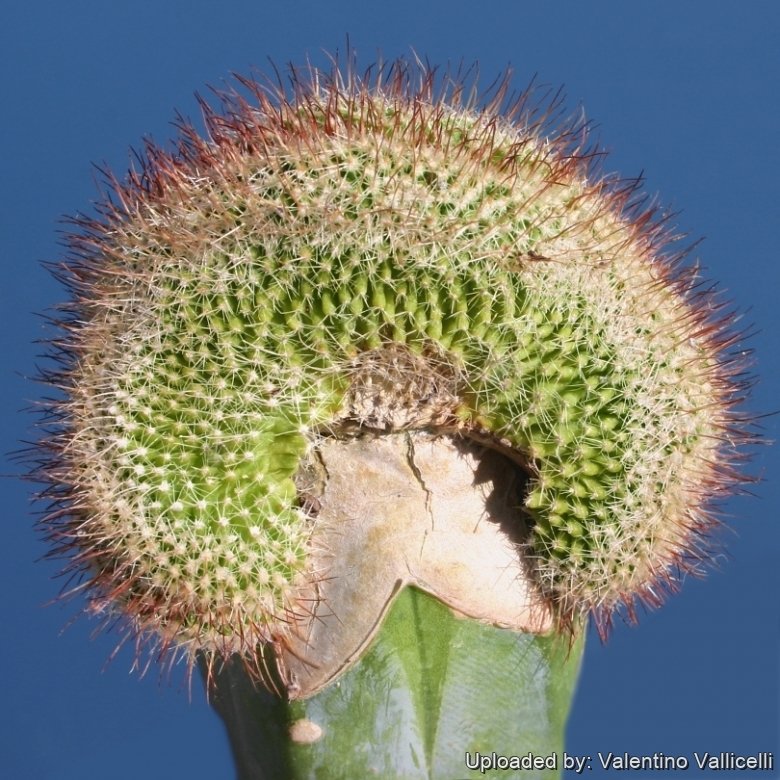
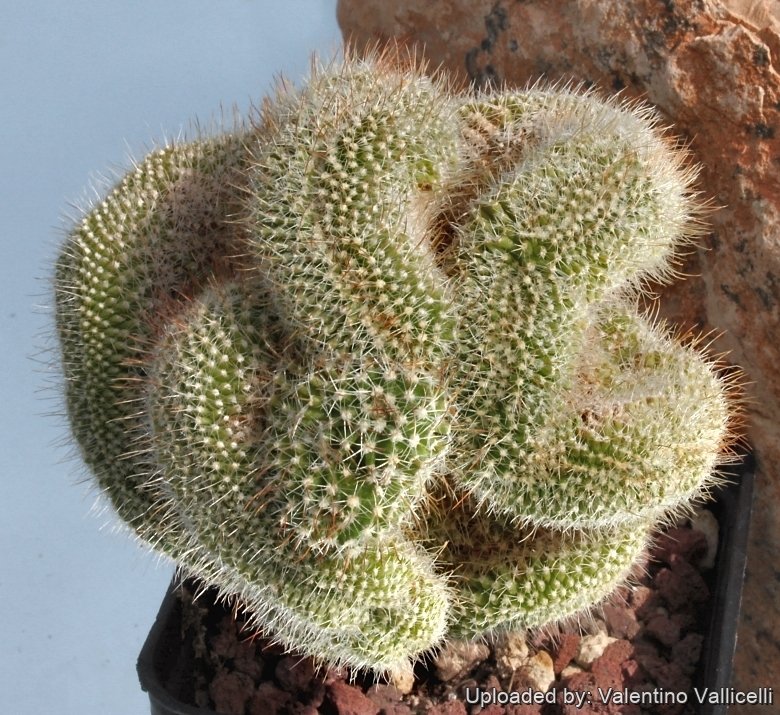
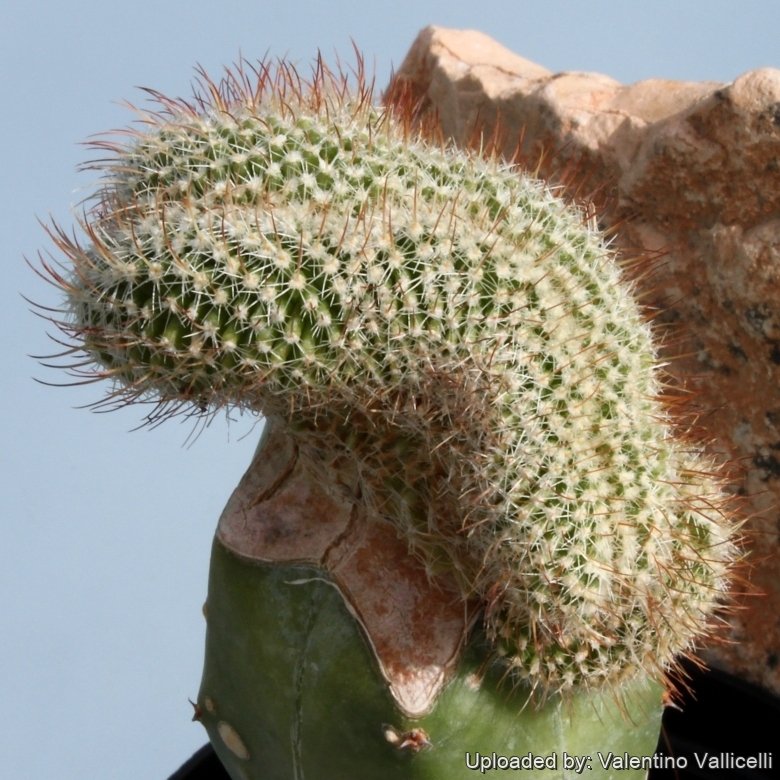
Remarks: The crested form is particularly beautiful.
Origin and Habitat
Garden origin.
Source: Echinofossulocactus crispatus f. cristatus, LLIFLE - Encyclopedia of living forms, CC-BY-SA, retrieved 2026-10-25.
Cultivars and forms (2)
Gallery