Publication: Kakteen (Berger) 248, 346 (1929)
Description
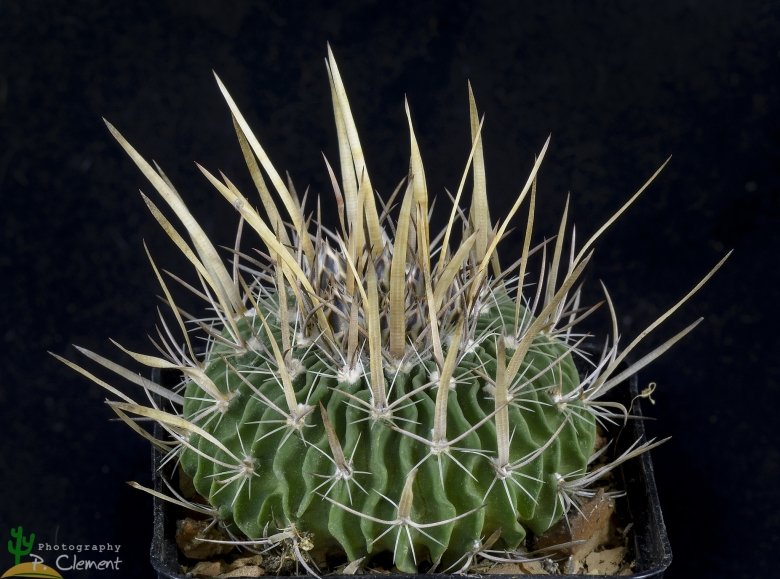
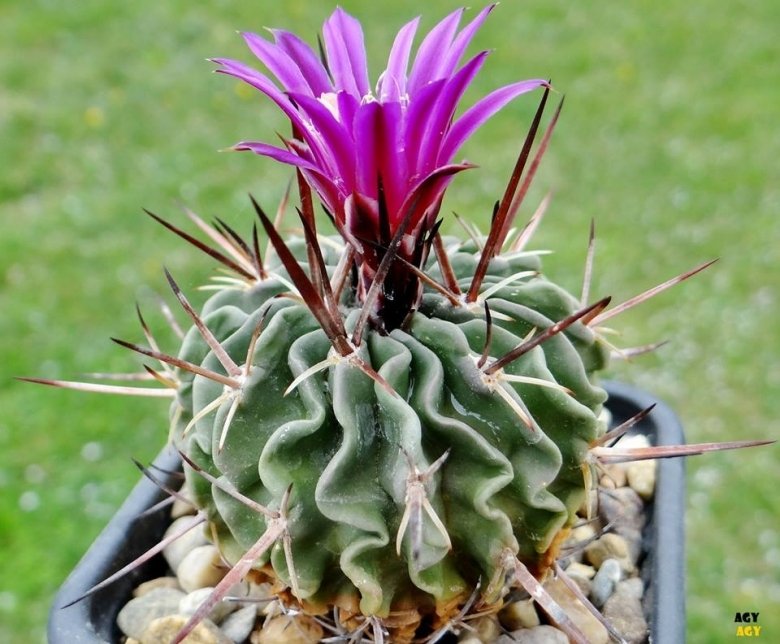
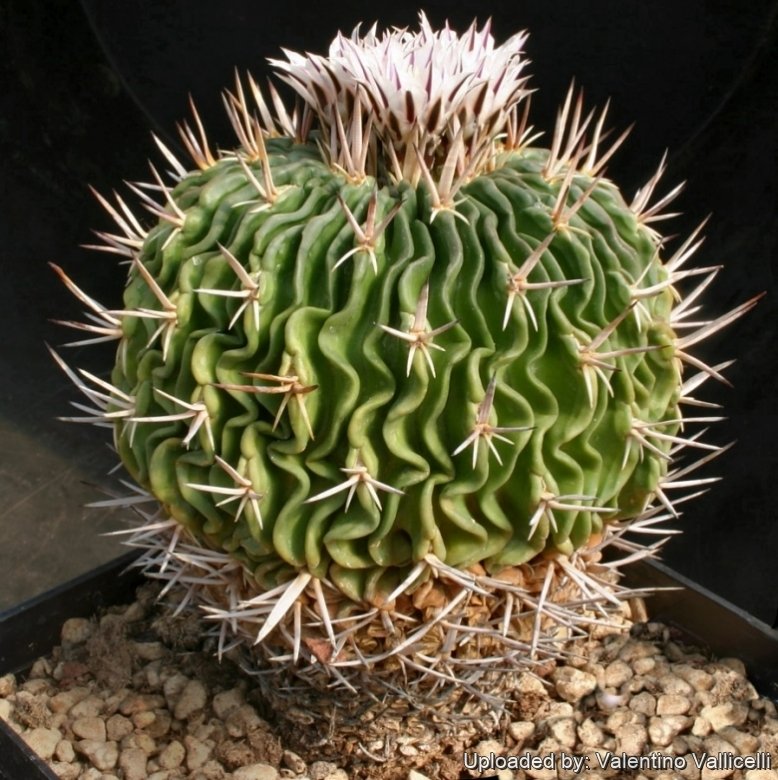
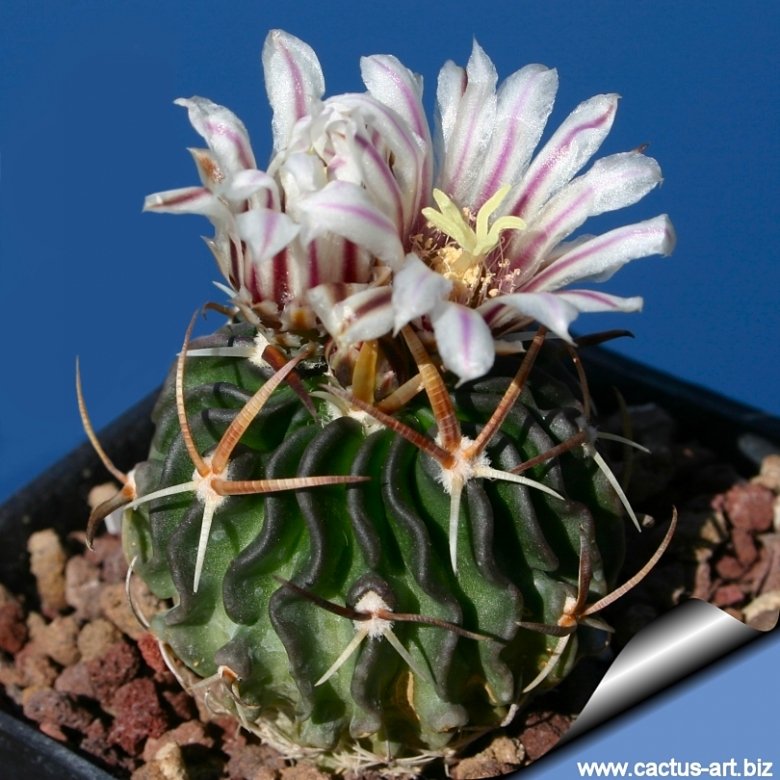
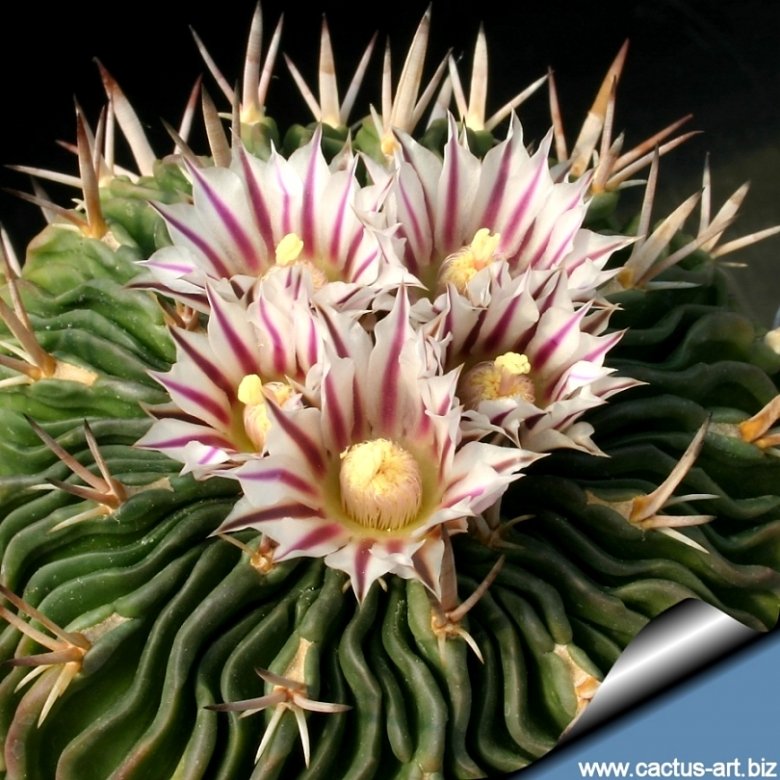
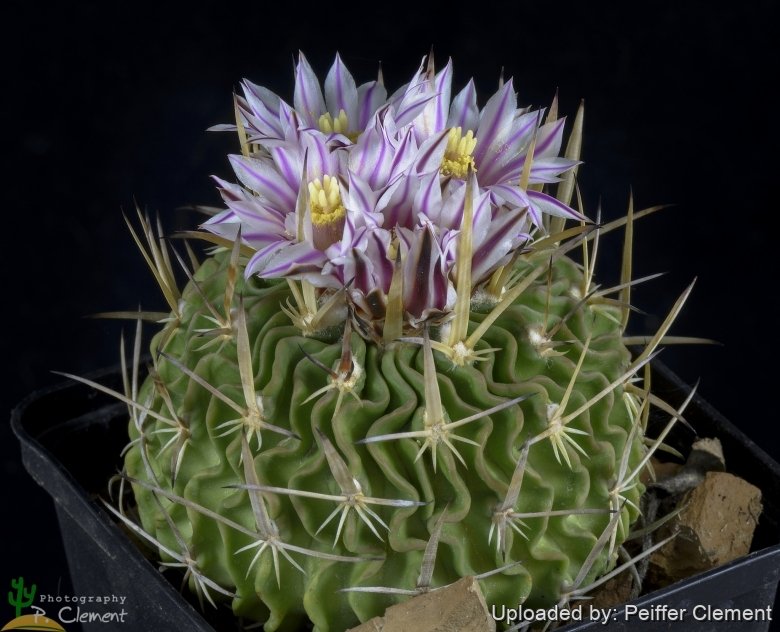
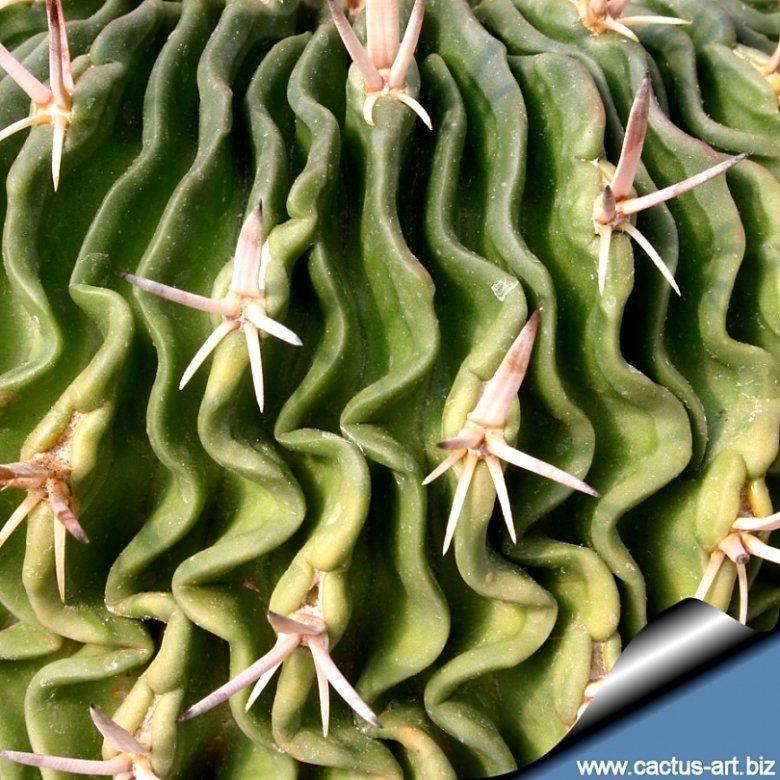
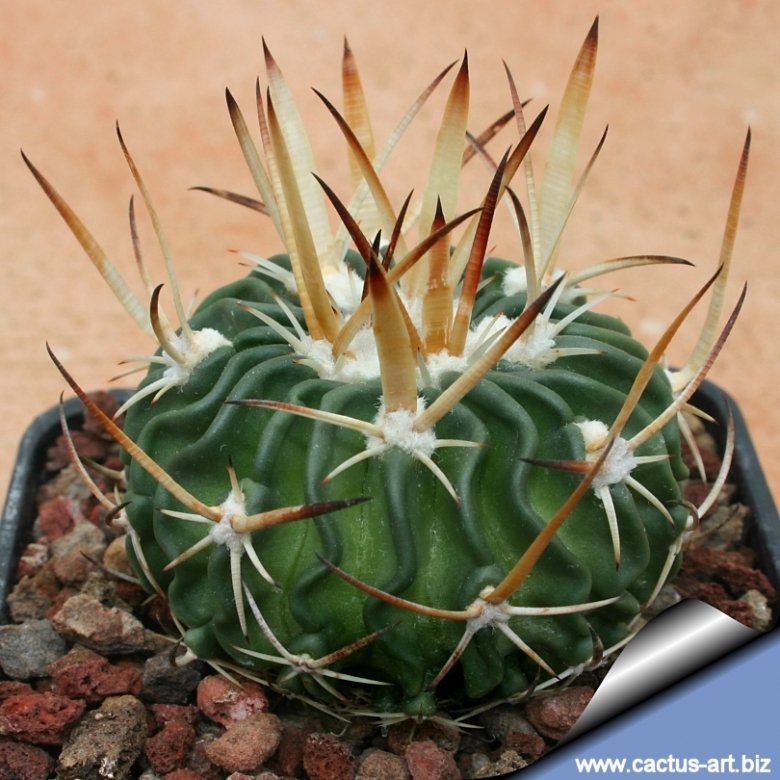
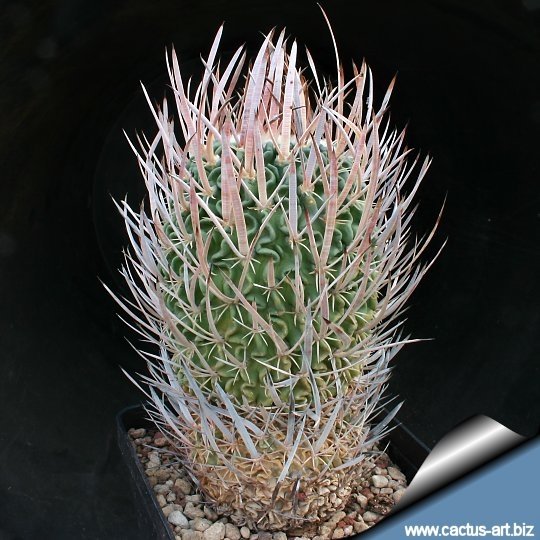
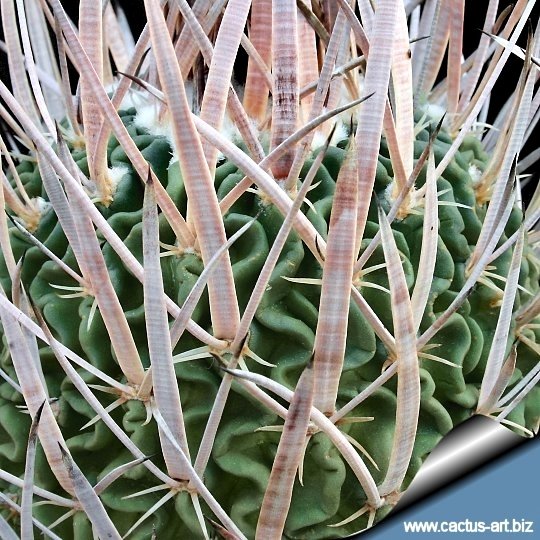
Stenocactus obvallatus is a ball-shaped, cactus with wavy-margined ribs. White areoles each bear 5–12 greyish-brown spines. In spring, has pale yellow to pale pink flowers, with a purplish-red stripe on each petal. Stenocactus obvallatus is strictly related to Stenocactus multicostatus. However the two are easy to tell apart. E. multicostatus plants have many pale green ribs (as many as 120) where Stenocactus obvallatus typically has less than 50 blue-green ribs.
Remarks: There is much variation within this species, the taxonomic position, habitats and ecology and populations size need further investigation, some of the “obvallatus” may correspond to other species.
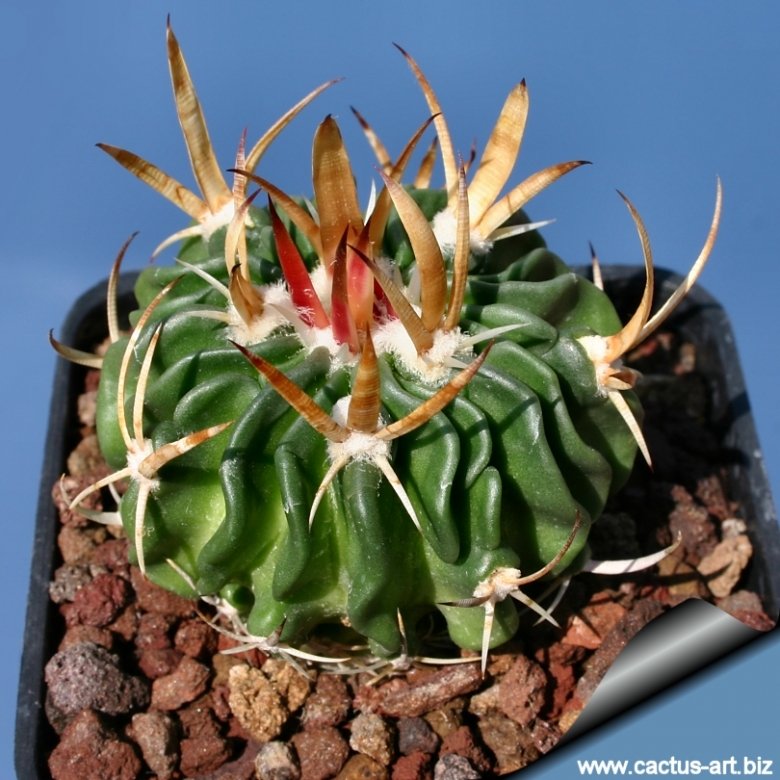
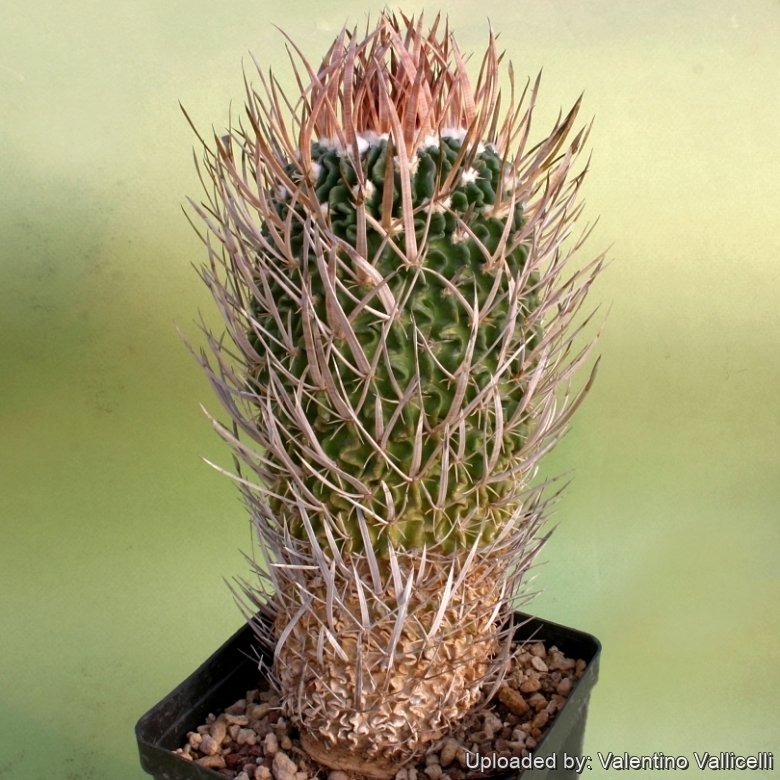
Stem: Obovoid to globose, usually solitary but sometimes forming two stems, greyish or blue-green, depressed at apex reaching a height of 6-10 (or more) cm and width of 6-11(-15) cm.
Ribs: 25 to 50, rather thin and undulate, very broad at the areoles.
Areoles: 2-4 on each rib.
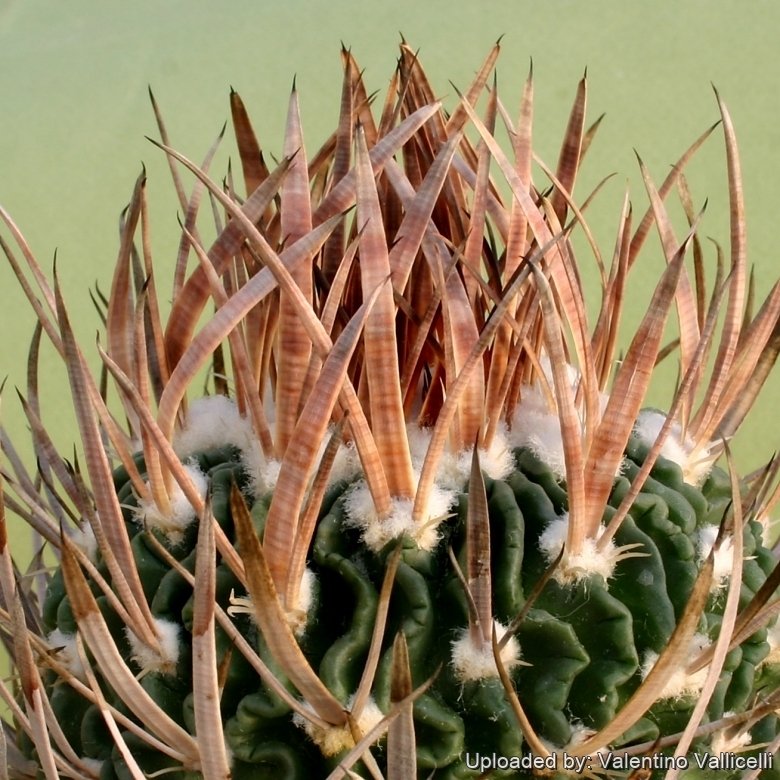
Spines: About 5-12, of which 3(-4) central spines subulate, ascending or spreading, the upper one flattened and wide, reddish brown, to 5 cm long, 3-4 mm wide, lateral 2 even wider, angular, spreading, and 4-6 radial spines shorter, white, perhaps not one-fourth the length of the longer ones (about 1 cm long).
Flowers: Flower buds are are held in the wool of the stem’s apex, often with just the tips visible until early spring, when some sunny days come along and both the buds and plant start to grow. The plant will throw quite a few buds in and open several 3 cm flowers at a time over the course of a month. If the conditions are right it can bloom again later in the year. The blooms are quitw large, pale yellow or white, with purplish midstripes and reddish center; perianth-segments linear-oblong.
Origin and Habitat
Stenocactus obvallatus is endemic to central México from the states of Aguascalientes, Durango, Guanajuato, Hidalgo, México Distrito Federal, México State, Oaxaca, Querétaro, San Luis Potosí, and Tamaulipas.
Habitat and Ecology: The species is very likely to occur in desert scrub. The genus Stenocactus is in need of taxonomic revision because there is a general lack of understanding on the taxonomic position of the species within the genus and thus is it no possible to define either the spatial or systematic limits of the taxon. It is not possible to establish its population size as its taxonomy is uncertain.
Cultivation and Propagation
Stenocactus obvallatus is easy to to care cactus, recommended for any collection that needs lots of light with ample airflow.
Growth rate: It is a small growing, but easily flowering species.
Soils: It needs regular cacti soil with little organic matter (peat, humus).
Repotting: Repotting every other year. As it is especially prone to rot under-pot in a smaller container filled with very porous compost. Use pot with good drainage.
Watering: Water regularly in summer, but do not overwater (very wet-sensitively, especially in light of its succulent root system), allow to dry between watering. Its roots are easily lost in pots that stay damp for any length of time. It should not be watered at all in winter. In the rest period no high atmospheric humidity!! Care must be taken with watering as they tends to become swollen and untidy in growth habit if given too much water and shade.
Fertilization: During the growing season enrich the soil using a fertilizer rich in potassium and phosphorous, but poor in nitrogen, because this chemical element doesn’t help the development of succulent plants, making them too soft and full of water.
Hardiness: Reputedly sensitive to frost , but less so if kept on the dry side prior to, and during, cold weather (hardy to -5° C for short periods). However some warmth throughout the year will increase the grower’s success (minimum 5° to 8°C during rest season).
Exposition: Outside bright sun it likes strong sunshine, but is tolerant and do well with light shade during the hot Summer months, inside it needs bright light, and some direct sun. Subject to sunburn if exposed to direct sun for too long. Tends to bronze in strong light, which encourages flowering and heavy wool and spine production.
Uses: It is an excellent plant for container growing. It always looks good and stays small. It look fine in a cold greenhouse and frame.
Pests & diseases: It may be attractive to a variety of insects, but plants in good condition should be nearly pest-free, particularly if they are grown in a mineral potting-mix, with good exposure and ventilation. Nonetheless, there are several pests to watch for:
- Red spiders: Sensitive to red spider mite. Overhead watering is helpful in controlling mites.
- Mealy bugs: Occasionally mealy bugs they develop aerial into the new growth among the wool with disfiguring results, but the worst types develop underground on the roots and are invisible except by their effects.
- Scales: Scales are rarely a problem.
- Rot: Rot it is only a minor problem with cacti if the plants are watered and “aired” correctly. If they are not, fungicides won’t help all that much.
Propagation: Seeds (usually). Seeds germinate in 7-14 days at 21-27° C in spring, remove the glass cover gradually as the plants develops and keep ventilated, no full sun for young plants! The seedlings should not be disturbed until they are well rooted, after which they can be planted separately in small pots.
Bibliography
Major references and further lectures
-
Edward F. Anderson “The Cactus Family” Timber Press, 2001
-
Christopher Brickell “RHS Encyclopedia of Plants and Flowers” Dorling Kindersley Ltd, 01 set 2010
-
“Botanica: The Illustrated A-Z of Over 10,000 Garden Plants and how to Cultivate Them” Mynah, 1997
-
Gómez-Hinostrosa, C., Sánchez , E., Guadalupe Martínez, J. & Bárcenas Luna, R. 2013. Stenocactus obvallatus. The IUCN Red List of Threatened Species. Version 2015.1. <www.iucnredlist.org>. Downloaded on 03 June 2015.
-
Nathaniel Lord Britton, Joseph Nelson Rose “The Cactaceae: Descriptions and Illustrations of Plants of the Cactus Family” Volume 3, 1922
-
Hans Hecht “BLV-Handbuch der Kakteen” BLV-Verlagsgesellschaft, 1982.
-
James Cullen, Sabina G. Knees, H. Suzanne Cubey “The European Garden Flora Flowering Plants: A Manual for the Identification of Plants Cultivated in Europe, Both Out-of-Doors and Under Glass” Cambridge University Press, 11/Aug./2011
-
David Hunt, Nigel Taylor “The New Cactus Lexicon” DH Books, 2006
-
Curt Backeberg: “Die Cactaceae: Handbuch der Kakteenkunde.” Volume V. 2. edition. 1984
-
Walther Haage: “Kakteen von A bis Z.” 3. edition. Quelle & Meyer, Heidelberg 1986
-
Cactus and Succulent Journal of Great Britain. 12: 81, London 1950
From llifle page Brittonrosea pentacantha
Description
{Stenocactus pentacanthus (Echinofossulocactus pentacanthus) is one of the local or morphological form of Stenocactus obvallatus distingushed by areoles with only 5 spines and by globular stems which became elongate when old, even though usually solitary this species is one of the few members of the genus that can put forth basal shoots. It does so as a young plant, becoming sometime densely branched.
Remarks: Stenocactus obvallatus is an exceedingly variable species throughout its range and some taxonomists recognize several varieties and even distinct “species”. The segregation of the many forms, varieties, and subspecies on the basis of morphology, however, is difficult to support, given the continuous range of variation in stem size and flower colour over its geographic range.
Stems: Rather small up to 10 cm in diameter, 10 (20) cm tall with about 27 corrugated, sharp-edged ribs, swollen where the areoles grow. The latter are round and thickly felted around the apex, later becoming almost bare.
Spines: “pentacanthus” means five spined, of this 5 spines there are 3 major on the upper part of the areoles: two are conical and curved upward while the central spine is flattened, yellowish or pinkish, about 2 (4) cm long and 2 (4) mm wide and 2 (occasionally 4) small spine on the lower part of the areole.
Flowers: 1-2 cm long can be up to 3-4cm in diameter. E. obvallatus has white or pale yellow flowers with pink mid-veins and a greenish base. The plants known as Stenocactus pentacanthus have long lasting flowers in early spring.
Origin and Habitat
Mexico (Tamaulipas, Queretaro).
Cultivation and Propagation
Small growing and easy to to care in normal and very drained cactus compost and very willing to flower, Because of it’s small size makes a great potted plant specimen, great for beginning collectors, water sparingly and allow to dry between watering, needs good drainage. Watering should be curtailed during the winter months. Full sun but is tolerant and prefers light shade during the hot Summer months. And provide very good ventilation.
Frost Tolerance: Hardy to - 5°C if kept dry.
Propagation: Seeds (usually) or by the shoots of adult plants (if available). It tillers more readily than most other species.
Source: Brittonrosea pentacantha, LLIFLE - Encyclopedia of living forms, CC-BY-SA, retrieved 2026-10-25.
From llifle page Echinofossulocactus caespitosus
Description
It is a globular cactus which became elongate when old , even though usually solitary this species is one of the few members of the genus that can put forth basal shoots. It does so as a young plant, becoming sometime densely branched. Stems rather small up to 10 cm in diameter, 10 (20) cm tall with about 27 corrugated, sharp-edged ribs, swollen where the areoles grow. The latter are round and thickly felted around the apex, later becoming almost bare.
Spines: there are 3 major spines on the upper part of the areoles: two are conical and curved upward while the central spine is flattened, yellowish or pinkish , about 2 (4) cm long and 2 (4) mm wide. On the older part of the plant there are four small white radial spines, and sometime another central spine appears below the others, pointing downward; it is curved, flat, and the same length as the upper central spine.
Flowers: 1-2 cm long can be up to 3-4cm in diameter. It has white or pale yellow flowers with pink mid-veins and a greenish base.. The plants known as Stenocactus pentacanthus have long lasting bluish flowers in early spring.
Remarks: S. caespitosus nowadays is not considered a distinct species or variety but only one of the variable phenotypes of the clinal species Stenocactus obvallatus.
Cultivation and Propagation
Easy to to care and flower. It needs regular cacti soil with good drainage, allow to dry between watering. It should not be watered at all in winter.
Propagation: Seeds (usually) or but, since it tillers early, it is simpler to use shoots.
Exposure: It likes strong sunshine but is tolerant and do well with light shade during the hot Summer months.
Frost Tolerance: does not tolerate intense or prolonged cold (hardy to -5°C if kept dry)
Source: Echinofossulocactus caespitosus, LLIFLE - Encyclopedia of living forms, CC-BY-SA, retrieved 2026-10-25.
Gallery