Publication: Kakteen (Berger) 346. 1929
Description
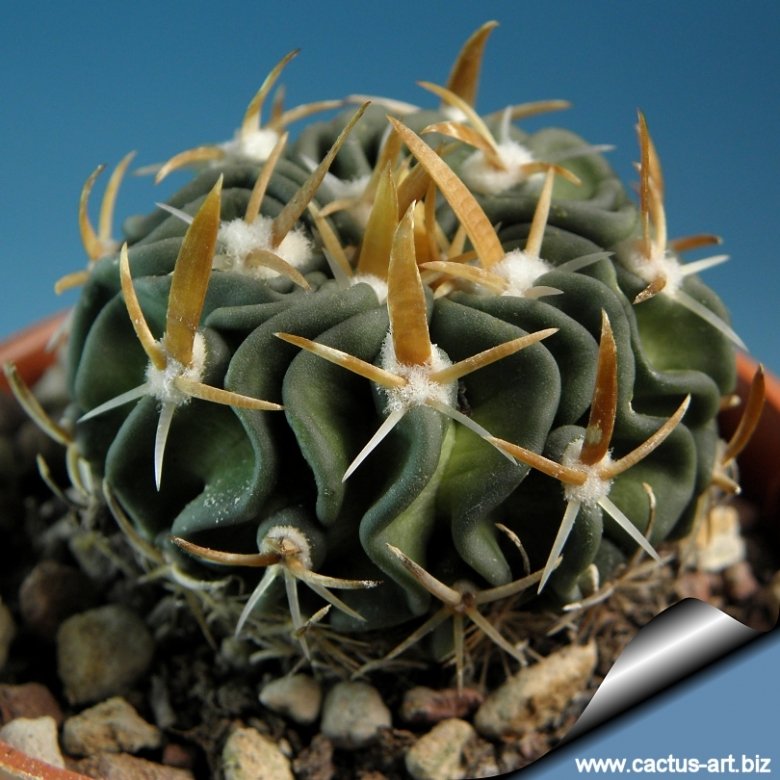
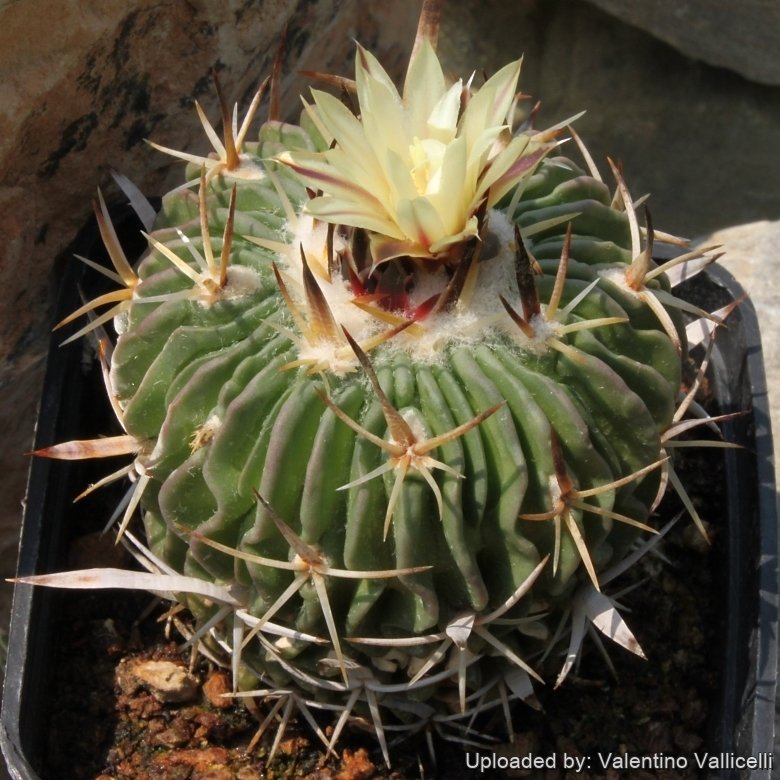
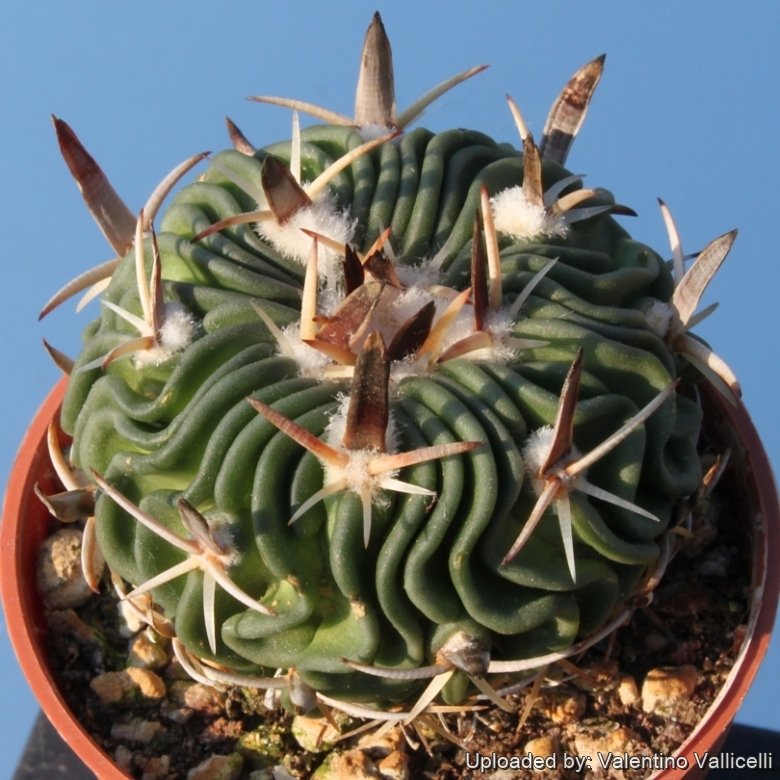
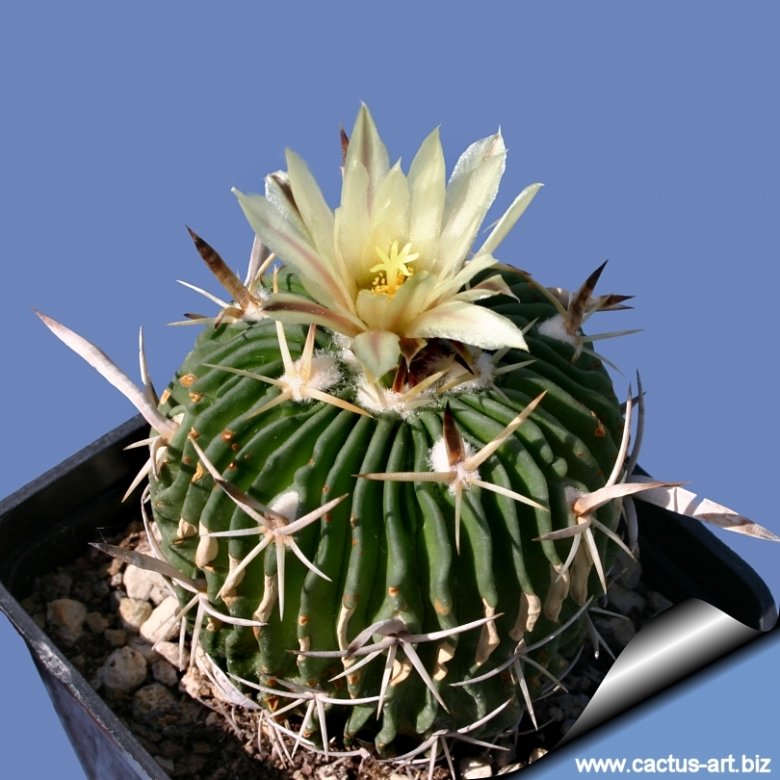
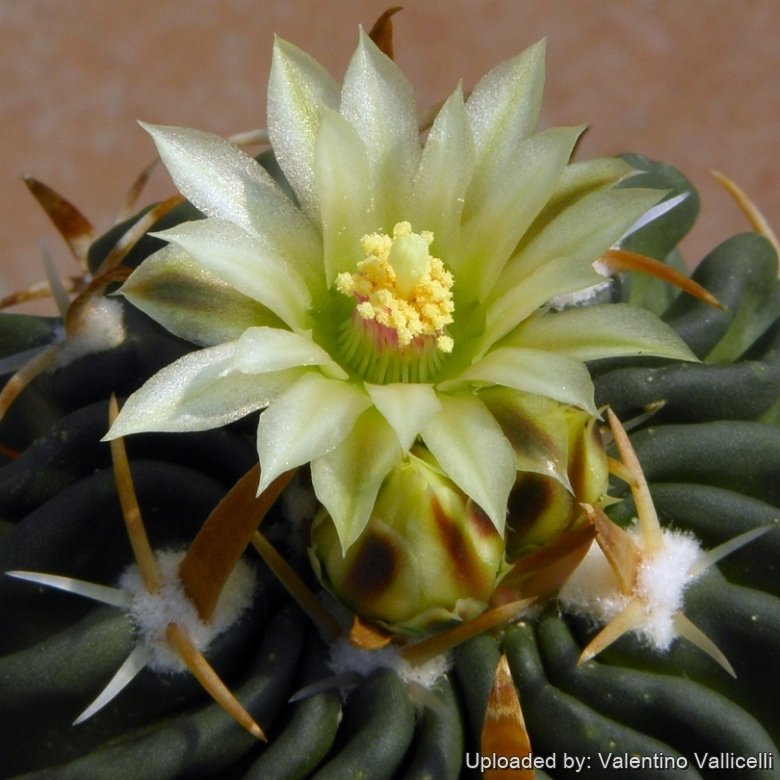
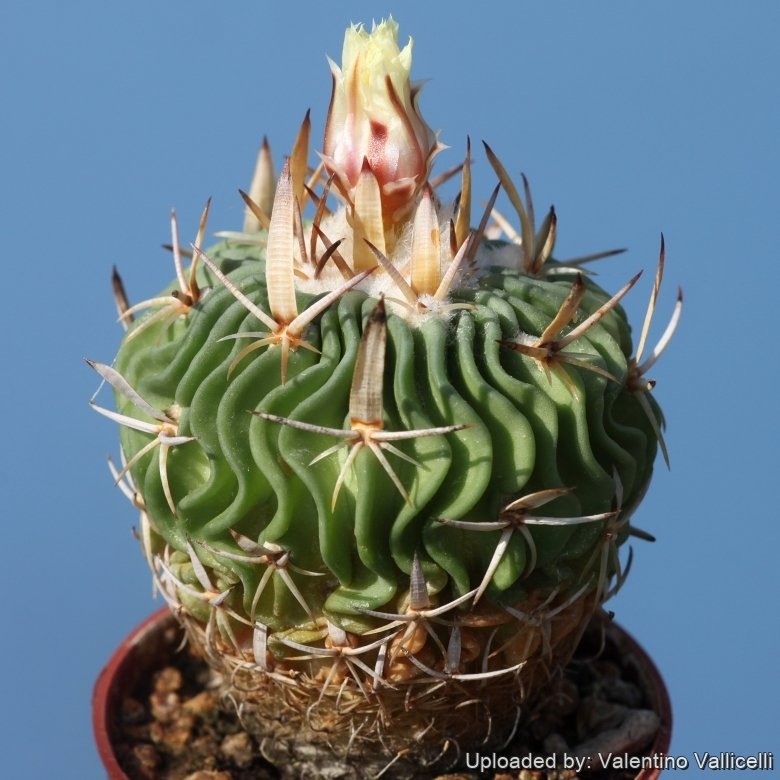
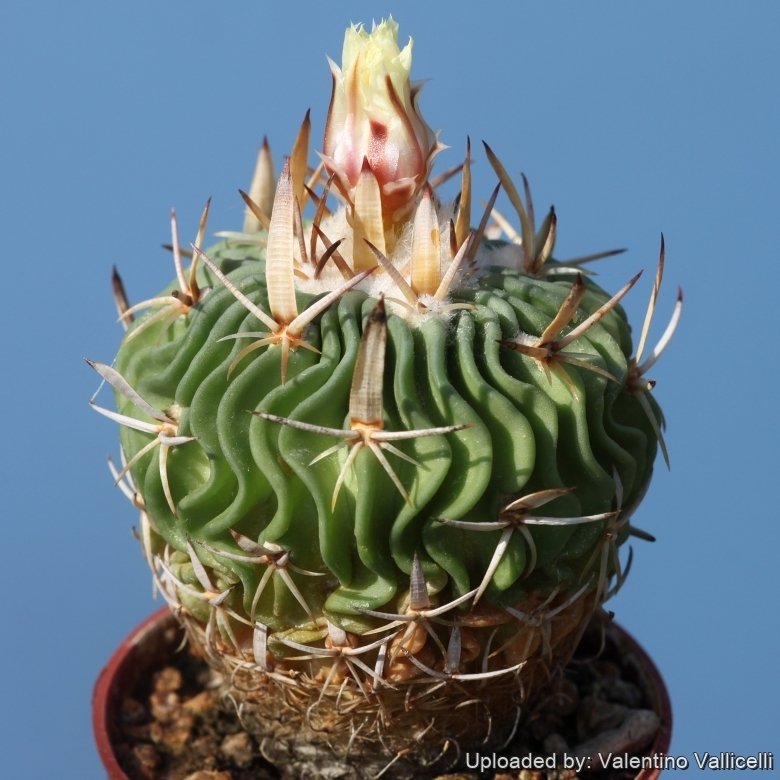
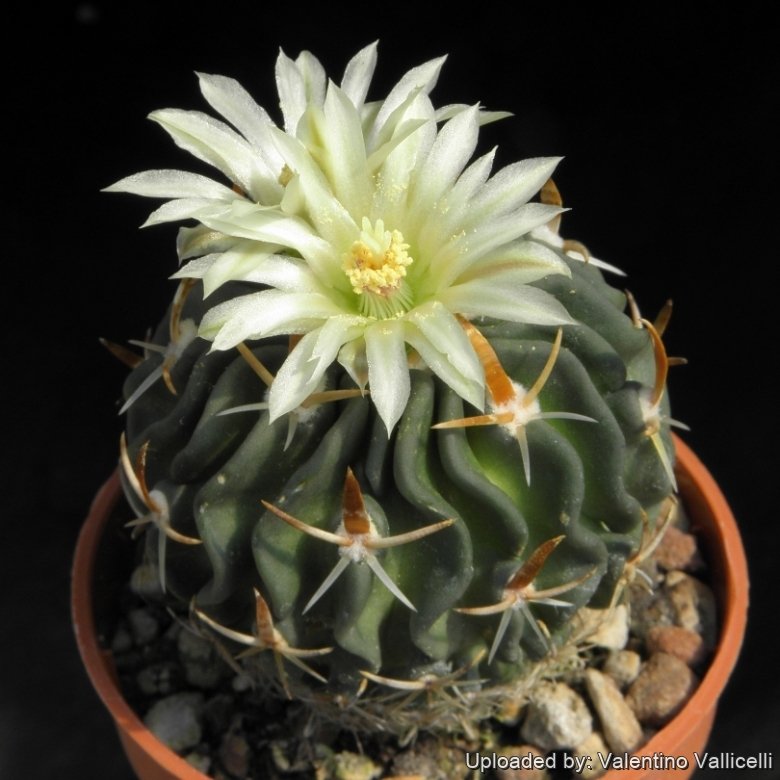
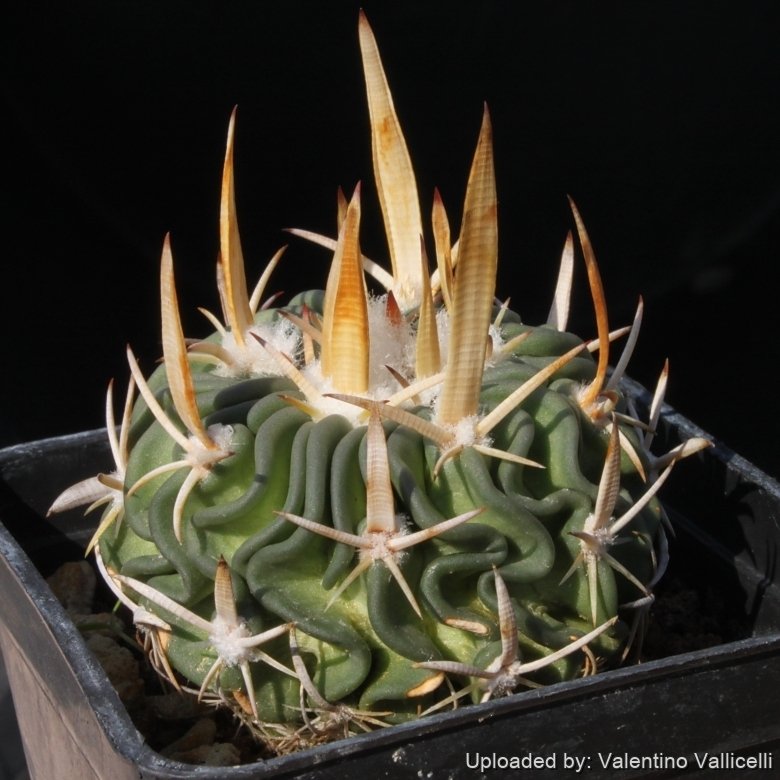
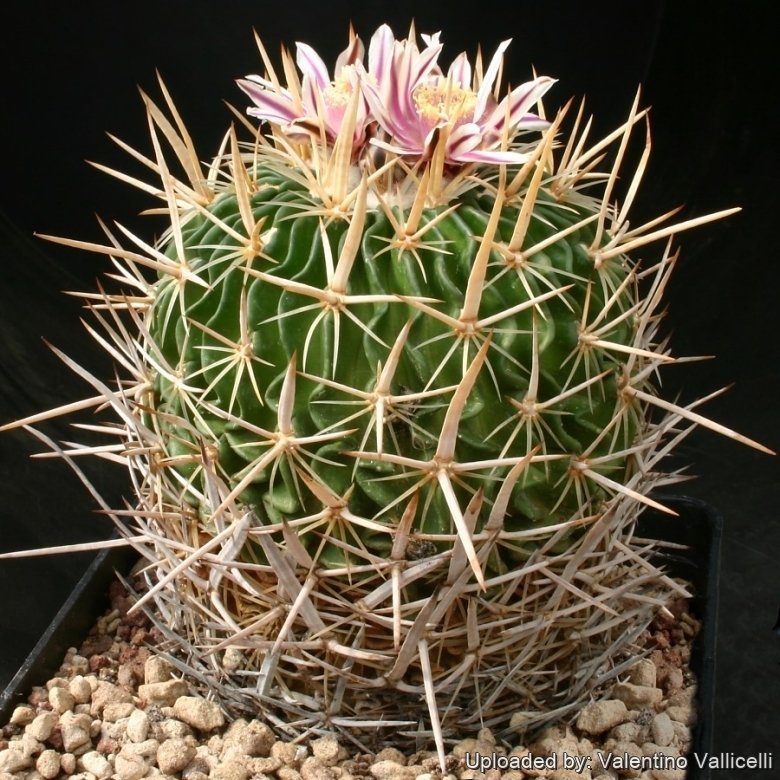
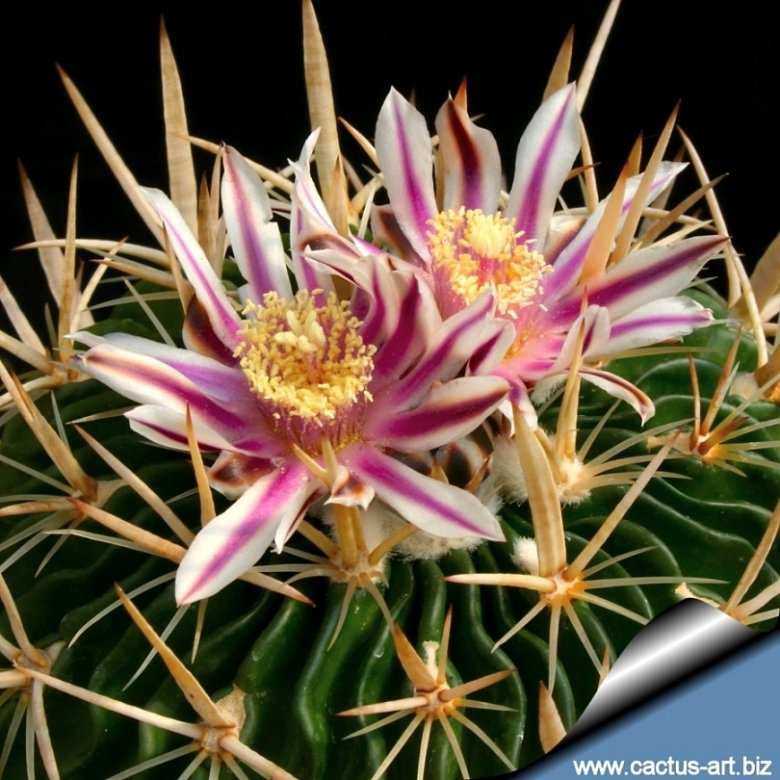
Stenocactus phyllacanthus, best known as Echinofossulocactus phyllacanthus, is a round cactus with the upper central spines three-pronged long, flattened grass-like and numerous wavy ribs, it is distinguished from similar wavy ribbed species by its small yellowish flowers and few radial spines. Older plants sometimes get corky near the base. There is a general lack of understanding on the taxonomic position of this species within the genus and thus is it no possible to define either the spatial or systematic limits of the taxon. There is much variation within the current taxon, and most of the “phyllacanthus” - especially those with pink o violet striped flowers - may correspond to other species.
Stems: Usually solitary, occasionally few branched, depressed globose to short cylindrical, dull green or dark bluish green, flat or somewhat depressed apically, 3 to 15 cm. high, 4-10 cm in diameter.
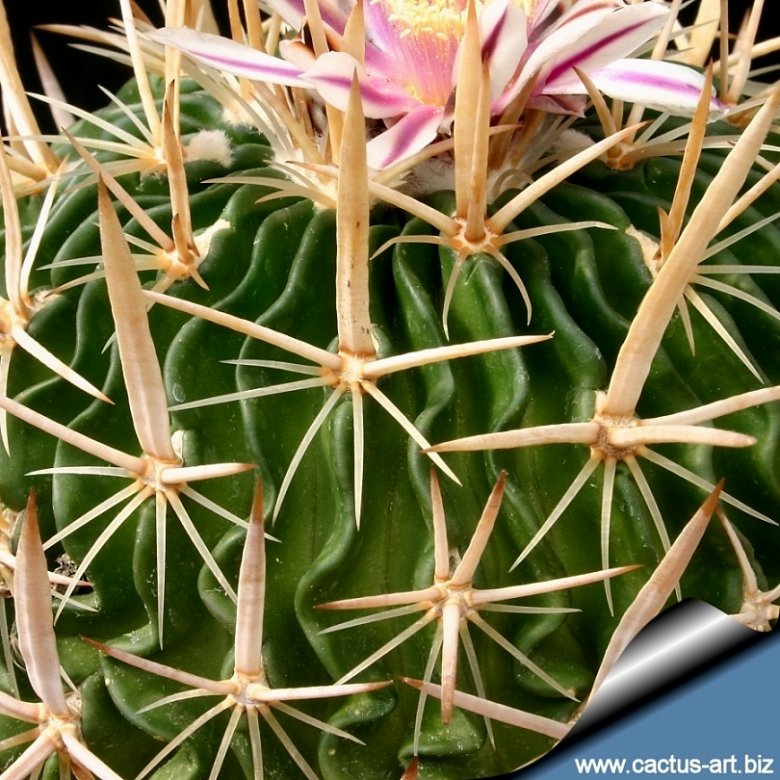
Ribs: (25-)30 to 35(-60), very thin, strongly undulate.
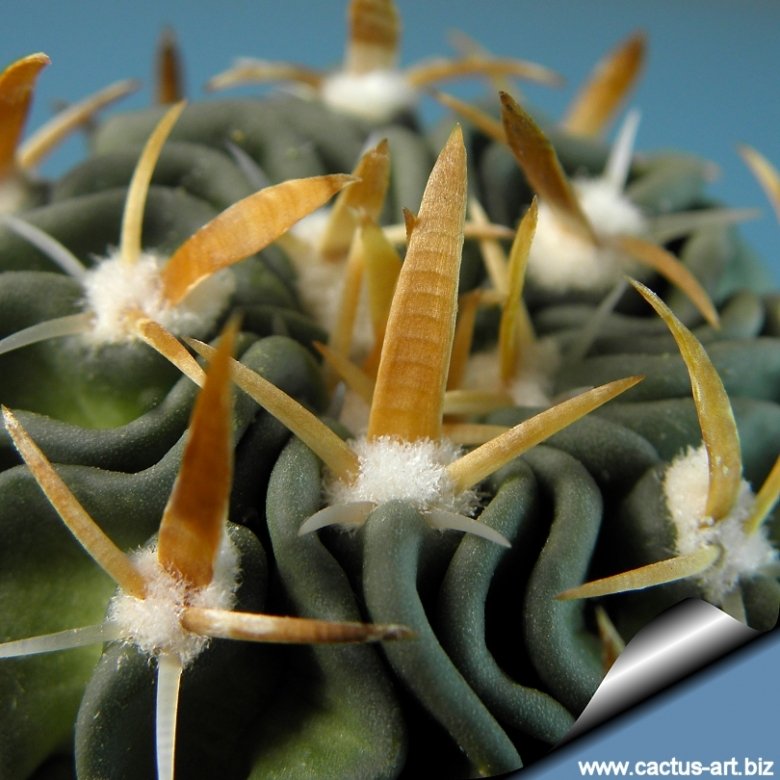
Areoles: Only a few to a rib (mostly 1-2), white-tomentose when young.
Spines: Shorter and less dense than in other species the main one broad and flattened.
Central spines: 1-3, lance shaped, reddish at first, becoming brownish or grey, 30-80 mm long, upper one, or rarely 2 spines, much elongated, erect or connivent over the top of the plant,
flattened, thin, somewhat annulate.
Radial spines: 2-7, straight, weak-subulate, white, bristly or awl shaped, and
spreading 4-9 mm long.
Flowers: Born singly or 2-3 together, produced sporadically all-through spring and summer, yellowish white with brownish red throats, 15 to 20 mm long. Tube short. Inner perianth-segments acute.
Fruits: Small, green.
Remarks: Stenocactus tricuspidatus (a multiheaded species) has been moved into Stenocactus phyllacanthus in the most recent revisions.
Origin and Habitat
Stenocactus phyllacanthus is endemic to Mexico, occurring in the states of Aguascalientes, Guanajuato, Hidalgo, Jalisco, Nuevo León, Querétaro, San Luis Potosí, Zacatecas.
Altitude range: It grows at elevations of 1700-2800 metres above sea level.
Habitat and ecology: This species occurs in desert scrub where it grows and hides in high grass, and the spines that looks like dried grass leaves, make the plants almost invisible in their natural environment.
Cultivation and Propagation
Easy to to care and flower. No absolute schedule can be given for watering as various factors (Soil mixture, containers, drainage, temperature, size of plant) influence water use, so - as a general rule - the soil should be thoroughly wetted at each watering during the active growing season (spring and summer), water when the top 1,5- 2 cm of soil feels dry to the finger. Do not soak the soil during the dormant period. Be careful, excessive watering can make root and/or stem to rots. Make sure there is good air circulation between plants. Good drainage is essential along good moisture retention properties and adequate nutrients availability. Require bright sunlight to grow well. Dormant plants do best at temperatures from 5-10°C (but will tolerate -5° for short periods). The cooler temperatures develop sturdier plants and encourage the formation of flower buds.
Pests: The narrow ribs, the wooly areoles, and the dense spines are an ideal habitat for mealy bugs. Frequent inspection of the plants will prevent them from spreading.
Bibliography
Major references and further lectures
-
Gómez-Hinostrosa, C., Sánchez , E., Guadalupe Martínez, J. & Bárcenas Luna, R. 2013. Stenocactus phyllacanthus. The IUCN Red List of Threatened Species. Version 2015.1. <www.iucnredlist.org>. Downloaded on 02 June 2015.
-
Graham Charles “Cacti and Succulents: An illustrated guide to the plants and their cultivation” Crowood, 30 April 2014
-
James Cullen, Sabina G. Knees, H. Suzanne Cubey “The European Garden Flora Flowering Plants: A Manual for the Identification of Plants Cultivated in Europe, Both Out-of-Doors and Under Glass” Cambridge University Press, 11/Aug./2011
-
David Hunt, Nigel Taylor “The New Cactus Lexicon” DH Books, 2006 ISBN 0953813444, 9780953813445.
-
Edward F. Anderson “The Cactus Family” Timber Press, 2001
-
Nathaniel Lord Britton, Joseph Nelson Rose “The Cactaceae: Descriptions and Illustrations of Plants of the Cactus Family” Volume 3, 1922
-
Willy Cullmann; Gerhard Groner; Erich Gotz “The Encyclopedia of Cacti” Alpha Books 1986
From llifle page Echinocactus tricuspidatus
Description
Habit: It is a multiheaded species distinguished for the small sized yellowish blooms, very short flattened foliaceous central spines and few radial spines.
Stem: Round to shortly cylindrical, apex flat or slightly depressed, up to 10 cm in diameter (but usually smaller) the epidermis is dark bluish-green. Older plants sometimes get corky near the base.
Ribs: Numerous,25-40(-55) wavy, thin .
Areoles: Well spaded (only 1 or 2 per ribs) Initially woolly, afterwards naked.
Spines: Typically 5.
Central spines: 3 short in the upper part of the areoles, lanceolate, straight or recurved 1-3 cm long, somewhat anulate, reddish to amber coloured (sometime with a darker tip) that becomes whitish as they ages. The upper one is very flat and sometime three-toothed at apex.
Radial spines: 2 (occasionally more), appressed, in the bottom of the areole, awl shaped pointing downward, much shorter than the upper ones, up to 1 cm long.
Flowers: Abundant up to 1,5 cm long, cream or yellowish-white often with darker reddish or brownish throat. Scales on the ovary ovate.
Fruits: Greenish, small.
Origin and Habitat
Echinofossulocactus tricuspidatus (Scheidweiler) Britton et Rose 1922
Habitat: This species grows and hides in high grass, and the spines that looks like dried grass leaves, make the plants almost invisible in their natural environment.
Source: Echinocactus tricuspidatus, LLIFLE - Encyclopedia of living forms, CC-BY-SA, retrieved 2026-10-25.
From llifle page Echinofossulocactus phyllacanthus var. macracanthus
Description
Generally solitary round cactus with whitish to cream coloured spines and numerous wavy ribs. Older plants sometimes get corky near the base. The var. macracanthus has large flattened spines.
Flowers: Abundant white with pink midribs.
Remarks: Identifying the species of an Echinofossulocactus is as difficult as identifying the genus is easy. For the most part, they tend to look alike, and there are far more names than there are species.
Source: Echinofossulocactus phyllacanthus var. macracanthus, LLIFLE - Encyclopedia of living forms, CC-BY-SA, retrieved 2026-10-25.
Cultivars and forms (2)
Gallery