Publication: Boll. Reale Orto Bot. Palermo 8: 253. 1909
Description
Stenocereus stellatus is a shrubby or treelike columnar cactus, branching at base, rarely branching above, 2-4 m high with short trunks. This species can be easily confused with Stenocereus treleasei.
Stems: Cylindrical, erect, 7-10 cm in diameter pale to dark bluish green.
Ribs: 8 to 12, up to 2 cm high low, obtuse, distinctly rounded, notched the areoles seated in the notches.
Areoles: 1 to 2 cm apart whitish.
Central spines: One to three, or sometimes more, slender often much longer than the others, flattened, one pointed downward, the others upward, 2 to 6 cm long dart brown or blackish at first, fading to grey.
Radial spines: The spine clusters are of 7-9 (sometime up to 13) radials about 12 mm long whitish-grey with dark tips, radiating star-like.
Flowers: Nocturnal, tubular to narrowly campanulate, appearing at or near the top of the plant, white or pale rose, with reddish sepals, about 4,5-6 cm cm long and 3-4 cm in diameter, tube scarcely flared, ovary bearing small scales subtending wool and bristly spines. Anthesis began around 8 on the evening and flowers open completely around 11 p.m. One hour later (around midnight), pollen starts being released but stigmatic lobes will be completely open only between 2 and 3 a.m. Flowers close between 7 and 9 on the mornining. Pollen and nectar is particularly abundant at night and attract pollinators like bats, hawkmoths and beetles.
Fruit: Red, spiny, globular, about 3 cm in diameter with spines falling early.
Phenology: Flowers are produced between June and September, and fruits in October.
Seeds: Dull, pitted.
Origin and Habitat
Morelos, Puebla, and Oaxaca, Central Mexico. Its distribution is clearly restricted to hot and dry regions of the Tehuacán Valley and the portion of the Balsas catchment that includes the northeast of Oaxaca and southeast of Puebla. It is also cultivated in home gardens elsewhere in Mexico and central America.
Altitude: Stenocereus stellatus grows at elevations of 500 to 2100 m asl.
Habitat and Ecology: The species inhabits tropical deciduous forest and xerophyllous scrub (thornscrub forest). Levels of precipitation vary between 300 and 800 mm per year; mean annual temperatures from 17 to 24°C; and soils derived from limestone, sandstone, volcanic rocks, or alluvial deposits.Other commonly associated plant species in the habitat include Coryphantha calipensis, Coryphantha elephantidens, Mammillaria carnea, Ferocactus recurvus, Opuntia pubescens, Schomburgkia superbiens, Bursera morelensis, Agave karwinskii, Agave lechuguilla and Yucca periculosa. Populations are abundant in both native and cultivated regions (species is dispersed by people). There are no threats, in addition this species is tolerant to some degree of habitat change.
Cultivation and Propagation
Stenocereus stellatus is easy to grow but not very cold hardy (Resistant as low as -2°C for a short time).
Growth rate: It produces good amounts of growth each year if kept well fed and watered throughout the warmest months, particularly if it has been acclimatised to accept full sun. It will make clumps given the best conditions.
Soils: It likes very porous fertile cactus mix soil.
Repotting: Use pot with good drainage.
Watering: Water regularly in summer, but do not overwater (Rot prone), keep dry in winter.
Fertilization: Feed with a high potassium fertilizer in summer.
Hardiness: Reputedly sensitive to frost , but less so if kept on the dry side prior to, and during, cold weather (hardy to -2° C for short periods). However warmth throughout the year will increase the grower’s success (8-12°C during rest season). During winter month, put them in a cool luminous place and encourage them to enter winter dormancy by withholding water and fertiliser over the winter as they will etiolate, or become thin, due to lower levels of light.
Exposition: Outside full sun, inside need bright light, and some direct sun. Tends to produce a dense white bloom in strong light, which encourages also flowering and spine production.
Uses: It is an excellent plant for container growing. It always looks good and stays small. It look fine in a cold greenhouse and frame or outdoor in a rockery.
Traditional uses: Stenocereus stellatus is cultivated for its a sourish edible fruit called xoconochtli or Joconostle, and is much relished.
Pests & diseases: It may be attractive to a variety of insects, but plants in good condition should be nearly pest-free, particularly if they are grown in a mineral potting-mix, with good exposure and ventilation. Nonetheless, there are several pests to watch for:
- Red spiders: Red spiders may be effectively rubbed up by watering the plants from above.
- Mealy bugs: Mealy bugs occasionally develop aerial into the new growth among the wool with disfiguring results, but the worst types develop underground on the roots and are invisible except by their effects.
- Scales: Scales are rarely a problem.
- Rot: They are susceptible to fungal diseases if overwatered, but are not nearly as sensitive as many other cacti, especially in warm weather. If kept damp through cold periods, they will invariably suffer. However rot is only a minor problem with cacti if the plants are watered and “aired” correctly. If they are not, fungicides won’t help all that much.
Propagation: Division, direct sow after last frost. The seeds are quite easy to germinate and grow. Seeds germinate in 7-14 days at 21-27° C in spring, remove the glass cover gradually as the plants develops and keep ventilated, no full sun for young plants! To make a cutting twist off a branch and permit it to dry out a couple of weeks, lay it on the soil and insert the stem end partially into the soil. Try to keep the cutting somewhat upright so that the roots are able to grow downward.
Notes
Stenocereus stellatus exhibits considerable morphological variation, especially in fruit characteristics. Pulp colour, flavour, amount of edible matter, skin thickness, and spininess of the mature fruits are the most significant characteristics. According to archaeological information obtained in caves from Tehuacan Valley, S. stellatus has apparently been used by humans for more than 5,000 years. Manipulation of this plant species by humans thus appears to involve artificial selection. Cultivation is practised mainly in home gardens, where desirable phenotypes are vegetatively propagated and new variation is incorporated.
Bibliography
Major references and further lectures
-
Curt Backeberg “Die Cactaceae: Handbuch der Kakteenkunde.” Volume 3, 1959
-
Theodore H. Fleming, Alfonso Valiente Banuet “Columnar Cacti and Their Mutualists: Evolution, Ecology, and Conservation” University of Arizona Press, 2002
-
Britton & Rose “The Cactaceae” 4: 273, 1923
-
Edward Anderson “The Cactus family” Timber Press, Incorporated, 2001
-
James Cullen, Sabina G. Knees, H. Suzanne Cubey “The European Garden Flora Flowering Plants: A Manual for the Identification of Plants Cultivated in Europe, Both Out-of-Doors and Under Glass” Cambridge University Press, 11/Aug/2011
-
David R Hunt; Nigel P Taylor; Graham Charles; International Cactaceae Systematics Group. “The New Cactus Lexicon” dh books, 2006
-
Thomas H. Everett “The New York Botanical Garden Illustrated Encyclopedia of Horticulture” Volume 10 Taylor & Francis, 1982
-
Casas, A., B. Pickersgill, J. Caballero, and A. Valiente-Banuet. “Ethnobotany and the process of domestication of the xoconochdi Stenocereus stellatus (Cactaceae) in the Tehuacan Valley and La Mixteca Baja, Mexico.” Economic Botany 51:279-92. 1997.
-
Casas, A., J. Caballero, C. Mapes, and S. Zarate. “Manejo de la vegetacion, domesticacion de plantas y origen de la agricultura en Mesoamerica.” Boletin de la Sociedad Botdnica de Mex-ico 61:31-47. 1997
-
Casas, A., A. Valiente-Banuet, and J. Caballero. “La domesticacion de Stenocereus stellatus (Pfeiffer) Riccobono (Cactaceae).” Boletin de la Sociedad Bottinica de Mexico 62:129-40 1998.
-
Casas, A., J. Caballero, and A. Valiente-Banuet. “Use, management and domestication of columnar cacti in south-central Mexico: a historical perspective.” Journal of Ethnobiology 19:71-95. 1999
-
Casas, A., J. Caballero, A. Valiente-Banuet, J. A. Soriano, and P. Davila. “Morphological variation and the process of domestication of Stenocereus stellatus (Cactaceae) in central Mexico.” American Journal of Botany 86:522-33. 1999
-
Casas, A., A. Valiente-Banuet, A. Rojas-Martinez, and P. Davila. “Reproductive biology and the process of domestication of Stenocereus stellutus (Cactaceae) in central Mexico.” American Journal of Botany 86:534-42. 1999
-
Bravo Hollis, “Las Cactaceas de Mexico” 1978
-
Arias, S. & Zavala-Hurtado, A. 2013. Stenocereus stellatus. In: IUCN 2013. “IUCN Red List of Threatened Species.” Version 2013.2. <www.iucnredlist.org>. Downloaded on 27 March 2014.
From llifle page Lemaireocereus stellatus f. cristata
Description
Stenocereus stellatus is a shrubby or treelike columnar cactus, branching at base, rarely branching above, 2-4 m high with short trunks.
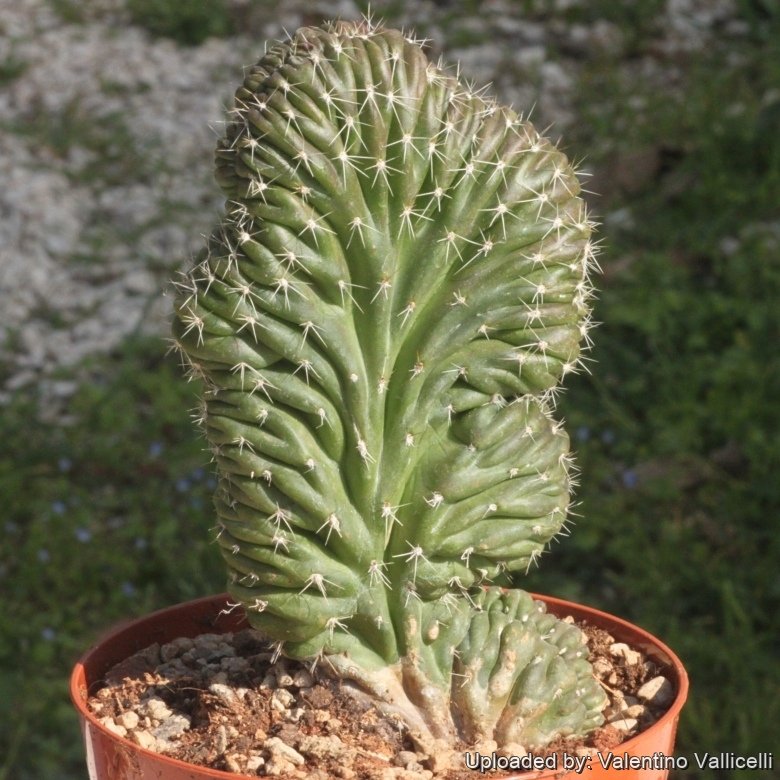
Crested form: The crested form Stenocereus stellatus f. cristata is nicely covered with greyish radiating star-like spines and is sought after by collectors, for its unique features. It is also very strong and can grow up to 1 m in diameter and height (or more).
Stems: Fan-shaped, pale to dark bluish green, forming with time imposing brain-like mounds to 1 metre in diameter and height .
Ribs: Up to 2 cm high low, obtuse, distinctly rounded, notched the areoles seated in the notches.
Areoles: 1 to 2 cm apart whitish.
Central spines: One to three, or sometimes more, (Often missing in crested plants) slender often much longer than the others, flattened, one pointed downward, the others upward, 2 to 6 cm long dart brown or blackish at first, fading to grey.
Radial spines: The spine clusters are of 7-9 (sometime up to 13) radials about 12 mm long whitish-grey with dark tips, radiating star-like.
Flowers: Nocturnal, tubular to narrowly campanulate, appearing at or near the top of the plant (Often missing in crested plants), white or pale rose, with reddish sepals, about 4,5-6 cm cm long and 3-4 cm in diameter, tube scarcely flared, ovary bearing small scales subtending wool and bristly spines.
Fruit: Red, spiny, globular, about 3 cm in diameter with spines falling early.
Phenology: Flowers are produced between June and September, and fruits in October.
Seeds: Dull, pitted.
Origin and Habitat
Garden origin (Nursery produced cultivar). The wild species occurs over a considerable range from Morelos to Puebla, and Oaxaca in Central Mexico.
Cultivation and Propagation
Although regarded as a choice and difficult plant is not too difficult in a greenhouse, but grows quite slowly. It is sometime seen as a grafted plant but grows very well on its own roots too.
Soil: Use mineral well permeable mineral soil with little organic matter (peat, humus).
Exposure: They need a good amount of light shade to full sun this help to keep the plants healthy, although slow growth.
Watering: Water sparingly from March till October (weekly during summertime, if the weather is sunny enough) , with a little fertilizer added. Less or no water during cold winter months, or when night temperatures remain below 10° to prevent root loss. It is sensitive to overwatering (rot prone).
Fertilization: Feeding may not be necessary at all if the compost is fresh then, feed in summer only if the plant hasn’t been repotted recently. Do not feed the plants from September onwards as this can cause lush growth which can be fatal during the darker cold months.
Hardiness: Reputedly sensitive to frost, but less so if kept on the dry side prior to, and during, cold weather. However warmth throughout the year will increase the grower’s success (8-12°C during rest season). During winter month, put them in a cool luminous place and encourage them to enter winter dormancy by withholding water and fertiliser over the winter as they will etiolate, or become thin, due to lower levels of light.
Crested growth: Unlike ‘monstrose’ varieties of plants, where the variation from normal growth is due to genetic mutation, crested growth can occur on normal plants. Sometimes it’s due to variances in light intensity, or damage, but generally the causes are unknown. A crested plant may have some areas growing normally, and a cresting plant that looks like a brain, may revert to normal growth for no apparent reason. If you have any of the crested part left you need to remove the normal growth and leave the crested part behind this will need to be done regularly.
Propagation: Grafting or cuttings. Plants are usually grafted onto column-shaped cacti but proved to be able to produce their own roots if degrafted. Cuttings will take root in a minimum temperature of 20° C (but better in hot weather). Cuttings of healthy shoots can be taken in the spring and summer. Cut the stem with a sharp, sterile knife, leave the cutting in a warm, dry place for a week or weeks (depending on how thick the cutting is) until a callus forms over the wound. Once the callus forms, the cutting may be inserted in a container filled with firmed cactus potting mix topped with a surface layer of coarse grit. They should be placed in the coarse grit only; this prevents the cut end from becoming too wet and allows the roots to penetrate the rich compost underneath. The cuttings should root in 2 to 6 weeks. Large crested piece must be placed on the soil surface without burying the plant base down in the soil.
Source: Lemaireocereus stellatus f. cristata, LLIFLE - Encyclopedia of living forms, CC-BY-SA, retrieved 2026-10-25.
Cultivars and forms (1)
Forms (1)
Gallery