Description
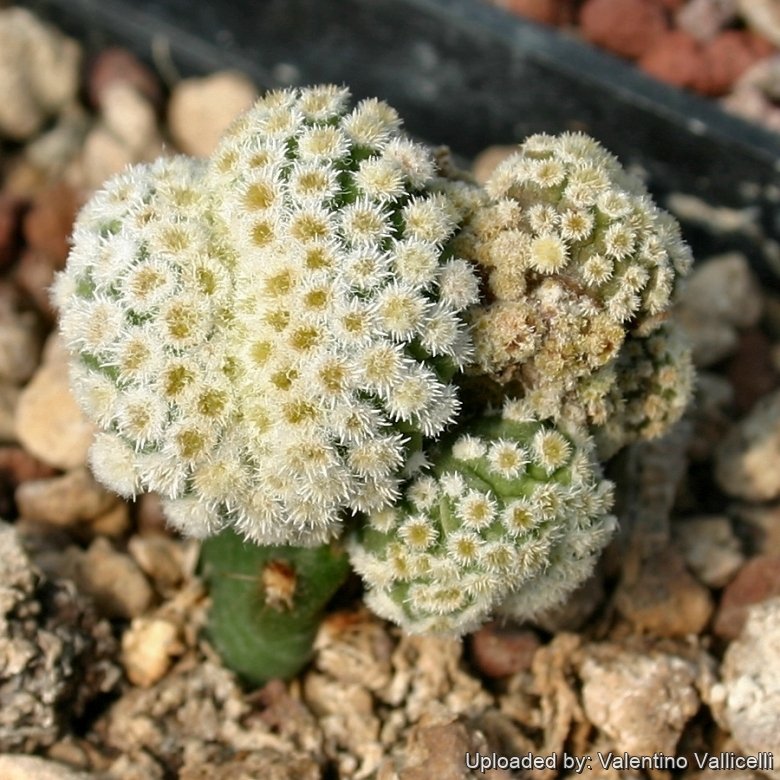
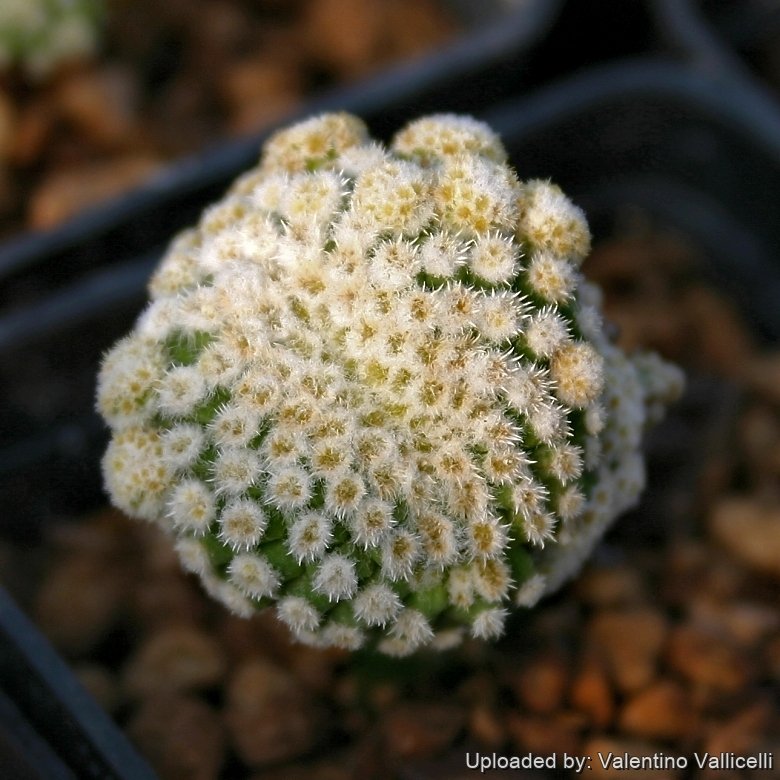
Strombocactus disciformis cv. Cactus Art is an odd monstrous plant with narrow felt-like areoles derived from the well known Strombocactus disciformis.
Habit: This cultivars is easily grown into crowded clumps or mounds, and tends to offset more abundantly than the normal form. Most plants will crest readily, and clumps can be produced in a few years.
Stem: Depressed-globose to somewhat elongated (depending on growing condition) 2-5 cm in diameter, blue-green with greyish tinge, with white wool in the centre, and also in the older areoles.
tubercles: Rhomboid and imbricate, somewhat laterally compressed, and often thinner than the above standing areoles.
Areoles: Very distinctive, creamy-white, woolly, conspicuous, in relief, 2-4 mm broad.
Spines: Extremely, short bristle-like that give the areoles a characteristic felty appearance, in fact these areoles are firm to the touch because they are densely covered by innumerable tiny spines. The younger areoles at the stems apex are greenish.
Flowers. Not seen.
Remarks: A similar abnormal uncoordinated form of vegetative growth, is also seen in several cactus species.
Origin and Habitat
Garden origin (Nursery produced cultivar)
This cultivar has been originated in Cactus Art Nursery, the mutation came out spontaneously among hundred of typical plant in the spring of 2004.
Cultivation and Propagation
Although regarded as a choice and difficult plant is not too difficult in a greenhouse, although grows quite slowly.
Soil: Use mineral well permeable mineral soil with little organic matter (peat, humus).
Exposure: They need a good amount of light shade to full sun this help to keep the plants healthy, although slow growth.
Watering: Water sparingly from March till October (weekly during summertime, if the weather is sunny enough) , with a little fertilizer added. Less or no water during cold winter months, or when night temperatures remain below 10° to prevent root loss. It is sensitive to overwatering (rot prone).
Hardiness: Keep perfectly dry in winter at temperatures from 5 to 15 degrees centigrade. (but it is relatively cold resistant and hardy to -5° C for short periods) In the rest period no high atmospheric humidity!! (Temperature Zone: USDA 9-11)
Propagation: Grafting since cutting root hardly. Plants are usually grafted onto column-shaped cacti but proved to be able to produce their own roots if degrafted.