Publication: Cactaceae (Britton & Rose) 4: 8. 1923 [24 Dec 1923]
Description
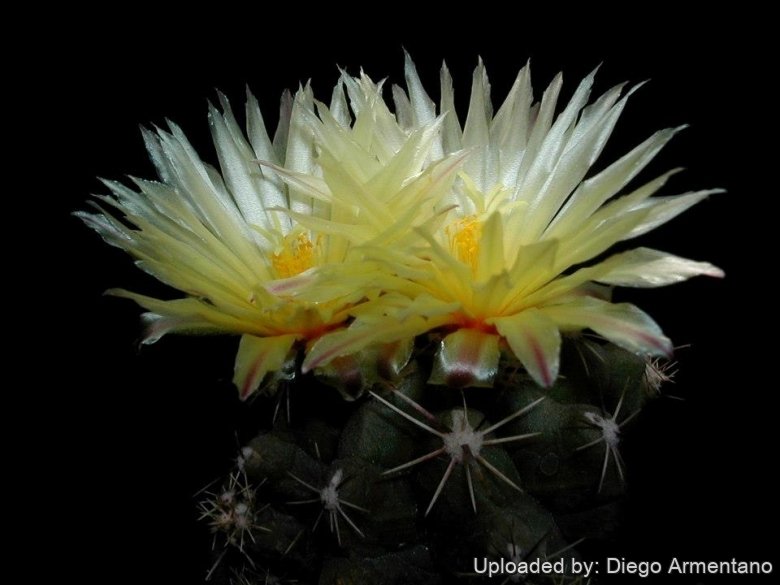
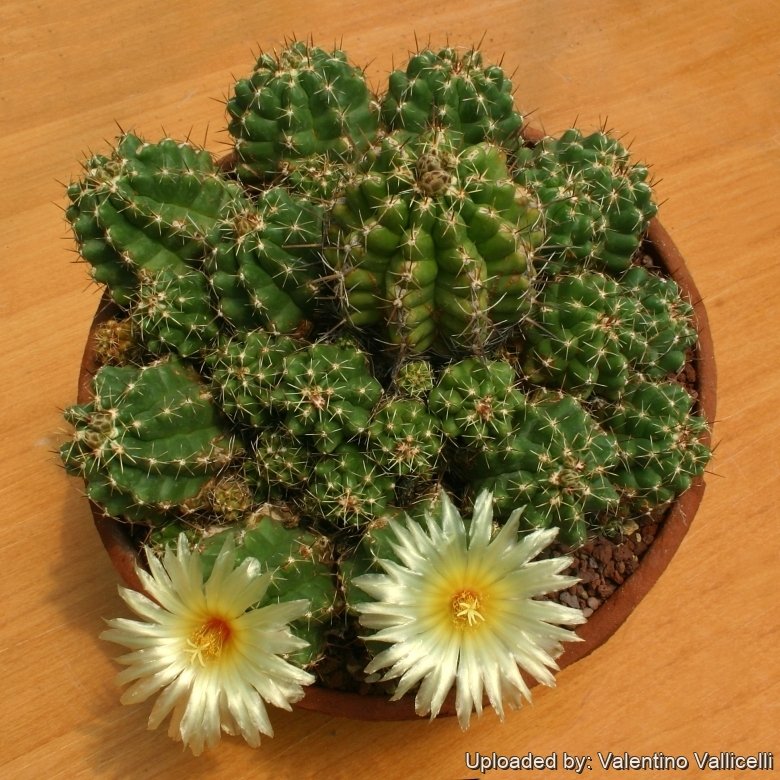
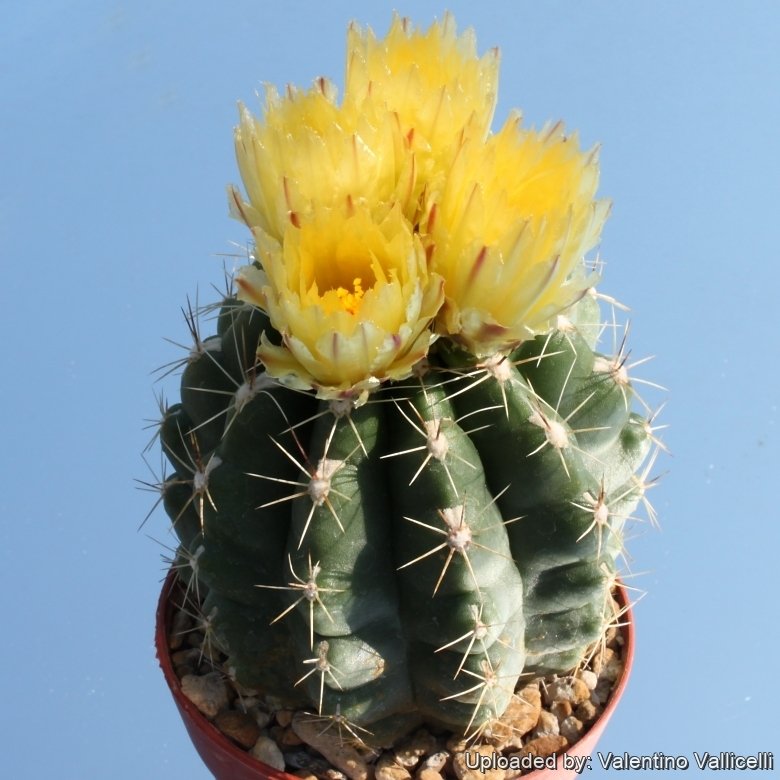
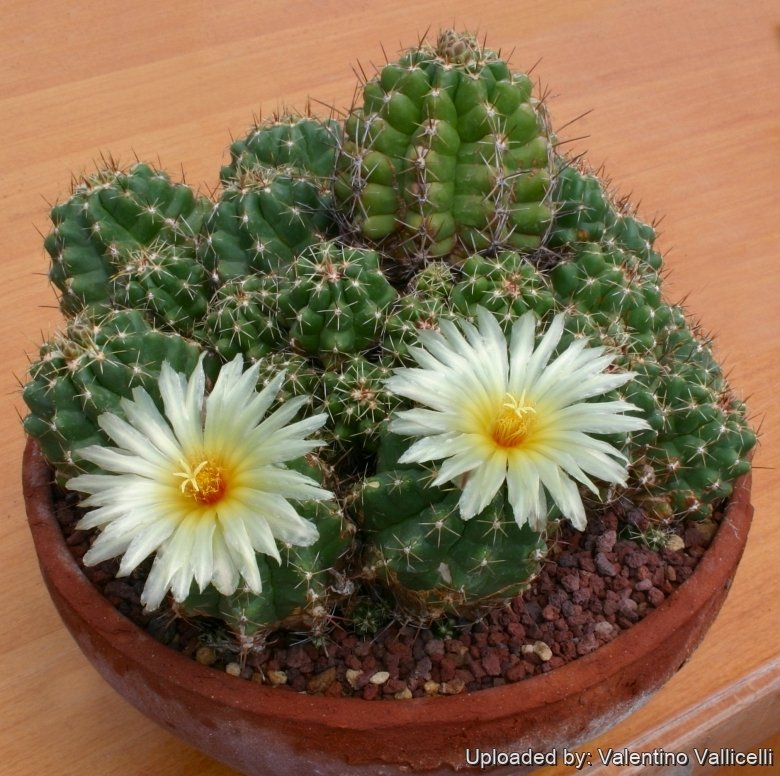
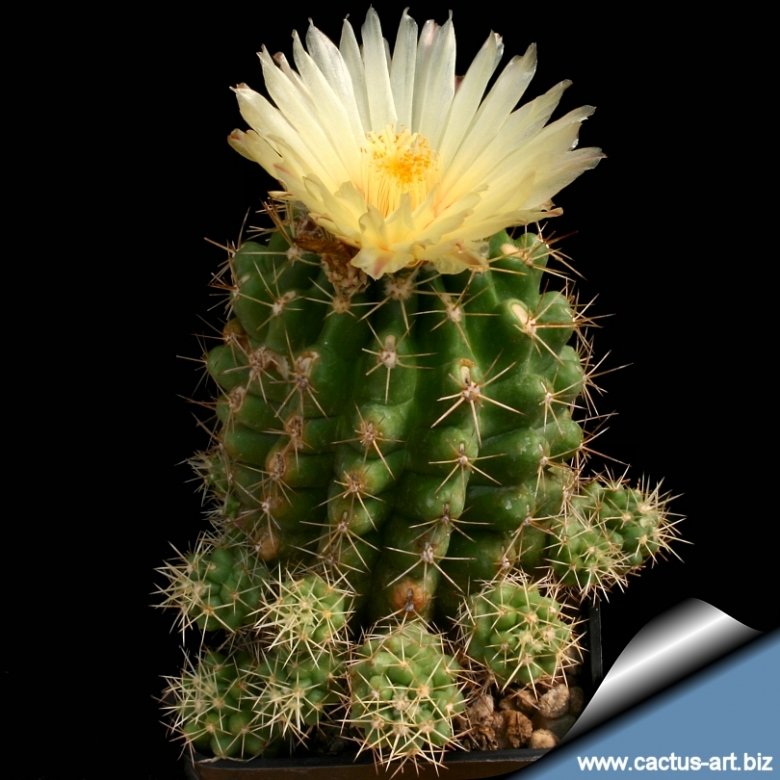
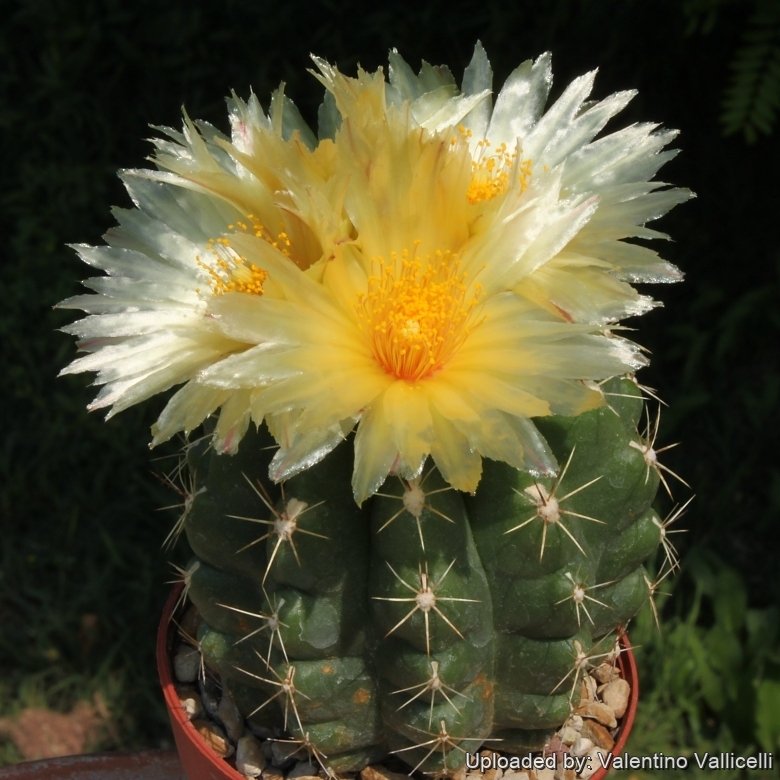
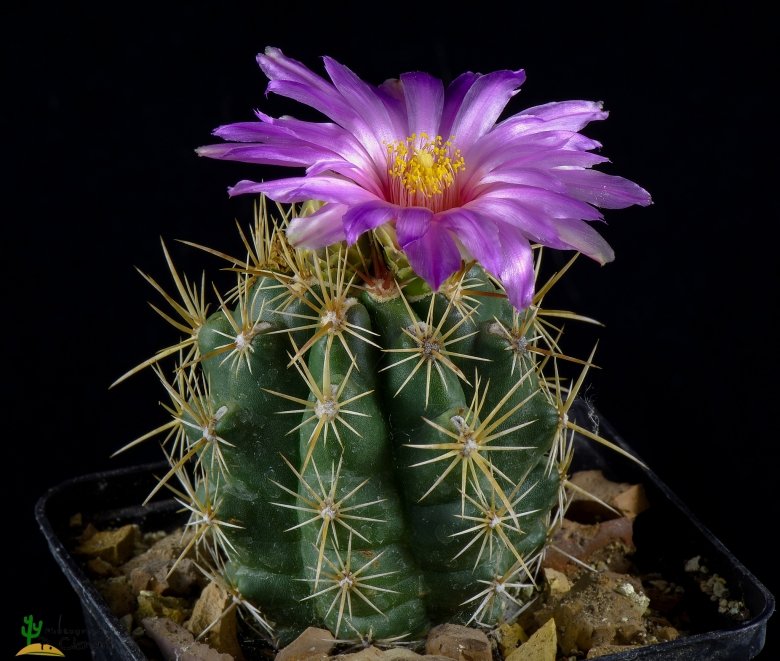
Thelocactus leucacanthus is a cushion forming cactus. It clusters very easily and in the wild it may form groups up to 80 cm in diameter with hundreds of heads. The flowers open on the day and the colour varies from pale yellow to pink depending on the variety and clone. The flowers last for several days but close every night. T. leucacanthus is extremely variable in the number and length of its spines.
Stem: Simple then clustering freely, light green globular or short-cylindric, 4.5-15 cm tall, 2.5-6 cm in diameter.
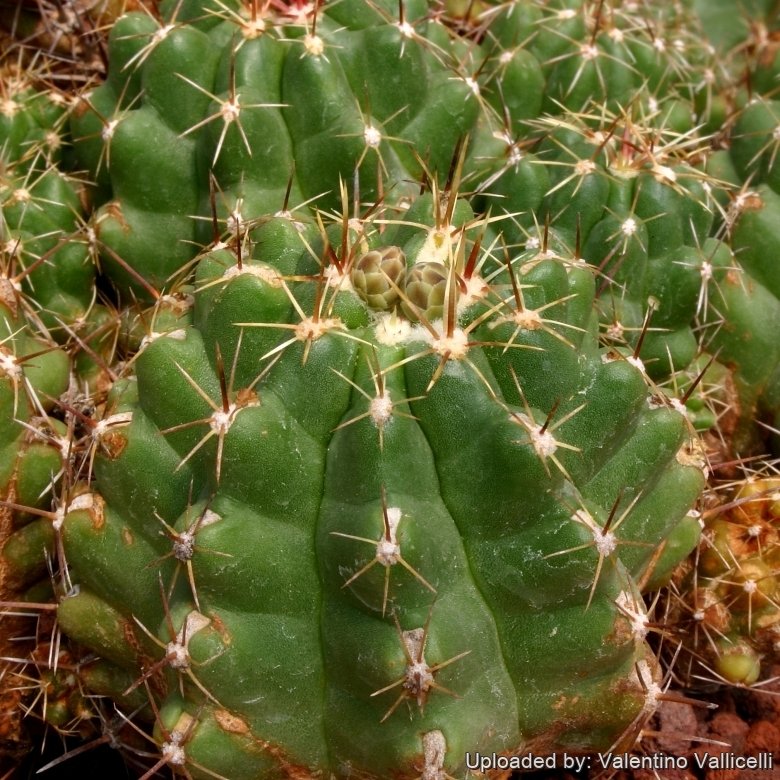
Ribs: 7-14 tuberculate but well-defined, straight or sometimes spiralling.
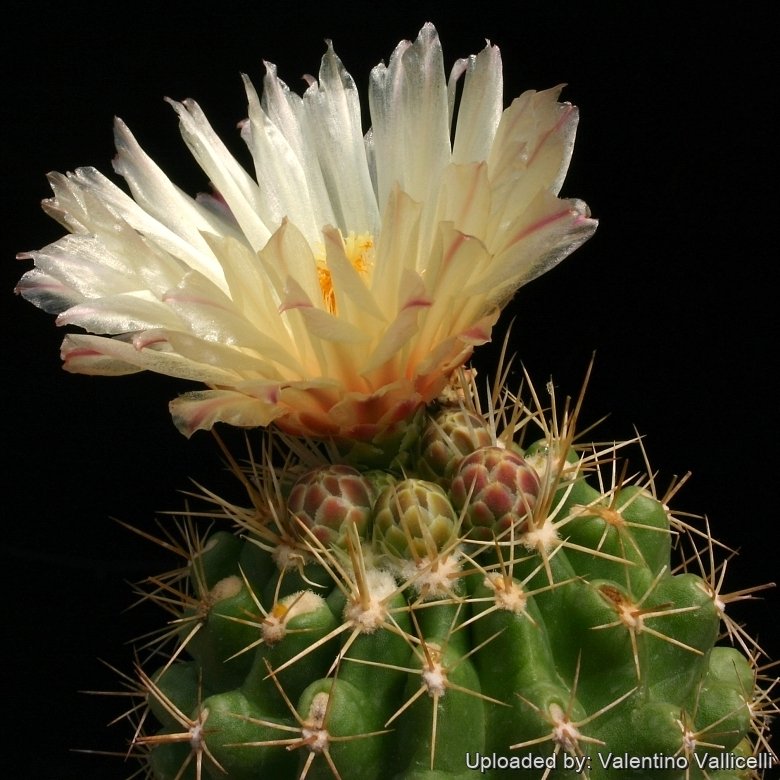
Tubercles: Conical-obtuse with rounded tip, 8-11 mm tall,. 10-14 mm wide.
Areoles: Elongated 6 x 3 mm wide, spaced 4-6 mm. Positioned on the top of the tubercle and furnished with with nectar-secreting glands.
Central spines: Absent or 1, rarely 3, upright-projecting, yellowish-white to almost black , but in age grey, more or less annulate, 5-50 mm long.
Radial spines: 6-20 unequal, 5-7 (or more) mm long, spreading or moderately recurved, at first yellowish-white becoming reddish to greyish as they age.
Flowers: Diurnal, funnel-shaped 2,5-5,2 cm long, 2-4,5 cm in diameter, the colour varies from pale yellow to pink (or magenta ) depending on the variety and clone. They are produced on the apex of the youngest tubercles and are furnished by scales. Inner perianth-segments numerous, lanceolate, acute. Tube short. Ovary and flower-tube bearing broad imbricated scales. Filament yellowish-green, anthers yellow, style pale magenta with 5-6 stigmatic lobes.
Blooming season: The Thelocactus leucacanthus blooms at the end of spring.
Fruit: Furnished of scales, dark green to yellowish sub spherical 6-9 mm in diameter that dry at maturity. Dehisces basally and conserve the floral remnant.
Seed: Pyriform black, 1,4-2 mm long, 1-1,8 mm in diameter, seed-coat net-like.
Origin and Habitat
Thelocactus leucacanthus has been reported from Central East Mexico, where it occurs in the states of Guanajuato, Hidalgo, and Querétaro. It is known from 23 subpopulations.
Habitat and Ecology: The species grows in matorral and xerophyllous scrub together with Thelocactus hastifer. This cactus is occasionally used as an ornamental. It is relatively widespread and abundant, and is not exposed to major threats, only grazing (trampling) and land-use changes (agriculture) threaten some subpupupulations.
Cultivation and Propagation
It is a summer grower species easy to cultivate. Water regularly from Spring to Autumn, but do not overwater, can become too elongated if compost is too rich. Requires full sun or light shade and careful watering to keep plant compact with strong coloured spines. Needs good drainage and very porous potting mix, In Winter, keep dry.
Reproduction: From seed or by cuttings as it produces many basal plantlets.
Notes
Mexico (The ssp. leucacanthus comes from Hidalgo while the ssp. schmollii comes from Queretaro.)
Habitat: Grows in the xerophytic scrublands in limestone rich substrata at an altitude of about 1200-1990 m.
Bibliography
Major references and further lectures
-
Edward Anderson “The Cactus family” Timber Press, Incorporated, 2001
-
James Cullen, Sabina G. Knees, H. Suzanne Cubey “The European Garden Flora Flowering Plants: A Manual for the Identification of Plants Cultivated in Europe, Both Out-of-Doors and Under Glass” Cambridge University Press, 11/Aug/2011
-
David R Hunt; Nigel P Taylor; Graham Charles; International Cactaceae Systematics Group. “The New Cactus Lexicon” dh books, 2006
-
Gómez-Hinostrosa, C., Sánchez , E., Guadalupe Martínez, J. & Bárcenas Luna, R. 2013. Thelocactus leucacanthus. The IUCN Red List of Threatened Species 2013: e.T152346A626445. http://dx.doi.org/10.2305/IUCN.UK.2013
-1.RLTS.T152346A626445.en. Downloaded on 02 March 2016.
-
Nathaniel Lord Britton, Joseph Nelson Rose “Cactaceae: Descriptions and Illustrations of Plants of the Cactus Family” volume 4, 1923
-
Backeberg, “Die Cactaceae” 5: 2814-820 1961
-
Haustein, “Der Kosmos-Kakteenfiihrer”, 243 1983
-
Bradleya 5: 67 1987
From llifle page Echinocactus ehrenbergii
Description
Thelocactus leucacanthus var. ehrenhergii (syn: Thelocactus ehrenhergii and Echinocactus ehrenhergii) is a cespitose cactus species that forms dense cushions. It is generally included within (as a synonym of) Thelocactus leucacanthus, suggesting that there is not really a fundamental difference between the two, but T. ehrenhergii usually has pink-rose flowers while T. leucacanthus has mostly yellow flowers. The description of Britton and Rose (Cactaceae:1923) included the following information: “…We are inclined to refer here Echinocactus ehrenhergii Pfeiffer (Allg. Gartenz. 6: 275. 1838), which, according to Schumann, also came from Ixmiquilpan, Mexico. In his monograph Schumann describes the flowers as yellow like those of E. leucacanthus, but in his English Keys he says that the flowers are rose-red. Dr. Rose, who collected in this region in 1905, found only one species of this relationship…”
For more details see: Thelocactus leucacanthus
Origin and Habitat
Ixmiquilpan, Mexico.
Cultivation and Propagation
Thelocactus ehrenhergii is a summer grower species easy to cultivate. Water regularly from Spring to Autumn, but do not overwater, can become too elongated if compost is too rich. Requires full sun or light shade and careful watering to keep plant compact with strong coloured spines. Needs good drainage and very porous potting mix, In Winter, keep dry.
Reproduction: From seed or by cuttings as it produces many basal plantlets.
Bibliography
Major references and further lectures
- Nathaniel Lord Britton, Joseph Nelson Rose “Cactaceae: Descriptions and Illustrations of Plants of the Cactus Family” volume 4, 1923
Source: Echinocactus ehrenbergii, LLIFLE - Encyclopedia of living forms, CC-BY-SA, retrieved 2026-10-25.
Cultivars and forms (1)
Varieties (1)
Gallery