Publication: Kaktusy (Brno) 40(1): 11 (5-13; figs.). 2004 [15 Feb. 2004]
Description
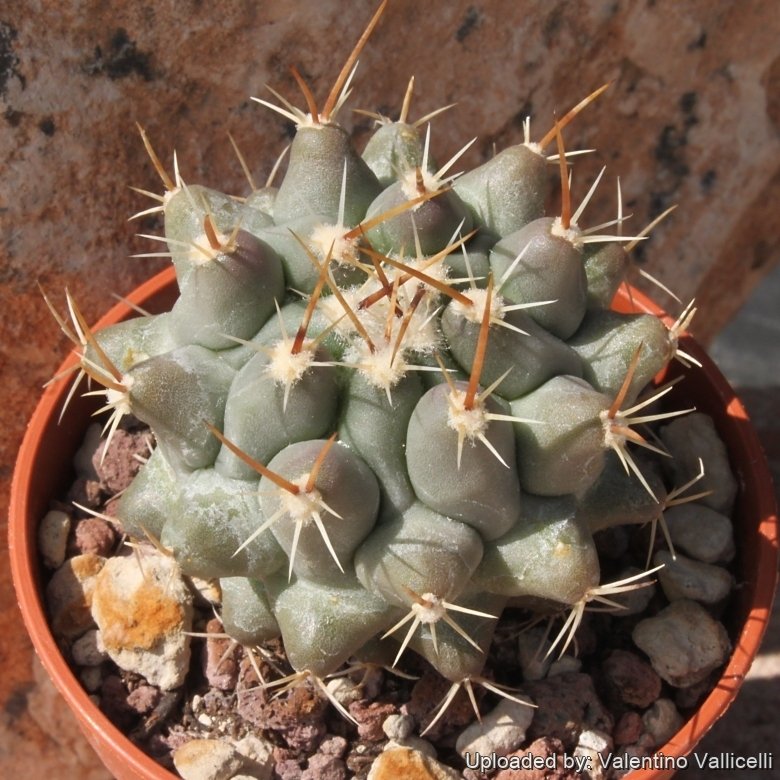
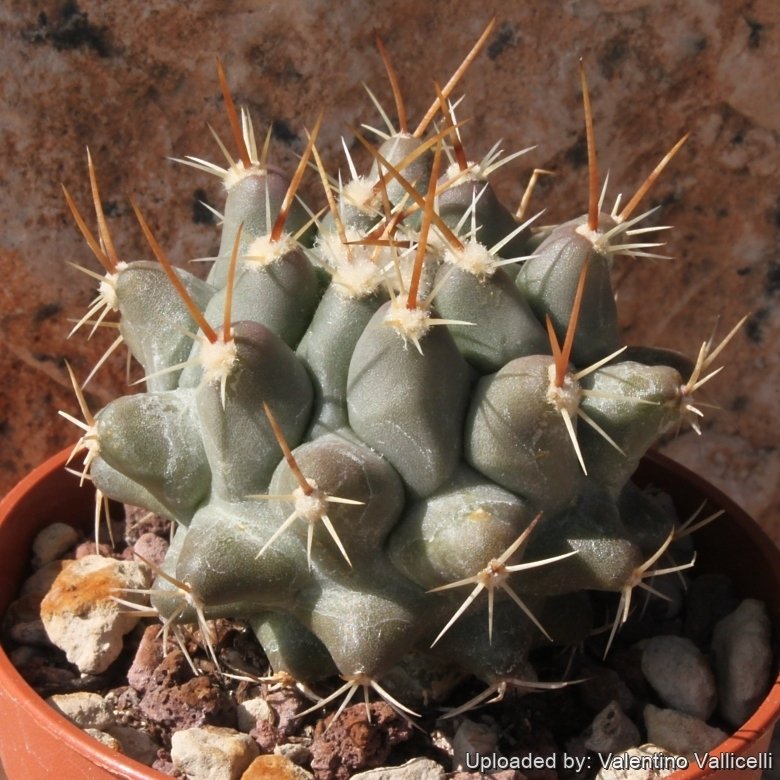
Stem: Single, depressed or spherical, 210 (-250) mm wide and 120 (-170) mm tall dark green to silver epidermis, often with purplish tubercles tips. Apex of the plant covered with yellowish wool.
Ribs: 13, in spirals, deeply divided into individual tubercles, tubercles erect with blunt keel on the bottom side down of the areoles.
Areoles: Oval, about 4 mm wide and 7 mm long, at first with yellowish or whitish felt later bare.
Central spines: 2-4 longer and stronger than marginal, straight, subulate, round in cross section, 2 mm thick at the base up to 80 mm long, young spines brownish with a mauve tinge, transversely ribbed, older spines greyish asbestos-like with piling fibrous surface.
Radial spines: 4-7(-11 ) yellowish-colored glassy.
Flowers: Funnel form with a short flower tube 50 mm wide and tall, tepals dark red-violet lanceolate, numerous, arranged in two or three rows. Outer tetals dark purple with lighter edges, inner tetals lighter purple, with darker central stripe. Pistil yellow, about 20 mm long, with 10 yellow stigma lobes. Anthers yellow.
Fruit: Barrel-shaped, at first fleshy, dark purple, covered with scales, about 10-12 mm wide, with a hard pericarp, opening at maturity at the base.
Seed: Black, pear-shaped, with tuberculate testa, about 1.5 mm long.
Origin and Habitat
Northern border of the Sierra Paila, Coahuila (Mexico Northeast)
Type Locality: La Paloma, ad viam publicam no 57 inter oppida Saltillo et Monclova, 1231m.
Habitat: Grows in matorral xerofilo on limestone hills.
Cultivation and Propagation
Thelocactus rinconensis subs. palomaensis is a summer grower species easy to cultivate.
Growth rate: It is a slow growing species.
Soil: Use mineral well permeable substratum with little organic matter (peat, humus), plants may become too elongated if compost is too rich.
Repotting: Re-pot every 2 years. Use pot with good drainage.
Fertilization: It grows much faster with a low nitrogen content fertilizer in spring and summer.
Watering: Requires careful watering to keep plant compact. Water sparingly from March till October, the thin, fibrous roots suffer if there is humidity, therefore the plant should be watered only when the surrounding terrain is dry. Keep dry as soon as the temperature starts dropping in October and keep it perfectly dry in winter at temperatures from 5 to 15 degrees centigrade.
Hardiness: They need to be kept in a cool place during winter rest and are somewhat resistant to frost if kept on the dry side prior to, and during, cold weather ( they are hardy to -5 C ° C or less for short periods). Although it is one of the easier Parodia to grow, it tends to rot in winter during the resting phase, if kept wet. In the rest period no high atmospheric humidity!!
Sun Exposure: Requires full sun in winter and some protection in summer, its colour tends to richer and darker when grown in light shade.
Uses: It is an excellent plant for container growing. It always looks good and stays small.
Pests & diseases: It may be attractive to a variety of insects, but plants in good condition should be nearly pest-free, particularly if they are grown in a mineral potting-mix, with good exposure and ventilation. Nonetheless, there are several pests to watch for:
- Red spiders: Red spiders may be effectively rubbed up by watering the infested plants from above.
- Mealy bugs: Mealy bugs occasionally develop aerial into the new growth among the wool with disfiguring results, but the worst types develop underground on the roots and are invisible except by their effects.
- Scales: Scales are rarely a problem.
- Rot: Rot is only a minor problem with cacti if the plants are watered and “aired” correctly. If they are not, fungicides won’t help all that much. To prevent rottenness it is also advisable to surround its root neck by very rough sand or grit, this help a fast water drainage.
Propagation: Nearly always from seed, since the plant rarely produces plantlets.