Publication: Kakteen Sukk. 43(5): 97 (96; photogrs. 1-4). (1992)
Description
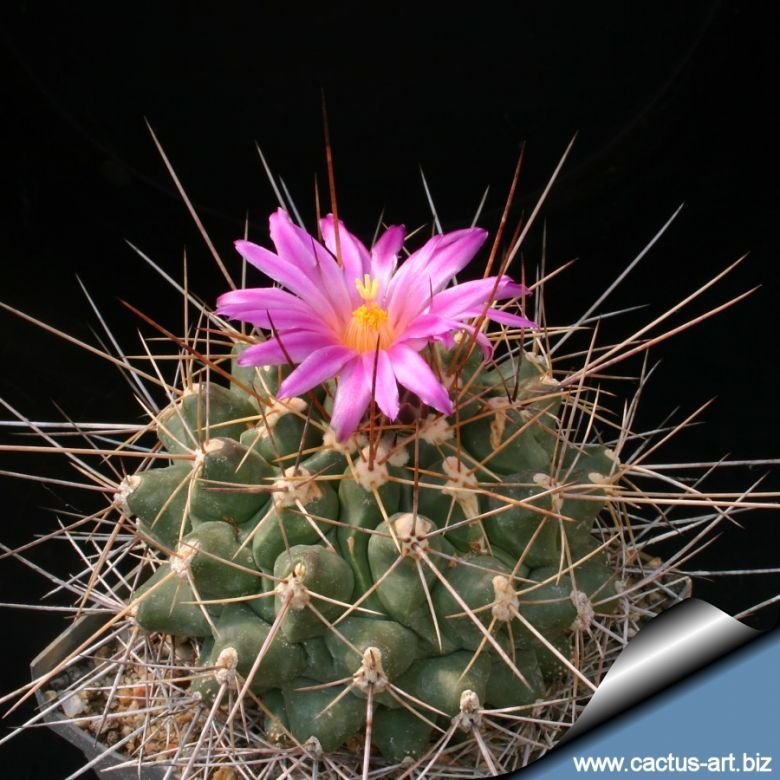
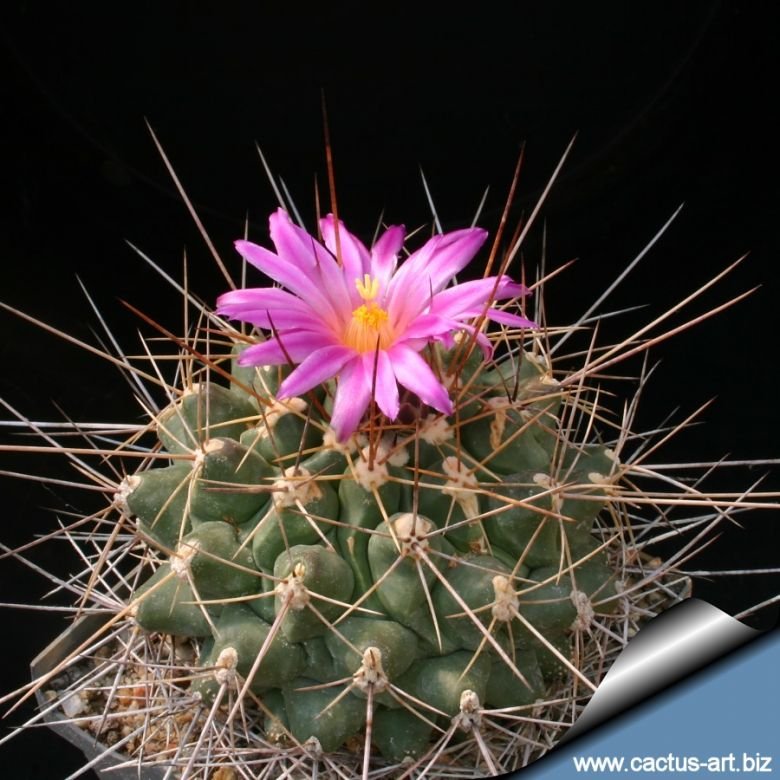
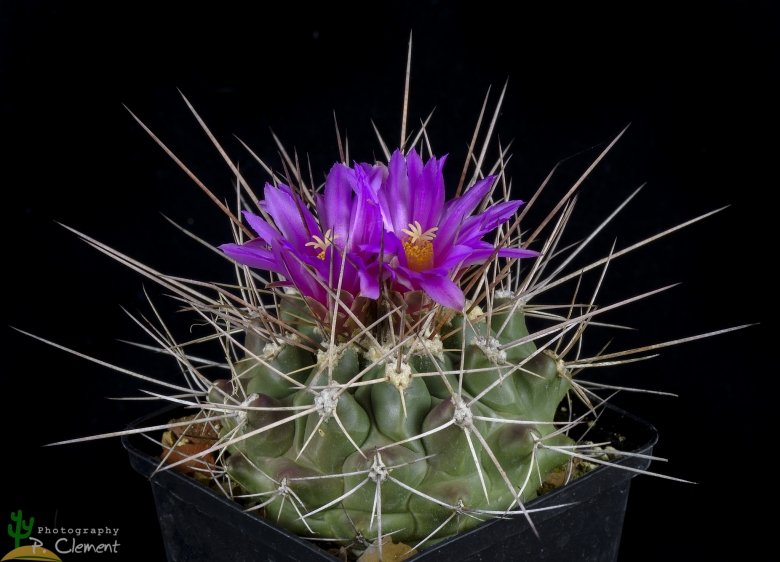
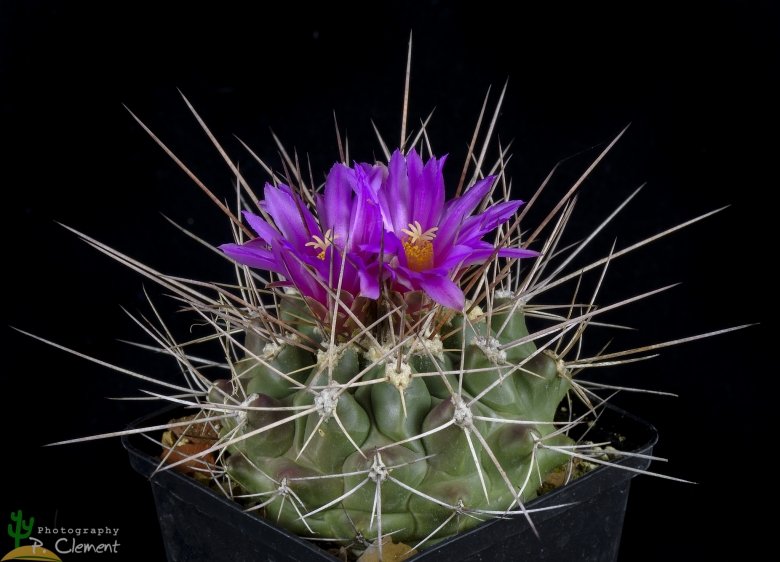
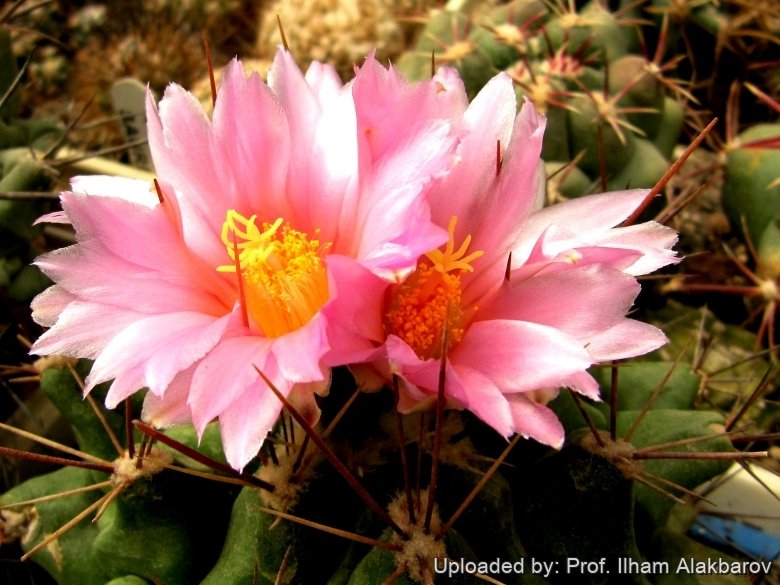
This subspecies differs from the type for the presence of acicular radial spines and the beautiful magenta flowers.
Habit: Usually solitary, develops a squat depressed to globose and highly ribbed stem with flattened top up to 8 cm tall, 15 cm wide.
Ribs: 21, distinct.
Tubercles: Conical.
Areoles: Without glands.
Central spines: 3-4, 40-100 mm long, ochre to greyish, straight or slightly curved, acicular.
Radial spines: 4-6, 15-40 mm long, ochre to greyish, straight, acicular.
Flowers: Flowers: 50-60 mm wide, magenta, usually fail to flower until they are 5-9 years old.
Origin and Habitat
Mexico, Nuevo León, known only from the type locality near Grutas de Garcia.
Habitat:: Matorral xerofilo on limestone hills.
Cultivation and Propagation
Thelocactus rinconensis subs. freudenbergeri is a summer grower species easy to cultivate.
Growth rate: It is a slow growing species.
Soil: Use mineral well permeable substratum with little organic matter (peat, humus), plants may become too elongated if compost is too rich.
Repotting: Re-pot every 2 years. Use pot with good drainage.
Fertilization: It grows much faster with a low nitrogen content fertilizer in spring and summer.
Watering: Requires careful watering to keep plant compact. Water sparingly from March till October, the thin, fibrous roots suffer if there is humidity, therefore the plant should be watered only when the surrounding terrain is dry. Keep dry as soon as the temperature starts dropping in October and keep it perfectly dry in winter at temperatures from 5 to 15 degrees centigrade.
Hardiness: They need to be kept in a cool place during winter rest and are somewhat resistant to frost if kept on the dry side prior to, and during, cold weather ( they are hardy to -5 C ° C or less for short periods). Although it is one of the easier Parodia to grow, it tends to rot in winter during the resting phase, if kept wet. In the rest period no high atmospheric humidity!!
Sun Exposure: Requires full sun in winter and some protection in summer, its colour tends to richer and darker when grown in light shade.
Uses: It is an excellent plant for container growing. It always looks good and stays small.
Pests & diseases: It may be attractive to a variety of insects, but plants in good condition should be nearly pest-free, particularly if they are grown in a mineral potting-mix, with good exposure and ventilation. Nonetheless, there are several pests to watch for:
- Red spiders: Red spiders may be effectively rubbed up by watering the infested plants from above.
- Mealy bugs: Mealy bugs occasionally develop aerial into the new growth among the wool with disfiguring results, but the worst types develop underground on the roots and are invisible except by their effects.
- Scales: Scales are rarely a problem.
- Rot: Rot is only a minor problem with cacti if the plants are watered and “aired” correctly. If they are not, fungicides won’t help all that much. To prevent rottenness it is also advisable to surround its root neck by very rough sand or grit, this help a fast water drainage.
Propagation: Nearly always from seed, since the plant rarely produces plantlets.
Bibliography
Major references and further lectures
-
Edward Anderson “The Cactus family” Timber Press, Incorporated, 2001
-
James Cullen, Sabina G. Knees, H. Suzanne Cubey “The European Garden Flora Flowering Plants: A Manual for the Identification of Plants Cultivated in Europe, Both Out-of-Doors and Under Glass” Cambridge University Press, 11/Aug/2011
-
David R Hunt; Nigel P Taylor; Graham Charles; International Cactaceae Systematics Group. “The New Cactus Lexicon” dh books, 2006
-
Urs Eggli, Leonard E. Newton: “Etymological Dictionary of Succulent Plant Names” Springer, Berlin/Heidelberg 2010
-
Philip Perl “Cacti and succulents” 1978
-
N. L. Britton, J. N. Rose: “The Cactaceae. Descriptions and Illustrations of Plants of the Cactus Family.” Volume III, The Carnegie Institution of Washington, Washington 1922
-
Hans Hecht “BLV-Handbuch der Kakteen” BLV-Verlagsgesellschaft, 1982
-
E Haustein “Der Kosmos Kakteenfuehrer (the Kosmos Cactus Guide)” Balogh Scientific Books 01 December 1998
-
Paul Carpenter Standley “Trees and shrubs of Mexico, Parti 1-3” Govt. Print. Off., 1926
-
Edgar Lamb, Brian Lamb “The Illustrated Reference on Cacti & Other Succulents, Volume 5” Blandford Press, 1978
-
Clive Innes “Complete Handbook of Cacti and Succulents” Van Nostrand Reinhold Company, 01/Dec/1981
-
Walther Haage “Cacti and succulents: a practical handbook” Dutton, 1963
-
A. J. van Laren, Scott Edson Haselton “Cactus” Abbey San Encino Press, 1935
-
Gordon D. Rowley “The illustrated encyclopedia of succulents” Crown Publishers, 01/Aug/1978
-
Hans Hecht “Cacti & Succulents” Sterling Publishing Company Incorporated, 1994
-
Roger Spencer “Horticultural Flora of South-eastern Australia: The Identification of Garden and Cultivated Plants. Flowering plants : Dicotyledons, Volume 2, Parte 1” UNSW Press, 1997
-
John Pilbeam “Cacti for the Connoisseur: A Guide for Growers & Collectors” Timber Press, 01/Jul/1987
Gallery