Publication: Cact. Succ. J. (Los Angeles) 49(6): 246. 1977
Description
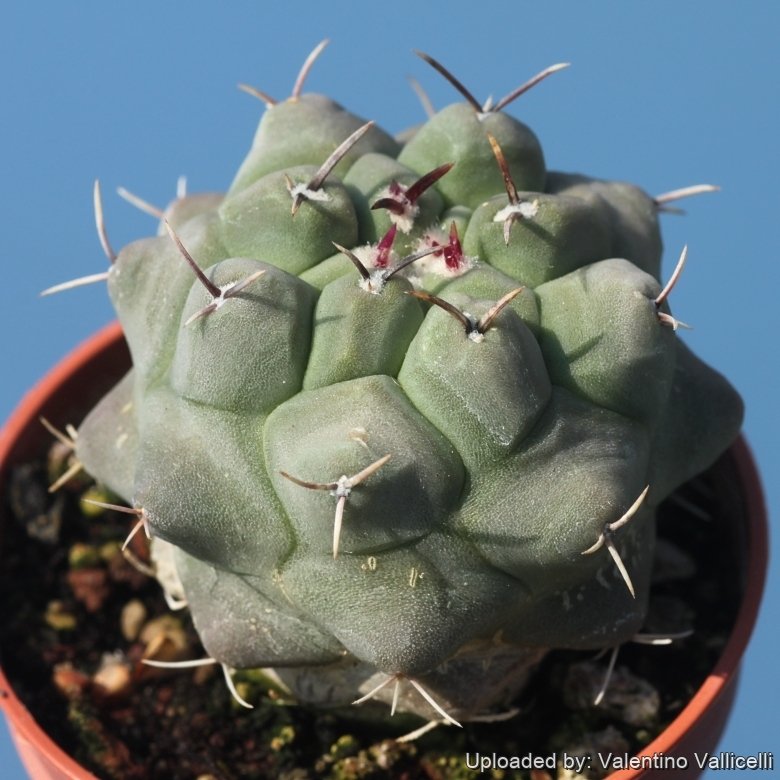
Thelocactus rinconensis subs. phymatothelos, better known as Thelocactus phymatothelos, can be distinguished from other forms of the Thelocactus rinconensis complex because the stem is always strongly depressed and glaucous, the spines are few, shorter and slightly curved, and the flowers are more or less clear pink.
Habit: Usually solitary or very slow to offset, develops a squat and highly ribbed stem with a flattened top.
Stem: Spherical with a compressed top, 9-15(-20) cm across, ap to 10 cm tall, chalky-grey, silvery-grey, glaucous sometimes tinged with purple.
Ribs: Mostly obscured by tubercles that are very prominent angled but more rounded and compressed than those of the main species Thelocactus rinconensis. Tubercles up to 1,5 cm hight.
Areoles: Round to elongate, mostly more than 2 cm apart and without nectaries.
Spines: Usually short but variable in length, depending on the clone, dark, usually black-brown , pale at apex, but also grey, brown or yellow, with a distinctive silvery appearance, and sometimes shredding. Spines in old age shiny grey-white.
Central spines: Most often 1-2 (rarely more) slightly curved, sometimes scaly with age, usually very short or occasionally up to 6 cm long.
Radial Spines: up to 5 (usually only1-2) similar to the centrals, erect to radiating, slightly curved shorter than the centrals.
Flowers: 3-5 cm long, 2,7-3 cm in diameter, white to pinkish with a pink midstripe. Tube short, pericarpels covered
with scales. The plants usually fail to flower until they are 5-9 years old.
Fruit: Spherical ta oblong with scales, 7-9 mm in diameter, greenish or yellowish, slightly fleshy when ripe, opening by basal pore.
Origin and Habitat
It is known only from the slopes of Arteaga Canyon just south of Saltillo, Coahuila. Mexico.
Altitude: Around 1900 metres above sea level.
Habitat: Chihuahuan Desert. Often found growing together with Neolloydia conoidea.
Cultivation and Propagation
Easy to cultivate. Water moderately from Spring to Autumn. In Winter, keep dry.
Sun Exposure: Full sun to light shade
Reproduction: Nearly always from seed, since the plant rarely produces plantlets.
Notes
Thelocactus phymatothelos is now considered a synonym of Thelocactus rinconensis, along with Thelocactus lophothele, Thelocactus nidulans, and others. It is not sufficiently distinct to deserve its own formal status.
Bibliography
Major references and further lectures
-
Edward Anderson “The Cactus family” Timber Press, Incorporated, 2001
-
James Cullen, Sabina G. Knees, H. Suzanne Cubey “The European Garden Flora Flowering Plants: A Manual for the Identification of Plants Cultivated in Europe, Both Out-of-Doors and Under Glass” Cambridge University Press, 11/Aug/2011
-
David R Hunt; Nigel P Taylor; Graham Charles; International Cactaceae Systematics Group. “The New Cactus Lexicon” dh books, 2006
-
Urs Eggli, Leonard E. Newton: “Etymological Dictionary of Succulent Plant Names” Springer, Berlin/Heidelberg 2010
-
Philip Perl “Cacti and succulents” 1978
-
N. L. Britton, J. N. Rose: “The Cactaceae. Descriptions and Illustrations of Plants of the Cactus Family.” Volume III, The Carnegie Institution of Washington, Washington 1922
-
Hans Hecht “BLV-Handbuch der Kakteen” BLV-Verlagsgesellschaft, 1982
-
E Haustein “Der Kosmos Kakteenfuehrer (the Kosmos Cactus Guide)” Balogh Scientific Books 01 December 1998
-
Paul Carpenter Standley “Trees and shrubs of Mexico, Parti 1-3” Govt. Print. Off., 1926
-
Edgar Lamb, Brian Lamb “The Illustrated Reference on Cacti & Other Succulents, Volume 5” Blandford Press, 1978
-
Clive Innes “Complete Handbook of Cacti and Succulents” Van Nostrand Reinhold Company, 01/Dec/1981
-
Walther Haage “Cacti and succulents: a practical handbook” Dutton, 1963
-
A. J. van Laren, Scott Edson Haselton “Cactus” Abbey San Encino Press, 1935
-
Gordon D. Rowley “The illustrated encyclopedia of succulents” Crown Publishers, 01/Aug/1978
-
Hans Hecht “Cacti & Succulents” Sterling Publishing Company Incorporated, 1994
-
Roger Spencer “Horticultural Flora of South-eastern Australia: The Identification of Garden and Cultivated Plants. Flowering plants : Dicotyledons, Volume 2, Parte 1” UNSW Press, 1997
-
John Pilbeam “Cacti for the Connoisseur: A Guide for Growers & Collectors” Timber Press, 01/Jul/1987
Gallery