Publication: Bradleya 5: 65 (1987)
Description
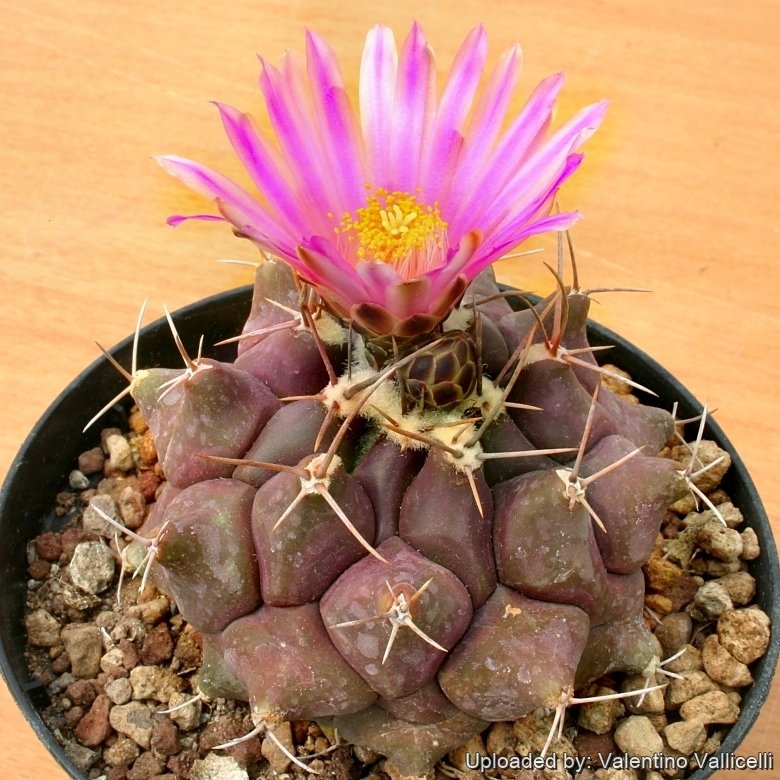
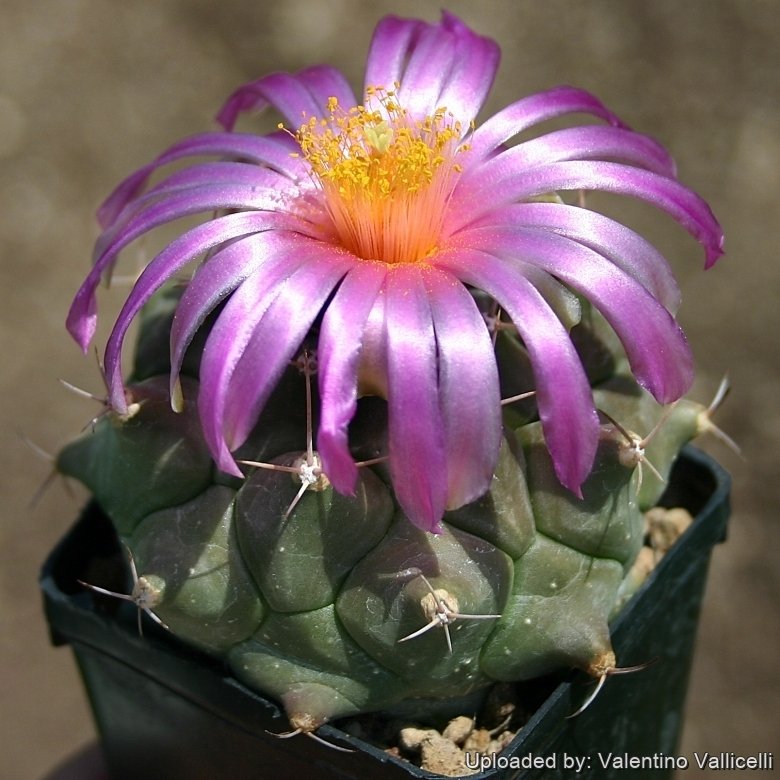
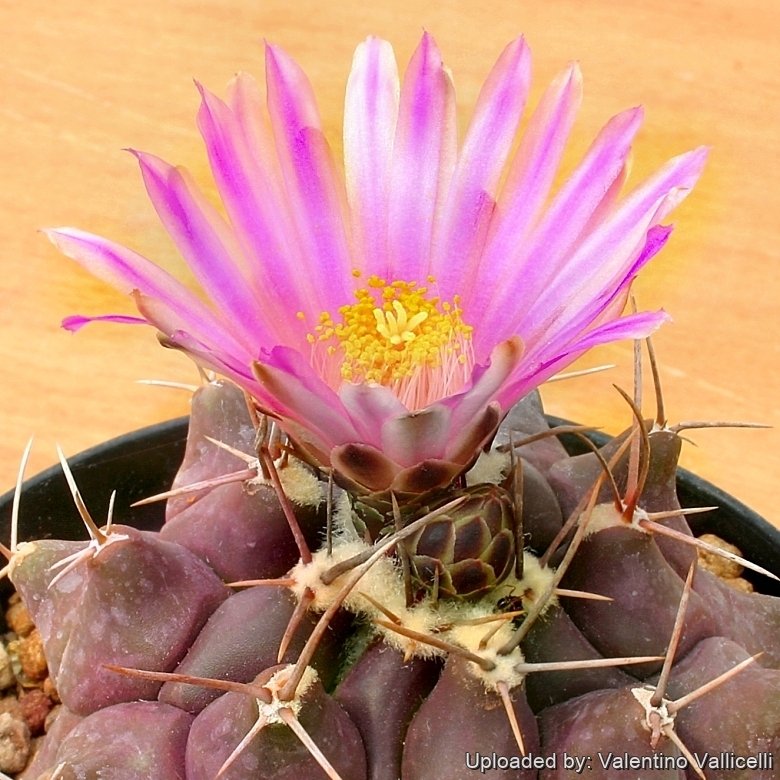
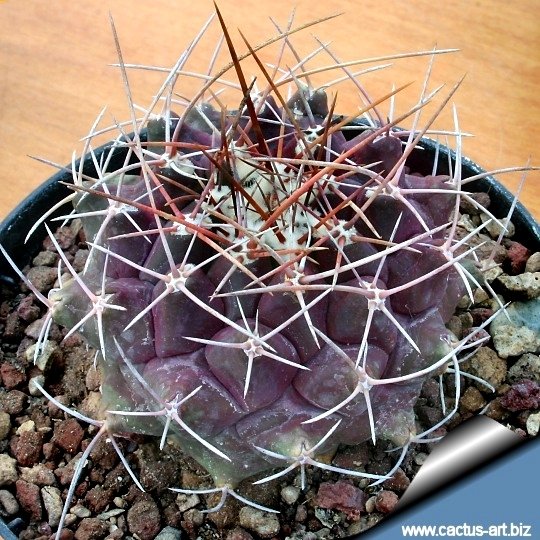
Thelocactus tulensis subsp. buekii is a globular cactus closely related to Thelocactus tulensis subsp. matudae, but with distinctive shorter tubercles, lower spine number and smaller flowers. Both taxa are subspecies of the very variable polymorphic Thelocactus tulensis which comprises innumerable geographical forms linked one to each others by populations of plants with intermediate characteristics. Such variations has led to establishment of several unnecessary names for this species.
Habit: Solitary, depressed to globose.
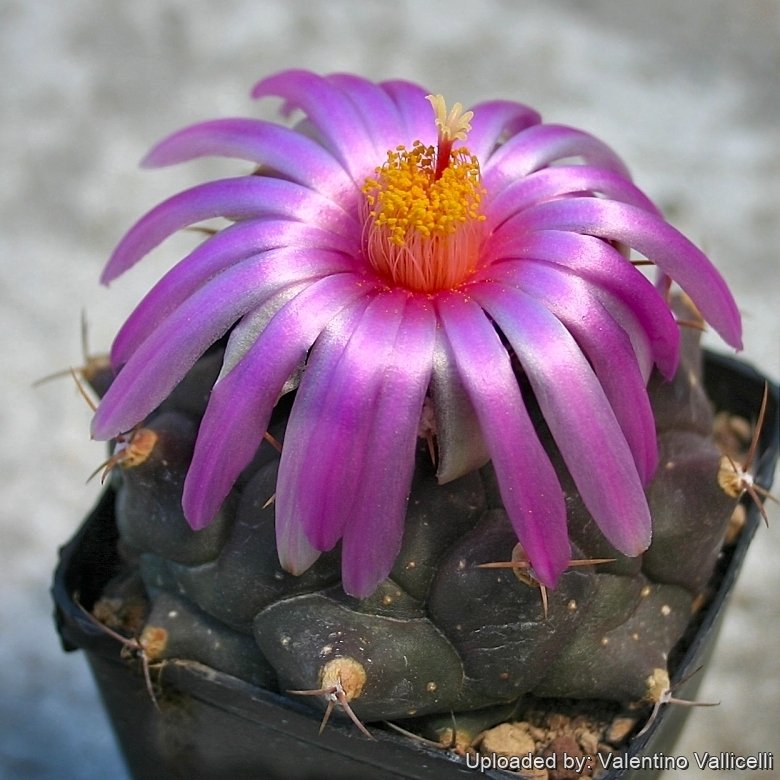
Stem: Flat with indistinct ribs completely divided into broad tubercles, glaucous green to dark brown or magenta, 5-22 cm tall, 11-16 in diameter.
Tubercles: 1,5-2,5 cm long.
Spines: 3 to 7 grey to reddish central vertical spines, up to 2 cm; 7 to 12 radials.
Root system: Fat underground tap root.
Flowers: Bright purple diurnal , up to 8 cm wide, in early summer.
Remarks:Thelocactus buekii and Thelocactus matudae are sharply distinguished from Thelocactus tulensis, for the different seed micro-morphology.
Origin and Habitat
Mexico (Nuevo León) at 800 to 1000 m elevation.
Habitat: Matorral xerofilo on limestone and, rarely, gypsum hills.
Cultivation and Propagation
Thelocactus matudae is easy to cultivate and recommended for any collection that needs lots of light with ample airflow.
Growth rate: It is a small growing, but easily flowering species. It offset from the base and can fill a 25 cm pot in just a few years given the best conditions.
Soils: It likes very porous standard cactus mix soil with little organic matter (peat, humus).
Repotting: Repotting every 2-3 years. It will need a pot with sufficient depth to allow the tap root. As it is especially prone to rot under-pot in a smaller container filled with very porous compost. Use pot with good drainage.
Watering: Water regularly in summer, but do not overwater (very wet-sensitively, especially in light of its succulent root system). Its roots are easily lost in pots that stay damp for any length of time. Keep dry with ample airflow in winter. In the rest period no high atmospheric humidity!! Care must be taken with watering as they tends to become swollen and untidy in growth habit if given too much water and shade.
Fertilization: During the growing season enrich the soil using a fertilizer rich in potassium and phosphorous, but poor in nitrogen, because this chemical element doesn’t help the development of succulent plants, making them too soft and full of water.
Hardiness: Reputedly sensitive to frost , but less so if kept on the dry side prior to, and during, cold weather (hardy to -7° C for short periods). However some warmth throughout the year will increase the grower’s success (minimum 5° to 8°C during rest season).
Exposition: Outside bright sun, filtered sunlight or afternoon shade, inside it needs bright light, and some direct sun. Subject to sunburn if exposed to direct sun for too long. Tends to bronze in strong light, which encourages flowering and heavy wool and spine production.
Uses: It is an excellent plant for container growing. It always looks good and stays small. It look fine in a cold greenhouse and frame.
Pests & diseases: It may be attractive to a variety of insects, but plants in good condition should be nearly pest-free, particularly if they are grown in a mineral potting-mix, with good exposure and ventilation. Nonetheless, there are several pests to watch for:
- Red spiders: Sensitive to red spider mite. Overhead watering is helpful in controlling mites.
- Mealy bugs: Occasionally mealy bugs they develop aerial into the new growth among the wool with disfiguring results, but the worst types develop underground on the roots and are invisible except by their effects.
- Scales: Scales are rarely a problem.
- Rot: Rot it is only a minor problem with cacti if the plants are watered and “aired” correctly. If they are not, fungicides won’t help all that much.
Reproduction: Nearly always from seed, since the plant rarely produces plantlets.
Bibliography
Major references and further lectures
-
Edward F. Anderson, Salvador Arias Montes, Nigel P. Taylor, Andrea Cattabriga “Threatened cacti of Mexico” Royal Botanic Gardens, Kew, 1994
-
Edward Anderson “The Cactus family” Timber Press, Incorporated, 2001
-
James Cullen, Sabina G. Knees, H. Suzanne Cubey “The European Garden Flora Flowering Plants: A Manual for the Identification of Plants Cultivated in Europe, Both Out-of-Doors and Under Glass” Cambridge University Press, 11/Aug/2011
-
David R Hunt; Nigel P Taylor; Graham Charles; International Cactaceae Systematics Group. “The New Cactus Lexicon” dh books, 2006
-
N. L. Britton, J. N. Rose “The Cactaceae. Descriptions and Illustrations of Plants of the Cactus Family.” Volume 4, The Carnegie Institution of Washington, Washington 1923,
-
Curt Backeberg: “Die Cactaceae: Handbuch der Kakteenkunde” Volume V, Gustav Fischer Verlag, Stuttgart New York 1982–1985
Gallery