Publication: Z. Sukkulentenk. iii. 30 (1927).
Description
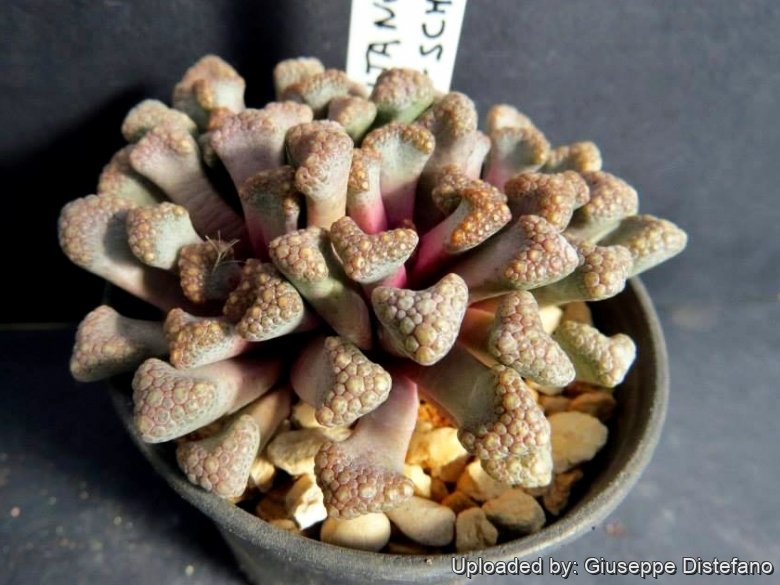
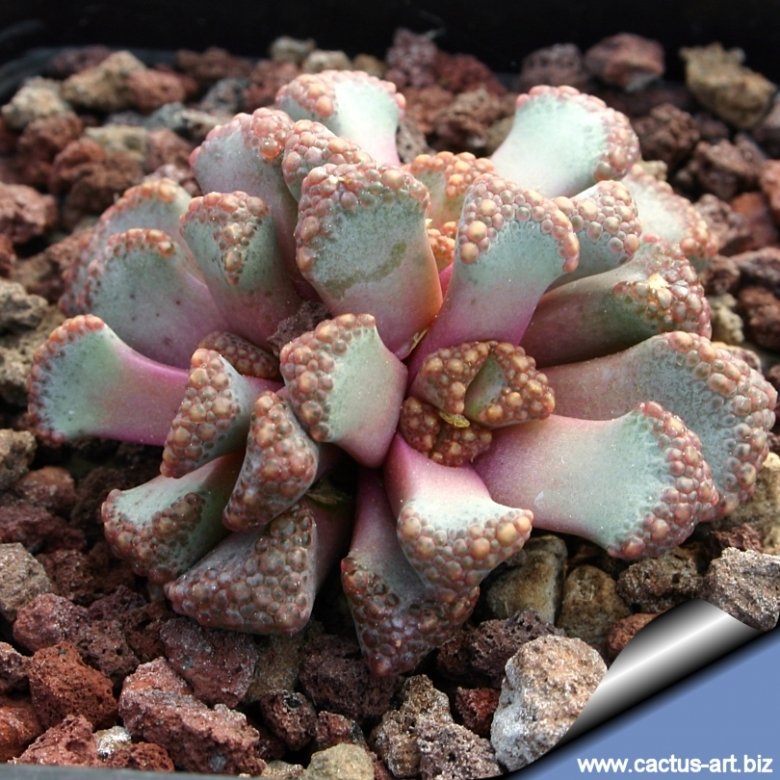
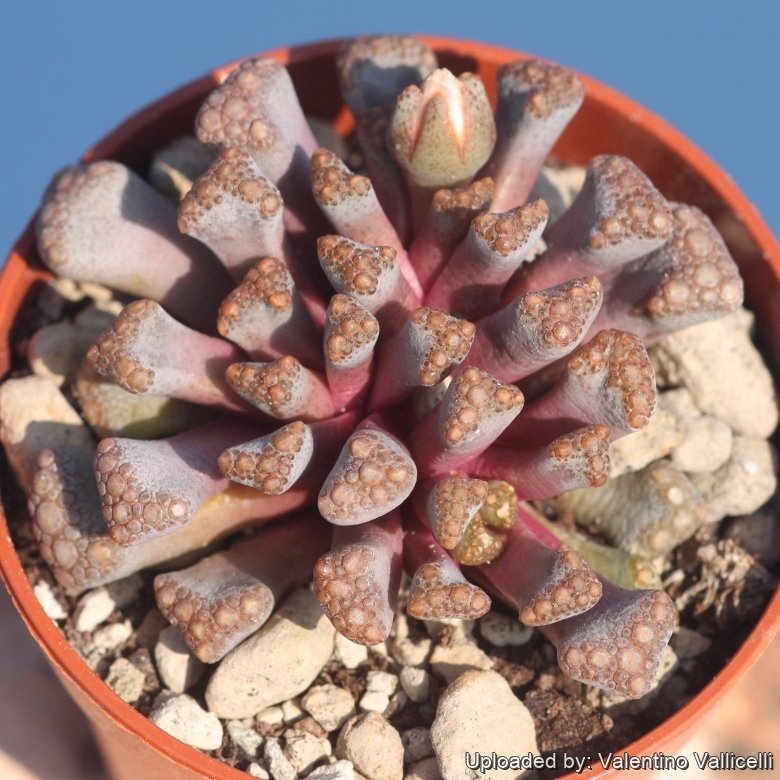
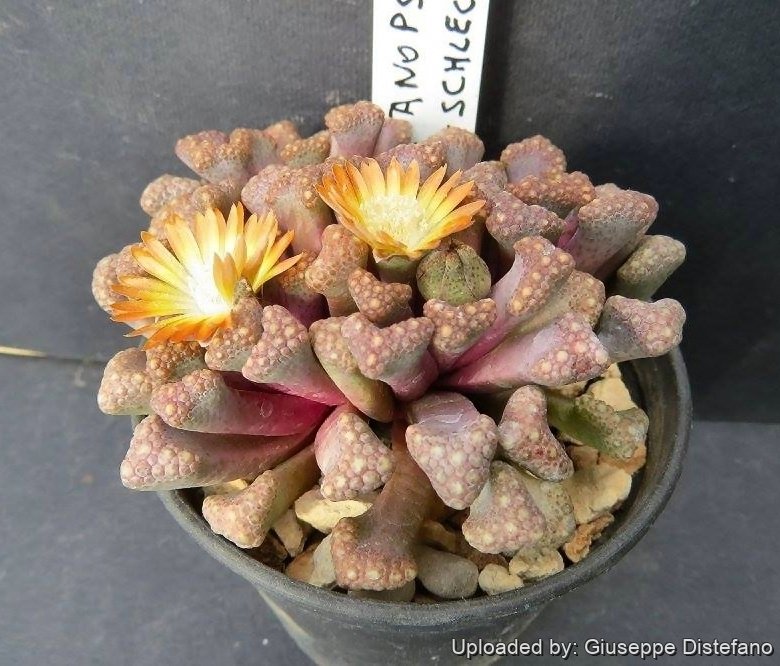
It is a multi-headed rosette succulent plant, it will form small mats as it ages. Individual rosettes are approx 4-5 cm in diameter.
Stem: Stem-less or very short-stemmed.
Root: Fleshy taproots.
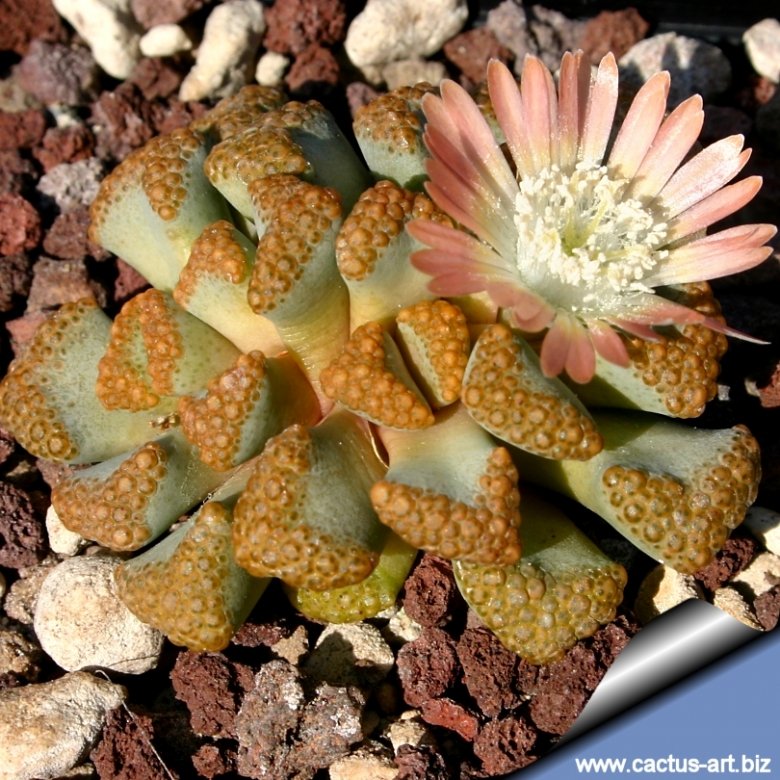
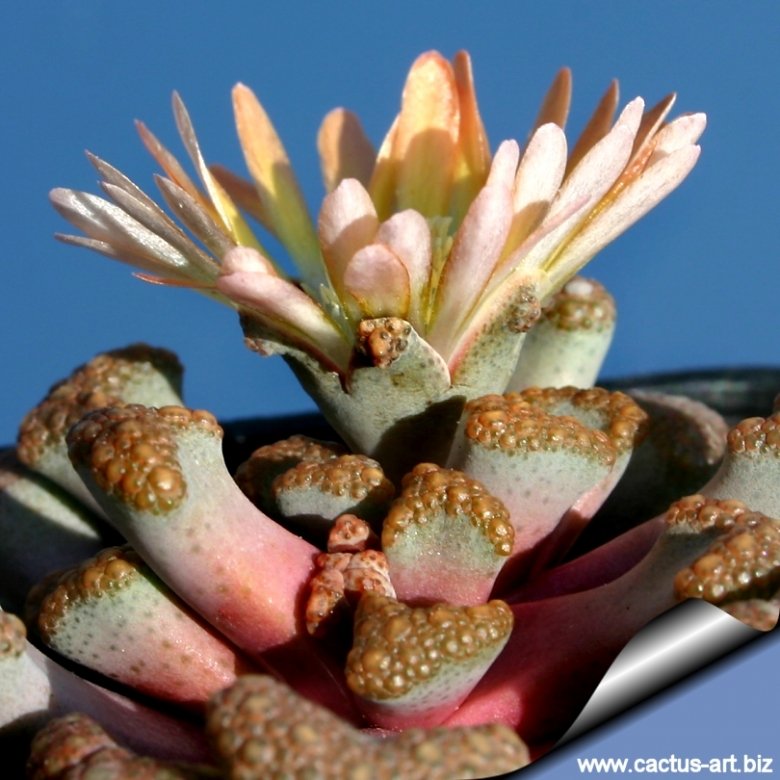
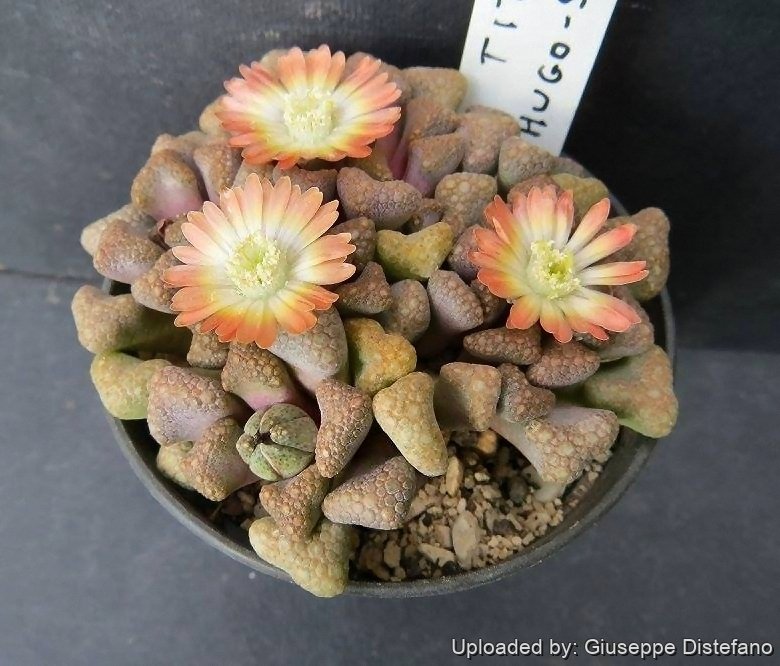
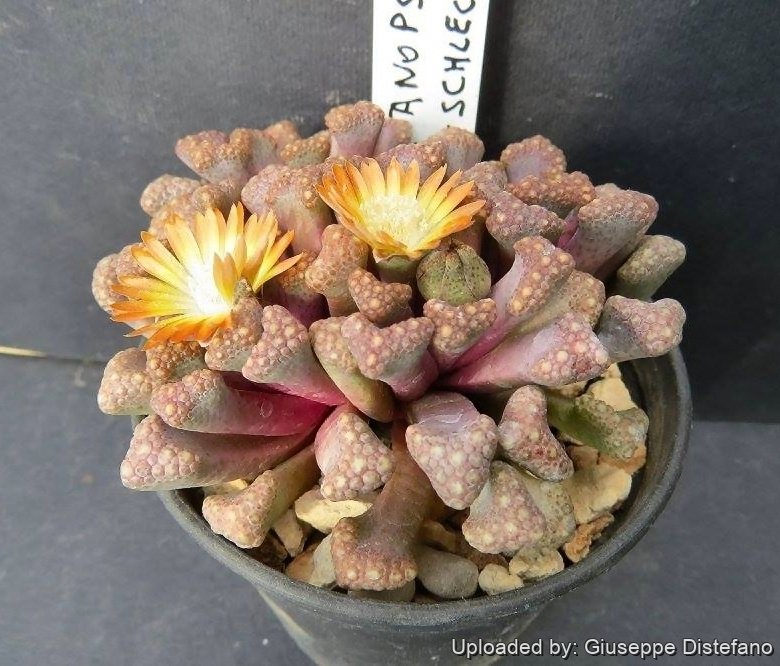
Leaves: Approx 2 cm long, crowded, with sculptured triangular/spatulate tips covered with pebbly flattish bumps. The colour of the leaves is very variable, depending on environmental and individual factors and comprises pale an dark green, blue, grey, red and purple while the wart vary from white to reddish-brown. The upper surfaces of the leaves are windowed and permit the underground part of the plant to receive the solar light and also their colouration mimic small, shining pebbles helping the plant to blend with the surroundings.
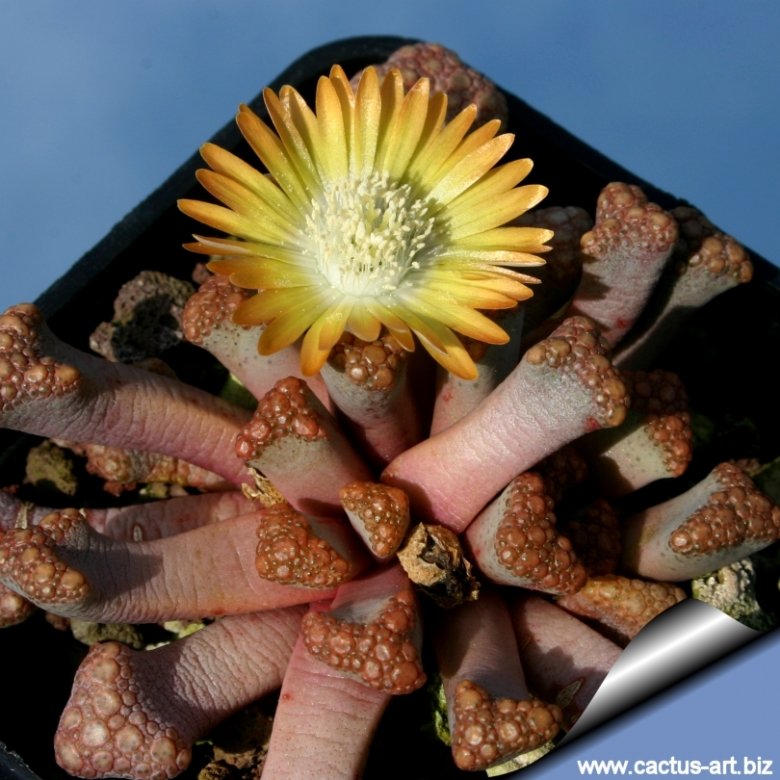
Flowers: Small daisy-like, yellow to orangish (occasionally pink) they last for several days and the colour varies as they ages taking a darker tone.
Blooming season: Winter.
Origin and Habitat
South Africa (Great Namaqualand), Namibia
Habitat: This is one of a few species that seeks out alkaline areas; lives in predominantly limestone outcrops and is almost covered in grey-white and variously coloured warts and incrustation on the leaves. This is probably a rare case of protective coloration in plants akin to that found in the animal kingdom and these plants blend in well with their surroundings.
The invisibility of such plants in their desert home is really remarkable and in the dry season they camouflage to such an extent that they can only be spotted by the keenest eye.
Cultivation and Propagation
This species is easy to grow and clumps readily, forming a beautiful succulent mat. Needs moderate water when growing in late fall and early spring. Keep somewhat dry the rest of the time. Like all living rocks, they thrive in porous soils with excellent drainage. It can tolerates high heat and heavy frost (hardy to -10° C). It is a very rewarding succulent, and can be cultivated in desert gardens in warm climates or in greenhouses or windowsills in the home. Enjoys bright shade in summer and full sun in the other seasons.
Propagation: They grow quickly from seed or by division of larger clumps.
Notes
The Genus Titanopsis comprises three to six species, depending on botanists’ opinions. Some botanists have now lumped Titanopsis lüderitzii and Titanopsis primosii in with Titanopsis schwantesii.
The species list for Titanopsis is considered to be Titanopsis calcarea, Titanopsis fulleri ( = calcarea ), Titanopsis hugo-schlecteri, Titanopsis lüderitzii ( = schwantesii ), Titanopsis primosii ( = schwantesii ), Titanopsis schwantesii
Bibliography
Major references and further lectures
-
Heidrun E. K. Hartmann “Aizoaceae F – Z” Springer, 2002
-
James Cullen, Sabina G. Knees, H. Suzanne Cubey “The European Garden Flora Flowering Plants: A Manual for the Identification of Plants Cultivated in Europe, Both Out-of-Doors and Under Glass - Casuarinaceae to Aristolochiaceae” Cambridge University Press, 11/ago/2011
-
Hermann Jacobsen, Vera Higgins “Succulent Plants: Description, Cultivation and Uses of Succulent Plants, Other Than Cacti” Williams and Norgate, Limited, 1935
-
Jacobsen. “Handbook of succulent plants” 1328 (1960)
-
H. Herre “The genera of the Mesembryanthemaceae”Tafelberg-Uitgewers Beperk, 1971
Cultivars and forms (1)
Forms (1)
Gallery