Publication: Z. Sukkulentenk. ii. 179 (1926).
Description
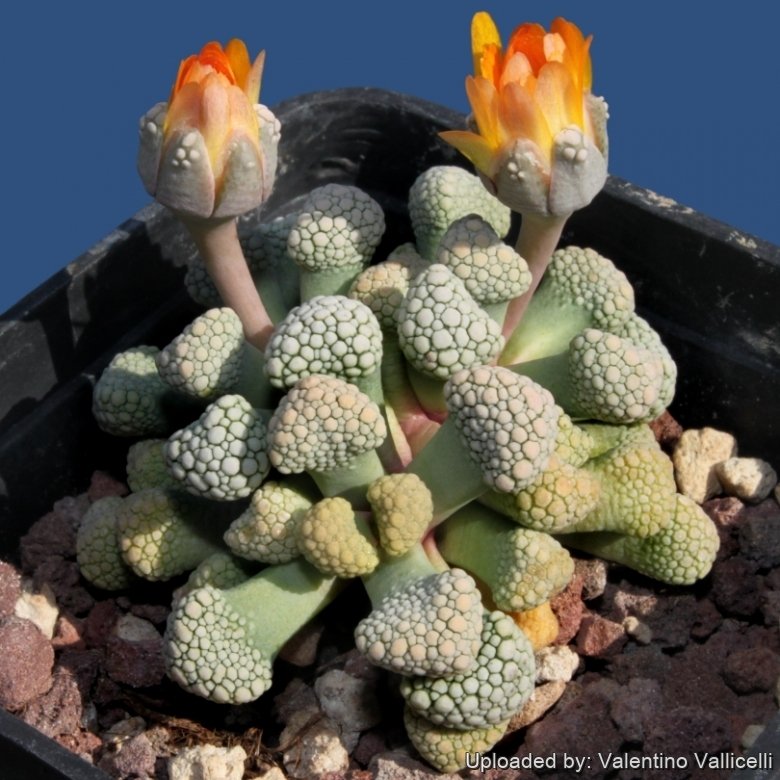
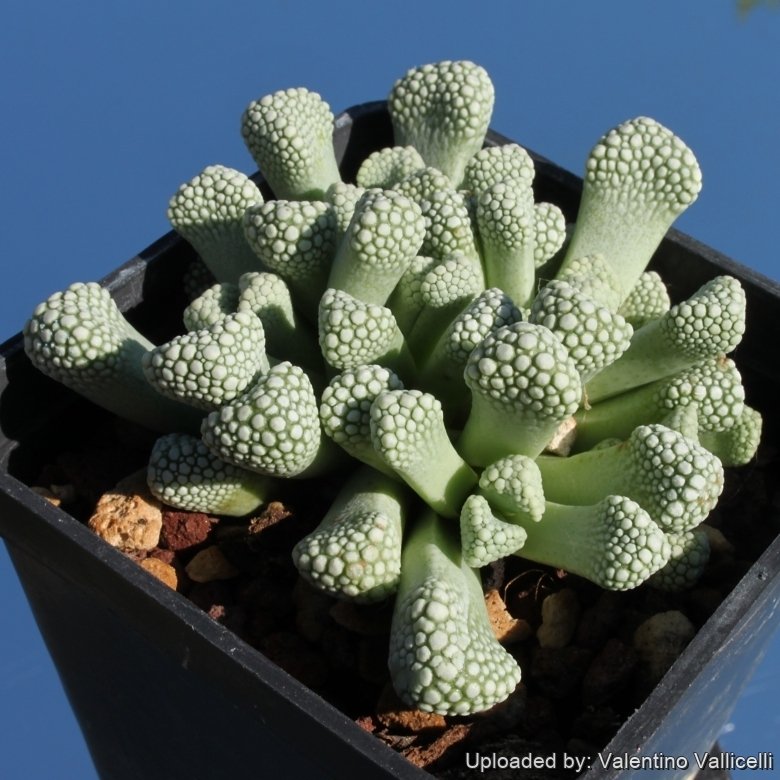
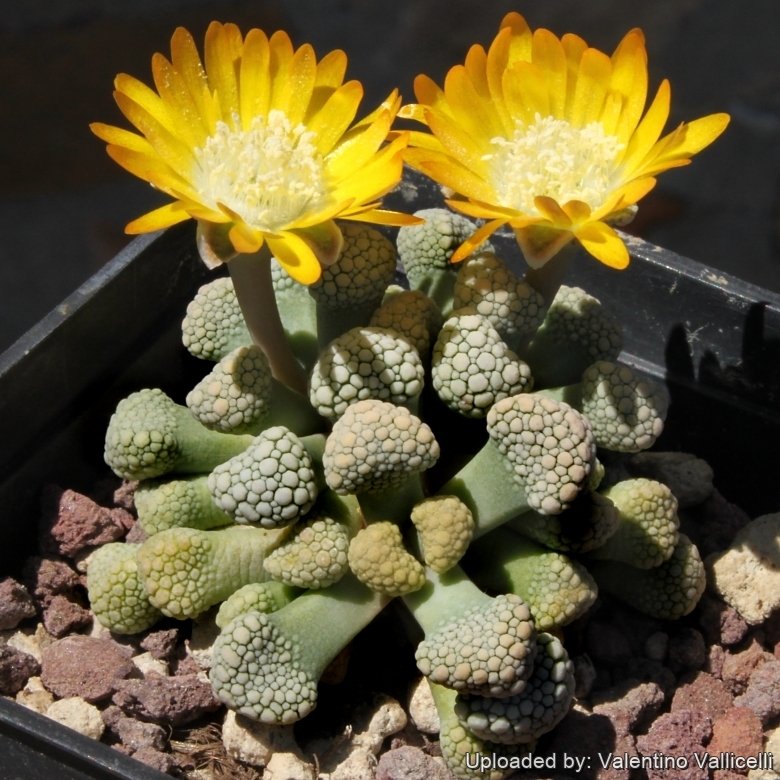
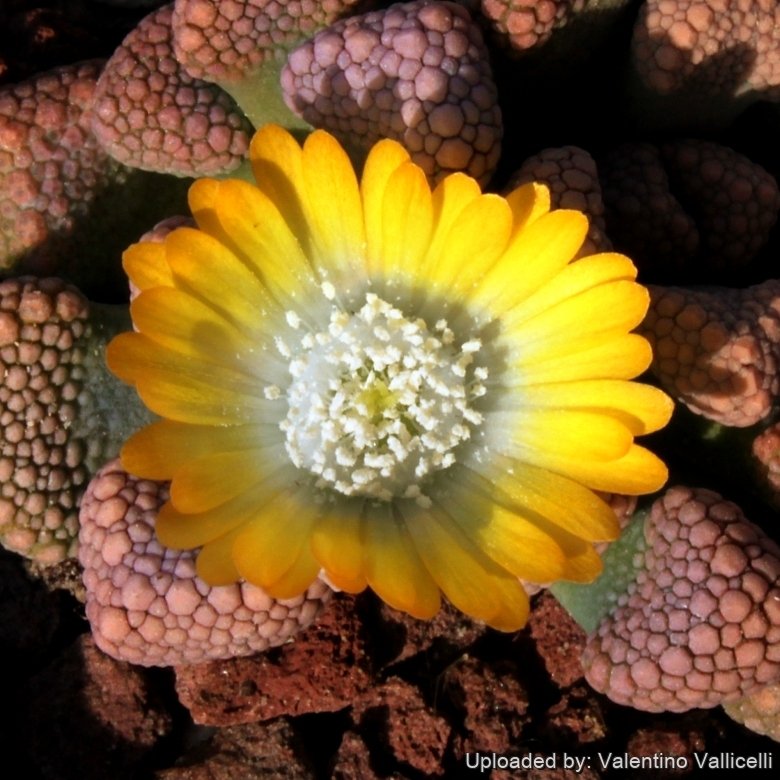
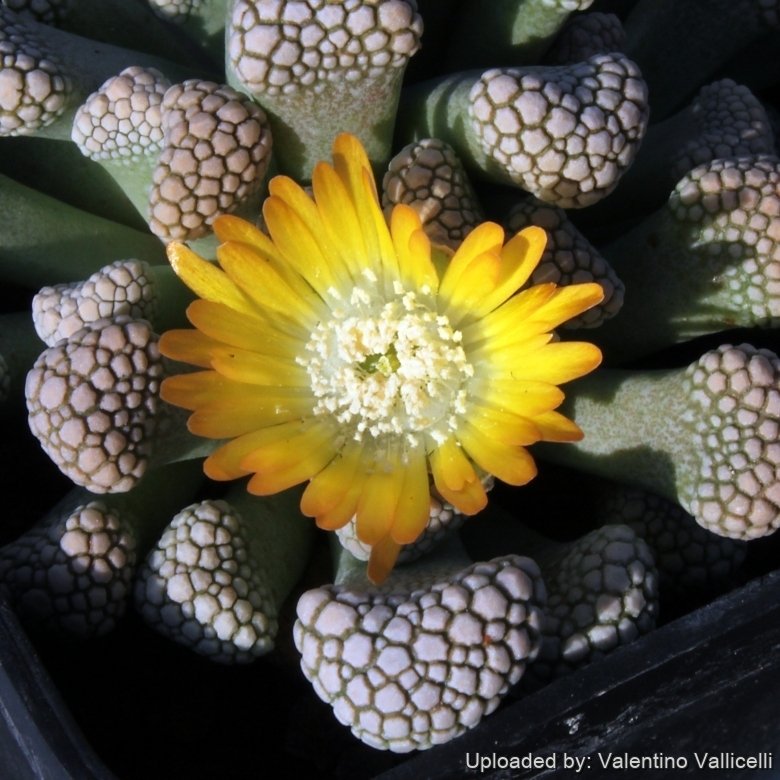
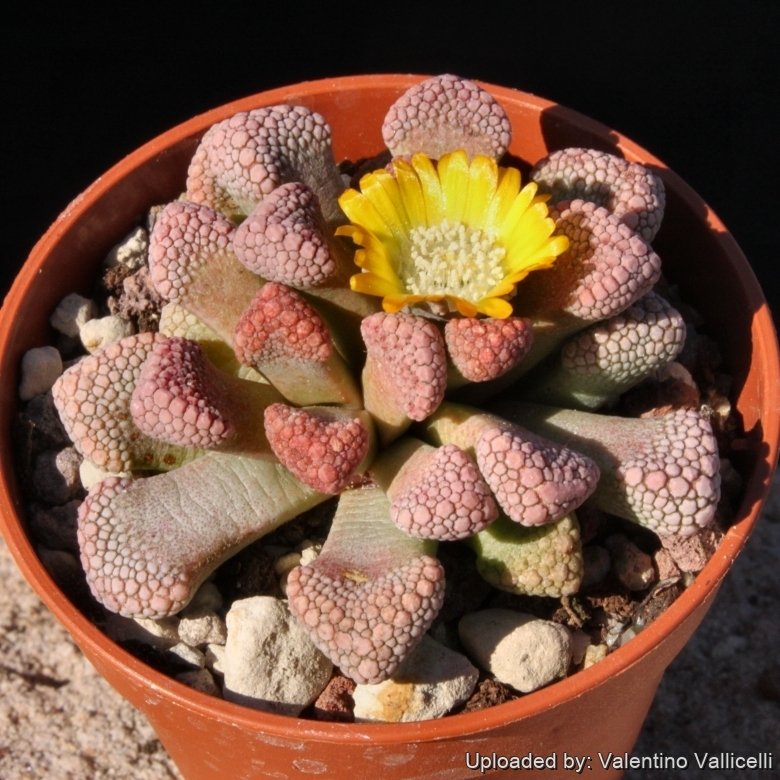
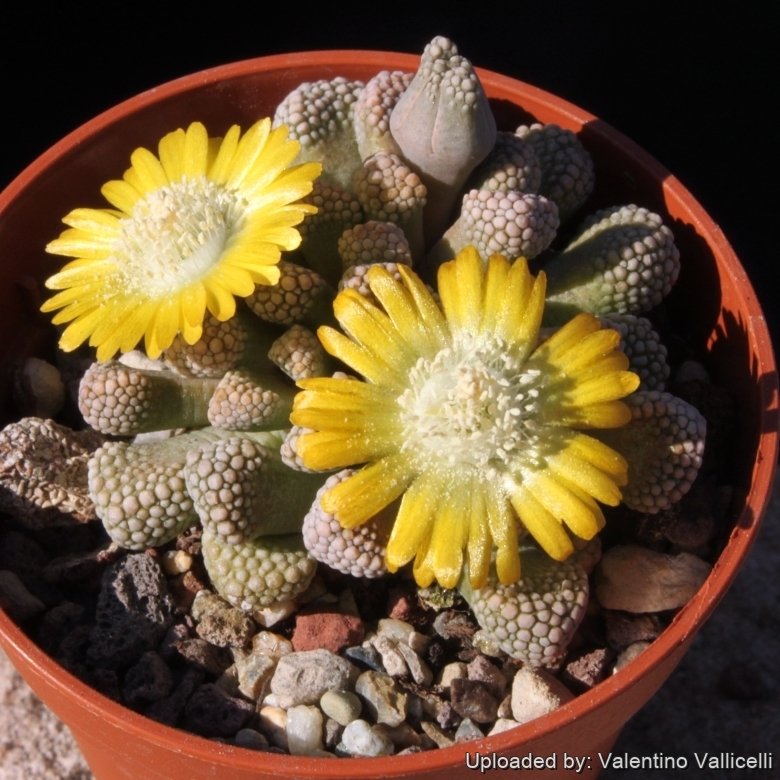
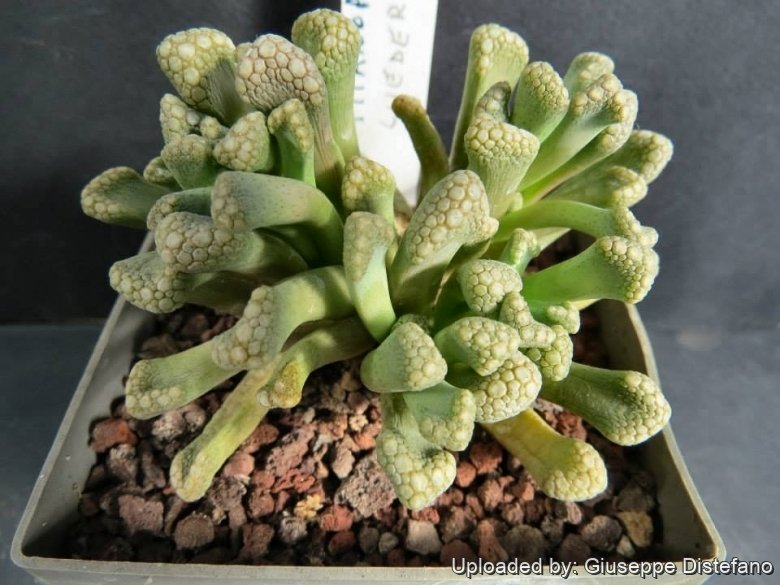
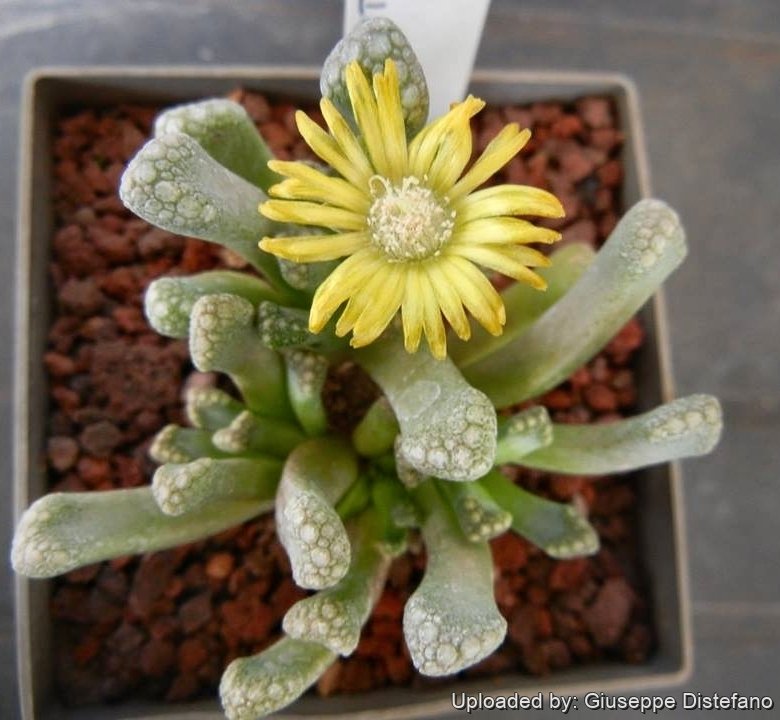
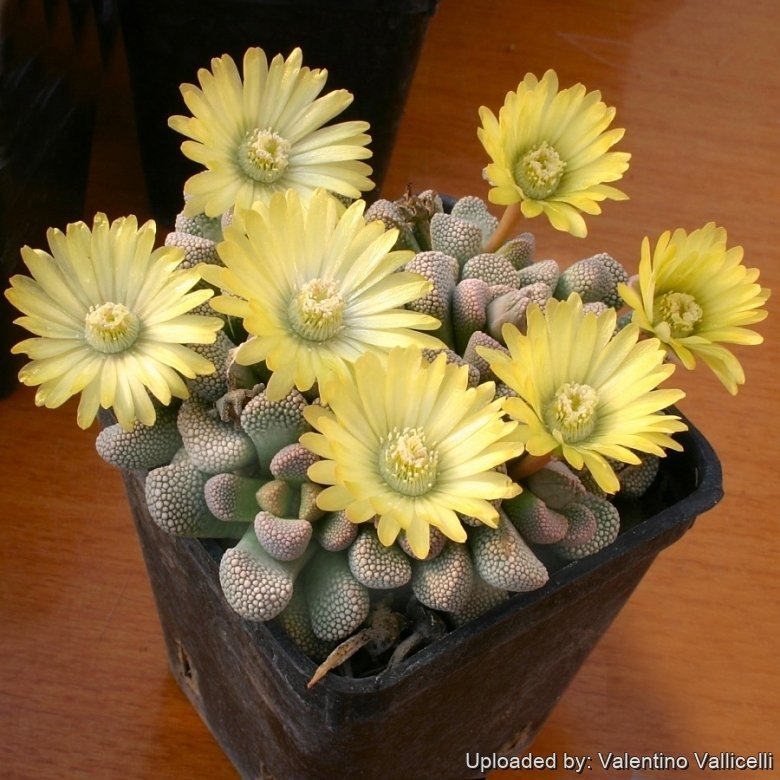
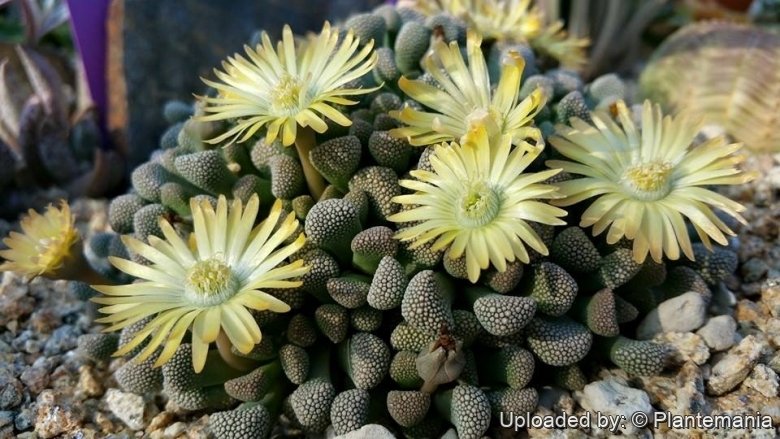
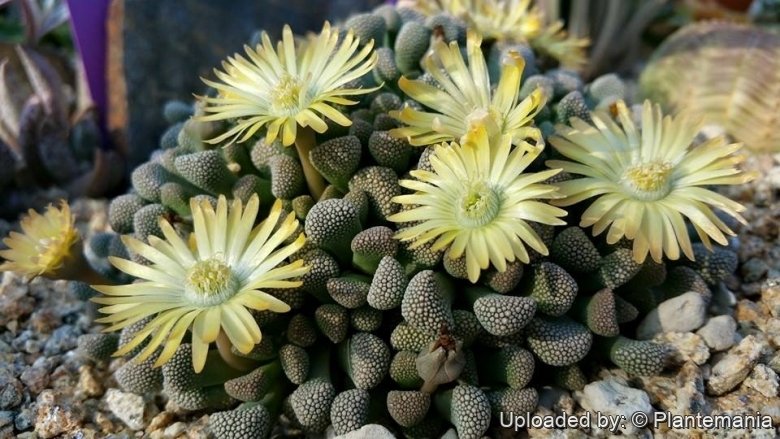
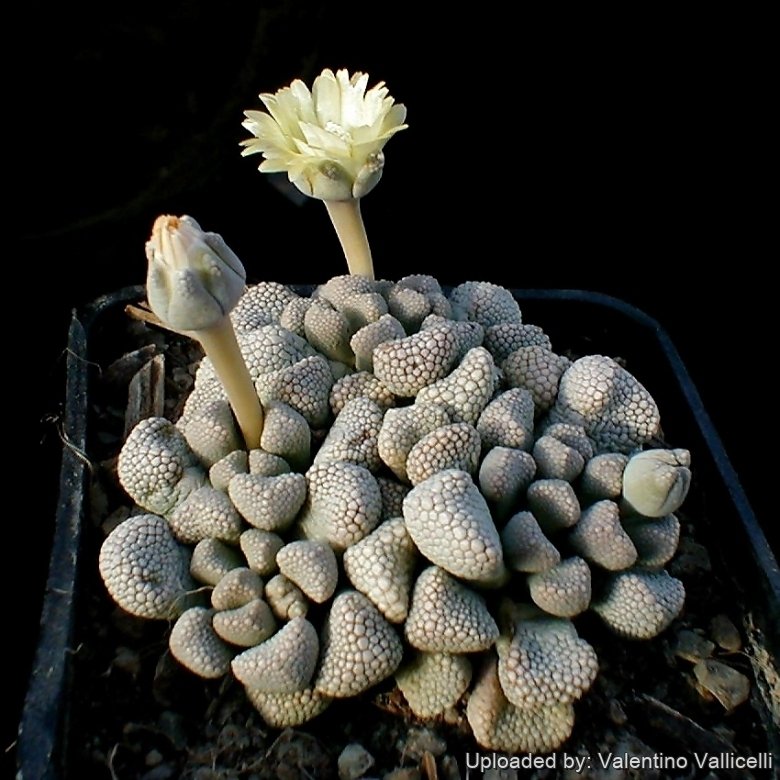
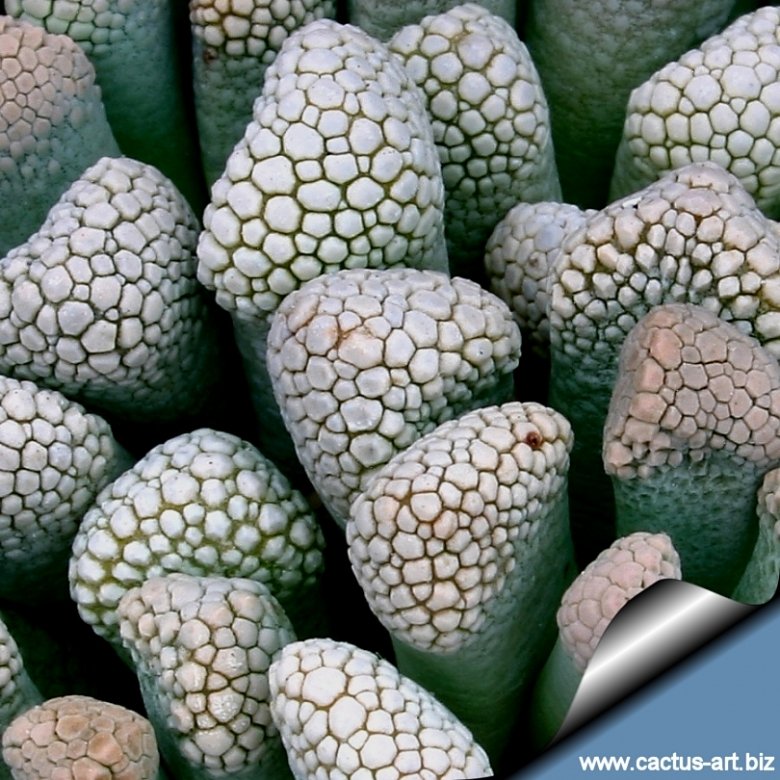
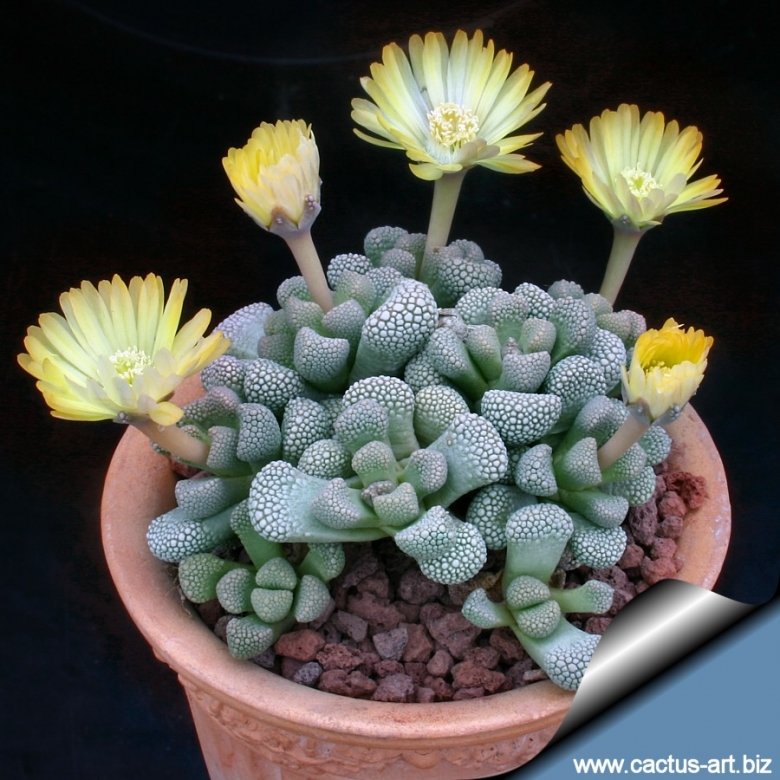
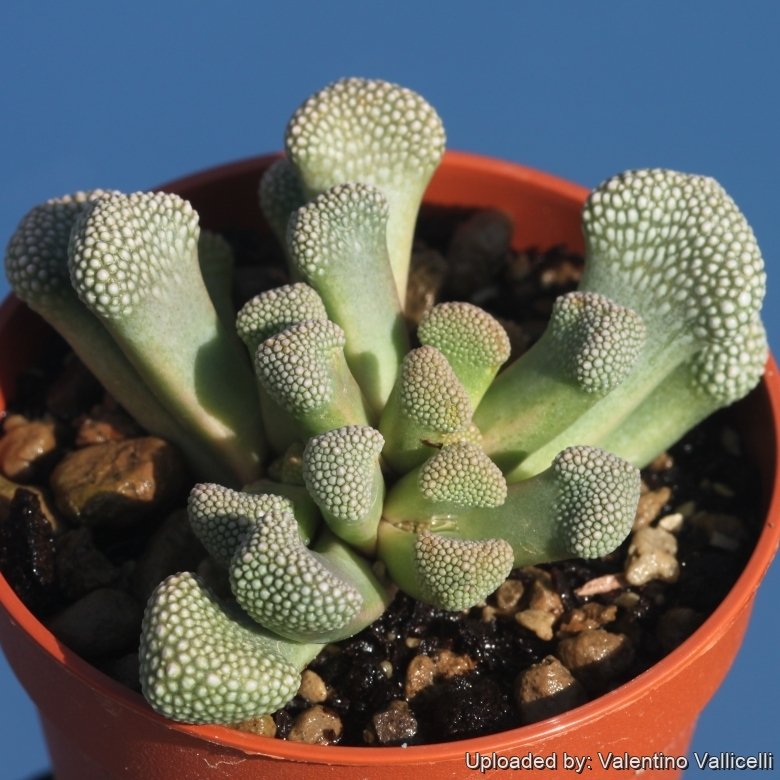
Titanopsis schwantesii is a plant of unique appearance which look very rock-like in habitat. The leaves grow in small rosettes and their tips are densely covered with white warty tubercles. The flowers are yellow in spring.
Habit: It is a mat forming succulent with clusters of basal rosettes.
Similar species: It is similar to Titanopsis calcarea , which is more a summer grower with flatter leaf tips and flatter rosettes. T. schwantesii has more erect leaves and smaller frosted warts on the somewhat rounding tips. Crassula ausensis subsp. titanopsis, was named for its resemblance to Titanopsis schwantesii growing in the same habitat.
Stem: Very short with internodes not visible.
Rosettes: up to 5(-7) cm wide, usually with 6-8 (or more) crowded opposite leaves.
Leaves: Short, fleshy, spathulate, with rounded ends up to 3 cm long and 3-7 mm broad toward the base and up to 12 mm broad above, mostly chunky white or grey. Upper and lower surface covered with greysh-white, yellowish, flesh-coloured, greyish-brown regular or yellowish-brown flat warts. (Leaves of Titanopsis calcarea are considerably larger, flatter with a more spoon-shaped apex and a mix of large and small warts). Old leaves will die off very slowly.
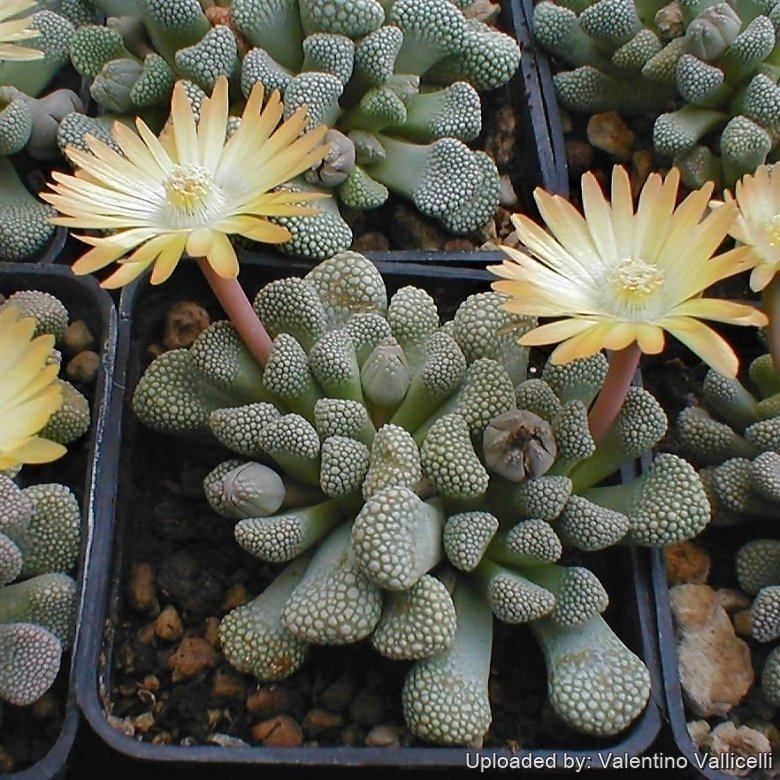
Flowers: Solitary, stalked, with usual mesemb ‘daisy’ form, 15-18 mm in diameter, pale canary yellow ( with flesh coloured tips in Titanopsis primosii ). Petals numerous in two whorls. Sepals 5(-6) with tubercles like those on the leaves and with membranous margin. Stigmas 5-6.
Blooming season: Titanopsis luderitzii flowers in the afternoon in early spring.
Fruit: Capsules 5-6-chamberd.
Origin and Habitat
Southern Namibia.
Habit:The delicate, frosted wafers of Titanopsis schwantesii grows thickly nestled into pebbles and gravel which this Titanopsis resembles to an unbelievable degree, this camouflage allows them to escape detection and is a very effective strategy for escaping predation. It comes from winter rainfall areas but will easily adapt to a summer watering regime and is probably the most common among these plants.
Cultivation and Propagation
This species is easy to grow and clumps readily, forming a beautiful succulent mat. This is a winter grower species, but in cold climates we expect most growth in spring and autumn when the weather is cool but the sun is strong. Needs moderate water when growing in late fall and early spring. Keep somewhat dry the rest of the time. It will need a little water even in summer, just enough to stop excessive shrivelling. Over-watering makes the old leaves die off more quickly, and can also produce rot. Like all living rocks, they thrive in porous soils with excellent drainage. It can tolerates high heat and heavy frost to -10° C. Enjoy bright shade in summer and full sun during the other seasons.
Propagation: They grow quickly from seed or by division of larger clumps, including a piece of the rootstock.
Notes
The Genus Titanopsis comprises three to six species, depending on botanists’ opinions. Some botanists have now lumped Titanopsis lüderitzii and Titanopsis primosii in with Titanopsis schwantesii.
The species list for Titanopsis is considered to be Titanopsis calcarea, Titanopsis fulleri ( = calcarea ), Titanopsis hugo-schlecteri, Titanopsis lüderitzii ( = schwantesii ), Titanopsis primosii ( = schwantesii ), Titanopsis schwantesii
Bibliography
Major references and further lectures
-
Heidrun E. K. Hartmann “Aizoaceae F – Z” Springer, 2002
-
James Cullen, Sabina G. Knees, H. Suzanne Cubey “The European Garden Flora Flowering Plants: A Manual for the Identification of Plants Cultivated in Europe, Both Out-of-Doors and Under Glass - Casuarinaceae to Aristolochiaceae” Cambridge University Press, 11/ago/2011
-
Hermann Jacobsen, Vera Higgins “Succulent Plants: Description, Cultivation and Uses of Succulent Plants, Other Than Cacti” Williams and Norgate, Limited, 1935
-
Jacobsen. “Handbook of succulent plants” 1328 (1960)
-
H. Herre “The genera of the Mesembryanthemaceae” Tafelberg-Uitgewers Beperk, 1971
-
Montague Free, Marjorie J. Dietz “All About House Plants: Their Selection, Culture, and Propagation and How to Use Them for Decorative Effect” Doubleday, 01/gen/1979
From llifle page Titanopsis luderitzii
Description
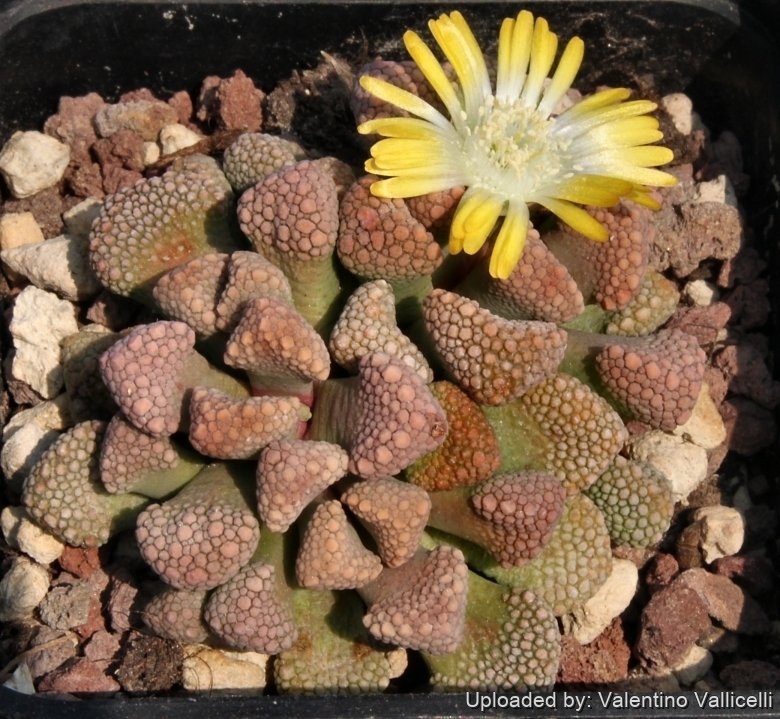
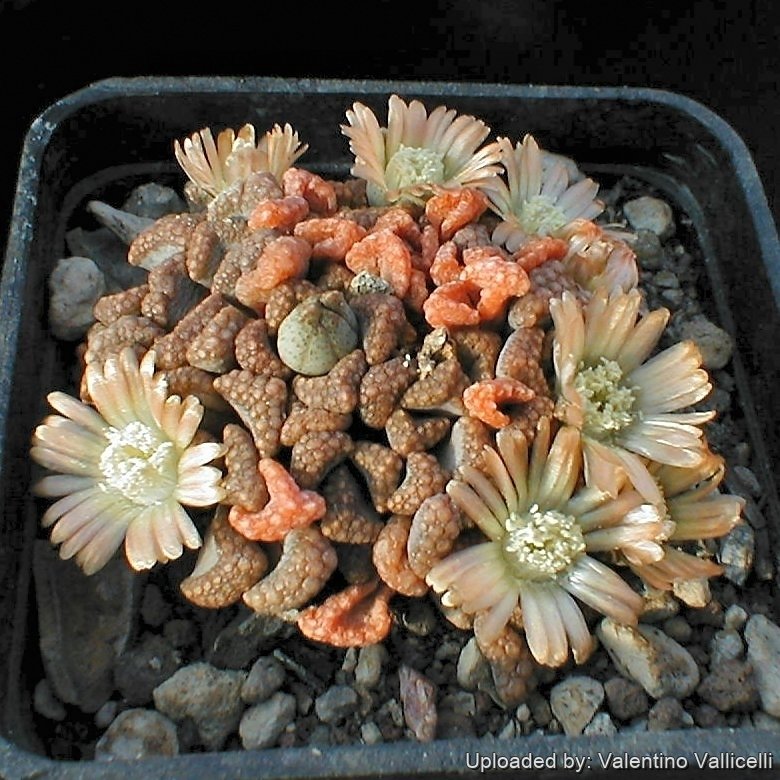
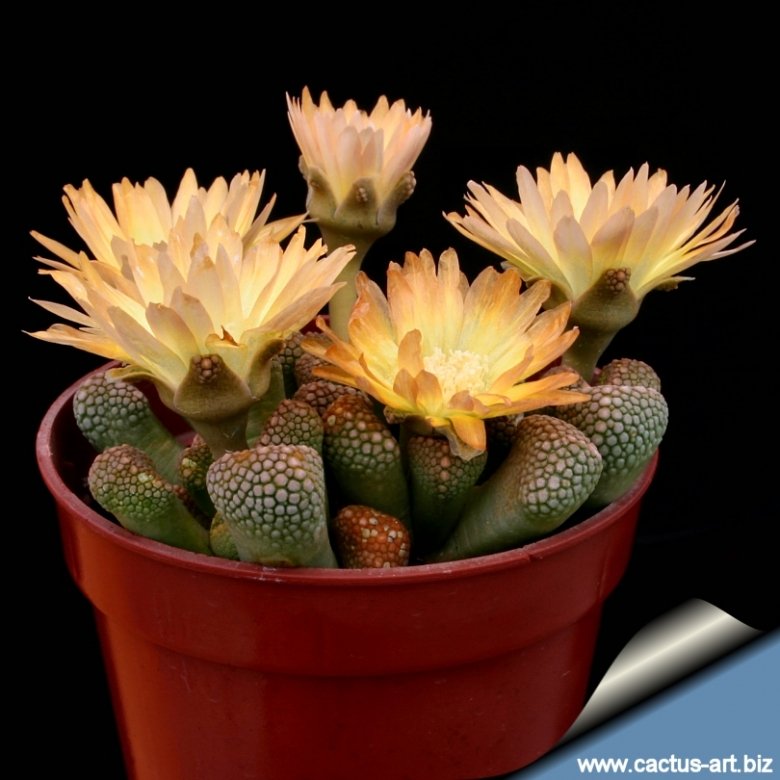
Titanopsis luderitzii is a local or morphological form of the variable Titanopsis schwantesii. It distinguishes for the leaves that are dark yellowish green with brownish colouring; is inclined to be more touchy than some of the other species. Flowers yellow with flesh coloured tips.
Habit: It is a mat forming succulent with clusters of basal rosettes.
Stem: Very short with internodes not visible.
Rosettes: up to 5(-7) cm wide, usually with 6-8 (or more) crowded opposite leaves.
Leaves: Short, fleshy, spathulate, with rounded ends up to 3 cm long and 3-7 mm broad toward the base and up to 12 mm broad above, yellowish green with brownish colouring. Upper and lower surface covered with yellowish, flesh-coloured, greyish-brown or yellowish-brown flat warts. Old leaves will die off very slowly.
Flowers: Solitary, stalked, with usual mesemb ‘daisy’ form, 15-18 mm in diameter, pale yellow with flesh coloured tips, occasiaonally orangish or pinkish (usually pale canary yellow in Titanopsis schwantesii). Petals numerous in two whorls. Sepals 5(-6) with tubercles like those on the leaves and with membranous margin. Stigmas 5-6
Blooming season: Titanopsis luderitzii flowers in the afternoon in early spring.
Fruit: Capsules 5-6-chamberd.
Bibliography
Major references and further lectures
-
Heidrun E. K. Hartmann “Aizoaceae F – Z” Springer, 2002
-
James Cullen, Sabina G. Knees, H. Suzanne Cubey “The European Garden Flora Flowering Plants: A Manual for the Identification of Plants Cultivated in Europe, Both Out-of-Doors and Under Glass - Casuarinaceae to Aristolochiaceae” Cambridge University Press, 11/ago/2011
-
Hermann Jacobsen, Vera Higgins “Succulent Plants: Description, Cultivation and Uses of Succulent Plants, Other Than Cacti” Williams and Norgate, Limited, 1935
-
Jacobsen. “Handbook of succulent plants” 1328 (1960)
-
H. Herre “The genera of the Mesembryanthemaceae” Tafelberg-Uitgewers Beperk, 1971
Source: Titanopsis luderitzii, LLIFLE - Encyclopedia of living forms, CC-BY-SA, retrieved 2026-10-26.
From llifle page Titanopsis primosii
Description
Titanopsis primosii is a local or morphological form of the variable Titanopsis schwantesii. It distinguishes for the upper surface with chunky white, grey or flesh-coloured regular warts which look very rock-like in habitat. Flowers yellow with flesh coloured tips.
Habit: It is a mat forming succulent with clusters of basal rosettes.
Stem: Very short with internodes not visible.
Rosettes: up to 5(-7) cm wide, usually with 6-8 (or more) crowded opposite leaves.
Leaves: Short, fleshy, spathulate, with rounded ends up to 3 cm long and 3-7 mm broad toward the base and up to 12 mm broad above, mostly chunky white or grey. Upper and lower surface covered with greyish-white, flesh-coloured flat warts. Old leaves will die off very slowly.
Flowers: Solitary, stalked, with usual mesemb ‘daisy’ form, 15-18 mm in diameter, pale yellow with flesh coloured tips, occasiaonally orangish or pinkish (usually pale canary yellow in Titanopsis schwantesii). Petals numerous in two whorls. Sepals 5(-6) with tubercles like those on the leaves and with membranous margin. Stigmas 5-6
Blooming season: Titanopsis primosii flowers in the afternoon in early spring.
Fruit: Capsules 5-6-chamberd.
Origin and Habitat
Southern Namibia.
Habit: The delicate, frosted wafers of Titanopsis promosii grows thickly nestled into greysh-white pebbles and gravel which this Titanopsis resembles to an unbelievable degree, this camouflage allows them to escape detection and is a very effective strategy for escaping predation. It comes from winter rainfall areas but will easily adapt to a summer watering regime and is probably the most common among these plants.
Source: Titanopsis primosii, LLIFLE - Encyclopedia of living forms, CC-BY-SA, retrieved 2026-10-26.
Gallery