Publication: Kakteen Sukk. 50(11): 279 (1999)
Description
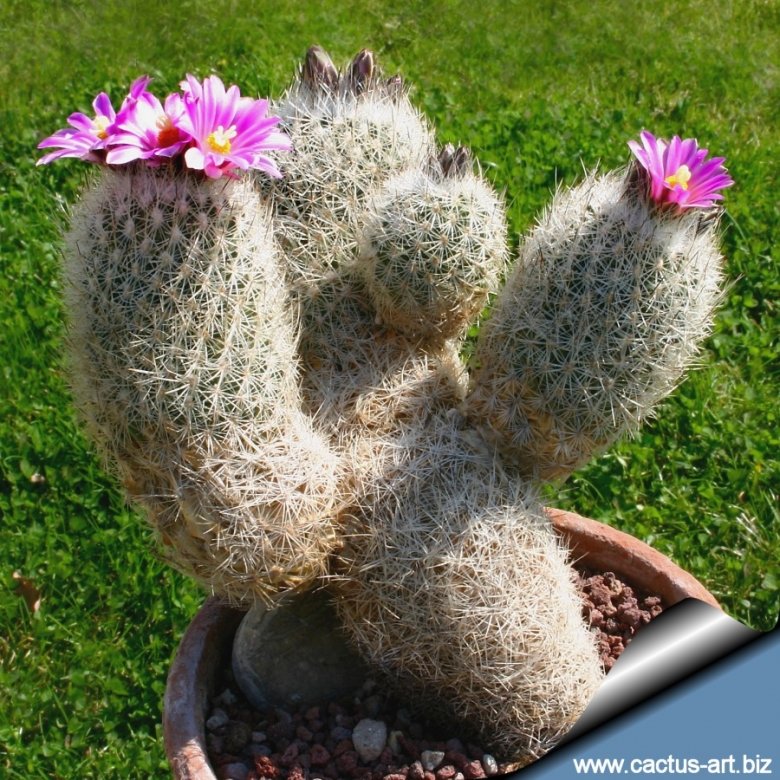
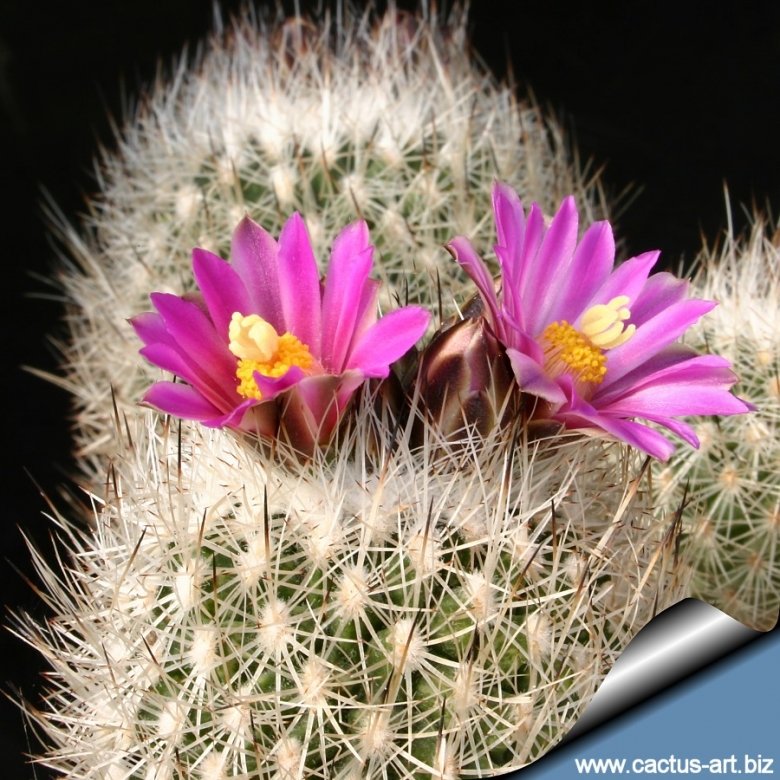
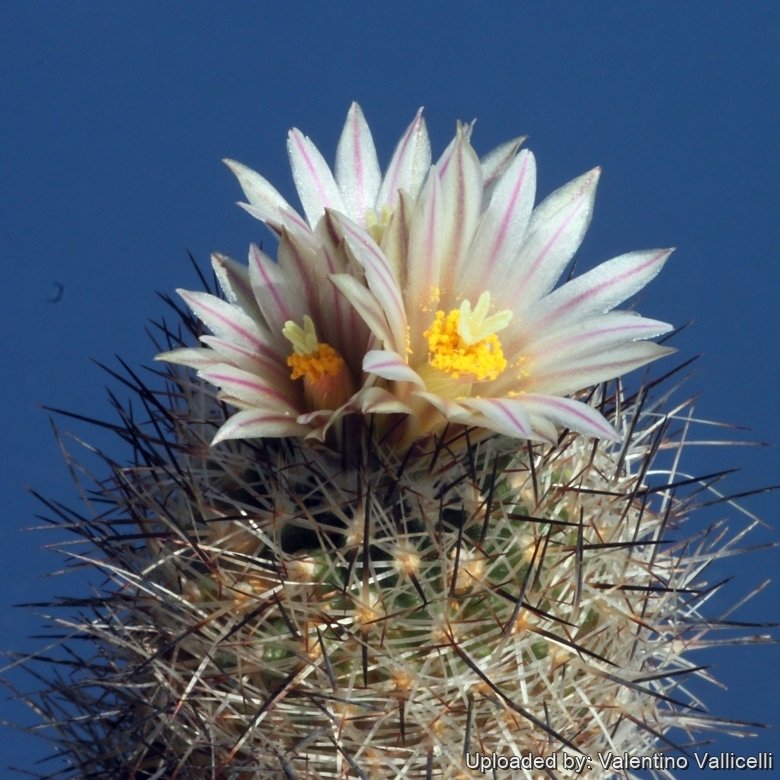
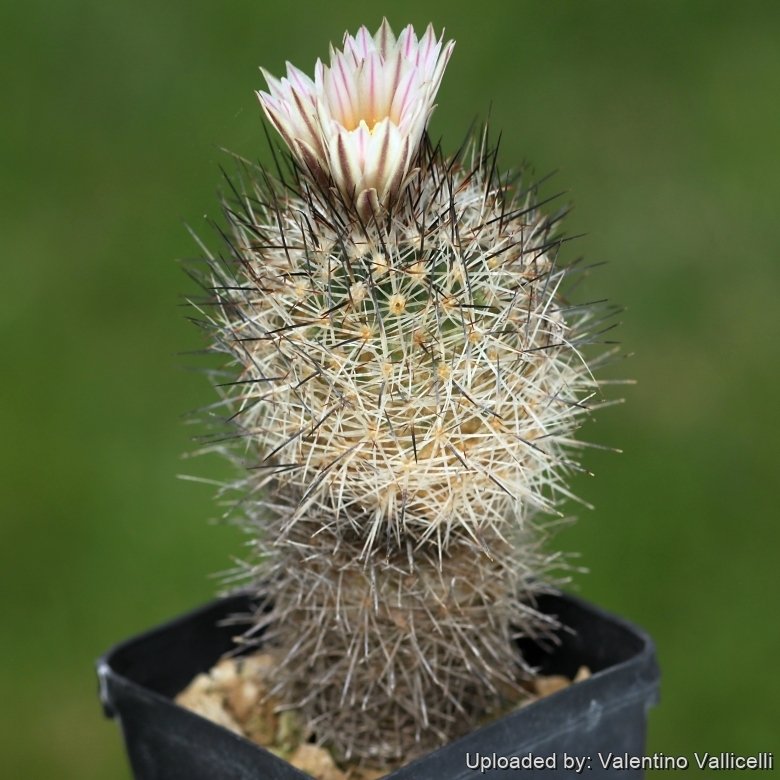
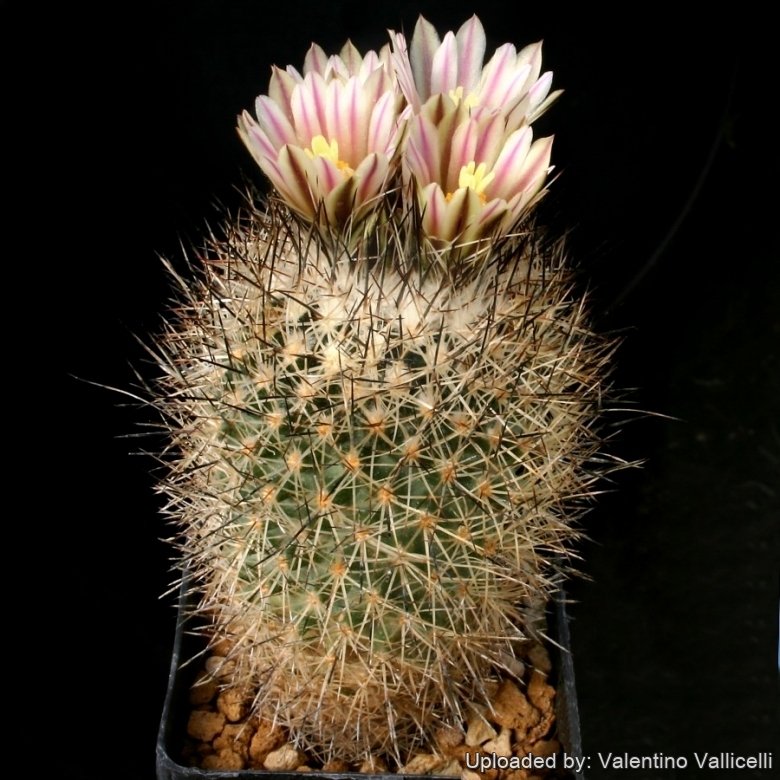
Body usually solitary, globose. Hardly offsetting in cultivation.
Stem: Spherical or somewhat conical, rounded above; apex rather deeply sunken, but fully hidden by the snow-white, dense wool; blue-green, 6-8 (10) cm high and 6-8 cm in diameter. Ribs fully arranged in tubercles, from 13 to 21, rather dense spirals, rhombic or sub-quadrangular, conical; the top somewhat compressed from the sides, with sharp upper and lower edges. The seedlings tend to become quite cylindrical.
Roots: Carrot-shaped
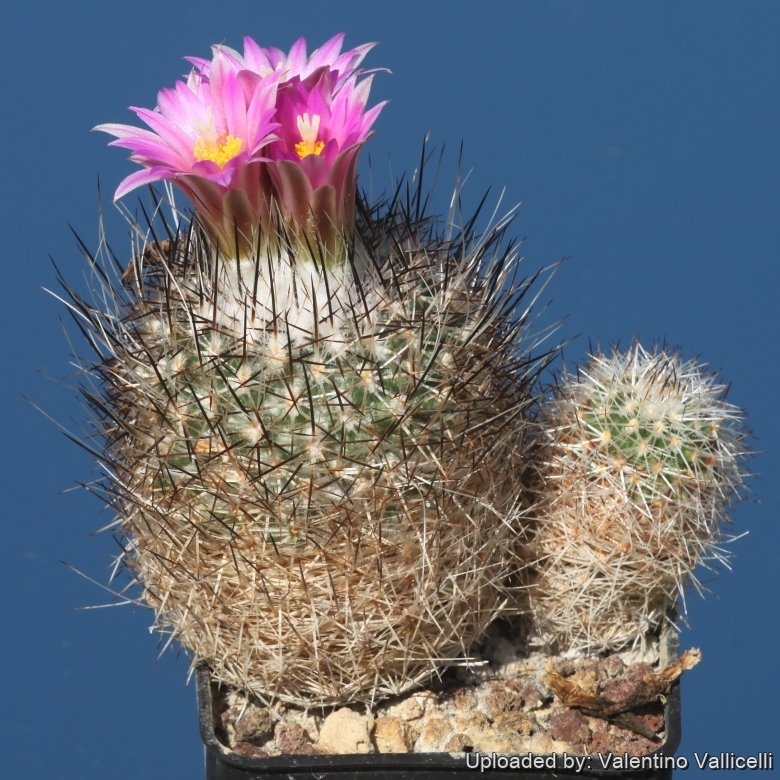
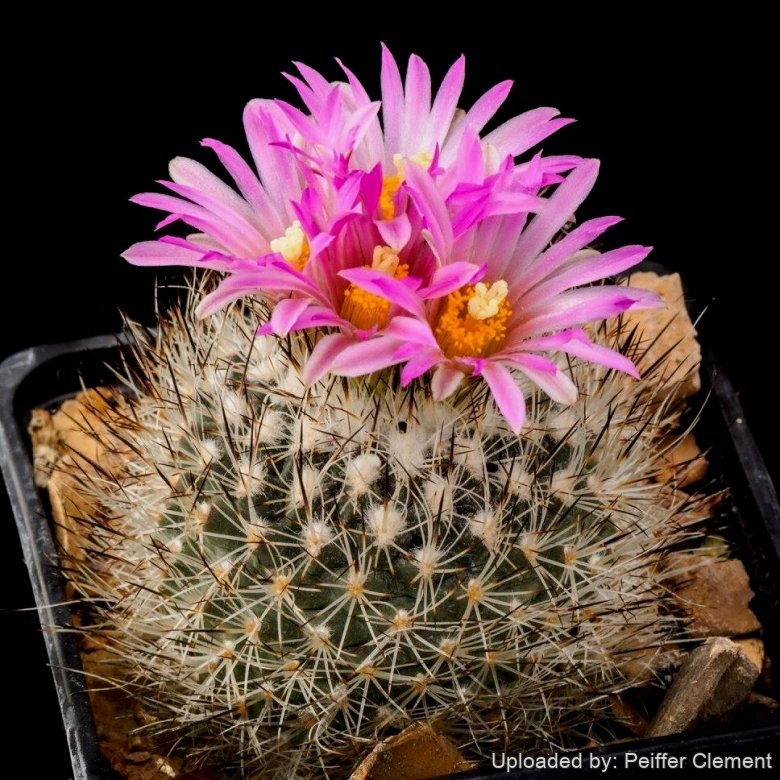
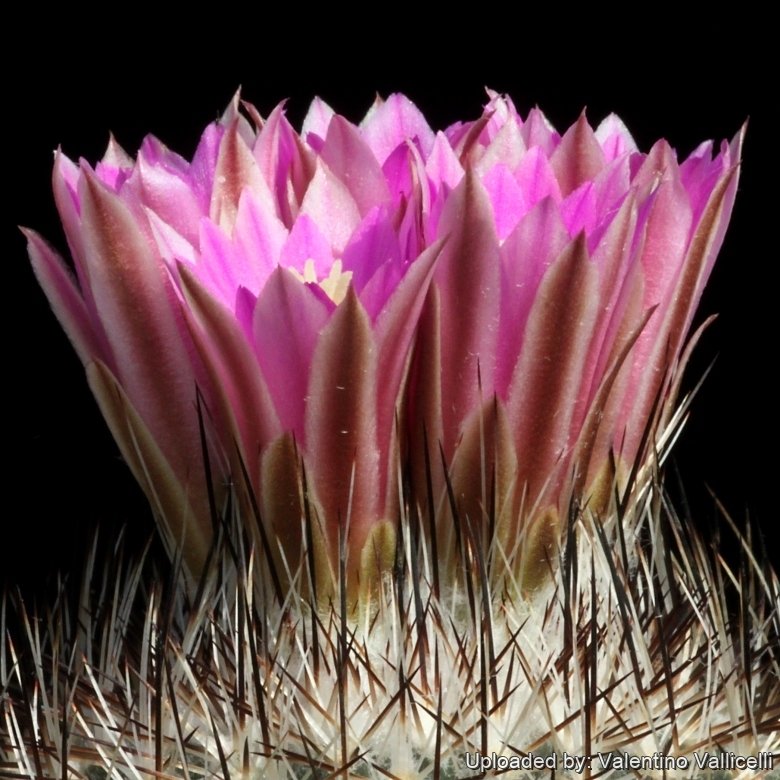
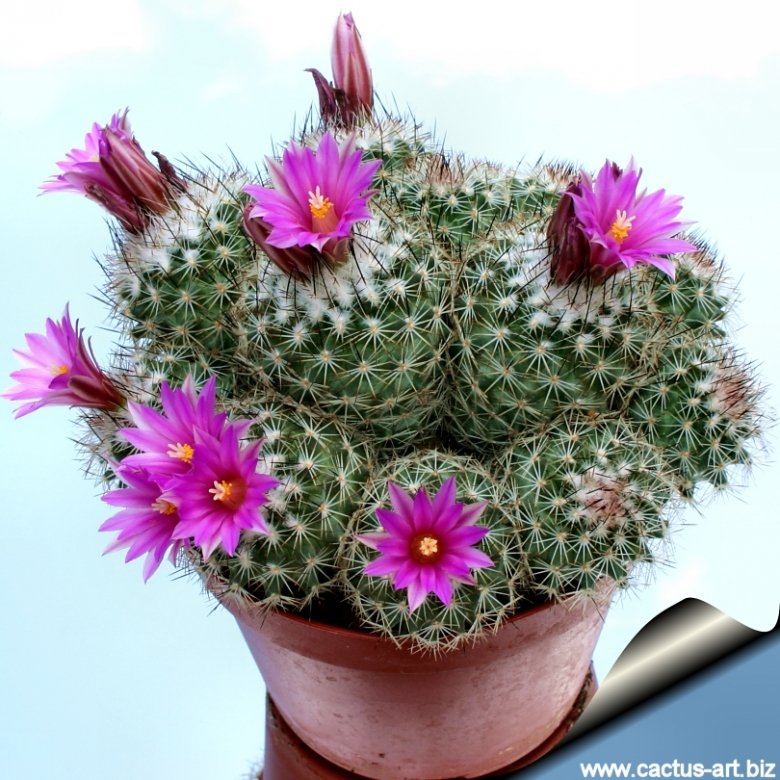
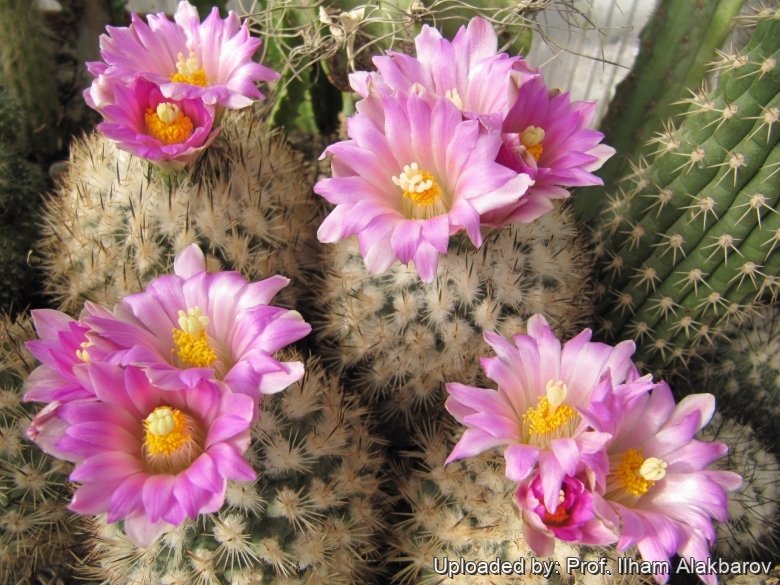
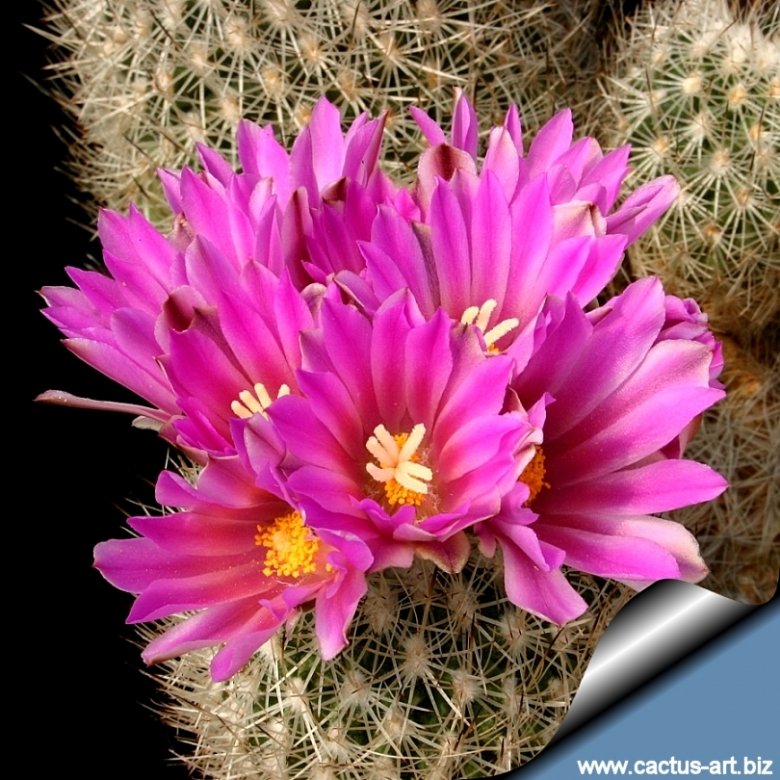
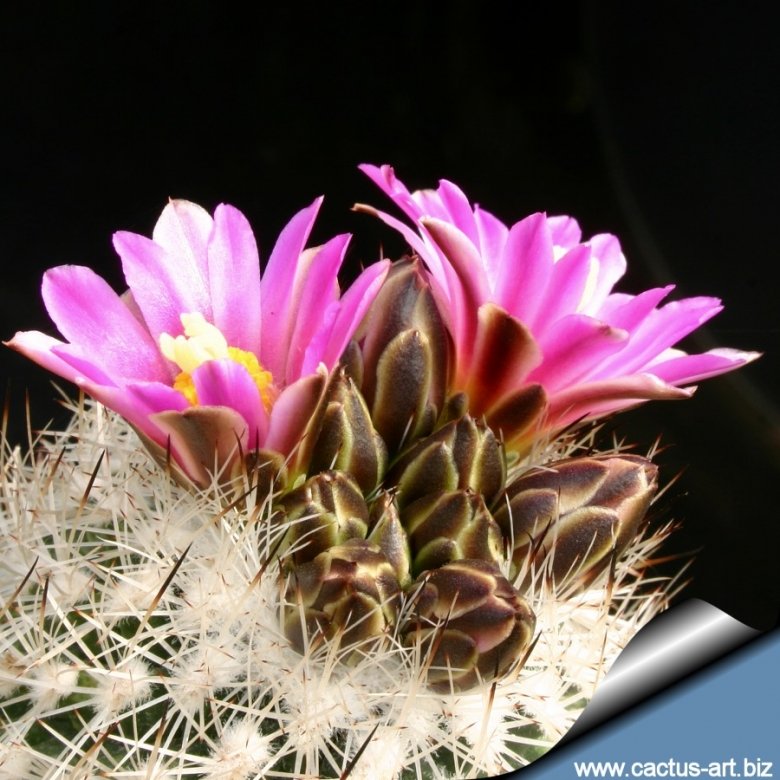
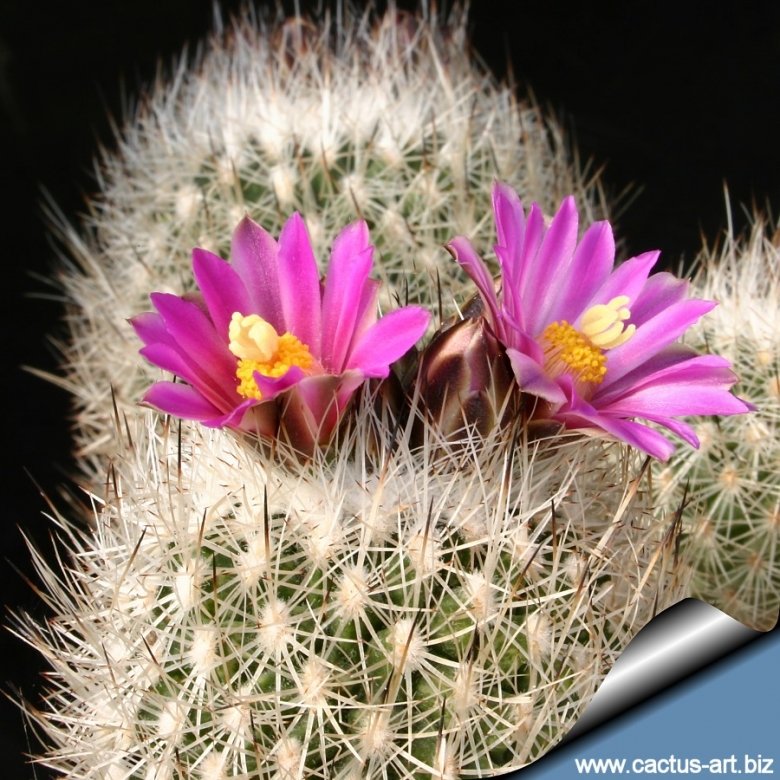
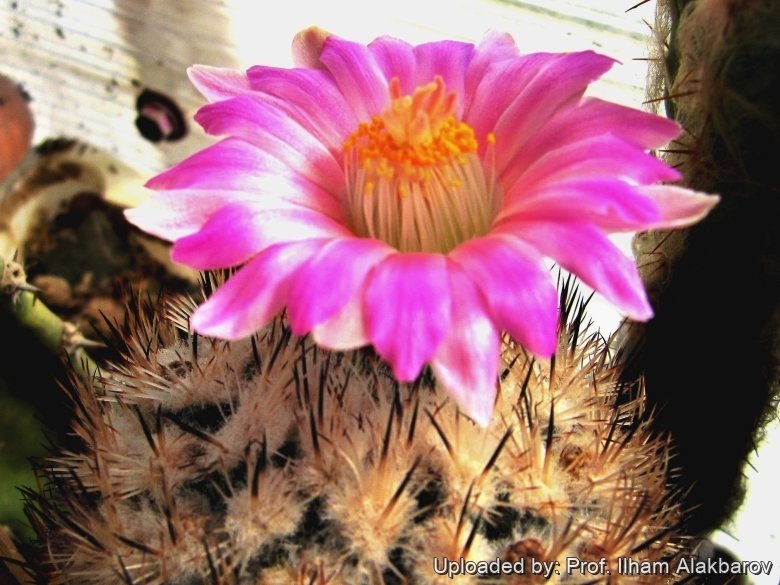
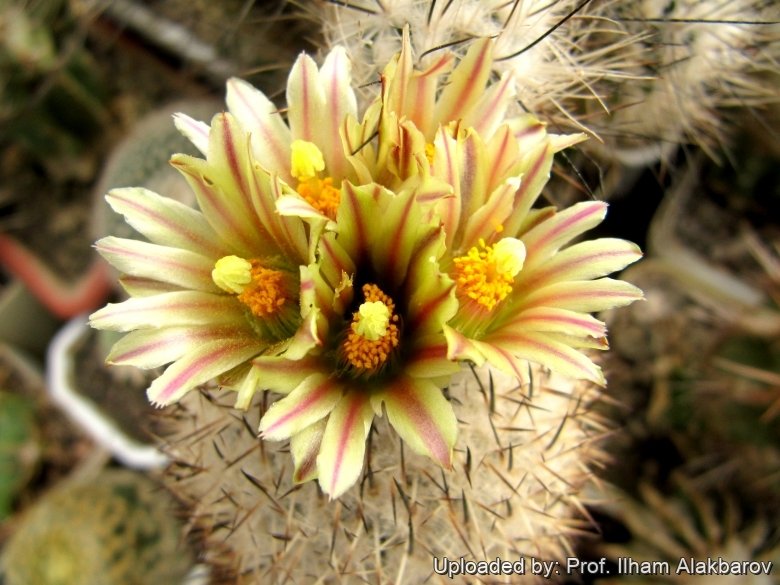
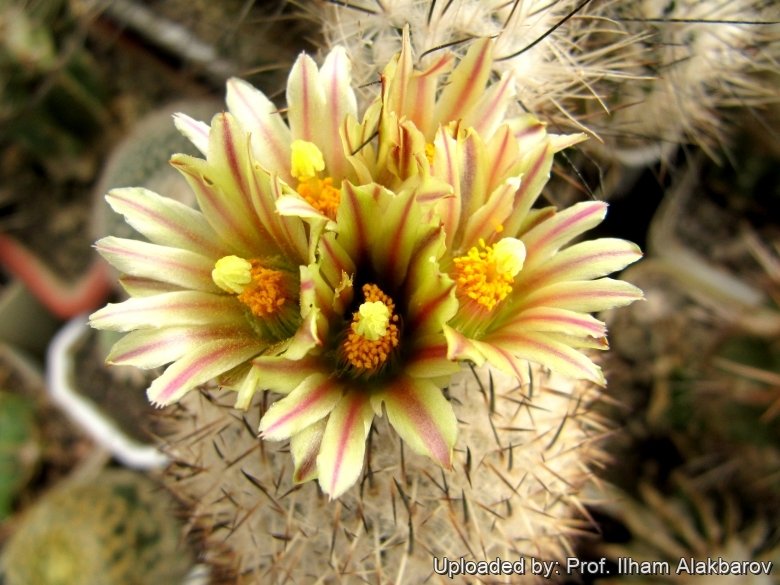
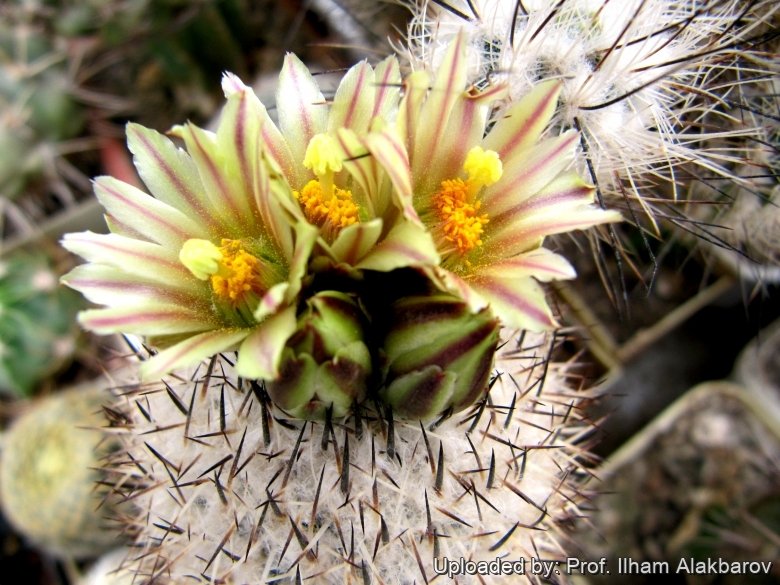
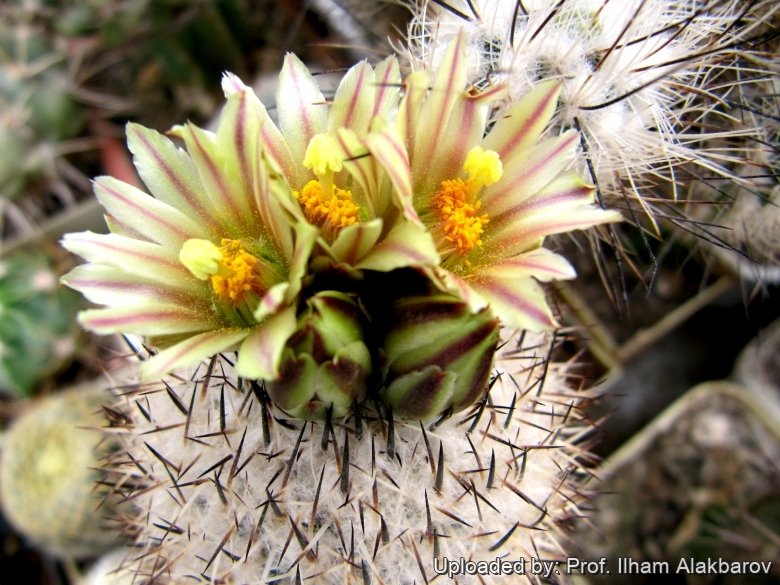
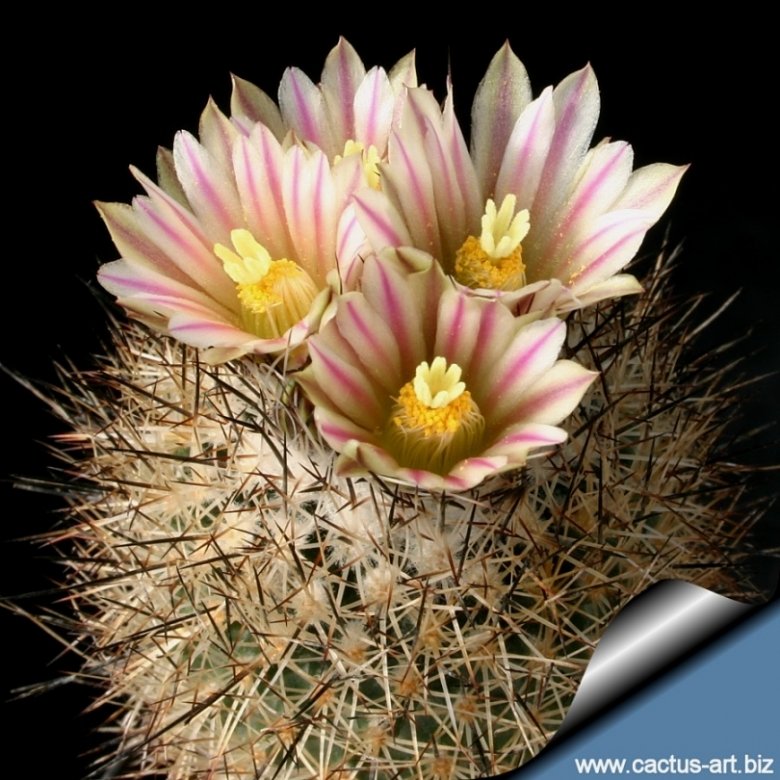
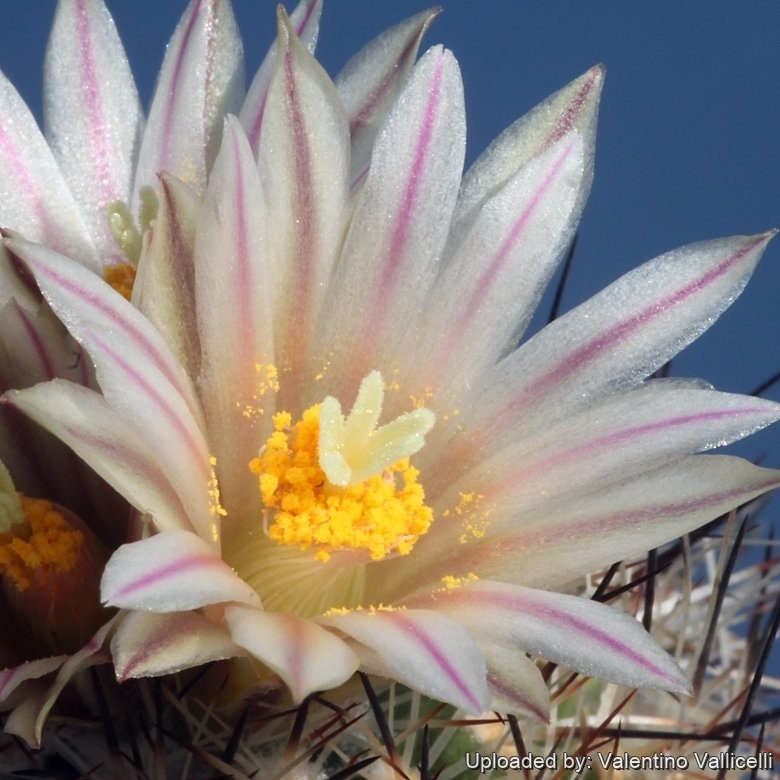
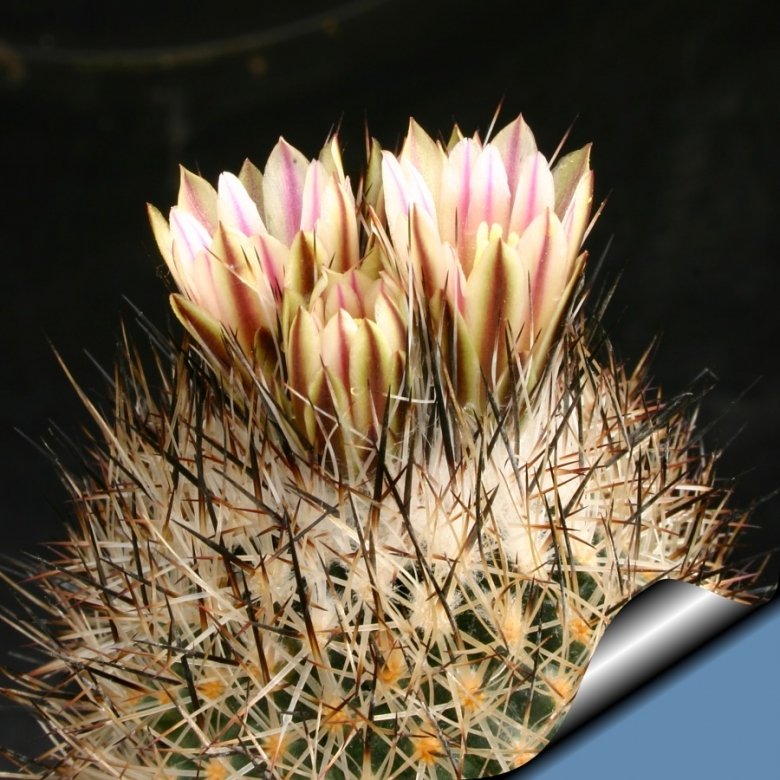
Flower: Flower broadly funnel-shaped. Tepals linear, blunt, green with violet edge; inner linear - lanceolate, pointed, magenta with lighter edges of petals. Length and diameter of the flower 2-2.5 cm. White Filaments; the Anthers are dark chrome yellow. The white style towers over them with 6 recurved lobes.
Phenology: Blossoming time: summer
Fruit: Fruits, urn-shaped, are 12 mm long.
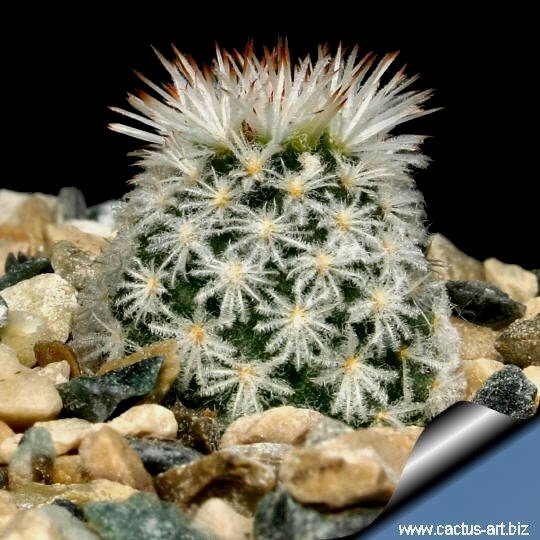
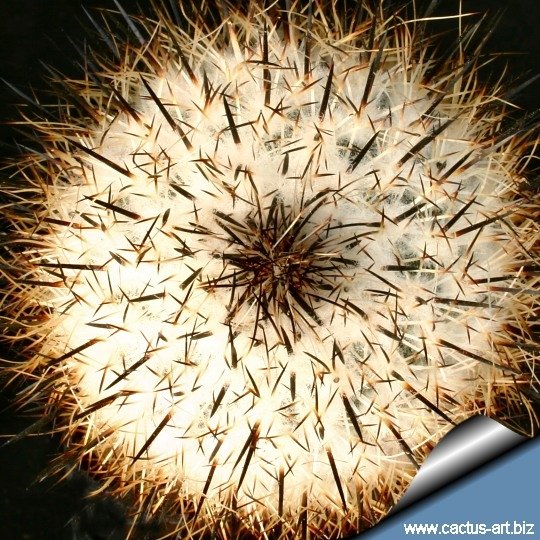
Spines (in adult plant): Close-packed, radial, mostly 12, awl-shaped, very sharp, sticking out up to 17 mm, snow-white, translucent, young almost glass-like, black tipped. Central spines 1, much longer (up to 30 mm), somewhat stronger, white, but at the top and further down, dark brown to black. Later they become grey, and the radial spines radiates horizontally, almost comb-like.
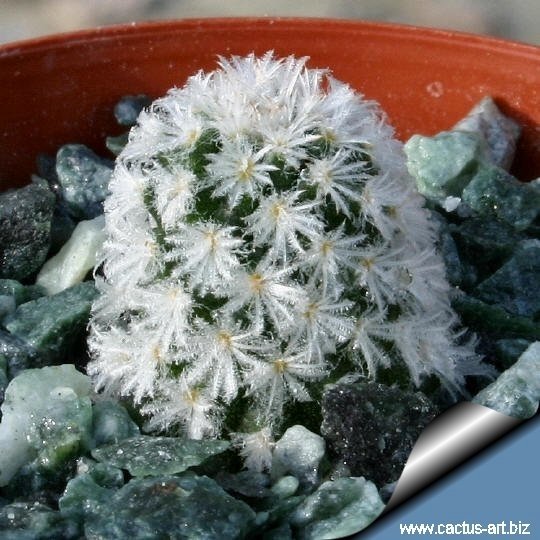
Juvenile spine: Plumose, soft, flexible, not pungent. During the first year near the base thin feathery hairs begin to form. Often the spine is densely covered, with hairs up to its tip. Spines of two-year-old seedlings (see figure) differ only in being longer and more ragged. There are no central spines; all are radial.
Origin and Habitat
Northeast Mexico to central Mexico, Zacatecas, San Luis Potosí, Coahuila to Hidalgo.
Habitat: It grows in scattered colonies, on different mountains, on warm steppes, and in pine forests or bushes, at altitudes of around 1900-2100 m., on lime with a high content of organic parts and a slightly basic pH. Localities are difficult to reach, and the main danger comes from fires.
Cultivation and Propagation
It is a summer-growing species fairly easy and robust to cultivate, but very slow growing. This plant is xerophytic, adapted to dry soils and is quite susceptible to over-watering if kept in a non ventilated place especially after the first flowering.
Growth rate: Slow-growing.
Soil: Grow it in an open mineral, sandy-gritty cactus compost and provide a very good drainage. Will benefit from adding up to 30% Gypsum to the potting mix.
Exposure: It is suited for sunny-brightly exposure, but can tolerate light shade. However it will do its best only with lots of sun and become stressed with inadequate light which could result in poor growth and unnatural shape. Direct sun is also beneficial in order to get a good spine growth. It has a good heat tolerance.
Watering: Waterings should be rather infrequent to keep the plant compact, and avoid its becoming excessively elongated and unnatural in appearance. Furthermore it has a tap root, and watering it properly is often difficult, because it tends to crack open or rot if over-watered. Keep dry in winter or when night temperatures remain below 10° C. Mature individuals easily rot and die especially after transplanting so be extremely cautious with watering. Water it less than average if in bigger pots.
Fertilization: Feed them once during the growing season with a fertilizer specifically formulated for cactus and succulents (high potash fertilizer with a dilute low nitrogen), including all micro nutrients and trace elements diluted to ½ the strength recommended on the label. They thrive in poor soils and need a limited supplies of fertilizer to avoid the plants developing excess vegetation, which is easily attacked by fungal diseases.
Special need: It is suited for airy exposures. Provide very good ventilation. Nearly all problems occur as a result of overwatering and poor ventilation, especially when weather conditions are dull and cool or very humid. They must have very dry atmosphere.
Hardiness: It likes warmth (recommended minimum winter temperature 5° C) But plants kept perfectly dry can easily survive a light frost.
Pests & diseases: These cacti may be attractive to a variety of insects, but plants in good condition should be nearly pest-free, particularly if they are grown in a mineral potting-mix, with good exposure and ventilation. Nonetheless, there are several pests to watch for:
- Red spiders: Red spiders may be effectively rubbed up by misting the plants from above.
- Mealy bugs: Mealy bugs occasionally develop aerial into the new leaves and flowers with disfiguring results, but the worst types develop underground on the roots and are invisible except by their effects.
- Scales, thrips and aphids: These insects are rarely a problem.
- Rot: Rot is only a minor problem if the plants are watered and “aired” correctly. If they are not, fungicides won’t help all that much.
Reproduction: From seed, since the plant rarely produces plantlets, or grafted. The seeds can be sown in pots of fine, well-drained sandy soil, any time during the spring when temperatures are warm. Cover the seeds with a fine layer of grit and water from below with a fungicide to prevent damping off. For the 1-2 weeks cover the pots with a sheet of glass/clear perspex to keep the humidity levels high. Remove the glass and replace it with light shade-cloth and mist once or twice a day for the next two weeks after which most seeds should have germinated. From then on mistings can be reduced to every second and then every third day as the little plants grow. The seedlings should not be disturbed until they are well rooted after which they can be planted separately in small pots. Sometimes it is grafted to avoid root rot problems as plants grafted on an hardy stock are easy to grow and no special skill is required.
Bibliography
Major references and further lectures
-
Edward Anderson “The Cactus family” Timber Press, Incorporated, 2001
-
James Cullen, Sabina G. Knees, H. Suzanne Cubey “The European Garden Flora Flowering Plants: A Manual for the Identification of Plants Cultivated in Europe, Both Out-of-Doors and Under Glass” Cambridge University Press, 11/Aug/2011
-
David R Hunt; Nigel P Taylor; Graham Charles; International Cactaceae Systematics Group. “The New Cactus Lexicon” dh books, 2006Jackie M. Poole, William R. Carr, Dana M. Price, Jason R. Singhurst “Rare plants of Texas: a field guide” Texas A&M University Press, 30/Dec/2007
-
Nathaniel Lord Britton, Joseph Nelson Rose “Cactaceae: Descriptions and Illustrations of Plants of the Cactus Family” Courier Dover Publications, 1963
From llifle page Gymnocactus beguinii var. senilis
Description
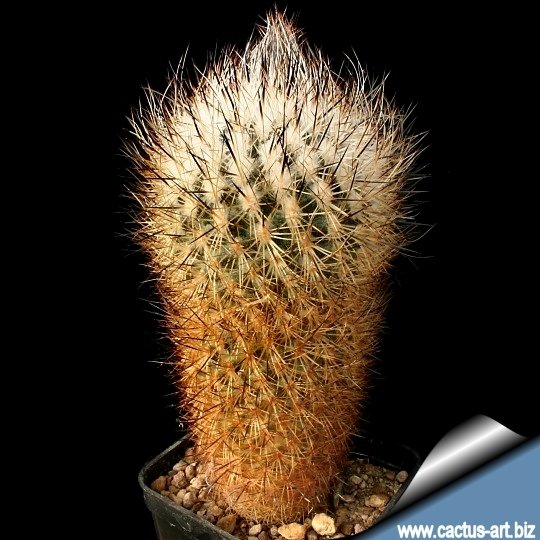
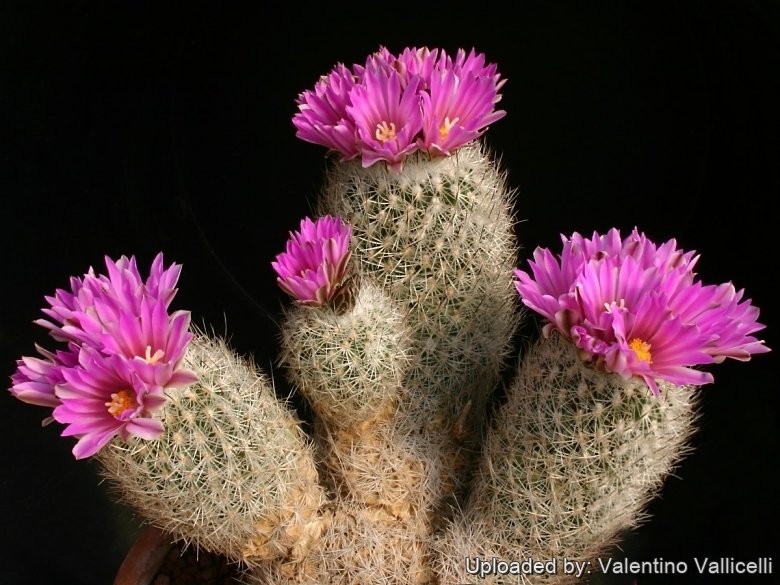
This form (or cultivar) grows relativeley fast up to 18-25 cm tall and has a dense covering of glassy white long curved spines. As plants ages became brown and corky towards the base. Flower are broadly funnel-shaped bright magenta. Length and diameter of the flower 3-5 cm.
Origin and Habitat
Coahuila, Mexico ? Rowley (Rep. Pl. Succ. 23: 8, 1972) considers this to be merely a long spined cultivar (Nursery produced ) and is treated as a synonym of Turbinicarpus mandragora ssp. beguinii by Jonas M. Lüthy.
Group:: Gymnocactus group (Saueri aggregate)
Cultivation and Propagation
It is a summer-growing species fairly easy and robust to cultivate, but very slow growing. This plant is xerophytic, adapted to dry soils and is quite susceptible to over-watering if kept in a non ventilated place.
Growth rate: Slow-growing.
Soil: Grow it in an open mineral, sandy-gritty cactus compost and provide a very good drainage.
Exposure: It is suited for sunny-brightly exposure, but can tolerate light shade. However it will do its best only with lots of sun and become stressed with inadequate light which could result in poor growth and unnatural shape. Direct sun is also beneficial in order to get a good spine growth. It has a good heat tolerance.
Watering: Waterings should be rather infrequent to keep the plant compact, and avoid its becoming excessively elongated and unnatural in appearance. Furthermore it has a tap root, and watering it properly is often difficult, because it tends to crack open or rot if over-watered. Keep dry in winter or when night temperatures remain below 10° C. Mature individuals easily rot and die especially after transplanting so be extremely cautious with watering. Water it less than average if in bigger pots.
Fertilization: Feed them once during the growing season with a fertilizer specifically formulated for cactus and succulents (high potash fertilizer with a dilute low nitrogen), including all micro nutrients and trace elements diluted to ½ the strength recommended on the label. They thrive in poor soils and need a limited supplies of fertilizer to avoid the plants developing excess vegetation, which is easily attacked by fungal diseases.
Special need: It is suited for airy exposures. Provide very good ventilation. Nearly all problems occur as a result of overwatering and poor ventilation, especially when weather conditions are dull and cool or very humid. They must have very dry atmosphere.
Hardiness: It likes warmth (recommended minimum winter temperature 5° C) But plants kept perfectly dry can easily survive a light frost.
Pests & diseases: These cacti may be attractive to a variety of insects, but plants in good condition should be nearly pest-free, particularly if they are grown in a mineral potting-mix, with good exposure and ventilation. Nonetheless, there are several pests to watch for:
- Red spiders: Red spiders may be effectively rubbed up by misting the plants from above.
- Mealy bugs: Mealy bugs occasionally develop aerial into the new leaves and flowers with disfiguring results, but the worst types develop underground on the roots and are invisible except by their effects.
- Scales, thrips and aphids: These insects are rarely a problem.
- Rot: Rot is only a minor problem if the plants are watered and “aired” correctly. If they are not, fungicides won’t help all that much.
Reproduction: From seed, since the plant rarely produces plantlets, or grafted. The seeds can be sown in pots of fine, well-drained sandy soil, any time during the spring when temperatures are warm. Cover the seeds with a fine layer of grit and water from below with a fungicide to prevent damping off. For the 1-2 weeks cover the pots with a sheet of glass/clear perspex to keep the humidity levels high. Remove the glass and replace it with light shade-cloth and mist once or twice a day for the next two weeks after which most seeds should have germinated. From then on mistings can be reduced to every second and then every third day as the little plants grow. The seedlings should not be disturbed until they are well rooted after which they can be planted separately in small pots. Sometimes it is grafted to avoid root rot problems as plants grafted on an hardy stock are easy to grow and no special skill is required.
Source: Gymnocactus beguinii var. senilis, LLIFLE - Encyclopedia of living forms, CC-BY-SA, retrieved 2026-10-25.
From llifle page Neolloydia glassii var. hintoniorum
Description
Turbinicarpus beguinii subs. hintoniorum A.Hofer nom. inval. is probably a synonym of the type species Turbinicarpus mandragora subs. beguinii (N.P.Taylor) Lüthy distinguished from the latter for its pale greenish yellows blooms.
Habit: Plant solitary, rarely growing together in small groups.
Stem: Hemispherical to oblong, sunken during the rest period, to 50 mm Ø, to 30 mm above ground. (but up to 25 cm tall and 8 cm in diameter in cultivation), merging into the tuberous root. Epidermis dark green, during the rest period almost completely concealed by the spines. Body completely divided into tubercles.
Tubercles: Round with rhombic outline, 5 mm high, diameter at the base 12 mm.
Areoles: Sitting on the tubercles, round, 3 mm Ø, bare.
Root: Conical tuberous root 50-70 mm long long with numerous fibrous roots, especially at the end of the tuberous root.
Tubercles conical: Low and conical.
Spines: Needle-like.
Radial spines: 9 (-10) white, often with dark brown, almost black tip, upper 16 (-20) mm long, lower 8 (-10) mm long.
Central spines: 2, white with black tip, one porrect, 15-20 mm long, second directed upwards, slightly towards the body, to 30 mm long.
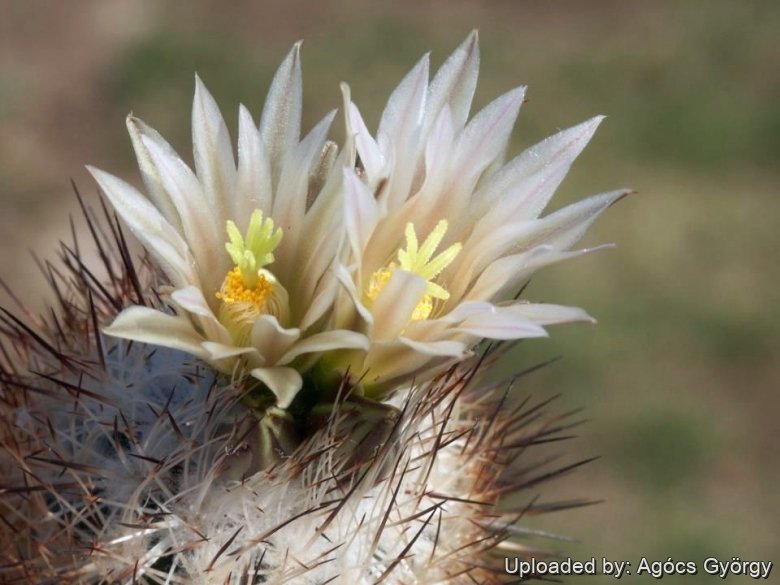
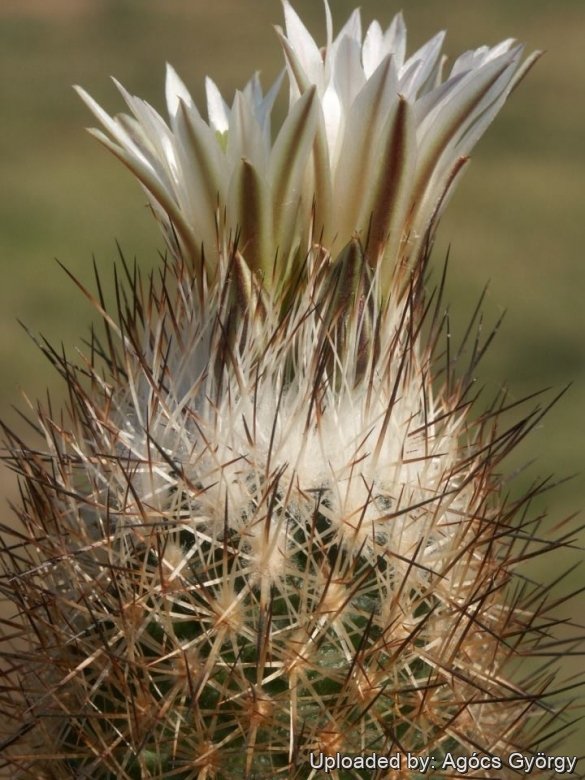
Flowers: Flowers: numerous (up to 6) appearing from the apical wool, funnel-shaped, 25 mm Ø, petals 33 mm long, lanceolate, pointed, pale greenish yellow, mid-stripe 2-3 mm wide, inside pale purple to pale pink or almost missing, outside brownish purple. Filaments pale greenish cream, pollen dark yellow, pistil pale greenish white, stigma lobes 6, pale greenish white.
Fruit: Naked, light green, barrel-shaped, 8 mm long, 4 mm Ø.
Seeds: Black, 1,5 x 1,1 mm large.
Origin and Habitat
Southern Nuevo Leon, Mexico.
Cultivation and Propagation
Turbinicarpus beguinii subs. hintoniorum is a summer-growing species fairly easy and robust to cultivate, but very slow growing. This plant is xerophytic, adapted to dry soils and is quite susceptible to over-watering if kept in a non ventilated place especially after the first flowering.
Growth rate: Slow-growing.
Soil: Grow it in an open mineral, sandy-gritty cactus compost and provide a very good drainage. Will benefit from adding up to 30% Gypsum to the potting mix.
Exposure: It is suited for sunny-brightly exposure, but can tolerate light shade. However it will do its best only with lots of sun and become stressed with inadequate light which could result in poor growth and unnatural shape. Direct sun is also beneficial in order to get a good spine growth. It has a good heat tolerance.
Watering: Waterings should be rather infrequent to keep the plant compact, and avoid its becoming excessively elongated and unnatural in appearance. Furthermore it has a tap root, and watering it properly is often difficult, because it tends to crack open or rot if over-watered. Keep dry in winter or when night temperatures remain below 10° C. Mature individuals easily rot and die especially after transplanting so be extremely cautious with watering. Water it less than average if in bigger pots.
Fertilization: Feed them once during the growing season with a fertilizer specifically formulated for cactus and succulents (high potash fertilizer with a dilute low nitrogen), including all micro nutrients and trace elements diluted to ½ the strength recommended on the label. They thrive in poor soils and need a limited supplies of fertilizer to avoid the plants developing excess vegetation, which is easily attacked by fungal diseases.
Special need: It is suited for airy exposures. Provide very good ventilation. Nearly all problems occur as a result of overwatering and poor ventilation, especially when weather conditions are dull and cool or very humid. They must have very dry atmosphere.
Hardiness: It likes warmth (recommended minimum winter temperature 5° C) But plants kept perfectly dry can easily survive a light frost.
Pests & diseases: These cacti may be attractive to a variety of insects, but plants in good condition should be nearly pest-free, particularly if they are grown in a mineral potting-mix, with good exposure and ventilation. Nonetheless, there are several pests to watch for:
- Red spiders: Red spiders may be effectively rubbed up by misting the plants from above.
- Mealy bugs: Mealy bugs occasionally develop aerial into the new leaves and flowers with disfiguring results, but the worst types develop underground on the roots and are invisible except by their effects.
- Scales, thrips and aphids: These insects are rarely a problem.
- Rot: Rot is only a minor problem if the plants are watered and “aired” correctly. If they are not, fungicides won’t help all that much.
Reproduction: From seed, since the plant rarely produces plantlets, or grafted. The seeds can be sown in pots of fine, well-drained sandy soil, any time during the spring when temperatures are warm. Cover the seeds with a fine layer of grit and water from below with a fungicide to prevent damping off. For the 1-2 weeks cover the pots with a sheet of glass/clear perspex to keep the humidity levels high. Remove the glass and replace it with light shade-cloth and mist once or twice a day for the next two weeks after which most seeds should have germinated. From then on mistings can be reduced to every second and then every third day as the little plants grow. The seedlings should not be disturbed until they are well rooted after which they can be planted separately in small pots. Sometimes it is grafted to avoid root rot problems as plants grafted on an hardy stock are easy to grow and no special skill is required.
Bibliography
Major references and further lectures
- Hofer, Succulentes 23(3):21-23, 2000
Source: Neolloydia glassii var. hintoniorum, LLIFLE - Encyclopedia of living forms, CC-BY-SA, retrieved 2026-10-25.
From llifle page Turbinicarpus beguinii subs. albiflorus
Description
Body usually solitary, globose. Hardly offsetting in cultivation.
Stem: Spherical or somewhat conical, rounded above; apex rather deeply sunken, but fully hidden by the snow-white, dense wool; blue-green, 6-8 (10) cm high and 6-8 cm in diameter. Ribs fully arranged in tubercles, from 13 to 21, rather dense spirals, rhombic or sub-quadrangular, conical; the top somewhat compressed from the sides, with sharp upper and lower edges. The seedlings tend to become quite cylindrical.
Roots: Carrot-shaped
Flower: Flower broadly funnel-shaped. Tepals linear, blunt, lanceolate, pointed, white with pink midstrips. Length and diameter of the flower 2-2.5 cm. Filaments white.
Phenology: Blossoming time: summer
Fruit: Fruits, urn-shaped, are 12 mm long.
Spines (in adult plant): Close-packed, radial, mostly 12, awl-shaped, very sharp, sticking out up to 17 mm, snow-white, translucent, young almost glass-like, black tipped. Central spines 1, much longer (up to 30 mm), somewhat stronger, white, but at the top and further down, dark brown to black. Later they become grey, and the radial spines radiates horizontally, almost comb-like.
Juvenile spine: Plumose, soft, flexible, not pungent. During the first year near the base thin feathery hairs begin to form. Often the spine is densely covered, with hairs up to its tip. Spines of two-year-old seedlings (see figure) differ only in being longer and more ragged. There are no central spines; all are radial.
Origin and Habitat
Southern Nuevo Leon, Mexico?
Source: Turbinicarpus beguinii subs. albiflorus, LLIFLE - Encyclopedia of living forms, CC-BY-SA, retrieved 2026-10-25.
Gallery